Monte Carlo simulation of selective adsorption in a binary hard-disk mixture on patterned adhesive surfaces
Pith reviewed 2026-05-21 02:37 UTC · model grok-4.3
The pith
Surface geometry with domains sized like the particles controls selectivity in binary hard-disk adsorption.
A machine-rendered reading of the paper's core claim, the machinery that carries it, and where it could break.
Core claim
Grand canonical Monte Carlo simulations of a two-dimensional binary hard-disk mixture on patterned adhesive surfaces demonstrate that selectivity depends strongly on surface geometry. When the two species have equal diameters and equal bulk chemical potentials but different attraction strengths to the domains, domains comparable to the particle size enhance selectivity by creating adsorption regions with large particle-domain overlap. Larger domains can provide high selectivity at low chemical potentials, and further reduction in domain size also increases selectivity as the system approaches a uniform attractive surface with the corresponding effective affinity parameters of the species.
What carries the argument
Grand canonical Monte Carlo simulations on surfaces patterned with circular adhesive domains whose size, surface coverage, and ordered or disordered arrangement are varied to isolate geometric effects on affinity-driven selectivity.
If this is right
- Domain diameters comparable to particle size maximize selectivity at low to intermediate chemical potentials through improved particle-domain overlap.
- Larger domains sustain high selectivity specifically in the low-chemical-potential regime.
- Very small domains recover selectivity by converging to the effective affinities of a uniform attractive surface.
- Both ordered and disordered domain arrangements influence the overall adsorption behavior and selectivity curves.
- Geometric tuning separates affinity-driven selectivity from effects of size asymmetry or unequal chemical potentials.
Where Pith is reading between the lines
- The reported trends could inform design of 2D patterned substrates for size-independent separation of colloidal mixtures that differ only in surface affinity.
- Similar Monte Carlo protocols might be applied to soft or three-dimensional particles to test whether domain-size rules survive when interactions are no longer strictly hard.
- Optimal domain size likely shifts with operating chemical potential, suggesting a practical map for choosing patterns in different concentration ranges.
- The approach isolates pure geometric control, which could be tested by comparing results against continuum theories that average over domain arrangements.
Load-bearing premise
The two species have equal diameters and equal bulk chemical potentials but differ only in attraction strength to the adhesive domains.
What would settle it
Running the same simulations with domains whose size is fixed but particle diameters made unequal, or measuring adsorption isotherms experimentally on lithographically patterned substrates and finding no peak in selectivity near domain size equal to particle diameter.
Figures
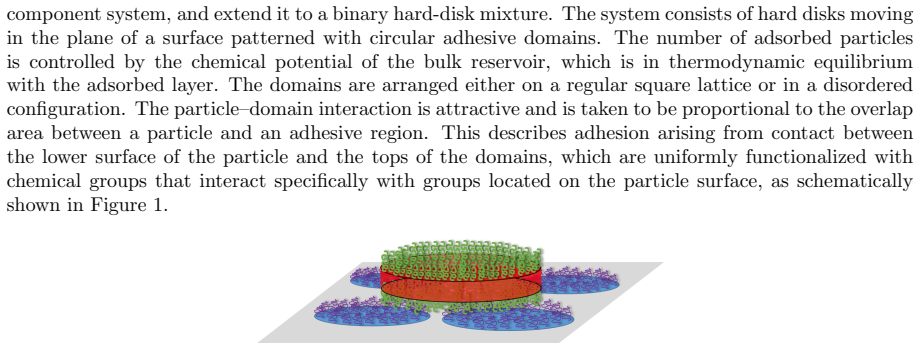


read the original abstract
Selective adsorption in a two-dimensional model of a binary hard-disk mixture on patterned adhesive surfaces is studied using grand canonical Monte Carlo simulations. The two species have equal diameters and equal bulk chemical potentials, but different attraction strengths to adhesive domains. Thus, affinity-driven selectivity is separated from particle-size asymmetry and unequal chemical potentials. The surface pattern is defined by domain size, domain surface coverage, and ordered or disordered arrangement of circular domains. The results show that selectivity depends strongly on surface geometry, especially at low and intermediate chemical potentials. Domains comparable to the particle size enhance selectivity by forming adsorption regions with large particle-domain overlap, whereas larger domains can provide high selectivity at low chemical potentials. For small domains, further reduction in size can also increase selectivity as the system approaches a uniform attractive surface with corresponding effective affinity parameters of the species.
Editorial analysis
A structured set of objections, weighed in public.
Referee Report
Summary. The manuscript reports grand canonical Monte Carlo simulations of selective adsorption for a binary hard-disk mixture on surfaces patterned with circular adhesive domains. The two species are assigned equal diameters and equal bulk chemical potentials but different attraction strengths to the domains, allowing the study to isolate affinity-driven selectivity. Selectivity is examined as a function of domain size, surface coverage, and ordered versus disordered domain arrangements, with the central finding that geometry strongly modulates selectivity, particularly at low and intermediate chemical potentials, with enhancements when domain size is comparable to particle diameter.
Significance. If the reported trends prove robust, the work supplies concrete, simulation-based design rules for using domain geometry to enhance selective adsorption in two-dimensional mixtures while cleanly separating affinity effects from size or chemical-potential asymmetry. The direct, parameter-controlled Monte Carlo sampling of an explicit hard-disk plus domain-attraction Hamiltonian is a strength that avoids circularity and permits falsifiable comparison with future experiments or theory.
major comments (1)
- [Simulation Methods] The manuscript supplies no information on Monte Carlo run lengths, equilibration diagnostics, statistical error estimation, or finite-size corrections. These omissions are load-bearing for the central claim that selectivity depends strongly on domain size and ordering, because grand-canonical adsorption and selectivity ratios can exhibit slow relaxation and large fluctuations at low chemical potentials. Without these controls it is impossible to judge whether the trends shown for small versus large domains are statistically reliable.
minor comments (1)
- [Abstract] The abstract states that domains 'comparable to the particle size enhance selectivity' but does not specify the numerical range of reduced chemical potentials or the precise form of the adhesive potential (square-well depth and range) used to generate the data; adding these details would improve reproducibility.
Simulated Author's Rebuttal
We thank the referee for the positive evaluation of our work and for the constructive comment on the simulation methods. We address the point below and will revise the manuscript accordingly.
read point-by-point responses
-
Referee: [Simulation Methods] The manuscript supplies no information on Monte Carlo run lengths, equilibration diagnostics, statistical error estimation, or finite-size corrections. These omissions are load-bearing for the central claim that selectivity depends strongly on domain size and ordering, because grand-canonical adsorption and selectivity ratios can exhibit slow relaxation and large fluctuations at low chemical potentials. Without these controls it is impossible to judge whether the trends shown for small versus large domains are statistically reliable.
Authors: We agree that these methodological details are essential for assessing the statistical reliability of the selectivity trends, particularly at low and intermediate chemical potentials where grand-canonical fluctuations can be large. In the revised manuscript we will add an explicit subsection to the Simulation Methods describing the Monte Carlo run lengths, the equilibration diagnostics employed (monitoring of particle numbers, energies, and adsorption isotherms until convergence), the procedure for statistical error estimation (block averaging over independent equilibrated segments), and finite-size checks performed by comparing results across different system sizes under periodic boundary conditions. These additions will directly address the concern and allow readers to evaluate the robustness of the geometry-dependent selectivity findings. revision: yes
Circularity Check
No significant circularity; results follow directly from explicit Monte Carlo sampling
full rationale
The paper reports grand-canonical Monte Carlo simulations of a binary hard-disk mixture with explicitly stated rules: equal particle diameters, equal bulk chemical potentials, and species-dependent surface attractions on domains whose size, coverage, and ordering are varied as input parameters. Selectivity measures are computed as direct averages over sampled configurations under the defined Hamiltonian; no parameters are fitted to a subset of data and then invoked as predictions of related quantities, no self-citations supply load-bearing uniqueness theorems, and no ansatz or renaming reduces the central trends to the inputs by construction. The model premise is introduced transparently to isolate affinity effects and does not create internal self-reference. The reported geometry-dependent selectivity therefore constitutes an independent computational experiment rather than a tautological restatement of the simulation protocol.
Axiom & Free-Parameter Ledger
free parameters (1)
- species-specific attraction strengths to adhesive domains
axioms (2)
- domain assumption Hard disks interact only by excluded-volume repulsion with no overlaps allowed
- domain assumption Grand canonical ensemble correctly samples adsorption at fixed chemical potential
Reference graph
Works this paper leans on
-
[1]
Maury P. A., Reinhoudt D. N., Huskens J., Current Opinion in Colloid & Interface Science, 2008, 13, No. 1–2, 74–80,
work page 2008
-
[2]
van Dommelen R., Fanzio P., Sasso L., Advances in Colloid and Interface Science, 2018,251, 97–114
work page 2018
-
[3]
J., Fuchsberger K., Nisch W., Stelzle M., In: Lithography, InTech, 2010
Burkhardt C. J., Fuchsberger K., Nisch W., Stelzle M., In: Lithography, InTech, 2010
work page 2010
-
[4]
Xing X., Man Z., Bian J., Yin Y., Zhang W., Lu Z., Nature Communications, 2020,11, 6002
work page 2020
-
[5]
V., Sundaravadivelan B., Sun A., Xu W., Yang S., Kannan A
Jambhulkar S., Ravichandran D., Zhu Y., Thippanna V., Ramanathan A., Patil D., Fonseca N., Thummalapalli S. V., Sundaravadivelan B., Sun A., Xu W., Yang S., Kannan A. M., Golan Y., Lancaster J., Chen L., Joyee E. B., Song K., Small, 2024,20, No. 6, 2306394
work page 2024
-
[6]
G., Results in Surfaces and Interfaces, 2024,17, 100326
Rao S. G., Results in Surfaces and Interfaces, 2024,17, 100326
work page 2024
-
[7]
J., Genzer J., Journal of Chemical Physics, 2003,119, No
Semler J. J., Genzer J., Journal of Chemical Physics, 2003,119, No. 10, 5274–5280
work page 2003
-
[8]
J., Genzer J., Macromolecular Theory and Simulations, 2004,13, No
Semler J. J., Genzer J., Macromolecular Theory and Simulations, 2004,13, No. 3, 219–229
work page 2004
-
[9]
I., Heinrich G., The Journal of Chemical Physics, 2006,125, No
Chervanyov A. I., Heinrich G., The Journal of Chemical Physics, 2006,125, No. 8, 084703
work page 2006
- [10]
-
[11]
Talbot J., Tarjus G., Viot P., The Journal of Physical Chemistry B, 2008,112, No. 41, 13051–13058
work page 2008
-
[12]
Oleyar C., Talbot J., Physica A: Statistical Mechanics and its Applications, 2007,376, 27–37
work page 2007
-
[13]
Cadilhe A., Ara´ ujo N. A. M., Privman V., Journal of Physics: Condensed Matter, 2007,19, No. 6, 065124
work page 2007
-
[14]
Ara´ ujo N. A. M., Cadilhe A., Privman V., Physical Review E, 2008,77, No. 3, 031603
work page 2008
-
[15]
Marques J. F., Lima A. B., Ara´ ujo N. A. M., Cadilhe A., Physical Review E, 2012,85, No. 6, 061122
work page 2012
-
[16]
Privman V., Yan H., The Journal of Chemical Physics, 2016,144, No. 24, 244704
work page 2016
-
[17]
Stojiljkovi´ c D. L., Vrhovac S. B., Physica A: Statistical Mechanics and its Applications, 2017,488, 16–29. 8
work page 2017
-
[18]
Nieszporek K., Szabelski P., Drach M., Langmuir, 2005,21, No. 16, 7335–7341
work page 2005
-
[19]
Sanchez-Varretti F. O., Garcia G. D., Pasinetti P. M., Ramirez-Pastor A. J., Adsorption, 2014,20, No. 7, 855–862
work page 2014
-
[20]
Sanchez-Varretti F. O., Bulnes F. M., Ramirez-Pastor A. J., Adsorption, 2019,25, No. 7, 1317–1328
work page 2019
-
[21]
Wagaskar K. V., Late R., Banpurkar A. G., Limaye A. V., Shelke P. B., Journal of Statistical Physics, 2020,181, 2191–2205
work page 2020
- [22]
- [23]
-
[24]
Steinbach A., Paust T., Pluntke M., Marti O., Volkmer D., ChemPhysChem, 2013,14, No. 15, 3523–3531
work page 2013
-
[25]
Beggiato M., Rastogi R., Dupont-Gillain C., Krishnamoorthy S., Sensors and Actuators B: Chemical, 2022,366, 131945
work page 2022
-
[26]
Kumar N., Parajuli O., Hahm J.-I., The Journal of Physical Chemistry B, 2007,111, No. 17, 4581– 4587
work page 2007
-
[27]
F., Tabrizian M., Lab on a Chip, 2010,10, No
Didar T. F., Tabrizian M., Lab on a Chip, 2010,10, No. 22, 3043–3053
work page 2010
-
[28]
Badenhorst R., Makaev S. V., Parker M., Marunych R., Reukov V., Bedzinska A., Korchynskyi O., Kalyuzhnyi O., Yaremchuk D., Ilnytskyi J., Patsahan T., Minko S., ACS Applied Materials & Interfaces, 2025,17, No. 35, 49193–49209
work page 2025
-
[29]
Kukarkin N., Patsahan T., Equilibrium adsorption of hard disks on patterned adhesive surfaces: A Monte Carlo simulation study, 2026, arXiv:2605.02671
work page internal anchor Pith review Pith/arXiv arXiv 2026
-
[30]
Allen M. P., Tildesley D. J., Computer simulation of liquids, Oxford university press, 2017. 9
work page 2017
discussion (0)
Sign in with ORCID, Apple, or X to comment. Anyone can read and Pith papers without signing in.