A Universal Magnetoelectric Limit for Chiral and Tellegen Bi-Isotropic Scatterers
Pith reviewed 2026-05-21 02:14 UTC · model grok-4.3
The pith
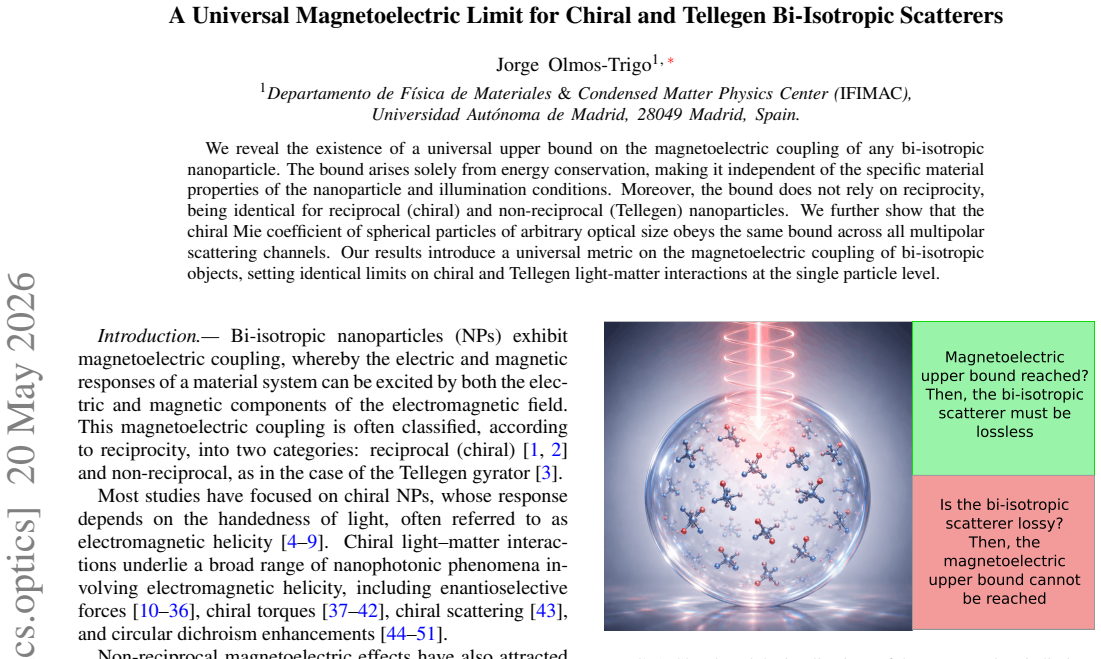
Any bi-isotropic nanoparticle obeys an upper limit on magnetoelectric coupling set solely by energy conservation.
A machine-rendered reading of the paper's core claim, the machinery that carries it, and where it could break.
Core claim
We reveal the existence of a universal upper bound on the magnetoelectric coupling of any bi-isotropic nanoparticle. The bound arises solely from energy conservation, making it independent of the specific material properties of the nanoparticle and illumination conditions. Moreover, the bound does not rely on reciprocity, being identical for reciprocal (chiral) and non-reciprocal (Tellegen) nanoparticles. We further show that the chiral Mie coefficient of spherical particles of arbitrary optical size obeys the same bound across all multipolar scattering channels. Our results introduce a universal metric on the magnetoelectric coupling of bi-isotropic objects, setting identical limits on both
What carries the argument
Energy-conservation inequality that directly caps the magnetoelectric coupling coefficient for any bi-isotropic nanoparticle.
If this is right
- The magnetoelectric coupling of any bi-isotropic nanoparticle is capped by this bound regardless of its shape or composition.
- The same numerical limit applies to both chiral and Tellegen nanoparticles, enabling direct comparison without reciprocity assumptions.
- Spherical particles obey the bound in every multipolar order, not only the dipole term.
- The bound supplies a universal benchmark for magnetoelectric performance at the single-particle level.
Where Pith is reading between the lines
- Designers seeking stronger magnetoelectric effects in nanoparticles are now constrained by this fixed ceiling.
- The result may extend to arrays or larger objects, showing how single-particle limits influence collective responses.
- Experimental tests could compare measured coupling strengths in fabricated chiral and non-reciprocal particles against the predicted value.
Load-bearing premise
Energy conservation by itself suffices to set the upper bound without any details on material response functions, reciprocity, or the illumination.
What would settle it
A numerical simulation or experiment that measures magnetoelectric coupling in a lossless bi-isotropic nanoparticle exceeding the value set by the energy-conservation bound.
Figures

read the original abstract
We reveal the existence of a universal upper bound on the magnetoelectric coupling of any bi-isotropic nanoparticle. The bound arises solely from energy conservation, making it independent of the specific material properties of the nanoparticle and illumination conditions. Moreover, the bound does not rely on reciprocity, being identical for reciprocal (chiral) and non-reciprocal (Tellegen) nanoparticles. We further show that the chiral Mie coefficient of spherical particles of arbitrary optical size obeys the same bound across all multipolar scattering channels. Our results introduce a universal metric on the magnetoelectric coupling of bi-isotropic objects, setting identical limits on chiral and Tellegen light-matter interactions at the single particle level.
Editorial analysis
A structured set of objections, weighed in public.
Referee Report
Summary. The manuscript asserts the existence of a universal upper bound on the magnetoelectric coupling of any bi-isotropic nanoparticle. The bound is derived solely from energy conservation, rendering it independent of material properties and illumination conditions. It is claimed to hold identically for reciprocal (chiral) and non-reciprocal (Tellegen) nanoparticles. The work further demonstrates that the chiral Mie coefficients of spherical particles of arbitrary optical size obey the same bound across all multipolar scattering channels.
Significance. If the central derivation is sound, the result would establish a fundamental, material-independent limit on magnetoelectric coupling at the nanoscale. The explicit demonstration that the bound is identical for chiral and Tellegen cases, without reliance on reciprocity, would be a notable strength, as would the verification for Mie scattering of spheres of arbitrary size. These features provide a general benchmark rooted in passivity that could guide the design of bi-isotropic scatterers.
major comments (2)
- §2, derivation following Eq. (5): The step from the bi-isotropic constitutive relations and the non-negativity of absorbed power to the claimed bound on the magnetoelectric parameter must explicitly demonstrate that no additional cross terms or phase factors arise for the non-reciprocal Tellegen case. The standard optical-theorem route assumes a symmetric scattering matrix; if this assumption is avoided, the explicit algebra confirming the bound remains numerically identical to the chiral case should be shown.
- §3.2, Eq. (18): The reduction of the general bound to the chiral Mie coefficients for spheres is presented as holding across multipoles, but the normalization factor relating the magnetoelectric coefficient to the standard chirality parameter is not derived in detail for the Tellegen case; this step is load-bearing for the universality claim.
minor comments (2)
- Figure 1: The caption should explicitly define the normalized magnetoelectric parameter plotted on the vertical axis and state the illumination conditions used for the numerical curves.
- Notation: The symbol for the magnetoelectric coupling coefficient is introduced without a clear distinction between its use in the constitutive relations versus the normalized bound; a brief table of symbols would improve clarity.
Simulated Author's Rebuttal
We thank the referee for their careful reading of the manuscript and for the constructive comments, which help to clarify the presentation of our results on the universal magnetoelectric bound. We address each major comment below and have revised the manuscript accordingly to improve explicitness.
read point-by-point responses
-
Referee: §2, derivation following Eq. (5): The step from the bi-isotropic constitutive relations and the non-negativity of absorbed power to the claimed bound on the magnetoelectric parameter must explicitly demonstrate that no additional cross terms or phase factors arise for the non-reciprocal Tellegen case. The standard optical-theorem route assumes a symmetric scattering matrix; if this assumption is avoided, the explicit algebra confirming the bound remains numerically identical to the chiral case should be shown.
Authors: We appreciate the referee's request for greater explicitness. Our derivation employs the most general bi-isotropic constitutive relations (covering both chiral and Tellegen media) and proceeds directly from the non-negativity of absorbed power expressed via the time-averaged Poynting theorem. Because the argument relies solely on passivity and does not invoke the optical theorem or scattering-matrix symmetry, no reciprocity assumption enters. In the revised manuscript we insert an expanded algebraic derivation immediately after Eq. (5) that treats the Tellegen constitutive parameters separately, showing that the cross terms cancel identically and that the resulting inequality on the magnetoelectric coefficient is numerically the same as in the chiral case. revision: yes
-
Referee: §3.2, Eq. (18): The reduction of the general bound to the chiral Mie coefficients for spheres is presented as holding across multipoles, but the normalization factor relating the magnetoelectric coefficient to the standard chirality parameter is not derived in detail for the Tellegen case; this step is load-bearing for the universality claim.
Authors: We agree that an explicit normalization step for the Tellegen Mie coefficients is necessary to substantiate the universality claim. In the revised §3.2 we add a short derivation that starts from the Tellegen constitutive parameters, expresses the magnetoelectric Mie coefficient in terms of the standard Tellegen parameter, and shows that the normalization factor is identical to the chiral case. This establishes that the bound applies uniformly across all multipolar channels for both reciprocal and non-reciprocal spheres. revision: yes
Circularity Check
No circularity: bound derived directly from energy conservation and optical theorem
full rationale
The paper's central claim is that a universal upper bound on the magnetoelectric coupling follows from the non-negativity of absorbed power (extinction minus scattering) applied to the bi-isotropic constitutive relations and the far-field Poynting theorem. The abstract explicitly states this derivation uses only energy conservation, requires no material response functions, no reciprocity assumptions, and holds identically for both chiral and Tellegen cases. No equations or steps in the provided text reduce the bound to a fitted parameter, a self-citation chain, or an ansatz smuggled from prior work; the result is presented as a direct inequality from standard conservation laws applied to the dipole response. This constitutes a self-contained derivation against external benchmarks rather than a re-expression of its own inputs.
Axiom & Free-Parameter Ledger
axioms (1)
- domain assumption Energy conservation applies directly to the magnetoelectric coupling in bi-isotropic scattering
Lean theorems connected to this paper
-
IndisputableMonolith/Cost/FunctionalEquation.leanwashburn_uniqueness_aczel echoes?
echoesECHOES: this paper passage has the same mathematical shape or conceptual pattern as the Recognition theorem, but is not a direct formal dependency.
A11 = ℑ{α_ee} − (k³/6π)(|α_ee|² + |α_em|²) ≥ 0 and the analogous expression for A22; maximization of f(z) = ℑ{z} − (k³/6π)|z|² yields the bound 3π/(2k³).
-
IndisputableMonolith/Foundation/BranchSelection.leanbranch_selection unclear?
unclearRelation between the paper passage and the cited Recognition theorem.
The bound holds identically for reciprocal (α_em = −α_me) and non-reciprocal (α_em = +α_me) cases and is attained only for lossless particles.
What do these tags mean?
- matches
- The paper's claim is directly supported by a theorem in the formal canon.
- supports
- The theorem supports part of the paper's argument, but the paper may add assumptions or extra steps.
- extends
- The paper goes beyond the formal theorem; the theorem is a base layer rather than the whole result.
- uses
- The paper appears to rely on the theorem as machinery.
- contradicts
- The paper's claim conflicts with a theorem or certificate in the canon.
- unclear
- Pith found a possible connection, but the passage is too broad, indirect, or ambiguous to say the theorem truly supports the claim.
Reference graph
Works this paper leans on
-
[1]
J.-B. Biot,Instructions pratiques sur l’observation et la mesure des propri´et´es optiques appel´ees rotatoires: avec l’expos´e suc- cinct de leur application a la chimie m ´edicale, scientifique et industrielle(Bachelier, 1845)
- [2]
-
[3]
B. D. Tellegen, Philips Res. Rep3, 81 (1948)
work page 1948
- [4]
-
[5]
I. Fernandez-Corbaton, X. Zambrana-Puyalto, N. Tischler, X. Vidal, M. L. Juan, and G. Molina-Terriza, Phys. Rev. Lett. 111, 060401 (2013)
work page 2013
-
[6]
J. Olmos-Trigo, D. R. Abujetas, C. Sanz-Fern ´andez, X. Zambrana-Puyalto, N. de Sousa, J. A. S ´anchez-Gil, and J. J. S´aenz, Physical Review Research2, 043021 (2020)
work page 2020
-
[7]
E. G. Ozaktas, P. V . Braun, and S. Fan, ACS Photonics12, 3591 (2025)
work page 2025
-
[8]
Olmos-Trigo, ACS photonics11, 3697 (2024)
J. Olmos-Trigo, ACS photonics11, 3697 (2024)
work page 2024
- [9]
-
[10]
Y . Zhao, A. A. Saleh, M. A. Van De Haar, B. Baum, J. A. Briggs, A. Lay, O. A. Reyes-Becerra, and J. A. Dionne, Na- ture nanotechnology12, 1055 (2017)
work page 2017
-
[11]
R. Jin, X. Zhang, P. Huo, Z. Cai, Y . Lu, T. Xu, and Y . Liu, Physical Review Letters133, 086901 (2024)
work page 2024
- [12]
-
[13]
I. D. Rukhlenko, N. V . Tepliakov, A. S. Baimuratov, S. A. An- dronaki, Y . K. Gun’ko, A. V . Baranov, and A. V . Fedorov, Sci- entific reports6, 36884 (2016)
work page 2016
- [14]
- [15]
-
[16]
Y . Zhao, A. A. Saleh, and J. A. Dionne, Acs Photonics3, 304 (2016)
work page 2016
- [17]
-
[18]
Z. Man, Y . Zhang, Y . Cai, X. Yuan, and H. Urbach, Physical review letters133, 233803 (2024)
work page 2024
- [19]
-
[20]
M. Kamandi, M. Albooyeh, C. Guclu, M. Veysi, J. Zeng, K. Wickramasinghe, and F. Capolino, Physical Review Applied 8, 064010 (2017)
work page 2017
-
[21]
H. Shi, H. Zheng, H. Chen, W. Lu, S. Liu, and Z. Lin, Physical Review A101, 043808 (2020)
work page 2020
-
[22]
Y . Li, G. Rui, S. Zhou, B. Gu, Y . Yu, Y . Cui, and Q. Zhan, Optics express28, 27808 (2020)
work page 2020
-
[23]
J. Mart ´ınez-Romeu, I. Diez, S. Golat, F. J. Rodr´ıguez-Fortu˜no, and A. Mart´ınez, Photonics Research12, 431 (2024)
work page 2024
-
[24]
H. Chen, N. Wang, W. Lu, S. Liu, and Z. Lin, Physical Review A90, 043850 (2014)
work page 2014
-
[25]
A. A. Sifat, F. Capolino, and E. O. Potma, ACS Photonics9, 2660 (2022)
work page 2022
- [26]
-
[27]
G. Serrera and P. Albella, arXiv preprint arXiv:2602.09264 (2026)
-
[28]
G. Pellegrini, M. Finazzi, M. Celebrano, L. Duo, M. A. Iat `ı, O. M. Marago, and P. Biagioni, The Journal of Physical Chem- istry C123, 28336 (2019)
work page 2019
-
[29]
H. A. A. Champi, R. H. Bustamante, and W. J. Salcedo, Optical Materials Express9, 1763 (2019)
work page 2019
-
[30]
A. Canaguier-Durand and C. Genet, Journal of Optics18, 015007 (2016)
work page 2016
-
[31]
A chiral route to pulling optical forces and left-handed optical torques
A. Canaguier-Durand and C. Genet, arXiv preprint arXiv:1503.02175 (2015)
work page internal anchor Pith review Pith/arXiv arXiv 2015
-
[32]
S. Hou, Y . Liu, W. Zhang, and X. Zhang, Optics Express29, 15177 (2021)
work page 2021
- [33]
-
[34]
J. Yao, Y . Bai, Y .-D. Liu, J. Wang, and Y . Yang, Applied Physics Letters124(2024)
work page 2024
-
[35]
J. Mart ´ınez-Romeu, D. Arenas-Ortega, I. Diez, and . T. . A. Mart´ınez, Optics Letters51, 45 (2025)
work page 2025
- [36]
-
[37]
X. Liu, J. Li, Q. Zhang, and M. G. Dirbeba, Physical Chemistry Chemical Physics21, 15339 (2019)
work page 2019
-
[38]
H. Chen, W. Lu, X. Yu, C. Xue, S. Liu, and Z. Lin, Optics Express25, 32867 (2017)
work page 2017
-
[39]
A. Rahimzadegan, M. Fruhnert, R. Alaee, I. Fernandez- Corbaton, and C. Rockstuhl, Physical Review B94, 125123 (2016)
work page 2016
-
[40]
J. Wen, H. Chen, H. Zheng, S. Yan, B. Yao, O. J. Martin, X. Xu, and Z. Lin, Photonics Research13, 2903 (2025)
work page 2025
- [41]
-
[42]
I. A. V ovk, A. S. Baimuratov, W. Zhu, A. G. Shalkovskiy, A. V . Baranov, A. V . Fedorov, and I. D. Rukhlenko, Scientific Re- ports7, 45925 (2017)
work page 2017
-
[43]
Q.-C. Shang, Z.-S. Wu, T. Qu, Z.-J. Li, L. Bai, and L. Gong, Optics express21, 8677 (2013)
work page 2013
- [44]
-
[45]
D. Vestler, A. Ben-Moshe, and G. Markovich, The Journal of Physical Chemistry C123, 5017 (2019)
work page 2019
- [46]
- [47]
- [48]
-
[49]
M. Sadrara and M. Miri, The Journal of Physical Chemistry C 128, 218 (2023)
work page 2023
-
[50]
R. M. Kim, J.-H. Huh, S. Yoo, T. G. Kim, C. Kim, H. Kim, J. H. Han, N. H. Cho, Y .-C. Lim, S. W. Im,et al., Nature612, 470 (2022)
work page 2022
- [51]
-
[52]
K. Y . Bliokh, Y . S. Kivshar, and F. Nori, Physical review letters 113, 033601 (2014)
work page 2014
-
[53]
D. Saltykova, D. A. Bobylev, and M. A. Gorlach, Applied Physics Letters127(2025)
work page 2025
-
[54]
S. Safaei Jazi, I. Faniayeu, R. Cichelero, D. C. Tzarouchis, M. M. Asgari, A. Dmitriev, S. Fan, and V . Asadchy, Nature 7 Communications15, 1293 (2024)
work page 2024
-
[55]
Q. Yang, X. Wen, Z. Li, O. You, and S. Zhang, Nature Com- munications16, 151 (2025)
work page 2025
- [56]
-
[57]
S. Albaladejo, R. G ´omez-Medina, L. S. Froufe-P ´erez, H. Mar- inchio, R. Carminati, J. Torrado, G. Armelles, A. Garc ´ıa- Mart´ın, and J. J. S´aenz, Optics Express18, 3556 (2010)
work page 2010
-
[58]
M. I. Mishchenko, L. D. Travis, and A. A. Lacis,Scattering, absorption, and emission of light by small particles(Cambridge university press, 2002)
work page 2002
-
[59]
C. F. Bohren, Chemical Physics Letters29, 458 (1974)
work page 1974
-
[60]
M. Nieto-Vesperinas, R. Gomez-Medina, and J. J. Saenz, J. Opt. Soc. Am. A28, 54 (2011)
work page 2011
-
[61]
I. Fernandez-Corbaton, M. Fruhnert, and C. Rockstuhl, Physi- cal Review X6, 031013 (2016)
work page 2016
- [62]
-
[63]
J. Olmos Trigo, C. Sanz-Fern ´andez, and I. Fernandez- Corbaton, arXiv e-prints , arXiv (2025)
work page 2025
-
[64]
Moreover, a harmonic time dependencee −iωt is assumed and omitted from the notation
In our framework, all polarizabilities are complex-valued scalars with dimensions of volume. Moreover, a harmonic time dependencee −iωt is assumed and omitted from the notation. In this regard, theα ij polarizabilities are frequency dependent, but we only write such dependence later
-
[65]
P. A. Belov, S. I. Maslovski, K. Simovski, and S. A. Tretyakov, Technical Physics Letters29, 718 (2003)
work page 2003
-
[66]
Dipole light-matter interactions in the bispinor formalism
S. Golat, A. J. Vernon, and F. J. Rodr ´ıguez-Fortu˜no, arXiv preprint arXiv:2605.13353 (2026)
work page internal anchor Pith review Pith/arXiv arXiv 2026
-
[67]
Olmos-Trigo, arXiv preprint arXiv:2601.10255 (2026)
J. Olmos-Trigo, arXiv preprint arXiv:2601.10255 (2026)
-
[68]
G. T. Gilbert, The American Mathematical Monthly98, 44 (1991)
work page 1991
-
[69]
J. Olmos-Trigo, C. Sanz-Fern ´andez, A. Garc ´ıa-Etxarri, G. Molina-Terriza, F. S. Bergeret, and J. J. S ´aenz, Phys. Rev. A99, 013852 (2019)
work page 2019
-
[70]
J. Olmos-Trigo, C. Sanz-Fern ´andez, F. S. Bergeret, and J. J. S´aenz, Opt. Lett.44, 1762 (2019)
work page 2019
-
[71]
M. Albooyeh, V . Asadchy, R. Alaee, S. Hashemi, M. Yazdi, M. Mirmoosa, C. Rockstuhl, C. Simovski, and S. Tretyakov, Physical Review B94, 245428 (2016)
work page 2016
- [72]
-
[73]
R. Ali, F. A. Pinheiro, R. S. Dutra, F. S. Rosa, and P. A. M. Neto, Nanoscale12, 5031 (2020)
work page 2020
-
[74]
R. Ali, F. Pinheiro, R. Dutra, F. Rosa, and P. M. Neto, JOSA B 37, 2796 (2020)
work page 2020
-
[75]
M. Li, X. Chen, S. Yan, Y . Zhang, and B. Yao, Advanced Pho- tonics Research3, 2200117 (2022)
work page 2022
-
[76]
H. Wu, P. Zhang, X. Zhang, Y . Hu, Z. Chen, and J. Xu, Optics Express30, 3592 (2022)
work page 2022
-
[77]
R. S. Dutra, F. A. Pinheiro, D. S. Ether Jr, C. Genet, N. B. Viana, and P. A. Maia Neto, ACS photonics (2026)
work page 2026
-
[78]
Y . Shi, T. Zhu, T. Zhang, A. Mazzulla, D. P. Tsai, W. Ding, A. Q. Liu, G. Cipparrone, J. J. S ´aenz, and C.-W. Qiu, Light: Science & Applications9, 1 (2020)
work page 2020
-
[79]
C. Lai, Y . Shi, H. Huang, W. Yi, A. Mazzulla, G. Cipparrone, Y . Zu, W. Ding, H. Li, Q. Song,et al., Physical review letters 133, 233802 (2024)
work page 2024
-
[80]
L. Feng, R. Zhang, Z. Li, B. Li, H. Zheng, H. Chen, B. Yun, Q. Zhan, and G. Rui, Laser & Photonics Reviews , e02345 (2025)
work page 2025
discussion (0)
Sign in with ORCID, Apple, or X to comment. Anyone can read and Pith papers without signing in.