Chandra X-ray Observations of the Pulsar Wind Nebula within CTA 1
Pith reviewed 2026-05-21 04:14 UTC · model grok-4.3
The pith
Chandra X-ray data on CTA 1's pulsar wind nebula show a magnetic field that decreases rapidly outside the compact core.
A machine-rendered reading of the paper's core claim, the machinery that carries it, and where it could break.
Core claim
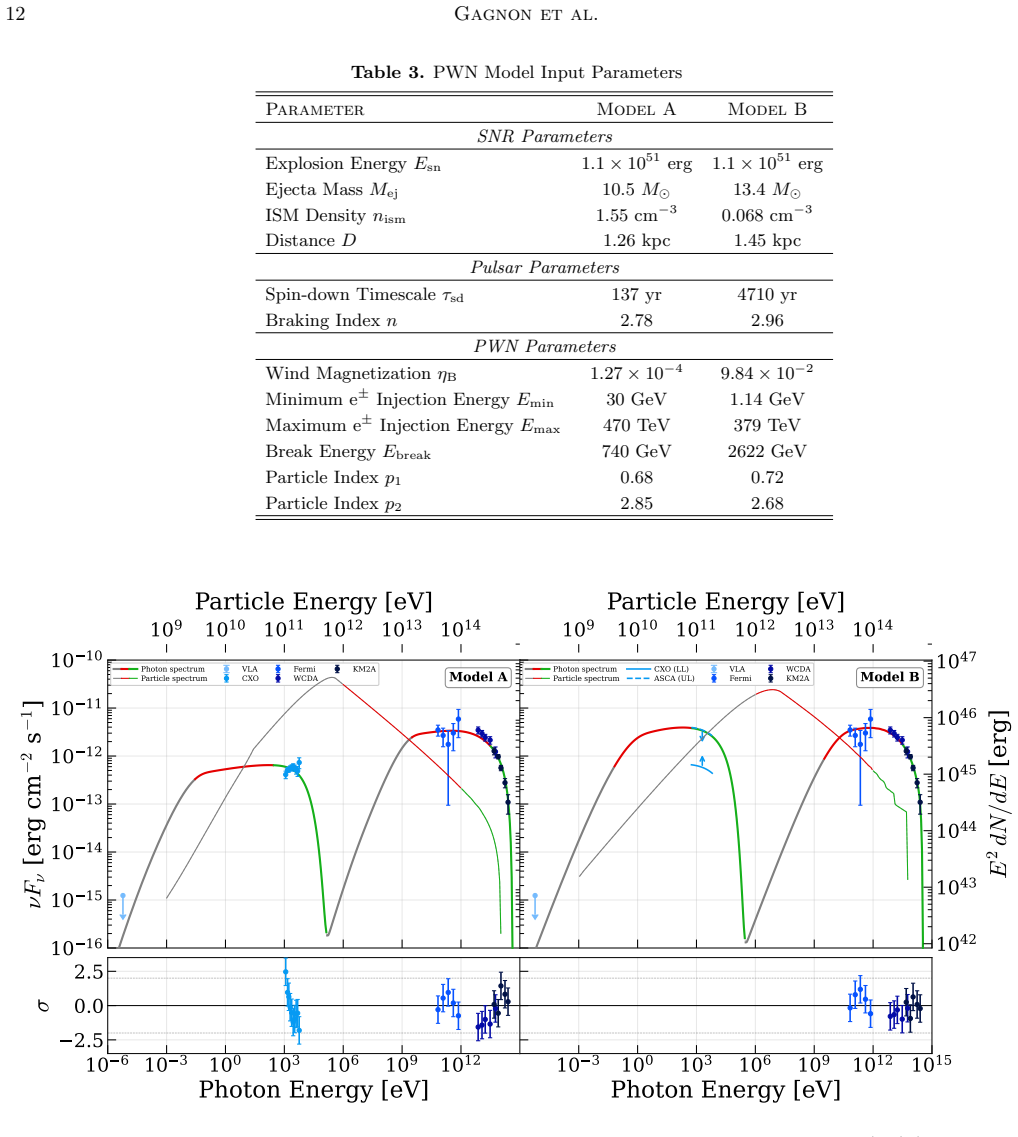
Broadband spectral energy distribution modeling for a one-zone leptonic scenario yields a low magnetic field (B ≈ 1.4-3.2 μG) and a high electron cutoff energy (E_cut ∼ 0.2-0.3 PeV), indicating that the magnetic field decreases rapidly outside of the compact nebula. These results establish CTA 1 as a young, low X-ray efficiency PWN with a hard injection spectrum capable of accelerating particles to PeV energies.
What carries the argument
one-zone leptonic scenario used to model the broadband spectral energy distribution from radio to PeV gamma rays, which sets the required magnetic field strength and maximum electron energy.
If this is right
- The jet and torus exhibit hard spectra with photon indices of 1.2-1.4, implying minimal radiative cooling in those compact structures.
- Modeling of the torus as an inclined circle gives a viewing angle near 50 degrees, which combined with pulsar emission models points to a moderate magnetic inclination of 20 to 70 degrees.
- The nebula is capable of accelerating particles to PeV energies and is classified as a young system with low X-ray efficiency and a hard injection spectrum.
Where Pith is reading between the lines
- If the rapid magnetic-field drop is common, similar multi-wavelength campaigns on other young PWNe should reveal comparably low fields and high cutoff energies.
- The tight velocity upper limit may help refine supernova kick-velocity distributions once the distance to CTA 1 is independently confirmed.
- Deeper TeV or PeV gamma-ray data could directly test whether the electron population truly extends to 0.3 PeV without additional spectral features.
Load-bearing premise
The assumption that a single-zone leptonic model fully describes the emission without accounting for spatial variations in magnetic field or particle properties across the nebula.
What would settle it
Spatially resolved X-ray or gamma-ray observations that measure a significantly higher magnetic field or a much lower maximum electron energy than the modeled values would directly contradict the rapid decrease outside the compact region.
Figures



read the original abstract
We present deep Chandra observations of the pulsar wind nebula (PWN) powered by PSR J0007+7303 in the composite supernova remnant CTA 1. The merged ACIS image shows a $\sim20''$ jet extending south of the pulsar and bending toward the southwest, a faint counter-jet to the north, and a compact torus oriented approximately perpendicular to the jet axis. Using an archival observation from 2003 we perform relative astrometry over a $\sim20$ yr baseline and constrain the pulsar's transverse velocity to $\lesssim 200~\mathrm{km~s^{-1}}$ at the distance of 1.4 kpc at 95% confidence. Spatially resolved spectroscopy shows hard spectra for the jet and torus (photon indicies $\Gamma \approx 1.2-1.4$) and a softer spectrum for the extended nebula ($\Gamma = 1.85 \pm 0.11$), indicating minimal radiative cooling in the compact regions. Modeling of the torus, associated with the termination shock, as an inclined circle yields a viewing angle $\zeta \approx 50^\circ$. The outer gap and two-pole caustic pulsar emission models then imply a moderate magnetic inclination ($\alpha \sim 20^\circ$-$70^\circ$). Broadband spectral energy distribution (SED) modeling from radio to PeV $\gamma$-rays for a one-zone leptonic scenario yields a low magnetic field ($B \approx 1.4$-$3.2~\mu\mathrm{G}$) and a high electron cutoff energy ($E_{\rm cut} \sim 0.2$-$0.3~\mathrm{PeV}$), indicating that the magnetic field decreases rapidly outside of the compact nebula. These results establish CTA 1 as a young, low X-ray efficiency PWN with a hard injection spectrum capable of accelerating particles to PeV energies.
Editorial analysis
A structured set of objections, weighed in public.
Referee Report
Summary. The manuscript presents deep Chandra ACIS observations of the pulsar wind nebula powered by PSR J0007+7303 in CTA 1. It reports X-ray morphology including a ~20'' southern jet bending southwest, a faint northern counter-jet, and a compact torus; relative astrometry over a 20-year baseline yielding a transverse velocity upper limit of ≲200 km s^{-1} at the adopted distance of 1.4 kpc; spatially resolved spectra with hard indices (Γ≈1.2-1.4) in the jet/torus and softer emission (Γ=1.85±0.11) in the extended nebula; torus modeling as an inclined circle giving viewing angle ζ≈50°; and one-zone leptonic broadband SED modeling from radio to PeV γ-rays that returns B≈1.4-3.2 μG and E_cut∼0.2-0.3 PeV, from which the authors infer rapid magnetic-field decline outside the compact nebula. The work characterizes CTA 1 as a young, low X-ray-efficiency PWN with a hard injection spectrum capable of PeV acceleration.
Significance. The Chandra imaging and spectroscopy supply directly supported, high-quality morphological and spectral data on this PWN that constitute a clear observational advance. The proper-motion limit and geometric constraints on viewing angle and magnetic inclination are useful ancillary results. If the one-zone leptonic SED modeling is robust, the low derived B and high E_cut would be significant for PWN magnetic-field evolution and for demonstrating that such systems can accelerate particles to PeV energies.
major comments (1)
- [Broadband SED modeling] The central claims on B≈1.4-3.2 μG and E_cut∼0.2-0.3 PeV rest on the one-zone leptonic SED fit. The manuscript itself reports spatially resolved spectral differences (Γ≈1.2-1.4 in the compact jet/torus versus Γ=1.85±0.11 in the extended nebula), indicating non-uniform particle populations or cooling. A single-zone model therefore averages over regions with distinct conditions; the low-B solution may be an artifact. The authors should either justify the one-zone approximation with quantitative tests or present multi-zone alternatives to show that the reported parameter ranges remain stable.
minor comments (2)
- [Torus geometry] The torus modeling as an inclined circle is described only briefly; quantitative details on the fit (e.g., position-angle constraints, uncertainties on ζ≈50°, or goodness-of-fit metrics) would improve reproducibility.
- [Proper-motion analysis] The abstract and text state the velocity limit at the adopted distance of 1.4 kpc; a short sensitivity statement on how the ≲200 km s^{-1} bound changes with plausible distance variations would be helpful even though it is not central to the SED results.
Simulated Author's Rebuttal
We thank the referee for their careful and constructive review of our manuscript. We address the single major comment below and have revised the text to strengthen the presentation of our modeling approach.
read point-by-point responses
-
Referee: The central claims on B≈1.4-3.2 μG and E_cut∼0.2-0.3 PeV rest on the one-zone leptonic SED fit. The manuscript itself reports spatially resolved spectral differences (Γ≈1.2-1.4 in the compact jet/torus versus Γ=1.85±0.11 in the extended nebula), indicating non-uniform particle populations or cooling. A single-zone model therefore averages over regions with distinct conditions; the low-B solution may be an artifact. The authors should either justify the one-zone approximation with quantitative tests or present multi-zone alternatives to show that the reported parameter ranges remain stable.
Authors: We acknowledge the spatially resolved spectral variations reported in the manuscript, which indicate that particle populations are not perfectly uniform. Nevertheless, the one-zone leptonic model remains a standard and appropriate tool for extracting global parameters from the broadband SED spanning radio to PeV energies, as is routinely done for other PWNe. The hard-spectrum compact jet and torus dominate the X-ray and higher-energy emission that primarily constrain B and E_cut, while the softer extended nebula is consistent with post-shock cooling. To address the concern directly, we have added a new paragraph in the discussion section that (i) quantifies the fractional flux contribution of the compact versus extended regions at key wavelengths and (ii) reports a sensitivity test in which the extended-nebula flux is down-weighted; the recovered B and E_cut values stay within the quoted ranges. We therefore maintain that the reported parameter intervals are robust for the integrated emission, while explicitly noting the limitations of the one-zone approximation. A full multi-zone treatment lies beyond the scope of this primarily observational work but is identified as a natural direction for follow-up modeling. revision: partial
Circularity Check
No significant circularity in derivation chain
full rationale
The paper's chain proceeds from Chandra imaging and astrometry (proper motion limit, jet/torus morphology) to spatially resolved spectroscopy (distinct Γ values for compact vs extended regions) to one-zone leptonic SED fitting that constrains B and E_cut from radio-to-PeV fluxes. These fitted parameters are outputs of standard χ² minimization against independent multi-wavelength data points; the subsequent interpretation of rapid B decline outside the compact nebula is an inference drawn from the low fitted value relative to typical compact-PWN expectations, not a definitional identity or a prediction that re-uses the same fitted quantity. No self-citation load-bearing steps, uniqueness theorems, or ansatzes imported from prior author work appear in the derivation. The modeling assumptions are stated explicitly and the observational anchors (spectra, morphology, distance) remain external to the fit itself.
Axiom & Free-Parameter Ledger
free parameters (2)
- Magnetic field B =
1.4-3.2 μG
- Electron cutoff energy E_cut =
0.2-0.3 PeV
axioms (2)
- domain assumption One-zone leptonic emission scenario
- domain assumption Distance to CTA 1 is 1.4 kpc
Lean theorems connected to this paper
-
IndisputableMonolith/Cost/FunctionalEquation.leanwashburn_uniqueness_aczel unclear?
unclearRelation between the paper passage and the cited Recognition theorem.
Broadband spectral energy distribution (SED) modeling from radio to PeV γ-rays for a one-zone leptonic scenario yields a low magnetic field (B ≈ 1.4-3.2 μG) and a high electron cutoff energy (E_cut ∼ 0.2-0.3 PeV)
-
IndisputableMonolith/Foundation/RealityFromDistinction.leanreality_from_one_distinction unclear?
unclearRelation between the paper passage and the cited Recognition theorem.
Spatially resolved spectroscopy shows hard spectra for the jet and torus (photon indices Γ ≈ 1.2-1.4) and a softer spectrum for the extended nebula (Γ = 1.85 ± 0.11)
What do these tags mean?
- matches
- The paper's claim is directly supported by a theorem in the formal canon.
- supports
- The theorem supports part of the paper's argument, but the paper may add assumptions or extra steps.
- extends
- The paper goes beyond the formal theorem; the theorem is a base layer rather than the whole result.
- uses
- The paper appears to rely on the theorem as machinery.
- contradicts
- The paper's claim conflicts with a theorem or certificate in the canon.
- unclear
- Pith found a possible connection, but the passage is too broad, indirect, or ambiguous to say the theorem truly supports the claim.
Reference graph
Works this paper leans on
-
[1]
Abdo, A. A., Ackermann, M., Atwood, W. B., et al. 2008, Science, 322, 1218, doi: 10.1126/science.1165572
-
[2]
A., Ajello, M., Allafort, A., et al
Abdo, A. A., Ajello, M., Allafort, A., et al. 2013, ApJS, 208, 17, doi: 10.1088/0067-0049/208/2/17
-
[3]
2013, ApJ, 764, 38, doi: 10.1088/0004-637X/764/1/38
Aliu, E., Archambault, S., Arlen, T., et al. 2013, ApJ, 764, 38, doi: 10.1088/0004-637X/764/1/38
-
[4]
2024, Nuovo Cimento Rivista Serie, 47, 399, doi: 10.1007/s40766-024-00059-8
Amato, E., & Recchia, S. 2024, Nuovo Cimento Rivista Serie, 47, 399, doi: 10.1007/s40766-024-00059-8
-
[5]
Fermi Large Area Telescope Fourth Source Catalog Data Release 4 (4FGL-DR4)
Ballet, J., Bruel, P., Burnett, T. H., Lott, B., & The Fermi-LAT collaboration. 2023, arXiv e-prints, arXiv:2307.12546, doi: 10.48550/arXiv.2307.12546
work page internal anchor Pith review Pith/arXiv arXiv doi:10.48550/arxiv.2307.12546 2023
-
[6]
V., Lyutikov, M., & Khangulyan, D
Barkov, M. V., Lyutikov, M., & Khangulyan, D. 2019, MNRAS, 484, 4760, doi: 10.1093/mnras/stz213
-
[7]
Bogovalov, S. V. 1999, A&A, 349, 1017, doi: 10.48550/arXiv.astro-ph/9907051
work page internal anchor Pith review Pith/arXiv arXiv doi:10.48550/arxiv.astro-ph/9907051 1999
-
[8]
Ustyugova, G. V. 2005, MNRAS, 358, 705, doi: 10.1111/j.1365-2966.2004.08592.x B¨ uhler, R., & Giomi, M. 2016, MNRAS, 462, 2762, doi: 10.1093/mnras/stw1773
-
[9]
Burgess, D. A., Mori, K., Gelfand, J. D., et al. 2022, ApJ, 930, 148, doi: 10.3847/1538-4357/ac650a
-
[10]
2024, arXiv e-prints, arXiv:2403.06180, doi: 10.48550/arXiv.2403.06180
Cao, G., Yang, X., & Zhang, L. 2024, arXiv e-prints, arXiv:2403.06180, doi: 10.48550/arXiv.2403.06180
-
[11]
A., De Luca, A., Marelli, M., et al
Caraveo, P. A., De Luca, A., Marelli, M., et al. 2010, ApJL, 725, L6, doi: 10.1088/2041-8205/725/1/L6
-
[12]
Cerutti, B., Philippov, A. A., & Spitkovsky, A. 2016, MNRAS, 457, 2401, doi: 10.1093/mnras/stw124
-
[13]
Davis, J. E., Bautz, M. W., Dewey, D., et al. 2012, in Society of Photo-Optical Instrumentation Engineers (SPIE) Conference Series, Vol. 8443, Space Telescopes and Instrumentation 2012: Ultraviolet to Gamma Ray, ed. T. Takahashi, S. S. Murray, & J.-W. A. den Herder, 84431A, doi: 10.1117/12.926937 de O˜ na Wilhelmi, E. M., L´ opez-Coto, R., Amato, E., &
-
[14]
Aharonian, F. 2022, The Astrophysical Journal Letters, 930, L2, doi: 10.3847/2041-8213/ac66cf de Vries, M., Romani, R. W., Kargaltsev, O., et al. 2021, ApJ, 908, 50, doi: 10.3847/1538-4357/abcebe
-
[15]
Dinsmore, J. T., & Romani, R. W. 2024, ApJ, 976, 4, doi: 10.3847/1538-4357/ad8344
-
[16]
Dodson, R., Legge, D., Reynolds, J. E., & McCulloch, P. M. 2003, ApJ, 596, 1137, doi: 10.1086/378089
-
[17]
Foreman-Mackey, D., Hogg, D. W., Lang, D., & Goodman, J. 2013, PASP, 125, 306, doi: 10.1086/670067
-
[18]
2001, in Society of Photo-Optical Instrumentation Engineers (SPIE) Conference Series, Vol
Freeman, P., Doe, S., & Siemiginowska, A. 2001, in Society of Photo-Optical Instrumentation Engineers (SPIE) Conference Series, Vol. 4477, Astronomical Data Analysis, ed. J.-L. Starck & F. D. Murtagh, 76–87, doi: 10.1117/12.447161
-
[19]
E., Kashyap, V., Rosner, R., & Lamb, D
Freeman, P. E., Kashyap, V., Rosner, R., & Lamb, D. Q. 2002, ApJS, 138, 185, doi: 10.1086/324017
-
[20]
Fruscione, A., McDowell, J. C., Allen, G. E., et al. 2006, in Society of Photo-Optical Instrumentation Engineers (SPIE) Conference Series, Vol. 6270, Observatory Operations: Strategies, Processes, and Systems, ed. D. R. Silva & R. E. Doxsey, 62701V, doi: 10.1117/12.671760
-
[21]
2024, ApJ, 968, 67, doi: 10.3847/1538-4357/ad3e6d
Gagnon, S., Kargaltsev, O., Klingler, N., et al. 2024, ApJ, 968, 67, doi: 10.3847/1538-4357/ad3e6d
-
[22]
Garmire, G. P., Bautz, M. W., Ford, P. G., Nousek, J. A., & Ricker, Jr., G. R. 2003, in Society of Photo-Optical Instrumentation Engineers (SPIE) Conference Series, Vol. 4851, X-Ray and Gamma-Ray Telescopes and Instruments for Astronomy., ed. J. E. Truemper & H. D. Tananbaum, 28–44, doi: 10.1117/12.461599
-
[23]
Gelfand, J. D., Slane, P. O., & Zhang, W. 2009, ApJ, 703, 2051, doi: 10.1088/0004-637X/703/2/2051
-
[24]
C., Cillis, A., Pichel, A., & Dubner, G
Giacani, E., Rovero, A. C., Cillis, A., Pichel, A., & Dubner, G. 2013, in International Cosmic Ray Conference, Vol. 33, International Cosmic Ray Conference, 2656
work page 2013
-
[25]
Green, D. A. 2025, Journal of Astrophysics and Astronomy, 46, 14, doi: 10.1007/s12036-024-10038-4
-
[26]
2023, ApJ, 943, 105, doi: 10.3847/1538-4357/acab05
Hakobyan, H., Philippov, A., & Spitkovsky, A. 2023, ApJ, 943, 105, doi: 10.3847/1538-4357/acab05
-
[27]
Halpern, J. P., Gotthelf, E. V., Camilo, F., Helfand, D. J., & Ransom, S. M. 2004, ApJ, 612, 398, doi: 10.1086/422409
-
[28]
Harding, A. K. 2016, Journal of Plasma Physics, 82, 635820306, doi: 10.1017/S0022377816000477
-
[29]
2023, ApJ, 954, 204, doi: 10.3847/1538-4357/ace972
Kazanas, D. 2023, ApJ, 954, 204, doi: 10.3847/1538-4357/ace972
-
[30]
2015, SSRv, 191, 391, doi: 10.1007/s11214-015-0171-x
Kargaltsev, O., Cerutti, B., Lyubarsky, Y., & Striani, E. 2015, SSRv, 191, 391, doi: 10.1007/s11214-015-0171-x
-
[31]
Kargaltsev, O., Klingler, N., Chastain, S., & Pavlov, G. G. 2017a, in Journal of Physics Conference Series, Vol. 932, Journal of Physics Conference Series (IOP), 012050, doi: 10.1088/1742-6596/932/1/012050
-
[32]
Kargaltsev, O., & Pavlov, G. G. 2008, in American Institute of Physics Conference Series, Vol. 983, 40 Years of Pulsars: Millisecond Pulsars, Magnetars and More, ed. C. Bassa, Z. Wang, A. Cumming, & V. M. Kaspi (AIP), 171–185, doi: 10.1063/1.2900138 Chandra Observations of CTA 117
-
[33]
Kargaltsev, O., & Pavlov, G. G. 2010, in American Institute of Physics Conference Series, Vol. 1248, X-ray Astronomy 2009; Present Status, Multi-Wavelength Approach and Future Perspectives, ed. A. Comastri, L. Angelini, & M. Cappi (AIP), 25–28, doi: 10.1063/1.3475228
-
[34]
G., Klingler, N., & Rangelov, B
Kargaltsev, O., Pavlov, G. G., Klingler, N., & Rangelov, B. 2017b, Journal of Plasma Physics, 83, 635830501, doi: 10.1017/S0022377817000630
-
[35]
G., Skjæraasen, O., & Gallant, Y
Kirk, J. G., Skjæraasen, O., & Gallant, Y. A. 2002, A&A, 388, L29, doi: 10.1051/0004-6361:20020599 Lhaaso Collaboration, Cao, Z., Aharonian, F., et al. 2025, Science China Physics, Mechanics, and Astronomy, 68, 279503, doi: 10.1007/s11433-024-2479-4
-
[36]
1983, ApJ, 272, 317, doi: 10.1086/161295
Li, T.-P., & Ma, Y.-Q. 1983, ApJ, 272, 317, doi: 10.1086/161295
-
[37]
2008, ApJ, 682, 1166, doi: 10.1086/589495
Li, X.-H., Lu, F.-J., & Li, Z. 2008, ApJ, 682, 1166, doi: 10.1086/589495
-
[38]
2024, Monthly Notices of the Royal Astronomical Society, 535, 21, doi: 10.1093/mnras/stae2068
Liu, K., Xie, F., & Liang, E.-W. 2024, Monthly Notices of the Royal Astronomical Society, 535, 21, doi: 10.1093/mnras/stae2068
-
[39]
Lyubarsky, Y. E. 2003, MNRAS, 345, 153, doi: 10.1046/j.1365-8711.2003.06927.x
-
[40]
Ng, C. Y., & Romani, R. W. 2004, ApJ, 601, 479, doi: 10.1086/380486 —. 2008, ApJ, 673, 411, doi: 10.1086/523935
-
[41]
Pavlov, G. G., Teter, M. A., Kargaltsev, O., & Sanwal, D. 2003, ApJ, 591, 1157, doi: 10.1086/375531 P´ etri, J. 2011, MNRAS, 412, 1870, doi: 10.1111/j.1365-2966.2010.18023.x —. 2024, A&A, 687, A169, doi: 10.1051/0004-6361/202348069 P´ etri, J., & Lyubarsky, Y. 2007, A&A, 473, 683, doi: 10.1051/0004-6361:20066981
-
[42]
2022, ARA&A, 60, 495, doi: 10.1146/annurev-astro-052920-112338
Philippov, A., & Kramer, M. 2022, ARA&A, 60, 495, doi: 10.1146/annurev-astro-052920-112338
-
[43]
Pierbattista, M., Harding, A. K., Grenier, I. A., et al. 2015, A&A, 575, A3, doi: 10.1051/0004-6361/201423815
-
[44]
1993, AJ, 105, 1060, doi: 10.1086/116493
Gaumont-Guay, S. 1993, AJ, 105, 1060, doi: 10.1086/116493
-
[45]
2017, SSRv, 207, 137, doi: 10.1007/s11214-017-0344-x
Porth, O., Buehler, R., Olmi, B., et al. 2017, SSRv, 207, 137, doi: 10.1007/s11214-017-0344-x
-
[46]
Posselt, B., Pavlov, G. G., Slane, P. O., et al. 2017, ApJ, 835, 66, doi: 10.3847/1538-4357/835/1/66
-
[47]
Reynolds, S. P., Pavlov, G. G., Kargaltsev, O., et al. 2017, SSRv, 207, 175, doi: 10.1007/s11214-017-0356-6
-
[48]
2011, ApJ, 741, 39, doi: 10.1088/0004-637X/741/1/39 —
Sironi, L., & Spitkovsky, A. 2011, ApJ, 741, 39, doi: 10.1088/0004-637X/741/1/39 —. 2014, ApJL, 783, L21, doi: 10.1088/2041-8205/783/1/L21
-
[49]
1997, ApJ, 485, 221, doi: 10.1086/304416
Tsunemi, H. 1997, ApJ, 485, 221, doi: 10.1086/304416
-
[50]
Slane, P., Zimmerman, E. R., Hughes, J. P., et al. 2004, ApJ, 601, 1045, doi: 10.1086/380498
-
[51]
A., Abdollahi, S., Ajello, M., et al
Smith, D. A., Abdollahi, S., Ajello, M., et al. 2023, ApJ, 958, 191, doi: 10.3847/1538-4357/acee67
-
[52]
Timokhin, A. N., & Harding, A. K. 2019, ApJ, 871, 12, doi: 10.3847/1538-4357/aaf050 van der Walt, S., Sch¨ onberger, J. L., Nunez-Iglesias, J., et al. 2014, PeerJ, 2, e453, doi: 10.7717/peerj.453 Van Etten, A., Romani, R. W., & Ng, C. Y. 2008, ApJ, 680, 1417, doi: 10.1086/587865
-
[54]
2009, ApJ, 695, 1289, doi: 10.1088/0004-637X/695/2/1289
Johnston, S. 2009, ApJ, 695, 1289, doi: 10.1088/0004-637X/695/2/1289
-
[55]
Weisskopf, M. C., Hester, J. J., Tennant, A. F., et al. 2000, ApJL, 536, L81, doi: 10.1086/312733
-
[56]
2000, ApJ, 542, 914, doi: 10.1086/317016
Wilms, J., Allen, A., & McCray, R. 2000, ApJ, 542, 914, doi: 10.1086/317016
work page internal anchor Pith review doi:10.1086/317016 2000
-
[57]
Wood, M., Caputo, R., Charles, E., et al. 2017, in International Cosmic Ray Conference, Vol. 301, 35th International Cosmic Ray Conference (ICRC2017), 824, doi: 10.22323/1.301.0824
-
[58]
2017, PhRvD, 95, 083007, doi: 10.1103/PhysRevD.95.083007
Yuan, Q., Lin, S.-J., Fang, K., & Bi, X.-J. 2017, PhRvD, 95, 083007, doi: 10.1103/PhysRevD.95.083007
-
[59]
2015, 34, 922, doi: 10.22323/1.236.0922 —
Zabalza, V. 2015, in International Cosmic Ray Conference, Vol. 34, 34th International Cosmic Ray Conference (ICRC2015), 922, doi: 10.22323/1.236.0922 18Gagnon et al. APPENDIX A.ASTROMETRY The X-ray sources are detected in each observation using the CIAO toolwavdetect. Prior to runningwavdetect the images were binned up by a factor of 2 (pixel size≈1 ′′) a...
discussion (0)
Sign in with ORCID, Apple, or X to comment. Anyone can read and Pith papers without signing in.