Let EEG Models Learn EEG
Pith reviewed 2026-05-21 05:08 UTC · model grok-4.3
The pith
EEG generation improves when models learn continuous trajectories of raw signals instead of discrete denoising steps.
A machine-rendered reading of the paper's core claim, the machinery that carries it, and where it could break.
Core claim
The paper claims that modeling EEG as raw sequences evolving along continuous trajectories via conditional flow matching, combined with constraints that preserve spectral structure, temporal stationarity, and signal-level statistics, produces generated signals whose long-range dependencies and transient dynamics match real neural activity more closely than discrete denoising methods do.
What carries the argument
Conditional flow matching that learns a smooth vector field transporting noise to the EEG data distribution, subject to constraints on spectral structure, temporal stationarity, and signal statistics.
If this is right
- JET reduces TS-FID by over 40 percent versus strong baselines on three large-scale EEG benchmarks.
- Generated signals maintain long-range temporal dependencies that discrete methods typically lose.
- The model captures key structural properties of neural dynamics without domain-specific representations.
- The framework scales to high-volume synthetic data production for downstream neural modeling tasks.
Where Pith is reading between the lines
- The same continuous-trajectory approach could be tested on other continuous biosignals such as ECG or MEG.
- Synthetic EEG produced this way might serve as augmentation data for training brain-computer interface models.
- The results suggest that any time-series generation task with inherent continuity may benefit from replacing discrete diffusion steps with flow matching plus structure-preserving constraints.
Load-bearing premise
The introduced constraints will keep the learned continuous vector field consistent with real EEG properties without introducing artifacts or losing long-range dependencies.
What would settle it
Generate long EEG traces with JET and compare their power spectral density and autocorrelation functions against real recordings; systematic mismatches in low-frequency content or stationarity statistics would show the constraints failed to enforce consistency.
Figures


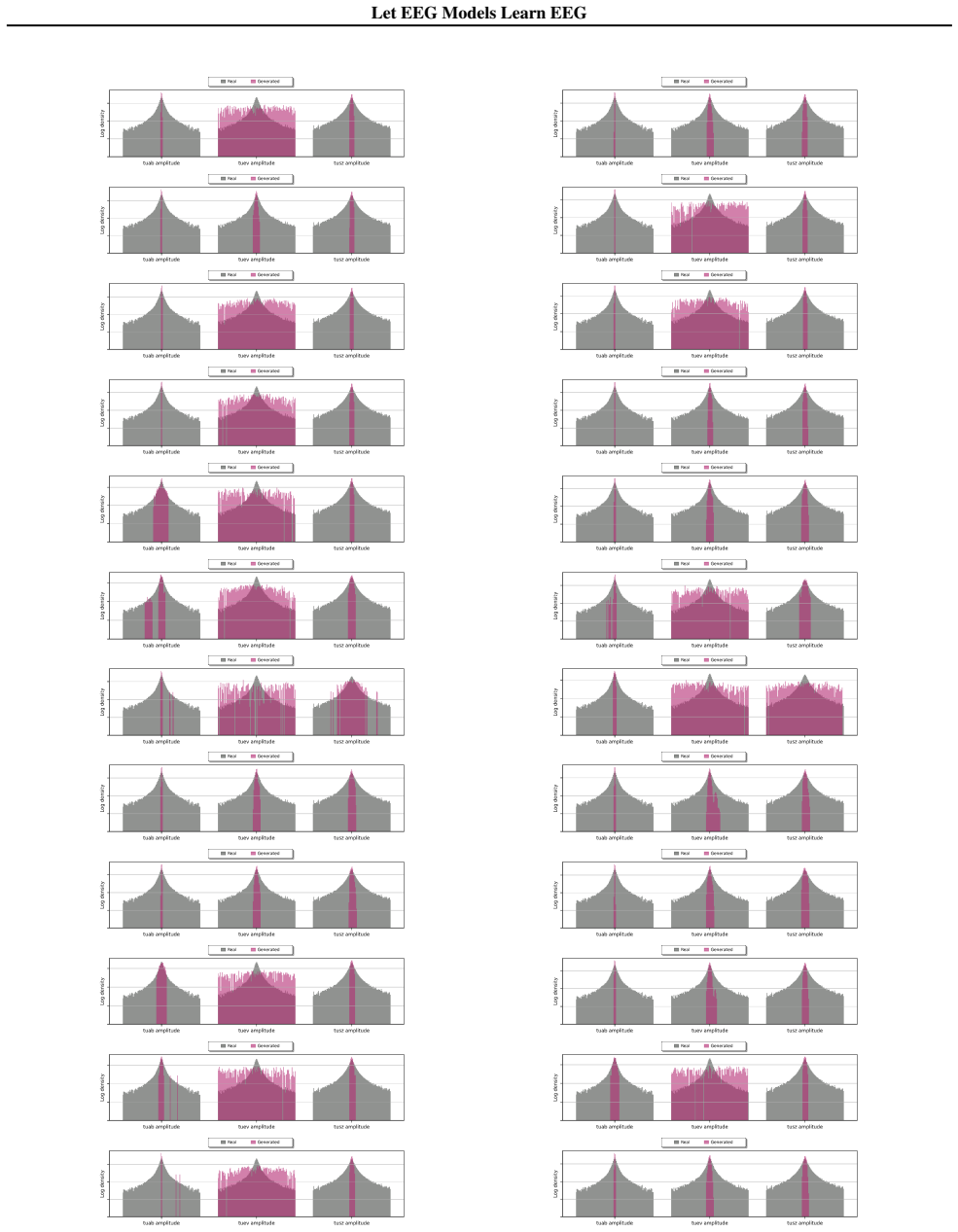
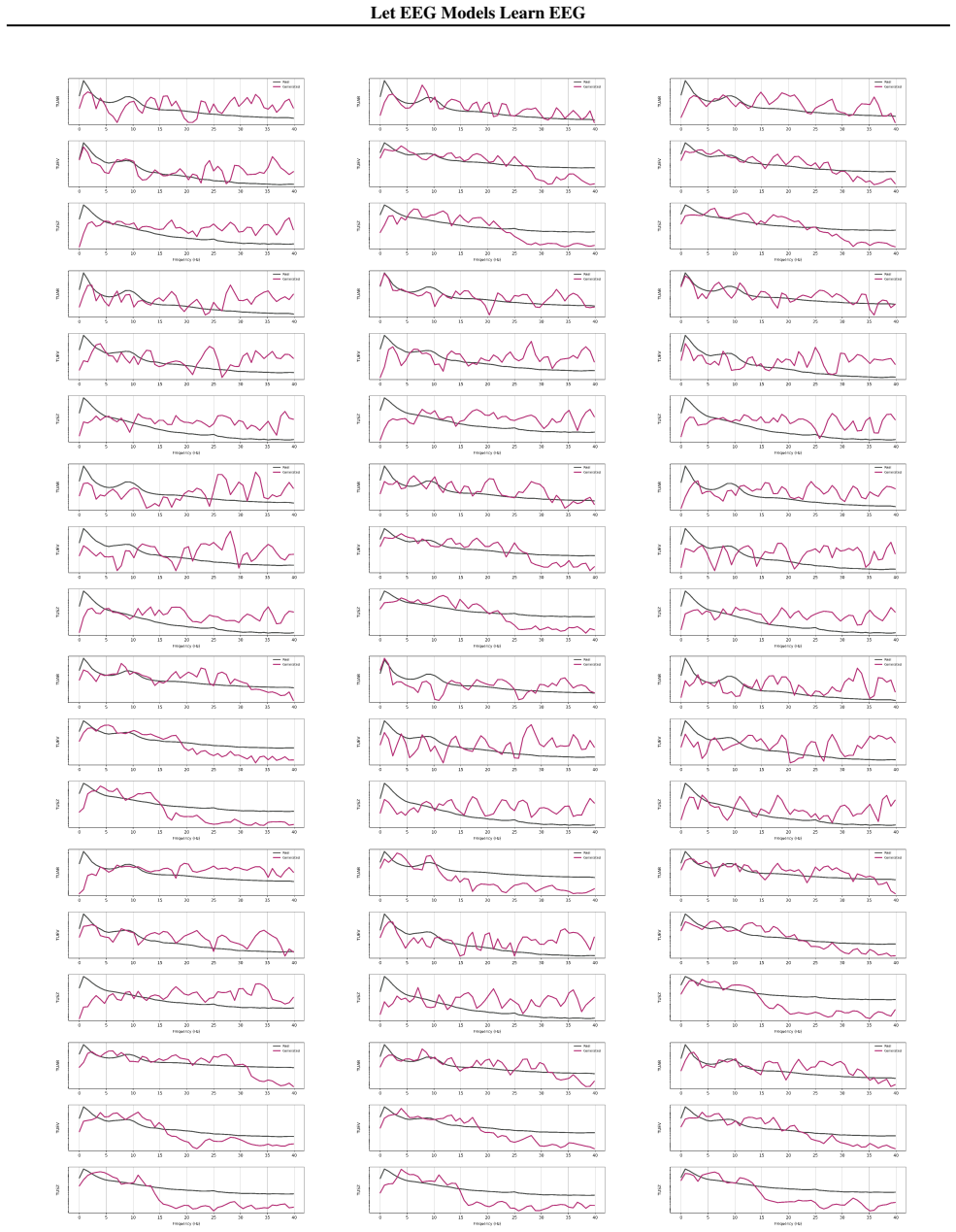


read the original abstract
High-fidelity EEG generation is critical for alleviating data scarcity and addressing privacy constraints in large-scale neural modeling. Despite recent progress, most existing approaches formulate EEG generation via discrete denoising objectives, which inadequately reflect the inherently continuous temporal dynamics and spectral structure of neural activity. As a result, these methods often struggle to preserve long-range temporal dependencies and exhibit mismatches in the spectral and temporal structure of the generated signals. In this work, we argue that effective EEG generation requires models that operate directly on the continuous evolution of neural signals. We introduce Just EEG Transformer (JET), a generative framework based on conditional flow matching that models EEG as raw sequences evolving along continuous trajectories. By learning a smooth vector field that transports noise to the EEG data distribution, JET captures temporal continuity and transient dynamics without relying on discretized denoising schemes or domain-specific representations. To ensure that the learned dynamics remain consistent with key properties of EEG signals, we introduce principled constraints that preserve spectral structure, temporal stationarity, and signal-level statistics. Across three large-scale benchmarks, JET consistently achieves state-of-the-art performance, reducing TS-FID by over 40% compared to strong baselines. Extensive analyses show that JET captures key structural properties of neural dynamics, providing a scalable and principled approach to EEG generation. Project page: https://y-research-sbu.github.io/JET/ .
Editorial analysis
A structured set of objections, weighed in public.
Referee Report
Summary. The paper introduces Just EEG Transformer (JET), a generative framework for high-fidelity EEG synthesis based on conditional flow matching. It models EEG signals as raw sequences evolving along continuous trajectories by learning a smooth vector field, augmented with three principled constraints to preserve spectral structure, temporal stationarity, and signal-level statistics. The central claim is that this approach outperforms discrete denoising baselines, achieving state-of-the-art results with over 40% reduction in TS-FID across three large-scale benchmarks while better capturing long-range temporal dependencies and neural dynamics.
Significance. If the empirical claims hold after verification, the work offers a principled shift from discrete to continuous modeling for EEG generation. This could meaningfully address data scarcity and privacy issues in neural signal processing by producing trajectories that respect EEG-specific properties, with potential downstream benefits for augmentation in BCI and clinical modeling tasks. The emphasis on flow matching and explicit constraints is a strength if supported by ablations and guarantees.
major comments (3)
- [Abstract and §3] Abstract and §3: The central performance claim of >40% TS-FID reduction is presented without accompanying statistical tests, confidence intervals, or error analysis. This makes it impossible to determine whether the improvement is robust or attributable to the proposed constraints versus the base conditional flow matching architecture.
- [§3.2] §3.2 (Constraints): The spectral, stationarity, and signal-level constraints are introduced as auxiliary losses or regularizers, but no derivation, weighting schedule, or bound is provided to guarantee that the resulting ODE trajectories remain on the manifold of valid EEG signals. This directly bears on the weakest assumption that long-range dependencies and transient events are preserved without artifacts.
- [§4] §4 (Experiments): No ablation studies isolating the contribution of each constraint, no implementation details (e.g., vector field parameterization, ODE solver tolerances), and no comparison against ablated versions of the flow-matching objective alone are reported. These omissions prevent verification that the reported gains stem from the full JET framework.
minor comments (2)
- [§2] Notation for the vector field and conditioning variables should be defined more explicitly in §2 to avoid ambiguity when reading the constraint formulations.
- [Figures] Figure captions and axis labels in the qualitative results could be expanded to indicate which constraint is active in each panel.
Simulated Author's Rebuttal
We thank the referee for the constructive feedback, which identifies key opportunities to strengthen the empirical validation and methodological details of the JET framework. We respond to each major comment below and describe the revisions planned for the next version of the manuscript.
read point-by-point responses
-
Referee: [Abstract and §3] Abstract and §3: The central performance claim of >40% TS-FID reduction is presented without accompanying statistical tests, confidence intervals, or error analysis. This makes it impossible to determine whether the improvement is robust or attributable to the proposed constraints versus the base conditional flow matching architecture.
Authors: We agree that statistical analysis is necessary to support the performance claims. In the revised manuscript we will report TS-FID means accompanied by standard deviations computed over multiple independent runs with different random seeds. We will also add statistical significance tests (paired t-tests and Wilcoxon signed-rank tests) between JET and the baselines on each benchmark to demonstrate that the observed reductions are robust and not explained by variance alone. revision: yes
-
Referee: [§3.2] §3.2 (Constraints): The spectral, stationarity, and signal-level constraints are introduced as auxiliary losses or regularizers, but no derivation, weighting schedule, or bound is provided to guarantee that the resulting ODE trajectories remain on the manifold of valid EEG signals. This directly bears on the weakest assumption that long-range dependencies and transient events are preserved without artifacts.
Authors: The constraints are introduced as soft penalty terms within the conditional flow-matching objective to encourage preservation of EEG-specific properties. Deriving a rigorous bound that keeps every ODE trajectory exactly on the valid EEG manifold is a non-trivial theoretical question that goes beyond the scope of the current empirical study. In the revision we will expand §3.2 with the concrete weighting schedule (including the values of the regularization coefficients and any annealing schedule used during training) and provide an empirical analysis of how the constraints affect the learned vector field and the generated trajectories. We will also discuss observed artifacts and the practical mitigation achieved by the combined objective. revision: partial
-
Referee: [§4] §4 (Experiments): No ablation studies isolating the contribution of each constraint, no implementation details (e.g., vector field parameterization, ODE solver tolerances), and no comparison against ablated versions of the flow-matching objective alone are reported. These omissions prevent verification that the reported gains stem from the full JET framework.
Authors: We will add a dedicated ablation subsection and an expanded appendix. The new experiments will include: (i) JET with each constraint removed individually, (ii) a pure conditional flow-matching baseline without any of the three constraints, and (iii) comparisons against discrete denoising models augmented with the same constraints. We will also document the vector-field network architecture, the ODE solver (including tolerances such as atol and rtol), and all training hyperparameters. These additions will make the contribution of each component verifiable. revision: yes
Circularity Check
No significant circularity; derivation relies on established conditional flow matching plus independently motivated constraints
full rationale
The paper's core framework is conditional flow matching applied to continuous EEG trajectories, an approach drawn from prior literature rather than defined in terms of the target EEG properties. The added constraints on spectral structure, temporal stationarity, and signal statistics are presented as auxiliary regularizers motivated by known EEG characteristics; they are not shown to be fitted to the model's own outputs or to reduce the performance metric by construction. No self-citation chain is invoked to justify uniqueness or to smuggle in an ansatz, and the reported TS-FID improvements are framed as empirical outcomes rather than tautological predictions. The derivation chain therefore remains self-contained against external benchmarks and does not collapse to its inputs.
Axiom & Free-Parameter Ledger
axioms (1)
- domain assumption Conditional flow matching can faithfully transport noise to the distribution of raw EEG sequences while preserving long-range temporal dependencies.
Lean theorems connected to this paper
-
IndisputableMonolith/Cost/FunctionalEquation.leanwashburn_uniqueness_aczel unclear?
unclearRelation between the paper passage and the cited Recognition theorem.
We introduce Just EEG Transformer (JET), a generative framework based on conditional flow matching that models EEG as raw sequences evolving along continuous trajectories... principled constraints that preserve spectral structure, temporal stationarity, and signal-level statistics.
-
IndisputableMonolith/Foundation/AlphaCoordinateFixation.leanJ_uniquely_calibrated_via_higher_derivative unclear?
unclearRelation between the paper passage and the cited Recognition theorem.
Ltotal = Lrecon + Lcons + Lgeo with Laplacian prior, moment matching, total variation and Pearson correlation.
What do these tags mean?
- matches
- The paper's claim is directly supported by a theorem in the formal canon.
- supports
- The theorem supports part of the paper's argument, but the paper may add assumptions or extra steps.
- extends
- The paper goes beyond the formal theorem; the theorem is a base layer rather than the whole result.
- uses
- The paper appears to rely on the theorem as machinery.
- contradicts
- The paper's claim conflicts with a theorem or certificate in the canon.
- unclear
- Pith found a possible connection, but the passage is too broad, indirect, or ambiguous to say the theorem truly supports the claim.
Reference graph
Works this paper leans on
-
[1]
P. Langley , title =. Proceedings of the 17th International Conference on Machine Learning (ICML 2000) , address =. 2000 , pages =
work page 2000
-
[2]
T. M. Mitchell. The Need for Biases in Learning Generalizations. 1980
work page 1980
-
[3]
M. J. Kearns , title =
-
[4]
Machine Learning: An Artificial Intelligence Approach, Vol. I. 1983
work page 1983
-
[5]
R. O. Duda and P. E. Hart and D. G. Stork. Pattern Classification. 2000
work page 2000
-
[6]
Suppressed for Anonymity , author=
-
[7]
A. Newell and P. S. Rosenbloom. Mechanisms of Skill Acquisition and the Law of Practice. Cognitive Skills and Their Acquisition. 1981
work page 1981
-
[8]
A. L. Samuel. Some Studies in Machine Learning Using the Game of Checkers. IBM Journal of Research and Development. 1959
work page 1959
-
[9]
arXiv preprint arXiv:2405.18765 , year=
Large brain model for learning generic representations with tremendous EEG data in BCI , author=. arXiv preprint arXiv:2405.18765 , year=
-
[10]
arXiv preprint arXiv:2401.10278 , year=
Eegformer: Towards transferable and interpretable large-scale eeg foundation model , author=. arXiv preprint arXiv:2401.10278 , year=
-
[11]
2024 IEEE International Symposium on Biomedical Imaging (ISBI) , pages=
Neuro-gpt: Towards a foundation model for eeg , author=. 2024 IEEE International Symposium on Biomedical Imaging (ISBI) , pages=. 2024 , organization=
work page 2024
-
[12]
Advances in Neural Information Processing Systems , volume=
Eegpt: Pretrained transformer for universal and reliable representation of eeg signals , author=. Advances in Neural Information Processing Systems , volume=
-
[13]
arXiv preprint arXiv:2305.10351 , year=
BIOT: Cross-data biosignal learning in the wild , author=. arXiv preprint arXiv:2305.10351 , year=
-
[14]
Dr eamDif- fusion: Generating high-quality images from brain EEG sign als,
Dreamdiffusion: Generating high-quality images from brain eeg signals , author=. arXiv preprint arXiv:2306.16934 , year=
-
[15]
Proceedings of the IEEE/CVF Conference on Computer Vision and Pattern Recognition , pages=
Seeing beyond the brain: Conditional diffusion model with sparse masked modeling for vision decoding , author=. Proceedings of the IEEE/CVF Conference on Computer Vision and Pattern Recognition , pages=
-
[16]
arXiv preprint arXiv:2409.00101 , year=
NeuroLM: A universal multi-task foundation model for bridging the gap between language and EEG signals , author=. arXiv preprint arXiv:2409.00101 , year=
-
[17]
Advances in Neural Information Processing Systems , volume=
Brant: Foundation model for intracranial neural signal , author=. Advances in Neural Information Processing Systems , volume=
-
[18]
arXiv preprint arXiv:2510.12515 , year=
HEAR: An EEG Foundation Model with Heterogeneous Electrode Adaptive Representation , author=. arXiv preprint arXiv:2510.12515 , year=
-
[19]
Zhou, Y ., Wu, J., Ren, Z., Yao, Z., Lu, W., Peng, K., Zheng, Q., Song, C., Ouyang, W., and Gou, C
CSBrain: A Cross-scale Spatiotemporal Brain Foundation Model for EEG Decoding , author=. arXiv preprint arXiv:2506.23075 , year=
-
[20]
Cbramod: A criss-cross brain foundation model for eeg decoding , author=. arXiv preprint arXiv:2412.07236 , year=
-
[21]
arXiv preprint arXiv:2511.14196 , year=
MindCross: Fast New Subject Adaptation with Limited Data for Cross-subject Video Reconstruction from Brain Signals , author=. arXiv preprint arXiv:2511.14196 , year=
-
[22]
arXiv preprint arXiv:2504.11936 , year=
Mind2matter: Creating 3d models from eeg signals , author=. arXiv preprint arXiv:2504.11936 , year=
-
[23]
arXiv preprint arXiv:2204.12440 , year=
Neuro-bert: Rethinking masked autoencoding for self-supervised neurological pretraining , author=. arXiv preprint arXiv:2204.12440 , year=
-
[24]
U., Kreiman, G., Katz, B., Cases, I., and Barbu, A
BrainBERT: Self-supervised representation learning for intracranial recordings , author=. arXiv preprint arXiv:2302.14367 , year=
-
[25]
arXiv preprint arXiv:2308.13234 , year=
Decoding natural images from eeg for object recognition , author=. arXiv preprint arXiv:2308.13234 , year=
-
[26]
IEEE Transactions on Neural Systems and Rehabilitation Engineering , volume=
EEG conformer: Convolutional transformer for EEG decoding and visualization , author=. IEEE Transactions on Neural Systems and Rehabilitation Engineering , volume=. 2022 , publisher=
work page 2022
-
[27]
Lawhern, Vernon J and Solon, Amelia J and Waytowich, Nicholas R and Gordon, Stephen M and Hung, Chou P and Lance, Brent J , title =. 2018 , month =. doi:10.1088/1741-2552/aace8c , url =
-
[28]
Deep learning with convolutional neural networks for EEG decoding and visualization , author=. Human brain mapping , volume=. 2017 , publisher=
work page 2017
-
[29]
EEG-GAN: Generative adversarial networks for electroencephalograhic (EEG) brain signals
EEG-GAN: Generative adversarial networks for electroencephalograhic (EEG) brain signals , author=. arXiv preprint arXiv:1806.01875 , year=
work page internal anchor Pith review Pith/arXiv arXiv
-
[30]
Proceedings of the 25th ACM international conference on Multimedia , pages=
Brain2image: Converting brain signals into images , author=. Proceedings of the 25th ACM international conference on Multimedia , pages=
-
[31]
arXiv preprint arXiv:2309.14030 , year=
Dewave: Discrete eeg waves encoding for brain dynamics to text translation , author=. arXiv preprint arXiv:2309.14030 , year=
-
[32]
Proceedings of the AAAI conference on artificial intelligence , year=
Towards voice reconstruction from EEG during imagined speech , author=. Proceedings of the AAAI conference on artificial intelligence , year=
-
[33]
arXiv preprint arXiv:2308.02510 , year=
Seeing through the brain: image reconstruction of visual perception from human brain signals , author=. arXiv preprint arXiv:2308.02510 , year=
-
[34]
Frontiers in Human Neuroscience , volume=
BENDR: Using transformers and a contrastive self-supervised learning task to learn from massive amounts of EEG data , author=. Frontiers in Human Neuroscience , volume=. 2021 , publisher=
work page 2021
-
[35]
IEEE Transactions on Cognitive and Developmental Systems , year=
Data augmentation for seizure prediction with generative diffusion model , author=. IEEE Transactions on Cognitive and Developmental Systems , year=
-
[36]
Visual neural decod- ing via improved visual-eeg semantic consistency
Visual neural decoding via improved visual-EEG semantic consistency , author=. arXiv preprint arXiv:2408.06788 , year=
-
[37]
Back to Basics: Let Denoising Generative Models Denoise
Back to basics: Let denoising generative models denoise , author=. arXiv preprint arXiv:2511.13720 , year=
work page internal anchor Pith review Pith/arXiv arXiv
-
[38]
Proceedings of the IEEE/CVF international conference on computer vision , pages=
Scalable diffusion models with transformers , author=. Proceedings of the IEEE/CVF international conference on computer vision , pages=
-
[39]
Flow Matching for Generative Modeling
Flow matching for generative modeling , author=. arXiv preprint arXiv:2210.02747 , year=
work page internal anchor Pith review Pith/arXiv arXiv
- [40]
-
[41]
Flow Straight and Fast: Learning to Generate and Transfer Data with Rectified Flow
Flow straight and fast: Learning to generate and transfer data with rectified flow , author=. arXiv preprint arXiv:2209.03003 , year=
work page internal anchor Pith review Pith/arXiv arXiv
-
[42]
SiT: Exploring Flow and Diffusion-based Generative Models with Scalable Interpolant Transformers , author=. 2024 , eprint=
work page 2024
-
[43]
Stochastic Interpolants: A Unifying Framework for Flows and Diffusions
Stochastic interpolants: A unifying framework for flows and diffusions , author=. arXiv preprint arXiv:2303.08797 , year=
work page internal anchor Pith review Pith/arXiv arXiv
-
[44]
Advances in neural information processing systems , volume=
Denoising diffusion probabilistic models , author=. Advances in neural information processing systems , volume=
-
[45]
International Conference on Learning Representations , year=
Denoising Diffusion Implicit Models , author=. International Conference on Learning Representations , year=
-
[46]
Score-Based Generative Modeling through Stochastic Differential Equations , author=. 2021 , eprint=
work page 2021
-
[47]
High-Resolution Image Synthesis with Latent Diffusion Models , author=. 2021 , eprint=
work page 2021
-
[48]
IEEE transactions on medical imaging , year=
CT super-resolution GAN constrained by the identical, residual, and cycle learning ensemble (GAN-CIRCLE) , author=. IEEE transactions on medical imaging , year=
-
[49]
arXiv preprint arXiv:2511.19917 , year=
Scale Where It Matters: Training-Free Localized Scaling for Diffusion Models , author=. arXiv preprint arXiv:2511.19917 , year=
-
[50]
Physics in Medicine & Biology , year=
MARGANVAC: metal artifact reduction method based on generative adversarial network with variable constraints , author=. Physics in Medicine & Biology , year=
-
[51]
Proceedings of the AAAI Conference on Artificial Intelligence , year=
Coma: Compositional human motion generation with multi-modal agents , author=. Proceedings of the AAAI Conference on Artificial Intelligence , year=
-
[52]
Proceedings of the IEEE/CVF Winter Conference on Applications of Computer Vision , year=
Hybrid neural diffeomorphic flow for shape representation and generation via triplane , author=. Proceedings of the IEEE/CVF Winter Conference on Applications of Computer Vision , year=
-
[53]
International Conference on Medical Image Computing and Computer-Assisted Intervention , year=
Medgen3d: A deep generative framework for paired 3d image and mask generation , author=. International Conference on Medical Image Computing and Computer-Assisted Intervention , year=
-
[54]
International Conference on Medical Image Computing and Computer-Assisted Intervention , year=
Pre-trained diffusion models for plug-and-play medical image enhancement , author=. International Conference on Medical Image Computing and Computer-Assisted Intervention , year=
- [55]
-
[56]
Latent Consistency Models: Synthesizing High-Resolution Images with Few-Step Inference , author=. 2023 , eprint=
work page 2023
-
[57]
International Conference on Learning Representations , year=
InstaFlow: One Step is Enough for High-Quality Diffusion-Based Text-to-Image Generation , author=. International Conference on Learning Representations , year=
-
[58]
The IEEE Conference on Computer Vision and Pattern Recognition (CVPR) , month =
MaskGIT: Masked Generative Image Transformer , author=. The IEEE Conference on Computer Vision and Pattern Recognition (CVPR) , month =
-
[59]
DC-AR: Efficient Masked Autoregressive Image Generation with Deep Compression Hybrid Tokenizer , author=. 2025 , eprint=
work page 2025
-
[60]
The Thirty-eighth Annual Conference on Neural Information Processing Systems , year=
Fisher Flow Matching for Generative Modeling over Discrete Data , author=. The Thirty-eighth Annual Conference on Neural Information Processing Systems , year=
- [61]
- [62]
-
[63]
A Style-Based Generator Architecture for Generative Adversarial Networks , author=. 2019 , eprint=
work page 2019
-
[64]
Andrew Brock and Jeff Donahue and Karen Simonyan , booktitle=. Large Scale. 2019 , url=
work page 2019
-
[65]
NeurIPS 2021 Workshop on Deep Generative Models and Downstream Applications , year=
Classifier-Free Diffusion Guidance , author=. NeurIPS 2021 Workshop on Deep Generative Models and Downstream Applications , year=
work page 2021
-
[66]
Tero Karras and Miika Aittala and Timo Aila and Samuli Laine , title =. Proc. NeurIPS , year =
-
[67]
Hierarchical Text-Conditional Image Generation with CLIP Latents , author=. 2022 , eprint=
work page 2022
-
[68]
Photorealistic Text-to-Image Diffusion Models with Deep Language Understanding , author=. 2022 , eprint=
work page 2022
-
[69]
Proceedings of the Computer Vision and Pattern Recognition Conference (CVPR) , month =
Shi, Yingdong and Li, Changming and Wang, Yifan and Zhao, Yongxiang and Pang, Anqi and Yang, Sibei and Yu, Jingyi and Ren, Kan , title =. Proceedings of the Computer Vision and Pattern Recognition Conference (CVPR) , month =. 2025 , pages =
work page 2025
-
[70]
Ouroboros: Single-step Diffusion Models for Cycle-consistent Forward and Inverse Rendering
Ouroboros: Single-step Diffusion Models for Cycle-consistent Forward and Inverse Rendering , author=. arXiv preprint arXiv:2508.14461 , year=
work page internal anchor Pith review Pith/arXiv arXiv
-
[71]
IEEE International Conference on Computer Vision (ICCV) , year=
Adding Conditional Control to Text-to-Image Diffusion Models , author=. IEEE International Conference on Computer Vision (ICCV) , year=
-
[72]
Advances in Neural Information Processing Systems , editor=
On Density Estimation with Diffusion Models , author=. Advances in Neural Information Processing Systems , editor=. 2021 , url=
work page 2021
- [73]
-
[74]
Thirty-seventh Conference on Neural Information Processing Systems , year=
Cold Diffusion: Inverting Arbitrary Image Transforms Without Noise , author=. Thirty-seventh Conference on Neural Information Processing Systems , year=
-
[75]
Transactions on Machine Learning Research , issn=
Soft Diffusion: Score Matching with General Corruptions , author=. Transactions on Machine Learning Research , issn=. 2023 , url=
work page 2023
- [76]
-
[77]
arXiv preprint arXiv:2602.21333 , year=
HorizonForge: Driving Scene Editing with Any Trajectories and Any Vehicles , author=. arXiv preprint arXiv:2602.21333 , year=
-
[78]
Diffusion Transformers with Representation Autoencoders
Diffusion transformers with representation autoencoders , author=. arXiv preprint arXiv:2510.11690 , year=
work page internal anchor Pith review Pith/arXiv arXiv
-
[79]
Frontiers in Neuroscience , VOLUME=
Obeid, Iyad and Picone, Joseph , TITLE=. Frontiers in Neuroscience , VOLUME=. 2016 , URL=. doi:10.3389/fnins.2016.00196 , ISSN=
-
[80]
Journal of Machine Learning Research , volume=
Normalizing flows for probabilistic modeling and inference , author=. Journal of Machine Learning Research , volume=
discussion (0)
Sign in with ORCID, Apple, or X to comment. Anyone can read and Pith papers without signing in.