OcclusionFormer: Arranging Z-Order for Layout-Grounded Image Generation
Pith reviewed 2026-05-21 04:51 UTC · model grok-4.3
The pith
OcclusionFormer resolves overlapping bounding-box ambiguities by explicitly modeling Z-order through instance decoupling and volume rendering.
A machine-rendered reading of the paper's core claim, the machinery that carries it, and where it could break.
Core claim
OcclusionFormer is an occlusion-aware Diffusion Transformer that explicitly models Z-order priority by decoupling instances and compositing them via volume rendering. Trained on the SA-Z dataset, which provides explicit occlusion ordering and pixel-level annotations, the model also employs a queried alignment loss that supervises individual instances and improves semantic consistency. This combination reduces ambiguity in overlapping regions, enforces correct occlusion dependencies, and preserves structural integrity, producing measurable accuracy gains across diverse scenes.
What carries the argument
The occlusion-aware Diffusion Transformer that decouples instances and composites them via volume rendering to enforce explicit Z-order priority.
If this is right
- Generated images exhibit fewer entangled textures in regions where bounding boxes intersect.
- Occlusion relationships between objects follow the intended depth order without additional post-processing.
- Structural boundaries and object identities remain intact even in densely overlapping layouts.
- Quantitative metrics for layout fidelity improve across a range of scene complexities.
Where Pith is reading between the lines
- The same decoupling-plus-volume-rendering pattern could be adapted to other conditional generators that currently ignore depth ordering.
- A dataset like SA-Z might become a standard testbed for measuring occlusion accuracy in future layout-conditioned models.
- Correct Z-order modeling may reduce the need for separate depth-estimation stages when these images are later used in 3D pipelines.
Load-bearing premise
Decoupling instances and compositing them via volume rendering together with the queried alignment loss will correctly resolve inter-object occlusion ordering when bounding boxes overlap.
What would settle it
Generate images from overlapping bounding-box layouts whose ground-truth Z-order is known from the SA-Z annotations; if the outputs still display entangled textures or inverted layering in the intersection regions, the central claim is false.
Figures


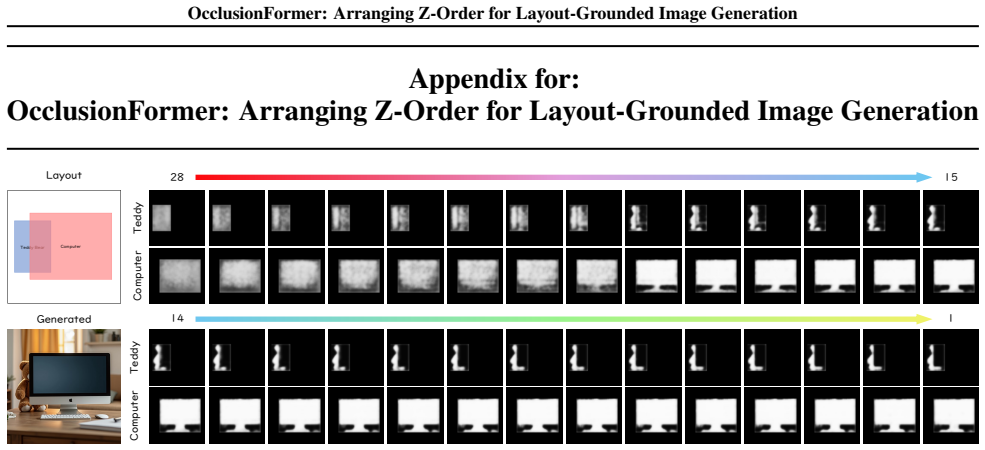


read the original abstract
Recent layout-to-image models have achieved remarkable progress in spatial controllability. However, they still struggle with inter-object occlusion. When bounding boxes overlap, most existing methods lack explicit occlusion information, which makes the generation in intersection regions inherently ambiguous and hinders the determination of complex occlusion relationships. As a result, they often produce entangled textures or physically inconsistent layering in the overlapped areas. To address this issue, we first construct SA-Z, a large-scale dataset enriched with explicit occlusion ordering and pixel-level annotations. Building upon our proposed dataset, we introduce OcclusionFormer, a novel occlusion-aware Diffusion Transformer framework that explicitly models Z-order priority by decoupling instances and compositing them via volume rendering. Furthermore, to ensure fine-grained spatial precision, we introduce a queried alignment loss that explicitly supervises individual instances and enhances semantic consistency. The proposed method effectively reduces ambiguity in overlapping regions, enforces correct occlusion dependencies, and preserves structural integrity, leading to substantial accuracy gains across diverse scenes.
Editorial analysis
A structured set of objections, weighed in public.
Referee Report
Summary. The paper introduces OcclusionFormer, a Diffusion Transformer for layout-to-image generation that addresses inter-object occlusion by constructing the SA-Z dataset (with explicit Z-order and pixel annotations) and decoupling instances before compositing them via volume rendering; a queried alignment loss is added to supervise per-instance semantics and enforce correct layering when bounding boxes overlap.
Significance. If the central mechanism holds and is validated, the work would provide a concrete way to reduce ambiguity in overlapped regions of layout-conditioned generation, which is a persistent failure mode in current models; the combination of a new annotated dataset, volume-rendering compositing, and instance-level supervision could serve as a useful baseline for future occlusion-aware synthesis.
major comments (3)
- [§3] §3 (Method, volume-rendering compositing): the description conditions on Z-order as an input feature but does not appear to include explicit layer sorting or depth-ordered transmittance modulation in the rendering integral; without these, the compositing step reduces to learned blending and does not provably enforce the supplied occlusion ordering when boxes overlap, leaving the core ambiguity unresolved. Please supply the exact rendering equation and a proof or ablation showing that the provided Z-order is strictly respected.
- [Experiments] Experimental section / results: the abstract asserts 'substantial accuracy gains across diverse scenes' yet the manuscript supplies no quantitative tables, FID/IoU numbers, ablation on the queried alignment loss, or comparisons against layout-to-image baselines on the SA-Z test split; without these the central claim cannot be evaluated.
- [§4] §4 (Dataset): the SA-Z annotations are introduced as a key contribution, but no details are given on annotation protocol, inter-annotator agreement, or how the pixel-level occlusion labels are derived from the bounding-box Z-order; this information is required to assess whether the supervision signal is reliable.
minor comments (2)
- [Figure 2] Figure 2 / architecture diagram: the flow from instance decoupling to volume rendering is hard to follow; add explicit arrows or a small equation block showing how Z-order is injected into the renderer.
- [§3.2] Notation: the symbol for the queried alignment loss is introduced without a clear definition of the query vectors; define it once in §3.2 before reuse.
Simulated Author's Rebuttal
We thank the referee for the careful review and valuable feedback on our manuscript. We address each major comment point by point below, clarifying the technical details and outlining the revisions we will incorporate to strengthen the paper.
read point-by-point responses
-
Referee: [§3] §3 (Method, volume-rendering compositing): the description conditions on Z-order as an input feature but does not appear to include explicit layer sorting or depth-ordered transmittance modulation in the rendering integral; without these, the compositing step reduces to learned blending and does not provably enforce the supplied occlusion ordering when boxes overlap, leaving the core ambiguity unresolved. Please supply the exact rendering equation and a proof or ablation showing that the provided Z-order is strictly respected.
Authors: We thank the referee for highlighting this aspect of the compositing mechanism. In OcclusionFormer, the Z-order from the SA-Z dataset is used to explicitly sort the decoupled instances prior to volume rendering; the rendering integral then accumulates color and transmittance in this sorted order so that higher-priority (closer) layers occlude lower-priority ones. We will add the exact rendering equation to the revised §3, following the standard ordered volume-rendering formulation with depth-dependent transmittance modulation. While a formal mathematical proof of strict enforcement is difficult given the stochastic nature of diffusion, we will include a targeted ablation that removes the Z-order sorting step and demonstrates degraded layering accuracy on overlapping boxes, thereby showing that the supplied ordering is respected in the full model. revision: yes
-
Referee: [Experiments] Experimental section / results: the abstract asserts 'substantial accuracy gains across diverse scenes' yet the manuscript supplies no quantitative tables, FID/IoU numbers, ablation on the queried alignment loss, or comparisons against layout-to-image baselines on the SA-Z test split; without these the central claim cannot be evaluated.
Authors: We acknowledge the omission of quantitative results in the submitted manuscript. In the revised version we will expand the experimental section with tables reporting FID and IoU metrics on the SA-Z test split, direct comparisons against layout-to-image baselines, and a dedicated ablation isolating the contribution of the queried alignment loss. These additions will provide the numerical evidence needed to substantiate the accuracy gains claimed in the abstract. revision: yes
-
Referee: [§4] §4 (Dataset): the SA-Z annotations are introduced as a key contribution, but no details are given on annotation protocol, inter-annotator agreement, or how the pixel-level occlusion labels are derived from the bounding-box Z-order; this information is required to assess whether the supervision signal is reliable.
Authors: We appreciate the request for greater transparency on dataset construction. The revised §4 will describe the annotation protocol in detail: multiple annotators assign Z-order ranks to objects per scene, pixel-level labels are obtained by rasterizing instances in the supplied Z-order and assigning each pixel to the foremost object, and inter-annotator agreement is quantified via Cohen’s kappa (reported on a held-out subset). These additions will allow readers to evaluate the reliability of the supervision signal. revision: yes
Circularity Check
No significant circularity; derivation relies on new dataset and independent compositing mechanism
full rationale
The paper constructs a new dataset SA-Z providing explicit occlusion ordering and pixel annotations as external supervision, then defines OcclusionFormer via instance decoupling followed by volume rendering compositing and a queried alignment loss. These elements are introduced as architectural choices trained against the new annotations rather than being defined in terms of the target accuracy metric or reducing to prior self-citations. The claimed gains in resolving overlapping regions are presented as empirical results from this pipeline, with no load-bearing step shown to be equivalent to its inputs by construction.
Axiom & Free-Parameter Ledger
axioms (1)
- domain assumption Volume rendering of decoupled instances can enforce correct Z-order priority in overlapping regions.
invented entities (1)
-
SA-Z dataset
no independent evidence
Lean theorems connected to this paper
-
IndisputableMonolith/Foundation/AbsoluteFloorClosure.leanreality_from_one_distinction unclear?
unclearRelation between the paper passage and the cited Recognition theorem.
explicitly models Z-order priority by decoupling instances and compositing them via volume rendering
What do these tags mean?
- matches
- The paper's claim is directly supported by a theorem in the formal canon.
- supports
- The theorem supports part of the paper's argument, but the paper may add assumptions or extra steps.
- extends
- The paper goes beyond the formal theorem; the theorem is a base layer rather than the whole result.
- uses
- The paper appears to rely on the theorem as machinery.
- contradicts
- The paper's claim conflicts with a theorem or certificate in the canon.
- unclear
- Pith found a possible connection, but the passage is too broad, indirect, or ambiguous to say the theorem truly supports the claim.
Reference graph
Works this paper leans on
-
[1]
LaRender: Training-Free Occlusion Control in Image Generation via Latent Rendering , author=
-
[2]
NeRF: Representing Scenes as Neural Radiance Fields for View Synthesis , author=
-
[3]
Eligen: Entity-level controlled image generation with regional attention , author=
-
[4]
Creatilayout: Siamese multimodal diffusion transformer for creative layout-to-image generation , author=
-
[5]
InstanceAssemble: Layout-Aware Image Generation via Instance Assembling Attention , author=
-
[6]
SceneDesigner: Controllable Multi-Object Image Generation with 9-DoF Pose Manipulation , author=
-
[7]
Gligen: Open-set grounded text-to-image generation , author=
-
[8]
Migc: Multi-instance generation controller for text-to-image synthesis , author=
-
[9]
Seg2Any: Open-set Segmentation-Mask-to-Image Generation with Precise Shape and Semantic Control , author=
-
[10]
Place: Adaptive layout-semantic fusion for semantic image synthesis , author=
-
[11]
Segment anything , author=
-
[12]
SAM 3D: 3Dfy Anything in Images , author=
-
[13]
High-resolution image synthesis with latent diffusion models , author=
-
[14]
Sdxl: Improving latent diffusion models for high-resolution image synthesis , author=
-
[15]
Scalable diffusion models with transformers , author=
-
[16]
Scaling rectified flow transformers for high-resolution image synthesis , author=
-
[17]
FLUX.1-dev , author =
-
[18]
Boxdiff: Text-to-image synthesis with training-free box-constrained diffusion , author=
-
[19]
Training-free layout control with cross-attention guidance , author=
-
[20]
Multidiffusion: Fusing diffusion paths for controlled image generation , author=
-
[21]
Microsoft coco: Common objects in context , author=
-
[22]
Describe anything: Detailed localized image and video captioning , author=
-
[23]
Instance-wise occlusion and depth orders in natural scenes , author=
-
[24]
The open images dataset v4: Unified image classification, object detection, and visual relationship detection at scale , author=
-
[25]
Visual genome: Connecting language and vision using crowdsourced dense image annotations , author=
-
[26]
Flow matching for generative modeling , author=
-
[27]
Lora: Low-rank adaptation of large language models , author=
-
[28]
Flow straight and fast: Learning to generate and transfer data with rectified flow , author=
-
[29]
OverLayBench: A Benchmark for Layout-to-Image Generation with Dense Overlaps , author=
-
[30]
Intrinsic images in the wild , author=
- [31]
-
[32]
Sam 3: Segment anything with concepts , author=
-
[33]
Semantic amodal segmentation , author=
-
[34]
Control and Realism: Best of Both Worlds in Layout-to-Image without Training , author=
-
[35]
PlanGen: Towards Unified Layout Planning and Image Generation in Auto-Regressive Vision Language Models , author=
-
[36]
AnyI2V: Animating Any Conditional Image with Motion Control , author=
-
[37]
Anycontrol: create your artwork with versatile control on text-to-image generation , author=
-
[38]
Adding conditional control to text-to-image diffusion models , author=
-
[39]
Instancediffusion: Instance-level control for image generation , author=
-
[40]
Hico: Hierarchical controllable diffusion model for layout-to-image generation , author=
-
[41]
Region-aware text-to-image generation via hard binding and soft refinement , author=
-
[42]
Ctrl-x: Controlling structure and appearance for text-to-image generation without guidance , author=
-
[43]
Freecontrol: Training-free spatial control of any text-to-image diffusion model with any condition , author=
-
[44]
Gans trained by a two time-scale update rule converge to a local nash equilibrium , author=
-
[45]
Learning transferable visual models from natural language supervision , author=
discussion (0)
Sign in with ORCID, Apple, or X to comment. Anyone can read and Pith papers without signing in.