Cilia-driven transport in confined ducts: an active porous media model
Pith reviewed 2026-05-22 08:40 UTC · model grok-4.3
The pith
Cilia in confined ducts show a linear trade-off between flow rate and sustainable pressure.
A machine-rendered reading of the paper's core claim, the machinery that carries it, and where it could break.
Core claim
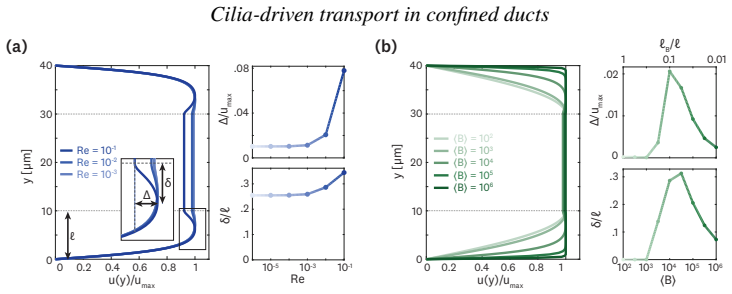
We model dense arrays of beating cilia lining duct walls as an active porous medium driven by prescribed metachronal waves. The resulting flows are described by the incompressible Navier-Stokes-Brinkman equations. We find that transport is characterized by a decreasing linear relationship between flow rate and pressure generation, marking a fundamental trade-off between throughput and sustainable adverse pressure. These results provide a unified physical interpretation of the morphological diversity of ciliated ducts, from high-throughput ciliary carpets to pressure-generating ciliary flames, and offer guiding principles for the design of bio-inspired microfluidic pumps.
What carries the argument
Active porous medium model of ciliary arrays with prescribed metachronal waves, governed by the incompressible Navier-Stokes-Brinkman equations.
Load-bearing premise
Dense ciliary arrays can be represented accurately as a homogeneous active porous medium with prescribed metachronal waves, without resolving individual filament dynamics or boundary effects at the duct scale.
What would settle it
Measure the pressure-flow curve in a microfluidic channel lined with artificial cilia and test whether the relation is linear and matches the predicted slope set by the confinement ratio and ciliary fraction.
Figures






read the original abstract
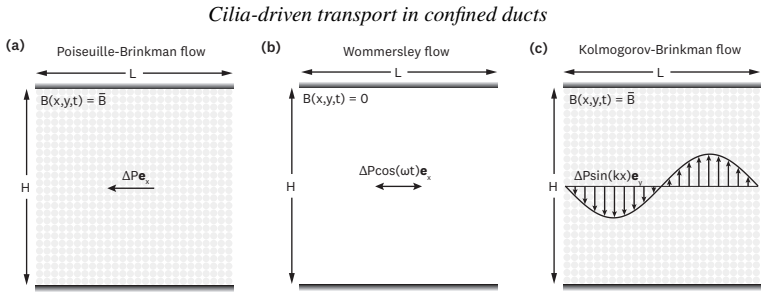
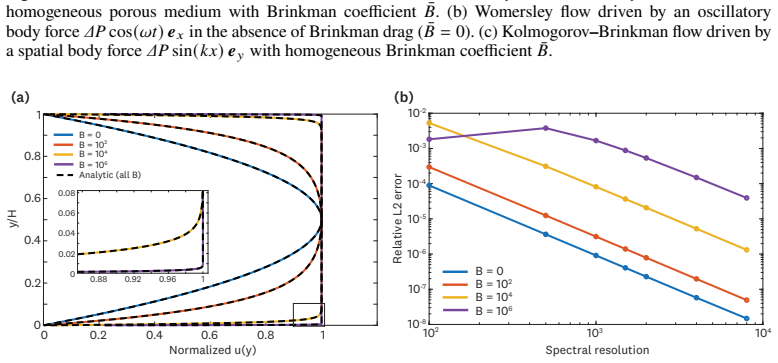
Ciliated organs transport viscous fluids through confined ducts, yet how duct morphology and ciliary activity jointly set the limits of flow rate and sustainable pressure remains unclear. Here, we model dense arrays of beating cilia lining duct walls as an active porous medium driven by prescribed metachronal waves, and identify two key morphological parameters that govern transport: the ciliary confinement ratio and the mean ciliary fraction. The resulting flows are described by the incompressible Navier-Stokes-Brinkman equations, which we solve numerically using a spectral method in the low-Reynolds-number regime. We also develop a complementary mean-field analytical model. The active porous medium framework provides an intermediate description between classical envelope theories and filament-resolved simulations and enables a systematic investigation of how fluid transport is shaped by confinement and packing of ciliary material. We find that transport is characterized by a decreasing linear relationship between flow rate and pressure generation, marking a fundamental trade-off between throughput and sustainable adverse pressure. These results provide a unified physical interpretation of the morphological diversity of ciliated ducts, from high-throughput ciliary carpets to pressure-generating ciliary flames, and offer guiding principles for the design of bio-inspired microfluidic pumps.
Editorial analysis
A structured set of objections, weighed in public.
Referee Report
Summary. The paper models dense ciliary arrays in confined ducts as a homogeneous active porous medium with prescribed metachronal waves. It solves the incompressible Navier-Stokes-Brinkman equations numerically via a spectral method at low Reynolds number and develops a complementary mean-field analytical model. Two morphological parameters—the ciliary confinement ratio and mean ciliary fraction—are identified as governing transport. The central result is a strictly decreasing linear relationship between flow rate Q and adverse pressure generation, interpreted as a fundamental trade-off between throughput and sustainable pressure head. The framework is positioned as an intermediate description between classical envelope models and filament-resolved simulations, offering a unified explanation for morphological diversity in ciliated ducts from high-throughput carpets to pressure-generating flames.
Significance. If the homogeneous active-porous-medium idealization remains quantitatively faithful when filament compliance, hydrodynamic interactions, and load-dependent metachronal adjustment are restored, the work supplies a useful reduced-order description that enables systematic exploration of confinement and packing effects. The linear Q–ΔP trade-off, if shown to be robust rather than an algebraic consequence of the chosen forcing, could rationalize observed duct morphologies and inform bio-inspired microfluidic pump design. The provision of both numerical spectral solutions and an analytical mean-field closure is a strength.
major comments (2)
- [Model formulation and governing equations] The linear relation Q(ΔP) = Q0 − α ΔP follows directly from the linearity of the Stokes-Brinkman equations once the active body-force (or velocity) term and permeability are fixed; any superposition of the prescribed metachronal drive with an imposed pressure gradient yields strict linearity at low Re. This algebraic property holds independently of the specific values of the ciliary confinement ratio and mean ciliary fraction. The manuscript should therefore qualify the claim that the relation marks a “fundamental trade-off” by demonstrating that the same linearity persists (or is modified) when the active term is allowed to depend on the local flow, e.g., through compliant filament dynamics or flow-induced changes in metachronal coordination.
- [Numerical methods and validation] The weakest assumption is the representation of dense ciliary arrays as a homogeneous active porous medium with waves prescribed independently of the flow. The paper should provide a quantitative test—e.g., comparison of the mean-field predictions against a limited set of filament-resolved simulations at the duct scale—for at least one value of the confinement ratio to establish the error incurred by the homogeneity approximation.
minor comments (2)
- [Model formulation] Clarify the precise definition of the active forcing term in the Brinkman equation (is it a body force or an effective velocity boundary condition?) and state whether the permeability is taken constant or spatially modulated by the local ciliary fraction.
- [Results] The abstract states that the model “enables a systematic investigation”; the results section should include a brief parameter sweep table or figure showing how the slope α and intercept Q0 vary with the two morphological parameters.
Simulated Author's Rebuttal
We thank the referee for the constructive and detailed comments. We address each major point below, indicating planned revisions to the manuscript where appropriate.
read point-by-point responses
-
Referee: [Model formulation and governing equations] The linear relation Q(ΔP) = Q0 − α ΔP follows directly from the linearity of the Stokes-Brinkman equations once the active body-force (or velocity) term and permeability are fixed; any superposition of the prescribed metachronal drive with an imposed pressure gradient yields strict linearity at low Re. This algebraic property holds independently of the specific values of the ciliary confinement ratio and mean ciliary fraction. The manuscript should therefore qualify the claim that the relation marks a “fundamental trade-off” by demonstrating that the same linearity persists (or is modified) when the active term is allowed to depend on the local flow, e.g., through compliant filament dynamics or flow-induced changes in metachronal coordination.
Authors: We agree that the linear Q(ΔP) relation is a direct algebraic consequence of the linearity of the Stokes-Brinkman equations with fixed active forcing and permeability. Within our model, this linearity constitutes a trade-off between throughput and pressure generation under the assumption of prescribed, flow-independent metachronal waves. To address the referee's suggestion, we will revise the manuscript to qualify the claim explicitly, noting that the relation is specific to this modeling choice. We will also add a concise discussion of how the relation might be modified by compliant filament dynamics or flow-dependent metachronal adjustments, supported by references to existing literature on ciliary mechanics. These revisions will appear in the updated version. revision: yes
-
Referee: [Numerical methods and validation] The weakest assumption is the representation of dense ciliary arrays as a homogeneous active porous medium with waves prescribed independently of the flow. The paper should provide a quantitative test—e.g., comparison of the mean-field predictions against a limited set of filament-resolved simulations at the duct scale—for at least one value of the confinement ratio to establish the error incurred by the homogeneity approximation.
Authors: We acknowledge that the homogeneous active porous medium idealization is the primary modeling assumption whose accuracy merits scrutiny. Direct filament-resolved simulations at the duct scale remain computationally prohibitive and lie outside the scope of this work, which develops the reduced-order framework as an intermediate description. In the revised manuscript we will substantially expand the discussion of limitations to include order-of-magnitude estimates of the homogeneity error and comparisons with prior filament-based studies, thereby clarifying the expected range of validity. revision: partial
- Quantitative validation of the homogeneous approximation via direct comparison against filament-resolved simulations at the duct scale for at least one confinement ratio.
Circularity Check
Linearity of flow rate vs. adverse pressure follows directly from linearity of Stokes-Brinkman equations with prescribed metachronal forcing
specific steps
-
other
[Abstract]
"We find that transport is characterized by a decreasing linear relationship between flow rate and pressure generation, marking a fundamental trade-off between throughput and sustainable adverse pressure."
The model is defined via the incompressible Navier-Stokes-Brinkman equations solved numerically in the low-Reynolds-number regime with prescribed metachronal waves as the active drive. At low Re these equations are linear, so the velocity (and thus flow rate Q) is a linear superposition of the active forcing term and any imposed pressure gradient. The reported linear Q(DeltaP) = Q0 - alpha DeltaP is therefore guaranteed by construction of the linear system and the independent prescription of wave kinematics; it does not depend on solving the equations or on the specific values of the ciliary confinement ratio and mean ciliary fraction.
full rationale
The paper solves the incompressible Navier-Stokes-Brinkman system at low Re with metachronal waves prescribed independently of the flow. The resulting linear Q vs. DeltaP relation is an algebraic consequence of the linearity of the governing equations once the active body force and permeability are fixed; it does not emerge from the morphological parameters or require numerical solution. While the active-porous-medium idealization may still be useful as an intermediate model, the central 'fundamental trade-off' claim reduces to a property of the chosen linear PDE system rather than a non-trivial prediction about ciliary physics.
Axiom & Free-Parameter Ledger
free parameters (2)
- ciliary confinement ratio
- mean ciliary fraction
axioms (2)
- domain assumption Low-Reynolds-number regime governs the flows
- domain assumption Dense ciliary arrays behave as a homogeneous active porous medium with prescribed metachronal waves
Lean theorems connected to this paper
-
IndisputableMonolith/Cost/FunctionalEquation.leanwashburn_uniqueness_aczel unclear?
unclearRelation between the paper passage and the cited Recognition theorem.
The resulting flows are described by the incompressible Navier–Stokes–Brinkman equations... We find that transport is characterized by a decreasing linear relationship between flow rate and pressure generation
-
IndisputableMonolith/Foundation/RealityFromDistinction.leanreality_from_one_distinction unclear?
unclearRelation between the paper passage and the cited Recognition theorem.
two key morphological parameters that govern transport: the ciliary confinement ratio and the mean ciliary fraction
What do these tags mean?
- matches
- The paper's claim is directly supported by a theorem in the formal canon.
- supports
- The theorem supports part of the paper's argument, but the paper may add assumptions or extra steps.
- extends
- The paper goes beyond the formal theorem; the theorem is a base layer rather than the whole result.
- uses
- The paper appears to rely on the theorem as machinery.
- contradicts
- The paper's claim conflicts with a theorem or certificate in the canon.
- unclear
- Pith found a possible connection, but the passage is too broad, indirect, or ambiguous to say the theorem truly supports the claim.
Reference graph
Works this paper leans on
-
[1]
Force generation and dynamics of individual cilia under external loading , author=. Biophysical journal , volume=. 2010 , publisher=
work page 2010
-
[2]
3D-printed low-voltage-driven ciliary hydrogel microactuators , author=. Nature , pages=. 2026 , publisher=
work page 2026
-
[3]
Annals of Anatomy-Anatomischer Anzeiger , volume=
Lymphatic lacunae of the mucosal folds of human uterine tubes—A rediscovery of forgotten structures and their possible role in reproduction , author=. Annals of Anatomy-Anatomischer Anzeiger , volume=. 2018 , publisher=
work page 2018
-
[4]
Journal of morphology , volume=
Morphology of the kidney in the West African caecilian, Geotrypetes seraphini (Amphibia, Gymnophiona, Caeciliidae) , author=. Journal of morphology , volume=. 2004 , publisher=
work page 2004
-
[5]
Ultrastructure of the metanephridial system in Aeolosoma bengalense (Annelida) , author=. Zoomorphology , volume=. 1994 , publisher=
work page 1994
-
[6]
Journal of Morphology , volume=
Fine structure of dicyemid mesozoans, with special reference to cell junctions , author=. Journal of Morphology , volume=. 1997 , publisher=
work page 1997
-
[7]
Dorsolateral ciliary folds in the polychaete foregut: structure, prevalence and phylogenetic significance , author=. Acta Zoologica , volume=. 1996 , publisher=
work page 1996
-
[8]
Ciliary function and motor protein composition of human fallopian tubes , author=. Human Reproduction , volume=. 2015 , publisher=
work page 2015
-
[9]
Regulation of cilia abundance in multiciliated cells , author=. Elife , volume=. 2019 , publisher=
work page 2019
-
[10]
Ciliary beating compartmentalizes cerebrospinal fluid flow in the brain and regulates ventricular development , author=. Current Biology , volume=. 2019 , publisher=
work page 2019
-
[11]
Stem Cells and Development , volume=
The number of stem cells in the subependymal zone of the adult rodent brain is correlated with the number of ependymal cells and not with the volume of the niche , author=. Stem Cells and Development , volume=. 2012 , publisher=
work page 2012
-
[12]
Frontiers in neuroanatomy , volume=
The neural elements in the lining of the ventricular-subventricular zone: making an old story new by high-resolution scanning electron microscopy , author=. Frontiers in neuroanatomy , volume=. 2015 , publisher=
work page 2015
-
[13]
High throughput screening of airway constriction in mouse lung slices , author=. Scientific Reports , volume=. 2024 , publisher=
work page 2024
-
[14]
Identification of cilia in different mouse tissues , author=. Cells , volume=. 2021 , publisher=
work page 2021
-
[15]
Transactions of the American Microscopical Society , pages=
Internal anatomy of Meiopriapulus fijiensis (Priapulida) , author=. Transactions of the American Microscopical Society , pages=. 1989 , publisher=
work page 1989
-
[16]
Ultrastructure and phylogenetic significance of the head kidneys in Thalassema thalassemum (Thalassematinae, Echiura) , author=. Zoomorphology , volume=. 2011 , publisher=
work page 2011
-
[17]
Ultrastructure of the flame bulbs and protonephridial capillaries of Artioposthia sp.(Platyhelminthes, Tricladida, Geoplanidae) , author=. Acta zoologica , volume=. 1992 , publisher=
work page 1992
-
[18]
Cell and Tissue Research , volume=
On the excretory system of the rotifer Habrotrocha rosa Donner , author=. Cell and Tissue Research , volume=. 1978 , publisher=
work page 1978
-
[19]
Cell and Tissue Research , volume =
Georg K. Cell and Tissue Research , volume =. 1962 , publisher =
work page 1962
-
[20]
Ductules, collecting ducts, and osmoregulatory cells , author=
Fine structure of the protonephridial system in planaria: II. Ductules, collecting ducts, and osmoregulatory cells , author=. Zeitschrift f. 1968 , publisher=
work page 1968
-
[21]
The ciliated brain duct of Oikopleura dioica (Tunicata, Appendicularia) , author=. Acta Zoologica , volume=. 1982 , publisher=
work page 1982
-
[22]
Applied scientific research , volume=
Analytical investigation of the fluid flow in the interface region between a porous medium and a clear fluid in channels partially filled with a porous medium , author=. Applied scientific research , volume=. 1996 , publisher=
work page 1996
-
[23]
International Journal of Heat and Fluid Flow , volume=
Fluid mechanics of the interface region between a porous medium and a fluid layer—an exact solution , author=. International Journal of Heat and Fluid Flow , volume=. 1990 , publisher=
work page 1990
-
[24]
Proceedings of the National Academy of Sciences , volume=
Finding the ciliary beating pattern with optimal efficiency , author=. Proceedings of the National Academy of Sciences , volume=. 2011 , publisher=
work page 2011
-
[25]
Physical Review Letters , volume=
Multisynchrony in active microfilaments , author=. Physical Review Letters , volume=. 2020 , publisher=
work page 2020
-
[26]
Nature Communications , volume=
Flow physics of nutrient transport drives functional design of ciliates , author=. Nature Communications , volume=. 2025 , publisher=
work page 2025
-
[27]
Journal of Fluid Mechanics , volume=
Optimal feeding in swimming and attached ciliates , author=. Journal of Fluid Mechanics , volume=. 2025 , publisher=
work page 2025
-
[28]
Feeding rates in sessile versus motile ciliates are hydrodynamically equivalent , author=. eLife , volume=. 2026 , publisher=
work page 2026
-
[29]
Physical Review Fluids , volume=
Nutrient transport in concentration gradients , author=. Physical Review Fluids , volume=. 2025 , publisher=
work page 2025
-
[30]
Nature communications , volume=
Structure and function relationships of mucociliary clearance in human and rat airways , author=. Nature communications , volume=. 2025 , publisher=
work page 2025
-
[31]
Transport in Porous Media , volume=
Effects of cilia movement on fluid velocity: II numerical solutions over a fixed domain , author=. Transport in Porous Media , volume=. 2020 , publisher=
work page 2020
-
[32]
Transport in Porous Media , volume=
Effects of cilia movement on fluid velocity: I model of fluid flow due to a moving solid in a porous media framework , author=. Transport in Porous Media , volume=. 2021 , publisher=
work page 2021
-
[33]
Journal of cell science , volume=
Ciliary activity of cultured rabbit tracheal epithelium: beat pattern and metachrony , author=. Journal of cell science , volume=. 1981 , publisher=
work page 1981
-
[34]
Nature Reviews Physics , volume=
The multiscale physics of cilia and flagella , author=. Nature Reviews Physics , volume=. 2020 , publisher=
work page 2020
-
[35]
Swirling Instability of the Microtubule Cytoskeleton , author =. Phys. Rev. Lett. , volume =. 2021 , month =. doi:10.1103/PhysRevLett.126.028103 , url =
-
[36]
Self-organized intracellular twisters , author=. Nature Physics , volume=. 2024 , publisher=
work page 2024
-
[37]
Journal of Fluid Mechanics , volume=
Measurements of the unsteady flow field around beating cilia , author=. Journal of Fluid Mechanics , volume=. 2021 , publisher=
work page 2021
-
[38]
Journal of theoretical Biology , volume=
Muco-ciliary transport in the lung , author=. Journal of theoretical Biology , volume=. 1986 , publisher=
work page 1986
-
[39]
Physical Review Research , volume=
Lagrangian transport by ciliary arrays , author=. Physical Review Research , volume=. 2025 , publisher=
work page 2025
-
[40]
Data-driven modeling & scientific computation: methods for complex systems & big data , author=. 2013 , publisher=
work page 2013
-
[41]
Proceedings of the National Academy of Sciences , volume=
Highly motile nanoscale magnetic artificial cilia , author=. Proceedings of the National Academy of Sciences , volume=. 2021 , publisher=
work page 2021
-
[42]
Proceedings of the National Academy of Sciences , volume=
Spontaneous phase coordination and fluid pumping in model ciliary carpets , author=. Proceedings of the National Academy of Sciences , volume=. 2022 , publisher=
work page 2022
-
[43]
Flow physics guides morphology of ciliated organs , author=. Nature physics , volume=. 2024 , publisher=
work page 2024
-
[44]
arXiv preprint arXiv:2108.01693 , year=
A multiscale biophysical model gives quantized metachronal waves in a lattice of cilia , author=. arXiv preprint arXiv:2108.01693 , year=
-
[45]
Magnetically-actuated artificial cilia for microfluidic propulsion , author=. Lab on a Chip , volume=. 2011 , publisher=
work page 2011
-
[46]
Microsystems & nanoengineering , volume=
Microfluidic pumping using artificial magnetic cilia , author=. Microsystems & nanoengineering , volume=. 2018 , publisher=
work page 2018
-
[47]
Stem cells and fluid flow drive cyst formation in an invertebrate excretory organ , author=. Elife , volume=. 2015 , publisher=
work page 2015
-
[48]
Fine structure of the protonephridial system in Planaria , author=. Zeitschrift f. 1968 , publisher=
work page 1968
-
[49]
Pumping fluids through conduits , author=
Living in a physical world X. Pumping fluids through conduits , author=. Journal of biosciences , volume=. 2007 , publisher=
work page 2007
-
[50]
Physical review letters , volume=
Is the zero Reynolds number approximation valid for ciliary flows? , author=. Physical review letters , volume=. 2019 , publisher=
work page 2019
-
[51]
On the formal structure of physical theories , author=. 1975 , publisher=
work page 1975
-
[52]
Journal of Computational Physics , volume=
An analysis of finite volume, finite element, and finite difference methods using some concepts from algebraic topology , author=. Journal of Computational Physics , volume=
-
[53]
Advances in imaging and electron physics , volume=
A reference discretization strategy for the numerical solution of physical field problems , author=. Advances in imaging and electron physics , volume=. 2002 , publisher=
work page 2002
- [54]
-
[55]
Discrete exterior calculus , author=. arXiv preprint math/0508341 , year=
work page internal anchor Pith review Pith/arXiv arXiv
-
[56]
Bulletin of the American mathematical society , volume=
Finite element exterior calculus: from Hodge theory to numerical stability , author=. Bulletin of the American mathematical society , volume=
-
[57]
International Conference on Large-Scale Scientific Computing , pages=
A locally conservative mimetic least-squares finite element method for the Stokes equations , author=. International Conference on Large-Scale Scientific Computing , pages=. 2009 , organization=
work page 2009
-
[58]
Compatible spatial discretizations , pages=
Principles of mimetic discretizations of differential operators , author=. Compatible spatial discretizations , pages=. 2006 , publisher=
work page 2006
-
[59]
Journal of Computational Physics , volume=
Mixed mimetic spectral element method for Stokes flow: A pointwise divergence-free solution , author=. Journal of Computational Physics , volume=. 2013 , publisher=
work page 2013
-
[60]
Measurement Science and Technology , volume=
A bi-symmetric log transformation for wide-range data , author=. Measurement Science and Technology , volume=. 2012 , publisher=
work page 2012
-
[61]
Journal of theoretical biology , volume=
Flow patterns around ciliated microorganisms and in ciliated ducts , author=. Journal of theoretical biology , volume=. 1982 , publisher=
work page 1982
-
[62]
Ciliary motion modeling, and dynamic multicilia interactions , author=. Biophysical journal , volume=. 1992 , publisher=
work page 1992
-
[63]
Journal of Fluid Mechanics , volume=
The discrete-cilia approach to propulsion of ciliated micro-organisms , author=. Journal of Fluid Mechanics , volume=. 1976 , publisher=
work page 1976
-
[64]
Journal of Fluid Mechanics , volume=
Fluid transport by cilia between parallel plates , author=. Journal of Fluid Mechanics , volume=. 1978 , publisher=
work page 1978
-
[65]
Physical Review Fluids , volume=
Coarse graining the dynamics of immersed and driven fiber assemblies , author=. Physical Review Fluids , volume=. 2019 , publisher=
work page 2019
-
[66]
Ciliary and flagellar membranes , pages=
Introduction to cilia and flagella , author=. Ciliary and flagellar membranes , pages=. 1990 , publisher=
work page 1990
-
[67]
Cilia and diseases , author=. Bioscience , volume=. 2014 , publisher=
work page 2014
-
[68]
Cilia beating patterns are not hydrodynamically optimal , author=. Physics of Fluids , volume=. 2014 , publisher=
work page 2014
-
[69]
Cilia-based flow network in the brain ventricles , author=. Science , volume=. 2016 , publisher=
work page 2016
-
[70]
British journal of diseases of the chest , volume=
Ciliary function in health and disease , author=. British journal of diseases of the chest , volume=. 1985 , publisher=
work page 1985
-
[71]
A human syndrome caused by immotile cilia , author=. Science , volume=. 1976 , publisher=
work page 1976
-
[72]
Optimal feeding is optimal swimming for all P
Michelin, S. Optimal feeding is optimal swimming for all P. Physics of Fluids , volume=. 2011 , publisher=
work page 2011
-
[73]
Bulletin of mathematical biology , volume=
Discrete cilia modelling with singularity distributions: application to the embryonic node and the airway surface liquid , author=. Bulletin of mathematical biology , volume=. 2007 , publisher=
work page 2007
-
[74]
Respiratory physiology & neurobiology , volume=
Modelling mucociliary clearance , author=. Respiratory physiology & neurobiology , volume=. 2008 , publisher=
work page 2008
-
[75]
Mathematical modelling of cilia-driven transport of biological fluids , author=. Proceedings of the Royal Society of London A: Mathematical, Physical and Engineering Sciences , pages=. 2009 , organization=
work page 2009
-
[76]
Journal of Fluid Mechanics , volume=
Mixing and transport by ciliary carpets: a numerical study , author=. Journal of Fluid Mechanics , volume=. 2014 , publisher=
work page 2014
-
[77]
Physical Review Fluids , volume=
Simulating cilia-driven mixing and transport in complex geometries , author=. Physical Review Fluids , volume=. 2020 , publisher=
work page 2020
-
[78]
Philosophical Transactions of the Royal Society B , volume=
Cilia oscillations , author=. Philosophical Transactions of the Royal Society B , volume=. 2020 , publisher=
work page 2020
-
[79]
Motor regulation results in distal forces that bend partially disintegrated Chlamydomonas axonemes into circular arcs , author=. Biophysical journal , volume=. 2014 , publisher=
work page 2014
-
[80]
Physical review letters , volume=
Cooperative molecular motors , author=. Physical review letters , volume=. 1995 , publisher=
work page 1995
discussion (0)
Sign in with ORCID, Apple, or X to comment. Anyone can read and Pith papers without signing in.