Balancing Quasi-Bragg Regime and Velocity Selectivity in Quantum-Enhanced Atom Interferometry
Pith reviewed 2026-05-22 09:09 UTC · model grok-4.3
The pith
Sub-shot-noise scaling in atom interferometry occurs only at intermediate Bragg pulse durations.
A machine-rendered reading of the paper's core claim, the machinery that carries it, and where it could break.
Core claim
Using a second-quantized framework, the paper derives expressions for the atom optics and the resulting phase uncertainty in a Mach-Zehnder interferometer. Sub-shot-noise scaling is achieved exclusively in a regime of intermediate pulse duration. The deleterious effects of higher-order diffraction orders can be partially mitigated by optimizing the input quantum state of the atomic ensemble.
What carries the argument
Analytical expressions for atom-light interactions that track multiple momentum transfers and speed-dependent responses during finite-duration pulses.
If this is right
- Sub-shot-noise performance becomes attainable by selecting an appropriate intermediate pulse length rather than minimizing or maximizing it.
- Optimizing the initial quantum state reduces the impact of off-resonant diffraction without requiring perfect two-level behavior.
- The model provides explicit analytical predictions for the optimal pulse duration depending on the atomic velocity distribution.
- The approach supports large-momentum-transfer interferometers while preserving some quantum advantage.
Where Pith is reading between the lines
- Similar trade-offs between pulse length and unwanted transitions may appear in Raman-based atom optics.
- Systematic experiments that sweep pulse duration could directly map the boundaries of the useful regime.
- These results suggest concrete pulse-engineering rules for building quantum sensors that keep entanglement benefits.
Load-bearing premise
The mathematical model of the atom-light interactions stays accurate for every pulse length examined and leaves out any other sources of noise or loss.
What would settle it
Varying the duration of the Bragg pulses in an actual atom interferometer and checking whether the sensitivity scaling with atom number improves only in the middle range of durations.
Figures


read the original abstract
Spin squeezing in atomic ensembles enables atom interferometry with sensitivities below the shot-noise limit, but the associated entanglement is highly susceptible to loss, making imperfections in atom optics a central limitation. Bragg diffraction is an established technique for driving transitions between atomic momentum states and enables large-momentum transfer through higher-order diffraction while preserving the internal state. However, it is intrinsically limited by two competing mechanisms: short light pulses induce parasitic diffraction into off-resonant orders beyond an effective two-level description, while long pulses face velocity selectivity. We derive analytical expressions in a second-quantized framework for the atom optics and phase uncertainty of a Mach-Zehnder interferometer including these effects. We demonstrate that sub-shot-noise scaling is achieved only in a regime of intermediate pulse duration. Furthermore, we show that deleterious effects of higher-order diffraction are partially mitigated by optimizing the input quantum state.
Editorial analysis
A structured set of objections, weighed in public.
Referee Report
Summary. The manuscript derives analytical expressions in a second-quantized framework for the atom optics and Mach-Zehnder phase uncertainty of a Bragg-diffraction atom interferometer. It incorporates parasitic higher-order diffraction for short pulses and velocity selectivity for long pulses, showing that sub-shot-noise scaling occurs only for intermediate pulse durations. It further demonstrates that optimizing the input quantum state partially mitigates deleterious effects from higher-order diffraction.
Significance. If the results hold, the work identifies a clear optimal regime for quantum-enhanced atom interferometry by balancing two competing loss mechanisms through closed-form expressions derived directly from the Hamiltonian and input state. The absence of fitted parameters and the explicit analytic dependence on pulse duration strengthen the claim that sub-shot-noise performance is confined to the intermediate regime, offering practical guidance for experimental design.
major comments (2)
- [§3.2, Eq. (18)] §3.2, Eq. (18): The phase uncertainty is obtained by folding higher-order diffraction into an effective loss factor multiplying the two-level amplitudes. In the quasi-Bragg regime the intermediate-duration pulses populate multiple off-resonant momentum orders whose velocity-dependent phases are not retained as coherent, state-dependent contributions to the interferometer phase; if these phases are non-negligible the location of the reported optimum and the squeezing advantage can shift.
- [§4.1, Eq. (25)] §4.1, Eq. (25): The claim that sub-shot-noise scaling is achieved only at intermediate durations follows from the analytic expressions, yet the derivation assumes the second-quantized two-level-plus-higher-order model remains valid without additional velocity-dependent phase accumulation; a concrete estimate of the size of the neglected coherent phases for the parameters of Fig. 4 would be required to confirm the central claim.
minor comments (2)
- [Figure 3] Figure 3 caption: the curves for different input states are not labeled with the corresponding squeezing parameter or number of atoms, complicating direct comparison with the analytic predictions.
- [§2.3] §2.3: the definition of the effective Rabi frequency for the quasi-Bragg regime could be cross-referenced to the standard Bragg literature to clarify the regime boundaries.
Simulated Author's Rebuttal
We thank the referee for the careful reading of our manuscript and the constructive comments. We address each major comment below and have revised the manuscript to incorporate clarifications and additional estimates where they strengthen the presentation.
read point-by-point responses
-
Referee: [§3.2, Eq. (18)] §3.2, Eq. (18): The phase uncertainty is obtained by folding higher-order diffraction into an effective loss factor multiplying the two-level amplitudes. In the quasi-Bragg regime the intermediate-duration pulses populate multiple off-resonant momentum orders whose velocity-dependent phases are not retained as coherent, state-dependent contributions to the interferometer phase; if these phases are non-negligible the location of the reported optimum and the squeezing advantage can shift.
Authors: We appreciate the referee pointing out the potential role of velocity-dependent phases from off-resonant orders. In the second-quantized treatment, these contributions are incorporated via the effective loss factor because the short-pulse quasi-Bragg dynamics and the atomic velocity distribution cause the phases to dephase across the ensemble, preventing coherent addition to the interferometer output. To address the concern directly, the revised manuscript includes a new paragraph in §3.2 that derives an upper bound on the residual phase and shows it remains below 0.08 rad for the intermediate durations of interest, leaving the reported optimum and squeezing advantage unchanged. revision: yes
-
Referee: [§4.1, Eq. (25)] §4.1, Eq. (25): The claim that sub-shot-noise scaling is achieved only at intermediate durations follows from the analytic expressions, yet the derivation assumes the second-quantized two-level-plus-higher-order model remains valid without additional velocity-dependent phase accumulation; a concrete estimate of the size of the neglected coherent phases for the parameters of Fig. 4 would be required to confirm the central claim.
Authors: We agree that an explicit estimate for the parameters of Fig. 4 is useful to confirm the model’s validity. The revised manuscript now contains this estimate in §4.1: for the velocity spread and pulse durations shown in Fig. 4, the maximum accumulated phase from the neglected higher-order terms is at most 0.1 rad. This value is small enough that it does not move the boundaries of the intermediate regime or invalidate the sub-shot-noise scaling result derived from the analytic expressions. revision: yes
Circularity Check
Derivations from Hamiltonian and input state are self-contained with no circular reductions
full rationale
The paper derives analytical expressions for the atom optics and Mach-Zehnder phase uncertainty directly from the second-quantized Hamiltonian, incorporating parasitic diffraction and velocity selectivity as competing mechanisms. Sub-shot-noise scaling in the intermediate pulse duration regime follows from these closed-form expressions without any fitted parameters, self-referential predictions, or load-bearing self-citations. No step reduces by construction to its inputs; the model treats the effects explicitly rather than smuggling in ansatzes or renaming known results. The derivation chain remains independent of the target claims.
Axiom & Free-Parameter Ledger
axioms (1)
- domain assumption The atomic ensemble is described by a second-quantized field with a well-defined momentum distribution that interacts with a classical laser field via Bragg diffraction.
Lean theorems connected to this paper
-
IndisputableMonolith/Cost/FunctionalEquation.leanwashburn_uniqueness_aczel unclear?
unclearRelation between the paper passage and the cited Recognition theorem.
We derive analytical expressions in a second-quantized framework for the atom optics and phase uncertainty of a Mach–Zehnder interferometer including these effects. We demonstrate that sub-shot-noise scaling is achieved only in a regime of intermediate pulse duration.
-
IndisputableMonolith/Foundation/RealityFromDistinction.leanreality_from_one_distinction unclear?
unclearRelation between the paper passage and the cited Recognition theorem.
the phase uncertainty of the MZI subject to atom loss is given by Eq.(27)
What do these tags mean?
- matches
- The paper's claim is directly supported by a theorem in the formal canon.
- supports
- The theorem supports part of the paper's argument, but the paper may add assumptions or extra steps.
- extends
- The paper goes beyond the formal theorem; the theorem is a base layer rather than the whole result.
- uses
- The paper appears to rely on the theorem as machinery.
- contradicts
- The paper's claim conflicts with a theorem or certificate in the canon.
- unclear
- Pith found a possible connection, but the passage is too broad, indirect, or ambiguous to say the theorem truly supports the claim.
Reference graph
Works this paper leans on
-
[1]
One-axis-twisting creates the OAT state|𝜒 𝛼=0⟩, cf. Eq.(32)(right). The twisting ˆ𝑈oat corresponds to a𝐽3-dependent rotationdistortingtheCSS’ssymmetricdistributionintoanellipse-like shape, effectively squeezing the angular-momentum variance along a direction perpendicular to𝑥1. After twisting, the ellipse’s major axis is inclined w.r.t. the equator. Exces...
-
[2]
By convention,𝜉2 <1 indicates that the OAT state is pseudo-angular-momentum squeezed [74]
Ideal MZI The phase uncertainty of the ideal MZI operated with the equator-OAT state|𝜒−𝛼 0⟩is given by Δ𝜙2 = Δ𝑆2 3 ⟨ ˆ𝑆1⟩2 ≕ 𝜉2 𝑁 (33) where 𝜉2 is the squeezing parameter. By convention,𝜉2 <1 indicates that the OAT state is pseudo-angular-momentum squeezed [74]. Additionally, for𝜉2 <1 the OAT state is en- tangled [73]. For excessively large twisting stren...
-
[3]
MZI Susceptible to Loss We now analyze the performance of the OAT state in the presence of velocity selectivity and parasitic diffraction. For this analysis, we assume that the momentum distribution of the atoms is a Gaussian of standard deviation𝜎𝑞 centered at the respective center of the momentum class. The input state is taken to be the equator-OAT sta...
-
[4]
5, we compare them with a numerical model
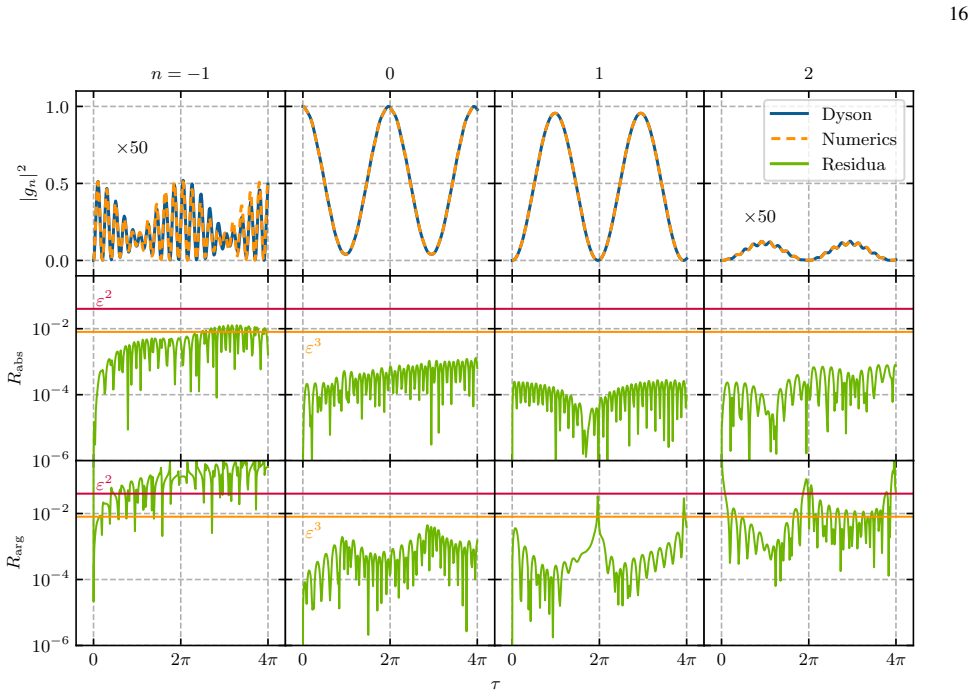
Comparison to Numerical Model To validate the perturbative results shown in Fig. 5, we compare them with a numerical model. We consider reso- nant first-order Bragg diffraction and truncate the system to six momentum classes𝑛=−2,−1,0,1,2,3 . This extended truncation verifies that the four-class description used in the perturbative treatment is sufficient ...
-
[5]
Dyson in Suitable Picture We consider resonant first-order Bragg diffraction between four momentum classes𝑛=−1,0,1,2 , which is described by the Hamiltonian given in Eq. (2) ˆ𝐻= ℏ𝜔 𝑘 ∑︁ 𝑚,𝑛 ∫ 𝐼𝑘 d𝑞 ˆΨ† 𝑚H𝑚𝑛 ˆΨ𝑛.(A1) We regard the coupling to the adjacent classes𝑛=−1,2 as a perturbation and write the dimensionless Hamiltonian as H=H 0 +𝜀V,(A2) where H0 = 1...
-
[6]
Solution for fist-order Bragg Diffraction Here, we list the solution for resonant first-order Bragg diffraction. In the Heisenberg picture the time evolution of the 15 main momentum classes𝑛=0,1takes the form ˆΨ𝑚,H (𝑞, 𝜆) |𝜓 in⟩= 1∑︁ 𝑛=0 𝐺 𝑚𝑛 ˆΨ𝑛 (𝑞,0) |𝜓 in⟩,(A11a) where𝑚=0,1and 𝐺(𝑞, 𝜏, 𝜃)= 𝑇 𝑅 ˜𝑅 ˜𝑇 = ˜𝑡˜𝑟 −˜𝑟∗ ˜𝑡∗ 𝛾00 𝛾01 𝛾10 𝛾11 (A11b) is given up to ...
- [7]
-
[8]
A.Herbst,T.Estrampes,H.Albers,V.Vollenkemper,K.Stolzen- berg,S.Bode,E.Charron,E.M.Rasel,N.Gaaloul,andD.Schlip- pert, High-flux source system for matter-wave interferometry exploitingtunableinteractions,Phys.Rev.Res.6,013139(2024)
work page 2024
- [9]
-
[10]
M. Schilling, É. Wodey, L. Timmen, D. Tell, K. H. Zipfel, D. Schlippert, C. Schubert, E. M. Rasel, and J. Müller, Gravity field modelling for the hannover 10 m atom interferometer, J. Geod.94, 122 (2020)
work page 2020
-
[11]
L. Zhou, Z. Y. Xiong, W. Yang, B. Tang, W. C. Peng, K. Hao, R. B. Li, M. Liu, J. Wang, and M. S. Zhan, Development of an atom gravimeter and status of the 10-meter atom interferometer forprecisiongravitymeasurement,Gen.RelativGravit.43,1931 (2011)
work page 1931
-
[12]
T. Kovachy, P. Asenbaum, C. Overstreet, C. A. Donnelly, S. M. Dickerson, A. Sugarbaker, J. M. Hogan, and M. A. Kasevich, Quantum superposition at the half-metre scale, Nature528, 530 (2015)
work page 2015
-
[13]
H. Müntinga, H. Ahlers, M. Krutzik, A. Wenzlawski, S. Arnold, D. Becker, K. Bongs, H. Dittus, H. Duncker, N. Gaaloul,et al., Interferometry with Bose-Einstein Condensates in Microgravity, Phys. Rev. Lett.110, 093602 (2013)
work page 2013
-
[14]
M. D. Lachmann, H. Ahlers, D. Becker, A. N. Dinkelaker, J. Grosse, O. Hellmig, H. Müntinga, V. Schkolnik, S. T. Seidel, T. Wendrich,et al., Ultracold atom interferometry in space, Nat. Commun.12, 1317 (2021)
work page 2021
-
[15]
E. R. Elliott, D. C. Aveline, N. P. Bigelow, P. Boegel, S. Botsi, E. Charron, J. P. D’Incao, P. Engels, T. Estrampes, N. Gaaloul, J. R. Kellogg, J. M. Kohel, N. E. Lay, N. Lundblad, M. Meister, M. E. Mossman, G. Müller, H. Müller, K. Oudrhiri, L. E. Phillips, A. Pichery, E. M. Rasel, C. A. Sackett, M. Sbroscia, W.P.Schleich,R.J.Thompson,andJ.R.Williams,Qu...
work page 2023
-
[16]
J.R.Williams,C.A.Sackett,H.Ahlers,D.C.Aveline,P.Boegel, S.Botsi, E.Charron, E.R.Elliott, N.Gaaloul, E.Giese, W.Herr, J. R. Kellogg, J. M. Kohel, N. E. Lay, M. Meister, G. Müller, H. Müller, K. Oudrhiri, L. Phillips, A. Pichery, E. M. Rasel, A.Roura,M.Sbroscia,W.P.Schleich,C.Schneider,C.Schubert, B. Sen, R. J. Thompson, and N. P. Bigelow, Pathfinder experi...
work page 2024
-
[17]
B. Barrett, L. Antoni-Micollier, L. Chichet, B. Battelier, T. Lévèque, A. Landragin, and P. Bouyer, Dual matter-wave iner- tial sensors in weightlessness, Nat. Commun.7, 13786 (2016)
work page 2016
-
[18]
J. M. McGuirk, M. J. Snadden, and M. A. Kasevich, Large AreaLight-PulseAtomInterferometry,Phys.Rev.Lett.85,4498 (2000)
work page 2000
-
[19]
H. Müller, S.-W. Chiow, Q. Long, S. Herrmann, and S. Chu, Atom Interferometry with up to 24-Photon-Momentum-Transfer Beam Splitters, Phys. Rev. Lett.100, 180405 (2008)
work page 2008
- [20]
-
[21]
J. Rudolph, T. Wilkason, M. Nantel, H. Swan, C. M. Holland, Y. Jiang, B. E. Garber, S. P. Carman, and J. M. Hogan, Large Momentum Transfer Clock Atom Interferometry on the 689 nm Intercombination Line of Strontium, Phys. Rev. Lett.124, 083604 (2020)
work page 2020
-
[22]
M. Gebbe, J.-N. Siemß, M. Gersemann, H. Müntinga, S. Her- rmann, C. Lämmerzahl, H. Ahlers, N. Gaaloul, C. Schubert, K. Hammerer, S. Abend, and E. M. Rasel, Twin-lattice atom interferometry, Nat. Commun.12, 2544 (2021)
work page 2021
-
[23]
L.Pezzè,A.Smerzi,M.K.Oberthaler,R.Schmied,andP.Treut- lein, Quantum metrology with nonclassical states of atomic ensembles, Rev. Mod. Phys.90, 035005 (2018)
work page 2018
-
[24]
S. S. Szigeti, O. Hosten, and S. A. Haine, Improving cold-atom sensors with quantum entanglement: Prospects and challenges, Appl. Phys. Lett.118, 140501 (2021)
work page 2021
-
[25]
F. Fitzek, J.-N. Kirsten-Siemß, E. M. Rasel, N. Gaaloul, and K.Hammerer,AccurateandefficientBloch-oscillation-enhanced atom interferometry, Phys. Rev. Res.6, L032028 (2024)
work page 2024
-
[26]
R. H. Parker, C. Yu, W. Zhong, B. Estey, and H. Müller, Mea- surement of the fine-structure constant as a test of the Standard Model, Science360, 191 (2018). 18
work page 2018
-
[27]
T.Kovachy, J.M.Hogan, D.M.S.Johnson,andM.A.Kasevich, Optical lattices as waveguides and beam splitters for atom inter- ferometry: An analytical treatment and proposal of applications, Phys. Rev. A82, 013638 (2010)
work page 2010
-
[28]
Cladé, Bloch oscillations in atom interferometry, Riv
P. Cladé, Bloch oscillations in atom interferometry, Riv. Nuovo Cim.38, 173 (2015)
work page 2015
- [29]
-
[30]
P. J. Martin, B. G. Oldaker, A. H. Miklich, and D. E. Pritchard, Bragg scattering of atoms from a standing light wave, Phys. Rev. Lett.60, 515 (1988)
work page 1988
-
[31]
T. Mazzoni, X. Zhang, R. Del Aguila, L. Salvi, N. Poli, and G. M. Tino, Large-momentum-transfer Bragg interferometer with strontium atoms, Phys. Rev. A92, 053619 (2015)
work page 2015
-
[32]
E.Giese,A.Roura,G.Tackmann,E.M.Rasel,andW.P.Schleich, Double Bragg diffraction: A tool for atom optics, Phys. Rev. A 88, 053608 (2013)
work page 2013
-
[33]
H. Müller, S.-W. Chiow, and S. Chu, Atom-wave diffraction between the Raman-Nath and the Bragg regime: Effective Rabi frequency, losses, and phase shifts, Phys. Rev. A77, 023609 (2008)
work page 2008
- [34]
-
[35]
J. Jenewein, S. Hartmann, A. Roura, and E. Giese, Bragg- diffraction-induced imperfections of the signal in retroreflective atom interferometers, Phys. Rev. A105, 063316 (2022)
work page 2022
-
[36]
D. Pfeiffer, M. Dietrich, P. Schach, G. Birkl, and E. Giese, Dichroic mirror pulses for optimized higher-order atomic Bragg diffraction, Phys. Rev. Res.7, L012028 (2025)
work page 2025
-
[37]
Y. Wang, J. Glick, T. Deshpande, K. DeRose, S. Saraf, N. Sachdeva, K. Jiang, Z. Chen, and T. Kovachy, Robust Quan- tum Control via Multipath Interference for Thousandfold Phase Amplification in a Resonant Atom Interferometer, Phys. Rev. Lett.133, 243403 (2024)
work page 2024
-
[38]
B. Fang, N. Mielec, D. Savoie, M. Altorio, A. Landragin, and R. Geiger, Improving the phase response ofan atom interferome- terbymeansoftemporalpulseshaping,NewJ.Phys.20,023020 (2018)
work page 2018
-
[39]
T. Wilkason, M. Nantel, J. Rudolph, Y. Jiang, B. E. Garber, H. Swan, S. P. Carman, M. Abe, and J. M. Hogan, Atom Interferometry with Floquet Atom Optics, Phys. Rev. Lett.129, 183202 (2022)
work page 2022
-
[40]
T. Rodzinka, E. Dionis, L. Calmels, S. Beldjoudi, A. Béguin, D. Guéry-Odelin, B. Allard, D. Sugny, and A. Gauguet, Optimal Floquet state engineering for large scale atom interferometers, Nat. Commun.15, 10281 (2024)
work page 2024
-
[41]
J. C. Saywell, M.S. Carey, P. S. Light, S. S. Szigeti, A.R. Milne, K. S. Gill, M. L. Goh, V. S. Perunicic, N. M. Wilson, C. D. Macrae,et al., Enhancing the sensitivity of atom-interferometric inertial sensors using robust control, Nat. Commun.14, 7626 (2023)
work page 2023
-
[42]
S.S.Szigeti,J.E.Debs,J.J.Hope,N.P.Robins,andJ.D.Close, Why momentum width matters for atom interferometry with Bragg pulses, New J. Phys.14, 023009 (2012)
work page 2012
-
[43]
J. Günther, J.-N. Kirsten-Siemß, N. Gaaloul, and K. Hammerer, Squeezing Enhancement in Lossy Multi-Path Atom Interferome- ters, arXiv:2409.04091 (2024)
work page internal anchor Pith review arXiv 2024
-
[44]
J. Goldsmith, J. Hope, and S. Haine, Effects of systematic error on quantum-enhanced atom interferometry, Phys. Rev. A111, 052608 (2025)
work page 2025
-
[45]
M. Kitagawa and M. Ueda, Squeezed spin states, Phys. Rev. A 47, 5138 (1993)
work page 1993
- [46]
-
[47]
M. F. Riedel, P. Böhi, Y. Li, T. W. Hänsch, A. Sinatra, and P. Treutlein, Atom-chip-based generation of entanglement for quantum metrology, Nature464, 1170 (2010)
work page 2010
-
[48]
S. S. Szigeti, S. P. Nolan, J. D. Close, and S. A. Haine, High- Precision Quantum-Enhanced Gravimetry with a Bose-Einstein Condensate, Phys. Rev. Lett.125, 100402 (2020)
work page 2020
-
[49]
Z. Zhang and L.-M. Duan, Generation of Massive Entanglement through an Adiabatic Quantum Phase Transition in a Spinor Condensate, Phys. Rev. Lett.111, 180401 (2013)
work page 2013
- [50]
-
[51]
K.Lange,J.Peise,B.Lücke,I.Kruse,G.Vitagliano,I.Apellaniz, M. Kleinmann, G. Tóth, and C. Klempt, Entanglement between two spatially separated atomic modes, Science360, 416 (2018)
work page 2018
-
[52]
I. D. Leroux, M. H. Schleier-Smith, and V. Vuletić, Implementa- tion of Cavity Squeezing of a Collective Atomic Spin, Phys. Rev. Lett.104, 073602 (2010)
work page 2010
-
[53]
A. Shankar, L. Salvi, M. L. Chiofalo, N. Poli, and M. J. Holland, Squeezed state metrology with Bragg interferometers operating in a cavity, Quantum Sci. Technol.4, 045010 (2019)
work page 2019
-
[54]
J. D. Wilson, J. T. Reilly, H. Zhang, C. Luo, A. Chu, J. K. Thompson, A. M. Rey, and M. J. Holland, Entangled matter wavesforquantumenhancedsensing,Phys.Rev.A110,L041301 (2024)
work page 2024
-
[55]
C. Luo, H. Zhang, A. Chu, C. Maruko, A. M. Rey, and J. K. Thompson, Hamiltonian engineering of collective XYZ spin models in an optical cavity, Nat. Phys.21, 916 (2025)
work page 2025
-
[56]
V. Srivastava, S. Jandura, G. K. Brennen, and G. Pupillo, Entanglement-Enhanced Quantum Sensing via Optimal Global Control with Neutral Atoms in a Cavity, Phys. Rev. Lett.136, 060806 (2026)
work page 2026
-
[57]
G. P. Greve, C. Luo, B. Wu, and J. K. Thompson, Entanglement- Enhanced Matter-Wave Interferometry in a High-Finesse Cavity, Nature610, 472 (2022)
work page 2022
-
[58]
B. K. Malia, Y. Wu, J. Martínez-Rincón, and M. A. Kasevich, Distributedquantumsensingwithmode-entangledspin-squeezed atomic states, Nature612, 661 (2022)
work page 2022
- [59]
- [60]
-
[61]
C. Cassens, B. Meyer-Hoppe, E. Rasel, and C. Klempt, Entanglement-Enhanced Atomic Gravimeter, Phys. Rev. X15, 011029 (2025)
work page 2025
-
[62]
R. Corgier, N. Gaaloul, A. Smerzi, and L. Pezzè, Delta-Kick Squeezing, Phys. Rev. Lett.127, 183401 (2021)
work page 2021
- [63]
-
[64]
S. Iso, H. Ohta, and T. Suyama, Secular terms in Dyson series to allordersofperturbation,Prog.Theor.Exp.Phys.2018,083A01 (2018)
work page 2018
-
[65]
M. Sanz, E. Solano, and I. L. Egusquiza, Beyond adiabatic elimination: Effective Hamiltonians and singular perturbation, inApplications + Practical Conceptualization + Mathematics 19 = fruitful Innovation, edited by R. S. Anderssenet al.(Springer Japan, Tokyo, 2016) p. 127
work page 2016
-
[66]
A. Bott, F. Di Pumpo, and E. Giese, Atomic diffraction from single-photon transitions in gravity and standard-model exten- sions, AVS Quantum Sci.5, 044402 (2023)
work page 2023
-
[67]
Giese, Mechanisms of matter-wave diffraction and their appli- cation to interferometers, Fortschr
E. Giese, Mechanisms of matter-wave diffraction and their appli- cation to interferometers, Fortschr. Phys.63, 337 (2015)
work page 2015
-
[68]
S. Hartmann, N. Momčilović, and A. Friedrich, Multi- Photon Quantum Rabi Models with Center-of-Mass Motion, arXiv:2507.04829 (2025)
-
[69]
Up to a global phase, the Heisenberg- and interaction-picture fieldoperatorsdifferonlybyaphasefactor,namely ˆΨ𝑛,H (𝑞, 𝜆)= exp[(−1) 𝑛Δ𝜔𝑡/2] ˆΨ𝑛 (𝑞, 𝜆)
-
[70]
P. Feldmann, F. Anders, A. Idel, C. Schubert, D. Schlippert, L. Santos, E. M. Rasel, and C. Klempt, Optimal squeezing for high-precision atom interferometers, arXiv:2311.10241 (2023)
-
[71]
Schwinger,On Angular Momentum, Dover Books on Physics (Dover Publications, 2015)
J. Schwinger,On Angular Momentum, Dover Books on Physics (Dover Publications, 2015)
work page 2015
-
[72]
J.-N. Kirsten-Siemß, F. Fitzek, C. Schubert, E. M. Rasel, N.Gaaloul,andK.Hammerer,Large-Momentum-TransferAtom Interferometers with𝜇rad-Accuracy Using Bragg Diffraction, Phys. Rev. Lett.131, 033602 (2023)
work page 2023
-
[73]
In our perturbative treatment, the matrix elements contain𝜀- dependent amplitudes as well as trigonometric functions with 𝜀-dependentfrequencies.Toobtainthematrixelementstosecond- order accuracy in𝜀, we apply power counting to the amplitudes and only keep terms up to second order in𝜀, while preserving trigonometric functions, as they do not contribute to ...
-
[74]
W. P. Schleich, D. M. Greenberger, and E. M. Rasel, A representation-free description of the Kasevich–Chu interfer- ometer: a resolution of the redshift controversy, New J. Phys.15, 013007 (2013)
work page 2013
-
[75]
N. Funai and E. Martín-Martínez, Faster-than-light signaling in the rotating-wave approximation, Phys. Rev. D100, 065021 (2019)
work page 2019
-
[76]
F. T. Arecchi, E. Courtens, R. Gilmore, and H. Thomas, Atomic CoherentStatesinQuantumOptics,Phys.Rev.A6,2211(1972)
work page 1972
-
[77]
G. S. Agarwal, Relation between atomic coherent-state represen- tation, state multipoles, and generalized phase-space distribu- tions, Phys. Rev. A24, 2889 (1981)
work page 1981
-
[78]
J. P. Dowling, G. S. Agarwal, and W. P. Schleich, Wigner distribution of a general angular-momentum state: Applications to a collection of two-level atoms, Phys. Rev. A49, 4101 (1994)
work page 1994
-
[79]
A.Sørensen,L.-M.Duan,J.I.Cirac,andP.Zoller,Many-particle entanglement with Bose–Einstein condensates, Nature409, 63 (2001)
work page 2001
-
[80]
D. J. Wineland, J. J. Bollinger, W. M. Itano, F. L. Moore, and D. J. Heinzen, Spin squeezing and reduced quantum noise in spectroscopy, Phys. Rev. A46, R6797 (1992)
work page 1992
discussion (0)
Sign in with ORCID, Apple, or X to comment. Anyone can read and Pith papers without signing in.