Solving forward and inverse wave scattering via boundary integral equations and deep learning. Applications to cloaking design
Pith reviewed 2026-05-22 07:11 UTC · model grok-4.3
The pith
Object-fitted layered cloaks reduce wave scattering more effectively than circular designs for irregular objects
A machine-rendered reading of the paper's core claim, the machinery that carries it, and where it could break.
Core claim
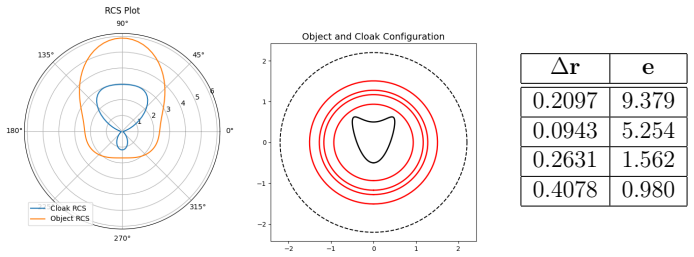
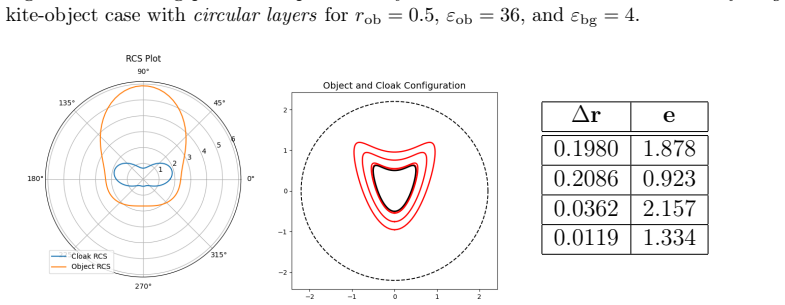
The authors demonstrate through encoder-decoder networks trained on boundary element solutions that object-fitted concentric layered cloaks, parameterized uniformly by layer thicknesses, consistently outperform circular-layer designs in scattering reduction for circular, star-shaped, and kite-shaped objects under Helmholtz wave propagation.
What carries the argument
Encoder-decoder neural network trained on geometry-specific datasets of layer thickness parameters and corresponding scattering responses obtained from boundary element method solutions.
Load-bearing premise
The boundary element method solutions used to generate training data accurately represent the true scattering behavior for the chosen geometries and material parameters without significant discretization or modeling errors.
What would settle it
An independent numerical computation of the scattering cross-section for a star-shaped object with both circular and object-fitted layers using a different solver such as finite elements, showing no consistent advantage for the fitted configuration.
Figures


read the original abstract
We propose a deep learning framework based on an encoder-decoder architecture for the design and evaluation of cloaking devices, demonstrated in this work for two-dimensional wave propagation governed by the Helmholtz equation. The cloaks under consideration are concentric layered media surrounding the object, whose geometry and material parameters determine the scattering response. We consider circular and object-fitted layer configurations and parameterize all designs by the layer thicknesses, enabling a unified representation for direct comparison of different cloaks for the same object. Training data are generated using a boundary element formulation suitable for geometries where analytic solutions are not available, and neural networks are trained with standard hyperparameters on geometry-specific datasets. The proposed approach is applied to circular, star-shaped, and kite-shaped objects. Results show that object-fitted configurations consistently outperform simpler circular-layer designs in scattering reduction, highlighting the importance of geometry in cloaking performance. Overall, we present a flexible, data-driven approach for systematic comparison of cloaking strategies, with potential extension to more complex geometries and broadband settings.
Editorial analysis
A structured set of objections, weighed in public.
Referee Report
Summary. The manuscript proposes a deep learning framework based on an encoder-decoder architecture to design and evaluate cloaking devices for two-dimensional Helmholtz wave scattering. Training data are generated via a boundary element method (BEM) formulation for circular, star-shaped, and kite-shaped objects; neural networks are trained on geometry-specific datasets to predict scattering responses. All cloaks are parameterized uniformly by layer thicknesses, enabling direct comparison between concentric circular-layer designs and object-fitted layer configurations. The central result is that object-fitted configurations consistently outperform circular-layer designs in scattering reduction for the tested objects.
Significance. If the central comparison holds after addressing validation concerns, the work provides a flexible, data-driven methodology for systematic evaluation of cloaking strategies across irregular geometries where analytic solutions are unavailable. The unified thickness-based parameterization and geometry-specific training are strengths that facilitate reproducible comparisons; the approach has clear potential for extension to broadband or three-dimensional settings.
major comments (2)
- [Section 3] Section 3 (BEM data generation): No validation of the BEM solver against analytic Mie-series solutions is reported for the circular-object case, even though such references exist and the abstract notes BEM is used 'where analytic solutions are not available.' Without this cross-check, it remains possible that discretization or quadrature errors differ systematically between smooth circular boundaries and the non-smooth star/kite geometries, which would undermine the claim that object-fitted layers outperform circular ones.
- [Section 4.2 and Table 2] Section 4.2 and Table 2: The reported scattering-reduction metrics for object-fitted vs. circular configurations lack error bars or convergence studies with respect to BEM mesh density or NN training-set size. This makes it difficult to assess whether the observed outperformance is statistically robust or sensitive to the particular discretization choices.
minor comments (2)
- [Figure 3] Figure 3: The color scale for the scattered-field plots is not labeled with units or normalized range, making quantitative comparison between panels difficult.
- Notation: The symbol for layer thickness is introduced inconsistently (sometimes t_i, sometimes d_i) across the methods and results sections; a single consistent symbol would improve readability.
Simulated Author's Rebuttal
We thank the referee for the careful reading and constructive feedback on our manuscript. We address each major comment below and have incorporated revisions to strengthen the validation and robustness analysis in the next version of the paper.
read point-by-point responses
-
Referee: [Section 3] Section 3 (BEM data generation): No validation of the BEM solver against analytic Mie-series solutions is reported for the circular-object case, even though such references exist and the abstract notes BEM is used 'where analytic solutions are not available.' Without this cross-check, it remains possible that discretization or quadrature errors differ systematically between smooth circular boundaries and the non-smooth star/kite geometries, which would undermine the claim that object-fitted layers outperform circular ones.
Authors: We agree that explicit validation of the BEM solver on the circular geometry would increase confidence in the results for non-circular objects. Although the abstract highlights BEM for cases without analytic solutions, we recognize the value of this cross-check. In the revised manuscript we have added a new paragraph and accompanying figure in Section 3 that directly compares BEM-computed scattering cross-sections with the analytic Mie-series solution for the circular object under several layer-thickness configurations. The relative difference remains below 0.5 % for the mesh parameters used throughout the study, confirming that discretization errors do not introduce systematic bias that would favor one cloak geometry over the other. revision: yes
-
Referee: [Section 4.2 and Table 2] Section 4.2 and Table 2: The reported scattering-reduction metrics for object-fitted vs. circular configurations lack error bars or convergence studies with respect to BEM mesh density or NN training-set size. This makes it difficult to assess whether the observed outperformance is statistically robust or sensitive to the particular discretization choices.
Authors: We acknowledge that the lack of quantitative uncertainty measures limits the ability to judge statistical robustness. In the revised manuscript we have updated Table 2 to include error bars given by the standard deviation across five independent neural-network training runs that differ only in random seed. We have also added a short convergence subsection in Section 4.2 that reports the change in scattering-reduction values when the BEM mesh density is doubled for a representative circular-object case; the metrics vary by less than 2 %, indicating that the reported outperformance of object-fitted layers is stable with respect to the discretization choices employed. revision: yes
Circularity Check
No significant circularity; derivation relies on independent BEM data generation
full rationale
The paper generates training data via boundary element method for circular, star-shaped, and kite-shaped objects, then trains encoder-decoder networks on geometry-specific datasets to predict scattering responses from layer thicknesses. The central comparison—that object-fitted configurations outperform circular-layer designs—is obtained by evaluating the trained networks on both parameterization types using the same externally generated BEM data. No step reduces a claimed prediction to a fitted parameter or self-citation by construction; the BEM solver is treated as an independent forward model, and the neural network approximates rather than tautologically reproduces its inputs. The derivation chain is therefore self-contained against external benchmarks.
Axiom & Free-Parameter Ledger
axioms (2)
- domain assumption The 2D Helmholtz equation governs the wave propagation in the layered media.
- domain assumption Boundary element method provides sufficiently accurate forward solutions for training data generation.
Lean theorems connected to this paper
-
IndisputableMonolith/Cost/FunctionalEquation.leanwashburn_uniqueness_aczel unclear?
unclearRelation between the paper passage and the cited Recognition theorem.
Training data are generated using a boundary element formulation suitable for geometries where analytic solutions are not available, and neural networks are trained with standard hyperparameters on geometry-specific datasets.
-
IndisputableMonolith/Foundation/AlexanderDuality.leanalexander_duality_circle_linking unclear?
unclearRelation between the paper passage and the cited Recognition theorem.
We consider circular and object-fitted layer configurations and parameterize all designs by the layer thicknesses
What do these tags mean?
- matches
- The paper's claim is directly supported by a theorem in the formal canon.
- supports
- The theorem supports part of the paper's argument, but the paper may add assumptions or extra steps.
- extends
- The paper goes beyond the formal theorem; the theorem is a base layer rather than the whole result.
- uses
- The paper appears to rely on the theorem as machinery.
- contradicts
- The paper's claim conflicts with a theorem or certificate in the canon.
- unclear
- Pith found a possible connection, but the passage is too broad, indirect, or ambiguous to say the theorem truly supports the claim.
Reference graph
Works this paper leans on
-
[1]
K.-T.Lee, C.Ji, H.Iizuka, D.Banerjee, Opticalcloakingandinvisibility: From fiction toward a technological reality 129 (23) 231101.doi:10. 1063/5.0048846
-
[2]
M. Cassier, T. DeGiovanni, S. Guenneau, F. G. Vasquez, Active exterior cloaking for the 2d helmholtz equation with complex wavenumbers and application to thermal cloaking (2022).arXiv:2203.02075. URLhttps://arxiv.org/abs/2203.02075
-
[3]
J. B. Pendry, D. Schurig, D. R. Smith, Controlling Electromagnetic Fields 312 (5781) 1780–1782.doi:10.1126/science.1125907
-
[4]
A. Alù, N. Engheta, Achieving transparency with plasmonic and meta- material coatings, Physical Review E 72 (1) (2005) 016623.doi: 10.1103/PhysRevE.72.016623
-
[5]
W. Cai, U. K. Chettiar, A. V. Kildishev, V. M. Shalaev, Optical cloaking with metamaterials 1 (4) 224–227.doi:10.1038/nphoton.2007.28
-
[6]
M. Schweiger, S. R. Arridge, The finite-element method for the prop- agation of light in scattering media: Frequency domain case, Medical Physics 24 (6) (1997) 895–902.doi:10.1118/1.598008
-
[7]
J. L. Volakis, A. Chatterjee, L. C. Kempel, Review of the finite-element method for three-dimensional electromagnetic scattering, J. Opt. Soc. Am. A 11 (4) (1994) 1422–1433.doi:10.1364/JOSAA.11.001422. 31
-
[8]
M. Frehner, S. M. Schmalholz, E. H. Saenger, H. Steeb, Compari- son of finite difference and finite element methods for simulating two- dimensional scattering of elastic waves, Physics of the Earth and Plane- tary Interiors 171 (1) (2008) 112–121.doi:10.1016/j.pepi.2008.07. 003
-
[9]
M. Bonnet, Boundary Integral Equation Methods for Solids and Fluids 34 (4) 301–302.doi:10.1023/A:1004795120236
-
[10]
Y. Liu, On the BEM for acoustic wave problems, Engineering Anal- ysis with Boundary Elements 107 (2019) 53–62.doi:10.1016/j. enganabound.2019.07.002
work page doi:10.1016/j 2019
-
[11]
A. H. Barnett, Evaluation of Layer Potentials Close to the Boundary for Laplace and Helmholtz Problems on Analytic Planar Domains, SIAM J. Sci. Comput. 36 (2) (2014) A427–A451, publisher: Society for Industrial and Applied Mathematics. URLhttps://doi.org/10.1137/120900253
- [12]
-
[13]
Z. Liu, D. Zhu, S. P. Rodrigues, K.-T. Lee, W. Cai, Generative Model for the Inverse Design of Metasurfaces 18 (10) 6570–6576.doi:10.1021/ acs.nanolett.8b03171
-
[14]
W. Ma, F. Cheng, Y. Liu, Deep-Learning-Enabled On-Demand De- sign of Chiral Metamaterials 12 (6) 6326–6334.doi:10.1021/acsnano. 8b03569
-
[15]
W. Ma, F. Cheng, Y. Xu, Q. Wen, Y. Liu, Probabilistic Representation and Inverse Design of Metamaterials Based on a Deep Generative Model withSemi-SupervisedLearningStrategy31(35)1901111.doi:10.1002/ adma.201901111
-
[16]
G. Cerniauskas, H. Sadia, P. Alam, Machine intelligence in metama- terials design: A review, Oxford Open Materials Science 4 (1) (2024) itae001.arXiv:https://academic.oup.com/ooms/article-pdf/4/1/ itae001/56750204/itae001.pdf,doi:10.1093/oxfmat/itae001. 32
- [17]
-
[18]
D. Liu, Y. Tan, E. Khoram, Z. Yu, Training Deep Neural Networks for the Inverse Design of Nanophotonic Structures 5 (4) 1365–1369.doi: 10.1021/acsphotonics.7b01377
-
[19]
Y. Kiarashinejad, S. Abdollahramezani, A. Adibi, Deep learning ap- proach based on dimensionality reduction for designing electromagnetic nanostructures 6 (1) 12.doi:10.1038/s41524-020-0276-y
-
[20]
W. W. Ahmed, M. Farhat, X. Zhang, Y. Wu, Deterministic and probabilistic deep learning models for inverse design of broadband acoustic cloak, Phys. Rev. Res. 3 (2021) 013142.doi:10.1103/ PhysRevResearch.3.013142
work page 2021
-
[21]
J.-W. Ra, Problems in inverse scattering-illposedness, resolution, local minima, and uniquenesse, Communications of the Korean Mathematical Society 16 (3) (2001) 445–458
work page 2001
-
[22]
R.-T. Wu, M. Jokar, M. R. Jahanshahi, F. Semperlotti, A physics- constrained deep learning based approach for acoustic inverse scattering problems 164 108190.doi:10.1016/j.ymssp.2021.108190
-
[23]
M. Lee, GELU Activation Function in Deep Learning: A Comprehensive Mathematical Analysis and Performance.arXiv:2305.12073,doi:10. 48550/arXiv.2305.12073
-
[24]
T. Song, Comparative Analysis of Activation Functions in Simple Con- volutional Neural Networks, in: 2024 IEEE 6th International Conference on Civil Aviation Safety and Information Technology (ICCASIT), pp. 1031–1036.doi:10.1109/ICCASIT62299.2024.10827900
-
[25]
S. R. Dubey, S. K. Singh, B. B. Chaudhuri, Activation Functions in Deep Learning: A Comprehensive Survey andBenchmark.arXiv:2109. 14545,doi:10.48550/arXiv.2109.14545. 33
-
[26]
R. Maurya, D. Aggarwal, T. Gopalakrishnan, N. N. Pandey, Enhancing Deep Neural Network Convergence and Performance: A Hybrid Activa- tion Function Approach by Combining ReLU and ELU Activation Func- tion, in: 2023 Second International Conference on Informatics (ICI), pp. 1–5.doi:10.1109/ICI60088.2023.10421353
-
[27]
R. Kress, Boundary integral equations in time-harmonic acoustic scat- tering, Mathematical and Computer Modelling 15 (3) (1991) 229–243. URLhttps://doi.org/10.1016/0895-7177(91)90068-I
-
[28]
C. Carvalho, S. Chaillat, E. Cortes, C. Tsogka, Discretization in Mul- tilayered Media with High Contrasts: Is It All About the Boundaries? (Feb. 2026).arXiv:2602.18629
-
[29]
A. Klöckner, A. Barnett, L. Greengard, M. O’Neil, Quadrature by ex- pansion: A new method for the evaluation of layer potentials, Journal of Computational Physics 252 (2013) 332–349.doi:10.1016/j.jcp. 2013.06.027
-
[30]
C. Carvalho, S. Khatri, A. D. Kim, Asymptotic approximations for the close evaluation of double-layer potentials, SIAM Journal on Scientific Computing 42 (1) (2020) A504–A533.doi:10.1137/18M1218698
-
[31]
C. Pérez-Arancibia, C. Turc, L. Faria, Planewave density interpolation methods for 3d helmholtz boundary integral equations, SIAM Journal on Scientific Computing 41 (4) (2019) A2088–A2116.doi:10.1137/ 19M1239866
work page 2019
-
[32]
E. A. Cortes, C. Carvalho, S. Chaillat, C. Tsogka, Fast and accurate boundary integral equation methods for the multi-layer transmission problem, in: WAVES2024-The16thInternationalConferenceonMath- ematical and Numerical Aspects of Wave Propagation, Edmond, Berlin, Germany, 2024.doi:10.17617/3.MBE4AA
-
[33]
Q. Sun, E. Klaseboer, B.-C. Khoo, D. Y. C. Chan, Boundary regularized integral equation formulation of the Helmholtz equation in acoustics, Royal Society Open Science 2 (1) (2015) 140520
work page 2015
-
[34]
M. Yan, W. Yan, M. Qiu, Invisibility Cloaking by Coordinate Trans- formation, in: Progress in Optics, Vol. 52, Elsevier, 2009, pp. 261–304. doi:10.1016/S0079-6638(08)00006-1. 34
discussion (0)
Sign in with ORCID, Apple, or X to comment. Anyone can read and Pith papers without signing in.