Spin torque driven mode hybridization and band engineering in nanopatterned magnonic crystals
Pith reviewed 2026-05-22 04:49 UTC · model grok-4.3
The pith
Inhomogeneous spin torque from applied current modulates magnonic frequency to enable tunable mode hybridization in nanopatterned crystals.
A machine-rendered reading of the paper's core claim, the machinery that carries it, and where it could break.
Core claim
Using the plane wave method and the linearised Landau-Lifshitz equation with a field like torque term, we show that inhomogeneous current induced spin torque produces periodic modulation of the magnonic frequency, enabling dynamic control of spin-wave dispersion. A pronounced avoided crossing between localised and propagating Damon Eshbach modes is observed, leading to tunable hybridisation gaps, band deformation, and enhanced mode mixing. The spin torque induced modulation enables controlled mode conversion and reconfigurable hybrid magnonic states, demonstrating efficient electrical tuning of nanoscale spin-wave dynamics.
What carries the argument
The inhomogeneous current-induced spin torque acting as a periodic modulator of the magnonic frequency in the bicomponent nanopatterned structure.
If this is right
- Variation of the applied current allows tuning of the hybridization gaps between spin-wave modes.
- Band deformation and enhanced mode mixing become controllable through electrical means.
- Reconfigurable hybrid magnonic states can be achieved for mode conversion.
- Dynamic control of spin-wave dispersion supports reconfigurable magnonic devices.
Where Pith is reading between the lines
- This mechanism could be extended to other current-driven magnonic systems for broader band engineering applications.
- Integration with existing spintronic components might lead to hybrid devices combining spin torque and magnonics.
- Experimental fabrication of similar nanopatterned structures and measurement of the spin-wave spectrum under bias would test the predictions.
Load-bearing premise
The plane wave method combined with the linearised Landau-Lifshitz equation including a field-like torque term accurately captures the spin dynamics and inhomogeneity created by the nanopatterned bicomponent structure.
What would settle it
Measuring the spin-wave dispersion relation in the fabricated device under varying current and checking for the presence or absence of an avoided crossing between the localized and propagating modes.
Figures


read the original abstract
Spin wave propagation and dynamic control are essential for reconfigurable magnonic and spintronic devices. Here, tunable mode coupling and band hybridisation are demonstrated in a nanopatterned bicomponent magnonic crystal consisting of a Permalloy/heavy metal bilayer patterned with a two dimensional array of Co nanodots. Using the plane wave method and the linearised Landau Lifshitz equation with a field like torque term, we show that inhomogeneous current induced spin torque produces periodic modulation of the magnonic frequency, enabling dynamic control of spin-wave dispersion. A pronounced avoided crossing between localised and propagating Damon Eshbach modes is observed, leading to tunable hybridisation gaps, band deformation, and enhanced mode mixing. The spin torque induced modulation enables controlled mode conversion and reconfigurable hybrid magnonic states, demonstrating efficient electrical tuning of nanoscale spin-wave dynamics.
Editorial analysis
A structured set of objections, weighed in public.
Referee Report
Summary. The manuscript investigates dynamic control of spin-wave dispersion in a bicomponent nanopatterned magnonic crystal consisting of a Permalloy/heavy-metal bilayer patterned with a 2D array of Co nanodots. Employing the plane-wave method to solve the linearized Landau-Lifshitz equation augmented by a field-like torque term, the authors claim that inhomogeneous current-induced spin torque produces a periodic modulation of the magnonic frequency. This modulation is shown to induce a pronounced avoided crossing between localized and propagating Damon-Eshbach modes, resulting in tunable hybridization gaps, band deformation, and enhanced mode mixing for reconfigurable magnonic applications.
Significance. If the numerical results hold, the work demonstrates an electrically tunable mechanism for mode hybridization and band engineering in magnonic crystals that does not require structural reconfiguration. This could be relevant for reconfigurable magnonic and spintronic devices, extending standard static magnonic-crystal concepts by incorporating active spin-torque modulation.
major comments (2)
- [Methods / plane-wave expansion] Methods (plane-wave implementation): The central claim rests on the plane-wave solution of the linearized LL equation with an added field-like torque term accurately capturing the hybridization gap. For the sharply inhomogeneous torque and magnetization profile created by the Co nanodots, Fourier truncation can converge slowly for localized modes. Please state the number of reciprocal-lattice vectors retained, show the gap size versus basis size, and demonstrate that the reported avoided crossing is stable against further truncation.
- [Results / mode hybridization] Results (hybridization gap and band deformation): The manuscript presents the avoided crossing and tunable gaps solely from the chosen numerical scheme without cross-validation against micromagnetic simulations or experimental spectra. Because the torque inhomogeneity is the load-bearing ingredient, an independent check (e.g., finite-element or finite-difference time-domain solution of the same LL equation) is needed to confirm that the hybridization is not an artifact of the plane-wave basis.
minor comments (2)
- [Abstract / Introduction] The abstract and introduction use “field like torque term” without specifying whether the torque is purely field-like or contains a damping-like component; a brief clarification of the torque vector form would aid readability.
- [Figure captions] Figure captions should explicitly state the current density values and the direction of the applied current relative to the Damon-Eshbach propagation direction.
Simulated Author's Rebuttal
Dear Editor, We thank the referee for the positive evaluation of our work and for the constructive comments, which will strengthen the manuscript. We address each major comment in detail below.
read point-by-point responses
-
Referee: Methods (plane-wave implementation): The central claim rests on the plane-wave solution of the linearized LL equation with an added field-like torque term accurately capturing the hybridization gap. For the sharply inhomogeneous torque and magnetization profile created by the Co nanodots, Fourier truncation can converge slowly for localized modes. Please state the number of reciprocal-lattice vectors retained, show the gap size versus basis size, and demonstrate that the reported avoided crossing is stable against further truncation.
Authors: We agree that convergence must be explicitly demonstrated for the inhomogeneous profiles. In the revised manuscript we will state that calculations retain 169 reciprocal-lattice vectors (13 by 13 grid). We will add a supplementary panel plotting the hybridization gap versus basis size, showing that the gap changes by less than 3 percent beyond 81 vectors and that the avoided crossing remains stable upon further increase in truncation. revision: yes
-
Referee: Results (hybridization gap and band deformation): The manuscript presents the avoided crossing and tunable gaps solely from the chosen numerical scheme without cross-validation against micromagnetic simulations or experimental spectra. Because the torque inhomogeneity is the load-bearing ingredient, an independent check (e.g., finite-element or finite-difference time-domain solution of the same LL equation) is needed to confirm that the hybridization is not an artifact of the plane-wave basis.
Authors: We acknowledge the desire for independent verification. The plane-wave method is a standard, analytically transparent approach for periodic magnonic systems and has been benchmarked extensively in the literature for bicomponent crystals. With the convergence study now included, the hybridization arises directly from the periodic frequency modulation and is consistent with first-order perturbation expectations. Full micromagnetic cross-validation for the dynamic torque case lies outside the present scope. We will add a paragraph in the revised manuscript discussing the method's established reliability and citing prior validations in spin-torque magnonics. revision: partial
Circularity Check
No circularity: standard plane-wave solution of linearised LLG with torque term
full rationale
The derivation applies the established plane-wave method to the linearised Landau-Lifshitz equation augmented by a field-like torque term to obtain the magnonic dispersion under periodic modulation from the nanopatterned Co dots. The avoided crossing, hybridisation gap, and band deformation are direct numerical outputs of this eigenvalue problem rather than quantities fitted to data and then re-predicted. No self-citation chain, ansatz smuggling, or self-definitional loop is present; the central claim remains an independent computation from the stated equations and geometry.
Axiom & Free-Parameter Ledger
axioms (1)
- domain assumption The linearised Landau-Lifshitz equation with an added field-like torque term remains valid for the current densities and length scales of the nanopatterned bilayer.
Lean theorems connected to this paper
-
IndisputableMonolith/Cost/FunctionalEquation.leanwashburn_uniqueness_aczel unclear?
unclearRelation between the paper passage and the cited Recognition theorem.
Using the plane wave method and the linearised Landau-Lifshitz equation with a field like torque term, we show that inhomogeneous current induced spin torque produces periodic modulation of the magnonic frequency...
-
IndisputableMonolith/Foundation/AlexanderDuality.leanalexander_duality_circle_linking unclear?
unclearRelation between the paper passage and the cited Recognition theorem.
The magnonic band structure... full magnonic band gap is obtained.
What do these tags mean?
- matches
- The paper's claim is directly supported by a theorem in the formal canon.
- supports
- The theorem supports part of the paper's argument, but the paper may add assumptions or extra steps.
- extends
- The paper goes beyond the formal theorem; the theorem is a base layer rather than the whole result.
- uses
- The paper appears to rely on the theorem as machinery.
- contradicts
- The paper's claim conflicts with a theorem or certificate in the canon.
- unclear
- Pith found a possible connection, but the passage is too broad, indirect, or ambiguous to say the theorem truly supports the claim.
Reference graph
Works this paper leans on
-
[1]
my[G] |k+G| 2 (ky +G y)2 ×(1−cosh [|k+G|x])e −|k+G|d/2 # ×e i(k+G)·r∥ (8) hms,x(r∥, x) =− X G
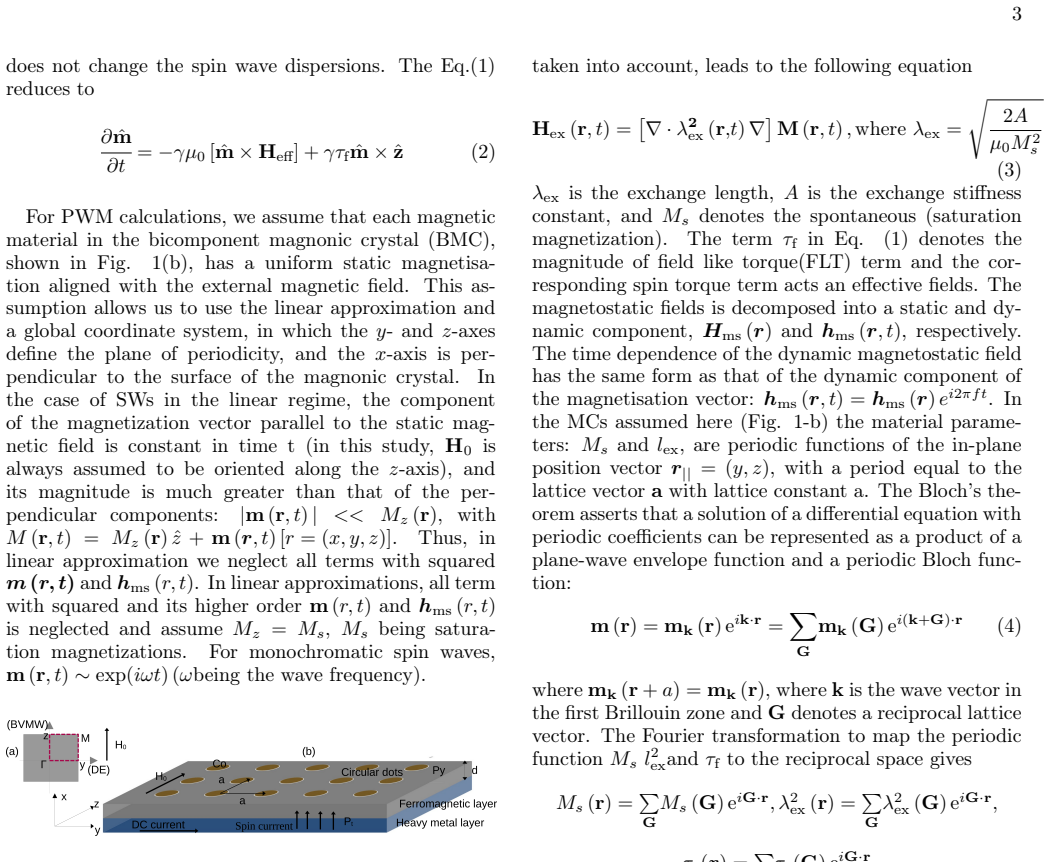
These terms mainly affect dissipation and linewidth, not the real part of the eigenfrequency. Leaving them out 3 does not change the spin wave dispersions. The Eq.(1) reduces to ∂ ˆm ∂t =−γµ 0 [ ˆm×H eff] +γτ f ˆm× ˆz(2) For PWM calculations, we assume that each magnetic material in the bicomponent magnonic crystal (BMC), shown in Fig. 1(b), has a uniform...
-
[2]
The eigen mode profile for the point at 1 and 2 is depicted in Fig. 3. magnetic fieldµ 0H0 = 0.02T.The heavy-metal layer is set to a thickness of 5 nm„ and the field-like torque effi- ciencyc ⊥ is assumed to be 0.28. The current density is taken to be8×1012A/m2. Magnetocrystalline anisotropy for both magnetic materials is neglected through out the analysi...
-
[3]
without spin torque shows a delocalized, stripe-like standing wave pattern that extends across the magnonic crystals. In this case, the spin wave forms broad hor- izontal stripes, so the magnons move together through the structure with only minor disturbance from the peri- odic nanodots. The almost uniform spatial distribution FIG. 3. Magnon band resolved...
-
[4]
V. Kruglyak, S. Demokritov, and D. Grundler, Magnon- ics, Journal of Physics D: Applied Physics43, 264001 (2010)
work page 2010
-
[5]
B. Lenk, H. Ulrichs, F. Garbs, and M. Münzenberg, The building blocks of magnonics, Physics Reports507, 107 (2011)
work page 2011
-
[6]
A. V. Chumak, V. I. Vasyuchka, A. A. Serga, and B. Hillebrands, Magnon spintronics, Nature physics11, 453 (2015)
work page 2015
-
[7]
S. O. Demokritov and A. N. Slavin,Magnonics: From fundamentals to applications, Vol. 125 (Springer Science & Business Media, 2012)
work page 2012
-
[8]
A. Khitun and K. L. Wang, Non-volatile magnonic logic circuits engineering, Journal of Applied Physics110 (2011)
work page 2011
-
[9]
A. V. Chumak, A. A. Serga, and B. Hillebrands, Magnonic crystals for data processing, Journal of Physics D: Applied Physics50, 244001 (2017)
work page 2017
-
[10]
S. Nikitov, P. Tailhades, and C. Tsai, Spin waves in pe- riodic magnetic structures magnonic crystals, Journal of Magnetism and Magnetic Materials236, 320 (2001)
work page 2001
-
[11]
G. E. Bauer, E. Saitoh, and B. J. Van Wees, Spin caloritronics, Nature materials11, 391 (2012)
work page 2012
-
[12]
M. Krawczyk and D. Grundler, Review and prospects of magnonic crystals and devices with reprogrammable band structure, Journal of physics: Condensed matter 26, 123202 (2014)
work page 2014
-
[13]
Grundler, Reconfigurable magnonics heats up, Nature Physics11, 438 (2015)
D. Grundler, Reconfigurable magnonics heats up, Nature Physics11, 438 (2015)
work page 2015
-
[14]
M. Mruczkiewicz, P. Graczyk, P. Lupo, A. Adeyeye, G. Gubbiotti, and M. Krawczyk, Spin-wave nonreciproc- ity and magnonic band structure in a thin permalloy film induced by dynamical coupling with an array of ni stripes, Physical Review B96, 104411 (2017)
work page 2017
-
[15]
P. Gruszecki, Y. S. Dadoenkova, N. Dadoenkova, I. Lyubchanskii, J. Romero-Vivas, K. Guslienko, and M. Krawczyk, Influence of magnetic surface anisotropy on spin wave reflection from the edge of ferromagnetic film, Physical Review B92, 054427 (2015)
work page 2015
-
[16]
M. Krawczyk and H. Puszkarski, Plane-wave theory of three-dimensional magnonic crystals, Physical Review B Condensed Matter and Materials Physics77, 054437 (2008)
work page 2008
-
[17]
J. W. Kłos, D. Kumar, M. Krawczyk, and A. Barman, Magnonic band engineering by intrinsic and extrinsic mirror symmetry breaking in antidot spin-wave waveg- uides, Scientific Reports3, 2444 (2013)
work page 2013
- [18]
-
[19]
K.Wagner, A.Kákay, K.Schultheiss, A.Henschke, T.Se- bastian, and H. Schultheiss, Magnetic domain walls as re- configurable spin-wave nanochannels, Nature nanotech- nology11, 432 (2016)
work page 2016
-
[20]
A. V. Sadovnikov, C. S. Davies, S. V. Grishin, V. Kruglyak, D. Romanenko, Y. P. Sharaevskii, and S. Nikitov, Magnonic beam splitter: The building block of parallel magnonic circuitry, Applied Physics Letters 106(2015)
work page 2015
- [21]
-
[22]
S. Neusser and D. Grundler, Magnonics: Spin waves on the nanoscale, Advanced materials21, 2927 (2009)
work page 2009
-
[23]
M. Mruczkiewicz, P. Gruszecki, M. Zelent, and M. Krawczyk, Collective dynamical skyrmion excitations in a magnonic crystal, Physical Review B93, 174429 (2016)
work page 2016
-
[24]
F. Ciubotaru, T. Devolder, M. Manfrini, C. Adelmann, and I. Radu, All electrical propagating spin wave spec- troscopy with broadband wavevector capability, Applied Physics Letters109(2016)
work page 2016
- [25]
-
[26]
A. V. Chumak, A. A. Serga, and B. Hillebrands, Magnon transistor for all-magnon data processing, Nature com- munications5, 4700 (2014). 9
work page 2014
-
[27]
T.Schneider, A.A.Serga, B.Leven, B.Hillebrands, R.L. Stamps, and M. P. Kostylev, Realization of spin-wave logic gates, Applied Physics Letters92(2008)
work page 2008
- [28]
-
[29]
A. Khitun and K. L. Wang, Nano scale computational architectures with spin wave bus, Superlattices and Mi- crostructures38, 184 (2005)
work page 2005
-
[30]
S. Klingler, P. Pirro, T. Brächer, B. Leven, B. Hille- brands, and A. V. Chumak, Design of a spin-wave ma- jority gate employing mode selection, Applied Physics Letters105(2014)
work page 2014
-
[31]
A. V. Chumak, P. Kabos, M. Wu, C. Abert, C. Adel- mann, A. O. Adeyeye, J. Åkerman, F. G. Aliev, A. Anane, A. Awad,et al., Advances in magnetics roadmap on spin-wave computing, IEEE Transactions on Magnetics58, 1 (2022)
work page 2022
-
[32]
Grundler, Nanomagnonics around the corner, Nature nanotechnology11, 407 (2016)
D. Grundler, Nanomagnonics around the corner, Nature nanotechnology11, 407 (2016)
work page 2016
-
[33]
I. M. Miron, K. Garello, G. Gaudin, P.-J. Zermatten, M. V. Costache, S. Auffret, S. Bandiera, B. Rodmacq, A. Schuhl, and P. Gambardella, Perpendicular switching of a single ferromagnetic layer induced by in-plane cur- rent injection, Nature476, 189 (2011)
work page 2011
-
[34]
Liuet al., Spin-torque switching with the giant spin hall effect, Science336, 555 (2012)
L. Liuet al., Spin-torque switching with the giant spin hall effect, Science336, 555 (2012)
work page 2012
-
[35]
Hoffmann, Spin hall effects in metals, IEEE Transac- tions on Magnetics49, 5172 (2013)
A. Hoffmann, Spin hall effects in metals, IEEE Transac- tions on Magnetics49, 5172 (2013)
work page 2013
-
[36]
Tserkovnyaket al., Spin pumping and magnetization dynamics, Reviews of Modern Physics77, 1375 (2005)
Y. Tserkovnyaket al., Spin pumping and magnetization dynamics, Reviews of Modern Physics77, 1375 (2005)
work page 2005
-
[37]
Sinovaet al., Spin hall effects, Reviews of Modern Physics87, 1213 (2015)
J. Sinovaet al., Spin hall effects, Reviews of Modern Physics87, 1213 (2015)
work page 2015
-
[38]
A. Manchonet al., Current-induced spin-orbit torques in ferromagnetic and antiferromagnetic systems, Reviews of Modern Physics91, 035004 (2019)
work page 2019
-
[39]
V. E. Demidovet al., Magnetic nano-oscillator driven by pure spin current, Nature Materials11, 1028 (2012)
work page 2012
-
[40]
A. Hamadehet al., Full control of spin-wave damping in magnetic insulator using spin-orbit torque, Physical Review Letters113, 197203 (2014)
work page 2014
-
[41]
V. E. Demidov, S. Urazhdin, and S. O. Demokritov, Spin hall controlled magnonic nano-oscillator, Scientific Re- ports4, 6467 (2014)
work page 2014
-
[42]
A. Brataas, A. D. Kent, and H. Ohno, Current-induced torques in magnetic materials, Nature Materials11, 372 (2012)
work page 2012
-
[43]
V. E. Demidov, S. Urazhdin, and S. O. Demokritov, Ex- citation of coherent propagating spin waves by pure spin currents, Nature Communications7, 10446 (2016)
work page 2016
-
[44]
B. Divinskiy, S. Urazhdin, V. E. Demidov, and S. O. Demokritov, Bridging magnonics and spin-orbitronics, Nature Communications9, 408 (2018)
work page 2018
-
[45]
V. Cros, J. Grollier, D. Querlioz, and M. D. Stiles, Spin-transfer torque nano-oscillators, Reviews of Modern Physics85, 1 (2013)
work page 2013
-
[46]
S. Urazhdin, V. E. Demidov, and S. O. Demokritov, Nanomagnonic devices based on spin current control, Na- ture Nanotechnology9, 509 (2014)
work page 2014
-
[47]
V. E. Demidov and S. O. Demokritov, Magnonic waveg- uides and spin-wave transport, IEEE Transactions on Magnetics51, 0800215 (2015)
work page 2015
-
[48]
A. Ananeet al., Ultralow-current-density and bias-field- free spin-transfer nano-oscillator, Nature Communica- tions11, 3124 (2020)
work page 2020
-
[49]
V. E. Demidovet al., Spin-orbit-torque magnonics, Na- ture Communications11, 3637 (2020)
work page 2020
-
[50]
H. Yu, O. d’Allivy Kelly, V. Cros, R. Bernard, P. Bor- tolotti, A. Anane, F. Brandl, R. Huber, I. Stasinopou- los, and D. Grundler, Magnetic thin-film insulator with ultra-low spin wave damping, Scientific Reports4, 6848 (2014)
work page 2014
-
[51]
Liet al., Hybrid magnonics and cavity spintronics, Physics Reports961, 1 (2022)
J. Liet al., Hybrid magnonics and cavity spintronics, Physics Reports961, 1 (2022)
work page 2022
-
[52]
Y. Li, N. Zhu, X. Zhang,et al., Coherent coupling be- tween magnons and microwave photons, Physical Review Letters123, 107701 (2019)
work page 2019
-
[53]
D. Lachance-Quirion, Y. Tabuchi, A. Gloppe, K. Usami, and Y. Nakamura, Hybrid quantum systems based on magnonics, Applied Physics Express12, 070101 (2019)
work page 2019
-
[54]
X. Zhang, C.-L. Zou, L. Jiang, and H. X. Tang, Strongly coupled magnons and cavity microwave photons, Physi- cal Review Letters113, 156401 (2014)
work page 2014
-
[55]
Y. Tabuchi, S. Ishino, T. Ishikawa, R. Yamazaki, K. Usami, and Y. Nakamura, Hybridizing ferromagnetic magnons and microwave photons in the quantum limit, Physical Review Letters113, 083603 (2014)
work page 2014
-
[56]
D. Grundler and A. V. Chumak, Nanomagnonics for quantum technologies, Nature Physics18, 1298 (2022)
work page 2022
- [57]
-
[58]
L. R. Walker, Magnetostatic modes in ferromagnetic res- onance, Physical Review105, 390 (1957)
work page 1957
-
[59]
R. W. Damon and J. R. Eshbach, Magnetostatic modes of a ferromagnet slab, Journal of Physics and Chemistry of Solids19, 308 (1961)
work page 1961
-
[60]
Kittel,Introduction to Solid State Physics, 8th ed
C. Kittel,Introduction to Solid State Physics, 8th ed. (Wiley, 2005)
work page 2005
-
[61]
T. Holstein and H. Primakoff, Field dependence of the in- trinsic domain magnetization of a ferromagnet, Physical Review58, 1098 (1940)
work page 1940
-
[62]
Bloch, Zur theorie des ferromagnetismus, Zeitschrift für Physik61, 206 (1930)
F. Bloch, Zur theorie des ferromagnetismus, Zeitschrift für Physik61, 206 (1930)
work page 1930
-
[63]
J. C. Slonczewski, Current-driven excitation of magnetic multilayers, Journal of Magnetism and Magnetic Materi- als159, L1 (1996)
work page 1996
-
[64]
L. Berger, Emission of spin waves by a magnetic multi- layer traversed by a current, Physical Review B54, 9353 (1996)
work page 1996
-
[65]
S. O. Demokritovet al., Bose–einstein condensation of quasi-equilibrium magnons at room temperature under pumping, Nature443, 430 (2006)
work page 2006
-
[66]
A. A. Serga, A. V. Chumak, and B. Hillebrands, Yig magnonics, Journal of Physics D: Applied Physics43, 264002 (2010)
work page 2010
-
[67]
Wanget al., Magnon-based neuromorphic computing, Nature Electronics3, 765 (2020)
H. Wanget al., Magnon-based neuromorphic computing, Nature Electronics3, 765 (2020)
work page 2020
-
[68]
Wanget al., Coherent magnon transport for quantum information, Science Advances7, eabg8562 (2021)
Q. Wanget al., Coherent magnon transport for quantum information, Science Advances7, eabg8562 (2021)
work page 2021
-
[69]
A. V. Chumak and H. Schultheiss, Magnon spintron- ics for unconventional computing, IEEE Transactions on Magnetics58, 0800175 (2022)
work page 2022
-
[70]
Grundler, Reconfigurable magnonic computing sys- tems, Nature Reviews Physics2, 1 (2020)
D. Grundler, Reconfigurable magnonic computing sys- tems, Nature Reviews Physics2, 1 (2020)
work page 2020
-
[71]
J. D. Joannopoulos, R. D. Meade, and J. N. Winn, 10 Photonic Crystals: Molding the Flow of Light, 2nd ed. (Princeton University Press, Princeton, NJ, 2008)
work page 2008
-
[72]
N. W. Ashcroft and N. D. Mermin,Solid State Physics (Holt, Rinehart and Winston, New York, 1976)
work page 1976
-
[73]
D. W. Prather, S. Shi, A. Sharkawy, J. Murakowski, and G. J. Schneider,Photonic Crystals: Theory, Appli- cations, and Fabrication(Wiley, New York, 2009)
work page 2009
-
[74]
M.KrawczykandH.Puszkarski,Phys.Rev.B77,054437 (2008)
work page 2008
-
[75]
R. P. Tiwari and D. Stroud, Phys. Rev. B81, 220403 (2010), (R)
work page 2010
-
[76]
J. W. Klos, M. L. Sokolovskyy, S. Mamica, and M. Krawczyk, J. Appl. Phys.111, 123910 (2012)
work page 2012
- [77]
-
[78]
H. Yang, G. Yun, and Y. Cao, J. Appl. Phys.111, 013908 (2012)
work page 2012
-
[79]
A. Yariv and P. Yeh,Optical Waves in Crystals(Wiley- Interscience, New York, 2003) p. 156
work page 2003
- [80]
discussion (0)
Sign in with ORCID, Apple, or X to comment. Anyone can read and Pith papers without signing in.