Optical anisotropy and electronic states in the pleochroic material Ca₃ReO₅Cl₂
Pith reviewed 2026-05-22 05:46 UTC · model grok-4.3
The pith
Re d electrons drive the pleochroic optical transitions in Ca₃ReO₅Cl₂ according to first-principles calculations.
A machine-rendered reading of the paper's core claim, the machinery that carries it, and where it could break.
Core claim
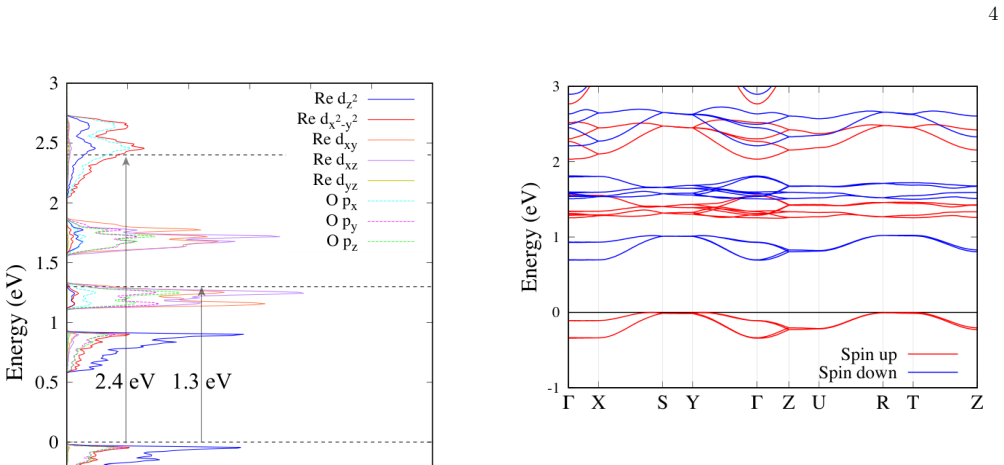
First-principles calculations performed in a ferromagnetically ordered state to represent the localized Re 5d electrons in paramagnetic Ca₃ReO₅Cl₂ yield a dielectric function and absorption coefficient that reproduce the main experimental peak structures. Orbital-resolved decomposition of the spectra demonstrates that the optical transitions tied to pleochroism arise predominantly from Re-d-dominated electronic states.
What carries the argument
Orbital-resolved decomposition of the dielectric function that isolates the contribution of Re d states to the polarization-dependent absorption.
If this is right
- The pleochroic response is controlled mainly by transitions between Re d states rather than oxygen or calcium orbitals.
- Adjusting for electron localization via a ferromagnetic configuration allows standard DFT to capture the observed optical anisotropy qualitatively.
- Similar orbital analysis can be applied to other compounds containing localized d electrons that exhibit direction-dependent optical properties.
Where Pith is reading between the lines
- If the Re d dominance holds, targeted substitution of Re with other transition metals could tune the pleochroic colors while preserving the crystal structure.
- The same modeling approach might help predict optical anisotropy in related oxychlorides before synthesis.
Load-bearing premise
A ferromagnetically ordered state can stand in for the localized character of the Re 5d electrons even though the real material is paramagnetic.
What would settle it
A mismatch between the calculated polarization-dependent absorption peaks and the experimentally measured color variation or peak positions under different light polarizations would falsify the link between Re d states and pleochroism.
Figures



read the original abstract
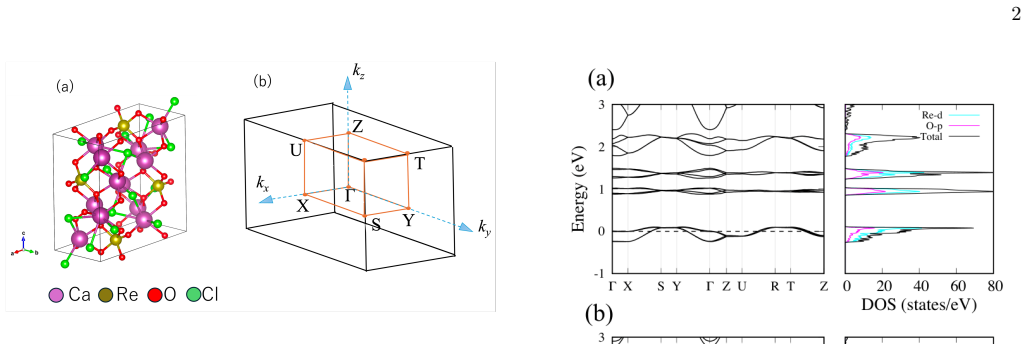
Pleochroism is a type of optical anisotropy in which the apparent color of a material varies depending on the polarization and propagation direction of incident light. The oxychloride compound Ca$_3$ReO$_5$Cl$_2$ has recently attracted attention due to its pronounced pleochroism. The paramagnetic state of this compound, characterized by localized Re 5$d$ electrons, is challenging to describe within conventional first-principles methods. In this study, we investigate the optical anisotropy in Ca$_3$ReO$_5$Cl$_2$ using first-principles calculations, with particular focus on the relationship between the optical spectra and electronic states. We employ a ferromagnetically ordered state to effectively capture the localized character of the Re 5$d$ electrons. The calculated dielectric function and absorption coefficient qualitatively reproduce the experimentally observed peak structures. An orbital-resolved analysis indicates that the characteristic optical transitions associated with the pleochroism predominantly involve Re-$d$-dominated electronic states, highlighting the key role of the Re $d$ electrons in the pleochroic optical response of Ca$_3$ReO$_5$Cl$_2$.
Editorial analysis
A structured set of objections, weighed in public.
Referee Report
Summary. The manuscript reports first-principles calculations of the optical properties of the pleochroic oxychloride Ca₃ReO₅Cl₂. A ferromagnetic supercell is used to approximate the localized Re 5d electrons in the paramagnetic phase. The resulting dielectric function and absorption coefficient are shown to reproduce experimental peak structures at a qualitative level. An orbital-resolved decomposition of the interband transitions is used to conclude that the pleochroic response is dominated by Re-d states.
Significance. If the orbital assignments are robust, the work would usefully identify the electronic origin of pleochroism in this material and underscore the importance of Re 5d electrons. The orbital decomposition itself is a positive contribution. However, the strictly qualitative experimental comparison and the unvalidated FM proxy limit the strength of the central claim.
major comments (2)
- [Computational Methods] Computational Methods: The ferromagnetic ordering imposed to localize the Re 5d electrons introduces an artificial exchange splitting that shifts spin-up and spin-down d-orbital energies and changes their hybridization with O/Cl p states. Because the dielectric function is constructed from interband transitions whose energies and dipole matrix elements depend on these occupations, the reported peak positions, anisotropies, and orbital weights may be artifacts of the imposed order rather than intrinsic to the paramagnetic material. A direct comparison with a paramagnetic or spin-disordered calculation is needed to establish that the Re-d dominance survives this modeling choice.
- [Results] Results section (optical spectra and orbital analysis): Agreement with experiment is stated only as “qualitative reproduction of peak structures.” No quantitative metrics (peak-position deviations, integrated intensity ratios, or mean absolute error) are supplied. Without such measures it is difficult to judge whether the orbital decomposition reliably identifies the transitions responsible for the observed pleochroism.
minor comments (2)
- [Figures] Figure captions should explicitly state the light polarization and propagation directions corresponding to each calculated spectrum.
- [Computational Methods] The manuscript should clarify whether a Hubbard U correction was applied to the Re 5d states and, if so, how its value was chosen.
Simulated Author's Rebuttal
We thank the referee for the careful reading of our manuscript and the constructive comments. We address each major point below, providing our responses and indicating planned revisions where appropriate.
read point-by-point responses
-
Referee: [Computational Methods] Computational Methods: The ferromagnetic ordering imposed to localize the Re 5d electrons introduces an artificial exchange splitting that shifts spin-up and spin-down d-orbital energies and changes their hybridization with O/Cl p states. Because the dielectric function is constructed from interband transitions whose energies and dipole matrix elements depend on these occupations, the reported peak positions, anisotropies, and orbital weights may be artifacts of the imposed order rather than intrinsic to the paramagnetic material. A direct comparison with a paramagnetic or spin-disordered calculation is needed to establish that the Re-d dominance survives this modeling choice.
Authors: We acknowledge that imposing ferromagnetic order introduces an artificial exchange splitting not present in the true paramagnetic state. Our choice of this approximation stems from the difficulty of describing localized Re 5d electrons within standard DFT, which otherwise yields an unphysical metallic ground state. The FM supercell provides a practical means to open a gap and localize the d electrons while remaining computationally tractable. Although the splitting affects precise energies and hybridizations, the orbital projections in our calculations show that the dominant interband transitions for the observed pleochroic features occur between states with predominant Re d character in both the occupied and unoccupied manifolds. This character is expected to persist under different spin arrangements because it reflects the local electronic structure around Re sites. We will expand the Computational Methods section in the revised manuscript to include a more explicit justification of the approximation together with a discussion of its limitations. revision: partial
-
Referee: [Results] Results section (optical spectra and orbital analysis): Agreement with experiment is stated only as “qualitative reproduction of peak structures.” No quantitative metrics (peak-position deviations, integrated intensity ratios, or mean absolute error) are supplied. Without such measures it is difficult to judge whether the orbital decomposition reliably identifies the transitions responsible for the observed pleochroism.
Authors: We agree that the addition of quantitative metrics would allow readers to assess the level of agreement more objectively. In the revised manuscript we will include numerical measures such as the mean absolute deviation of the main calculated peak positions relative to experiment and the ratios of integrated absorption intensities for the prominent features in the dielectric function. These additions will be placed in the Results section alongside the existing qualitative comparison. revision: yes
Circularity Check
No circularity: standard DFT calculation with external modeling choice
full rationale
The paper selects a ferromagnetic supercell as a proxy to localize Re 5d electrons in the paramagnetic phase, then computes the dielectric function and performs orbital-resolved decomposition of interband transitions. This decomposition yields the claim that pleochroic features are Re-d dominated. The FM choice is an upfront approximation external to the target optical spectra; the calculated peaks and orbital weights are outputs of the electronic-structure run rather than re-statements of the input ansatz. No self-definitional loop, fitted-parameter prediction, or load-bearing self-citation chain appears in the derivation. The result therefore remains independent of its own fitted values and is not equivalent to the inputs by construction.
Axiom & Free-Parameter Ledger
axioms (1)
- domain assumption A ferromagnetically ordered state can be used as an effective proxy to capture the localized character of Re 5d electrons in the paramagnetic phase.
Lean theorems connected to this paper
-
IndisputableMonolith/Cost/FunctionalEquation.leanwashburn_uniqueness_aczel unclear?
unclearRelation between the paper passage and the cited Recognition theorem.
We employ a ferromagnetically ordered state to effectively capture the localized character of the Re 5d electrons... An orbital-resolved analysis indicates that the characteristic optical transitions associated with the pleochroism predominantly involve Re-d-dominated electronic states
-
IndisputableMonolith/Foundation/AlphaCoordinateFixation.leanJ_uniquely_calibrated_via_higher_derivative unclear?
unclearRelation between the paper passage and the cited Recognition theorem.
The calculated dielectric function and absorption coefficient qualitatively reproduce the experimentally observed peak structures
What do these tags mean?
- matches
- The paper's claim is directly supported by a theorem in the formal canon.
- supports
- The theorem supports part of the paper's argument, but the paper may add assumptions or extra steps.
- extends
- The paper goes beyond the formal theorem; the theorem is a base layer rather than the whole result.
- uses
- The paper appears to rely on the theorem as machinery.
- contradicts
- The paper's claim conflicts with a theorem or certificate in the canon.
- unclear
- Pith found a possible connection, but the passage is too broad, indirect, or ambiguous to say the theorem truly supports the claim.
Reference graph
Works this paper leans on
-
[1]
P. G. Manning, An optical absorption study of the origin of colour and pleochroism in pink and brown tourmalines, Can. Mineral.9, 678 (1968)
work page 1968
-
[2]
C. S. Hurlbut, Gem zoisite from tanzania, Am. Mineral. 54, 702 (1969)
work page 1969
- [3]
- [4]
-
[5]
K. Nawa, D. Hirai, M. Kofu, K. Nakajima, R. Murasaki, S. Kogane, M. Kimata, H. Nojiri, Z. Hiroi, and T. J. Sato, Bound spinon excitations in the spin-1/2 anisotropic tri- angular antiferromagnet Ca 3ReO5Cl2, Phys. Rev. Res. 2, 043121 (2020)
work page 2020
-
[6]
S. A. Zvyagin, A. N. Ponomaryov, J. Wosnitza, D. Hi- rai, Z. Hiroi, M. Gen, Y. Kohama, A. Matsuo, Y. H. Matsuda, and K. Kindo, Dimensional reduction and incommensurate dynamic correlations in theS= 1/2 triangular-lattice antiferromagnet Ca3ReO5Cl2, Nat. Commun.13, 6310 (2022)
work page 2022
-
[7]
I. A. Abrikosov, T. Bartel, T. Burkert, T. Hickel, J. Neugebauer, A. V. Ruban, E. A. Smirnova, I. Tanaka, I. Turek, and L. Vitos, Recent progress in simulations of the paramagnetic state of magnetic materials, Rep. Prog. Phys.79, 096501 (2016)
work page 2016
-
[8]
G. Kresse and J. Hafner, Ab initio molecular dynamics for liquid metals, Phys. Rev. B47, 558 (1993)
work page 1993
-
[9]
G. Kresse and J. Hafner, Ab initio molecular dynamics for open-shell transition metals, Phys. Rev. B48, 13115 (1993)
work page 1993
-
[10]
G. Kresse and J. Furthm¨ uller, Efficiency of ab-initio total energy calculations for metals and semiconductors using a plane-wave basis set, Comput. Mater. Sci.6, 15 (1996)
work page 1996
-
[11]
Wooten,Optical Properties of Solids(Academic Press,
F. Wooten,Optical Properties of Solids(Academic Press,
discussion (0)
Sign in with ORCID, Apple, or X to comment. Anyone can read and Pith papers without signing in.