A Robust Semantic Segmentation Pipeline for the CVPR 2026 8th UG2+ Challenge Track 2
Pith reviewed 2026-05-25 06:03 UTC · model grok-4.3
The pith
A semi-supervised pipeline applies UniMatch V2 to the WeatherProof dataset by treating degraded images as unlabeled data and adds test-time augmentation at inference.
A machine-rendered reading of the paper's core claim, the machinery that carries it, and where it could break.
Core claim
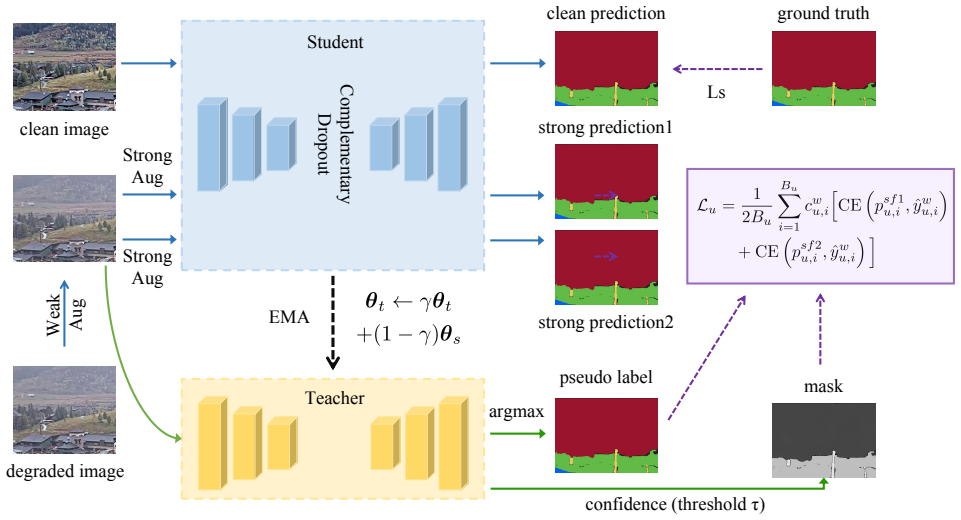
We adopt UniMatch V2 as the baseline model and treat all degraded-weather images as unlabeled data for semi-supervised training, thereby fully exploiting the data distribution provided by the challenge. During inference, we further apply test-time augmentation to improve the robustness and segmentation accuracy of the final predictions.
What carries the argument
UniMatch V2 semi-supervised training framework applied to the WeatherProof dataset, with test-time augmentation during inference.
If this is right
- The full challenge data distribution can be used without any external labeled images.
- Test-time augmentation further raises final segmentation accuracy under adverse conditions.
- The pipeline remains confined to the WeatherProof dataset and its internal splits.
- Performance gains derive directly from the semi-supervised exploitation of unlabeled degraded images.
Where Pith is reading between the lines
- If the semi-supervised gains hold, similar pipelines could be tested on other weather or sensor-degraded segmentation benchmarks that supply both labeled and unlabeled splits.
- The method's reliance on a single baseline leaves open whether other semi-supervised segmentation models would produce comparable or larger lifts on the same data.
- Success would imply that distribution shift from adverse weather can be mitigated by treating the shift itself as a source of unlabeled examples rather than noise.
Load-bearing premise
Treating the challenge's degraded-weather images as unlabeled data within the UniMatch V2 semi-supervised framework will yield meaningful performance gains without the adverse conditions introducing harmful label noise or distribution shift that the method cannot handle.
What would settle it
Compare mean intersection-over-union on the WeatherProof test set between the full semi-supervised pipeline and the same UniMatch V2 model trained only on the labeled portion; a clear gap favoring the semi-supervised version would support the claim.
Figures

read the original abstract
This report presents our solution for the WeatherProof Dataset Challenge, namely CVPR 2026 8th UG2+ Challenge Track 2: Semantic Segmentation in Adverse Weather. For the semantic segmentation task under adverse weather conditions, we propose a semi-supervised segmentation pipeline. Our method is trained exclusively on the WeatherProof dataset, without using any additional external data. Specifically, we adopt UniMatch V2 as the baseline model and treat all degraded-weather images as unlabeled data for semi-supervised training, thereby fully exploiting the data distribution provided by the challenge. During inference, we further apply test-time augmentation to improve the robustness and segmentation accuracy of the final predictions. The code is publicly available at: https://github.com/ylb888/weatherproof-challenge-unimatchv2.
Editorial analysis
A structured set of objections, weighed in public.
Referee Report
Summary. The manuscript describes a semi-supervised semantic segmentation pipeline for the WeatherProof Dataset in the CVPR 2026 UG2+ Challenge Track 2. It adopts UniMatch V2 as the baseline, treats all degraded-weather images as unlabeled data for semi-supervised training without external data, and applies test-time augmentation at inference. The code is released publicly.
Significance. The work provides a practical, reproducible application of an existing semi-supervised framework (UniMatch V2) to the challenge data distribution. The public code release supports reproducibility. However, the absence of any quantitative results, ablations, or error analysis substantially limits the ability to assess whether the approach yields meaningful gains under adverse weather conditions.
major comments (1)
- [Abstract] Abstract (and full manuscript): No quantitative results (e.g., mIoU on validation or test sets), ablations, or comparisons to the supervised UniMatch V2 baseline are reported. This leaves the central claim—that treating degraded images as unlabeled data plus TTA improves robustness—unsupported by evidence, making it impossible to evaluate the pipeline's effectiveness.
Simulated Author's Rebuttal
We thank the referee for the feedback on our challenge report. We agree that the manuscript lacks quantitative results, ablations, and baseline comparisons, which prevents a full assessment of the pipeline's effectiveness. We will revise the manuscript to incorporate these elements.
read point-by-point responses
-
Referee: [Abstract] Abstract (and full manuscript): No quantitative results (e.g., mIoU on validation or test sets), ablations, or comparisons to the supervised UniMatch V2 baseline are reported. This leaves the central claim—that treating degraded images as unlabeled data plus TTA improves robustness—unsupported by evidence, making it impossible to evaluate the pipeline's effectiveness.
Authors: We acknowledge that the current manuscript, as a concise challenge report, does not report any mIoU values, ablations, or comparisons to the supervised UniMatch V2 baseline. This omission means the effectiveness of the semi-supervised approach and TTA cannot be quantitatively evaluated from the text alone. In the revised version we will add validation-set mIoU results for the full pipeline, an ablation isolating the contribution of treating degraded images as unlabeled data, and a direct comparison against the supervised UniMatch V2 baseline trained only on labeled data. These additions will supply the missing evidence while preserving the report's focus on the challenge submission. revision: yes
Circularity Check
No significant circularity
full rationale
The manuscript is a competition report that describes an applied pipeline using the publicly documented UniMatch V2 model on the provided WeatherProof dataset (with degraded images treated as unlabeled data) plus standard test-time augmentation. No novel derivation, equation, fitted parameter, uniqueness theorem, or ansatz is introduced; the central steps are direct invocations of an external baseline and standard semi-supervised procedures without any reduction of outputs to inputs by construction or self-citation chain.
Axiom & Free-Parameter Ledger
Reference graph
Works this paper leans on
-
[1]
FirstName LastName , title =
-
[2]
FirstName Alpher , title =
-
[3]
IEEE Transactions on Pattern Analysis and Machine Intelligence , volume=
Unimatch v2: Pushing the limit of semi-supervised semantic segmentation , author=. IEEE Transactions on Pattern Analysis and Machine Intelligence , volume=. 2025 , publisher=
work page 2025
-
[4]
IEEE Transactions on Pattern Analysis and Machine Intelligence , year=
Like Human Rethinking: Contour Transformer AutoRegression for Referring Remote Sensing Interpretation , author=. IEEE Transactions on Pattern Analysis and Machine Intelligence , year=
-
[5]
Language-guided modulation-update for semi-supervised semantic segmentation , author=. Pattern Recognition , pages=. 2026 , publisher=
work page 2026
-
[6]
arXiv preprint arXiv:2312.09534 , year=
Weatherproof: A paired-dataset approach to semantic segmentation in adverse weather , author=. arXiv preprint arXiv:2312.09534 , year=
-
[7]
International Journal of Computer Vision , volume=
Semantic understanding of scenes through the ade20k dataset , author=. International Journal of Computer Vision , volume=. 2019 , publisher=
work page 2019
-
[8]
The Cityscapes Dataset for Semantic Urban Scene Understanding , author=. Proc. of the IEEE Conference on Computer Vision and Pattern Recognition (CVPR) , year=
-
[9]
Proceedings of the IEEE/CVF Conference on Computer Vision and Pattern Recognition , year=
WeatherStream: Light Transport Automation of Single Image Deweathering , author=. Proceedings of the IEEE/CVF Conference on Computer Vision and Pattern Recognition , year=
discussion (0)
Sign in with ORCID, Apple, or X to comment. Anyone can read and Pith papers without signing in.