Geometric Construction of Optimal Teleportation Witnesses
Pith reviewed 2026-05-22 06:46 UTC · model grok-4.3
The pith
A geometric projection method constructs optimal witnesses that fully determine whether any two-qudit entangled state works for teleportation.
A machine-rendered reading of the paper's core claim, the machinery that carries it, and where it could break.
Core claim
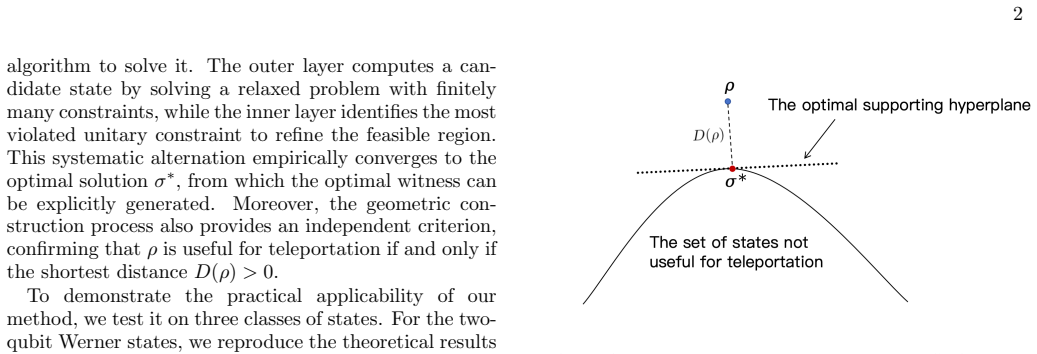
By developing a two-layer iterative cutting-plane algorithm to solve the shortest distance problem from the target state ρ to the convex set S of useless states, we obtain the projection point σ* ∈ S and then construct the optimal teleportation witness from the projection geometry. Moreover, the shortest distance D(ρ) obtained during this construction also serves as a necessary and sufficient criterion for usefulness.
What carries the argument
The two-layer iterative cutting-plane algorithm that computes the Euclidean projection of a target state onto the convex set of teleportation-useless states, from which the witness is built geometrically.
If this is right
- Optimal teleportation witnesses can be constructed for arbitrary two-qudit density operators.
- The shortest distance D(ρ) provides a complete necessary-and-sufficient test for teleportation usefulness.
- The geometric construction applies directly to any entangled state in two-qudit systems.
- The method has been applied to identify usefulness in three distinct classes of entangled states.
Where Pith is reading between the lines
- The projection technique could be adapted to witness constructions for other quantum tasks that involve convex sets of states.
- Computational scaling of the cutting-plane algorithm on higher-dimensional qudit systems would be a natural next test.
- Similar distance-to-useless-set ideas might apply to other resource theories in quantum information.
Load-bearing premise
The set of states useless for teleportation is convex, and the algorithm reliably finds the closest point in that set to any given two-qudit state.
What would settle it
A concrete two-qudit state for which the constructed witness fails to correctly identify teleportation usefulness or for which the computed distance D(ρ) does not match the state's actual performance in a teleportation protocol.
Figures


read the original abstract
Not all entangled states are useful for quantum teleportation. We present a geometric method to construct optimal teleportation witnesses, which provide operational necessary and sufficient criteria for identifying the teleportation usefulness of arbitrary two-qudit entangled states. Specifically, by developing a two-layer iterative cutting-plane algorithm to solve the shortest distance problem from the target state $\rho$ to the convex set $S$ of useless states, we obtain the projection point $\sigma^* \in S$ and then construct the optimal teleportation witness from the projection geometry. Moreover, the shortest distance $D(\rho)$ obtained during this construction also serves as a necessary and sufficient criterion for usefulness. We apply our method to identify the teleportation usefulness of three classes of entangled states.
Editorial analysis
A structured set of objections, weighed in public.
Referee Report
Summary. The paper claims to provide a geometric construction of optimal teleportation witnesses for arbitrary two-qudit states. It formulates the problem as computing the shortest Euclidean distance from a target state ρ to the convex set S of states useless for teleportation via a two-layer iterative cutting-plane algorithm, obtains the projection point σ* ∈ S, and constructs the witness from the supporting hyperplane at σ*. The distance D(ρ) is asserted to be a necessary and sufficient criterion for teleportation usefulness, with the method applied to three classes of entangled states.
Significance. If the algorithm computes the exact projection and the geometric construction is valid, the work would offer a practical, operational tool for assessing teleportation usefulness that goes beyond standard entanglement witnesses. The convexity-based projection approach is a natural fit for the problem and could enable systematic checks for general two-qudit systems, strengthening the link between geometry and quantum communication tasks.
major comments (1)
- [the section detailing the two-layer iterative cutting-plane algorithm] The section detailing the two-layer iterative cutting-plane algorithm: the manuscript describes the algorithm for solving the shortest-distance problem but provides no formal convergence proof, iteration bounds, or error estimates guaranteeing that the numerical output equals the exact Euclidean projection σ* for arbitrary two-qudit density operators. This is load-bearing for the central claims, as the optimality of the witness and the necessity-sufficiency of D(ρ) rest on σ* being the true projection; without such guarantees the criteria may hold only approximately.
minor comments (2)
- The introduction would benefit from an earlier, explicit statement of the convexity of S and the choice of Hilbert-Schmidt norm to set up the geometric framework for readers.
- Notation for the witness operator and the distance function D(ρ) could be standardized more consistently across the abstract, introduction, and main text.
Simulated Author's Rebuttal
We thank the referee for the careful reading of our manuscript and the constructive comment on the algorithmic section. We address the concern point by point below.
read point-by-point responses
-
Referee: The section detailing the two-layer iterative cutting-plane algorithm: the manuscript describes the algorithm for solving the shortest-distance problem but provides no formal convergence proof, iteration bounds, or error estimates guaranteeing that the numerical output equals the exact Euclidean projection σ* for arbitrary two-qudit density operators. This is load-bearing for the central claims, as the optimality of the witness and the necessity-sufficiency of D(ρ) rest on σ* being the true projection; without such guarantees the criteria may hold only approximately.
Authors: We agree that the current manuscript does not contain a formal convergence proof, iteration bounds, or explicit error estimates for the two-layer iterative cutting-plane algorithm. This is a valid observation, as the optimality of the constructed witnesses and the necessity-sufficiency of D(ρ) rely on σ* being the exact projection. To address this rigorously, we will add a new subsection in the revised version that provides a convergence analysis. The analysis will establish that the cutting-plane procedure converges to the unique Euclidean projection onto the convex set S in finite-dimensional space, derive iteration bounds in terms of the Hilbert-space dimension and target precision, and supply a posteriori error estimates that bound the distance between the numerical output and the exact σ*. With these additions the central claims will hold exactly (within controllable numerical tolerance) rather than approximately. revision: yes
Circularity Check
No significant circularity: witness constructed from independent geometric projection
full rationale
The paper defines S as the convex set of teleportation-useless states, develops a two-layer cutting-plane algorithm to compute the Euclidean projection σ* of an arbitrary ρ onto S, and then builds the witness operator from the supporting hyperplane at σ* while taking D(ρ) as the distance. This chain is self-contained: the witness is obtained directly from the geometry of the projection (a standard convex-optimization step), and D(ρ) is the defining distance to S rather than a fitted or renamed quantity. No equation reduces to its own input by construction, no parameter is fitted on a subset and then called a prediction, and no load-bearing premise rests on a self-citation whose validity is presupposed. The derivation therefore stands on the convexity of S and the algorithm's output without circular reduction.
Axiom & Free-Parameter Ledger
axioms (1)
- domain assumption The set S of states useless for teleportation is a convex subset of the space of two-qudit density operators.
Lean theorems connected to this paper
-
IndisputableMonolith/Cost/FunctionalEquation.leanwashburn_uniqueness_aczel unclear?
unclearRelation between the paper passage and the cited Recognition theorem.
by developing a two-layer iterative cutting-plane algorithm to solve the shortest distance problem from the target state ρ to the convex set S of useless states, we obtain the projection point σ* ∈ S and then construct the optimal teleportation witness from the projection geometry
-
IndisputableMonolith/Foundation/RealityFromDistinction.leanreality_from_one_distinction unclear?
unclearRelation between the paper passage and the cited Recognition theorem.
the shortest distance D(ρ) obtained during this construction also serves as a necessary and sufficient criterion for usefulness
What do these tags mean?
- matches
- The paper's claim is directly supported by a theorem in the formal canon.
- supports
- The theorem supports part of the paper's argument, but the paper may add assumptions or extra steps.
- extends
- The paper goes beyond the formal theorem; the theorem is a base layer rather than the whole result.
- uses
- The paper appears to rely on the theorem as machinery.
- contradicts
- The paper's claim conflicts with a theorem or certificate in the canon.
- unclear
- Pith found a possible connection, but the passage is too broad, indirect, or ambiguous to say the theorem truly supports the claim.
Reference graph
Works this paper leans on
-
[1]
Hence the algorithm simultaneously provides the dis- tance criterionD(ρ) =∥ρ−σ ∗∥F (withD(ρ)>0 if and only ifρis useful) and the optimal teleportation witness operator. IV. EXAMPLES In the following, we present concrete examples to illus- trate how the shortest distance is computed and how the corresponding witness operator is constructed, thereby demonst...
-
[2]
are not directly applicable. We propose a two-layer cutting-plane algorithm to solve this shortest distance problem, which empirically converges to the projection σ∗ and thus yields the corresponding optimal telepor- tation witness. In our algorithmic implementation, the inner optimization is based on a randomized fixed-point iteration with restarts, whic...
-
[3]
C. H. Bennett, G. Brassard, C. Cr´ epeau, R. Jozsa, A. Peres, and W. K. Wootters, Phys. Rev. Lett.70, 1895 (1993)
work page 1993
-
[4]
D. Bouwmeester, J.-W. Pan, K. Mattle, M. Eibl, H. We- infurter, and A. Zeilinger, Nature390, 575 (1997)
work page 1997
- [5]
-
[6]
M. Horodecki, P. Horodecki, and R. Horodecki, Phys. Rev. A60, 1888 (1999)
work page 1999
-
[7]
X.-M. Hu, Y. Guo, B.-H. Liu, C.-F. Li, and G.-C. Guo, Nature Reviews Physics5, 339 (2023), published online: 2023-06-01
work page 2023
- [8]
-
[9]
Chakrabarty, The European Physical Journal D57, 265 (2010)
I. Chakrabarty, The European Physical Journal D57, 265 (2010)
work page 2010
- [10]
-
[11]
S. Adhikari, A. S. Majumdar, S. Roy, B. Ghosh, and N. Nayak, Quantum Information & Computation10, 398 (2010)
work page 2010
-
[12]
N. Brunner, D. Cavalcanti, S. Pironio, V. Scarani, and S. Wehner, Rev. Mod. Phys.86, 419 (2014)
work page 2014
-
[13]
R. Uola, A. C. S. Costa, H. C. Nguyen, and O. G¨ uhne, Rev. Mod. Phys.92, 015001 (2020)
work page 2020
-
[14]
R. Horodecki, P. Horodecki, and M. Horodecki, Physics Letters A200, 340 (1995)
work page 1995
-
[15]
R. Horodecki, M. Horodecki, and P. Horodecki, Physics Letters A222, 21 (1996)
work page 1996
-
[16]
Y. Fan, C. Jia, and L. Qiu, Phys. Rev. A106, 012433 (2022)
work page 2022
-
[17]
Y. Guo, X. Chen, H. Peng, and Q. Tian, Phys. Rev. A 112, 052403 (2025)
work page 2025
-
[18]
N. Ganguly, S. Adhikari, A. S. Majumdar, and J. Chat- terjee, Phys. Rev. Lett.107, 270501 (2011). 8
work page 2011
-
[19]
S. Adhikari, N. Ganguly, and A. S. Majumdar, Phys. Rev. A86, 032315 (2012)
work page 2012
-
[20]
M.-J. Zhao, Z.-G. Li, S.-M. Fei, and Z.-X. Wang, Journal of Physics A: Mathematical and Theoretical43, 275203 (2010)
work page 2010
-
[21]
G. Rui-Juan, L. Ming, F. Shao-Ming, and L. jost Xian- Qing, Communications in Theoretical Physics53, 265 (2010)
work page 2010
-
[22]
S. Adhikari, A. S. Majumdar, S. Roy, B. Ghosh, and N. Nayak, Quantum Inf. Comput.10, 398 (2008)
work page 2008
- [23]
-
[24]
R. T. Rockafellar,Convex Analysis(Princeton University Press, 1970)
work page 1970
- [25]
-
[26]
Rudin,Functional Analysis, 2nd ed
W. Rudin,Functional Analysis, 2nd ed. (McGraw-Hill, 1991)
work page 1991
-
[27]
R. A. Bertlmann and P. Krammer, Phys. Rev. A77, 024303 (2008)
work page 2008
-
[28]
R. Horodecki, P. Horodecki, M. Horodecki, and K. Horodecki, Rev. Mod. Phys.81, 865 (2009)
work page 2009
-
[29]
J. W. Blankenship and J. E. Falk, Journal of Optimiza- tion Theory and Applications19, 261 (1976)
work page 1976
-
[30]
A. H. G. Rinnooy Kan and G. T. Timmer, Mathematical Programming39, 57 (1987)
work page 1987
-
[31]
R. F. Werner, Phys. Rev. A40, 4277 (1989)
work page 1989
-
[32]
D. Cavalcanti, A. Ac´ ın, N. Brunner, and T. V´ ertesi, Phys. Rev. A87, 042104 (2013)
work page 2013
- [33]
-
[34]
M. A. Nielsen and I. L. Chuang,Quantum Computation and Quantum Information, 10th ed. (Cambridge Univer- sity Press, 2010)
work page 2010
-
[35]
P. Horodecki, M. Horodecki, and R. Horodecki, Phys. Rev. Lett.82, 1056 (1999)
work page 1999
- [36]
- [37]
- [38]
-
[39]
S. Lu, S. Huang, K. Li, J. Li, J. Chen, D. Lu, Z. Ji, Y. Shen, D. Zhou, and B. Zeng, Phys. Rev. A98, 012315 (2018)
work page 2018
- [40]
-
[41]
V. M. Akulin, G. A. Kabatiansky, and A. Mandilara, Phys. Rev. A92, 042322 (2015)
work page 2015
- [42]
-
[43]
R. H¨ ubener, M. Kleinmann, T.-C. Wei, C. Gonz´ alez- Guill´ en, and O. G¨ uhne, Phys. Rev. A80, 032324 (2009)
work page 2009
-
[44]
M. Hayashi, D. Markham, M. Murao, M. Owari, and S. Virmani, Journal of Mathematical Physics50, 122104 (2009)
work page 2009
-
[45]
A. O. Pittenger and M. H. Rubin, Phys. Rev. A67, 012327 (2003)
work page 2003
-
[46]
R. A. Bertlmann, H. Narnhofer, and W. Thirring, Phys. Rev. A66, 032319 (2002)
work page 2002
- [47]
- [48]
- [49]
- [50]
-
[51]
Barasi´ nski, A.ˇCernoch, and K
A. Barasi´ nski, A.ˇCernoch, and K. Lemr, Phys. Rev. Lett. 122, 170501 (2019)
work page 2019
discussion (0)
Sign in with ORCID, Apple, or X to comment. Anyone can read and Pith papers without signing in.