QuantSR+: Pushing the Limit of Quantized Image Super-Resolution Networks
Pith reviewed 2026-05-22 06:30 UTC · model grok-4.3
The pith
QuantSR+ improves low-bit quantized super-resolution models by reshaping bit distributions, pruning blocks progressively, and applying block-aware distillation.
A machine-rendered reading of the paper's core claim, the machinery that carries it, and where it could break.
Core claim
QuantSR+ achieves state-of-the-art results for quantized super-resolution by combining Redistribution-driven Bit Determination to reshape quantization distributions in forward and backward passes, Quantized Slimmable Architecture to start over-parameterized and then prune less critical blocks, and Slimming-guided Function-localized Distillation to align features block by block with a progressive schedule. On SwinIR-S for 4x upscaling on Urban100 at 2 bits, this yields a 0.29 dB PSNR gain over the prior 2-bit baseline while reducing operations by up to 87.9 percent and storage by 89.4 percent. The same gains appear on both convolutional and transformer-based SR models.
What carries the argument
The unified QuantSR+ framework that integrates RBD for distribution reshaping, QSA for progressive block pruning, and SFD for localized distillation under a single training process.
If this is right
- The method works equally on convolutional and transformer-based super-resolution architectures.
- Efficiency gains at 2-bit precision reach nearly 88 percent fewer operations and 89 percent less storage.
- The framework improves accuracy-efficiency trade-offs compared with both specialized quantized SR methods and general quantization techniques.
- Progressive pruning inside QSA allows the same base model to meet different efficiency targets by removing blocks during training.
Where Pith is reading between the lines
- The block-aware distillation schedule may generalize to other detail-sensitive tasks such as image denoising or inpainting under quantization.
- Because pruning decisions are made progressively, the trained model could support runtime scaling where a device chooses how many blocks to keep based on its current power budget.
- The redistribution step in RBD might be adapted to other low-precision regimes such as 1-bit or ternary weights if the distribution reshaping is extended.
Load-bearing premise
The three components can be trained together in one unified process without instabilities or needing heavy extra tuning beyond what the experiments already report.
What would settle it
Running the full QuantSR+ pipeline on a different SR backbone or dataset at 2 bits and finding no PSNR gain over the prior SOTA baseline while keeping the reported efficiency reductions would falsify the central performance claim.
Figures


read the original abstract
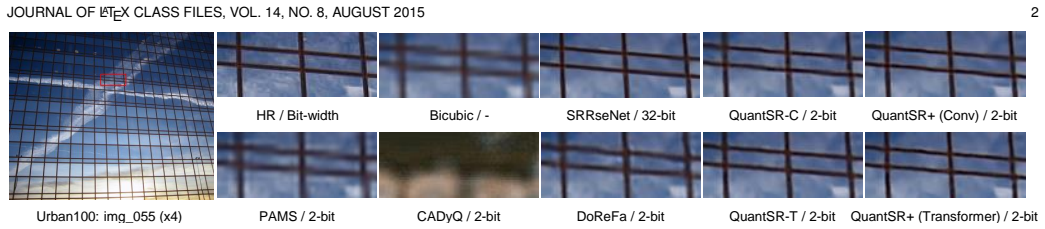
Low-bit quantization is widely used to compress super-resolution (SR) models and reduce storage and computation costs for deployment on resource-limited devices. However, when SR models are pushed to ultra-low precision (2-4 bits), performance can drop sharply due to diminished representational capacity and the detail-sensitive nature of SR. To address these issues, we propose QuantSR+, a unified framework that improves quantization operators, network design, and training optimization, achieving better trade-offs between accuracy and efficiency than prior low-bit SR methods. QuantSR+ mainly relies on three technical contributions: (1) Redistribution-driven Bit Determination (RBD), which reshapes quantization distributions in both forward and backward passes to preserve representation fidelity; (2) Quantized Slimmable Architecture (QSA), which begins with an over-parameterized model and progressively prunes less critical blocks to meet efficiency budgets while pushing the accuracy performance; and (3) Slimming-guided Function-localized Distillation (SFD), which enforces block-aware feature alignment via a direct loss and a progressive, function-local training schedule to capture quantization effects better and speed up convergence. Extensive experiments show that QuantSR+ achieves state-of-the-art performance against both specialized quantized SR methods and generic quantization approaches. For SwinIR-S on Urban100 (x4), it improves PSNR by 0.29 dB over the 2-bit SOTA baseline. Meanwhile, it delivers strong efficiency gains at 2-bit, reducing operations by up to 87.9% and storage by 89.4%. QuantSR+ is effective for both convolutional and transformer-based SR models, indicating broad applicability.
Editorial analysis
A structured set of objections, weighed in public.
Referee Report
Summary. The paper introduces QuantSR+, a unified framework for ultra-low-bit (2-4 bit) quantization of image super-resolution networks. It proposes three components: Redistribution-driven Bit Determination (RBD) to reshape quantization distributions in forward and backward passes, Quantized Slimmable Architecture (QSA) that starts from an over-parameterized model and progressively prunes blocks, and Slimming-guided Function-localized Distillation (SFD) for block-aware feature alignment with a progressive training schedule. The central claim is that this combination achieves state-of-the-art accuracy-efficiency trade-offs on both CNN and transformer SR models, with a reported 0.29 dB PSNR gain over the prior 2-bit SOTA on SwinIR-S for Urban100 (×4) and reductions of up to 87.9% in operations and 89.4% in storage.
Significance. If the reported gains and ablations hold under rigorous verification, the work would be significant for practical deployment of detail-sensitive SR models on resource-constrained devices. The joint handling of quantization operators, architecture slimming, and distillation tailored to quantization effects addresses a recognized bottleneck in low-bit SR, and the claimed applicability across convolutional and transformer backbones increases potential impact. The concrete efficiency numbers and cross-model results strengthen the case for adoption if reproducibility is confirmed.
major comments (2)
- [§4.3] §4.3 (Training schedule): The unified training process that interleaves RBD, QSA progressive pruning, and SFD is presented as stable, but no sensitivity analysis or ablation on the pruning threshold schedule or distillation weight annealing is provided; this is load-bearing because the headline 0.29 dB gain and 87.9% operation reduction are attributed to the joint effect of all three components.
- [Table 2] Table 2 (2-bit SwinIR-S results): The reported PSNR improvement of 0.29 dB over the prior SOTA baseline lacks error bars or multiple-run statistics; given the stochastic nature of quantization-aware training, this weakens the claim that the gain is reliably attributable to the proposed components rather than training variance.
minor comments (3)
- [Eq. (3)] The notation for bit-width assignment in RBD (Eq. 3) uses an undefined symbol E_p; please add its definition or reference the earlier equation where it is introduced.
- [Figure 4] Figure 4 (visual comparisons) would benefit from zoomed insets on high-frequency regions to better illustrate the claimed preservation of detail under 2-bit quantization.
- [§2] The related-work section omits recent generic quantization methods such as those using learnable clipping or mixed-precision search that were published after 2023; a brief comparison paragraph would strengthen the positioning.
Simulated Author's Rebuttal
We thank the referee for the constructive feedback and positive evaluation of our work. We address the major comments point by point below, agreeing that the suggested additions will improve the manuscript.
read point-by-point responses
-
Referee: [§4.3] §4.3 (Training schedule): The unified training process that interleaves RBD, QSA progressive pruning, and SFD is presented as stable, but no sensitivity analysis or ablation on the pruning threshold schedule or distillation weight annealing is provided; this is load-bearing because the headline 0.29 dB gain and 87.9% operation reduction are attributed to the joint effect of all three components.
Authors: We agree that a sensitivity analysis on the pruning threshold schedule and distillation weight annealing would provide additional evidence for the stability of the interleaved training process. While our existing ablations in Section 4 isolate the contributions of RBD, QSA, and SFD, we will add dedicated experiments varying these hyperparameters in the revised manuscript to confirm that the reported gains remain consistent. revision: yes
-
Referee: [Table 2] Table 2 (2-bit SwinIR-S results): The reported PSNR improvement of 0.29 dB over the prior SOTA baseline lacks error bars or multiple-run statistics; given the stochastic nature of quantization-aware training, this weakens the claim that the gain is reliably attributable to the proposed components rather than training variance.
Authors: We acknowledge the stochastic elements in quantization-aware training and the benefit of reporting variability. The 0.29 dB improvement is backed by our component-wise ablations, but to address this concern directly we will rerun the 2-bit SwinIR-S experiments with multiple random seeds and include mean PSNR values with standard deviations in the revised Table 2. revision: yes
Circularity Check
No significant circularity detected
full rationale
The paper introduces QuantSR+ as an empirical framework combining three proposed components (RBD for redistribution-driven bit determination, QSA for quantized slimmable architecture, and SFD for slimmable-guided distillation) to improve low-bit quantized super-resolution. All central claims rest on experimental benchmarks (e.g., 0.29 dB PSNR gain on SwinIR-S/Urban100 at 2 bits) and comparisons to prior methods rather than any first-principles derivation, mathematical prediction, or self-referential equation. No load-bearing self-citations, fitted inputs renamed as predictions, or ansatzes smuggled via prior work are present in the provided text; the results are externally falsifiable through replication on standard SR datasets and do not reduce to tautological inputs by construction.
Axiom & Free-Parameter Ledger
Lean theorems connected to this paper
-
IndisputableMonolith/Cost/FunctionalEquation.leanwashburn_uniqueness_aczel unclear?
unclearRelation between the paper passage and the cited Recognition theorem.
Redistribution-driven Bit Determination (RBD), Quantized Slimmable Architecture (QSA), Slimming-guided Function-localized Distillation (SFD)
-
IndisputableMonolith/Foundation/RealityFromDistinction.leanreality_from_one_distinction unclear?
unclearRelation between the paper passage and the cited Recognition theorem.
2-bit QuantSR+ improves PSNR by 0.29 dB over SOTA baseline while reducing operations by 87.9 %
What do these tags mean?
- matches
- The paper's claim is directly supported by a theorem in the formal canon.
- supports
- The theorem supports part of the paper's argument, but the paper may add assumptions or extra steps.
- extends
- The paper goes beyond the formal theorem; the theorem is a base layer rather than the whole result.
- uses
- The paper appears to rely on the theorem as machinery.
- contradicts
- The paper's claim conflicts with a theorem or certificate in the canon.
- unclear
- Pith found a possible connection, but the passage is too broad, indirect, or ambiguous to say the theorem truly supports the claim.
Reference graph
Works this paper leans on
-
[1]
Fast, accurate, and lightweight super-resolution with cascading residual network
Namhyuk Ahn, Byungkon Kang, and Kyung-Ah Sohn. Fast, accurate, and lightweight super-resolution with cascading residual network. InECCV, 2018
work page 2018
-
[2]
Estimating or Propagating Gradients Through Stochastic Neurons for Conditional Computation
Yoshua Bengio, Nicholas Léonard, and Aaron Courville. Estimating or propagating gradients through stochastic neurons for conditional computation.arXiv preprint arXiv:1308.3432, 2013
work page internal anchor Pith review Pith/arXiv arXiv 2013
-
[3]
Low-complexity single-image super- resolution based on nonnegative neighbor embedding
Marco Bevilacqua, Aline Roumy, Christine Guillemot, and Marie Line Alberi-Morel. Low-complexity single-image super- resolution based on nonnegative neighbor embedding. InBMVC, 2012
work page 2012
-
[4]
Hanlin Chen, Li’An Zhuo, Baochang Zhang, Xiawu Zheng, Jianzhuang Liu, David Doermann, and Rongrong Ji. Binarized neural architecture search.AAAI 2020 - 34th AAAI Conference on Artificial Intelligence, pages 10526–10533, 2020
work page 2020
-
[6]
PACT: Parameterized Clipping Activation for Quantized Neural Networks
Jungwook Choi, Zhuo Wang, Swagath Venkataramani, Pierce I-Jen Chuang, Vijayalakshmi Srinivasan, and Kailash Gopalakrishnan. Pact: Parameterized clipping activation for quantized neural networks.arXiv preprint arXiv:1805.06085, 2018
work page internal anchor Pith review Pith/arXiv arXiv 2018
-
[7]
Low-bit quantization of neural networks for efficient inference
Yoni Choukroun, Eli Kravchik, Fan Yang, and Pavel Kisilev. Low-bit quantization of neural networks for efficient inference. InICCVW, 2019
work page 2019
-
[8]
Xiangxiang Chu, Bo Zhang, Hailong Ma, Ruijun Xu, and Qingyuan Li. Fast, accurate and lightweight super-resolution with neural architecture search.arXiv preprint arXiv:1901.07261, 2019
-
[9]
HAWQ: Hessian aware quantization of neural net- works with mixed-precision
Zhen Dong, Zhewei Yao, Amir Gholami, Michael Mahoney, and Kurt Keutzer. HAWQ: Hessian aware quantization of neural net- works with mixed-precision. InProceedings of the IEEE International Conference on Computer Vision, 2019
work page 2019
-
[10]
An Image is Worth 16x16 Words: Transformers for Image Recognition at Scale
Alexey Dosovitskiy, Lucas Beyer, Alexander Kolesnikov, Dirk Weis- senborn, Xiaohua Zhai, Thomas Unterthiner, Mostafa Dehghani, Matthias Minderer, Georg Heigold, Sylvain Gelly, et al. An image is worth 16x16 words: Transformers for image recognition at scale. arXiv preprint arXiv:2010.11929, 2020
work page internal anchor Pith review Pith/arXiv arXiv 2010
-
[11]
Amir Gholami, Sehoon Kim, Zhen Dong, Zhewei Yao, Michael W. Mahoney, and Kurt Keutzer. A Survey of Quantization Methods for Efficient Neural Network Inference.Low-Power Computer Vision, pages 291–326, 3 2022
work page 2022
-
[12]
Yong Guo, Jingdong Wang, Qi Chen, Jiezhang Cao, Zeshuai Deng, Yanwu Xu, Jian Chen, and Mingkui Tan. Towards lightweight super-resolution with dual regression learning.IEEE Transactions on Pattern Analysis and Machine Intelligence, 2024
work page 2024
-
[13]
B. Hassibi and D. G. Stork. Second order derivatives for network pruning: Optimal brain surgeon. InNeurIPS, 1993
work page 1993
-
[14]
Fakd: Feature-affinity based knowledge distillation for efficient image super-resolution
Zibin He, Tao Dai, Jian Lu, Yong Jiang, and Shu-Tao Xia. Fakd: Feature-affinity based knowledge distillation for efficient image super-resolution. InICIP, 2020
work page 2020
-
[15]
Distilling the knowledge in a neural network
Geoffrey Hinton, Oriol Vinyals, and Jeff Dean. Distilling the knowledge in a neural network. InNeurIPS Workshop, 2014
work page 2014
-
[16]
Cadyq: Content-aware dynamic quantization for image super-resolution
Cheeun Hong, Sungyong Baik, Heewon Kim, Seungjun Nah, and Kyoung Mu Lee. Cadyq: Content-aware dynamic quantization for image super-resolution. InECCV, 2022
work page 2022
-
[17]
Cheeun Hong, Sungyong Baik, Heewon Kim, Seungjun Nah, and Kyoung Mu Lee. Cadyq, 05 2023
work page 2023
-
[18]
Daq: Channel-wise distribution-aware quantization for deep image super-resolution networks
Cheeun Hong, Heewon Kim, Sungyong Baik, Junghun Oh, and Ky- oung Mu Lee. Daq: Channel-wise distribution-aware quantization for deep image super-resolution networks. InWACV, 2022
work page 2022
-
[19]
Adabm: On-the-fly adaptive bit mapping for image super-resolution
Cheeun Hong and Kyoung Mu Lee. Adabm: On-the-fly adaptive bit mapping for image super-resolution. InProceedings of the IEEE/CVF Conference on Computer Vision and Pattern Recognition, pages 2641– 2650, 2024
work page 2024
-
[20]
Overcoming distribution mismatch in quantizing image super-resolution networks
Cheeun Hong and Kyoung Mu Lee. Overcoming distribution mismatch in quantizing image super-resolution networks. In European Conference on Computer Vision, pages 380–396. Springer, 2024
work page 2024
-
[21]
Single image super-resolution from transformed self-exemplars
Jia-Bin Huang, Abhishek Singh, and Narendra Ahuja. Single image super-resolution from transformed self-exemplars. InCVPR, 2015
work page 2015
-
[22]
Accurate post training quantization with small calibration sets
Itay Hubara, Yury Nahshan, Yair Hanani, Ron Banner, and Daniel Soudry. Accurate post training quantization with small calibration sets. InICML, 2021
work page 2021
-
[23]
Lightweight image super-resolution with information multi- distillation network
Zheng Hui, Xinbo Gao, Yunchu Yang, and Xiumei Wang. Lightweight image super-resolution with information multi- distillation network. InACM MM, 2019
work page 2019
-
[24]
Andrey Ignatov, Radu Timofte, Maurizio Denna, Abdel Younes, Ganzorig Gankhuyag, Jingang Huh, Myeong Kyun Kim, Kihwan Yoon, Hyeon-Cheol Moon, Seungho Lee, et al. Efficient and accurate quantized image super-resolution on mobile npus, mobile ai & aim 2022 challenge: report. InECCVW, 2022
work page 2022
-
[25]
Adaptive quantization of model updates for communication-efficient federated learning
Divyansh Jhunjhunwala, Advait Gadhikar, Gauri Joshi, and Yonina C Eldar. Adaptive quantization of model updates for communication-efficient federated learning. InICASSP, 2021
work page 2021
-
[26]
Deeply-recursive convolutional network for image super-resolution
Jiwon Kim, Jung Kwon Lee, and Kyoung Mu Lee. Deeply-recursive convolutional network for image super-resolution. InCVPR, 2016
work page 2016
-
[27]
Adam: A method for stochastic optimization
Diederik Kingma and Jimmy Ba. Adam: A method for stochastic optimization. InICLR, 2015
work page 2015
-
[28]
Photo-realistic single image super-resolution using a generative adversarial network
Christian Ledig, Lucas Theis, Ferenc Huszár, Jose Caballero, Andrew Cunningham, Alejandro Acosta, Andrew Aitken, Alykhan Tejani, Johannes Totz, Zehan Wang, and Wenzhe Shi. Photo-realistic single image super-resolution using a generative adversarial network. InCVPR, 2017
work page 2017
-
[29]
Refqsr: Reference-based quantization for image super-resolution networks
Hongjae Lee, Jun-Sang Yoo, and Seung-Won Jung. Refqsr: Reference-based quantization for image super-resolution networks. IEEE Transactions on Image Processing, 33:2823–2834, 2024
work page 2024
-
[30]
Learning with privileged information for efficient image super- resolution
Wonkyung Lee, Junghyup Lee, Dohyung Kim, and Bumsub Ham. Learning with privileged information for efficient image super- resolution. InECCV, 2020
work page 2020
-
[31]
Pams: Quantized super- resolution via parameterized max scale
Huixia Li, Chenqian Yan, Shaohui Lin, Xiawu Zheng, Baochang Zhang, Fan Yang, and Rongrong Ji. Pams: Quantized super- resolution via parameterized max scale. InECCV, 2020
work page 2020
-
[32]
Huixia Li, Chenqian Yan, Shaohui Lin, Xiawu Zheng, Baochang Zhang, Fan Yang, and Rongrong Ji. Pams, 05 2023
work page 2023
-
[33]
Swinir: Image restoration using swin trans- former
Jingyun Liang, Jiezhang Cao, Guolei Sun, Kai Zhang, Luc Van Gool, and Radu Timofte. Swinir: Image restoration using swin trans- former. InICCVW, 2021
work page 2021
-
[34]
Enhanced deep residual networks for single image super-resolution
Bee Lim, Sanghyun Son, Heewon Kim, Seungjun Nah, and Ky- oung Mu Lee. Enhanced deep residual networks for single image super-resolution. InCVPRW, 2017
work page 2017
-
[35]
Diffbir: Towards blind image restoration with generative diffusion prior
Xinqi Lin, Jingwen He, Ziyan Chen, Zhaoyang Lyu, Bo Dai, Fanghua Yu, Wanli Ouyang, Yu Qiao, and Chao Dong. Diffbir: Towards blind image restoration with generative diffusion prior. ECCV, 2024
work page 2024
-
[36]
Anran Liu, Yihao Liu, Jinjin Gu, Yu Qiao, and Chao Dong. Blind image super-resolution: A survey and beyond.IEEE transactions on pattern analysis and machine intelligence, 45(5):5461–5480, 2022
work page 2022
-
[37]
Super- resolution model quantized in multi-precision.Electronics, 10(17):2176, 2021
Jingyu Liu, Qiong Wang, Dunbo Zhang, and Li Shen. Super- resolution model quantized in multi-precision.Electronics, 10(17):2176, 2021
work page 2021
-
[38]
Kai Liu, Haotong Qin, Yong Guo, Xin Yuan, Linghe Kong, Guihai Chen, and Yulun Zhang. 2dquant: Low-bit post-training quanti- zation for image super-resolution.Advances in Neural Information Processing Systems, 37:71068–71084, 2025
work page 2025
-
[39]
Towards robust full low-bit quantization of super resolution networks
Denis Makhov, Ruslan Ostapets, Irina Zhelavskaya, Dehua Song, and Kirill Solodskikh. Towards robust full low-bit quantization of super resolution networks. InEuropean Conference on Computer Vision, pages 182–198. Springer, 2024
work page 2024
-
[40]
David Martin, Charless Fowlkes, Doron Tal, and Jitendra Malik. A database of human segmented natural images and its application to evaluating segmentation algorithms and measuring ecological statistics. InICCV, 2001
work page 2001
-
[41]
Sketch-based manga retrieval using manga109 dataset.Multimedia Tools and Applications, 2017
Yusuke Matsui, Kota Ito, Yuji Aramaki, Azuma Fujimoto, Toru Ogawa, Toshihiko Yamasaki, and Kiyoharu Aizawa. Sketch-based manga retrieval using manga109 dataset.Multimedia Tools and Applications, 2017
work page 2017
-
[42]
Haotong Qin, Yulun Zhang, Yifu Ding, Xianglong Liu, Martin Danelljan, Fisher Yu, et al. Quantsr, 10 2023
work page 2023
-
[43]
Haotong Qin, Yulun Zhang, Yifu Ding, Xianglong Liu, Martin Danelljan, Fisher Yu, et al. Quantsr: accurate low-bit quantization for efficient image super-resolution.Advances in Neural Information Processing Systems, 36, 2024
work page 2024
-
[44]
Global learnable attention for single image super-resolution
Jian-Nan Su, Min Gan, Guang-Yong Chen, Jia-Li Yin, and CL Philip Chen. Global learnable attention for single image super-resolution. JOURNAL OF LATEX CLASS FILES, VOL. 14, NO. 8, AUGUST 2015 14 IEEE Transactions on Pattern Analysis and Machine Intelligence, 45(7):8453–8465, 2022
work page 2015
-
[45]
Liting Sun, Jingwei Xin, Keyu Li, Jie Li, Nannan Wang, and Xinbo Gao. I 2nq: Inter and intra nonuniform quantization for single image super-resolution.IEEE Transactions on Neural Networks and Learning Systems, 2024
work page 2024
-
[46]
Wanjie Sun and Zhenzhong Chen. Learning many-to-many mapping for unpaired real-world image super-resolution and downscaling.IEEE Transactions on Pattern Analysis and Machine Intelligence, 2024
work page 2024
-
[47]
Cabm: Content-aware bit mapping for single image super-resolution network with large input
Senmao Tian, Ming Lu, Jiaming Liu, Yandong Guo, Yurong Chen, and Shunli Zhang. Cabm: Content-aware bit mapping for single image super-resolution network with large input. InProceedings of the IEEE/CVF Conference on Computer Vision and Pattern Recognition, pages 1756–1765, 2023
work page 2023
-
[48]
Ntire 2017 challenge on single image super- resolution: Methods and results
Radu Timofte, Eirikur Agustsson, Luc Van Gool, Ming-Hsuan Yang, Lei Zhang, Bee Lim, Sanghyun Son, Heewon Kim, Seungjun Nah, Kyoung Mu Lee, et al. Ntire 2017 challenge on single image super- resolution: Methods and results. InCVPRW, 2017
work page 2017
-
[49]
Toward accurate post-training quantization for image super resolution
Zhijun Tu, Jie Hu, Hanting Chen, and Yunhe Wang. Toward accurate post-training quantization for image super resolution. In Proceedings of the IEEE/CVF Conference on Computer Vision and Pattern Recognition, pages 5856–5865, 2023
work page 2023
-
[50]
Fully quantized image super-resolution networks
Hu Wang, Peng Chen, Bohan Zhuang, and Chunhua Shen. Fully quantized image super-resolution networks. InACM MM, 2021
work page 2021
-
[51]
Outlier- aware post-training quantization for image super-resolution
Hailing Wang, Jianglin Lu, Yitian Zhang, and Yun Fu. Outlier- aware post-training quantization for image super-resolution. In Proceedings of the IEEE/CVF International Conference on Computer Vision, pages 16175–16184, 2025
work page 2025
-
[52]
Jianyi Wang, Zongsheng Yue, Shangchen Zhou, Kelvin CK Chan, and Chen Change Loy. Exploiting diffusion prior for real-world image super-resolution.International Journal of Computer Vision, 132(12):5929–5949, 2024
work page 2024
-
[53]
Mingshen Wang, Zhao Zhang, Feng Li, Ke Xu, Kang Miao, and Meng Wang. Thinking in granularity: Dynamic quantization for image super-resolution by intriguing multi-granularity clues. In Proceedings of the AAAI Conference on Artificial Intelligence, volume 39, pages 7826–7834, 2025
work page 2025
-
[54]
Image quality assessment: from error visibility to structural similarity.TIP, 2004
Zhou Wang, Alan C Bovik, Hamid R Sheikh, and Eero P Simon- celli. Image quality assessment: from error visibility to structural similarity.TIP, 2004
work page 2004
-
[55]
Hao Wu, Patrick Judd, Xiaojie Zhang, Mikhail Isaev, and Paulius Micikevicius. Integer quantization for deep learning inference: Principles and empirical evaluation.arXiv preprint arXiv:2004.09602, 2020
-
[56]
One-step effective diffusion network for real-world image super- resolution.NIPS, 2024
Rongyuan Wu, Lingchen Sun, Zhiyuan Ma, and Lei Zhang. One-step effective diffusion network for real-world image super- resolution.NIPS, 2024
work page 2024
-
[57]
Binarized neural network for single image super resolution
Jingwei Xin, Nannan Wang, Xinrui Jiang, Jie Li, Heng Huang, and Xinbo Gao. Binarized neural network for single image super resolution. InECCV, 2020
work page 2020
-
[58]
Zongsheng Yue, Kang Liao, and Chen Change Loy. Arbitrary- steps image super-resolution via diffusion inversion.arXiv preprint arXiv:2412.09013, 2024
-
[59]
On single image scale-up using sparse-representations
Roman Zeyde, Michael Elad, and Matan Protter. On single image scale-up using sparse-representations. InProc. 7th Int. Conf. Curves Surf., 2010
work page 2010
-
[60]
Densely connected pyramid dehazing network
He Zhang and Vishal M Patel. Densely connected pyramid dehazing network. InCVPR, 2018
work page 2018
-
[61]
Jingyi Zhang, Ziwei Wang, Haoyu Wang, Jie Zhou, and Jiwen Lu. Anycost network quantization for image super-resolution.IEEE Transactions on Image Processing, 33:2279–2292, 2024
work page 2024
-
[62]
Learning a single convolutional super-resolution network for multiple degradations
Kai Zhang, Wangmeng Zuo, and Lei Zhang. Learning a single convolutional super-resolution network for multiple degradations. InCVPR, 2018
work page 2018
-
[63]
Yulun Zhang, Yapeng Tian, Yu Kong, Bineng Zhong, and Yun Fu. Residual dense network for image restoration.IEEE transactions on pattern analysis and machine intelligence, 43(7):2480–2495, 2021
work page 2021
-
[64]
Aligned structured sparsity learning for efficient image super-resolution
Yulun Zhang, Huan Wang, Can Qin, and Yun Fu. Aligned structured sparsity learning for efficient image super-resolution. In NeurIPS, 2021
work page 2021
-
[65]
DoReFa-Net: Training Low Bitwidth Convolutional Neural Networks with Low Bitwidth Gradients
Shuchang Zhou, Yuxin Wu, Zekun Ni, Xinyu Zhou, He Wen, and Yuheng Zou. Dorefa-net: Training low bitwidth convolutional neural networks with low bitwidth gradients.arXiv preprint arXiv:1606.06160, 2016. JOURNAL OF LATEX CLASS FILES, VOL. 14, NO. 8, AUGUST 2015 15 Haotong Qinis a Postdoctoral Researcher at the Center for Project-Based Learning (PBL) D- ITET...
work page internal anchor Pith review Pith/arXiv arXiv 2016
discussion (0)
Sign in with ORCID, Apple, or X to comment. Anyone can read and Pith papers without signing in.