The habitability trade-off: Chemical decoupling and quenching in massive galaxies
Pith reviewed 2026-05-22 04:15 UTC · model grok-4.3
The pith
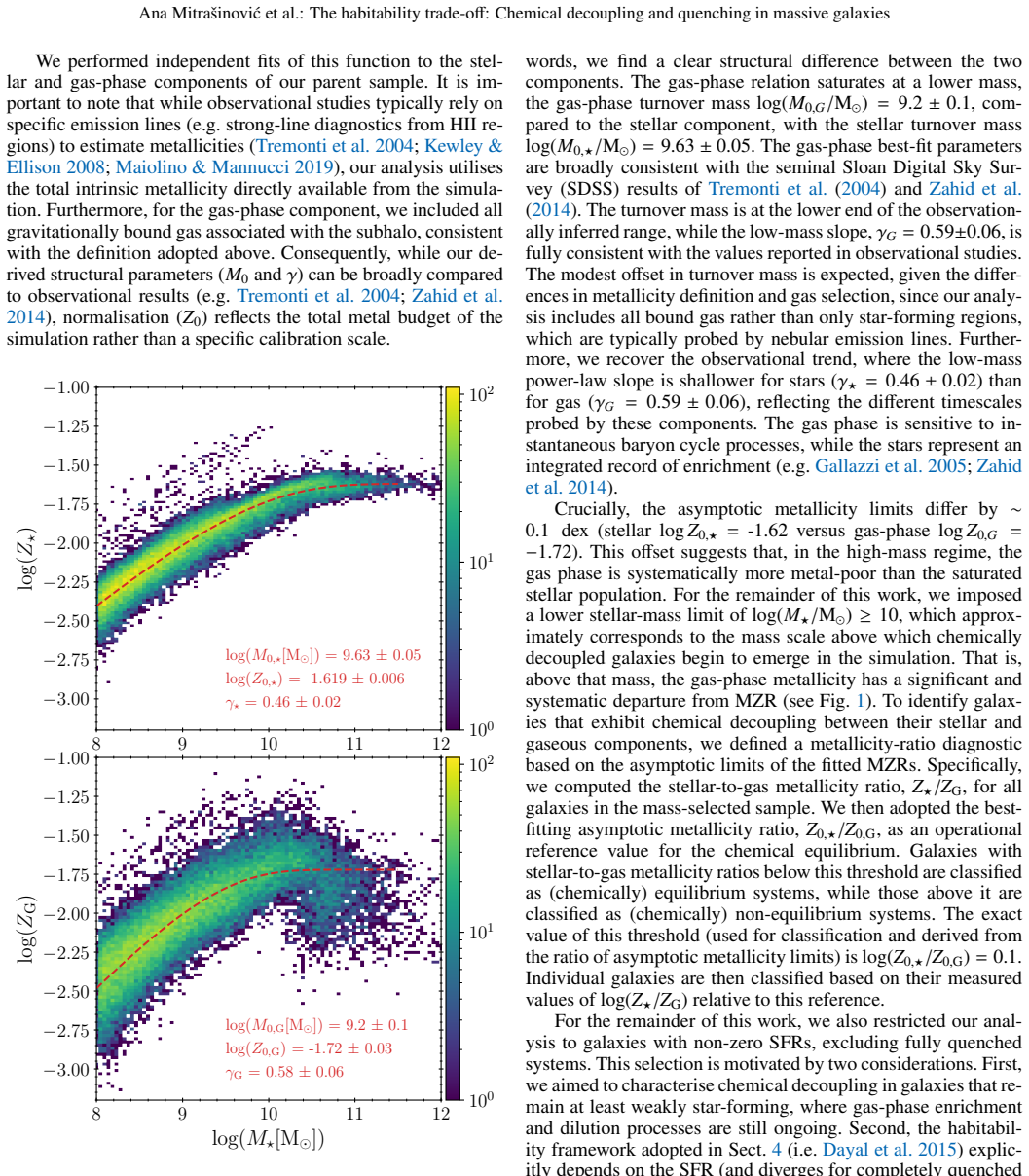
Non-equilibrium galaxies dominate the high end of present-day habitability proxy distributions by more than an order of magnitude.
A machine-rendered reading of the paper's core claim, the machinery that carries it, and where it could break.
Core claim
A substantial fraction (~31.5%) of massive star-forming galaxies at z=0 are chemically decoupled, with metal-rich stars coexisting with diluted gas, driven by mergers and partial quenching; when a terrestrial planet abundance proxy is applied, these non-equilibrium systems dominate the high end of the inferred present-day habitability distribution and exceed equilibrium systems by more than an order of magnitude, indicating a habitability trade-off where the same processes that suppress future planet formation also reduce sterilising hazards.
What carries the argument
The terrestrial planet abundance proxy that combines stellar mass, gas-phase metallicity, and the rate of sterilising events, used to compare habitability outcomes between chemically decoupled and equilibrium galaxy populations.
If this is right
- Non-equilibrium galaxies represent a transitional evolutionary phase with suppressed star-formation rates and reduced gas fractions.
- Galactic habitability is intrinsically time-dependent rather than a fixed property of a galaxy.
- Galaxies exiting their peak star-forming phase form a distinct demographic that is highly relevant for galaxy-scale habitability assessments.
- The Andromeda galaxy (M31) displays qualitative similarities to the chemically decoupled population identified in the simulation.
Where Pith is reading between the lines
- Similar chemically decoupled signatures could be searched for in observational surveys to flag galaxies currently offering reduced radiation hazards to their planets.
- The time-dependent nature of the habitability trade-off suggests that the habitability ranking of a given galaxy can shift as it moves through merger or quenching episodes.
- Refinements to the proxy might incorporate explicit time evolution to track how the trade-off plays out over cosmic time.
Load-bearing premise
The terrestrial planet abundance proxy that combines stellar mass, gas-phase metallicity, and the rate of sterilising events accurately captures the net habitability outcome for decoupled versus equilibrium populations.
What would settle it
Direct observations or counts showing that chemically decoupled galaxies like M31 do not host a substantially higher number of terrestrial planets or lower sterilising event rates than comparable equilibrium galaxies.
Figures


read the original abstract
Massive galaxies experience complex evolutionary processes, including mergers and gas accretion, which can disrupt the chemical equilibrium between their stellar and gaseous components. Using the IllustrisTNG (TNG100) simulation at $z=0$, we investigated the prevalence and physical properties of such chemically decoupled systems within the massive star-forming galaxy population. We identify a substantial subpopulation ($\sim 31.5\%$ of the sample) that exhibits systematic stellar-gas decoupling, characterised by a metal-rich stellar component coexisting with a diluted gas reservoir. These non-equilibrium galaxies are closely linked to recent merger activity and partial quenching, and display systematically suppressed star-formation rates and reduced gas fractions, consistent with a transitional evolutionary phase. We then examined the implications of this phase for galaxy-scale habitability prescriptions by applying a terrestrial planet abundance proxy that combines stellar mass, gas-phase metallicity, and the rate of sterilising events. Despite their diluted gas reservoirs, non-equilibrium galaxies dominate the high end of the inferred present-day habitability proxy distribution, exceeding equilibrium systems by more than an order of magnitude. We interpret this as a habitability trade-off: the same gas dilution and quenching processes that reduce the efficiency of future terrestrial planet formation simultaneously create a transient phase of suppressed radiation hazards for existing planets. The Andromeda galaxy (M31) shows qualitative similarities to this chemically decoupled population, suggesting that galaxies exiting their peak star-forming phase represent a distinct and highly relevant demographic for galaxy-scale habitability. Galactic habitability is therefore intrinsically time-dependent.
Editorial analysis
A structured set of objections, weighed in public.
Referee Report
Summary. The manuscript uses the IllustrisTNG TNG100 simulation at z=0 to identify a subpopulation (~31.5%) of massive star-forming galaxies exhibiting chemical decoupling, with metal-rich stellar components coexisting with diluted gas reservoirs. These systems are linked to recent mergers and partial quenching, showing suppressed SFR and gas fractions. Applying a terrestrial planet abundance proxy that combines stellar mass, gas-phase metallicity, and sterilising event rates, the authors find that non-equilibrium galaxies dominate the high end of the present-day habitability proxy distribution by more than an order of magnitude. They interpret this as a habitability trade-off and note qualitative similarities to M31, concluding that galactic habitability is time-dependent.
Significance. If the proxy holds, the work highlights a transient phase in galaxy evolution where gas dilution and quenching reduce future planet formation efficiency but suppress radiation hazards, potentially elevating present-day habitability. This connects simulation-based galaxy demographics to astrobiological considerations and suggests galaxies exiting peak star formation (e.g., M31 analogs) as key targets. The identification of the decoupled subpopulation and its merger association provides a concrete demographic for further study.
major comments (2)
- [Habitability proxy definition and application] The central claim that non-equilibrium galaxies exceed equilibrium systems by more than an order of magnitude in the habitability proxy (abstract and results section on proxy application) rests on an author-defined weighting of stellar mass, gas-phase metallicity, and sterilising event rate. No explicit functional form, calibration against exoplanet occurrence rates, or sensitivity tests to alternative weightings (e.g., cumulative vs. instantaneous sterilising rates) are provided, so the dominance cannot be independently verified and may not survive plausible reweightings that emphasize diluted metallicity more strongly.
- [Identification of chemically decoupled systems] Section on subpopulation identification: the ~31.5% fraction and criteria for 'systematic stellar-gas decoupling' (metal-rich stars with diluted gas) lack quantitative thresholds or robustness checks against variations in metallicity measurement or sample selection, which directly affects the size of the population to which the proxy is applied and thus the reported dominance.
minor comments (2)
- [Proxy description] Clarify the exact definition of sterilising events (e.g., supernovae, AGN activity, or other) and whether the rate is instantaneous or integrated over time, as this enters the proxy directly.
- [Discussion] The link to M31 is described as 'qualitative similarities'; adding a brief quantitative comparison of its observed properties to the simulated decoupled population would strengthen the observational tie-in.
Simulated Author's Rebuttal
We thank the referee for their careful reading and constructive comments, which have helped us improve the clarity and robustness of the manuscript. We address each major comment below and have revised the text accordingly to provide the requested details and tests.
read point-by-point responses
-
Referee: [Habitability proxy definition and application] The central claim that non-equilibrium galaxies exceed equilibrium systems by more than an order of magnitude in the habitability proxy (abstract and results section on proxy application) rests on an author-defined weighting of stellar mass, gas-phase metallicity, and sterilising event rate. No explicit functional form, calibration against exoplanet occurrence rates, or sensitivity tests to alternative weightings (e.g., cumulative vs. instantaneous sterilising rates) are provided, so the dominance cannot be independently verified and may not survive plausible reweightings that emphasize diluted metallicity more strongly.
Authors: We agree that the explicit functional form of the proxy should be stated more prominently. The proxy is defined in Section 3.2 as a multiplicative combination of normalized stellar mass, inverse gas-phase metallicity (to reflect dilution effects), and an inverse sterilising event rate term; we will add the precise equation and variable definitions to the revised manuscript. While a direct calibration against observed exoplanet occurrence rates is beyond the scope of this simulation-based study, we have now performed sensitivity tests using alternative weightings, including those that place greater emphasis on diluted metallicity and both cumulative and instantaneous sterilising rates. These tests show that non-equilibrium galaxies still dominate the upper end of the distribution, although the factor of dominance varies between 5 and 15 depending on the weighting. We have added a new subsection discussing these tests and the proxy's limitations. revision: yes
-
Referee: [Identification of chemically decoupled systems] Section on subpopulation identification: the ~31.5% fraction and criteria for 'systematic stellar-gas decoupling' (metal-rich stars with diluted gas) lack quantitative thresholds or robustness checks against variations in metallicity measurement or sample selection, which directly affects the size of the population to which the proxy is applied and thus the reported dominance.
Authors: We acknowledge that the decoupling criteria require more quantitative specification. In the revised manuscript we now define the decoupling threshold explicitly (stellar metallicity exceeding gas-phase metallicity by at least 0.2 dex, with both measurements above a minimum signal-to-noise threshold). We have also added robustness checks by varying the metallicity calibration method, the minimum stellar mass cut, and the sample selection (e.g., excluding recent major mergers). The subpopulation fraction remains between 28% and 34% across these variations, and the dominance in the habitability proxy persists. These details and the associated figures have been incorporated into Section 2. revision: yes
Circularity Check
No significant circularity detected in habitability proxy application
full rationale
The paper identifies chemically decoupled non-equilibrium galaxies via stellar-gas metallicity differences and associations with mergers/quenching in the TNG100 simulation. It then applies a composite terrestrial planet abundance proxy (stellar mass + gas-phase metallicity + sterilising event rate) to compare the two subpopulations. This yields the reported dominance result as an output of the simulation data under the chosen proxy, without the proxy definition reducing to the decoupling metric or the subpopulations being defined in terms of the proxy itself. No self-citations, fitted parameters renamed as predictions, or ansatzes are shown as load-bearing for the central claim. The analysis remains self-contained against the simulation outputs and the stated proxy construction.
Axiom & Free-Parameter Ledger
free parameters (1)
- habitability proxy weights
axioms (1)
- domain assumption IllustrisTNG TNG100 accurately reproduces the chemical evolution and merger-driven gas dilution in massive galaxies at z=0
Lean theorems connected to this paper
-
IndisputableMonolith/Cost/FunctionalEquation.leanwashburn_uniqueness_aczel unclear?
unclearRelation between the paper passage and the cited Recognition theorem.
We adopted the framework introduced by Dayal et al. (2015), which estimates the abundance of terrestrial planets in a galaxy by combining its stellar mass (M⋆), gas-phase metallicity (Z), and SFR.
-
IndisputableMonolith/Foundation/RealityFromDistinction.leanreality_from_one_distinction unclear?
unclearRelation between the paper passage and the cited Recognition theorem.
Non-equilibrium galaxies dominate the high end of the inferred present-day habitability proxy distribution, exceeding equilibrium systems by more than an order of magnitude.
What do these tags mean?
- matches
- The paper's claim is directly supported by a theorem in the formal canon.
- supports
- The theorem supports part of the paper's argument, but the paper may add assumptions or extra steps.
- extends
- The paper goes beyond the formal theorem; the theorem is a base layer rather than the whole result.
- uses
- The paper appears to rely on the theorem as machinery.
- contradicts
- The paper's claim conflicts with a theorem or certificate in the canon.
- unclear
- Pith found a possible connection, but the passage is too broad, indirect, or ambiguous to say the theorem truly supports the claim.
Reference graph
Works this paper leans on
-
[1]
Arnaboldi, M., Bhattacharya, S., Gerhard, O., et al. 2022, A&A, 666, A109
work page 2022
- [2]
-
[3]
Barmby, P., Ashby, M. L. N., Bianchi, L., et al. 2006, ApJ, 650, L45
work page 2006
-
[4]
Bhattacharya, S., Arnaboldi, M., Caldwell, N., et al. 2022, MNRAS, 517, 2343
work page 2022
-
[5]
Bhattacharya, S., Arnaboldi, M., Hammer, F., et al. 2023, MNRAS, 522, 6010
work page 2023
-
[6]
Buchhave, L. A. & Latham, D. W. 2015, ApJ, 808, 187
work page 2015
-
[7]
Buchhave, L. A., Latham, D. W., Johansen, A., et al. 2012, Nature, 486, 375
work page 2012
-
[8]
Bustamante, S., Sparre, M., Springel, V ., & Grand, R. J. J. 2018, MNRAS, 479, 3381
work page 2018
- [9]
-
[10]
Colombo, D., Kalinova, V ., Bazzi, Z., et al. 2025, A&A, 699, A366
work page 2025
-
[11]
Crain, R. A. & van de V oort, F. 2023, ARA&A, 61, 473
work page 2023
-
[12]
Dayal, P., Cockell, C., Rice, K., & Mazumdar, A. 2015, ApJ, 810, L2 Article number, page 10 of 11 Ana Mitrašinovi´c et al.: The habitability trade-off: Chemical decoupling and quenching in massive galaxies
work page 2015
-
[13]
Dey, A., Najita, J. R., Koposov, S. E., et al. 2023, ApJ, 944, 1 D’Souza, R. & Bell, E. F. 2018, Nature Astronomy, 2, 737
work page 2023
-
[14]
Eisert, L., Pillepich, A., Nelson, D., et al. 2023, MNRAS, 519, 2199
work page 2023
-
[15]
Ferguson, A. M. N., Irwin, M. J., Ibata, R. A., Lewis, G. F., & Tanvir, N. R. 2002, AJ, 124, 1452
work page 2002
-
[16]
Fischer, D. A. & Valenti, J. 2005, ApJ, 622, 1102
work page 2005
-
[17]
Font, A. S. 2025, Nature Astronomy, 9, 1107
work page 2025
- [18]
-
[19]
2017, International Journal of Astrobiology, 16, 60
Forgan, D., Dayal, P., Cockell, C., & Libeskind, N. 2017, International Journal of Astrobiology, 16, 60
work page 2017
- [20]
-
[21]
Gallazzi, A., Charlot, S., Brinchmann, J., White, S. D. M., & Tremonti, C. A. 2005, MNRAS, 362, 41
work page 2005
-
[22]
M., Guhathakurta, P., Kollipara, P., et al
Gilbert, K. M., Guhathakurta, P., Kollipara, P., et al. 2009, ApJ, 705, 1275
work page 2009
-
[23]
Gilbert, K. M., Kalirai, J. S., Guhathakurta, P., et al. 2014, ApJ, 796, 76
work page 2014
- [24]
- [25]
-
[26]
1997, Monthly Notices of the Royal Astronomical Society, 285, 403
Gonzalez, G. 1997, Monthly Notices of the Royal Astronomical Society, 285, 403
work page 1997
- [27]
-
[28]
Gowanlock, M. G. & Morrison, I. S. 2018, in Habitability of the Universe Before Earth, ed. R. Gordon & A. A. Sharov, Astrobiology Exploring Life on Earth and Beyond (Academic Press), 149–171
work page 2018
-
[29]
Gowanlock, M. G., Patton, D. R., & McConnell, S. M. 2011, Astrobiology, 11, 855
work page 2011
-
[30]
Guhathakurta, P., Rich, R. M., Reitzel, D. B., et al. 2006, AJ, 131, 2497
work page 2006
- [31]
-
[32]
Hart, M. H. 1979, Icarus, 37, 351
work page 1979
- [33]
-
[34]
Hwang, H.-C., Barrera-Ballesteros, J. K., Heckman, T. M., et al. 2019, ApJ, 872, 144
work page 2019
-
[35]
Ibata, R., Irwin, M., Lewis, G., Ferguson, A. M. N., & Tanvir, N. 2001, Nature, 412, 49
work page 2001
-
[36]
Ibata, R., Martin, N. F., Irwin, M., et al. 2007, ApJ, 671, 1591
work page 2007
-
[37]
Ibata, R. A., Lewis, G. F., McConnachie, A. W., et al. 2014, ApJ, 780, 128
work page 2014
-
[38]
Kaib, N. A. 2018, in Handbook of Exoplanets, ed. H. J. Deeg & J. A. Belmonte, 59
work page 2018
-
[39]
Kalirai, J. S., Gilbert, K. M., Guhathakurta, P., et al. 2006, ApJ, 648, 389
work page 2006
-
[40]
Kasting, J. F., Whitmire, D. P., & Reynolds, R. T. 1993, Icarus, 101, 108
work page 1993
-
[41]
Kewley, L. J. & Ellison, S. L. 2008, ApJ, 681, 1183
work page 2008
-
[42]
Kobayashi, C., Bhattacharya, S., Arnaboldi, M., & Gerhard, O. 2023, ApJ, 956, L14
work page 2023
- [43]
- [44]
-
[45]
Licquia, T. C. & Newman, J. A. 2015, ApJ, 806, 96
work page 2015
-
[46]
Lin, L., Ellison, S. L., Pan, H.-A., et al. 2022, ApJ, 926, 175
work page 2022
- [47]
- [48]
-
[49]
Lineweaver, C. H. 2001, Icarus, 151, 307
work page 2001
-
[50]
Lineweaver, C. H., Fenner, Y ., & Gibson, B. K. 2004, Science, 303, 59
work page 2004
- [51]
- [52]
- [53]
-
[54]
Mannucci, F., Cresci, G., Maiolino, R., Marconi, A., & Gnerucci, A. 2010, MN- RAS, 408, 2115
work page 2010
-
[55]
Marinacci, F., V ogelsberger, M., Pakmor, R., et al. 2018, MNRAS, 480, 5113
work page 2018
-
[56]
Martig, M., Bournaud, F., Teyssier, R., & Dekel, A. 2009, ApJ, 707, 250
work page 2009
- [57]
-
[58]
McConnachie, A. W., Irwin, M. J., Ibata, R. A., et al. 2009, Nature, 461, 66 Miloševi´c, S., Mi´ci´c, M., & Lewis, G. F. 2022, MNRAS, 511, 2868 Miloševi´c, S., Mi´ci´c, M., & Lewis, G. F. 2024, MNRAS, 527, 4797 Mitrašinovi´c, A., Vukoti´c, B., Micic, M., & ´Cirkovi´c, M. M. 2023, PASA, 40, e054 Mitrašinovi´c, A., Vukoti ´c, B., Žižak, T., Micic, M., & ´Ci...
work page 2009
-
[59]
P., Pillepich, A., Springel, V ., et al
Naiman, J. P., Pillepich, A., Springel, V ., et al. 2018, MNRAS, 477, 1206
work page 2018
-
[60]
Nelson, D., Pillepich, A., Ayromlou, M., et al. 2024, A&A, 686, A157
work page 2024
-
[61]
Nelson, D., Pillepich, A., Springel, V ., et al. 2018, MNRAS, 475, 624
work page 2018
-
[62]
2019, Computational Astrophysics and Cosmology, 6, 2
Nelson, D., Springel, V ., Pillepich, A., et al. 2019, Computational Astrophysics and Cosmology, 6, 2
work page 2019
- [63]
-
[64]
Padois, C., del Ser, D., Anders, F., et al. 2025, A&A, 704, A275
work page 2025
-
[65]
Pan, H.-A., Lin, L., Sánchez, S. F., Barrera-Ballesteros, J. K., & Hsieh, B.-C. 2025, ApJ, 982, 130
work page 2025
- [66]
-
[67]
2008, Space Science Reviews, 135, 313 Pérez-Díaz, B., Pérez-Montero, E., Fernández-Ontiveros, J
Prantzos, N. 2008, Space Science Reviews, 135, 313 Pérez-Díaz, B., Pérez-Montero, E., Fernández-Ontiveros, J. A., Vílchez, J. M., & Amorín, R. 2024, Nature Astronomy, 1
work page 2008
- [68]
- [69]
-
[70]
Rodriguez-Gomez, V ., Sales, L. V ., Genel, S., et al. 2017, MNRAS, 467, 3083
work page 2017
-
[71]
Salomon, J.-B., Ibata, R., Reylé, C., et al. 2021, MNRAS, 507, 2592
work page 2021
-
[72]
Santos, N. C., Israelian, G., & Mayor, M. 2001, A&A, 373, 1019
work page 2001
-
[73]
C., Israelian, G., Mayor, M., et al
Santos, N. C., Israelian, G., Mayor, M., et al. 2005, A&A, 437, 1127
work page 2005
- [74]
- [75]
-
[76]
Sick, J., Courteau, S., Cuillandre, J.-C., et al. 2015, in IAU Symposium, V ol. 311, Galaxy Masses as Constraints of Formation Models, ed. M. Cappellari & S. Courteau, 82–85
work page 2015
-
[77]
Sparre, M., Whittingham, J., Damle, M., et al. 2022, MNRAS, 509, 2720
work page 2022
-
[78]
Spinelli, R., Ghirlanda, G., Haardt, F., Ghisellini, G., & Scuderi, G. 2021, A&A, 647, A41
work page 2021
-
[79]
Spitoni, E. 2025, Rendiconti Lincei. Scienze Fisiche e Naturali, 36, 739
work page 2025
- [80]
discussion (0)
Sign in with ORCID, Apple, or X to comment. Anyone can read and Pith papers without signing in.