Sudden death of entanglement, rebirth of magic
Pith reviewed 2026-05-22 05:14 UTC · model grok-4.3
The pith
Under local amplitude damping the n-qubit GHZ family loses magic then regains it while entanglement dies irreversibly, with the two thresholds always summing to one.
A machine-rendered reading of the paper's core claim, the machinery that carries it, and where it could break.
Core claim
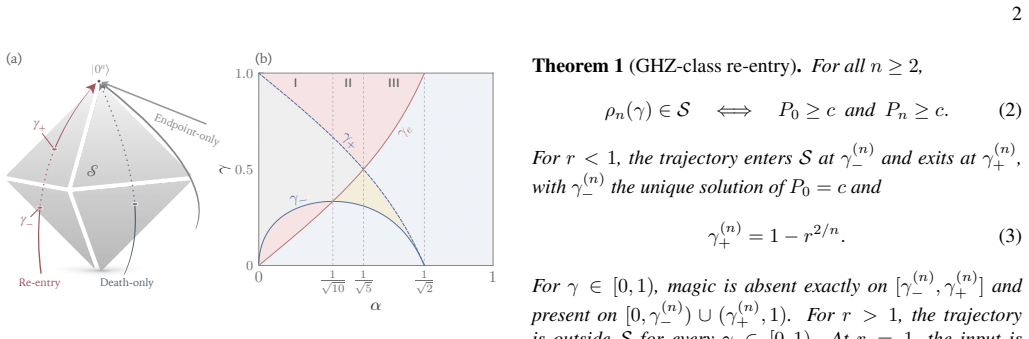
Under local amplitude damping the n-qubit GHZ family α|0^n⟩ + β|1^n⟩ (0<α<β) loses its magic at a lower damping strength γ_- and regains it at a higher one γ_+, while entanglement is irreversibly lost at γ_e. The magic-entanglement complementarity γ_e + γ_+ =1 holds for every n and reflects a system-environment duality of amplitude damping that persists for a broader class of dissipative channels. For small α the reborn magic resides in a fully separable state with all proper marginals stabilizer yet parity-syndrome extraction concentrates it onto a single qubit for magic-state distillation. Local dissipation further divides pure stabilizer states into magic-generators and magic-insulators.
What carries the argument
The complementarity relation γ_e + γ_+ =1 that links the entanglement sudden-death threshold to the magic-rebirth threshold under local amplitude damping, exposing the system-environment duality.
If this is right
- Magic can reappear after entanglement has already vanished under local dissipative noise.
- For small α the reborn magic lives inside a fully separable state whose every proper marginal is stabilizer.
- Parity-syndrome extraction can concentrate the reborn magic onto a single qubit suitable for distillation.
- Local dissipation partitions pure stabilizer states into magic-generators that leave the stabilizer polytope immediately and magic-insulators that remain inside it.
- The same complementarity extends to a wider family of dissipative channels beyond amplitude damping.
Where Pith is reading between the lines
- Similar threshold relations may exist for other noise models or for states beyond the GHZ family.
- Controlled dissipation could serve as a passive method to produce magic resources in hardware.
- Classifying stabilizer states as generators or insulators may guide noise-engineering strategies on quantum processors.
- Environmental monitoring might detect the rebirth of magic without direct access to the system state.
Load-bearing premise
The analysis assumes the specific n-qubit GHZ family with 0 < α < β together with local Markovian amplitude damping as the noise model.
What would settle it
Computing or measuring the exact values of γ_e and γ_+ for any fixed n and any chosen α, β and verifying whether their sum equals one; a reproducible deviation from equality would refute the claimed complementarity.
Figures


read the original abstract
Local Markovian noise cannot bring entanglement back, but it can bring magic back. Unlike separability, stabilizer membership is not preserved by local channels, allowing dissipation to push states out of the stabilizer polytope as well as in. Under local amplitude damping, the $n$-qubit GHZ family $\alpha|0^n\rangle+\beta|1^n\rangle$ ($0<\alpha<\beta$) loses its magic at a lower damping strength $\gamma_-$ and regains it at a higher one $\gamma_+$, while entanglement is irreversibly lost at $\gamma_e$. This magic-entanglement complementarity, $\gamma_e+\gamma_+=1$ for every $n$, reflects a system-environment duality of amplitude damping and persists for a broader class of dissipative channels. For small $\alpha$, the reborn magic resides in a fully separable state with all proper marginals stabilizer, yet parity-syndrome extraction concentrates it onto a single qubit for magic-state distillation. Local dissipation further divides pure stabilizer states into magic-generators and magic-insulators: at two qubits, the Bell state $|\Phi^+\rangle$ generates magic immediately, while its Bell-state partner $|\Psi^+\rangle$ remains stabilizer. Together, magic and entanglement reveal a symmetry invisible to either alone.
Editorial analysis
A structured set of objections, weighed in public.
Referee Report
Summary. The manuscript studies the evolution of entanglement and non-stabilizerness (magic) in the n-qubit GHZ family α|0^n⟩ + β|1^n⟩ (0 < α < β) under local Markovian amplitude damping. Entanglement undergoes sudden death at damping strength γ_e, while magic disappears at a lower value γ_- and is reborn at γ_+, with the complementarity relation γ_e + γ_+ = 1 holding for every n. This is interpreted as arising from a system-environment duality of the amplitude damping channel and is claimed to persist for a broader class of dissipative channels. For small α the reborn magic appears in a fully separable state whose proper marginals are stabilizer states, yet can be concentrated via parity-syndrome extraction. The paper additionally classifies pure stabilizer states into magic-generators and magic-insulators under local dissipation, with explicit two-qubit examples.
Significance. If the observed complementarity and its duality interpretation are placed on a firm analytical footing, the work identifies a symmetry between entanglement and magic under dissipation that is invisible when either resource is considered separately. The concrete demonstration that magic can be reborn inside a fully separable state, together with the generator/insulator distinction for stabilizer states, supplies new insight into how local noise can both destroy and create non-stabilizerness. The numerical verification of the relation across n provides a falsifiable prediction that can be checked for other channels.
major comments (2)
- [Abstract and Section IV (duality discussion)] Abstract and the paragraph introducing the duality: the claim that γ_e + γ_+ = 1 'reflects a system-environment duality of amplitude damping' is presented as an interpretive conclusion, yet the manuscript supplies only the numerical observation for the GHZ family. No explicit mapping is given that relates the magic measure evaluated on the reduced system state ρ(γ) to a dual quantity (e.g., environment entanglement or non-stabilizerness) evaluated at 1-γ via the Stinespring unitary of the amplitude-damping channel. Without this step the duality remains a conjecture rather than a derived symmetry, which is load-bearing for both the interpretive claim and the asserted extension to other dissipative channels.
- [Section V (small-α and separability)] Section on small-α regime and separability: the assertion that 'for small α the reborn magic resides in a fully separable state with all proper marginals stabilizer' is central to the claim that magic can be distilled from separable states. The manuscript shows that parity-syndrome extraction concentrates the magic, but does not report explicit verification that every proper marginal remains inside the stabilizer polytope for n > 2; a single counter-example marginal would undermine the statement.
minor comments (2)
- [Introduction] The damping parameters γ_-, γ_+, and γ_e are introduced in the abstract and first paragraph but are not given explicit mathematical definitions (e.g., as the roots of the relevant magic or negativity functions) until later sections; a single early equation defining each threshold would improve readability.
- [Figure 2 and Figure 3 captions] Figure captions should state the precise values of n and α used for each plotted curve, together with the numerical method employed to locate the thresholds γ_e, γ_-, γ_+.
Simulated Author's Rebuttal
We thank the referee for the careful reading and constructive comments on our manuscript. The points raised regarding the analytical support for the duality interpretation and the explicit verification of marginal stabilizer properties are well taken. We address each major comment below and commit to revisions that strengthen the manuscript without altering its core claims.
read point-by-point responses
-
Referee: [Abstract and Section IV (duality discussion)] Abstract and the paragraph introducing the duality: the claim that γ_e + γ_+ = 1 'reflects a system-environment duality of amplitude damping' is presented as an interpretive conclusion, yet the manuscript supplies only the numerical observation for the GHZ family. No explicit mapping is given that relates the magic measure evaluated on the reduced system state ρ(γ) to a dual quantity (e.g., environment entanglement or non-stabilizerness) evaluated at 1-γ via the Stinespring unitary of the amplitude-damping channel. Without this step the duality remains a conjecture rather than a derived symmetry, which is load-bearing for both the interpretive claim and the asserted extension to other dissipative channels.
Authors: We agree that the duality interpretation would be more robust with an explicit analytical mapping. The complementarity γ_e + γ_+ = 1 is established numerically for the GHZ family across all n, and the manuscript presents the system-environment duality as the natural interpretation arising from the structure of the amplitude-damping channel. In the revised version we will add a derivation in Section IV that uses the Stinespring dilation: the channel is realized by a unitary on system plus environment qubit (initialized in |0⟩), with γ controlling the excitation transfer. We will show that the non-stabilizerness of the system state at damping strength γ is dual to a corresponding quantity (entanglement or magic) generated in the environment at 1-γ, thereby deriving the observed complementarity directly from the unitary rather than leaving it as a numerical observation. This addition will also support the claimed persistence for other dissipative channels admitting analogous dilations. revision: yes
-
Referee: [Section V (small-α and separability)] Section on small-α regime and separability: the assertion that 'for small α the reborn magic resides in a fully separable state with all proper marginals stabilizer' is central to the claim that magic can be distilled from separable states. The manuscript shows that parity-syndrome extraction concentrates the magic, but does not report explicit verification that every proper marginal remains inside the stabilizer polytope for n > 2; a single counter-example marginal would undermine the statement.
Authors: We thank the referee for highlighting the need for explicit verification. The claim rests on the explicit form of the damped GHZ state for small α, where the reduced k-qubit marginals (k < n) become diagonal in the computational basis and hence lie inside the stabilizer polytope; this is shown analytically for n=2 and verified numerically for n=3,4. We acknowledge that a general demonstration for arbitrary n>2 is not reported in detail. In the revision we will add an explicit calculation of the marginals together with a short proof that, for sufficiently small α, all proper reduced states remain stabilizer states (they are convex combinations of computational-basis states with no coherences). We will also include numerical confirmation up to n=6 to rule out counterexamples, thereby placing the separability-plus-stabilizer-marginals statement on firmer ground. revision: yes
Circularity Check
No significant circularity; complementarity observed from explicit model calculation
full rationale
The paper calculates the damping thresholds γ_e (entanglement sudden death) and γ_+ (magic rebirth) for the specific n-qubit GHZ family under local amplitude damping, then reports the numerical identity γ_e + γ_+ = 1. This relation is not obtained by fitting a parameter to data and renaming the fit as a prediction, nor by self-definition, nor by load-bearing self-citation. The system-environment duality is presented as an interpretive reflection of the observed identity rather than a prior theorem used to force the result. The analysis remains self-contained against the chosen noise model and state family, with no reduction of the central claim to its own inputs by construction.
Axiom & Free-Parameter Ledger
axioms (1)
- domain assumption Amplitude damping is modeled as a local Markovian channel acting independently on each qubit
Reference graph
Works this paper leans on
-
[1]
and Smith, Graeme and Smolin, John A
Shor, Peter W. and Smith, Graeme and Smolin, John A. and Zeng, Bei , journal=. High Performance Single-Error-Correcting Quantum Codes for Amplitude Damping , year=
-
[2]
Noise robustness and threshold of many-body quantum magic , author=. 2024 , eprint=
work page 2024
-
[3]
Finite-Time Disentanglement Via Spontaneous Emission , author =. Phys. Rev. Lett. , volume =. 2004 , month =. doi:10.1103/PhysRevLett.93.140404 , url =
-
[4]
Quantum Open System Theory: Bipartite Aspects , author =. Phys. Rev. Lett. , volume =. 2006 , month =. doi:10.1103/PhysRevLett.97.140403 , url =
-
[5]
Ting Yu and J. H. Eberly , title =. Science , volume =. 2009 , doi =
work page 2009
-
[6]
Sudden death of entanglement at finite temperature , author =. Phys. Rev. A , volume =. 2008 , month =. doi:10.1103/PhysRevA.77.012117 , url =
-
[7]
Bravyi, Sergey and Kitaev, Alexei , journal =. Universal quantum computation with ideal. 2005 , month =. doi:10.1103/PhysRevA.71.022316 , url =
-
[8]
Gross, D. , title =. Journal of Mathematical Physics , volume =. 2006 , month =. doi:10.1063/1.2393152 , url =
-
[9]
New Journal of Physics , abstract =
Veitch, Victor and Hamed Mousavian, S A and Gottesman, Daniel and Emerson, Joseph , title =. New Journal of Physics , abstract =. 2014 , month =. doi:10.1088/1367-2630/16/1/013009 , url =
-
[10]
Application of a Resource Theory for Magic States to Fault-Tolerant Quantum Computing , author =. Phys. Rev. Lett. , volume =. 2017 , month =. doi:10.1103/PhysRevLett.118.090501 , url =
-
[11]
Heinrich, Markus and Gross, David , journal =. Robustness of. doi:10.22331/q-2019-04-08-132 , url =
-
[12]
Alberto Palhares and Santiago Zamora and Rafael A. Macêdo and Tailan S. Sarubi and Joab M. Varela and Gabriel W.C. Rocha and Darlan A. Moreira and Rafael Chaves , keywords =. A trace distance-based geometric analysis of the stabilizer polytope for few-qubit systems , journal =. 2026 , issn =. doi:https://doi.org/10.1016/j.physleta.2026.131417 , url =
-
[13]
Nonstabilizerness and Error Resilience in Noisy Quantum Circuits , author=. 2025 , eprint=
work page 2025
-
[14]
The unbearable hardness of deciding about magic , author=. 2026 , eprint=
work page 2026
-
[15]
Magic-Induced Computational Separation in Entanglement Theory , author =. PRX Quantum , volume =. 2025 , month =. doi:10.1103/PRXQuantum.6.020324 , url =
-
[16]
Improved simulation of stabilizer circuits , author =. Phys. Rev. A , volume =. 2004 , month =. doi:10.1103/PhysRevA.70.052328 , url =
-
[17]
Entanglement of Formation of an Arbitrary State of Two Qubits , author =. Phys. Rev. Lett. , volume =. 1998 , month =. doi:10.1103/PhysRevLett.80.2245 , url =
-
[18]
M. P. Almeida and F. de Melo and M. Hor-Meyll and A. Salles and S. P. Walborn and P. H. Souto Ribeiro and L. Davidovich , title =. Science , volume =. 2007 , doi =
work page 2007
-
[19]
Gottesman, Daniel , booktitle =. The. 1999 , publisher =
work page 1999
- [20]
-
[21]
Clifford group, stabilizer states, and linear and quadratic operations over
Dehaene, Jeroen and De Moor, Bart , journal =. Clifford group, stabilizer states, and linear and quadratic operations over. 2003 , month =. doi:10.1103/PhysRevA.68.042318 , url =
-
[22]
Stabilizer R\'enyi Entropy , author =. Phys. Rev. Lett. , volume =. 2022 , month =. doi:10.1103/PhysRevLett.128.050402 , url =
-
[23]
Many-Body Quantum Magic , author =. PRX Quantum , volume =. 2022 , month =. doi:10.1103/PRXQuantum.3.020333 , url =
-
[24]
Sticlet, Doru and Dóra, Balázs and Szombathy, Dominik and Zaránd, Gergely and Moca, Cătălin Paşcu , journal =. Nonstabilizerness in open. 2025 , month =. doi:10.1103/96bk-xf8p , url =
-
[25]
Niroula, Pradeep and White, Christopher David and Wang, Qingfeng and Johri, Sonika and Zhu, Daiwei and Monroe, Christopher and Noel, Crystal and Gullans, Michael J. , date =. Phase transition in magic with random quantum circuits , url =. Nature Physics , number =. 2024 , bdsk-url-1 =. doi:10.1038/s41567-024-02637-3 , id =
-
[26]
Improved Classical Simulation of Quantum Circuits Dominated by
Bravyi, Sergey and Gosset, David , journal =. Improved Classical Simulation of Quantum Circuits Dominated by. 2016 , month =. doi:10.1103/PhysRevLett.116.250501 , url =
-
[27]
Stabilizer entropies are monotones for magic-state resource theory , author =. Phys. Rev. A , volume =. 2024 , month =. doi:10.1103/PhysRevA.110.L040403 , url =
-
[28]
Magic Monotone for Faithful Detection of Nonstabilizerness in Mixed States , author =. Phys. Rev. Lett. , volume =. 2025 , month =. doi:10.1103/2s3j-t22p , url =
-
[29]
Monogamy of quantum entanglement and other correlations , author =. Phys. Rev. A , volume =. 2004 , month =. doi:10.1103/PhysRevA.69.022309 , url =
-
[30]
Reichardt, Ben W. , date =. Quantum Universality from Magic States Distillation Applied to. Quantum Information Processing , number =. 2005 , bdsk-url-1 =. doi:10.1007/s11128-005-7654-8 , id =
- [31]
-
[32]
Efficient witnessing and testing of magic in mixed quantum states , url =
Haug, Tobias and Tarabunga, Poetri Sonya , date =. Efficient witnessing and testing of magic in mixed quantum states , url =. npj Quantum Information , number =. 2026 , bdsk-url-1 =. doi:10.1038/s41534-026-01189-z , id =
-
[33]
Triangle Criterion: a mixed-state magic criterion with applications in distillation and detection
Zhenhuan Liu and Tobias Haug and Qi Ye and Zi-Wen Liu and Ingo Roth , year=. Triangle. 2512.16777 , archivePrefix=
work page internal anchor Pith review Pith/arXiv arXiv
-
[34]
Quantifying Quantum Speedups: Improved Classical Simulation From Tighter Magic Monotones , author =. PRX Quantum , volume =. 2021 , month =. doi:10.1103/PRXQuantum.2.010345 , url =
-
[35]
doi:10.22331/q-2024-10-04-1492 , url =
Mixed-state additivity properties of magic monotones based on quantum relative entropies for single-qubit states and beyond , author =. doi:10.22331/q-2024-10-04-1492 , url =
-
[36]
doi:10.22331/q-2023-08-28-1092 , url =
Stabilizer entropies and nonstabilizerness monotones , author =. doi:10.22331/q-2023-08-28-1092 , url =
-
[37]
Contextuality supplies the `magic' for quantum computation , url =
Howard, Mark and Wallman, Joel and Veitch, Victor and Emerson, Joseph , date =. Contextuality supplies the `magic' for quantum computation , url =. Nature , number =. 2014 , bdsk-url-1 =. doi:10.1038/nature13460 , id =
-
[38]
Scaling Laws for the Decay of Multiqubit Entanglement , author =. Phys. Rev. Lett. , volume =. 2008 , month =. doi:10.1103/PhysRevLett.100.080501 , url =
-
[39]
Journal of Mathematical Physics , volume =
Christandl, Matthias and Winter, Andreas , title =. Journal of Mathematical Physics , volume =. 2004 , month =. doi:10.1063/1.1643788 , url =
-
[40]
A Fundamental Property of Quantum-Mechanical Entropy , author =. Phys. Rev. Lett. , volume =. 1973 , month =. doi:10.1103/PhysRevLett.30.434 , url =
-
[41]
Conformal field theories are magical , author =. Phys. Rev. B , volume =. 2021 , month =. doi:10.1103/PhysRevB.103.075145 , url =
-
[42]
Magic state distillation from entangled states , author =. Phys. Rev. A , volume =. 2022 , month =. doi:10.1103/PhysRevA.105.022602 , url =
-
[43]
Long-Range Nonstabilizerness and Phases of Matter , author =. Phys. Rev. Lett. , volume =. 2025 , month =. doi:10.1103/1hlj-h6t9 , url =
-
[44]
doi:10.22331/q-2021-12-28-612 , url =
Symmetry-protected sign problem and magic in quantum phases of matter , author =. doi:10.22331/q-2021-12-28-612 , url =
-
[45]
Long-range nonstabilizerness and quantum codes, phases, and complexity , author=. 2026 , eprint=
work page 2026
-
[46]
Genuinely multipartite concurrence of N -qubit X matrices , author =. Phys. Rev. A , volume =. 2012 , month =. doi:10.1103/PhysRevA.86.062303 , url =
- [47]
-
[48]
Reports on Progress in Physics , abstract =
Aolita, Leandro and de Melo, Fernando and Davidovich, Luiz , title =. Reports on Progress in Physics , abstract =. 2015 , month =. doi:10.1088/0034-4885/78/4/042001 , url =
-
[49]
Decoherence and Multipartite Entanglement , author =. Phys. Rev. Lett. , volume =. 2004 , month =. doi:10.1103/PhysRevLett.93.230501 , url =
-
[50]
Seddon, James R. and Campbell, Earl T. , title =. Proceedings of the Royal Society A: Mathematical, Physical and Engineering Sciences , volume =. 2019 , month =. doi:10.1098/rspa.2019.0251 , url =
-
[51]
Magic transition in measurement-only circuits , url =
Tarabunga, Poetri Sonya and Tirrito, Emanuele , date =. Magic transition in measurement-only circuits , url =. npj Quantum Information , number =. 2025 , bdsk-url-1 =. doi:10.1038/s41534-025-01104-y , id =
-
[52]
Greenberger, Daniel M. and Horne, Michael A. and Shimony, Abner and Zeilinger, Anton , title =. American Journal of Physics , volume =. 1990 , month =. doi:10.1119/1.16243 , url =
-
[53]
Three qubits can be entangled in two inequivalent ways , author =. Phys. Rev. A , volume =. 2000 , month =. doi:10.1103/PhysRevA.62.062314 , url =
-
[54]
Dynamics of quantum entanglement , author =. Phys. Rev. A , volume =. 2001 , month =. doi:10.1103/PhysRevA.65.012101 , url =
-
[55]
Experimental investigation of the dynamics of entanglement: Sudden death, complementarity, and continuous monitoring of the environment , author =. Phys. Rev. A , volume =. 2008 , month =. doi:10.1103/PhysRevA.78.022322 , url =
-
[56]
Verstraete, Frank and Wolf, Michael M. and Ignacio Cirac, J. , date =. Quantum computation and quantum-state engineering driven by dissipation , url =. Nature Physics , number =. 2009 , bdsk-url-1 =. doi:10.1038/nphys1342 , id =
-
[57]
Estimating Outcome Probabilities of Quantum Circuits Using Quasiprobabilities , author =. Phys. Rev. Lett. , volume =. 2015 , month =. doi:10.1103/PhysRevLett.115.070501 , url =
-
[58]
New Journal of Physics , abstract =
Wang, Xin and Wilde, Mark M and Su, Yuan , title =. New Journal of Physics , abstract =. 2019 , month =. doi:10.1088/1367-2630/ab451d , url =
-
[59]
Oliviero, Salvatore F. E. and Leone, Lorenzo and Hamma, Alioscia and Lloyd, Seth , date =. Measuring magic on a quantum processor , url =. npj Quantum Information , number =. 2022 , bdsk-url-1 =. doi:10.1038/s41534-022-00666-5 , id =
-
[60]
Entanglement properties of multipartite entangled states under the influence of decoherence , author =. Phys. Rev. A , volume =. 2005 , month =. doi:10.1103/PhysRevA.71.032350 , url =
-
[61]
Devetak, I. and Shor, P. W. , date =. The Capacity of a Quantum Channel for Simultaneous Transmission of Classical and Quantum Information , url =. Communications in Mathematical Physics , number =. 2005 , bdsk-url-1 =. doi:10.1007/s00220-005-1317-6 , id =
- [62]
-
[63]
Robustness of quantum discord to sudden death , author =. Phys. Rev. A , volume =. 2009 , month =. doi:10.1103/PhysRevA.80.024103 , url =
-
[64]
Sudden Transition between Classical and Quantum Decoherence , author =. Phys. Rev. Lett. , volume =. 2010 , month =. doi:10.1103/PhysRevLett.104.200401 , url =
-
[65]
Classification of multiqubit mixed states: Separability and distillability properties , author =. Phys. Rev. A , volume =. 2000 , month =. doi:10.1103/PhysRevA.61.042314 , url =
-
[66]
Optimal detection of entanglement in
Kay, Alastair , journal =. Optimal detection of entanglement in. 2011 , month =. doi:10.1103/PhysRevA.83.020303 , url =
-
[67]
Tolerant Testing of Stabilizer States with Mixed State Inputs , author=. 2025 , eprint=
work page 2025
-
[68]
Quantum nonlocal nonstabilizerness , author =. Phys. Rev. A , volume =. 2025 , month =. doi:10.1103/PhysRevA.111.052443 , url =
-
[69]
Bridging Entanglement and Magic Resources within Operator Space , author =. Phys. Rev. Lett. , volume =. 2025 , month =. doi:10.1103/c7k1-xcwy , url =
-
[70]
Bellomo, B. and Lo Franco, R. and Compagno, G. , journal =. Non-. 2007 , month =. doi:10.1103/PhysRevLett.99.160502 , url =
-
[71]
Sudden Birth versus Sudden Death of Entanglement in Multipartite Systems , author =. Phys. Rev. Lett. , volume =. 2008 , month =. doi:10.1103/PhysRevLett.101.080503 , url =
-
[72]
Computable measure of entanglement , author =. Phys. Rev. A , volume =. 2002 , month =. doi:10.1103/PhysRevA.65.032314 , url =
-
[73]
Robustness of entanglement , author =. Phys. Rev. A , volume =. 1999 , month =. doi:10.1103/PhysRevA.59.141 , url =
-
[74]
Litinski, Daniel , journal =. A. doi:10.22331/q-2019-03-05-128 , url =
-
[75]
and Ruskai, Mary Beth and Smith, Graeme , title =
Cubitt, Toby S. and Ruskai, Mary Beth and Smith, Graeme , title =. Journal of Mathematical Physics , volume =. 2008 , month =. doi:10.1063/1.2953685 , url =
-
[76]
One T Gate Makes Distribution Learning Hard , author =. Phys. Rev. Lett. , volume =. 2023 , month =. doi:10.1103/PhysRevLett.130.240602 , url =
-
[77]
Shiyu Zhou and Zhi-Cheng Yang and Alioscia Hamma and Claudio Chamon , journal=. 2020 , publisher=. doi:10.21468/SciPostPhys.9.6.087 , url=
-
[78]
Good quantum error-correcting codes exist , author =. Phys. Rev. A , volume =. 1996 , month =. doi:10.1103/PhysRevA.54.1098 , url =
-
[79]
Proceedings of the Royal Society A: Mathematical, Physical and Engineering Sciences , volume =
Steane, Andrew , title =. Proceedings of the Royal Society A: Mathematical, Physical and Engineering Sciences , volume =. 1996 , month =. doi:10.1098/rspa.1996.0136 , url =
-
[80]
Coherence in Spontaneous Radiation Processes , author =. Phys. Rev. , volume =. 1954 , month =. doi:10.1103/PhysRev.93.99 , url =
discussion (0)
Sign in with ORCID, Apple, or X to comment. Anyone can read and Pith papers without signing in.