Spintronic Neuromorphic Hardware Using Domain Wall Based Neurons and Quantized Synapses
Pith reviewed 2026-05-22 03:37 UTC · model grok-4.3
The pith
Pinned domain walls in notched magnetic nanotracks supply discrete conductance values that function as synaptic weights in a working artificial neural network.
A machine-rendered reading of the paper's core claim, the machinery that carries it, and where it could break.
Core claim
The electrical conductance of a domain wall pinned at successive notches in a corrugated nanotrack supplies discrete, stable synaptic weights. When these conductances replace conventional weights in a fully connected ANN, the network reaches approximately 97 percent accuracy on MNIST and 86 percent on Fashion-MNIST with float32 values, and 95 percent and 62 percent respectively after quantization of the weights to a small set of levels. The same pinning dynamics also produce a threshold-dependent delay between successive depinning events that reproduces synaptic memory and adaptability.
What carries the argument
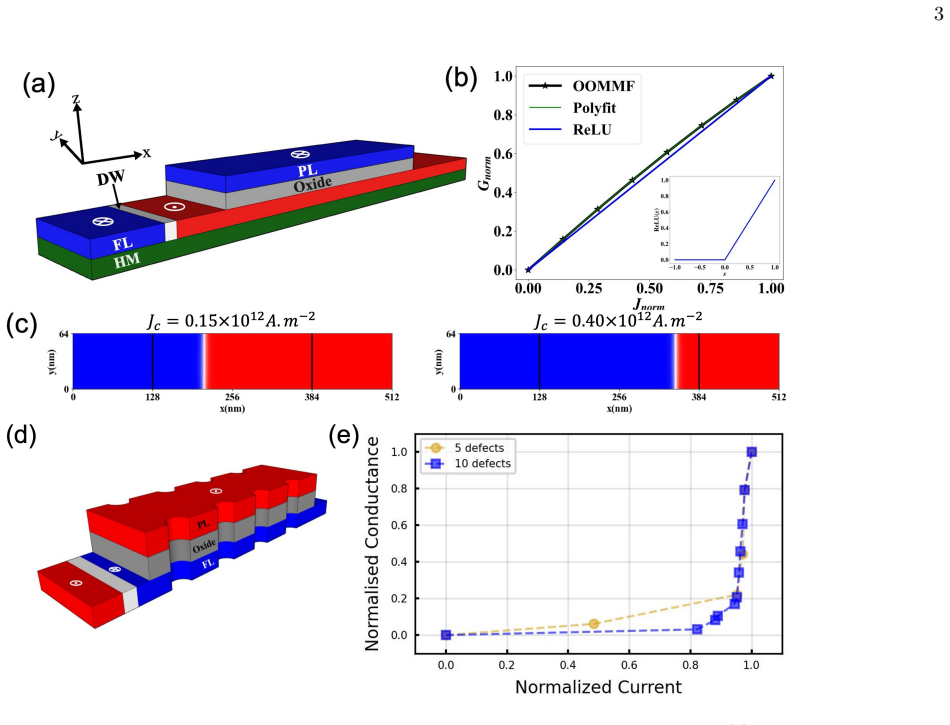
Corrugated HM/FM nanotrack with symmetric semicircular notches that forces current-driven domain wall motion into discrete, repeatable pinning steps whose conductance values become the synaptic weights.
If this is right
- Step-like pinning supplies built-in quantization of synaptic weights without separate memory arrays.
- Threshold-dependent delay between depinning events directly implements short-term synaptic memory.
- Quantized weights cut memory footprint while retaining usable accuracy on MNIST-scale tasks.
- The same device geometry can serve as both neuron and synapse in a single material stack.
- The approach supplies a hardware test bed for sparse, low-precision neuromorphic networks.
Where Pith is reading between the lines
- Energy cost per operation could drop if the same current pulses both compute and store the weights in place.
- Thermal stability of the pinned states will set the practical limit on how many discrete levels can be used.
- The notch geometry might be tuned to match other common activation functions besides ReLU.
- Hybrid circuits could combine these spintronic elements with conventional CMOS for larger networks.
Load-bearing premise
The chosen micromagnetic model, 3 ns neuron pulses, 10 ns synapse pulses, and selected current densities accurately reproduce pinning and depinning in real devices without significant thermal fluctuations or fabrication imperfections.
What would settle it
Fabricate the notched HM/FM nanotrack, apply 10 ns current pulses of varying density, and measure whether the wall position and resulting conductance actually advance in the predicted discrete steps and remain stable after each pulse.
Figures


read the original abstract
In this work, we simulate the functionality of artificial neuron and synapse using spin-orbit torque-based spintronic devices and implemented a fully connected artificial neural netwrok (ANN). These neuro-synaptic devices are emulated using transverse domain wall dynamics in a rectangular magnetic nanotrack comprised of heavy metal/ferromagnet (HM/FM) heterostructures. The ReLU activation function of the neuron has been mimicked using the domain wall motion induced by a 3 ns current pulse. The synapse has been modelled using current-induced domain wall (DW) dynamics through a corrugated HM/FM nanotrack under the influence of a 10 ns current pulse with varying current density. The semicircular corrugations are in the form of notches, which are symmetrically located on both sides of the nanotrack. By applying 10 ns current pulses of varying densities, we achieve controlled DW pinning, revealing a step-like motion caused by temporary pauses at each pinning center. The electrical conductance of the pinned DW across various pinning points, act as stable synaptic weights for our ANN. Furthermore, we observe a threshold-dependent delay effect where each depinning event is influenced by previous ones, successfully mimicking synaptic memory and adaptability in neuromorphic systems. The fully connected ANN has been modeled using the conventional float32 synaptic weights for the MNIST and Fashion MNIST datasets with an accuracy of ~97 % and ~86 %, respectively, which serves as a test bed of our neuromorphic simulations. With the aim of implementing a sparse and low memory footprint ANN, we quantize the trained synaptic weights into discrete quantized level and tested the network, which demonstrate an accuracy of ~95% and ~62%, for the MNIST and Fashion-MNIST dataset, respectively.
Editorial analysis
A structured set of objections, weighed in public.
Referee Report
Summary. The paper simulates spin-orbit torque driven domain wall (DW) dynamics in HM/FM nanotracks to emulate neurons (ReLU-like response via 3 ns current pulses) and synapses (step-like pinning at symmetric notches under 10 ns pulses of varying current density). The pinned-DW conductances are proposed as stable quantized synaptic weights. A fully connected ANN is trained on MNIST and Fashion-MNIST, yielding ~97 % / ~86 % accuracy with float32 weights and ~95 % / ~62 % after generic quantization to discrete levels.
Significance. If the simulated conductance steps were shown to match the quantization levels actually used in the network and if the threshold-dependent delay were folded into inference, the work would provide a concrete device-to-algorithm mapping for spintronic neuromorphic hardware. The notched-track geometry for multi-level pinning is a useful engineering detail, but the current separation between micromagnetic results and ANN evaluation limits the strength of the hardware claim.
major comments (2)
- [Abstract] Abstract: the central claim that 'the electrical conductance of the pinned DW across various pinning points act as stable synaptic weights for our ANN' is not supported by the reported results. The accuracies are obtained from a standard float32-trained network followed by generic quantization; no section maps the specific conductance values (or number of stable states) extracted from the 10 ns notched-track simulations to the quantization levels actually employed.
- [Synapse modeling and ANN implementation] Synapse and ANN sections: the threshold-dependent delay effect (each depinning influenced by prior events) is described as mimicking synaptic memory, yet the manuscript does not show how this history dependence is incorporated into the forward pass or weight-update rule of the ANN; without this step the accuracy numbers test only conventional quantization, not the device-derived dynamics.
minor comments (2)
- [Abstract] Abstract: 'netwrok' is a typographical error.
- [Device simulation results] The manuscript would benefit from an explicit table listing the simulated conductance (or resistance) values at each pinning site together with the corresponding current densities, so that readers can verify the quantization mapping.
Simulated Author's Rebuttal
We thank the referee for the constructive and detailed comments, which have helped us identify areas where the connection between our micromagnetic simulations and the ANN implementation can be clarified. We address each major comment below and have revised the manuscript to strengthen the device-to-algorithm linkage without overstating the current results.
read point-by-point responses
-
Referee: [Abstract] Abstract: the central claim that 'the electrical conductance of the pinned DW across various pinning points act as stable synaptic weights for our ANN' is not supported by the reported results. The accuracies are obtained from a standard float32-trained network followed by generic quantization; no section maps the specific conductance values (or number of stable states) extracted from the 10 ns notched-track simulations to the quantization levels actually employed.
Authors: We agree that the abstract and main text would benefit from greater precision on this point. The step-like pinning at the symmetric notches produces a discrete set of stable positions, and the number of quantization levels in the ANN was chosen to align with the number of distinct pinning states observed in the 10 ns pulse simulations. However, we did not include an explicit extraction of the conductance values from those simulations and their direct assignment to the quantization bins. In the revised manuscript we will add a short subsection (or extended caption to an existing figure) that reports the simulated conductance steps and states how they motivated the specific discrete levels used for the reported ~95 % / ~62 % accuracies. This revision will make the mapping explicit while preserving the original accuracy numbers. revision: yes
-
Referee: [Synapse modeling and ANN implementation] Synapse and ANN sections: the threshold-dependent delay effect (each depinning influenced by prior events) is described as mimicking synaptic memory, yet the manuscript does not show how this history dependence is incorporated into the forward pass or weight-update rule of the ANN; without this step the accuracy numbers test only conventional quantization, not the device-derived dynamics.
Authors: The threshold-dependent delay is a genuine dynamical feature extracted from the micromagnetic runs and is presented as a potential route to synaptic memory. In the present study the ANN forward pass and training use static quantized weights; the history dependence was not folded into the inference or update rule because doing so would require a stateful, time-dependent network model that lies outside the scope of this initial demonstration. We will revise the manuscript to (i) explicitly note this distinction, (ii) clarify that the reported accuracies therefore reflect device-motivated quantization rather than full dynamical emulation, and (iii) outline a concrete path for incorporating the delay (e.g., via recurrent weight modulation) in follow-on work. This addresses the referee’s concern while remaining accurate about what the current results demonstrate. revision: partial
Circularity Check
No significant circularity in derivation chain
full rationale
The paper simulates domain-wall pinning conductances separately via micromagnetic modeling of notched HM/FM tracks under 10 ns pulses, then reports ANN accuracies obtained from independent standard training of float32 weights on MNIST/Fashion-MNIST followed by generic quantization to discrete levels. No equation, fitted parameter, or self-citation reduces any reported accuracy or weight value to a quantity defined by the same device data; the conductances are proposed as weights but the numerical results test conventional quantization as a test-bed rather than device-derived levels, leaving the derivation self-contained.
Axiom & Free-Parameter Ledger
free parameters (1)
- current pulse duration and density
axioms (1)
- domain assumption Domain wall velocity and pinning behavior follow the standard Landau-Lifshitz-Gilbert equation with spin-orbit torque term
Reference graph
Works this paper leans on
-
[1]
A logical calculus of the ideas immanent in nervous activity,
W. S. McCulloch and W. Pitts, “A logical calculus of the ideas immanent in nervous activity,”The bulletin of mathematical biophysics, vol. 5, no. 4, pp. 115–133, 1943
work page 1943
-
[2]
D. O. Hebb,The organization of behavior: A neuropsychological theory. 1949
work page 1949
-
[3]
Evaluating the energy efficiency of deep convolutional neural networks on cpus and gpus,
D. Li, X. Chen, M. Becchi, and Z. Zong, “Evaluating the energy efficiency of deep convolutional neural networks on cpus and gpus,” in2016 IEEE international conferences on big data and cloud computing (BDCloud), social computing and networking (SocialCom), sustainable computing and communications (SustainCom)(BDCloud-SocialCom- SustainCom), pp. 477–484, I...
work page 2016
-
[4]
Y. Hong, B. Hou, H. Jiang, and J. Zhang, “Machine learning and artificial neural network accelerated computational discoveries in materials science,”Wiley Interdisciplinary Reviews: Computational Molecular Science, vol. 10, no. 3, p. e1450, 2020
work page 2020
-
[5]
J. Lee, A. Seko, K. Shitara, K. Nakayama, and I. Tanaka, “Prediction model of band gap for inorganic compounds by combination of density functional theory calculations and machine learning techniques,”Physical Review B, vol. 93, no. 11, p. 115104, 2016
work page 2016
-
[6]
Bandgap energy modeling of the deformed ternary gaas1-unu by artificial neural networks,
A. Tarbi, T. Chtouki, Y. Elkouari, H. Erguig, A. Migalska- Zalas, and A. Aissat, “Bandgap energy modeling of the deformed ternary gaas1-unu by artificial neural networks,” Heliyon, vol. 8, no. 8, 2022
work page 2022
-
[7]
S. Agatonovic-Kustrin and R. Beresford, “Basic concepts of artificial neural network (ann) modeling and its application in pharmaceutical research,”Journal of pharmaceutical and 9 biomedical analysis, vol. 22, no. 5, pp. 717–727, 2000
work page 2000
-
[8]
A renaissance of neural networks in drug discovery,
I. I. Baskin, D. Winkler, and I. V. Tetko, “A renaissance of neural networks in drug discovery,”Expert opinion on drug discovery, vol. 11, no. 8, pp. 785–795, 2016
work page 2016
-
[9]
Imagenet classification with deep convolutional neural networks,
A. Krizhevsky, I. Sutskever, and G. E. Hinton, “Imagenet classification with deep convolutional neural networks,” Advances in neural information processing systems, vol. 25, 2012
work page 2012
-
[10]
K. Gopalakrishnan, S. K. Khaitan, A. Choudhary, and A. Agrawal, “Deep convolutional neural networks with transfer learning for computer vision-based data-driven pavement distress detection,”Construction and building materials, vol. 157, pp. 322–330, 2017
work page 2017
-
[11]
M. Xiao, Y. Li, X. Yan, M. Gao, and W. Wang, “Convolutional neural network classification of cancer cytopathology images: taking breast cancer as an example,” inProceedings of the 2024 7th International Conference on Machine Vision and Applications, pp. 145–149, 2024
work page 2024
-
[12]
Brain tumor grading based on neural networks and convolutional neural networks,
Y. Pan, W. Huang, Z. Lin, W. Zhu, J. Zhou, J. Wong, and Z. Ding, “Brain tumor grading based on neural networks and convolutional neural networks,” in2015 37th annual international conference of the IEEE engineering in medicine and biology society (EMBC), pp. 699–702, IEEE, 2015
work page 2015
-
[13]
Neuro-inspired computing with emerging nonvolatile memorys,
S. Yu, “Neuro-inspired computing with emerging nonvolatile memorys,”Proceedings of the IEEE, vol. 106, no. 2, pp. 260– 285, 2018
work page 2018
-
[14]
Rram for compute- in-memory: From inference to training,
S. Yu, W. Shim, X. Peng, and Y. Luo, “Rram for compute- in-memory: From inference to training,”IEEE Transactions on Circuits and Systems I: Regular Papers, vol. 68, no. 7, pp. 2753–2765, 2021
work page 2021
-
[15]
A. Baroni, A. Glukhov, E. Perez, C. Wenger, D. Ielmini, P. Olivo, and C. Zambelli, “Low conductance state drift characterization and mitigation in resistive switching memories (rram) for artificial neural networks,”IEEE Transactions on Device and Materials Reliability, vol. 22, no. 3, pp. 340–347, 2022
work page 2022
-
[16]
G. W. Burr, R. M. Shelby, S. Sidler, C. Di Nolfo, J. Jang, I. Boybat, R. S. Shenoy, P. Narayanan, K. Virwani, E. U. Giacometti,et al., “Experimental demonstration and tolerancing of a large-scale neural network (165 000 synapses) using phase-change memory as the synaptic weight element,”IEEE Transactions on Electron Devices, vol. 62, no. 11, pp. 3498–3507, 2015
work page 2015
-
[17]
Recent progress in phase-change memory technology,
G. W. Burr, M. J. Brightsky, A. Sebastian, H.-Y. Cheng, J.-Y. Wu, S. Kim, N. E. Sosa, N. Papandreou, H.-L. Lung, H. Pozidis,et al., “Recent progress in phase-change memory technology,”IEEE Journal on Emerging and Selected Topics in Circuits and Systems, vol. 6, no. 2, pp. 146–162, 2016
work page 2016
-
[18]
Computational phase-change memory: Beyond von neumann computing,
A. Sebastian, M. Le Gallo, and E. Eleftheriou, “Computational phase-change memory: Beyond von neumann computing,”Journal of Physics D: Applied Physics, vol. 52, no. 44, p. 443002, 2019
work page 2019
-
[19]
L. Wang, G. Ma, S. Yan, X. Cheng, and X. Miao, “Reconfigurable multilevel storage and neuromorphic computing based on multilayer phase-change memory,” ACS Applied Materials & Interfaces, vol. 16, no. 40, pp. 54829–54836, 2024
work page 2024
-
[20]
A. Sengupta, Y. Shim, and K. Roy, “Proposal for an all-spin artificial neural network: Emulating neural and synaptic functionalities through domain wall motion in ferromagnets,”IEEE transactions on biomedical circuits and systems, vol. 10, no. 6, pp. 1152–1160, 2016
work page 2016
-
[21]
Multilayer spintronic neural networks with radiofrequency connections,
A. Ross, N. Leroux, A. De Riz, D. Marković, D. Sanz- Hernández, J. Trastoy, P. Bortolotti, D. Querlioz, L. Martins, L. Benetti,et al., “Multilayer spintronic neural networks with radiofrequency connections,”Nature Nanotechnology, vol. 18, no. 11, pp. 1273–1280, 2023
work page 2023
-
[22]
Spintronic devices for high-density memory and neuromorphic computing–a review,
B. Chen, M. Zeng, K. H. Khoo, D. Das, X. Fong, S. Fukami, S. Li, W. Zhao, S. S. Parkin, S. Piramanayagam, et al., “Spintronic devices for high-density memory and neuromorphic computing–a review,”Materials Today, vol. 70, pp. 193–217, 2023
work page 2023
-
[23]
Bimodal alteration of cognitive accuracy for spintronic artificial neural networks,
A. Kumar, D. Das, D. J. Lin, L. Huang, S. L. Yap, H. K. Tan, R. J. Lim, H. R. Tan, Y. T. Toh, S. Ter Lim,et al., “Bimodal alteration of cognitive accuracy for spintronic artificial neural networks,”Nanoscale Horizons, vol. 9, no. 9, pp. 1522–1531, 2024
work page 2024
-
[24]
Efficient metallic spintronic emitters of ultrabroadband terahertz radiation,
T. Seifert, S. Jaiswal, U. Martens, J. Hannegan, L. Braun, P. Maldonado, F. Freimuth, A. Kronenberg, J. Henrizi, I. Radu,et al., “Efficient metallic spintronic emitters of ultrabroadband terahertz radiation,”Nature photonics, vol. 10, no. 7, pp. 483–488, 2016
work page 2016
-
[25]
Picosecond spin-orbit torque–induced coherent magnetization switching in a ferromagnet,
D. Polley, A. Pattabi, A. Rastogi, K. Jhuria, E. Diaz, H. Singh, A. Lemaitre, M. Hehn, J. Gorchon, and J. Bokor, “Picosecond spin-orbit torque–induced coherent magnetization switching in a ferromagnet,”Science Advances, vol. 9, no. 36, p. eadh5562, 2023
work page 2023
-
[26]
Progress toward picosecond on-chip magnetic memory,
D. Polley, A. Pattabi, J. Chatterjee, S. Mondal, K. Jhuria, H. Singh, J. Gorchon, and J. Bokor, “Progress toward picosecond on-chip magnetic memory,”Applied Physics Letters, vol. 120, no. 14, 2022
work page 2022
-
[27]
D. Fan, Y. Shim, A. Raghunathan, and K. Roy, “Stt-snn: A spin-transfer-torque based soft-limiting non-linear neuron for low-power artificial neural networks,”IEEE Transactions on Nanotechnology, vol. 14, no. 6, pp. 1013–1023, 2015
work page 2015
-
[28]
Spintronics for low-power computing,
Y. Zhang, W. Zhao, J.-O. Klein, W. Kang, D. Querlioz, Y. Zhang, D. Ravelosona, and C. Chappert, “Spintronics for low-power computing,” in2014 Design, Automation & Test in Europe Conference & Exhibition (DATE), pp. 1–6, IEEE, 2014
work page 2014
-
[29]
The promise of spintronics for unconventional computing,
G. Finocchio, M. Di Ventra, K. Y. Camsari, K. Everschor- Sitte, P. K. Amiri, and Z. Zeng, “The promise of spintronics for unconventional computing,”Journal of Magnetism and Magnetic Materials, vol. 521, p. 167506, 2021
work page 2021
-
[30]
Spin-transfer torque devices for logic and memory: Prospects and perspectives,
X. Fong, Y. Kim, K. Yogendra, D. Fan, A. Sengupta, A. Raghunathan, and K. Roy, “Spin-transfer torque devices for logic and memory: Prospects and perspectives,” IEEE Transactions on Computer-Aided Design of Integrated Circuits and Systems, vol. 35, no. 1, pp. 1–22, 2015
work page 2015
-
[31]
Single-shot switching in tb/co-multilayer based nanoscale magnetic tunnel junctions,
S.Mondal, D.Polley, A.Pattabi, J.Chatterjee, D.Salomoni, L. Aviles-Felix, A. Olivier, M. Rubio-Roy, B. Diény, L. D. B. Prejbeanu, R. Sousa, I. L. Prejbeanu, and J. Bokor, “Single-shot switching in tb/co-multilayer based nanoscale magnetic tunnel junctions,”Journal of Magnetism and Magnetic Materials, vol. 581, p. 170960, 2023
work page 2023
-
[32]
Giant tunnelling magnetoresistance at room temperature with mgo (100) tunnel barriers,
S. S. Parkin, C. Kaiser, A. Panchula, P. M. Rice, B. Hughes, M. Samant, and S.-H. Yang, “Giant tunnelling magnetoresistance at room temperature with mgo (100) tunnel barriers,”Nature materials, vol. 3, no. 12, pp. 862– 867, 2004
work page 2004
-
[33]
X. Fong, S. H. Choday, and K. Roy, “Bit-cell level optimization for non-volatile memories using magnetic tunnel junctions and spin-transfer torque switching,”IEEE Transactions on Nanotechnology, vol. 11, no. 1, pp. 172–181, 2011
work page 2011
-
[34]
Exploring stt-mram based in-memory computing paradigm with application of image edge extraction,
Z. He, S. Angizi, and D. Fan, “Exploring stt-mram based in-memory computing paradigm with application of image edge extraction,” in2017 IEEE International Conference on Computer Design (ICCD), pp. 439–446, IEEE, 2017
work page 2017
-
[35]
C. Wang, D. Zhang, L. Zeng, E. Deng, J. Chen, and W. Zhao, “A novel mtj-based non-volatile ternary content- addressable memory for high-speed, low-power, and high- reliable search operation,”IEEE Transactions on Circuits and Systems I: Regular Papers, vol. 66, no. 4, pp. 1454–1464, 2018. 10
work page 2018
-
[36]
Maximized lateral inhibition in paired magnetic domain wall racetracks for neuromorphic computing,
C. Cui, O. G. Akinola, N. Hassan, C. H. Bennett, M. J. Marinella, J. S. Friedman, and J. A. C. Incorvia, “Maximized lateral inhibition in paired magnetic domain wall racetracks for neuromorphic computing,”Nanotechnology, vol. 31, no. 29, p. 294001, 2020
work page 2020
-
[37]
Review and comparison of commonly used activation functions for deep neural networks,
T. Szandała, “Review and comparison of commonly used activation functions for deep neural networks,” inBio- inspired neurocomputing, pp. 203–224, Springer, 2020
work page 2020
-
[38]
Bilayer-skyrmion- based design of neuron and synapse for spiking neural network,
D. Das, Y. Cen, J. Wang, and X. Fong, “Bilayer-skyrmion- based design of neuron and synapse for spiking neural network,”Physical Review Applied, vol. 19, no. 2, p. 024063, 2023
work page 2023
-
[39]
OOMMF user’s guide, version 2.0a0,
M. J. Donahue and D. G. Porter, “OOMMF user’s guide, version 2.0a0,” 2019. http://math.nist.gov/oommf/
work page 2019
-
[40]
DMExchange6Ngbr: OOMMF oxs extension modules,
S. Rohart and A. Thiaville, “DMExchange6Ngbr: OOMMF oxs extension modules,” 2012. https://math.nist.gov/oommf/contrib/oxsext
work page 2012
-
[41]
Ubermag: Toward more effective micromagnetic workflows,
M. Beg, M. Lang, and H. Fangohr, “Ubermag: Toward more effective micromagnetic workflows,”IEEE Transactions on Magnetics, vol. 58, no. 2, pp. 1–5, 2021
work page 2021
-
[42]
Magnetic skyrmion-based synaptic devices,
Y. Huang, W. Kang, X. Zhang, Y. Zhou, and W. Zhao, “Magnetic skyrmion-based synaptic devices,” Nanotechnology, vol. 28, no. 8, p. 08LT02, 2017
work page 2017
-
[43]
Neuromorphic computation with a single magnetic domain wall,
R. V. Ababei, M. O. Ellis, I. T. Vidamour, D. S. Devadasan, D. A. Allwood, E. Vasilaki, and T. J. Hayward, “Neuromorphic computation with a single magnetic domain wall,”Scientific Reports, vol. 11, no. 1, p. 15587, 2021
work page 2021
-
[44]
S. J. Noh, Y. Miyamoto, M. Okuda, N. Hayashi, and Y. Keun Kim, “Effects of notch shape on the magnetic domain wall motion in nanowires with in-plane or perpendicular magnetic anisotropy,”Journal of Applied Physics, vol. 111, no. 7, 2012
work page 2012
discussion (0)
Sign in with ORCID, Apple, or X to comment. Anyone can read and Pith papers without signing in.