Generation of Quantum Turbulence by Neutrino Cooling in Neutron Stars
Pith reviewed 2026-05-22 03:25 UTC · model grok-4.3
The pith
Rapid neutrino cooling triggers the Kibble-Zurek mechanism and produces dense vortex networks in young neutron star superfluids.
A machine-rendered reading of the paper's core claim, the machinery that carries it, and where it could break.
Core claim
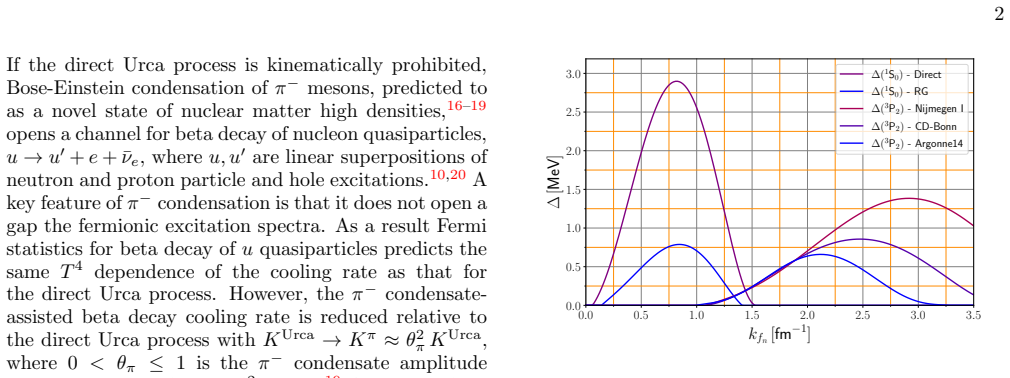
The nonequilibrium phase transition imposed by neutrino cooling in neutron star cores leads to the generation of a large density of topological defects in the neutron superfluid condensate. These defects form a random network of vortex lines and loops according to the Kibble-Zurek mechanism applied to the Cooper pair fluctuation propagator near Tc. Explicit calculations for both Urca and modified Urca cooling processes, using several models of the superfluid gap and transition temperature, all yield sufficiently high defect densities to constitute quantum turbulence.
What carries the argument
The Kibble-Zurek mechanism, which extracts the vortex density from the scaling of the correlation length set by the Cooper pair fluctuation propagator as the system is quenched through Tc.
If this is right
- Young neutron stars contain an initial random network of neutron vortices throughout the core.
- This network provides a built-in source of quantum turbulence that can influence early pulsar spin-down and glitch behavior.
- Both standard Urca and modified Urca cooling rates produce comparable high vortex densities for the range of gap models examined.
Where Pith is reading between the lines
- If the initial vortex tangle decays slowly, it may leave a lasting imprint on the long-term thermal evolution and magnetic-field decay of the star.
- The same quench-driven defect formation could operate in other rapidly cooled superfluid systems, such as those in heavy-ion collisions or laboratory Bose gases.
- Pulsar timing arrays or cooling-curve data for the youngest neutron stars could be compared against the predicted initial vortex density to test the mechanism.
Load-bearing premise
The neutrino cooling rate imposes a quench through the superfluid transition that obeys the standard Kibble-Zurek scaling derived from pair fluctuations, without major alterations from the coexisting proton superconductor or relativistic electron liquid.
What would settle it
A calculation of the post-quench vortex density that includes the back-action of the proton superconductor and shows the resulting line density is orders of magnitude lower than the KZM prediction for the same cooling trajectory.
Figures


read the original abstract
The interior crust and much of the liquid core of neutron stars is believed to be a quantum liquid mixture of neutron and proton superfluids and a relativistic electron liquid. Quantized vortices in the neutron superfluid and quantized flux lines in the proton superconductor are topological defects of these hadronic condensates. I consider the formation of the superfluid state in young neutron stars under non-equilibrium conditions imposed by the neutrino cooling rate. The nonequilibrium phase transition implies that the onset of superfluidity is accompanied by the generation of quantized vortices based on the mechanism envisioned by Kibble in the context cosmic string formation in an evolutionary models of an expanding universe, and further developed by Zurek for nonequilibrium phase transitions in quantum liquids such as \Hefour. I discuss the Kibble-Zurek mechanism (KZM) and scaling relations for topological defect formation starting from the Cooper pair fluctuation propagator for temperatures approaching $T_c$. I then calculate the predicted vortex densities based on Urca and modified Urca cooling mechanisms in the cores of neutron stars for several models of the superfluid gap and transition temperature of the interior neutron superfluid. In all cases studied the KZM leads to a large density of topological defects in the condensate phase, which in 3D form a random network of vortex lines and loops, i.e. the generation of quantum turbulence.
Editorial analysis
A structured set of objections, weighed in public.
Referee Report
Summary. The manuscript proposes that neutrino cooling through the critical temperature in young neutron stars drives a nonequilibrium phase transition in the neutron superfluid. Applying the Kibble-Zurek mechanism (KZM) with scaling relations extracted from the Cooper-pair fluctuation propagator, the paper calculates vortex densities for Urca and modified-Urca cooling rates across several superfluid gap and transition-temperature models. In all cases the resulting defect density is high, producing a random network of vortex lines and loops that constitutes quantum turbulence in the stellar core.
Significance. If the central claim is robust, the work identifies a concrete astrophysical realization of the KZM that could seed quantum turbulence in neutron-star interiors, with potential consequences for glitch dynamics, mutual friction, and thermal evolution. The use of multiple gap models and both Urca processes provides a useful parameter survey; the absence of free parameters beyond standard literature inputs for gaps and cooling rates is a strength.
major comments (1)
- [KZM scaling and cooling calculations] The application of unmodified KZM exponents (derived from the single-component neutron Cooper-pair propagator) to the cooling trajectory is load-bearing for the predicted vortex densities. The manuscript does not quantify how electromagnetic coupling to the pre-existing proton superconductor, entrainment, or the relativistic electron liquid renormalizes the relaxation time or correlation length near Tc, nor does it test whether these degrees of freedom leave the KZM scaling exponents intact.
minor comments (2)
- [Section on numerical estimates] Notation for the effective quench rate and the precise definition of the KZM length scale should be stated explicitly when the cooling curves are inserted into the scaling relations.
- [Discussion of results] A brief comparison of the predicted vortex density to the typical inter-vortex spacing set by rotation or magnetic flux would help the reader assess whether the KZM network is dynamically relevant.
Simulated Author's Rebuttal
We thank the referee for the careful reading and positive evaluation of our manuscript. We address the major comment below.
read point-by-point responses
-
Referee: [KZM scaling and cooling calculations] The application of unmodified KZM exponents (derived from the single-component neutron Cooper-pair propagator) to the cooling trajectory is load-bearing for the predicted vortex densities. The manuscript does not quantify how electromagnetic coupling to the pre-existing proton superconductor, entrainment, or the relativistic electron liquid renormalizes the relaxation time or correlation length near Tc, nor does it test whether these degrees of freedom leave the KZM scaling exponents intact.
Authors: We appreciate the referee drawing attention to the multi-component nature of the neutron-star interior. The KZM exponents used in the manuscript are extracted from the neutron Cooper-pair fluctuation propagator in the standard single-component treatment employed throughout the neutron-star superfluidity literature. Electromagnetic coupling to the proton superconductor and entrainment modify the effective neutron mass and the superfluid density, while the relativistic electron liquid enforces charge neutrality; however, these effects do not alter the U(1) symmetry-breaking universality class that governs the critical dynamics of the neutron order parameter. Consequently the correlation-length and relaxation-time exponents that enter the KZM scaling remain unchanged at leading order. A complete renormalization-group analysis of the coupled neutron-proton-electron system lies beyond the scope of the present work. In the revised manuscript we have added a short clarifying paragraph in Section II that states this assumption explicitly and explains why the leading KZM exponents are expected to be robust. revision: partial
Circularity Check
KZM scaling applied to standard cooling rates yields independent defect density estimates
full rationale
The paper derives vortex densities by applying the standard Kibble-Zurek scaling relations (obtained from the Cooper-pair fluctuation propagator near Tc) to independently tabulated Urca and modified-Urca cooling curves together with literature superfluid gap models. These cooling rates and gap parameters are external inputs drawn from prior work and are not fitted or redefined to match the target defect densities. No load-bearing step reduces by construction to a self-citation or to a parameter that was adjusted against the final result; the central prediction therefore remains a genuine calculation rather than a tautology.
Axiom & Free-Parameter Ledger
free parameters (1)
- superfluid gap and transition temperature models
axioms (1)
- domain assumption The Kibble-Zurek mechanism and its scaling relations apply to the nonequilibrium superfluid phase transition driven by neutrino cooling in neutron-star cores.
Lean theorems connected to this paper
-
IndisputableMonolith/Cost/FunctionalEquation.leanwashburn_uniqueness_aczel unclear?
unclearRelation between the paper passage and the cited Recognition theorem.
the Kibble-Zurek mechanism (KZM) and scaling relations for topological defect formation starting from the Cooper pair fluctuation propagator... n_KZ^v = f ξ0^{-2} (τ0/τ_Q)^{1/2}
-
IndisputableMonolith/Foundation/AlexanderDuality.leanalexander_duality_circle_linking unclear?
unclearRelation between the paper passage and the cited Recognition theorem.
in 3D form a random network of vortex lines and loops
What do these tags mean?
- matches
- The paper's claim is directly supported by a theorem in the formal canon.
- supports
- The theorem supports part of the paper's argument, but the paper may add assumptions or extra steps.
- extends
- The paper goes beyond the formal theorem; the theorem is a base layer rather than the whole result.
- uses
- The paper appears to rely on the theorem as machinery.
- contradicts
- The paper's claim conflicts with a theorem or certificate in the canon.
- unclear
- Pith found a possible connection, but the passage is too broad, indirect, or ambiguous to say the theorem truly supports the claim.
Reference graph
Works this paper leans on
-
[1]
note This scale is set by the Feynman-Onsager relation for the mean areal density of vortices as discussed in App. sec-vortex_density-rotation . Stop
-
[2]
author author T. W. B. \ Kibble ,\ Topology of Cosmic Domains and Strings title Topology of Cosmic Domains and Strings ,\ 10.1088/0305-4470/9/8/029 journal journal Journal of Physics A: Mathematical and General \ volume 9 ,\ pages 1387 ( year 1976 ) NoStop
-
[3]
author author T. W. B. \ Kibble ,\ Some Implications of a Cosmological Phase Transition title Some Implications of a Cosmological Phase Transition ,\ 10.1016/0370-1573(80)90091-5 journal journal Physics Reports \ volume 67 ,\ pages 183 ( year 1980 ) NoStop
-
[4]
author author A. Vilenkin \ and\ author E. P. S. \ Shellard ,\ @noop title Cosmic Strings and Other Topological Defects \ ( publisher Cambridge University Press ,\ address Cambridge, UK ,\ year 1994 ) NoStop
work page 1994
-
[5]
author author M. B. \ Hindmarsh \ and\ author T. W. B. \ Kibble ,\ Cosmic Strings title Cosmic Strings ,\ 10.1088/0034-4885/58/5/001 journal journal Rep. Prog. Phys. \ volume 58 ,\ pages 477 ( year 1995 ) NoStop
-
[6]
author author W. H. \ Zurek ,\ Cosmological Experiments in Superfluid Helium? title Cosmological Experiments in Superfluid Helium? \ 10.1038/382296a0 journal journal Nature \ volume 317 ,\ pages 505 ( year 1985 ) NoStop
-
[7]
author author W. H. \ Zurek ,\ Cosmological Experiments in Condensed Matter Systems title Cosmological Experiments in Condensed Matter Systems ,\ 10.1016/S0370-1573(96)00009-9 journal journal Phys. Rep. \ volume 276 ,\ pages 177 ( year 1996 ) NoStop
-
[8]
author author J. Boguta ,\ Remarks on the beta stability in neutron stars title Remarks on the beta stability in neutron stars ,\ 10.1016/0370-2693(81)90529-3 journal journal Phys. Lett. B \ volume 106 ,\ pages 255 ( year 1981 ) NoStop
-
[9]
author author J. M. \ Lattimer , author C. J. \ Pethick , author M. Prakash , \ and\ author P. Haensel ,\ Direct URCA process in neutron stars title Direct URCA process in neutron stars ,\ 10.1103/PhysRevLett.66.2701 journal journal Phys. Rev. Lett. \ volume 66 ,\ pages 2701 ( year 1991 ) NoStop
-
[10]
author author O. Maxwell , author G. E. \ Brown , author D. K. \ Campbell , author R. F. \ Dashen , \ and\ author J. T. \ Manassah ,\ Beta decay of pion condensates as a cooling mechanism for neutron stars title Beta decay of pion condensates as a cooling mechanism for neutron stars ,\ 10.1086/155447 journal journal The Astrophysical Journal \ volume 216 ...
-
[11]
author author D. G. \ Yakovlev , author K. P. \ Levenfish , \ and\ author Y. A. \ Shibanov ,\ Cooling of Neutron Stars and Superfluidity in their Cores title Cooling of Neutron Stars and Superfluidity in their Cores ,\ 10.1070/PU1999v042n08ABEH000556 journal journal Physics-Uspekhi \ volume 42 ,\ pages 737 ( year 1999 ) NoStop
-
[12]
author author M. Prakash , author M. Prakash , author J. M. \ Lattimer , \ and\ author C. J. \ Pethick ,\ Rapid Cooling of Neutron Stars by Hyperons and Delta Isobars title Rapid Cooling of Neutron Stars by Hyperons and Delta Isobars ,\ 10.1086/186376 journal journal Astrophysical Journal \ volume 390 ,\ pages L77 ( year 1992 ) NoStop
-
[13]
author author C. J. \ Pethick ,\ Cooling of neutron stars title Cooling of neutron stars ,\ 10.1103/RevModPhys.64.1133 journal journal Rev. Mod. Phys. \ volume 64 ,\ pages 1133 ( year 1992 ) NoStop
-
[14]
author author M. Prakash , author T. L. \ Ainsworth , \ and\ author J. M. \ Lattimer ,\ Equation of State and the Maximum Mass of Neutron Stars title Equation of State and the Maximum Mass of Neutron Stars ,\ 10.1103/PhysRevLett.61.2518 journal journal Phys. Rev. Lett. \ volume 61 ,\ pages 2518 ( year 1988 ) NoStop
-
[15]
author author M. Baldo \ and\ author H.-J. \ Schulze ,\ Proton pairing in neutron stars title Proton pairing in neutron stars ,\ 10.1103/PhysRevC.75.025802 journal journal Phys. Rev. C \ volume 75 ,\ pages 025802 ( year 2007 ) NoStop
-
[16]
author author A. B. \ Migdal ,\ Phase Transition in Nuclear Matter and Non-Pair Nuclear Forces title Phase Transition in Nuclear Matter and Non-Pair Nuclear Forces ,\ https://jetp.ras.ru/cgi-bin/e/index/e/36/6/p1052?a=list journal journal Sov Phys JETP \ volume 36 ,\ pages 1052 ( year 1973 ) NoStop
work page 1973
-
[17]
author author S. Barshay , author G. Vagradov , \ and\ author G. E. \ Brown ,\ Possibility of a phase transition to a pion condensate in neutron stars title Possibility of a phase transition to a pion condensate in neutron stars ,\ 10.1016/0370-2693(73)90370-5 journal journal Phys. Lett. B \ volume 43 ,\ pages 359 ( year 1973 ) NoStop
-
[18]
author author G. Baym ,\ in\ @noop booktitle Quantum Statistics and the Many Body Problem ,\ editor edited by\ editor S. Trickey , editor W. Kirk , \ and\ editor J. Dufty \ ( publisher Plenum, New York ,\ year 1975 )\ p.\ pages 221 NoStop
work page 1975
-
[19]
author author W. Weise \ and\ author G. E. \ Brown ,\ Equation of state for neutron matter in the presence of a pion condensate title Equation of state for neutron matter in the presence of a pion condensate ,\ 10.1016/0370-2693(75)90658-9 journal journal Phys. Lett. B \ volume 58 ,\ pages 300 ( year 1975 ) NoStop
-
[20]
author author J. N. \ Bahcall \ and\ author R. A. \ Wolf ,\ Neutron Stars II: Neutrino-Cooling and Observability title Neutron Stars II: Neutrino-Cooling and Observability ,\ 10.1103/PhysRev.140.B1452 journal journal Phys. Rev. \ volume 140 ,\ pages B1452 ( year 1965 ) NoStop
-
[21]
author author D. Yakovlev \ and\ author C. Pethick ,\ Neutron Star Cooling title Neutron Star Cooling ,\ 10.1146/annurev.astro.42.053102.134013 journal journal Annual Review of Astronomy and Astrophysics \ volume 42 ,\ pages 169 ( year 2004 ) NoStop
-
[22]
author author K. Hebeler , author A. Schwenk , \ and\ author B. Friman ,\ Dependence of the BCS ^1 S _0 superfluid pairing gap on nuclear interactions title Dependence of the BCS ^1 S _0 superfluid pairing gap on nuclear interactions ,\ 10.1016/j.physletb.2007.03.022 journal journal Physics Letters B \ volume 648 ,\ pages 176 ( year 2007 ) NoStop
-
[23]
author author A. Schwenk , author B. Friman , \ and\ author G. Brown ,\ Renormalization group approach to neutron matter: Quasiparticle interactions, superfluid gaps and the equation of state title Renormalization group approach to neutron matter: Quasiparticle interactions, superfluid gaps and the equation of state ,\ 10.1016/S0375-9474(02)01290-3 journa...
-
[24]
author author M. Baldo , author . Elgarøy , author L. Engvik , author M. Hjorth-Jensen , \ and\ author H.-J. \ Schulze ,\ ^3P_2 - ^3F_2 pairing in neutron matter with modern nucleon-nucleon potentials title ^3P_2 - ^3F_2 pairing in neutron matter with modern nucleon-nucleon potentials ,\ 10.1103/PhysRevC.58.1921 journal journal Phys. Rev. C \ volume 58 ,\...
-
[25]
author author D. Page , author J. M. \ Lattimer , author M. Prakash , \ and\ author A. W. \ Steiner ,\ Neutrino Emission From Cooper Pairs and Minimal Cooling of Neutron Stars title Neutrino Emission From Cooper Pairs and Minimal Cooling of Neutron Stars ,\ 10.1088/0004-637X/707/2/1131 journal journal Astrophysical Journal \ volume 707 ,\ pages 1131 ( yea...
-
[26]
author author A. B. \ Migdal ,\ Superfluidity and the Moments of Inertia of Nuclei title Superfluidity and the Moments of Inertia of Nuclei ,\ @noop journal journal Sov. Phys. JETP \ volume 10 ,\ pages 176 ( year 1960 ) ,\ note Zh. Eskp. Teor. Fiz. 37 , 1, 249 (1969) NoStop
work page 1960
-
[27]
author author V. L. \ Ginzburg \ and\ author D. A. \ Kirzhnits ,\ On Superfluidity of Neutron Stars title On Superfluidity of Neutron Stars ,\ @noop journal journal Sov. Phys. JETP \ volume 20 ,\ pages 1346 ( year 1965 ) ,\ note translated from: Zh. Eskp. Teor. Fiz. 47, 2006 (1964) NoStop
work page 1965
-
[28]
author author M. Hoffberg , author A. E. \ Glassgold , author R. W. \ Richardson , \ and\ author M. Ruderman ,\ Anisotropic Superfluidity in Neutron Star Matter title Anisotropic Superfluidity in Neutron Star Matter ,\ 10.1103/PhysRevLett.24.775 journal journal Phys. Rev. Lett. \ volume 24 ,\ pages 175 ( year 1970 ) NoStop
-
[29]
Tamagaki ,\ Superfluid state in neutron star matter
author author R. Tamagaki ,\ Superfluid state in neutron star matter. I. Generalized Bogoliubov transformation and existence of ^3 P _2 gap at high density title Superfluid state in neutron star matter. I. Generalized Bogoliubov transformation and existence of ^3 P _2 gap at high density ,\ 10.1143/PTP.44.905 journal journal Prog. Theor. Phys. \ volume 44...
-
[30]
note Here I set k_ 5 6 B = =1 and restore normal dimensions when needed. The factors of (-1) and 5 6 1 5 6 2 come from the Feynman rules for vertices and equivalent Fermion lines, respectively. Stop
-
[31]
author author S. Babu \ and\ author G. E. \ Brown ,\ Quasiparticle interaction in liquid title Quasiparticle interaction in liquid ,\ 10.1016/0003-4916(73)90002-X journal journal Annals of Physics \ volume 78 ,\ pages 1 ( year 1973 ) NoStop
-
[32]
author author W.-T. \ Lin \ and\ author J. A. \ Sauls ,\ Effects of Incipient Pairing on Non-equilibrium Quasiparticle Transport in Fermi Liquids title Effects of Incipient Pairing on Non-equilibrium Quasiparticle Transport in Fermi Liquids ,\ 10.1093/ptep/ptep027 \ volume 2022 ,\ pages 1 ( year 2022 ) NoStop
-
[33]
author author A. Abrikosov , author L. Gorkov , \ and\ author I. Dzyaloshinski ,\ @noop title Methods of Quantum Field Theory in Statistical Physics ,\ edition 2nd \ ed.\ ( publisher Pergamon ,\ address Oxford ,\ year 1965 ) NoStop
work page 1965
-
[34]
note The Riemann zeta function (3) 1.20205 [ @citealpnum abramowitz84 ] NoStop
-
[35]
author author W. H. \ Zurek , author L. M. A. \ Bettencourt , author J. Dziarmaga , \ and\ author N. D. \ Antunes ,\ title Shards of Broken Symmetry: Topological Defects as Traces of the Phase Transition Dynamics ,\ in\ @noop booktitle Topological Defects and the Non-equilibrium Dynamics of Symmetry Breaking Phase Transitions \ ( publisher Kluwer Academic...
work page 2000
-
[36]
author author K. S. \ C. F. Barenghi , L. Skrbek ,\ @noop title Quantum Turbulence \ ( publisher Cambridge University Press ,\ address Cambridge, UK ,\ year 2024 ) NoStop
work page 2024
-
[37]
author author Y. Tsutsumi , author T. Kawakami , author T. Mizushima , author M. Ichioka , \ and\ author K. Machida ,\ Majorana bound state in rotating superfluid ^3 He-A between parallel plates title Majorana bound state in rotating superfluid ^3 He-A between parallel plates ,\ @noop journal journal Phys. Rev. Lett. \ volume 101 ,\ pages 135302 ( year 20...
work page 2008
-
[38]
author author L. Onsager ,\ Statistical Hydrodynamics title Statistical Hydrodynamics ,\ 10.1007/BF02780991 journal journal Il Nouvo Cimento \ volume 6 ,\ pages 279 ( year 1949 ) NoStop
-
[39]
author author R. P. \ Feynman ,\ title Chapter 2: The Application of Quantum Mechanics to Liquid Helium ,\ in\ 10.1016/S0079-6417(08)60077-3 booktitle Progress in Low Temperature Physics ,\ Vol. volume I ,\ editor edited by\ editor C. J. \ Gorter \ ( publisher North Holland Publishing Co. ,\ address Amsterdam ,\ year 1955 )\ pp.\ pages 17--53 NoStop
-
[40]
author author M. Abramowitz \ and\ author I. Stegun ,\ @noop title Pocketbook of Mathematical Functions ,\ edition abrigded \ ed.\ ( publisher Verlag Harry Deutsch ,\ year 1984 ) NoStop
work page 1984
discussion (0)
Sign in with ORCID, Apple, or X to comment. Anyone can read and Pith papers without signing in.