DecQ: Detail-Condensing Queries for Enhanced Reconstruction and Generation in Representation Autoencoders
Pith reviewed 2026-05-22 05:58 UTC · model grok-4.3
The pith
Detail-condensing queries resolve the reconstruction-generation trade-off in representation autoencoders that use frozen vision foundation models.
A machine-rendered reading of the paper's core claim, the machinery that carries it, and where it could break.
Core claim
DecQ introduces lightweight detail-condensing queries that extract fine-grained information from intermediate VFM features through condenser modules. These queries are incorporated into the decoder to support reconstruction and are jointly generated with patch tokens during generative modeling. By aggregating information from both shallow and deep layers, DecQ effectively mitigates the reconstruction--generation trade-off, improving both reconstruction quality and generative performance.
What carries the argument
Lightweight detail-condensing queries that extract and aggregate fine-grained details from shallow and deep layers of the frozen vision foundation model to support reconstruction while preserving the pretrained semantic space.
If this is right
- Reconstruction PSNR rises from 19.13 dB to 22.76 dB with only 8 queries and 3.9 percent extra computation.
- Generative modeling converges 3.3 times faster and reaches FID of 1.41 without guidance or 1.05 with guidance.
- Latent diffusion models gain improved support for fine-grained generation and image editing tasks.
Where Pith is reading between the lines
- The query approach could be applied to other frozen foundation models to test whether similar trade-off mitigation occurs beyond the tested encoder.
- Joint generation of the queries alongside patch tokens may allow extra conditioning signals for tasks such as targeted image editing.
- The low overhead suggests the method could be combined with larger-scale diffusion training to reduce overall compute requirements.
Load-bearing premise
Lightweight detail-condensing queries can be added to the decoder and jointly generated with patch tokens while preserving the pretrained semantic space of the frozen VFM without causing the degradation seen when reconstruction signals are introduced through fine-tuning.
What would settle it
An experiment in which adding the queries produces no increase in reconstruction PSNR or no reduction in generative convergence time relative to the frozen baseline would show the claimed mitigation of the trade-off does not occur.
Figures


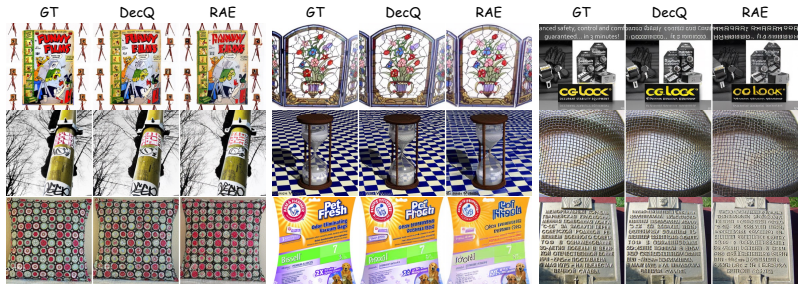

read the original abstract
Representation Autoencoders (RAEs) leverage frozen vision foundation models (VFMs) as tokenizer encoders, providing robust high-level representations that facilitate fast convergence and high-quality generation in latent diffusion models. However, freezing the VFM inherently constrains its spatial reconstruction capacity, limiting fine-grained generation and image editing; in contrast, incorporating reconstruction-oriented signals via fine-tuning disrupts the pretrained semantic space and degrades generative fidelity. To address this trade-off, we propose DecQ, a simple yet effective framework for RAEs. Specifically, DecQ introduces lightweight detail-condensing queries that extract fine-grained information from intermediate VFM features through condenser modules. These queries are incorporated into the decoder to support reconstruction and are jointly generated with patch tokens during generative modeling. By aggregating information from both shallow and deep layers, DecQ effectively mitigates the reconstruction--generation trade-off, improving both reconstruction quality and generative performance. Our experiments demonstrate that: (1) with only 8 additional queries and 3.9% extra computation, DecQ improves reconstruction over the frozen DINOv2-based RAE, increasing PSNR from 19.13 dB to 22.76 dB; and (2) for generative modeling, DecQ achieves 3.3$\times$ faster convergence than RAE, attaining an FID of 1.41 without guidance and 1.05 with guidance.
Editorial analysis
A structured set of objections, weighed in public.
Referee Report
Summary. The paper proposes DecQ for Representation Autoencoders (RAEs) that use frozen vision foundation models (VFMs) as encoders. It introduces lightweight detail-condensing queries extracted via condenser modules from intermediate VFM layers; these queries augment the decoder for reconstruction and are jointly generated with patch tokens in latent diffusion models. The central claim is that aggregating shallow and deep layer information mitigates the reconstruction-generation trade-off without fine-tuning the VFM. Experiments report a PSNR rise from 19.13 dB to 22.76 dB using 8 queries (3.9% extra compute), 3.3× faster convergence, and improved FID scores (1.41 without guidance, 1.05 with guidance).
Significance. If the experimental claims hold under fuller controls, DecQ provides a low-overhead way to improve both reconstruction fidelity and generative quality in RAEs while preserving the frozen VFM's semantic space. This could meaningfully advance latent diffusion pipelines for high-resolution synthesis and editing by avoiding the semantic degradation typically induced by reconstruction fine-tuning. The reported minimal parameter overhead and concrete metric gains are strengths that, if reproducible, would make the method practically attractive.
major comments (2)
- Abstract: The reported PSNR gain (19.13 dB to 22.76 dB) and FID improvements are presented without error bars, standard deviations across runs, or dataset specifications; this directly affects the load-bearing claim that DecQ consistently mitigates the reconstruction-generation trade-off.
- Abstract and §4 (Experiments): The generative results cite 3.3× faster convergence and FID 1.41/1.05 but provide no ablation on query count, layer selection, or comparison against recent RAE variants; without these controls it is unclear whether the joint generation of queries with patch tokens is the operative factor or whether the gains could arise from other architectural choices.
minor comments (2)
- Notation: The term 'detail-condensing queries' is introduced without a precise mathematical definition or diagram showing how they are concatenated with patch tokens before the decoder; a small equation or figure would clarify the integration.
- Abstract: The phrase '3.9% extra computation' should specify the exact metric (FLOPs, wall-clock time, or parameter count) and the baseline model size for reproducibility.
Simulated Author's Rebuttal
We thank the referee for the constructive feedback on our manuscript. We address each major comment point by point below, indicating the changes we will make to strengthen the presentation of our results.
read point-by-point responses
-
Referee: Abstract: The reported PSNR gain (19.13 dB to 22.76 dB) and FID improvements are presented without error bars, standard deviations across runs, or dataset specifications; this directly affects the load-bearing claim that DecQ consistently mitigates the reconstruction-generation trade-off.
Authors: We agree that the abstract would benefit from explicit dataset references and measures of result variability to better support the central claim. The reported numbers come from our primary experimental setup on standard image datasets (detailed in Section 4), but these are not restated in the abstract and no error bars are shown. In the revised manuscript we will update the abstract to name the evaluation datasets and add error bars computed from multiple independent runs for both PSNR and FID metrics. revision: yes
-
Referee: Abstract and §4 (Experiments): The generative results cite 3.3× faster convergence and FID 1.41/1.05 but provide no ablation on query count, layer selection, or comparison against recent RAE variants; without these controls it is unclear whether the joint generation of queries with patch tokens is the operative factor or whether the gains could arise from other architectural choices.
Authors: The referee is correct that the current manuscript does not include systematic ablations on query count or layer selection, nor direct comparisons against the most recent RAE variants beyond the base frozen RAE. While the main results demonstrate the overall benefit of DecQ, these additional controls would help isolate the contribution of jointly generating the detail-condensing queries. We will expand Section 4 with the requested ablations (varying query count and layer choices) and include comparisons to additional recent RAE methods in the revised version. revision: yes
Circularity Check
No significant circularity; claims rest on empirical validation
full rationale
The paper introduces DecQ as an architectural addition of lightweight detail-condensing queries that aggregate shallow and deep VFM features for a frozen encoder. Central claims of mitigating the reconstruction-generation trade-off are supported directly by reported experimental metrics (PSNR increase from 19.13 dB to 22.76 dB with 8 queries, 3.3× faster convergence, FID scores of 1.41/1.05). No equations, fitted parameters renamed as predictions, or self-citation chains are used to derive the performance gains; the method is described as a simple extension whose benefits are measured against external benchmarks like DINOv2-based RAE. This constitutes a self-contained empirical contribution.
Axiom & Free-Parameter Ledger
free parameters (1)
- number of queries =
8
axioms (1)
- domain assumption Frozen vision foundation models provide robust high-level representations that facilitate fast convergence and high-quality generation in latent diffusion models.
invented entities (1)
-
detail-condensing queries
no independent evidence
Lean theorems connected to this paper
-
IndisputableMonolith/Cost/FunctionalEquation.leanwashburn_uniqueness_aczel unclear?
unclearRelation between the paper passage and the cited Recognition theorem.
DecQ introduces lightweight detail-condensing queries that extract fine-grained information from intermediate VFM features through condenser modules... By aggregating information from both shallow and deep layers, DecQ effectively mitigates the reconstruction–generation trade-off
-
IndisputableMonolith/Foundation/AlexanderDuality.leanalexander_duality_circle_linking unclear?
unclearRelation between the paper passage and the cited Recognition theorem.
condensers attached to VFM layers 0, 3, 6, and 9... shallow layers favor reconstruction, while deeper layers benefit generation
What do these tags mean?
- matches
- The paper's claim is directly supported by a theorem in the formal canon.
- supports
- The theorem supports part of the paper's argument, but the paper may add assumptions or extra steps.
- extends
- The paper goes beyond the formal theorem; the theorem is a base layer rather than the whole result.
- uses
- The paper appears to rely on the theorem as machinery.
- contradicts
- The paper's claim conflicts with a theorem or certificate in the canon.
- unclear
- Pith found a possible connection, but the passage is too broad, indirect, or ambiguous to say the theorem truly supports the claim.
Reference graph
Works this paper leans on
-
[1]
High- resolution image synthesis with latent diffusion models
Robin Rombach, Andreas Blattmann, Dominik Lorenz, Patrick Esser, and Björn Ommer. High- resolution image synthesis with latent diffusion models. InCVPR, 2022. 1, 3, 6
work page 2022
-
[2]
Flux.https://github.com/black-forest-labs/flux, 2024
Black Forest Labs. Flux.https://github.com/black-forest-labs/flux, 2024
work page 2024
-
[3]
SANA: Efficient High-Resolution Image Synthesis with Linear Diffusion Transformers
Enze Xie, Junsong Chen, Junyu Chen, Han Cai, Haotian Tang, Yujun Lin, Zhekai Zhang, Muyang Li, Ligeng Zhu, Yao Lu, et al. Sana: Efficient high-resolution image synthesis with linear diffusion transformers.arXiv preprint arXiv:2410.10629, 2024. 1
work page internal anchor Pith review Pith/arXiv arXiv 2024
-
[4]
Diffusion transformers with representation autoencoders
Boyang Zheng, Nanye Ma, Shengbang Tong, and Saining Xie. Diffusion transformers with representation autoencoders. InICLR, 2026. 1, 3, 4, 5, 6, 7, 8, 14
work page 2026
-
[5]
Dinov2: Learning robust visual features without supervision.TMLR, 2024
Maxime Oquab, Timothée Darcet, Théo Moutakanni, Huy V o, Marc Szafraniec, Vasil Khali- dov, Pierre Fernandez, Daniel Haziza, Francisco Massa, Alaaeldin El-Nouby, et al. Dinov2: Learning robust visual features without supervision.TMLR, 2024. 1
work page 2024
-
[6]
Michael Tschannen, Alexey Gritsenko, Xiao Wang, Muhammad Ferjad Naeem, Ibrahim Al- abdulmohsin, Nikhil Parthasarathy, Talfan Evans, Lucas Beyer, Ye Xia, Basil Mustafa, et al. Siglip 2: Multilingual vision-language encoders with improved semantic understanding, local- ization, and dense features.arXiv preprint arXiv:2502.14786, 2025. 1
work page internal anchor Pith review Pith/arXiv arXiv 2025
-
[7]
Learning transferable visual models from natural language supervision
Alec Radford, Jong Wook Kim, Chris Hallacy, Aditya Ramesh, Gabriel Goh, Sandhini Agar- wal, Girish Sastry, Amanda Askell, Pamela Mishkin, Jack Clark, et al. Learning transferable visual models from natural language supervision. InICML, 2021. 1
work page 2021
-
[8]
Sigmoid loss for lan- guage image pre-training
Xiaohua Zhai, Basil Mustafa, Alexander Kolesnikov, and Lucas Beyer. Sigmoid loss for lan- guage image pre-training. InICCV, 2023. 1
work page 2023
-
[9]
Oriane Siméoni, Huy V V o, Maximilian Seitzer, Federico Baldassarre, Maxime Oquab, Cijo Jose, Vasil Khalidov, Marc Szafraniec, Seungeun Yi, Michaël Ramamonjisoa, et al. Dinov3. arXiv preprint arXiv:2508.10104, 2025. 1
work page internal anchor Pith review Pith/arXiv arXiv 2025
-
[10]
Auto-encoding variational bayes
Diederik P Kingma and Max Welling. Auto-encoding variational bayes. InICLR, 2014. 1
work page 2014
-
[11]
Neural discrete representation learning
Aaron Van Den Oord, Oriol Vinyals, et al. Neural discrete representation learning. InNeurIPS, 2017
work page 2017
-
[12]
Taming transformers for high-resolution image synthesis
Patrick Esser, Robin Rombach, and Bjorn Ommer. Taming transformers for high-resolution image synthesis. InCVPR, 2021. 1
work page 2021
-
[13]
Hao Tang, Chenwei Xie, Xiaoyi Bao, Tingyu Weng, Pandeng Li, Yun Zheng, and Liwei Wang. Unilip: Adapting clip for unified multimodal understanding, generation and editing.arXiv preprint arXiv:2507.23278, 2025. 1, 2
-
[14]
Latent diffusion model without variational autoencoder
Minglei Shi, Haolin Wang, Wenzhao Zheng, Ziyang Yuan, Xiaoshi Wu, Xintao Wang, Pengfei Wan, Jie Zhou, and Jiwen Lu. Latent diffusion model without variational autoencoder. InICLR,
-
[15]
Dualtoken: Towards unifying visual understanding and generation with dual visual vocabularies
Wei Song, Yuran Wang, Zijia Song, Yadong Li, Zenan Zhou, Long Chen, Jianhua Xu, Jiaqi Wang, and Kaicheng Yu. Dualtoken: Towards unifying visual understanding and generation with dual visual vocabularies. InICLR, 2026. 1
work page 2026
-
[16]
Aligning visual foundation encoders to tokenizers for diffusion models
Bowei Chen, Sai Bi, Hao Tan, He Zhang, Tianyuan Zhang, Zhengqi Li, Yuanjun Xiong, Jian- ming Zhang, and Kai Zhang. Aligning visual foundation encoders to tokenizers for diffusion models. InICLR, 2026. 2, 3
work page 2026
-
[17]
Yue Gong, Hongyu Li, Shanyuan Liu, Bo Cheng, Yuhang Ma, Liebucha Wu, Xiaoyu Wu, Manyuan Zhang, Dawei Leng, Yuhui Yin, et al. Rpiae: A representation-pivoted autoencoder enhancing both image generation and editing.arXiv preprint arXiv:2603.19206, 2026. 2, 3, 6, 7 10
-
[18]
Improving reconstruction of representation autoencoder.arXiv preprint arXiv:2602.08620, 2026
Siyu Liu, Chujie Qin, Hubery Yin, Qixin Yan, Zheng-Peng Duan, Chen Li, Jing Lyu, Chun-Le Guo, and Chongyi Li. Improving reconstruction of representation autoencoder.arXiv preprint arXiv:2602.08620, 2026. 2, 3, 7
-
[19]
Scalable diffusion models with transformers
William Peebles and Saining Xie. Scalable diffusion models with transformers. InICCV, 2023. 3
work page 2023
-
[20]
Sit: Exploring flow and diffusion-based generative models with scalable inter- polant transformers
Nanye Ma, Mark Goldstein, Michael S Albergo, Nicholas M Boffi, Eric Vanden-Eijnden, and Saining Xie. Sit: Exploring flow and diffusion-based generative models with scalable inter- polant transformers. InECCV, 2024. 3, 7
work page 2024
-
[21]
Representation alignment for generation: Training diffusion transformers is easier than you think
Sihyun Yu, Sangkyung Kwak, Huiwon Jang, Jongheon Jeong, Jonathan Huang, Jinwoo Shin, and Saining Xie. Representation alignment for generation: Training diffusion transformers is easier than you think. InICLR, 2025. 3, 7, 8
work page 2025
-
[22]
What matters for representation alignment: Global information or spatial struc- ture? InICLR, 2026
Jaskirat Singh, Xingjian Leng, Zongze Wu, Liang Zheng, Richard Zhang, Eli Shechtman, and Saining Xie. What matters for representation alignment: Global information or spatial struc- ture? InICLR, 2026. 3
work page 2026
-
[23]
Repa-e: Unlocking vae for end-to-end tuning with latent diffusion transformers
Xingjian Leng, Jaskirat Singh, Yunzhong Hou, Zhenchang Xing, Saining Xie, and Liang Zheng. Repa-e: Unlocking vae for end-to-end tuning with latent diffusion transformers. In ICCV, 2025. 3
work page 2025
-
[24]
Ge Wu, Shen Zhang, Ruijing Shi, Shanghua Gao, Zhenyuan Chen, Lei Wang, Zhaowei Chen, Hongcheng Gao, Yao Tang, jian Yang, Ming-Ming Cheng, and Xiang Li. Representation entanglement for generation: Training diffusion transformers is much easier than you think. In NeurIPS, 2026. 3, 7, 8
work page 2026
-
[25]
Catok: Taming mean flows for one-dimensional causal image tokenization
Yitong Chen, Zuxuan Wu, Xipeng Qiu, and Yu-Gang Jiang. Catok: Taming mean flows for one-dimensional causal image tokenization. InCVPR, 2026. 3
work page 2026
-
[26]
Jingfeng Yao, Bin Yang, and Xinggang Wang. Reconstruction vs. generation: Taming opti- mization dilemma in latent diffusion models. InCVPR, 2025. 3, 6, 7, 13
work page 2025
-
[27]
Distribution matching variational autoencoder.arXiv preprint arXiv:2512.07778, 2025
Sen Ye, Jianning Pei, Mengde Xu, Shuyang Gu, Chunyu Wang, Liwei Wang, and Han Hu. Distribution matching variational autoencoder.arXiv preprint arXiv:2512.07778, 2025. 3, 7
-
[28]
Qifan Li, Xingyu Zhou, Jinhua Zhang, Weiyi You, and Shuhang Gu. Taming sampling perturbations with variance expansion loss for latent diffusion models.arXiv preprint arXiv:2603.21085, 2026. 3
-
[29]
VFM-VAE: Vision Foundation Models Can Be Good Tokenizers for Latent Diffusion Models
Tianci Bi, Xiaoyi Zhang, Yan Lu, and Nanning Zheng. Vision foundation models can be good tokenizers for latent diffusion models.arXiv preprint arXiv:2510.18457, 2025. 3
work page internal anchor Pith review Pith/arXiv arXiv 2025
-
[30]
Generative multimodal pretraining with discrete diffusion timestep tokens
Kaihang Pan, Wang Lin, Zhongqi Yue, Tenglong Ao, Liyu Jia, Wei Zhao, Juncheng Li, Siliang Tang, and Hanwang Zhang. Generative multimodal pretraining with discrete diffusion timestep tokens. InCVPR, 2025. 5, 6
work page 2025
-
[31]
Scaling rectified flow trans- formers for high-resolution image synthesis
Patrick Esser, Sumith Kulal, Andreas Blattmann, Rahim Entezari, Jonas Müller, Harry Saini, Yam Levi, Dominik Lorenz, Axel Sauer, Frederic Boesel, et al. Scaling rectified flow trans- formers for high-resolution image synthesis. InICML, 2024. 3, 6
work page 2024
-
[32]
Yuan Gao, Chen Chen, Tianrong Chen, and Jiatao Gu. One layer is enough: Adapting pre- trained visual encoders for image generation.arXiv preprint arXiv:2512.07829, 2025. 3, 6, 7
-
[33]
Efros, Eli Shechtman, and Oliver Wang
Richard Zhang, Phillip Isola, Alexei A. Efros, Eli Shechtman, and Oliver Wang. The unreason- able effectiveness of deep features as a perceptual metric. InCVPR, 2018. 4
work page 2018
-
[34]
Stylegan-t: Unlocking the power of gans for fast large-scale text-to-image synthesis
Axel Sauer, Tero Karras, Samuli Laine, Andreas Geiger, and Timo Aila. Stylegan-t: Unlocking the power of gans for fast large-scale text-to-image synthesis. InICML, 2023. 11
work page 2023
-
[35]
An image is worth 16x16 words: Transformers for image recognition at scale
Alexey Dosovitskiy, Lucas Beyer, Alexander Kolesnikov, Dirk Weissenborn, Xiaohua Zhai, Thomas Unterthiner, Mostafa Dehghani, Matthias Minderer, Georg Heigold, Sylvain Gelly, et al. An image is worth 16x16 words: Transformers for image recognition at scale. InICLR,
-
[36]
Imagenet: A large-scale hierarchical image database
Jia Deng, Wei Dong, Richard Socher, Li-Jia Li, Kai Li, and Li Fei-Fei. Imagenet: A large-scale hierarchical image database. InCVPR, 2009. 6
work page 2009
-
[37]
Zhou Wang, A.C. Bovik, H.R. Sheikh, and E.P. Simoncelli. Image quality assessment: from error visibility to structural similarity.TIP, 2004. 6
work page 2004
-
[38]
Gans trained by a two time-scale update rule converge to a local nash equilibrium
Martin Heusel, Hubert Ramsauer, Thomas Unterthiner, Bernhard Nessler, and Sepp Hochreiter. Gans trained by a two time-scale update rule converge to a local nash equilibrium. InNeurIPS,
-
[39]
Diffusion models beat gans on image synthesis
Prafulla Dhariwal and Alexander Nichol. Diffusion models beat gans on image synthesis. In NeurIPS, 2021. 6
work page 2021
-
[40]
Fast training of diffusion models with masked transformers.TMLR, 2023
Hongkai Zheng, Weili Nie, Arash Vahdat, and Anima Anandkumar. Fast training of diffusion models with masked transformers.TMLR, 2023. 7
work page 2023
-
[41]
Vision transformers need registers
Timothée Darcet, Maxime Oquab, Julien Mairal, and Piotr Bojanowski. Vision transformers need registers. InICLR, 2024. 13
work page 2024
-
[42]
Tero Karras, Miika Aittala, Tuomas Kynkäänniemi, Jaakko Lehtinen, Timo Aila, and Samuli Laine. Guiding a diffusion model with a bad version of itself. InNeurIPS, 2025. 13 12 A Implementation Details A.1 DecQ Implementation We follow the training scheme of RAE. For the encoder, we use DINOv2 with Registers [41] to process images resized to224×224, producin...
work page 2025
discussion (0)
Sign in with ORCID, Apple, or X to comment. Anyone can read and Pith papers without signing in.