Real-Time Earthquake Magnitude Classification from Initial P-Waves: Models, Dataset, and Comparative Analysis for South Asia
Pith reviewed 2026-05-25 00:06 UTC · model grok-4.3
The pith
Transformer classifies earthquake magnitudes from 7-second P-waves with 76% accuracy
A machine-rendered reading of the paper's core claim, the machinery that carries it, and where it could break.
Core claim
The authors show that attention mechanisms within a Transformer model extract enough temporal information from short single-station P-wave segments to separate five Richter-scale magnitude classes on their South Asia catalog, delivering higher accuracy than other tested approaches and supporting real-time use despite limited samples of the largest events.
What carries the argument
Transformer architecture with attention applied to 7-second vertical P-wave time series for five-class magnitude classification
Load-bearing premise
The 7318-event South Asia dataset represents the full variety of real earthquake signals and that the initial 7-second single-station P-wave contains enough information to separate the five magnitude classes reliably.
What would settle it
Running the trained model on an independent collection of earthquakes recorded after the dataset period or from a different region and checking whether accuracy remains near 76 percent.
Figures



read the original abstract
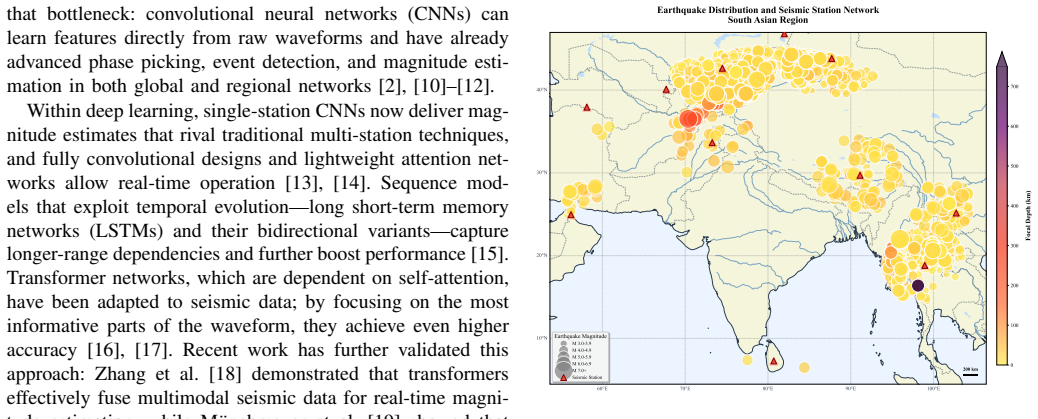
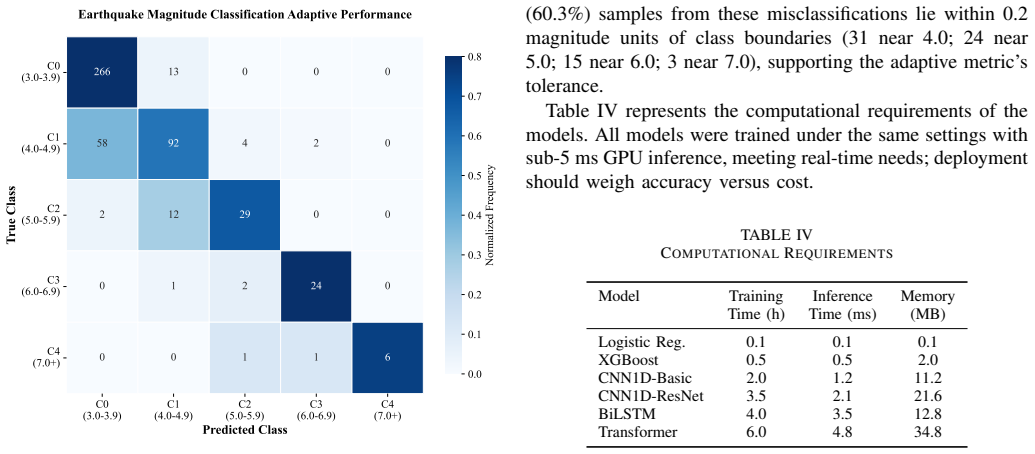
Rapid earthquake magnitude estimation is crucial for effective early warning systems that can save lives and reduce economic damage. In this paper, we present a comprehensive study of magnitude classification using only the vertical component of the initial 7-second P-wave window from a single station. We compare six machine learning approaches that range from traditional models to state-of-the-art deep learning architectures. We also curated a novel dataset of 7,318 earthquake events in South Asia. The dataset was categorized into five Richter-scale classes: slight (3.0-3.9), light (4.0-4.9), moderate (5.0-5.9), strong (6.0-6.9) and severe (>= 7.0). Our experiments show that deep learning models substantially outperform traditional approaches. Our Transformer based architecture achieved 76.23% standard accuracy and 81.56% adaptive accuracy with 4.8 ms inference latency. The adaptive-accuracy metric is introduced for the inherent uncertainty in magnitude estimation of near class boundaries. These results indicate that the attention mechanisms in Transformers combined with adaptive classification effectively capture the temporal dynamics of seismic signals. The architectural advantage facilitates promising generalization to rare high-magnitude events, despite the inherent data scarcity characteristic of seismic catalogs. The adaptive accuracy provides a more realistic assessment of model performance, and the result suggests viability for real-time deployment.
Editorial analysis
A structured set of objections, weighed in public.
Referee Report
Summary. The paper claims that machine learning models, particularly a Transformer architecture, can classify earthquakes into five magnitude classes (slight 3.0-3.9, light 4.0-4.9, moderate 5.0-5.9, strong 6.0-6.9, severe >=7.0) using only the vertical component of the initial 7-second P-wave from a single station. On a newly curated dataset of 7318 South Asia events, the Transformer achieves 76.23% standard accuracy and 81.56% adaptive accuracy with 4.8 ms inference latency, outperforming traditional models and suggesting viability for real-time early warning with promising generalization to rare high-magnitude events.
Significance. If the reported accuracies prove robust under proper validation, the work would contribute a novel South Asia seismic dataset and an adaptive accuracy metric that accounts for boundary uncertainty in magnitude estimation. The low inference latency and focus on attention mechanisms for temporal signal dynamics represent practical strengths for early earthquake warning systems. Dataset curation for a region with limited prior ML studies is a clear positive.
major comments (3)
- [Dataset] Dataset section: The distribution of the 7318 events across the five magnitude classes is not reported, nor is any analysis of class imbalance or selection criteria to ensure representativeness of real-world operational conditions. This directly undermines evaluation of the generalization claim to rare severe (>=7.0) events.
- [Experiments] Experimental setup: No description is provided of the train-test split strategy (temporal, spatial, or random), cross-validation method, or class-imbalance handling (weighting, oversampling). These details are load-bearing for interpreting whether the 76.23% and 81.56% figures reflect genuine performance or overfitting/selection effects.
- [Results] Results: No ablation is shown isolating performance on the severe class or testing whether the 7-second single-station vertical P-wave window suffices to separate classes for high-magnitude events; the generalization claim therefore lacks direct supporting evidence.
minor comments (2)
- [Abstract] Abstract: The phrase 'Richter-scale classes' should be clarified, as modern catalogs typically use moment magnitude (Mw) or local magnitude (ML); specifying the exact magnitude type improves precision.
- [Methods] Methods: The adaptive accuracy metric is introduced without a formal equation or pseudocode definition, hindering exact reproduction and comparison to standard accuracy.
Simulated Author's Rebuttal
We thank the referee for their constructive comments, which highlight important areas for improving the manuscript's clarity and rigor. We will revise the paper to address the missing details on dataset composition, experimental protocols, and targeted analyses. Our responses to each major comment are provided below.
read point-by-point responses
-
Referee: [Dataset] Dataset section: The distribution of the 7318 events across the five magnitude classes is not reported, nor is any analysis of class imbalance or selection criteria to ensure representativeness of real-world operational conditions. This directly undermines evaluation of the generalization claim to rare severe (>=7.0) events.
Authors: We agree this information is necessary. The revised manuscript will include a table reporting the exact event counts per class and an analysis of imbalance (noting the expected scarcity of severe events). Selection criteria from the ISC catalog will be detailed, including requirements for clear P-wave signals and magnitude reporting. This will allow readers to evaluate the generalization claims directly. revision: yes
-
Referee: [Experiments] Experimental setup: No description is provided of the train-test split strategy (temporal, spatial, or random), cross-validation method, or class-imbalance handling (weighting, oversampling). These details are load-bearing for interpreting whether the 76.23% and 81.56% figures reflect genuine performance or overfitting/selection effects.
Authors: We will expand the Experimental Setup section to specify the split (stratified random 80/20 to preserve class ratios), 5-fold cross-validation, and imbalance handling via class-weighted loss functions. These additions will demonstrate that the reported accuracies arise from standard validation practices rather than selection artifacts. revision: yes
-
Referee: [Results] Results: No ablation is shown isolating performance on the severe class or testing whether the 7-second single-station vertical P-wave window suffices to separate classes for high-magnitude events; the generalization claim therefore lacks direct supporting evidence.
Authors: We will add a dedicated ablation subsection with per-class metrics (including severe-class precision/recall) and a comparison of window lengths (e.g., 3s vs. 7s vs. 10s) focused on high-magnitude events. This will provide direct evidence for the generalization statement while acknowledging data scarcity for the severe class. revision: yes
Circularity Check
No circularity: empirical test-set accuracies from standard ML training
full rationale
The paper reports 76.23% standard accuracy and 81.56% adaptive accuracy for a Transformer model trained on a curated 7318-event dataset, evaluated on held-out data. These are conventional empirical metrics obtained after model fitting; no equations, self-citations, or ansatzes are shown that reduce the claimed performance or generalization statements to the inputs by construction. The adaptive accuracy metric is introduced to handle boundary uncertainty but is not demonstrated to be tautological with the training process. The derivation chain consists of data curation followed by standard supervised learning and evaluation, which remains self-contained against external benchmarks.
Axiom & Free-Parameter Ledger
free parameters (1)
- Transformer hyperparameters and training settings
axioms (1)
- domain assumption The initial 7-second vertical P-wave from one station contains sufficient discriminative information for five-class magnitude classification
Reference graph
Works this paper leans on
-
[1]
O. Mishra, “Seismic microzonation study of south asian cities and its implications to urban risk resiliency under climate change scenario,” International Journal of Geosciences, vol. 11, no. 4, pp. 197–237, 2020
work page 2020
-
[2]
Generalized seismic phase detection with deep learning,
Z. E. Ross, M. A. Meier, E. Hauksson, and T. H. Heaton, “Generalized seismic phase detection with deep learning,”Bulletin of the Seismolog- ical Society of America, vol. 108, no. 5A, pp. 2894–2901, 2018
work page 2018
-
[3]
S. Nazeri, Z. H. Shomali, S. Colombelli, L. Elia, and A. Zollo, “Magnitude estimation based on integrated amplitude and frequency content of the initial p wave in earthquake early warning applied to tehran, iran,”Bulletin of the Seismological Society of America, vol. 107, no. 3, pp. 1432–1438, 04 2017. [Online]. Available: https://doi.org/10.1785/0120160380
-
[4]
The richter scale: its development and use for determining earthquake source parameters,
D. M. Boore, “The richter scale: its development and use for determining earthquake source parameters,”Tectonophysics, vol. 166, no. 1, pp. 1–14, 1989, quantification of Earthquakes and the Determination of Source Parameters. [Online]. Available: https: //www.sciencedirect.com/science/article/pii/004019518990200X
-
[5]
M. B ¨ose, E. Hauksson, K. Solanki, H. Kanamori, and T. H. Heaton, “Real-time testing of the on-site warning algorithm in southern cali- fornia and its performance during the july 29 2008 mw5.4 chino hills earthquake,”Geophysical Research Letters, vol. 36, no. 5, 2009
work page 2008
-
[6]
A p wave-based, on-site method for earthquake early warning,
S. Colombelli, A. Caruso, A. Zollo, G. Festa, and H. Kanamori, “A p wave-based, on-site method for earthquake early warning,”Geophysical Research Letters, vol. 42, no. 5, pp. 1390–1398, 2015
work page 2015
-
[7]
Earthquake early warning system in southern italy: Methodologies and performance evaluation,
A. Zolloet al., “Earthquake early warning system in southern italy: Methodologies and performance evaluation,”Geophysical Research Let- ters, vol. 36, no. 5, 2009
work page 2009
-
[8]
C. Satriano, L. Elia, C. Martino, M. Lancieri, A. Zollo, and G. Ian- naccone, “Presto, the earthquake early warning system for southern italy: Concepts, capabilities and future perspectives,”Soil Dynamics and Earthquake Engineering, vol. 31, no. 2, pp. 137–153, 2011
work page 2011
-
[9]
Continuous earthquake detection and classification using discrete hidden markov models,
M. Beyreuther and J. Wassermann, “Continuous earthquake detection and classification using discrete hidden markov models,”Geophysical Journal International, vol. 175, no. 3, pp. 1055–1066, 2008
work page 2008
-
[10]
Phasenet: A deep-neural-network-based seis- mic arrival-time picking method,
W. Zhu and G. C. Beroza, “Phasenet: A deep-neural-network-based seis- mic arrival-time picking method,”Geophysical Journal International, vol. 216, no. 1, pp. 261–273, 2019
work page 2019
-
[11]
A machine-learning approach for earthquake magnitude estimation,
S. M. Mousavi and G. C. Beroza, “A machine-learning approach for earthquake magnitude estimation,”Geophysical Research Letters, vol. 47, no. 1, p. e2019GL085976, 2020
work page 2020
-
[12]
A. Wibowo, L. S. Heliani, C. Pratama, D. P. Sahara, S. Widiyantoro, D. Ramdani, M. B. Fuady Bisri, A. Sudrajat, S. T. Wibowo, and S. R. Purnama, “Deep learning for real-time p-wave detection: A case study in indonesia’s earthquake early warning system,”Applied Computing and Geosciences, vol. 24, p. 100194, 2024. [Online]. Available: https://www.sciencedir...
work page 2024
-
[13]
J. Guo, J. Tian, Y . Guo, and H. Zhang, “Lftnet: A lightweight multi- scale attention network for real-time seismic event detection and phase picking,”Earth and Space Science, vol. 12, no. 9, p. e2025EA004548, 2025
work page 2025
-
[14]
A. Lomax, A. Michelini, and D. Jozinovi ´c, “An investigation of rapid earthquake characterization using single-station waveforms and a con- volutional neural network,”Seismological Research Letters, vol. 90, no. 2A, pp. 517–529, 2019
work page 2019
-
[15]
X. Zhang, J. Zhang, C. Yuan, S. Liu, Z. Chen, and W. Li, “Locating induced earthquakes with a network of seismic stations in oklahoma via a deep learning method,”Scientific Reports, vol. 10, no. 1, pp. 1–12, 2020
work page 2020
-
[16]
A. Vaswaniet al., “Attention is all you need,” inAdvances in Neural Information Processing Systems, 2017, pp. 5998–6008
work page 2017
-
[17]
S. M. Mousavi, W. L. Ellsworth, W. Zhu, L. Y . Chuang, and G. C. Beroza, “Earthquake transformer—an attentive deep-learning model for simultaneous earthquake detection and phase picking,”Nature Commu- nications, vol. 11, no. 1, pp. 1–12, 2020
work page 2020
-
[18]
H. Zhang, Z. Xu, X. Jin, and M. Song, “Real-time earthquake magnitude estimation via a deep learning network based on waveform and text mixed modal,”Earth, Planets and Space, vol. 76, no. 1, p. 70, 2024
work page 2024
-
[19]
J. M ¨unchmeyer, D. Bindi, U. Leser, and F. Tilmann, “Earthquake magnitude and location estimation from real time seismic waveforms with a transformer network,”Geophysical Journal International, vol. 226, no. 2, pp. 1086–1104, 2021
work page 2021
-
[20]
Wavecastnet: An AI- enabled wavefield forecasting framework for earthquake early warning,
D. Lyu, R. Wang, D. Melgar, and V . Sahakian, “Wavecastnet: An AI- enabled wavefield forecasting framework for earthquake early warning,” arXiv preprint arXiv:2405.20516, 2024
discussion (0)
Sign in with ORCID, Apple, or X to comment. Anyone can read and Pith papers without signing in.