Staging by the Book: Automatic Sleep Stage Classification Using Scoring Rules
Pith reviewed 2026-05-25 06:23 UTC · model grok-4.3
The pith
A rule-based system encodes AASM sleep scoring guidelines as executable code to produce classifications and explanations.
A machine-rendered reading of the paper's core claim, the machinery that carries it, and where it could break.
Core claim
The paper introduces a rule-based sleep staging algorithm that directly implements the AASM scoring manual in software, including an explanation trace that converts the decision path into readable text. On a test set of 50 PSG recordings the algorithm agrees with the ten-scorer consensus reference in 60.5 percent of epochs with a kappa of 0.42, performing best on N2 and R stages. The resulting decisions are fully determined by the encoded rules and come with justifications that mirror clinical reasoning.
What carries the argument
An executable encoding of the AASM sleep staging rules together with an explanation trace that generates epoch-level natural-language justifications.
If this is right
- The method supplies verifiable, rule-following decisions that can audit opaque machine learning models.
- Natural language explanations allow clinicians to inspect why a particular stage was assigned.
- Deterministic behavior eliminates variability from training data or model initialization.
- Lower agreement than deep learning models is accepted in exchange for explicit alignment with clinical guidelines.
- Performance differences between development and test sets indicate that implementation details affect outcomes.
Where Pith is reading between the lines
- Disagreements with human consensus may point to specific ambiguities in the AASM guidelines that need clarification.
- The rule set could be used to create large volumes of labeled data for training more accurate yet still interpretable models.
- Similar rule translations might apply to other standardized medical scoring procedures beyond sleep.
- Integration with signal processing pipelines could allow real-time staging during recordings.
Load-bearing premise
The AASM scoring rules are sufficiently precise and complete to be converted into deterministic code without significant loss of the judgment human experts apply to edge cases.
What would settle it
Expert review of the code's output on a new set of epochs that identifies systematic misapplications of the AASM rules arising from unencoded ambiguities.
Figures


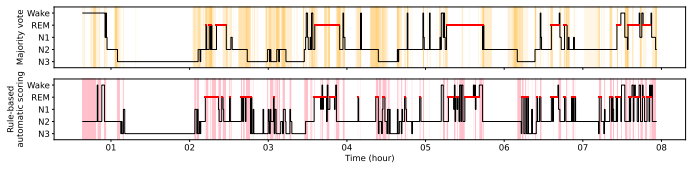

read the original abstract
Automated sleep staging is commonly approached as a supervised machine learning problem, with deep learning methods dominating recent research. While machine learning models achieve near-human level agreement with human-scored reference sleep stages, their decisions are typically opaque and not designed to follow clinical scoring rules. We propose a transparent alternative: a deterministic, rule-based sleep staging method that explicitly operationalizes the American Academy of Sleep Medicine's (AASM) scoring logic as executable code, coupled with epoch-level natural-language justifications derived from an explanation trace. We evaluate the approach on 50 polysomnography recordings with a 10-scorer majority-vote consensus as reference. Across all recordings, the method agreed with the majority-vote reference in 60.5% of epochs ($\kappa=0.42$), with substantially higher agreement on a dataset used during development (77.1%, $\kappa=0.61$). Agreement with the reference was highest for sleep stage N2 (recall 83.5%) and moderate for sleep stage R (recall 68.7%), while Wake and N1 recall were low. Despite lower agreement with the reference than contemporary deep learning models, the method provides deterministic decisions and natural language explanations aligned with AASM scoring rules, making it a complementary tool for auditing, debugging, and governing deep learning-based sleep staging.
Editorial analysis
A structured set of objections, weighed in public.
Referee Report
Summary. The manuscript proposes a deterministic, rule-based sleep staging algorithm that translates AASM scoring rules into executable code, generating epoch-level natural-language explanations from an internal trace. Evaluated on 50 PSG recordings against a 10-scorer majority-vote reference, it achieves 60.5% epoch agreement (κ=0.42) overall and 77.1% (κ=0.61) on a development subset, with highest recall for N2 and lower for Wake/N1; the work positions this as a transparent complement to opaque deep-learning models for auditing and governance.
Significance. If the rule translations prove faithful, the approach supplies a reproducible, parameter-free baseline that can serve as an auditing tool for ML sleep-staging systems and as an educational or regulatory reference. The explicit use of an external consensus reference and the generation of human-readable justifications are concrete strengths that address a recognized gap in interpretability. The lower absolute agreement relative to contemporary DL models is expected and does not diminish the potential utility for verification tasks.
major comments (3)
- [§2] §2 (Rule Implementation): The description of the executable AASM encoding does not specify the concrete numerical cutoffs, tie-breaking procedures, or edge-case resolutions chosen for inherently ambiguous manual criteria (e.g., amplitude thresholds for slow waves, K-complex detection, or contextual stage-transition rules). Without these details or an external validation against multiple scorers on ambiguous epochs, the central claim that the code constitutes a faithful, lossless operationalization cannot be assessed.
- [Abstract and Evaluation] Abstract and Evaluation section: The 16.6-point gap between development-set agreement (77.1%) and overall agreement (60.5%) raises the possibility that implementation choices were tuned to the development recordings. This directly undermines the asserted deterministic, non-data-dependent character of the method and must be resolved by documenting a strict separation with no post-hoc adjustments.
- [Results] Results: No per-epoch or per-recording breakdown is provided that isolates performance on epochs where the 10 human scorers themselves disagree; such an analysis is required to determine whether the reported 60.5% agreement reflects intrinsic limits of the AASM rules or artifacts introduced by the deterministic encoding.
minor comments (2)
- The manuscript should include at least one full worked example of an epoch trace with the generated natural-language justification in the main text or a clearly labeled supplementary figure.
- [§2] The version of the AASM manual being operationalized (2012 or later) and any explicit deviations from the printed guidelines should be stated in §2.
Simulated Author's Rebuttal
Thank you for the opportunity to respond to the referee's report. We address the major comments point by point below, proposing revisions where appropriate to strengthen the manuscript.
read point-by-point responses
-
Referee: [§2] §2 (Rule Implementation): The description of the executable AASM encoding does not specify the concrete numerical cutoffs, tie-breaking procedures, or edge-case resolutions chosen for inherently ambiguous manual criteria (e.g., amplitude thresholds for slow waves, K-complex detection, or contextual stage-transition rules). Without these details or an external validation against multiple scorers on ambiguous epochs, the central claim that the code constitutes a faithful, lossless operationalization cannot be assessed.
Authors: We agree that additional details on the specific numerical thresholds and handling of edge cases are necessary to allow full assessment of the implementation's fidelity. In the revised manuscript, we will include an expanded section or supplementary material that lists all concrete cutoffs (e.g., for delta wave amplitude, K-complex criteria) and tie-breaking rules used in the code. We will also reference the open-source implementation for complete transparency. While we cannot perform new external validation on ambiguous epochs without additional data, the majority-vote reference already reflects inter-scorer variability, and we will add a note on this limitation. revision: yes
-
Referee: [Abstract and Evaluation] Abstract and Evaluation section: The 16.6-point gap between development-set agreement (77.1%) and overall agreement (60.5%) raises the possibility that implementation choices were tuned to the development recordings. This directly undermines the asserted deterministic, non-data-dependent character of the method and must be resolved by documenting a strict separation with no post-hoc adjustments.
Authors: The development subset was employed only during the initial coding phase to verify that the rule translations produced reasonable explanations on a small number of recordings; no quantitative metrics were optimized, and no adjustments were made based on the full evaluation results. The method remains fully deterministic with no learned parameters. To address the concern, we will revise the manuscript to clearly document the development recordings used, confirm that no post-hoc changes were applied after the full evaluation, and emphasize that the performance difference arises from the varying difficulty across recordings rather than data-dependent tuning. revision: yes
-
Referee: [Results] Results: No per-epoch or per-recording breakdown is provided that isolates performance on epochs where the 10 human scorers themselves disagree; such an analysis is required to determine whether the reported 60.5% agreement reflects intrinsic limits of the AASM rules or artifacts introduced by the deterministic encoding.
Authors: We concur that dissecting performance on epochs with high inter-scorer disagreement would help isolate the sources of discrepancy. However, the dataset provides only the majority-vote labels and not the individual scorer annotations per epoch, which precludes this specific analysis. We will add a discussion of this limitation in the revised paper and note that the overall agreement with the consensus serves as a conservative estimate. If individual scorer data were available, such a breakdown could be performed in future extensions. revision: partial
Circularity Check
No circularity: derivation from external AASM rules is self-contained
full rationale
The paper's core method is an explicit translation of external AASM scoring guidelines into deterministic code, with no equations, fitted parameters, or self-citations forming the load-bearing chain. The development-set agreement (77.1%) is reported separately from the primary evaluation on the 50-recording majority-vote set (60.5%), without presenting the development result as an independent prediction or validation. Implementation choices for ambiguities are acknowledged as necessary but do not reduce the central claim to a fit or self-definition; the transparency argument rests on the external rule source rather than internal data tuning.
Axiom & Free-Parameter Ledger
axioms (1)
- domain assumption AASM scoring rules can be fully and unambiguously translated into deterministic executable code
Reference graph
Works this paper leans on
-
[1]
Maha Alattar, Alok Govind, and Shraddha Mainali. Artificial Intelligence Models for the Automation of Standard Diagnostics in Sleep Medicine—A Systematic Review.Bioengineering, 11(3):206, March 2024. ISSN 2306-
work page 2024
-
[2]
URLhttps://www.mdpi.com /2306-5354/11/3/206
doi: 10.3390/bioengineering11030206. URLhttps://www.mdpi.com /2306-5354/11/3/206. Number: 3
-
[3]
A Systematic Review of Literature on Automated Sleep Scoring.IEEE Access, 10:79419–79443, 2022
Hadeel Alsolai, Shahnawaz Qureshi, Syed Muhammad Zeeshan Iqbal, Sirirut Vanichayobon, Lawrence Edward Henesey, Craig Lindley, and Seppo Karrila. A Systematic Review of Literature on Automated Sleep Scoring.IEEE Access, 10:79419–79443, 2022. ISSN 2169-3536. doi: 10.1109/ACCESS.2022.3194145. URLhttps://ieeexplore.ieee.or g/document/9841539. Conference Name:...
-
[4]
Madai, and the Precise4Q consortium
Julia Amann, Alessandro Blasimme, Effy Vayena, Dietmar Frey, Vince I. Madai, and the Precise4Q consortium. Explainability for artificial intelli- gence in healthcare: a multidisciplinary perspective.BMC Medical Infor- matics and Decision Making, 20(1):310, November 2020. ISSN 1472-6947. 17 N3 N2 N1 REM WakeMajority vote 01 02 03 04 05 06 07 08 Time (hour)...
-
[5]
Peter Anderer, Georg Gruber, Silvia Parapatics, Michael Woertz, Tatiana Miazhynskaia, Gerhard Klösch, Bernd Saletu, Josef Zeitlhofer, Manuel J. Barbanoj, Heidi Danker-Hopfe, Sari-Leena Himanen, Bob Kemp, Thomas Penzel, Michael Grözinger, Dieter Kunz, Peter Rappelsberger, Alois Schlögl, and Georg Dorffner. An E-Health Solution for Automatic Sleep Classific...
-
[6]
Saletu-Zyhlarz, Heidi Danker-Hopfe, Josef Zeitlhofer, and Georg Dorffner
Peter Anderer, Arnaud Moreau, Michael Woertz, Marco Ross, Georg Gruber, Silvia Parapatics, Erna Loretz, Esther Heller, Andrea Schmidt, Marion Boeck, Doris Moser, Gerhard Kloesch, Bernd Saletu, Gerda M. Saletu-Zyhlarz, Heidi Danker-Hopfe, Josef Zeitlhofer, and Georg Dorffner. Computer-assisted sleep classification according to the standard of the American ...
-
[7]
Peter Anderer, Marco Ross, Andreas Cerny, Ray Vasko, Edmund Shaw, and Pedro Fonseca. Overview of the hypnodensity approach to scoring sleep for polysomnography and home sleep testing.Frontiers in Sleep, 2,
-
[8]
URLhttps://www.frontiersin.org/articles /10.3389/frsle.2023.1163477
ISSN 2813-2890. URLhttps://www.frontiersin.org/articles /10.3389/frsle.2023.1163477
-
[9]
Jessie P Bakker, Marco Ross, Andreas Cerny, Ray Vasko, Edmund Shaw, Samuel Kuna, Ulysses J Magalang, Naresh M Punjabi, and Peter An- derer. Scoring sleep with artificial intelligence enables quantification of 18 sleep stage ambiguity: hypnodensity based on multiple expert scorers and auto-scoring.Sleep, 46(2):zsac154, February 2023. ISSN 0161-8105. doi: 1...
-
[10]
Ignacio Boira, Violeta Esteban, José Norberto Sancho-Chust, Esther Pas- tor, Paula Fernández-Martínez, Anastasiya Torba, and Eusebi Chiner. Validation of the Somnolyzer 24×7 automatic scoring system in children with suspected obstructive sleep apnea.Frontiers in Medicine, 12, June
-
[11]
doi: 10.3389/fmed.2025.1617530
ISSN 2296-858X. doi: 10.3389/fmed.2025.1617530. URL https://www.frontiersin.org/journals/medicine/articles/10. 3389/fmed.2025.1617530/full
-
[12]
M. Braun, M. Stockhoff, M. Tijssen, S. Dietz-Terjung, S. Coughlin, and C. Schöbel. A Systematic Review on the Technical Feasibility of Home- Polysomnography for Diagnosis of Sleep Disorders in Adults.Current Sleep Medicine Reports, 10(2):276–288, June 2024. ISSN 2198-6401. doi: 10.100 7/s40675-024-00301-z. URLhttps://doi.org/10.1007/s40675-024-0 0301-z
-
[13]
Oliver Faust, Hajar Razaghi, Ragab Barika, Edward J Ciaccio, and U Ra- jendra Acharya. A review of automated sleep stage scoring based on physiological signals for the new millennia.Computer Methods and Pro- grams in Biomedicine, 176:81–91, July 2019. ISSN 0169-2607. doi: 10.1016/j.cmpb.2019.04.032. URLhttps://www.sciencedirect.co m/science/article/pii/S0...
-
[14]
Luigi Fiorillo, Alessandro Puiatti, Michela Papandrea, Pietro-Luca Ratti, Paolo Favaro, Corinne Roth, Panagiotis Bargiotas, Claudio L. Bassetti, and Francesca D. Faraci. Automated sleep scoring: A review of the latest approaches.Sleep Medicine Reviews, 48:101204, December 2019. ISSN 1087-0792. doi: 10.1016/j.smrv.2019.07.007. URLhttps://www.scienc edirect...
-
[15]
Luigi Fiorillo, Giuliana Monachino, Julia van der Meer, Marco Pesce, Jan D. Warncke, Markus H. Schmidt, Claudio L. A. Bassetti, Athina Tzo- vara, Paolo Favaro, and Francesca D. Faraci. U-Sleep’s resilience to AASM guidelines.npj Digital Medicine, 6(1):1–9, March 2023. ISSN 2398-6352. doi: 10.1038/s41746-023-00784-0. URLhttps://www.nature.com/artic les/s41...
-
[16]
Jürgen Fischer, Zoran Dogas, Claudio L. Bassetti, Søren Berg, Ludger Grote, Poul Jennum, Patrick Levy, Stefan Mihaicuta, Lino Nobili, Dieter Riemann, F. Javier Puertas Cuesta, Friedhart Raschke, Debra J. Skene, Neil Stanley, Dirk Pevernagie, Executive Committee (EC) of the Assem- bly of the National Sleep Societies (ANSS), and Board of the European Sleep ...
-
[17]
Maksym Gaiduk, Ángel Serrano Alarcón, Ralf Seepold, and Natividad Martínez Madrid. Current status and prospects of automatic sleep stages scoring: Review.Biomedical Engineering Letters, 13(3):247–272, July
-
[18]
doi: 10.1007/s13534-023-00299-3
ISSN 2093-9868. doi: 10.1007/s13534-023-00299-3. URL https://www.ncbi.nlm.nih.gov/pmc/articles/PMC10382458/
-
[19]
Gunnarsdottir, Charlene Gamaldo, Rachel Marie Salas, Joshua B
Kristin M. Gunnarsdottir, Charlene Gamaldo, Rachel Marie Salas, Joshua B. Ewen, Richard P. Allen, Katherine Hu, and Sridevi V. Sarma. A novel sleep stage scoring system: Combining expert-based features with the generalized linear model.Journal of Sleep Research, 29(5):e12991, Oc- tober 2020. ISSN 0962-1105, 1365-2869. doi: 10.1111/jsr.12991. URL https://o...
-
[20]
Emil Hardarson, Frida Ivarsson, Anna Sigríður Islind, Erna Sif Arnardóttir, and María Óskarsdóttir. Human-AI Collaboration: From Explainable AI to Co-Creating Meaning.ACIS 2024 Proceedings, December 2024. URL https://aisel.aisnet.org/acis2024/148
work page 2024
-
[21]
Emil Hardarson, Luka Biedebach, Ómar Bessi Ómarsson, Teitur Hrólfsson, Anna Sigridur Islind, and María Óskarsdóttir. Data-Local Autonomous LLM-Guided Neural Architecture Search for Multiclass Multimodal Time- Series Classification, March 2026. URLhttp://arxiv.org/abs/2603.1
work page 2026
- [22]
-
[23]
Joel Hasan. Past and Future of Computer-Assisted Sleep Analysis and Drowsiness Assessment:.Journal of Clinical Neurophysiology, 13(4):295– 313, July 1996. ISSN 0736-0258. doi: 10.1097/00004691-199607000-00004. URLhttp://journals.lww.com/00004691-199607000-00004
-
[24]
The Curious Case of Neural Text Degeneration
Ari Holtzman, Jan Buys, Li Du, Maxwell Forbes, and Yejin Choi. The Curious Case of Neural Text Degeneration, February 2020. URLhttp: //arxiv.org/abs/1904.09751. arXiv:1904.09751 [cs]
work page internal anchor Pith review Pith/arXiv arXiv 2020
-
[25]
Tim Hulsen. Explainable Artificial Intelligence (XAI): Concepts and Chal- lenges in Healthcare.AI, 4(3):652–666, September 2023. ISSN 2673-2688. doi: 10.3390/ai4030034. URLhttps://www.mdpi.com/2673-2688/4/3/
-
[26]
Conrad Iber, Sonia Ancoli-Israel, Andrew Chesson, and Stuart Quan. The AASM Manual for the Scoring of Sleep and Associated Events: Rules, Terminology, and Techinical Specifications, 1st ed., 2007
work page 2007
-
[27]
Steven Labkoff, Bilikis Oladimeji, Joseph Kannry, Anthony Solomonides, Russell Leftwich, Eileen Koski, Amanda L Joseph, Monica Lopez-Gonzalez, Lee A Fleisher, Kimberly Nolen, Sayon Dutta, Deborah R Levy, Amy Price, Paul J Barr, Jonathan D Hron, Baihan Lin, Gyana Srivastava, Nuria Pastor, Unai Sanchez Luque, Tien Thi Thuy Bui, Reva Singh, Tayler 20 William...
-
[28]
ISSN 1067-5027, 1527-974X. doi: 10.1093/jamia/ocae209. URL https://academic.oup.com/jamia/article/31/11/2730/7776823
-
[29]
Eric Larson, Alexandre Gramfort, Denis A Engemann, Jaakko Leppakan- gas, Christian Brodbeck, Mainak Jas, Teon L Brooks, Jona Sassenhagen, Daniel McCloy, Martin Luessi, Jean-Rémi King, Richard Höchenberger, Clemens Brunner, Roman Goj, Guillaume Favelier, Marijn van Vliet, Mark Wronkiewicz, Stefan Appelhoff, Alex Rockhill, Chris Holdgraf, Mathieu Scheltienn...
-
[30]
Yun Ji Lee, Jae Yong Lee, Jae Hoon Cho, and Ji Ho Choi. Interrater reliability of sleep stage scoring: a meta-analysis.Journal of Clinical Sleep Medicine : JCSM : Official Publication of the American Academy of Sleep Medicine, 18(1):193–202, January 2022. ISSN 1550-9389. doi: 10.5664/jc sm.9538. URLhttps://pmc.ncbi.nlm.nih.gov/articles/PMC8807917/
work page doi:10.5664/jc 2022
-
[31]
Sheng-Fu Liang, Chin-En Kuo, Yu-Han Hu, and Yu-Shian Cheng. A rule- based automatic sleep staging method.Journal of Neuroscience Methods, 205(1):169–176, March 2012. ISSN 0165-0270. doi: 10.1016/j.jneumeth.2 011.12.022. URLhttps://www.sciencedirect.com/science/article/ pii/S016502701100759X
-
[32]
Atul Malhotra, Magdy Younes, Samuel T. Kuna, Ruth Benca, Clete A. Kushida, James Walsh, Alexandra Hanlon, Bethany Staley, Allan I. Pack, and Grace W. Pien. Performance of an automated polysomnography scor- ing system versus computer-assisted manual scoring.Sleep, 36(4):573–582, April 2013. ISSN 1550-9109. doi: 10.5665/sleep.2548
-
[33]
Sami Nikkonen, Pranavan Somaskandhan, Henri Korkalainen, Samu Kain- ulainen, Philip I. Terrill, Heidur Gretarsdottir, Sigridur Sigurdardot- tir, Kristin Anna Olafsdottir, Anna Sigridur Islind, María Óskarsdóttir, Erna Sif Arnardóttir, and Timo Leppänen. Multicentre sleep-stage scoring agreement in the Sleep Revolution project.Journal of Sleep Research, 33...
-
[34]
Computer based sleep recording and analysis.Sleep Medicine Reviews, 4(2):131–148, April2000
Thomas Penzel and Regina Conradt. Computer based sleep recording and analysis.Sleep Medicine Reviews, 4(2):131–148, April2000. ISSN10870792. doi: 10.1053/smrv.1999.0087. URLhttps://linkinghub.elsevier.com/ retrieve/pii/S1087079299900874
-
[35]
U-Sleep: resilient high-frequency sleep staging
MathiasPerslev, SuneDarkner, LykkeKempfner, MikiNikolic, PoulJørgen Jennum, and Christian Igel. U-Sleep: resilient high-frequency sleep staging. 23 npj Digital Medicine, 4(1):72, April 2021. ISSN 2398-6352. doi: 10.1038/ s41746-021-00440-5. URLhttps://www.nature.com/articles/s41746 -021-00440-5
work page 2021
-
[36]
Lorenzen, Elisabeth Heremans, Oliver Y
Huy Phan, Kristian P. Lorenzen, Elisabeth Heremans, Oliver Y. Chén, Minh C. Tran, Philipp Koch, Alfred Mertins, Mathias Baumert, Kaare B. Mikkelsen, and Maarten De Vos. L-SeqSleepNet: Whole-cycle Long Se- quence Modeling for Automatic Sleep Staging.IEEE Journal of Biomedical and Health Informatics, 27(10):4748–4757, October 2023. ISSN 2168-2208. doi: 10.1...
-
[37]
University of California, Brain Information Service/Brain Research Institute, Los Ange- les, 1968
A Rechtschaffen and A Kales.A manual of standardized terminology, tech- niques and scoring system of sleep stages in human subjects. University of California, Brain Information Service/Brain Research Institute, Los Ange- les, 1968
work page 1968
-
[38]
Richard S. Rosenberg and Steven Van Hout. The American Academy of Sleep Medicine inter-scorer reliability program: sleep stage scoring.Jour- nal of clinical sleep medicine: JCSM: official publication of the American Academy of Sleep Medicine, 9(1):81–87, January 2013. ISSN 1550-9397. doi: 10.5664/jcsm.2350
-
[39]
Cynthia Rudin. Stop Explaining Black Box Machine Learning Models for High Stakes Decisions and Use Interpretable Models Instead, September
-
[40]
URLhttp://arxiv.org/abs/1811.10154. arXiv:1811.10154 [cs, stat]
-
[41]
The Future of Sleep Staging, Revisited.Nature and Science of Sleep, 15:313–322, May 2023
Neil Stanley. The Future of Sleep Staging, Revisited.Nature and Science of Sleep, 15:313–322, May 2023. doi: 10.2147/NSS.S405663
-
[42]
Akara Supratak, Hao Dong, Chao Wu, and Yike Guo. DeepSleepNet: a Model for Automatic Sleep Stage Scoring based on Raw Single-Channel EEG.IEEE Transactions on Neural Systems and Rehabilitation Engineer- ing, 25(11):1998–2008, November 2017. ISSN 1534-4320, 1558-0210. doi: 10.1109/TNSRE.2017.2721116. URLhttp://arxiv.org/abs/1703.040
-
[43]
arXiv:1703.04046 [stat]
work page internal anchor Pith review Pith/arXiv arXiv
-
[44]
Matthew M. Troester, Stuart F. Quan, American Academy of Sleep Medicine, and Richard B. Berry.The AASM Manual for the Scoring of Sleep and Associated Events, Version 3. American Academy Of Sleep Medicine, June 2023. ISBN 978-0-9706137-1-4
work page 2023
-
[45]
An open-source, high-performance tool for automated sleep staging.eLife, 10:e70092, October 2021
Raphael Vallat and Matthew P Walker. An open-source, high-performance tool for automated sleep staging.eLife, 10:e70092, October 2021. ISSN 2050-084X. doi: 10.7554/eLife.70092. URLhttps://doi.org/10.7554/ eLife.70092. 24
-
[46]
P. Welch. The use of fast Fourier transform for the estimation of power spectra: A method based on time averaging over short, modified peri- odograms.IEEE Transactions on Audio and Electroacoustics, 15(2):70–73, June 1967. ISSN 1558-2582. doi: 10.1109/TAU.1967.1161901. URL https://ieeexplore.ieee.org/document/1161901
-
[47]
A Review on Au- tomated Sleep Study.Annals of Biomedical Engineering, 52(6):1463–1491, June 2024
Mehran Yazdi, Mahdi Samaee, and Daniel Massicotte. A Review on Au- tomated Sleep Study.Annals of Biomedical Engineering, 52(6):1463–1491, June 2024. ISSN 1573-9686. doi: 10.1007/s10439-024-03486-0. URL https://doi.org/10.1007/s10439-024-03486-0
-
[48]
Bingtao Zhang, Tao Lei, Hong Liu, and Hanshu Cai. EEG-Based Auto- matic Sleep Staging Using Ontology and Weighting Feature Analysis.Com- putational and Mathematical Methods in Medicine, 2018:1–16, September
work page 2018
-
[49]
ISSN 1748-670X, 1748-6718. doi: 10.1155/2018/6534041. URL https://www.hindawi.com/journals/cmmm/2018/6534041/. 25 0 5000 10000 15000 20000Number of epochs Method disagrees Method agrees 0.3 0.4 0.5 0.6 0.7 0.8 0.9 1.0 Human agreement ratio 0.0 0.5 1.0Proportion Figure 7: Distribution of human inter-scorer agreement for epochs where the rule-based algorith...
discussion (0)
Sign in with ORCID, Apple, or X to comment. Anyone can read and Pith papers without signing in.