Mean first passage time of chiral active Brownian particles
Pith reviewed 2026-05-25 04:47 UTC · model grok-4.3
The pith
Chiral active Brownian particles escape confined domains fastest at an intermediate rotation rate rather than at zero or high chirality.
A machine-rendered reading of the paper's core claim, the machinery that carries it, and where it could break.
Core claim
For chiral active Brownian particles in confined domains, the mean first passage time to escape exhibits a non-monotonic dependence on the angular velocity, with a minimum at an intermediate value of chirality that depends on geometry and other parameters.
What carries the argument
The mean first passage time obtained by solving the Fokker-Planck equation for the joint probability density of position and orientation subject to absorbing boundary conditions on selected parts of the domain.
If this is right
- In one-dimensional intervals the mean first passage time obeys explicit scaling laws with chirality in the high-rotation limit.
- In two-dimensional disks the escape time is minimized at an intermediate chirality whose value shifts with domain size and propulsion speed.
- The non-monotonic dependence appears for both single-arc and two-arc absorbing boundaries.
- Chirality functions as an adjustable parameter that controls transport and search times in the studied confinements.
Where Pith is reading between the lines
- Tuning the rotation rate of synthetic microswimmers to the identified optimum could shorten search times inside microfluidic channels or cellular compartments.
- The same non-monotonic pattern may appear in three-dimensional or multiply connected domains where the particle can circle around obstacles before escaping.
- Natural microswimmers whose chirality is under evolutionary control might exploit the intermediate optimum to improve foraging efficiency.
- The optimal chirality is likely to shift when the domain boundaries are partially reflecting instead of fully absorbing.
Load-bearing premise
The particles maintain constant self-propulsion speed and fixed angular velocity with perfectly absorbing boundaries and no additional noise or interactions.
What would settle it
Direct measurement or simulation of mean first passage time versus angular velocity in a disk with one absorbing arc that shows strictly monotonic behavior without an interior minimum would falsify the reported non-monotonic dependence.
Figures




read the original abstract
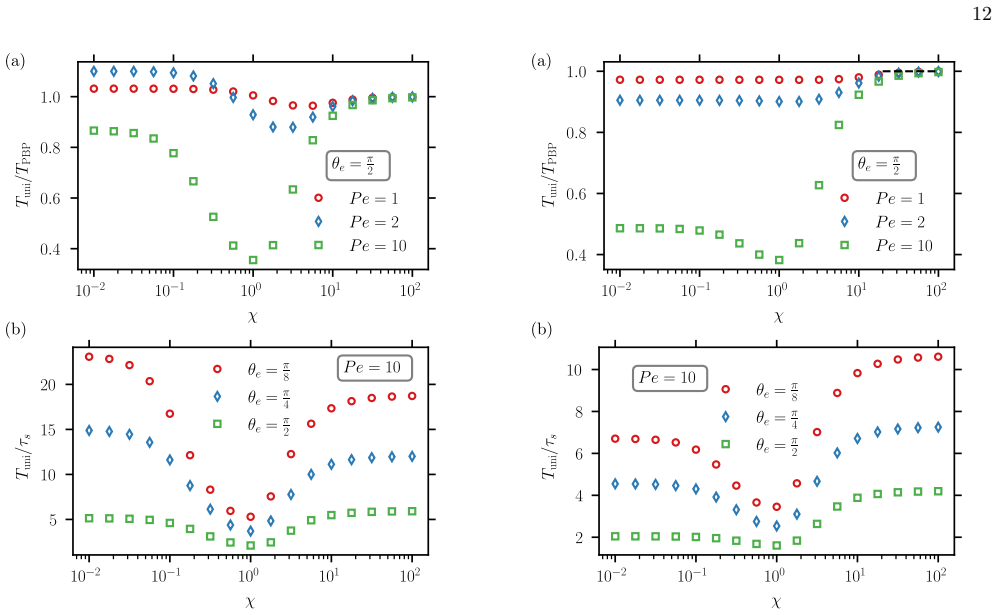
Chiral active Brownian particles (CABPs) are self-propelled agents with intrinsic rotational dynamics, giving rise to circular trajectories commonly observed in biological and synthetic microswimmers. Understanding how CABPs explore confined environments and locate targets is crucial for characterizing transport, search efficiency, and reaction processes in physical and biological systems. We study the escape dynamics of CABPs from one- and two-dimensional confined domains. In one dimension, we consider intervals with either two absorbing boundaries or a reflecting boundary on one side and an absorbing boundary on the other, and derive closed-form asymptotic solutions in the high-chirality regime, revealing the quantitative scaling of the mean first passage time (MFPT) as a function of particle rotation speed (chirality). In two dimensions, we analyze escape from a disk containing one absorbing arc or two symmetric absorbing arcs. By numerically solving the governing partial differential equations, we compute the MFPT for CABPs to escape the domains as a function of the particle's initial orientation, self-propulsion speed, angular velocity, and domain geometry. Our results show that, depending on the parameters and geometry, the MFPT can exhibit non-monotonic behavior as a function of chirality. There exists an optimal chirality at an intermediate value that minimizes the escape time. Our work offers a comprehensive characterization of CABP escape dynamics in canonical confinements and identifies chirality as a key control parameter for transport and search in confined physical and biological systems.
Editorial analysis
A structured set of objections, weighed in public.
Referee Report
Summary. The manuscript studies the mean first passage time (MFPT) of chiral active Brownian particles (CABPs) escaping confined domains. In one dimension, asymptotic analytical expressions are derived for the MFPT in the high-chirality limit for intervals with absorbing or mixed boundaries. In two dimensions, the MFPT from a disk with one or two absorbing arcs is computed by numerically solving the associated backward Kolmogorov or Fokker-Planck equation, showing non-monotonic dependence on chirality with an optimal value that minimizes the MFPT.
Significance. Should the numerical findings be confirmed, the result that an intermediate chirality optimizes escape time would establish chirality as a tunable parameter for enhancing search efficiency in confined active systems, relevant to both biological and engineered microswimmers. The 1D asymptotics provide clear scaling laws that strengthen the overall contribution.
major comments (1)
- [section on 2D numerical solutions] The non-monotonic behavior and the existence of an optimal chirality (central claim in the abstract) are obtained from numerical PDE solutions in the 2D disk geometry, yet the manuscript provides no evidence of validation such as recovery of the known MFPT for passive particles when the angular velocity ω=0, or tests of spatial and angular grid convergence. Without these, it is unclear whether the reported optimum is physical or a numerical artifact.
minor comments (2)
- [Abstract] The abstract mentions 'one- and two-dimensional confined domains' but could specify the exact geometries (disk with absorbing arcs) earlier for immediate clarity.
- Ensure consistent notation for the self-propulsion speed and angular velocity upon first use in the governing equations.
Simulated Author's Rebuttal
We thank the referee for the constructive feedback and positive assessment of the significance of our results. We address the concern regarding validation of the 2D numerical solutions below.
read point-by-point responses
-
Referee: The non-monotonic behavior and the existence of an optimal chirality (central claim in the abstract) are obtained from numerical PDE solutions in the 2D disk geometry, yet the manuscript provides no evidence of validation such as recovery of the known MFPT for passive particles when the angular velocity ω=0, or tests of spatial and angular grid convergence. Without these, it is unclear whether the reported optimum is physical or a numerical artifact.
Authors: We agree that explicit validation of the numerical PDE solver is necessary to substantiate the central claim of an optimal intermediate chirality. In the revised manuscript we will add (i) a direct comparison showing that the numerical MFPT recovers the known passive-particle result when ω=0, and (ii) systematic grid-convergence tests (both spatial and angular) demonstrating that the location and depth of the MFPT minimum are insensitive to discretization parameters within the reported range. These additions will be placed in a new subsection or appendix accompanying the 2D results. revision: yes
Circularity Check
No circularity; derivations are independent of inputs
full rationale
The paper derives 1D asymptotic MFPT solutions directly from the backward Kolmogorov equation for the CABP dynamics and obtains 2D results by numerical solution of the same PDE. No quoted steps reduce a claimed prediction to a fitted parameter, self-citation chain, or definitional renaming. The non-monotonicity and optimal chirality emerge from the PDE solutions themselves rather than being imposed by construction. This is the standard, non-circular workflow for such escape problems.
Axiom & Free-Parameter Ledger
axioms (2)
- domain assumption CABP dynamics are governed by constant self-propulsion speed and constant angular velocity (chirality) with no additional translational or rotational noise beyond the model definition.
- domain assumption Boundaries are perfectly absorbing or reflecting with no partial absorption or interaction potentials.
Lean theorems connected to this paper
-
IndisputableMonolith/Cost/FunctionalEquation.leanwashburn_uniqueness_aczel unclear?
unclearRelation between the paper passage and the cited Recognition theorem.
By numerically solving the governing partial differential equations, we compute the MFPT... non-monotonic behavior as a function of chirality. There exists an optimal chirality at an intermediate value that minimizes the escape time.
-
IndisputableMonolith/Foundation/AbsoluteFloorClosure.leanabsolute_floor_iff_bare_distinguishability unclear?
unclearRelation between the paper passage and the cited Recognition theorem.
the MFPT is governed by a backward Fokker–Planck equation, which reads L†[T]=−1
What do these tags mean?
- matches
- The paper's claim is directly supported by a theorem in the formal canon.
- supports
- The theorem supports part of the paper's argument, but the paper may add assumptions or extra steps.
- extends
- The paper goes beyond the formal theorem; the theorem is a base layer rather than the whole result.
- uses
- The paper appears to rely on the theorem as machinery.
- contradicts
- The paper's claim conflicts with a theorem or certificate in the canon.
- unclear
- Pith found a possible connection, but the passage is too broad, indirect, or ambiguous to say the theorem truly supports the claim.
Reference graph
Works this paper leans on
-
[1]
using a random walk approach [29, 33]. II. CABPS IN ONE DIMENSION In this section, we investigate the MFPT for CABPs escaping from a 1D interval. This setup models a narrow slit geometry in which translational motion is confined to the horizontal direction, while the orientation vector ro- tates unconstrained in two dimensions. We consider two boundary con...
-
[2]
While its translational motion is confined to 1D, the CABP is allowed to freely rotate in 2D. We parametrize the orientation vector as q = cos φ ex + sin φ ey, where ex and ey are the unit basis vectors in the x and y directions, respectively. The angular velocity is defined as Ω = Ω ez, where ez = ex × ey is the unit vector along the z axis, perpendicular ...
-
[3]
The non-dimensional form of Eq
non-dimensional, we scale time by the swim timescale τs = L/U s and length by L. The non-dimensional form of Eq. ( 2) is given by cos φ ∂T ∂x + 1 P e ∂ 2T ∂x2 + χ ∂T ∂φ + β ∂ 2T ∂φ 2 = − 1, (3) where T = T /τ s, x = x/L , P e = UsL/D x, χ = Ω L/U s, and β = L/ (UsτR). Here, P e compares the diffusive timescale L2/D x to the swim timescale L/U s, χ com- par...
-
[4]
In the limit χ → ∞ , the MFPT is expected to approach that of passive Brownian particles (PBPs)
The high-chirality regime: two absorbing boundaries For high chirality, CABPs rotate rapidly, which effec- tively reduces their swimming persistence. In the limit χ → ∞ , the MFPT is expected to approach that of passive Brownian particles (PBPs). To characterize the MFPT of CABPs in this high- χ regime, we employ a perturbation expansion given by T (x, φ )...
-
[5]
(7) In dimensional terms, TPBP = T 0τs = 1 2 L2 Dx ( 1 − (x/L )2)
with the corresponding absorbing boundary conditions is T 0(x) = P e 2 (1 − x2). (7) In dimensional terms, TPBP = T 0τs = 1 2 L2 Dx ( 1 − (x/L )2) . Inserting T 0 into Eq. ( 5) and integrating the resulting equation yields T 1 = P e x sin φ, (8) where the integration constant vanishes by symmetry. Unlike the isotropic leading-order term T 0, this O(1/χ ) ...
-
[6]
( 3), we obtain the equation governing T 3/ 2: ∂T 3/ 2 ∂φ = 0
into Eq. ( 3), we obtain the equation governing T 3/ 2: ∂T 3/ 2 ∂φ = 0. (10) The solutions to T 0 and T 1 are given in Eqs. ( 7) and (8), respectively. From Eq. ( 10), we have T 3/ 2 ≡ T 3/ 2(x). The solvability condition for T 5/ 2 dictates that T ′′ 3/ 2 = 0. To resolve the behavior near x = 1, we introduce a stretched boundary-layer coordinate s = √ χ ...
-
[7]
01 (T − TPBP) /τ s φ = 0 π/ 4 π/ 2 − π/ 4 − 1. 0 − 0. 5 0. 0 0 . 5 1 . 0 x/L
-
[8]
48 T /τ s (a) (b) FIG. 2. Asymptotic solutions for the MFPT of CABPs in a 1D interval with absorbing boundaries. (a) Comparison be- tween the full numerical (FEM; solid lines) and asymptotic (markers) solutions for ( T − TPBP) /τ s. The plotted asymp- totic solution [see Eq. (21)] is given by ( T − TPBP) /τ s = F1/χ + F3/ 2/χ 3/ 2. (b) Contour plot showin...
-
[9]
as a function of the initial position and orientation of the particles, for χ = 50 and P e = 1. In the high-chirality regime, the MFPT of CABPs is, to leading order, identical to that of PBPs [see first term in Eq. ( 21)]. Due to the presence of correction terms at higher order, one observes a weak dependence of the MFPT on the orientation angle of the par...
-
[10]
This regime also includes the limit χ → 0, which recovers the ABP case
The finite-chirality regime: two absorbing boundaries We next study the MFPT for CABPs on the 1D in- terval [ − 1, 1] with absorbing boundaries in the finite- chirality regime, for which no closed-form analytical so- lution is available. This regime also includes the limit χ → 0, which recovers the ABP case. For arbitrary χ , we therefore solve Eq. (
-
[11]
numerically using a finite element method (FEM) implemented in FreeFem++.[35] Results are presented in Figs. 3 and 4. To further validate our results, for these cases, we also carry out Brownian Dy- namics (BD; see Appendix C) simulations and compare the results with the FEM solution. Excellent agreement has been achieved, and thus we omit BD simulations f...
-
[12]
Our results highlight the effect of asymmetry in the confinement geometry on CABP dynamics
In this configuration, the reflecting boundary prevents escape to the left, so the particle can only exit the domain through the right absorbing bound- ary. Our results highlight the effect of asymmetry in the confinement geometry on CABP dynamics. The MFPT for the CABP to escape the domain in this configuration is parameterized analogously to that of the symm...
-
[13]
In the bulk, we use the regular perturbation expansion intro- duced in Eq
The high-chirality regime: reflecting-absorbing boundaries Similar to the case with absorbing boundaries at both ends, we employ matched asymptotic expansions to de- rive analytical solutions in the high-chirality limit. In the bulk, we use the regular perturbation expansion intro- duced in Eq. ( 4). This leads to the same leading-order problem for T 0 as ...
-
[14]
and ( 13), respectively. The distinction lies solely in the matching conditions: ˜T1/ 2 ∼ 2P e s and ˜T1 ∼ a(1) − P e s2/ 2 + 2 P e sin φ as s → ∞ . Solving the boundary-layer equations subject to these matching conditions yields ˜T1/ 2 = 2P e s; ˜T1 = − P e s2 2 +2P e ( sin φ − e− λs sin(λs + φ) ) . (31) A necessary condition for the above solution is th...
-
[15]
02 (T − TPBP) /τ s φ = 0 π/ 4 π/ 2 − π/ 4 − 1. 0 − 0. 5 0. 0 0 . 5 1 . 0 x/L
-
[16]
0 T /τ s (a) (b) FIG. 6. Asymptotic solutions for the MFPT of CABPs in a 1D interval with reflecting left and absorbing right boundaries, . (a) Comparison between the full numeri- cal (FEM; solid lines) and asymptotic (markers) solutions for ( T − TPBP) /τ s. The plotted asymptotic solution [see Eq. (38)] is given by ( T − TPBP) /τ s = ( G1 + T 1 ) /χ +( G...
-
[17]
as a function of the initial position and orientation of the particles, for χ = 50 and P e = 1. In the high-chirality regime, the MFPT of CABPs is, to leading order, identical to that of PBPs [see first term in Eq. ( 38)]. The presence of higher-order correction terms introduces a weak dependence of the MFPT on the par- ticle orientation φ. Since the left ...
-
[18]
0 T (0, 0)/T PBP (a) 10− 2 10− 1 100 101 102 χ
-
[19]
0 T (0, π )/T PBP (b) P e = 1 P e = 10 P e = 20 10− 2 10− 1 100 101 102 χ
-
[20]
2 Tuni/T PBP (c) FIG. 7. Scaled MFPT as a function of chirality ( χ ) for CABPs in a 1D interval with reflecting left and absorbing right boundaries, computed using FEM. We plot T /T PBP for particles starting at x = 0 under three initial-orientation conditions: (a) φ = 0 (right-pointing), (b) φ = π (left-pointing), and (c) φ uniformly random, and for thre...
-
[21]
The finite-chirality regime: reflecting-absorbing boundaries As in the absorbing-boundary problem, the MFPT for CABPs in the interval with a left reflecting boundary ad- mits no closed-form solution in the finite-chirality regime. We therefore solve Eq. (
-
[22]
subject to the boundary con- ditions in Eq. ( 27) using FEM. The computed MFPT for CABPs is presented in Figs. 7 and 8. Fig. 7 shows the normalized MFPT, T /T PBP, as a function of chirality, for particles starting at the midpoint of the interval ( x = 0) with varying initial orientations and different P´ eclet numbers. In Fig. 7(a), we show the MFPT for p...
-
[23]
at the domain midpoint (¯x = 0) yields the asymptotic expan- sion T TPBP ⏐ ⏐ ⏐ x=0 = 1 + 1 χ 2 sin φ 3 − λ χ 3/ 2 + O ( 1/χ 2) . (42) 10 FIG. 8. Contour plots showing the MFPT of CABPs in a 1D interva l with left reflecting and right absorbing boundaries as a function of the initial position ( x/L ) and orientation ( φ/π ) of the particles for varying chir...
-
[24]
The physical parameters are P e = 10 and β = 0. 1. Each subplot corresponds to a dif- ferent fixed value of chirality χ . For χ = 0 [see Fig. 8(a)], the MFPT corresponds to that of standard ABPs. In this case, the MFPT is maximized when particles are initially oriented toward the reflecting boundary and lo- cated at x/L = − 1 (i.e., φ/π = 1), and it decreas...
-
[25]
TPBP is the passive MFPT and τs is the swimming time scale of the particles
1. TPBP is the passive MFPT and τs is the swimming time scale of the particles. Peng.[29] To examine the dependence of the MFPT on the size of the absorbing arc, in Fig. 10(b) we show the MFPT for several values of the absorbing arc half-angle θe (θe = π/ 8, π/ 4, π/ 2) at a fixed value of P e = 10. In- creasing θe corresponds to enlarging the absorbing ar...
-
[26]
P. Romanczuk, M. B¨ ar, W. Ebeling, B. Lindner, and L. Schimansky-Geier, Active brownian particles: From individual to collective stochastic dynamics, Eur. Phys. J. Spec. Top. 202, 1 (2012)
work page 2012
-
[27]
A. P. Solon, M. E. Cates, and J. Tailleur, Active brownian particles and run-and-tumble particles: A comparative study, Eur. Phys. J. Spec. Top. 224, 1231 (2015)
work page 2015
-
[28]
A. Z¨ ottl and H. Stark, Modeling active colloids: from active brownian particles to hydrodynamic and chemical fields, Annu. Rev. Condens. Matter Phys. 14, 109 (2023)
work page 2023
-
[29]
B. Liebchen and D. Levis, Chiral active matter, Euro- phys. Lett. 139, 67001 (2022)
work page 2022
- [30]
-
[31]
V. Soni, E. S. Bililign, S. Magkiriadou, S. Sacanna, D. Bartolo, M. J. Shelley, and W. T. Irvine, The odd free surface flows of a colloidal chiral fluid, Nat. Phys. 16 15, 1188 (2019)
work page 2019
-
[32]
L. Metselaar, A. Doostmohammadi, and J. M. Yeomans, Topological states in chiral active matter: Dynamic blue phases and active half-skyrmions, J. Chem. Phys. 150, 064909 (2019)
work page 2019
-
[33]
B. Liebchen and D. Levis, Collective behavior of chiral active matter: Pattern formation and enhanced flocking, Phys. Rev. Lett. 119, 058002 (2017)
work page 2017
- [34]
-
[35]
A. R. Poggioli and D. T. Limmer, Odd mobility of a passive tracer in a chiral active fluid, Phys. Rev. Lett. 130, 158201 (2023)
work page 2023
-
[36]
L. Langford and A. K. Omar, Phase separation, capillar- ity, and odd-surface flows in chiral active matter, Phys. Rev. Lett. 134, 068301 (2025)
work page 2025
- [37]
-
[38]
S. van Teeffelen and H. L¨ owen, Dynamics of a Brownian circle swimmer, Phys. Rev. E 78, 020101 (2008)
work page 2008
-
[39]
A. Upadhyaya and V. S. Akella, The narrow escape prob- lem of a chiral active particle (CAP): an optimal scheme, Soft Matter 20, 2280 (2024)
work page 2024
-
[40]
A. Negi, K. Beppu, and Y. T. Maeda, Geometry- induced dynamics of confined chiral active matter, Phys. Rev. Res. 5, 023196 (2023)
work page 2023
-
[41]
E. Lauga and T. R. Powers, The hydrodynamics of swimming microorganisms, Rep. Prog. Phys. 72, 096601 (2009)
work page 2009
-
[42]
Y. Magariyama, M. Ichiba, K. Nakata, K. Baba, T. Ohtani, S. Kudo, and T. Goto, Difference in bacterial motion between forward and backward swimming caused by the wall effect, Biophys. J. 88, 3648 (2005)
work page 2005
-
[43]
A. S. Chin, K. E. Worley, P. Ray, G. Kaur, J. Fan, and L. Q. Wan, Epithelial cell chirality revealed by three- dimensional spontaneous rotation, Proc. Natl. Acad. Sci. U.S.A. 115, 12188 (2018)
work page 2018
-
[44]
R. Rusconi, M. Garren, and R. Stocker, Microfluidics ex- panding the frontiers of microbial ecology, Annu. Rev. Biophys. 43, 65 (2014)
work page 2014
-
[45]
C. Bechinger, R. Di Leonardo, H. L¨ owen, C. Reichhardt, G. Volpe, and G. Volpe, Active particles in complex and crowded environments, Rev. Mod. Phys. 88, 045006 (2016)
work page 2016
-
[46]
C. W. Chan, D. Wu, K. Qiao, K. L. Fong, Z. Yang, Y. Han, and R. Zhang, Chiral active particles are sensi- tive reporters to environmental geometry, Nat. Commun. 15, 1406 (2024)
work page 2024
-
[47]
L. Angelani, R. Di Leonardo, and M. Paoluzzi, First- passage time of run-and-tumble particles, Eur. Phys. J. E 37, 59 (2014)
work page 2014
-
[48]
E. Q. Z. Moen, K. S. Olsen, J. Rønning, and L. Anghe- luta, Trapping of active Brownian and run-and-tumble particles: A first-passage time approach, Phys. Rev. Res. 4, 043012 (2022)
work page 2022
-
[49]
A. Scacchi and A. Sharma, Mean first passage time of active Brownian particle in one dimension, Mol. Phys. 116, 460 (2018)
work page 2018
-
[50]
Y. Baouche and C. Kurzthaler, Optimal first-passage times of active Brownian particles under stochastic re- setting, Soft Matter 21, 5998 (2025)
work page 2025
-
[51]
Y. Baouche, M. Gu´ eneau, and C. Kurzthaler, Spatiotem- poral characterization of active brownian dynamics in channels, arXiv preprint arXiv:2603.12080 (2026)
-
[52]
S. A. Iyaniwura and Z. Peng, Asymptotic analysis and simulation of mean first passage time for active Brownian particles in 1-D, SIAM J. Appl. Math. 84, 1079 (2024)
work page 2024
-
[53]
F. Di Trapani, T. Franosch, and M. Caraglio, Active Brownian particles in a circular disk with an absorbing boundary, Phys. Rev. E 107, 064123 (2023)
work page 2023
-
[54]
S. A. Iyaniwura and Z. Peng, Mean first passage time of active Brownian particles in two dimensions, New J. Phys. 27, 104401 (2025)
work page 2025
-
[55]
E. Locatelli, F. Baldovin, E. Orlandini, and M. Pierno, Active Brownian particles escaping a channel in single file, Phys. Rev. E 91, 022109 (2015)
work page 2015
- [56]
-
[57]
Zwanzig, Nonequilibrium Statistical Mechanics (Ox- ford University Press, 2001)
R. Zwanzig, Nonequilibrium Statistical Mechanics (Ox- ford University Press, 2001)
work page 2001
-
[58]
S. A. Iyaniwura and Z. Peng, Splitting probabil- ities of confined chiral active Brownian particles, New J. Phys. 28, 054401 (2026)
work page 2026
-
[59]
M. V. Dyke, Perturbation Methods in Fluid Mechanics , Applied Mathematics and Mechanics, Vol. 8 (Academic Press, New York, 1964) p. 229
work page 1964
-
[60]
Hecht, New development in freefem++, J
F. Hecht, New development in freefem++, J. Numer. Math. 20, 251 (2012)
work page 2012
-
[61]
A. Ghosh and P. Fischer, Controlled propulsion of arti- ficial magnetic nanostructured propellers, Nano Lett. 9, 2243 (2009)
work page 2009
- [62]
-
[63]
R. Dreyfus, J. Baudry, M. L. Roper, M. Fermigier, H. A. Stone, and J. Bibette, Microscopic artificial swimmers, Nature 437, 862 (2005)
work page 2005
-
[64]
K. J. Modica, Y. Xi, and S. C. Takatori, Porous media microstructure determines the diffusion of active matter: Experiments and simulations, Front. Phys. 10, 869175 (2022)
work page 2022
-
[65]
K. J. Modica, A. K. Omar, and S. C. Takatori, Boundary design regulates the diffusion of active matter in hetero- geneous environments, Soft Matter 19, 1890 (2023)
work page 2023
-
[66]
P. Malgaretti, T. Nizkaia, and G. Oshanin, Splitting probabilities for dynamics in corrugated channels: Pas- sive vs. active brownian motion, Europhy. Lett. 142, 57001 (2023)
work page 2023
- [67]
-
[68]
A. F. Cheviakov, M. J. Ward, and R. Straube, An asymp- totic analysis of the mean first passage time for narrow escape problems, Multiscale Model. Simul. 8, 836 (2010)
work page 2010
-
[69]
S. A. Iyaniwura, T. Wong, C. B. Macdonald, and M. J. Ward, Optimization of the mean first passage time in near-disk and elliptical domains in 2-d with small ab- sorbing traps, SIAM Rev. 63, 525 (2021)
work page 2021
discussion (0)
Sign in with ORCID, Apple, or X to comment. Anyone can read and Pith papers without signing in.