Generative AI and the Reorganization of Labor Demand
Pith reviewed 2026-05-25 02:52 UTC · model grok-4.3
The pith
Firms reduce generative AI exposure in job postings mainly by shifting hiring across roles rather than redesigning tasks inside them.
A machine-rendered reading of the paper's core claim, the machinery that carries it, and where it could break.
Core claim
The central claim is that generative AI exposure at the posting level changes substantially over time, and the aggregate decline in exposure decomposes into hiring reallocation across jobs (52 percent on average) and within-job task redesign (39.5 percent), with the latter becoming more prominent over time. An Oaxaca-Blinder decomposition attributes about 90 percent of the reallocation component to shifts in occupational composition. Senior jobs adjust earlier and mainly via reallocation, whereas junior jobs adjust through a broader combination of reallocation, redesign, and their interaction.
What carries the argument
The two-stage LLM pipeline that extracts tasks from each job posting and classifies the extent to which generative AI can perform or assist those tasks, producing a dynamic, posting-level exposure score that supports decomposition of aggregate change into reallocation versus redesign margins.
Load-bearing premise
The two-stage LLM pipeline produces an unbiased, stable measure of generative AI exposure at the individual posting level that can be tracked dynamically over time without systematic classification error across occupations or periods.
What would settle it
A large-scale human annotation exercise on postings drawn from multiple years and occupations that reveals systematic over- or under-classification by the LLM pipeline in particular sectors or time windows would undermine the reported shares of reallocation and redesign.
Figures


read the original abstract
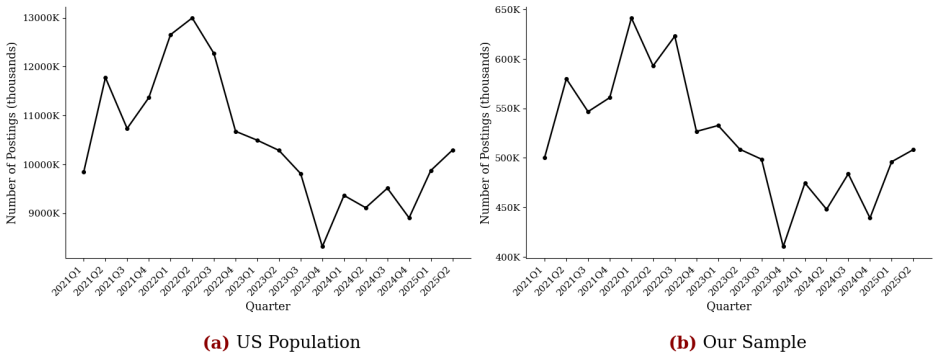
Generative artificial intelligence (AI) is expected to transform work, but less is known about how firms reorganize labor demand as the technology diffuses. Existing research has largely focused on which occupations are exposed to AI or whether exposed jobs decline. We extend this debate by examining whether firms adjust by changing where they hire, what jobs contain, or both. Using a nationwide dataset of job postings in the United States, covering all sectors of the economy, we construct a dynamic, posting-level measure of generative AI exposure with a two-stage large language model pipeline. The pipeline identifies the tasks described in each posting and classifies the extent to which generative AI can perform or assist them. We then decompose changes in aggregate exposure into two margins: reallocation of demand across jobs and redesign of tasks within jobs. We document three main findings. First, generative AI exposure is dynamic rather than fixed, changing substantially over time. Second, labor demand adjusts through both margins. Hiring reallocation explains the largest share of the aggregate decline in exposure, accounting for 52% on average, while within-job redesign becomes increasingly important, accounting for 39.5%. A complementary Oaxaca-Blinder decomposition shows that shifts in occupational composition account for about 90% of the exposure change attributable to observable job characteristics. Third, adjustment differs across the job ladder. Senior jobs adjust earlier and mainly through reallocation, whereas junior jobs adjust through a broader mix of reallocation, redesign, and their interaction. These findings suggest that labor-market adjustment to generative AI is a process of organizational reconfiguration, in which firms reshape both hiring demand and the task architecture of work.
Editorial analysis
A structured set of objections, weighed in public.
Referee Report
Summary. The paper constructs a dynamic, posting-level measure of generative AI exposure from a nationwide US job-postings dataset using a two-stage LLM pipeline that identifies tasks and classifies their substitutability. It decomposes the observed aggregate decline in exposure into two margins—hiring reallocation across jobs (52% on average) and within-job task redesign (39.5%)—with the redesign share rising over time, documents earlier adjustment via reallocation in senior jobs versus a broader mix in junior jobs, and reports an Oaxaca-Blinder decomposition in which occupational composition shifts explain ~90% of the exposure change attributable to observables.
Significance. If the LLM exposure scores prove reliable and stable, the results would be significant for labor economics: they move beyond static occupation-level exposure measures to show that firms reorganize demand on both extensive (reallocation) and intensive (redesign) margins, with reallocation dominant but redesign gaining importance, and with heterogeneity by job seniority. The use of high-frequency posting data and the explicit two-margin decomposition provide a quantitative framework for tracking organizational adjustment to generative AI.
major comments (1)
- [Abstract] Abstract: The central quantitative claims attribute 52% of the aggregate exposure decline to hiring reallocation and 39.5% to within-job redesign. These shares are obtained from a two-stage LLM pipeline applied to individual postings, yet the abstract (and the description of the pipeline) supplies no validation metrics, human-annotated benchmark sample, inter-annotator agreement, robustness to alternative prompts or models, or classification error rates. Without such evidence the reported margin shares cannot be interpreted as recovering the true margins of labor-demand adjustment.
minor comments (1)
- [Abstract] Abstract: The Oaxaca-Blinder result is stated as explaining ~90% of the exposure change attributable to observables, but no table, variable list, or specification details are referenced, making it difficult to assess how the 90% figure is constructed.
Simulated Author's Rebuttal
We thank the referee for the careful reading and for emphasizing the need for explicit validation of the LLM pipeline. We agree this is a substantive point and will make the requested changes in revision.
read point-by-point responses
-
Referee: [Abstract] Abstract: The central quantitative claims attribute 52% of the aggregate exposure decline to hiring reallocation and 39.5% to within-job redesign. These shares are obtained from a two-stage LLM pipeline applied to individual postings, yet the abstract (and the description of the pipeline) supplies no validation metrics, human-annotated benchmark sample, inter-annotator agreement, robustness to alternative prompts or models, or classification error rates. Without such evidence the reported margin shares cannot be interpreted as recovering the true margins of labor-demand adjustment.
Authors: We agree that the current abstract and pipeline description omit the validation evidence required to support the reported margin shares. In the revised manuscript we will (i) add a concise statement to the abstract summarizing benchmark accuracy and robustness results, (ii) insert a dedicated validation subsection in the methods that reports human-annotated benchmark performance, inter-annotator agreement, classification error rates, and sensitivity to alternative prompts and models, and (iii) present these checks alongside the main decomposition results. These additions will allow readers to assess the reliability of the 52% and 39.5% figures directly. revision: yes
Circularity Check
No significant circularity; empirical decomposition of observed job posting data
full rationale
The paper constructs a posting-level generative AI exposure measure via a two-stage LLM pipeline applied to job postings data, then decomposes aggregate exposure changes into reallocation (52%) and redesign (39.5%) margins plus an Oaxaca-Blinder decomposition on observable characteristics. No equations, fitted parameters, or self-citations reduce these shares to inputs by construction; the shares are direct empirical partitions of observed posting-level changes over time. The pipeline is a measurement step whose validity is external to the decomposition arithmetic, and no uniqueness theorems, ansatzes, or renamings are invoked that loop back to the reported results. The derivation is therefore self-contained against external benchmarks.
Axiom & Free-Parameter Ledger
Lean theorems connected to this paper
-
IndisputableMonolith/Foundation/RealityFromDistinction.leanreality_from_one_distinction unclear?
unclearRelation between the paper passage and the cited Recognition theorem.
We construct a dynamic, posting-level measure of generative AI exposure with a two-stage large language model pipeline... decompose changes in aggregate exposure into two margins: reallocation of demand across jobs and redesign of tasks within jobs.
-
IndisputableMonolith/Cost/FunctionalEquation.leanwashburn_uniqueness_aczel unclear?
unclearRelation between the paper passage and the cited Recognition theorem.
The pipeline identifies the tasks described in each posting and classifies the extent to which generative AI can perform or assist them.
What do these tags mean?
- matches
- The paper's claim is directly supported by a theorem in the formal canon.
- supports
- The theorem supports part of the paper's argument, but the paper may add assumptions or extra steps.
- extends
- The paper goes beyond the formal theorem; the theorem is a base layer rather than the whole result.
- uses
- The paper appears to rely on the theorem as machinery.
- contradicts
- The paper's claim conflicts with a theorem or certificate in the canon.
- unclear
- Pith found a possible connection, but the passage is too broad, indirect, or ambiguous to say the theorem truly supports the claim.
Reference graph
Works this paper leans on
-
[1]
CEOs start saying the quiet part out loud: AI will wipe out jobs
“CEOs start saying the quiet part out loud: AI will wipe out jobs. ” https://www.wsj.com/tech/ai/ai-white-collar-job-loss-b9856259 , Accessed: 2026-05-25. Deming, David, and Lisa B Kahn
work page 2026
-
[2]
How will language modelers like Chat- GPT affect occupations and industries?
“How will language modelers like Chat- GPT affect occupations and industries?” arXiv preprint arXiv:2303.01157. F elten, Edward, Manav Raj, and Robert Seamans
-
[3]
arXiv preprint arXiv:2503.04761 , year=
“Which economic tasks are performed with AI? Evidence from millions of Claude conversations. ” arXiv preprint arXiv:2503.04761. Hartley , Jonathan, Filip Jolevski, Vitor Melo, and Brendan Moore
-
[4]
“The short-term effects of generative arti- ficial intelligence on employment: Evidence from an online labor market. ” Organization Science, 35(6): 1977–1989. Humlum, Anders, and Emilie V estergaard
work page 1977
-
[5]
The state of AI in 2023: Generative AI’s breakout year
“The state of AI in 2023: Generative AI’s breakout year. ” McK- insey Global Institute. Oaxaca, Ronald
work page 2023
-
[6]
Introducing ChatGPT Enterprise
“Introducing ChatGPT Enterprise. ” https://openai.com/index/ introducing-chatgpt-enterprise/, Accessed: 2026-05-25. Pizzinelli, Carlo, Augustus J Panton, Marina Mendes T avares, Mauro Cazzaniga, and Longji Li
work page 2026
-
[7]
AI and jobs: Has the inflection point arrived? Evidence from an online labor platform
“AI and jobs: Has the inflection point arrived? Evidence from an online labor platform. ” arXiv preprint arXiv:2312.04180. Reuters
-
[8]
Amazon’s corporate workforce may shrink as AI takes over routine tasks
“Amazon’s corporate workforce may shrink as AI takes over routine tasks. ” https://www.reuters.com/business/retail-consumer/ amazons-workforce-reduce-rollout-generative-ai-agents-2025-06-17/ , Accessed: 2026-05-25. Schubert, Gregor
work page 2025
-
[9]
Is AI responsible for the rise in entry- level unemployment?
“Is AI responsible for the rise in entry- level unemployment?” https://www.reveliolabs.com/news/macro/ 47 is-ai-responsible-for-the-rise-in-entry-level-unemployment/ , Revelio Labs. Ac- cessed: 2026-04-12. Singla, Alex, Alexander Sukharevsky , Lareina Y ee, Michael Chui, and Bryce Hall
work page 2026
-
[10]
The state of AI: How organizations are rewiring to cap- ture value
“The state of AI: How organizations are rewiring to cap- ture value. ” https://www.mckinsey.com/capabilities/quantumblack/our-insights/ the-state-of-ai-how-organizations-are-rewiring-to-capture-value , Accessed: 2026- 05-25. T eutloff, Ole, Johanna Einsiedler, Otto Kässi, F abian Braesemann, Pamela Mishkin, and R Maria del Rio-Chanona
work page 2026
-
[11]
arXiv preprint arXiv:2507.07935 , year=
“Working with AI: Measuring the applicability of generative AI to occupations. ” arXiv preprint arXiv:2507.07935. V andeHei, Jim, and Mike Allen
-
[12]
Behind the curtain: A white-collar bloodbath
“Behind the curtain: A white-collar bloodbath. ” https: //www.axios.com/2025/05/28/ai-jobs-white-collar-unemployment-anthropic , Accessed: 2026-05-25. W ebb, Michael
work page 2025
-
[13]
Match Tasks to Skill Groups -------------------------------------------------- - Assign EACH task exactly ONE skill_group_id. - Compare the task against all skill groups (specialized + common). - Choose the closest semantic match. - In case of ties, prefer specialized groups (S*) over common groups (C*). - If no skills exist, assign all tasks to NS0. ----...
work page 2024
-
[14]
Using these weights, the common-support aggregate exposure in period t is ¯ECS, renorm t = X c∈St ˜w(t) ct Ect, and the corresponding baseline object is ¯ECS, renorm 2021 (t) = X c∈St ˜w(t) c,2021Ec,2021. Renormalization is useful because, without it, a decomposition on the common support would still reflect not only changes among persistent cells, but al...
work page 2021
-
[15]
In the earlier part of the sample, the composition counterfactual tracks observed exposure closely, while the within-only counter- factual remains much closer to the 2021 baseline. This indicates that the early increase in aggre- gate generative AI exposure is driven mainly by compositional reallocation across job cells. After 2023Q3, however, both counte...
work page 2021
discussion (0)
Sign in with ORCID, Apple, or X to comment. Anyone can read and Pith papers without signing in.