Dissecting the Perseus-Pisces supercluster observed with CFHT-MegaCam: Exploring late-type galaxy shape alignments within the local cosmic web
Pith reviewed 2026-05-25 03:32 UTC · model grok-4.3
The pith
Late-type galaxies dominate shape alignments in the Perseus-Pisces supercluster out to 1 Mpc/h.
A machine-rendered reading of the paper's core claim, the machinery that carries it, and where it could break.
Core claim
Positive intrinsic alignment signals appear for both early- and late-type galaxies out to 1 Mpc/h. Late-type galaxies dominate the shape-shape signal, preferentially occupy filaments, and display higher ellipticities consistent with edge-on orientations, whereas early-type galaxies cluster near group and cluster centers. Shape-shape correlations exceed position-shape correlations, comoving measurements increase the fraction of strongly aligned pairs, and the profiles show little radial dependence across three isophotal radii.
What carries the argument
Morphology-stratified two-point correlation functions of galaxy shapes and positions, evaluated at three isophotal radii in comoving coordinates inside the supercluster.
If this is right
- Late-type galaxies supply the dominant contribution to shape alignments inside filamentary regions.
- Distinct mechanisms operate: tidal torquing for late-types in filaments versus tidal stretching for early-types in dense environments.
- Comoving rather than angular measurements recover a larger fraction of strongly aligned galaxy pairs.
- The signals remain stable across different isophotal radii even though individual galaxy ellipticities change in 10-20 percent of cases.
- These local-universe results supply direct input for intrinsic-alignment modeling needed by Euclid, DESI, and LSST.
Where Pith is reading between the lines
- Repeating the same analysis on other nearby superclusters would test whether the morphology segregation is a general feature of the cosmic web.
- If systematics can be ruled out, the results imply that blue spiral galaxies must be modeled separately in low-redshift intrinsic-alignment prescriptions.
- Direct comparison with hydrodynamic simulations could reveal which galaxy-formation processes produce the observed filament versus cluster segregation.
- Extending the stellar-mass threshold downward would show whether the alignment signals weaken or strengthen at lower masses.
Load-bearing premise
The measured correlations are produced by genuine tidal alignments rather than residual errors in imaging, morphology classification, or the chosen stellar-mass and radius cuts.
What would settle it
An independent imaging dataset or a different morphology classification method that yields no significant alignment signal would show the result is driven by systematics.
Figures


read the original abstract
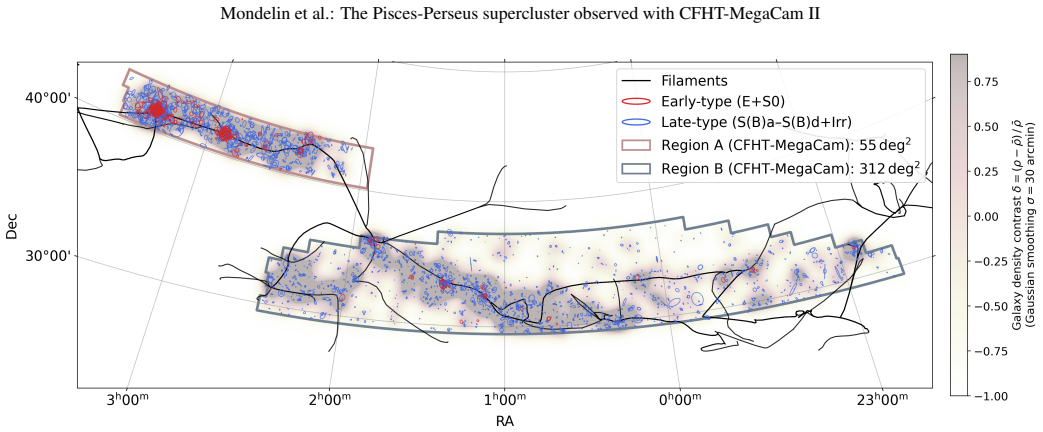
Intrinsic alignments of galaxy shapes are a major systematic for weak gravitational lensing and provide insight into how galaxies acquire orientations within the cosmic web. Most studies rely on large statistical samples; here, we probe this signal in a single nearby superstructure, extending to outer regions where secondary infall should dominate. We measure intrinsic alignments in the Perseus-Pisces supercluster as a function of galaxy morphology and radial extent into the low surface brightness regime. Using deep CFHT r-band imaging covering 367 deg2 (mainly from the UNIONS survey) and reaching 28 mag/arcsec2, we compute correlation functions at three isophotal radii for 2004 galaxies with log M*/Msun > 8.6, stratified by morphology and stellar mass in comoving coordinates. We detect positive intrinsic alignment signals for both early- and late-type galaxies out to 1 Mpc/h, including a clear signal for spirals. Shape-shape correlations are stronger than position-shape correlations, while comoving measurements increase the fraction of strongly correlated systems. Correlation profiles show little radial dependence across the three isophotes despite ellipticity variations in 10-20% of galaxies. We find strong morphology dependence: late-type galaxies dominate the shape-shape signal, preferentially inhabiting filaments and displaying higher ellipticities consistent with edge-on orientations. Early-type galaxies instead cluster near group and cluster centers, with no comparable excess in position-shape correlations. This segregation suggests distinct alignment mechanisms: tidal stretching for early-types in dense environments and tidal torquing for late-types in filaments. These local-Universe constraints inform intrinsic alignment modeling for Euclid, DESI, and LSST, highlighting the contribution of blue spiral galaxies to low-redshift cosmic shear contamination.
Editorial analysis
A structured set of objections, weighed in public.
Referee Report
Summary. The manuscript measures intrinsic alignments of galaxy shapes in the Perseus-Pisces supercluster using deep CFHT r-band imaging over 367 deg². For a sample of 2004 galaxies with log M*/Msun > 8.6, it computes comoving correlation functions at three isophotal radii, stratified by morphology and stellar mass. It reports positive IA signals for both early- and late-type galaxies out to 1 Mpc/h, with late-types dominating the shape-shape signal, preferentially in filaments and showing higher ellipticities consistent with edge-on orientations, while early-types cluster near group and cluster centers. The results are interpreted as evidence for distinct mechanisms (tidal stretching vs. tidal torquing) and are positioned as constraints for IA modeling in Euclid, DESI, and LSST.
Significance. If the morphology-dependent signals and mechanism distinction hold after systematic checks, the work supplies rare local-universe constraints on IA in a single superstructure, extending into low-surface-brightness regimes. It highlights the role of blue spirals in low-redshift shape alignments, which is directly relevant for cosmic-shear contamination modeling in Stage-IV surveys.
major comments (2)
- [Abstract; correlation function measurements section] Abstract and correlation function measurements section: detections of positive IA signals and the morphology segregation are stated without quantitative error bars, covariance details, or significance thresholds. This is load-bearing for the central claim that late-types dominate the shape-shape signal and exhibit distinct environmental preferences, as the reported trends cannot be assessed for robustness without these quantities.
- [Abstract; correlation function measurements section] Abstract and correlation function measurements section: no quantitative purity/completeness for the morphology classification nor null tests that isolate imaging or selection artifacts (e.g., radius-dependent PSF residuals or surface-brightness biases) from the comoving correlation functions. Since ellipticities change in 10-20% of galaxies across the three isophotes and the sample is split at log M*/Msun > 8.6, this directly undermines the claimed distinction between tidal stretching (early-types) and tidal torquing (late-types).
minor comments (1)
- The manuscript would benefit from explicit definitions or references for the correlation function estimators (position-shape vs. shape-shape) and the precise isophotal radii used.
Simulated Author's Rebuttal
We thank the referee for their careful review and constructive comments on our manuscript. We address the major comments point by point below, agreeing that additional quantitative details are needed to support the central claims.
read point-by-point responses
-
Referee: [Abstract; correlation function measurements section] Abstract and correlation function measurements section: detections of positive IA signals and the morphology segregation are stated without quantitative error bars, covariance details, or significance thresholds. This is load-bearing for the central claim that late-types dominate the shape-shape signal and exhibit distinct environmental preferences, as the reported trends cannot be assessed for robustness without these quantities.
Authors: The correlation function measurements section presents the IA signals with error bars in the figures and describes the covariance estimation procedure. However, the abstract and portions of the text do not explicitly quote numerical values, covariance details, or significance thresholds. We will revise the abstract to include these quantitative elements from our measurements and add explicit statements on significance and covariance in the correlation function measurements section. revision: yes
-
Referee: [Abstract; correlation function measurements section] Abstract and correlation function measurements section: no quantitative purity/completeness for the morphology classification nor null tests that isolate imaging or selection artifacts (e.g., radius-dependent PSF residuals or surface-brightness biases) from the comoving correlation functions. Since ellipticities change in 10-20% of galaxies across the three isophotes and the sample is split at log M*/Msun > 8.6, this directly undermines the claimed distinction between tidal stretching (early-types) and tidal torquing (late-types).
Authors: We agree that the manuscript lacks quantitative purity and completeness estimates for the morphology classification as well as dedicated null tests isolating imaging or selection artifacts such as PSF residuals or surface-brightness biases. The classification method is described in the text and some systematics are discussed, but these specific quantitative elements and tests are absent. We will add the missing estimates and null tests in the revised manuscript to better support the claimed distinction between alignment mechanisms. revision: yes
Circularity Check
No circularity: direct observational measurements on public survey data
full rationale
The paper reports correlation-function measurements of galaxy shapes in a single supercluster using CFHT imaging data, stratified by morphology and stellar mass. No derivation chain, model fitting, or prediction step is present that reduces to its own inputs by construction; the central claims rest on empirical correlation functions computed in comoving coordinates at multiple isophotal radii. Self-citations, if present, are not load-bearing for the reported signals, and the analysis does not invoke uniqueness theorems, ansatzes smuggled via prior work, or renaming of known results as new derivations. The work is self-contained against external benchmarks as a straightforward observational study.
Axiom & Free-Parameter Ledger
free parameters (2)
- stellar mass threshold
- isophotal radii
axioms (2)
- standard math Standard Lambda-CDM cosmology for converting observed positions to comoving coordinates
- domain assumption Reliable morphological classification of galaxies into early- and late-type from imaging
Reference graph
Works this paper leans on
-
[1]
A., van de Weygaert, R., Jones, B
Aragón-Calvo, M. A., van de Weygaert, R., Jones, B. J. T., & van der Hulst, J. M. 2007, ApJ, 655, L5
work page 2007
-
[2]
2022, Monthly Notices of the Royal Astronomical Society, 516, 3569
Barsanti, S., Colless, M., Welker, C., et al. 2022, Monthly Notices of the Royal Astronomical Society, 516, 3569
work page 2022
- [3]
-
[4]
Blazek, J., McQuinn, M., & Seljak, U. 2011, J. Cosmology Astropart. Phys., 2011, 010
work page 2011
-
[5]
Blazek, J. A., MacCrann, N., Troxel, M. A., & Fang, X. 2019, Phys. Rev. D, 100, 103506
work page 2019
-
[6]
Bond, J. R., Kofman, L., & Pogosyan, D. 1996, Nature, 380, 603
work page 1996
- [7]
- [8]
-
[9]
Chisari, N., Codis, S., Laigle, C., et al. 2015, MNRAS, 454, 2736
work page 2015
-
[10]
Chisari, N. E. 2025, The Astronomy and Astrophysics Review, 33
work page 2025
-
[11]
E., Koukoufilippas, N., Jindal, A., et al
Chisari, N. E., Koukoufilippas, N., Jindal, A., et al. 2017, MNRAS, 472, 1163
work page 2017
- [12]
-
[13]
Codis, S., Pichon, C., Devriendt, J., et al. 2012, MNRAS, 427, 3320
work page 2012
-
[14]
Cuillandre, J.-C., Bertin, E., Bolzonella, M., et al. 2025, A&A, 697, A6
work page 2025
-
[15]
2024, A&A, this issue Dark Energy Survey and Kilo-Degree Survey Collaboration, Abbott, T
Cuillandre, J.-C., Bolzonella, M., Boselli, A., et al. 2024, A&A, this issue Dark Energy Survey and Kilo-Degree Survey Collaboration, Abbott, T. M. C.,
work page 2024
-
[16]
The DESI Experiment Part I: Science,Targeting, and Survey Design
Aguena, M., et al. 2023, The Open Journal of Astrophysics, 6, 36 DESI Collaboration, Aghamousa, A., Aguilar, J., et al. 2016, arXiv e-prints, arXiv:1611.00036
work page internal anchor Pith review Pith/arXiv arXiv 2023
-
[17]
Doroshkevich, A. G. 1970, Astrophysics, 6, 320
work page 1970
- [18]
-
[19]
2014, MNRAS, 444, 1453 Euclid Collaboration, Aussel, H., Tereno, I., et al
Dubois, Y ., Pichon, C., Welker, C., et al. 2014, MNRAS, 444, 1453 Euclid Collaboration, Aussel, H., Tereno, I., et al. 2025a, arXiv e-prints, arXiv:2503.15302 Euclid Collaboration, Laigle, C., Gouin, C., et al. 2025b, arXiv e-prints, arXiv:2503.15333 Euclid Collaboration, Mellier, Y ., Abdurro’uf, et al. 2025c, A&A, 697, A1 Euclid Collaboration: Mellier,...
-
[20]
Ferrarese, L., Côté, P., Cuillandre, J.-C., et al. 2012, ApJS, 200, 4
work page 2012
-
[21]
Gwyn, S., McConnachie, A. W., Cuillandre, J.-C., et al. 2025, AJ, 170, 324
work page 2025
-
[22]
Hahn, O., Teyssier, R., & Carollo, C. M. 2010, MNRAS, 405, 274 Hervas Peters, F., Kilbinger, M., Paviot, R., et al. 2025, A&A, 699, A201
work page 2010
-
[23]
Hildebrandt, H., Erben, T., Kuijken, K., et al. 2012, MNRAS, 421, 2355
work page 2012
-
[24]
M., Mandelbaum, R., Seljak, U., et al
Hirata, C. M., Mandelbaum, R., Seljak, U., et al. 2004, MNRAS, 353, 529
work page 2004
-
[25]
Ivezic, Z., Kahn, S. M., Tyson, J. A., et al. 2019, The Astrophysical Journal, 873, 111
work page 2019
-
[26]
Jarvis, M. 2015, TreeCorr: Two-point correlation functions, Astrophysics Source Code Library, record ascl:1508.007
work page 2015
- [27]
-
[28]
Joachimi, B., Mandelbaum, R., Abdalla, F. B., & Bridle, S. L. 2011, A&A, 527, A26
work page 2011
-
[29]
Kiessling, A., Cacciato, M., Joachimi, B., et al. 2015, Space Sci. Rev., 193, 67
work page 2015
-
[30]
2015, Reports on Progress in Physics, 78, 086901
Kilbinger, M. 2015, Reports on Progress in Physics, 78, 086901
work page 2015
-
[31]
Klypin, A. A. & Shandarin, S. F. 1983, MNRAS, 204, 891
work page 1983
- [32]
-
[33]
Kraljic, K., Duckworth, C., Tojeiro, R., et al. 2021, MNRAS, 504, 4626
work page 2021
-
[34]
Laigle, C., Pichon, C., Codis, S., et al. 2015, MNRAS, 446, 2744
work page 2015
-
[35]
2024, The Open Journal of Astrophysics, 7, 14
Lamman, C., Tsaprazi, E., Shi, J., et al. 2024, The Open Journal of Astrophysics, 7, 14
work page 2024
-
[36]
Euclid Definition Study Report
Laureijs, R., Amiaux, J., Arduini, S., et al. 2011, arXiv e-prints, arXiv:1110.3193
work page internal anchor Pith review Pith/arXiv arXiv 2011
- [37]
-
[38]
Mandelbaum, R., Hirata, C. M., Ishak, M., & Seljak, U. 2006, in American As- tronomical Society Meeting Abstracts, V ol. 209, American Astronomical So- ciety Meeting Abstracts, 77.27
work page 2006
- [39]
-
[40]
More, S., Sugiyama, S., Miyatake, H., et al. 2023, Phys. Rev. D, 108, 123520
work page 2023
-
[41]
Muralichandran, Y ., Libeskind, N. I., & Tempel, E. 2025, A&A, 703, A11 Navarro-Gironés, D., Crocce, M., Gaztañaga, E., et al. 2026, MNRAS, 545, staf1630
work page 2025
-
[42]
Peebles, P. J. E. 1969, ApJ, 155, 393
work page 1969
-
[43]
Peng, Y .-K., Lilly, S. J., Kovaˇc, K., & et al. 2010, The Astrophysical Journal, 721, 193 Regaldo-Saint Blancard, B., Codis, S., Bond, J. R., & Stein, G. 2021, MNRAS, 504, 1694
work page 2010
-
[44]
2015, MNRAS, 450, 2195 Article number, page 11 A&A proofs:manuscript no
Singh, S., Mandelbaum, R., & More, S. 2015, MNRAS, 450, 2195 Article number, page 11 A&A proofs:manuscript no. main-2
work page 2015
-
[45]
Singh, S., Shakir, A., Jagvaral, Y ., & Mandelbaum, R. 2024, Increasing the power of weak lensing survey data with multipole-based intrinsic alignment estima- tors
work page 2024
- [46]
-
[47]
J., Arora, N., Courteau, S., & Cuillandre, J.-C
Stone, C. J., Arora, N., Courteau, S., & Cuillandre, J.-C. 2021, MNRAS, 508, 1870
work page 2021
-
[48]
J., Courteau, S., Cuillandre, J.-C., et al
Stone, C. J., Courteau, S., Cuillandre, J.-C., et al. 2023, MNRAS, 525, 6377
work page 2023
-
[49]
Troxel, M. A. & Ishak, M. 2015, Phys. Rep., 558, 1
work page 2015
-
[50]
Tudorache, M. N., Jung, S. L., Jarvis, M. J., et al. 2025, MNRAS, 544, 4306
work page 2025
-
[51]
Welker, C., Bland-Hawthorn, J., van de Sande, J., et al. 2020, MNRAS, 491, 2864
work page 2020
-
[52]
Welker, C., Devriendt, J., Dubois, Y ., Pichon, C., & Peirani, S. 2014, MNRAS, 445, L46
work page 2014
-
[53]
Welker, C., Dubois, Y ., Pichon, C., Devriendt, J., & Chisari, N. E. 2018, A&A, 613, A4
work page 2018
-
[54]
G., Adelman, J., Anderson, Jr., J
York, D. G., Adelman, J., Anderson, Jr., J. E., et al. 2000, AJ, 120, 1579
work page 2000
-
[55]
2020, arXiv e-prints, arXiv:2009.03329
Zjupa, J., Paranjape, A., Hahn, O., & Pakmor, R. 2020, arXiv e-prints, arXiv:2009.03329
-
[56]
Zjupa, J. & Springel, V . 2017, MNRAS, 466, 1625 Acknowledgements.Based on observations obtained at the Canada-France- Hawai’i Telescope (CFHT) which is operated by the National Research Council of Canada, the Institut National des Sciences de l’Univers of the Centre National de la Recherche Scientifique of France, and the University of Hawai’i. CFHT is l...
work page 2017
discussion (0)
Sign in with ORCID, Apple, or X to comment. Anyone can read and Pith papers without signing in.