Quantum Simulation of Energy Bifurcation and Z₂-Symmetry Restoration in Macroscopic Quantum Tunneling
Pith reviewed 2026-05-25 04:50 UTC · model grok-4.3
The pith
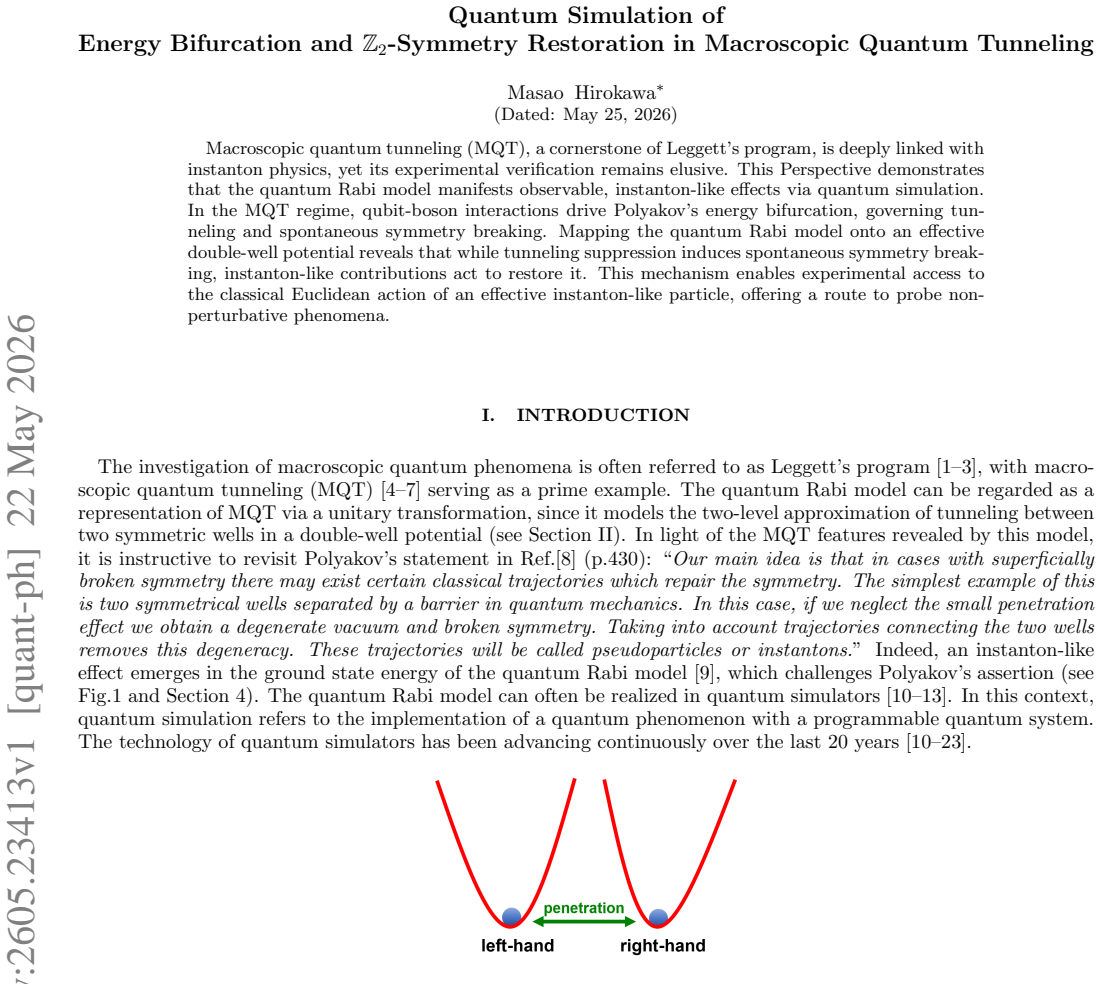
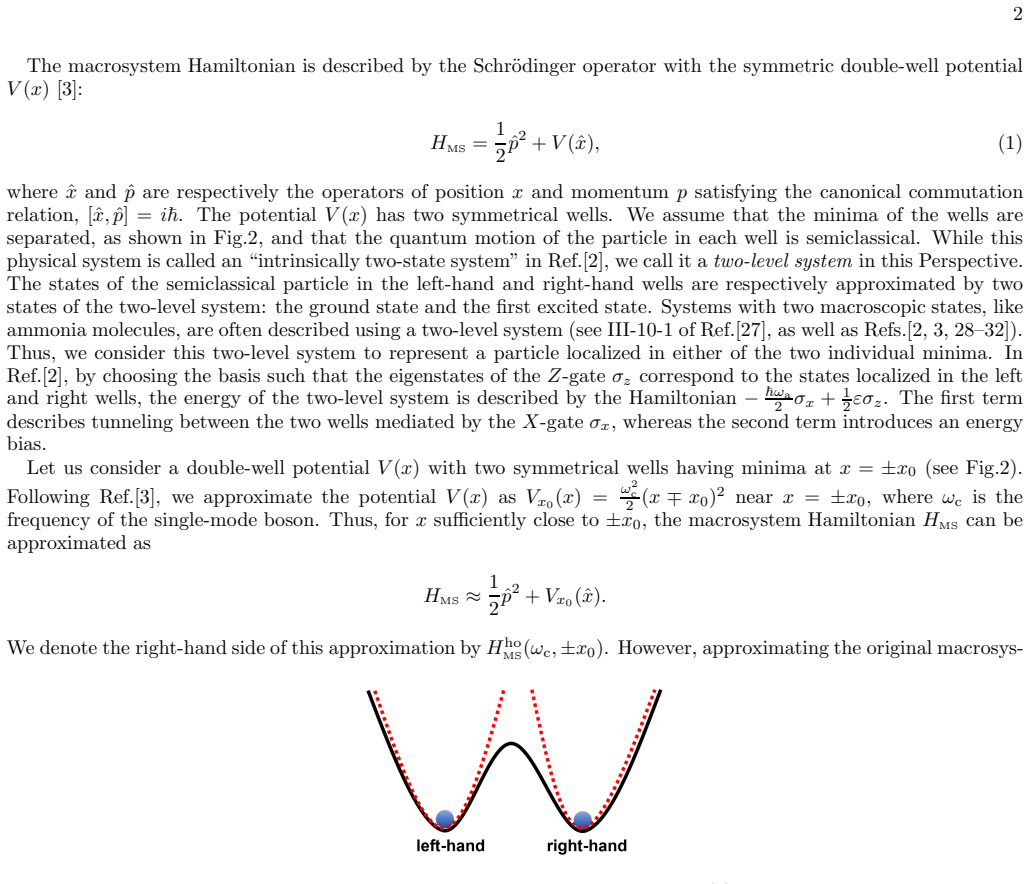
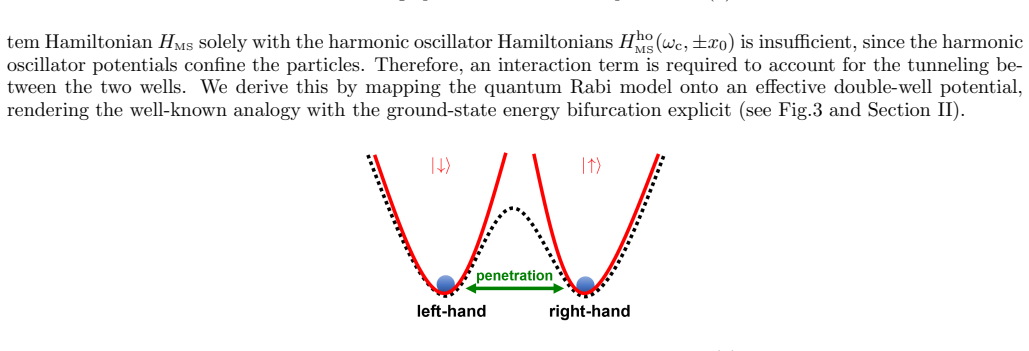
The quantum Rabi model maps onto a double-well potential where instanton-like effects restore symmetry after tunneling suppression.
A machine-rendered reading of the paper's core claim, the machinery that carries it, and where it could break.
Core claim
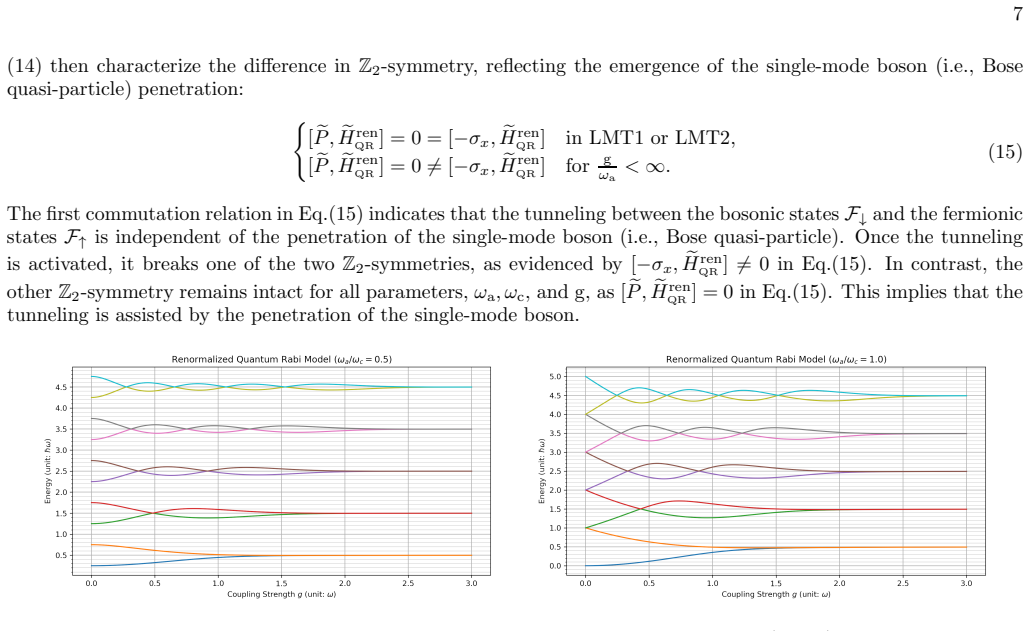
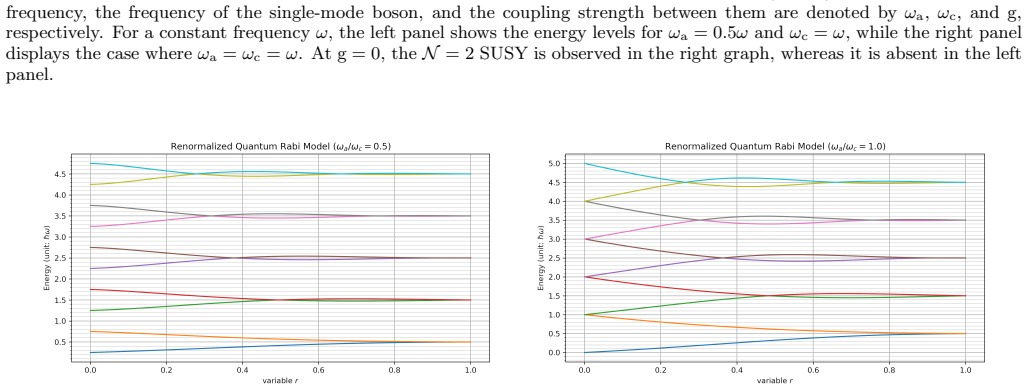
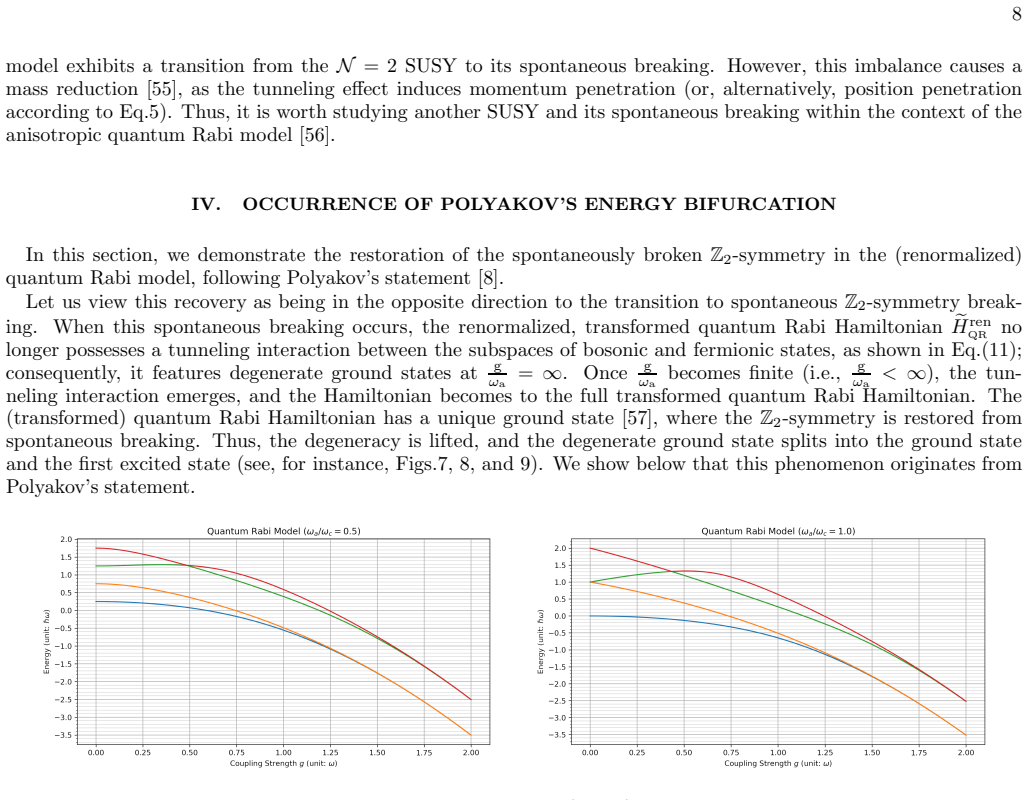
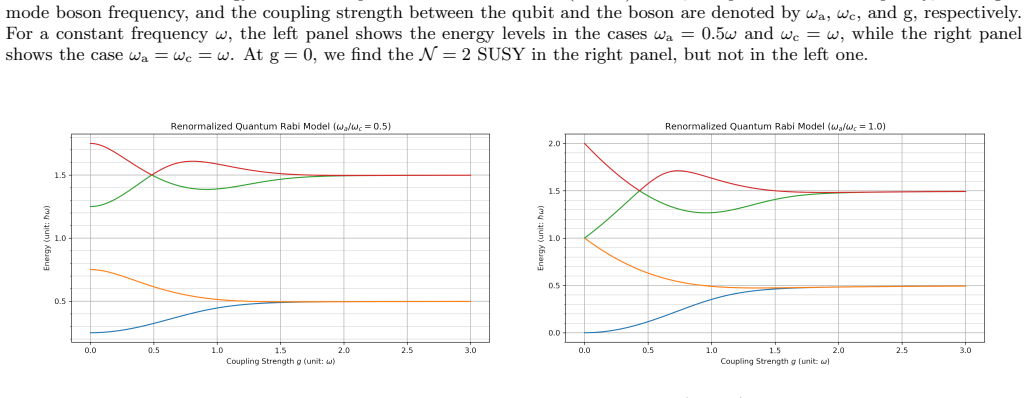
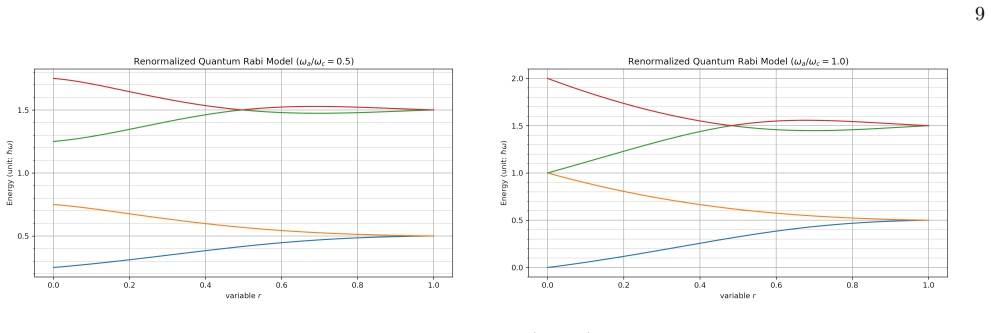
In the MQT regime, the quantum Rabi model with qubit-boson interactions drives Polyakov's energy bifurcation. The mapping to an effective double-well potential reveals that tunneling suppression induces spontaneous symmetry breaking, but instanton-like contributions act to restore the Z_2 symmetry. This mechanism offers experimental access to the classical Euclidean action of an effective instanton-like particle.
What carries the argument
The mapping of the quantum Rabi model onto an effective double-well potential that separates the effects of tunneling suppression from instanton-like symmetry restoration.
If this is right
- Spontaneous symmetry breaking occurs due to tunneling suppression in the effective potential.
- Instanton-like contributions restore the broken Z_2 symmetry.
- Experiments with the quantum Rabi model can probe the classical Euclidean action of the effective instanton-like particle.
Where Pith is reading between the lines
- Quantum simulation of this type could be applied to study similar non-perturbative effects in other condensed matter systems.
- Further work might examine how the energy bifurcation behaves under variations in the coupling strengths.
Load-bearing premise
The mapping of the quantum Rabi model to the effective double-well potential faithfully captures the instanton-like contributions driven by the qubit-boson interactions without significant corrections.
What would settle it
A measurement in a quantum Rabi system showing symmetry properties or tunneling rates that do not match the expected instanton action from the effective potential mapping.
Figures
read the original abstract
Macroscopic quantum tunneling (MQT), a cornerstone of Leggett's program, is deeply linked with instanton physics, yet its experimental verification remains elusive. This Perspective demonstrates that the quantum Rabi model manifests observable, instanton-like effects via quantum simulation. In the MQT regime, qubit-boson interactions drive Polyakov's energy bifurcation, governing tunneling and spontaneous symmetry breaking. Mapping the quantum Rabi model onto an effective double-well potential reveals that while tunneling suppression induces spontaneous symmetry breaking, instanton-like contributions act to restore it. This mechanism enables experimental access to the classical Euclidean action of an effective instanton-like particle, offering a route to probe non-perturbative phenomena.
Editorial analysis
A structured set of objections, weighed in public.
Referee Report
Summary. The manuscript is a Perspective claiming that the quantum Rabi model in the macroscopic quantum tunneling (MQT) regime exhibits Polyakov's energy bifurcation driven by qubit-boson interactions. Mapping the model to an effective double-well potential is said to show that tunneling suppression induces spontaneous Z_2 symmetry breaking while instanton-like contributions restore the symmetry, thereby enabling experimental access to the classical Euclidean action of an effective instanton-like particle and providing a quantum-simulation route to non-perturbative MQT phenomena linked to Leggett's program.
Significance. If the mapping is faithful and the instanton-like restoration mechanism holds without uncontrolled corrections, the work would supply a concrete quantum-optical platform for probing non-perturbative instanton physics in MQT, a long-standing experimental challenge. The conceptual link between the Rabi model, energy bifurcation, and an effective instanton-like particle could stimulate new simulation experiments and broaden the intersection of quantum optics with field-theoretic non-perturbative methods.
major comments (2)
- [Abstract] Abstract: the central claim that qubit-boson interactions drive Polyakov's energy bifurcation and that the mapping to an effective double-well potential faithfully encodes instanton-like contributions responsible for Z_2 restoration is presented without any derivation, explicit effective potential, regime-of-validity bounds, or error estimate. This is load-bearing for the symmetry-restoration and experimental-access assertions; higher-order microscopic terms could shift the bifurcation point or alter the Euclidean action.
- [Abstract] Abstract: no explicit form of the effective double-well potential, no calculation of the instanton action, and no demonstration that the mapping captures the restoration mechanism without uncontrolled corrections are supplied, preventing evaluation of whether the claimed spontaneous symmetry breaking followed by instanton restoration actually follows from the quantum Rabi model in the MQT regime.
Simulated Author's Rebuttal
We thank the referee for their thoughtful review and for highlighting the need for greater clarity in the abstract regarding the mapping and its implications. As this is a Perspective article, the focus is on conceptual connections and experimental prospects rather than exhaustive derivations; however, we address the specific concerns below and indicate where revisions are appropriate.
read point-by-point responses
-
Referee: [Abstract] Abstract: the central claim that qubit-boson interactions drive Polyakov's energy bifurcation and that the mapping to an effective double-well potential faithfully encodes instanton-like contributions responsible for Z_2 restoration is presented without any derivation, explicit effective potential, regime-of-validity bounds, or error estimate. This is load-bearing for the symmetry-restoration and experimental-access assertions; higher-order microscopic terms could shift the bifurcation point or alter the Euclidean action.
Authors: We agree that the abstract, as a high-level summary, omits the explicit derivation and bounds. The main text describes the mapping of the quantum Rabi model to an effective double-well in the MQT regime and outlines the regime of validity under the qubit-boson interaction dominance. To strengthen the presentation, we will revise the abstract to include a concise reference to the mapping procedure and the key assumptions, along with a note on the absence of uncontrolled higher-order corrections within the stated regime. revision: yes
-
Referee: [Abstract] Abstract: no explicit form of the effective double-well potential, no calculation of the instanton action, and no demonstration that the mapping captures the restoration mechanism without uncontrolled corrections are supplied, preventing evaluation of whether the claimed spontaneous symmetry breaking followed by instanton restoration actually follows from the quantum Rabi model in the MQT regime.
Authors: The Perspective emphasizes the conceptual link and the route to quantum simulation of instanton effects rather than performing the full quantitative calculation of the instanton action. The mapping is presented at the level needed to connect Polyakov bifurcation to Z_2 restoration, with the explicit effective potential and action estimates referenced to the established MQT literature on the Rabi model. We can partially address this by expanding the main text with the explicit double-well form and a qualitative estimate of the instanton contribution in revision, while noting that a complete error analysis would require a follow-up technical paper. revision: partial
Circularity Check
No circularity; abstract states mapping without equations or self-citation chains
full rationale
The provided abstract and context contain no equations, no explicit derivation steps, and no citations (self or otherwise). The central claim is that a mapping of the quantum Rabi model to an effective double-well 'reveals' symmetry breaking and restoration, but this is presented as a statement of result rather than a chain that reduces to fitted inputs or prior self-work by construction. Without any load-bearing equations or self-referential definitions visible, the derivation cannot be shown to collapse to its own inputs. This is the expected honest non-finding when the text supplies no inspectable steps.
Axiom & Free-Parameter Ledger
axioms (1)
- domain assumption The quantum Rabi model in the MQT regime can be mapped onto an effective double-well potential that reproduces Polyakov energy bifurcation.
invented entities (1)
-
effective instanton-like particle
no independent evidence
discussion (0)
Sign in with ORCID, Apple, or X to comment. Anyone can read and Pith papers without signing in.