Coulomb bridge mechanism for peripheral polarization of weakly bound projectiles
Pith reviewed 2026-05-25 02:52 UTC · model grok-4.3
The pith
Halo reactions exhibit peripheral polarization as a Coulomb-bridge effect in the dynamical polarization potential.
A machine-rendered reading of the paper's core claim, the machinery that carries it, and where it could break.
Core claim
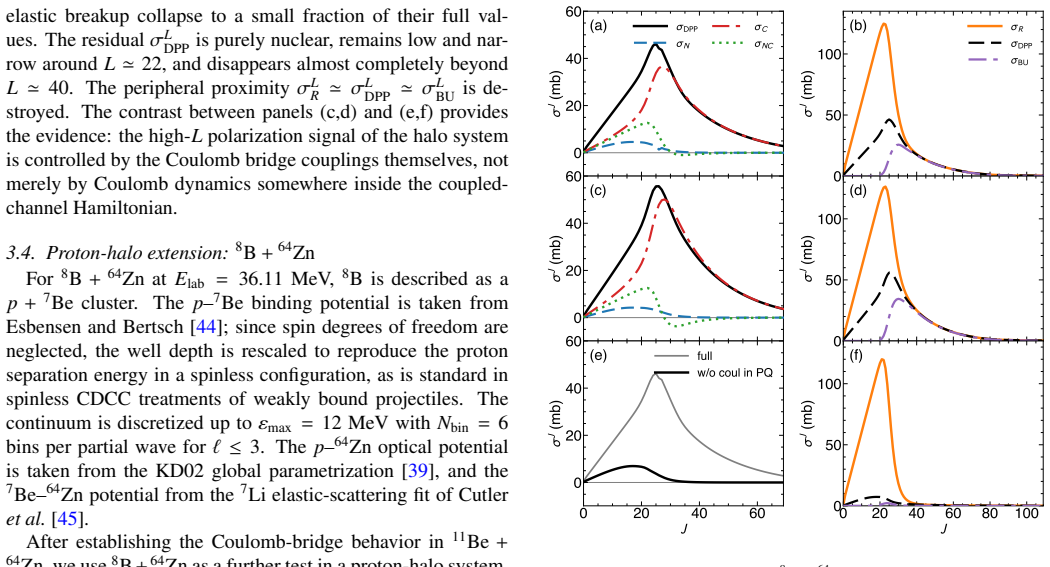
Splitting the two P-Q bridge couplings into nuclear and Coulomb parts while keeping a single Q-space propagator common to every term decomposes the DPP into nuclear, Coulomb, and interference components. Applied to several reactions, the decomposition reveals a Coulomb-dominated bridge in both halo systems, with peripheral partial waves satisfying σ_R^L ≃ σ_DPP^L ≃ σ_BU^L and the high-L DPP tail dominated by σ_C^L. Diagnostic calculations confirm that removing the Coulomb part of the P-Q bridge collapses both DPP-induced absorption and breakup, whereas removing off-diagonal Coulomb propagation inside Q leaves the pattern intact.
What carries the argument
The decomposition of the Feshbach dynamical polarization potential obtained by separating the P-Q bridge couplings into nuclear and Coulomb parts while sharing a common Q-space propagator.
If this is right
- For halo reactions the peripheral polarization is carried by the Coulomb component of the DPP.
- The high-L elastic-breakup yield functions as the observable signature of this Coulomb-bridge effect.
- Light stable systems exhibit a nuclear bridge while heavy stable systems exhibit a mixed bridge with strong destructive interference.
- Proton-halo systems exhibit constructive nuclear-Coulomb interference in the bridge.
Where Pith is reading between the lines
- The same decomposition could be applied to other halo projectiles to test whether the Coulomb dominance persists across different targets.
- Measurements of elastic breakup at large scattering angles might isolate the Coulomb-bridge contribution without requiring full CDCC re-runs.
- If the common Q-propagator assumption holds, similar bridge decompositions could clarify polarization mechanisms in transfer reactions involving the same projectiles.
Load-bearing premise
Splitting the two P-Q bridge couplings into nuclear and Coulomb parts while keeping a single Q-space propagator common to every term produces a physically meaningful decomposition that isolates the matrix elements responsible for peripheral polarization.
What would settle it
A CDCC calculation for a halo reaction in which the Coulomb part of the P-Q bridge is removed should cause both the DPP-induced absorption and the breakup cross section to collapse at high L, while the same calculation with only off-diagonal Coulomb propagation removed inside Q should leave the high-L pattern intact.
Figures


read the original abstract
We identify the matrix elements that carry peripheral polarization of weakly bound projectiles through the Feshbach dynamical polarization potential (DPP) within the continuum-discretized coupled-channels (CDCC) framework. Splitting the two P-Q bridge couplings into nuclear and Coulomb parts, while keeping a single Q-space propagator common to every term, decomposes the DPP into a nuclear, a Coulomb, and an interference component, $\Delta U_{\rm DPP}=\Delta U_N+\Delta U_C+\Delta U_{NC}$. Applied to $d+{}^{58}$Ni, ${}^{6}$Li$+{}^{208}$Pb, ${}^{11}$Be$+{}^{64}$Zn, and ${}^{8}$B$+{}^{64}$Zn, the decomposition reveals a controlled hierarchy: a nuclear bridge in the light system, a mixed bridge with strong destructive interference in the heavy stable case, and a Coulomb-dominated bridge in both halo systems, with the proton halo showing constructive nuclear-Coulomb interference. For the halo reactions, peripheral partial waves ($L\gtrsim 35$) satisfy $\sigma_R^L\simeq\sigma_{\rm DPP}^L\simeq\sigma_{\rm BU}^L$, with the high-$L$ DPP tail dominated by $\sigma_C^L$. Two diagnostic calculations isolate the responsible matrix elements: removing the off-diagonal Coulomb propagation inside Q leaves the pattern essentially intact, whereas removing the Coulomb part of the P-Q bridge collapses both DPP-induced absorption and breakup. The peripheral polarization of halo reactions is therefore a Coulomb-bridge effect, and the high-$L$ elastic-breakup yield serves as its observable signature.
Editorial analysis
A structured set of objections, weighed in public.
Referee Report
Summary. The manuscript identifies the matrix elements responsible for peripheral polarization of weakly bound projectiles in the CDCC framework by decomposing the dynamical polarization potential (DPP) into nuclear, Coulomb, and interference components through splitting the P-Q bridge couplings while retaining a common Q-space propagator. Applied to d+58Ni, 6Li+208Pb, 11Be+64Zn, and 8B+64Zn, it concludes that for halo systems the peripheral polarization is a Coulomb-bridge effect, with high-L (L≳35) partial waves satisfying σ_R^L ≃ σ_DPP^L ≃ σ_BU^L and the DPP tail dominated by the Coulomb part, serving as an observable signature via elastic-breakup yield.
Significance. If the decomposition holds, this work offers a clear mechanistic explanation for peripheral polarization in halo reactions, distinguishing it from nuclear-dominated cases in stable systems. The inclusion of diagnostic calculations to test the role of Coulomb in the bridge versus in Q-space propagation is a positive feature, providing some validation of the isolation of effects. This could impact interpretations of scattering data for exotic nuclei.
major comments (2)
- [DPP decomposition (abstract and methods)] The decomposition ΔU_DPP=ΔU_N+ΔU_C+ΔU_NC is achieved by splitting only the P-Q bridge couplings but using a single G_Q=(E-H_QQ)^{-1} that includes both nuclear and Coulomb in H_QQ. This shared propagator couples the terms, so the reported high-L dominance by σ_C^L for halo systems may not cleanly isolate the Coulomb-bridge matrix elements. The diagnostic calculations (off-diagonal Coulomb removal in Q vs. in P-Q bridge) address numerical sensitivity but do not demonstrate that the decomposition itself separates the physics without mixing.
- [Results for halo systems (abstract)] The central claim that peripheral partial waves satisfy σ_R^L ≃ σ_DPP^L ≃ σ_BU^L with high-L DPP tail dominated by σ_C^L relies on the above decomposition. Without explicit quantification of the approximation (e.g., how close the equality is across the cited systems, or error estimates from the partial-wave analysis), and given the potential mixing through G_Q, the evidence for the Coulomb-bridge mechanism as the dominant effect needs further substantiation.
minor comments (1)
- The abstract would benefit from a brief mention of the specific systems' results or key numerical findings to support the hierarchy described.
Simulated Author's Rebuttal
We thank the referee for the careful reading and constructive comments on our manuscript. We address each major comment point by point below.
read point-by-point responses
-
Referee: [DPP decomposition (abstract and methods)] The decomposition ΔU_DPP=ΔU_N+ΔU_C+ΔU_NC is achieved by splitting only the P-Q bridge couplings but using a single G_Q=(E-H_QQ)^{-1} that includes both nuclear and Coulomb in H_QQ. This shared propagator couples the terms, so the reported high-L dominance by σ_C^L for halo systems may not cleanly isolate the Coulomb-bridge matrix elements. The diagnostic calculations (off-diagonal Coulomb removal in Q vs. in P-Q bridge) address numerical sensitivity but do not demonstrate that the decomposition itself separates the physics without mixing.
Authors: We agree that the shared G_Q introduces coupling between the decomposed terms and that the decomposition does not achieve a completely independent separation of physics. The method partitions only the P-Q bridge couplings while retaining the full propagator, which is the standard Feshbach approach for isolating bridge contributions. The diagnostics show that the peripheral effect is insensitive to Coulomb removal from Q-propagation but collapses when Coulomb is removed from the P-Q bridge, indicating the dominant role of the bridge matrix elements. We will add text in the revised manuscript to explicitly note the mixing inherent in the shared propagator and its implications. revision: partial
-
Referee: [Results for halo systems (abstract)] The central claim that peripheral partial waves satisfy σ_R^L ≃ σ_DPP^L ≃ σ_BU^L with high-L DPP tail dominated by σ_C^L relies on the above decomposition. Without explicit quantification of the approximation (e.g., how close the equality is across the cited systems, or error estimates from the partial-wave analysis), and given the potential mixing through G_Q, the evidence for the Coulomb-bridge mechanism as the dominant effect needs further substantiation.
Authors: The figures display the partial-wave cross sections demonstrating the stated relations and the dominance of the Coulomb component in the high-L tail for the halo systems. While the original text did not include explicit numerical ratios or error estimates, the visual agreement supports the claim. We agree that additional quantification would strengthen the evidence and will incorporate ratios of the relevant cross sections for L ≳ 35 (across the halo systems) in the revised manuscript. revision: yes
Circularity Check
No circularity: decomposition is defined splitting applied numerically
full rationale
The paper introduces the decomposition ΔU_DPP=ΔU_N+ΔU_C+ΔU_NC explicitly as a defined procedure (splitting only the P-Q bridge couplings while retaining one shared G_Q), then reports numerical outcomes from CDCC calculations on specific reactions. No step reduces by the paper's own equations to a fitted parameter or input renamed as prediction; no self-citation is invoked as load-bearing uniqueness theorem; diagnostics are presented as numerical sensitivity checks rather than tautological verification. The peripheral-polarization claim follows from the computed partial-wave cross sections, not from any self-definitional equivalence.
Axiom & Free-Parameter Ledger
axioms (1)
- domain assumption The CDCC framework and Feshbach DPP accurately capture the polarization physics for the listed reactions
Reference graph
Works this paper leans on
-
[1]
I. Tanihata, H. Hamagaki, O. Hashimoto, Y . Shida, N. Yoshikawa, K. Sugimoto, O. Yamakawa, T. Kobayashi, N. Takahashi, Measurements of Interaction Cross Sec- tions and Nuclear Radii in the Light p-Shell Region, Phys. Rev. Lett. 55 (1985) 2676–2679.doi:10.1103/ PhysRevLett.55.2676
work page 1985
- [2]
-
[3]
Jonson, Light dripline nuclei, Phys
B. Jonson, Light dripline nuclei, Phys. Rept. 389 (2004) 1–59.doi:10.1016/j.physrep.2003.07.004
-
[4]
L. F. Canto, P. R. S. Gomes, R. Donangelo, M. S. Hussein, Fusion and breakup of weakly bound nuclei, Phys. Rept. 424 (2006) 1–111.doi:10.1016/j.physrep.2005. 10.006. 6
-
[5]
L. F. Canto, P. R. S. Gomes, R. Donangelo, J. Lubian, M. S. Hussein, Recent developments in fusion and di- rect reactions with weakly bound nuclei, Phys. Rept. 596 (2015) 1–86.doi:10.1016/j.physrep.2015.08.001
-
[6]
I. Tanihata, H. Savajols, R. Kanungo, Recent experimen- tal progress in nuclear halo structure studies, Prog. Part. Nucl. Phys. 68 (2013) 215–313.doi:10.1016/j.ppnp. 2012.07.001
-
[7]
R. S. Mackintosh, A. M. Kobos, Potential model repre- sentation of 6Li break-up through a simple inversion pro- cedure, Phys. Lett. B 116 (1982) 95–98.doi:10.1016/ 0370-2693(82)90983-2
work page 1982
-
[8]
Y . Sakuragi, M. Yahiro, M. Kamimura, Microscopic Cou- pled Channels Study of Scattering and Breakup of Light Heavy Ions, Prog. Theor. Phys. Suppl. 89 (1986) 136–211. doi:10.1143/PTPS.89.136
-
[9]
I. J. Thompson, Coupled reaction channels calculations in nuclear physics, Comput. Phys. Rept. 7 (1988) 167–212. doi:10.1016/0167-7977(88)90005-6
-
[10]
G. H. Rawitscher, Effect of deuteron breakup on elastic deuteron-nucleus scattering, Phys. Rev. C 9 (1974) 2210– 2229.doi:10.1103/PhysRevC.9.2210
-
[11]
N. Austern, Y . Iseri, M. Kamimura, M. Kawai, G. Raw- itscher, M. Yahiro, Continuum-discretized coupled- channels calculations for three-body models of deuteron- nucleus reactions, Phys. Rept. 154 (1987) 125–204.doi: 10.1016/0370-1573(87)90094-9
-
[12]
R. C. Johnson, E. J. Stephenson, J. A. Tostevin, Na- ture of the amplitudes missing from adiabatic distorted- wave models of medium energy (d, p) and (p, d) reac- tions, Nucl. Phys. A 505 (1989) 26–66.doi:10.1016/ 0375-9474(89)90415-6
work page 1989
-
[13]
The continuum discretized coupled-channels method and its applications
M. Yahiro, K. Ogata, T. Matsumoto, K. Minomo, The Continuum Discretized Coupled-Channels Method and its Applications, PTEP 2012 (2012) 01A206.arXiv: 1203.5392,doi:10.1093/ptep/pts008
work page internal anchor Pith review Pith/arXiv arXiv doi:10.1093/ptep/pts008 2012
-
[14]
I. J. Thompson, F. M. Nunes, Nuclear Reactions for Astrophysics: Principles, Calculation and Applications of Low-Energy Reactions, Cambridge University Press, Cambridge, UK, 2009. URLhttps://www.cambridge.org/core/ books/nuclear-reactions-for-astrophysics/ E2A6D1BEE4A0E9B84FB0D3B0C5FE0F24
work page 2009
-
[15]
T. Matsumoto, E. Hiyama, K. Ogata, Y . Iseri, M. Kamimura, S. Chiba, M. Yahiro, Continuum- discretized coupled-channels method for four-body nu- clear breakup in 6He+ 12C scattering, Phys. Rev. C 70 (2004) 061601.doi:10.1103/PhysRevC.70.061601
-
[16]
M. Rodriguez-Gallardo, J. M. Arias, J. Gomez-Camacho, R. C. Johnson, A. M. Moro, I. J. Thompson, J. A. Tostevin, Four-body CDCC calculations using a trans- formed harmonic oscillator basis, Phys. Rev. C 77 (2008) 064609.doi:10.1103/PhysRevC.77.064609
-
[17]
Feshbach, Unified theory of nuclear reactions, Annals Phys
H. Feshbach, Unified theory of nuclear reactions, Annals Phys. 5 (1958) 357–390.doi:10.1016/ 0003-4916(58)90007-1
work page 1958
-
[18]
Feshbach, A unified theory of nuclear reactions
H. Feshbach, A unified theory of nuclear reactions. II, Annals Phys. 19 (1962) 287–313.doi:10.1016/ 0003-4916(62)90221-X
work page 1962
-
[19]
R. S. Mackintosh, N. Keeley, Breakup dynamic polariza- tion potential for 6He+ 208Pb at 27 MeV, Phys. Rev. C 70 (2004) 024604.doi:10.1103/PhysRevC.70.024604
-
[20]
R. S. Mackintosh, D. Y . Pang, Increase in|S L|induced by channel coupling: The case of deuteron breakup, Phys. Rev. C 86 (2012) 047602.doi:10.1103/PhysRevC.86. 047602
- [21]
- [22]
-
[23]
H. Liu, J. Lei, Z. Ren, Coherent absorption dynamics: The dual role of off-diagonal couplings in weakly bound nu- clei, Phys. Rev. C 113 (2026) 054601.doi:10.1103/ bgwc-x5wj
work page 2026
-
[24]
H. Liu, J. Lei, Z. Ren, Channel couplings redirect ab- sorbed flux from peripheral loss to fusion in weakly bound nuclear reactions, Phys. Lett. B 877 (2026) 140479.doi: 10.1016/j.physletb.2026.140479
-
[25]
K. Alder, A. Bohr, T. Huus, B. Mottelson, A. Winther, Study of Nuclear Structure by Electromagnetic Excitation with Accelerated Ions, Rev. Mod. Phys. 28 (1956) 432– 542.doi:10.1103/RevModPhys.28.432
-
[26]
G. Baur, C. A. Bertulani, H. Rebel, Coulomb dissociation as a source of information on radiative capture processes of astrophysical interest, Nucl. Phys. A 458 (1986) 188– 204.doi:10.1016/0375-9474(86)90290-3
-
[27]
C. A. Bertulani, G. Baur, Electromagnetic Processes in Relativistic Heavy Ion Collisions, Phys. Rept. 163 (1988) 299–408.doi:10.1016/0370-1573(88)90142-1
-
[28]
V . N. Garcia, J. Lubian, P. R. S. Gomes, A. Gomez- Camacho, L. F. Canto, 9Be breakup polarization potential at near-barrier energies, Phys. Rev. C 80 (2009) 037602. doi:10.1103/PhysRevC.80.037602. 7
-
[29]
A. Di Pietro, et al., Elastic Scattering and Reaction Mech- anisms of the Halo Nucleus 11Be around the Coulomb Barrier, Phys. Rev. Lett. 105 (2010) 022701.doi:10. 1103/PhysRevLett.105.022701
work page 2010
-
[30]
A. Di Pietro, V . Scuderi, A. M. Moro, L. Acosta, F. Amor- ini, M. J. G. Borge, P. Figuera, M. Fisichella, L. M. Fraile, J. Gomez-Camacho, et al., Experimental study of the collision 11Be+ 64Zn around the Coulomb barrier, Phys. Rev. C 85 (2012) 054607.doi:10.1103/PhysRevC.85. 054607
-
[31]
F. M. Nunes, I. J. Thompson, Multistep effects in sub- Coulomb breakup, Phys. Rev. C 59 (1999) 2652–2659. doi:10.1103/PhysRevC.59.2652
-
[32]
J. A. Tostevin, F. M. Nunes, I. J. Thompson, Calculations of three-body observables in 8B breakup, Phys. Rev. C 63 (2001) 024617.doi:10.1103/PhysRevC.63.024617
-
[33]
N. C. Summers, F. M. Nunes, I. J. Thompson, Extended continuum discretized coupled channels method: Core excitation in the breakup of exotic nuclei, Phys. Rev. C 74 (2006) 014606, [Erratum: Phys. Rev. C 89, 069901 (2014)].doi:10.1103/PhysRevC.74.014606
-
[34]
A. M. Moro, F. M. Nunes, R. C. Johnson, Theory of (d, p) and (p, d) reactions including breakup: Comparison of methods, Phys. Rev. C 80 (2009) 064606.doi:10.1103/ PhysRevC.80.064606
work page 2009
-
[35]
R. Crespo, A. M. Moro, Polarization observables in the elastic scattering of protons from 4,6,8He, Phys. Rev. C 76 (2007) 054607.doi:10.1103/PhysRevC.76.054607
-
[36]
L. Acosta, et al., Elastic scattering andα-particle produc- tion in 6He+ 208Pb collisions at 22 MeV, Phys. Rev. C 84 (2011) 044604.doi:10.1103/PhysRevC.84.044604
-
[37]
A. M. Moro, Models for nuclear reactions with weakly- bound systems, in: Proc. Int. Sch. Phys. Fermi, V ol. 201, IOS Press, 2019, pp. 129–207.arXiv:1807.04349, doi:10.3254/978-1-61499-957-7-129
work page internal anchor Pith review Pith/arXiv arXiv doi:10.3254/978-1-61499-957-7-129 2019
-
[38]
P. Descouvemont, L. F. Canto, M. S. Hussein, Coulomb and nuclear effects in breakup and reac- tion cross sections, Phys. Rev. C 95 (2017) 014604. doi:10.1103/PhysRevC.95.014604. URLhttps://link.aps.org/doi/10.1103/ PhysRevC.95.014604
-
[39]
A. J. Koning, J. P. Delaroche, Local and global nucleon optical models from 1 keV to 200 MeV, Nucl. Phys. A 713 (2003) 231–310.doi:10.1016/S0375-9474(02) 01321-0
-
[40]
A. R. Barnett, J. S. Lilley, Interaction of alpha particles in the lead region near the coulomb barrier, Phys. Rev. C 9 (1974) 2010–2027.doi:10.1103/PhysRevC.9.2010. URLhttps://link.aps.org/doi/10.1103/ PhysRevC.9.2010
-
[41]
Y . Han, Y . Shi, Q. Shen, Deuteron global optical model potential for energies up to 200 mev, Phys. Rev. C 74 (2006) 044615.doi:10.1103/PhysRevC.74.044615. URLhttps://link.aps.org/doi/10.1103/ PhysRevC.74.044615
-
[42]
J. Lei, A. M. Moro, Reexamining closed-form formulae for inclusive breakup: Application to deuteron- and 6Li-induced reactions, Phys. Rev. C 92 (2015) 044616. doi:10.1103/PhysRevC.92.044616. URLhttps://link.aps.org/doi/10.1103/ PhysRevC.92.044616
-
[43]
J. Lei, A. M. Moro, Comprehensive analysis of largeα yields observed in 6Li-induced reactions, Phys. Rev. C 95 (2017) 044605.doi:10.1103/PhysRevC.95.044605. URLhttps://link.aps.org/doi/10.1103/ PhysRevC.95.044605
-
[44]
H. Esbensen, G. F. Bertsch, Effects of E2 transitions in the Coulomb dissociation of 8B, Nucl. Phys. A 600 (1996) 37–62.doi:10.1016/0375-9474(96)00006-1
-
[45]
R. I. Cutler, M. J. Nadworny, K. W. Kemper, 28- and 34- MeV 6Li and 7Li elastic scattering on nuclei with 40≤ A≤91, Phys. Rev. C 15 (1977) 1318–1324.doi:10. 1103/PhysRevC.15.1318
work page 1977
-
[46]
A. Di Pietro, A. Moro, J. Lei, R. de Diego, Insights into the dynamics of breakup of the halo nucleus 11be on a 64zn target, Physics Letters B 798 (2019) 134954. doi:10.1016/j.physletb.2019.134954. URLhttps://www.sciencedirect.com/science/ article/pii/S0370269319306768
-
[47]
R. Spartà, A. Di Pietro, P. Figuera, O. Tengblad, A. M. Moro, I. Martel, J. P. Fernández-García, J. Lei, et al., Probing proton halo effects in the 8B+64Zn collision around the Coulomb barrier, Phys. Lett. B 820 (2021) 136477.doi:10.1016/j.physletb.2021.136477. 8
discussion (0)
Sign in with ORCID, Apple, or X to comment. Anyone can read and Pith papers without signing in.