Disorder-Induced Phase Transitions in Altermagnetic Josephson Junctions
Pith reviewed 2026-05-25 02:46 UTC · model grok-4.3
The pith
Disorder induces phase transitions between the exotic π and conventional 0 phases in altermagnetic Josephson junctions while suppressing the critical current.
A machine-rendered reading of the paper's core claim, the machinery that carries it, and where it could break.
Core claim
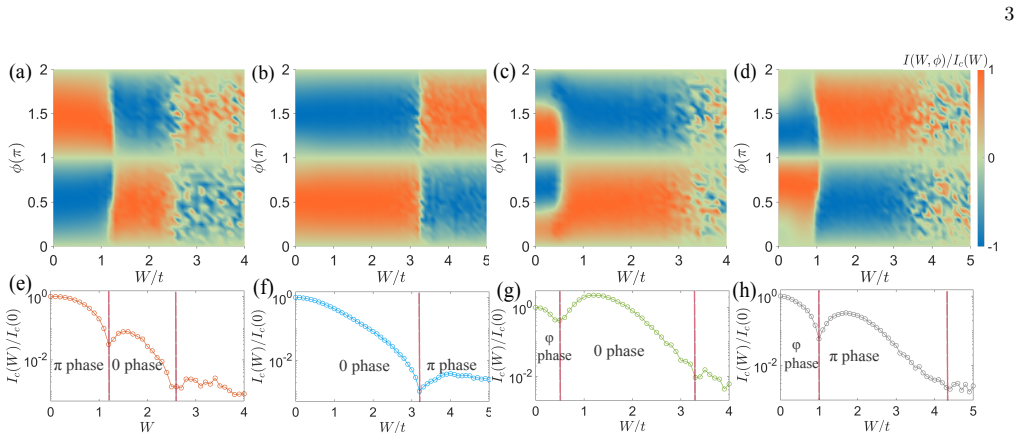
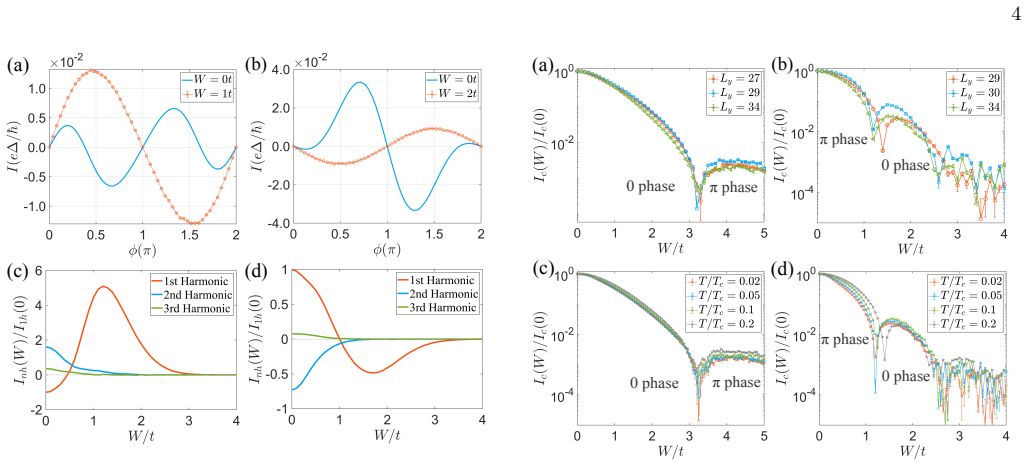
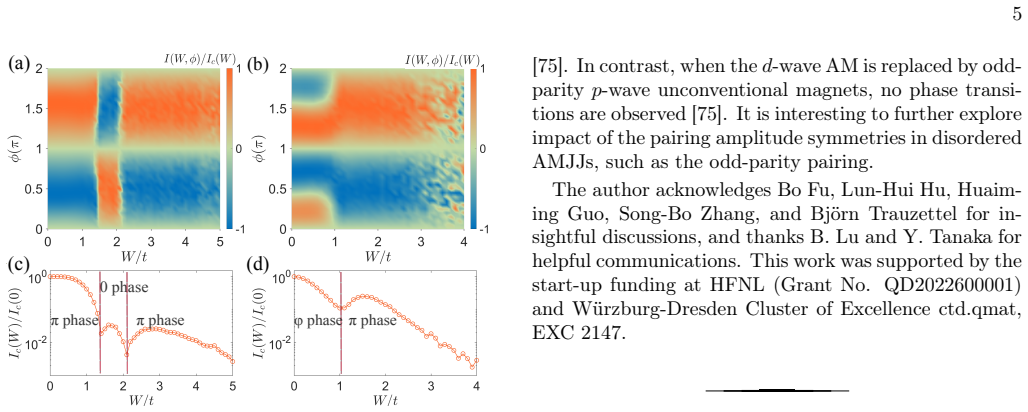
In two-dimensional d-wave altermagnetic Josephson junctions, disorder induces phase transitions between the exotic π and conventional 0 phases accompanied by strong suppression of the critical current. The anomalous φ phase is highly fragile in the presence of disorder and can be driven to either a π phase or 0 phase in a nonreciprocal manner. Across such transitions the first harmonic of the current-phase relation changes sign while the higher-order harmonics are rapidly suppressed. This behavior is attributed to modifications of the tunneling Cooper-pair phase shift and superconducting decoherence.
What carries the argument
Modifications of the tunneling Cooper-pair phase shift and superconducting decoherence caused by disorder.
If this is right
- The critical current undergoes strong suppression during the induced phase transitions.
- The first harmonic of the current-phase relation reverses sign across the transitions.
- Higher-order harmonics of the current-phase relation are rapidly suppressed.
- The φ phase transitions nonreciprocally to either the π or 0 phase depending on the disorder configuration.
Where Pith is reading between the lines
- Disorder concentration could function as a controllable parameter for switching between junction phases in devices.
- The fragility of the φ phase suggests that phase stability in altermagnetic junctions may require careful material purification.
- Analogous disorder-driven effects could be examined in three-dimensional or other symmetry altermagnetic junctions.
- Device applications relying on a stable φ phase would need to account for inevitable material disorder.
Load-bearing premise
The two-dimensional model with the chosen altermagnetic order and disorder distribution accurately represents the physical behavior in real materials.
What would settle it
Fabricate altermagnetic Josephson junctions with controlled levels of disorder and measure the current-phase relation to check whether the φ phase disappears and the π-0 transitions occur with the predicted suppression of critical current.
Figures

read the original abstract
Altermagnetic Josephson junctions (AMJJs) can host unconventional $\pi$ phase and $\varphi$ phase despite vanishing net magnetizations. Whether these phases are stable against disorder existing in real materials remains an open question. Here, we investigate impact of disorder on exotic phases in two-dimensional d-wave AMJJs. We show that disorder is able to induce phase transitions between the exotic $\pi$ and conventional 0 phases, accompanied by a strong suppression of critical current. This behavior is attributed to modifications of the tunneling Cooper-pair phase shift and superconducting decoherence. Remarkably, the anomalous $\varphi$ phase is highly fragile in presence of disorder and can be driven to either a $\pi$ phase or 0 phase in a nonreciprocal manner. Across such transitions, the first harmonic of current-phase relation changes sign, while the higher-order harmonics are rapidly suppressed. Our findings reveal the crucial role of disorder in tailoring distinct phases of AMJJs and shed new light on their potential functionalities.
Editorial analysis
A structured set of objections, weighed in public.
Referee Report
Summary. The paper uses 2D tight-binding Bogoliubov-de Gennes calculations to study disorder effects in d-wave altermagnetic Josephson junctions. It reports that on-site or hopping disorder induces transitions between the π and 0 phases with strong suppression of the critical current, attributes this to changes in Cooper-pair phase shift and decoherence, and finds the anomalous φ phase to be fragile, driven nonreciprocally to either π or 0 with sign change in the first harmonic of the current-phase relation and rapid suppression of higher harmonics.
Significance. If the numerical results hold under the stated model, they indicate disorder as a mechanism to control and switch between unconventional phases in altermagnetic junctions, potentially relevant for device design. The work provides concrete, falsifiable predictions for 2D systems via the computed current-phase relations and phase diagrams.
major comments (2)
- [Modeling and results sections] The central claims (disorder-driven π↔0 transitions, Ic suppression, and nonreciprocal φ-phase destruction) rest entirely on the 2D d-wave altermagnet tight-binding BdG model with a specific disorder distribution; no robustness checks against 3D stacking, continuum limit, or alternative disorder symmetries (magnetic vs. non-magnetic) are reported. If any of these alter the sign of the first harmonic or φ-state stability, the reported transitions do not survive.
- [Introduction and methods] The mapping from the chosen 2D lattice altermagnetic order parameter and disorder implementation to real materials is not justified or validated against experimental constraints; deviations in symmetry or dimensionality would directly impact the predicted phase transitions and current-phase relations.
minor comments (2)
- [Abstract] The abstract supplies no equations, parameter values, or simulation details, making it difficult to assess the underlying calculations from the summary alone.
- [Results] Notation for the current-phase relation harmonics and the definition of the φ phase should be clarified with explicit equations in the main text for reproducibility.
Simulated Author's Rebuttal
We thank the referee for the careful reading and constructive comments. We respond point-by-point to the major concerns below.
read point-by-point responses
-
Referee: [Modeling and results sections] The central claims (disorder-driven π↔0 transitions, Ic suppression, and nonreciprocal φ-phase destruction) rest entirely on the 2D d-wave altermagnet tight-binding BdG model with a specific disorder distribution; no robustness checks against 3D stacking, continuum limit, or alternative disorder symmetries (magnetic vs. non-magnetic) are reported. If any of these alter the sign of the first harmonic or φ-state stability, the reported transitions do not survive.
Authors: We agree that the results are obtained within a specific 2D tight-binding BdG framework and that explicit checks in 3D, continuum, or with magnetic disorder are absent. The manuscript is explicitly framed as a 2D study of thin-film altermagnetic junctions, where the d-wave altermagnetic order and nearest-neighbor hopping are natural. In revision we will add a dedicated paragraph in the discussion section outlining why the qualitative π↔0 transitions and φ-phase fragility are expected to persist in related geometries (e.g., weak interlayer coupling preserves the in-plane phase winding), while acknowledging that quantitative shifts in critical disorder strength may occur. Full 3D or continuum calculations lie beyond the present scope but are noted as future work. revision: partial
-
Referee: [Introduction and methods] The mapping from the chosen 2D lattice altermagnetic order parameter and disorder implementation to real materials is not justified or validated against experimental constraints; deviations in symmetry or dimensionality would directly impact the predicted phase transitions and current-phase relations.
Authors: The model parameters (d-wave altermagnetic splitting, superconducting gap, and disorder strength) are chosen to be representative of known altermagnets such as RuO₂ and MnTe in the thin-film limit. We will revise the introduction and methods to cite the relevant material parameters and to state explicitly that the on-site and hopping disorder distributions are intended to capture generic non-magnetic impurities and interface roughness. The work is presented as a theoretical prediction whose CPR signatures can be tested experimentally; we do not claim quantitative material-specific mapping. revision: yes
Circularity Check
No significant circularity; results from explicit numerical BdG modeling
full rationale
The paper reports numerical results from a 2D tight-binding Bogoliubov-de Gennes calculation on a d-wave altermagnet Josephson junction with added on-site or hopping disorder. Phase transitions, Ic suppression, and nonreciprocal φ-phase destruction are direct outputs of solving the model Hamiltonian under the stated symmetries and disorder distributions. No self-definitional loops, fitted parameters renamed as predictions, or load-bearing self-citations appear; the derivation chain consists of standard discretization, diagonalization, and current-phase relation extraction without reducing to tautological inputs or prior author results by construction. This is the normal non-circular outcome for a model-based study.
Axiom & Free-Parameter Ledger
Reference graph
Works this paper leans on
-
[1]
Crystal time-reversal symmetry breaking and spontaneous Hall effect in collinear antiferromagnets
L. Šmejkal, R. González-Hernández, T. Jungwirth, and J. Sinova, “Crystal time-reversal symmetry breaking and spontaneous Hall effect in collinear antiferromagnets”, Sci. Adv.6, eaaz8809 (2020)
work page 2020
-
[2]
Spin current generation in organic antiferromagnets
M. Naka, S. Hayami, H. Kusunose, Y. Yanagi, Y. Mo- tome, and H. Seo, “Spin current generation in organic antiferromagnets”, Nat. Commun.10, 4305 (2019)
work page 2019
-
[3]
Anti- ferromagnetism in RuO2 asd-wave Pomeranchuk insta- bility
K.-H. Ahn, A. Hariki, K.-W. Lee, and J. Kuneš, “Anti- ferromagnetism in RuO2 asd-wave Pomeranchuk insta- bility”, Phys. Rev. B99, 184432 (2019)
work page 2019
-
[4]
Momentum- Dependent Spin Splitting by Collinear Antiferromagnetic Ordering
S. Hayami, Y. Yanagi, and H. Kusunose, “Momentum- Dependent Spin Splitting by Collinear Antiferromagnetic Ordering”, J. Phys. Soc. Jpn.88, 123702 (2019)
work page 2019
-
[5]
Giant momentum-dependent spin splitting in centrosymmetric low-Zantiferromagnets
L.-D. Yuan, Z. Wang, J.-W. Luo, E. I. Rashba, and A. Zunger, “Giant momentum-dependent spin splitting in centrosymmetric low-Zantiferromagnets”, Phys. Rev. B102, 014422 (2020)
work page 2020
-
[6]
Emerging re- search landscape of altermagnetism
L. Šmejkal, J. Sinova, and T. Jungwirth, “Emerging re- search landscape of altermagnetism”, Phys. Rev. X12, 040501 (2022)
work page 2022
-
[7]
L. Šmejkal, J. Sinova, and T. Jungwirth, “Beyond con- ventional ferromagnetism and antiferromagnetism: A phase with nonrelativistic spin and crystal rotation sym- metry”, Phys. Rev. X12, 031042 (2022)
work page 2022
-
[8]
Altermagnetism: Exploring New Frontiers in Magnetism and Spintronics
L. Bai, W. Feng, S. Liu, L. Šmejkal, Y. Mokrousov, and Y. Yao, “Altermagnetism: Exploring New Frontiers in Magnetism and Spintronics”, Adv. Funct. Mater.34, 2409327 (2024)
work page 2024
-
[9]
Altermagnets as a new class of functional materials
C. Song, H. Bai, Z. Zhou, L. Han, H. Reichlova, J. H. Dil, J. Liu, X. Chen, and F. Pan, “Altermagnets as a new class of functional materials”, Nat. Rev. Mater. , 1 (2025)
work page 2025
-
[10]
Altermagnetism: An unconventional spin-ordered phase of matter
T. Jungwirth, R. M. Fernandes, E. Fradkin, A. H. Mac- Donald, J. Sinova, and L. Šmejkal, “Altermagnetism: An unconventional spin-ordered phase of matter”, Newton1 (2025), 10.1016/j.newton.2025.100162
-
[11]
Ef- ficient Electrical Spin Splitter Based on Nonrelativistic Collinear Antiferromagnetism
R. González-Hernández, L. Šmejkal, Karel Výborný, Y. Yahagi, J. Sinova, T. Jungwirth, and J. Železný, “Ef- ficient Electrical Spin Splitter Based on Nonrelativistic Collinear Antiferromagnetism”, Phys. Rev. Lett.126, 127701 (2021)
work page 2021
-
[12]
Spin-neutral currents for spintronics
D.-F. Shao, S.-H. Zhang, M. Li, C.-B. Eom, and E. Y. Tsymbal, “Spin-neutral currents for spintronics”, Nature Communications12, 7061 (2021)
work page 2021
-
[13]
Predictable gate-field control of spin in al- termagnets with spin-layer coupling
R.-W. Zhang, C. Cui, R. Li, J. Duan, L. Li, Z.-M. Yu, 6 and Y. Yao, “Predictable gate-field control of spin in al- termagnets with spin-layer coupling”, Phys. Rev. Lett. 133, 056401 (2024)
work page 2024
-
[14]
Two-dimensional altermagnets: Superconductivity in a minimal micro- scopic model
B. Brekke, A. Brataas, and A. Sudbø, “Two-dimensional altermagnets: Superconductivity in a minimal micro- scopic model”, Phys. Rev. B108, 224421 (2023)
work page 2023
-
[15]
Broken kramers degeneracy in altermagnetic mnte
S. Lee, S. Lee, S. Jung, J. Jung, D. Kim, Y. Lee,et al., “Broken kramers degeneracy in altermagnetic mnte”, Phys. Rev. Lett.132, 036702 (2024)
work page 2024
-
[16]
Altermagnetic lifting of kramers spin degeneracy
J. Krempaský, L. Šmejkal, S. W. D’Souza, M. Hajlaoui, G. Springholz, K. Uhlířová,et al., “Altermagnetic lifting of kramers spin degeneracy”, Nature626, 517 (2024)
work page 2024
-
[17]
Topolog- ical superconductivity in two-dimensional altermagnetic metals
D. Zhu, Z.-Y. Zhuang, Z. Wu, and Z. Yan, “Topolog- ical superconductivity in two-dimensional altermagnetic metals”, Phys. Rev. B108, 184505 (2023)
work page 2023
-
[18]
Majoranacornermodesandtun- able patterns in an altermagnet heterostructure
Y.-X.LiandC.-C.Liu,“Majoranacornermodesandtun- able patterns in an altermagnet heterostructure”, Phys. Rev. B108, 205410 (2023)
work page 2023
-
[19]
Chiral Magnons in AltermagneticRuO2
L. Šmejkal, A. Marmodoro, K.-H. Ahn, R. González- Hernández, I. Turek, S. Mankovsky,et al., “Chiral Magnons in AltermagneticRuO2”, Phys. Rev. Lett.131, 256703 (2023)
work page 2023
-
[20]
Chi- ral Split Magnon in Altermagnetic MnTe
Z. Liu, M. Ozeki, S. Asai, S. Itoh, and T. Masuda, “Chi- ral Split Magnon in Altermagnetic MnTe”, Phys. Rev. Lett.133, 156702 (2024)
work page 2024
-
[21]
Alter- magnetic routes to majorana modes in zero net magne- tization
S. A. A. Ghorashi, T. L. Hughes, and J. Cano, “Alter- magnetic routes to majorana modes in zero net magne- tization”, Phys. Rev. Lett.133, 106601 (2024)
work page 2024
-
[22]
Crystal Thermal Transport in AltermagneticRuO 2
X. Zhou, W. Feng, R.-W. Zhang, L. Šmejkal, J. Sinova, Y. Mokrousov, and Y. Yao, “Crystal Thermal Transport in AltermagneticRuO 2”, Phys. Rev. Lett.132, 056701 (2024)
work page 2024
-
[23]
Spon- taneous formation of altermagnetism from orbital order- ing
V. Leeb, A. Mook, L. Šmejkal, and J. Knolle, “Spon- taneous formation of altermagnetism from orbital order- ing”, Phys. Rev. Lett.132, 236701 (2024)
work page 2024
-
[24]
Altermagnetic anomalous hall effect emerging from electronic correlations
T. Sato, S. Haddad, I. C. Fulga, F. F. Assaad, and J. van den Brink, “Altermagnetic anomalous hall effect emerging from electronic correlations”, Phys. Rev. Lett. 133, 086503 (2024)
work page 2024
-
[25]
Antiferroelectric Altermagnets: Antiferro- electricity Alters Magnets
X. Duan, J. Zhang, Z. Zhu, Y. Liu, Z. Zhang, I. Žutić, and T. Zhou, “Antiferroelectric Altermagnets: Antiferro- electricity Alters Magnets”, Phys. Rev. Lett.134, 106801 (2025)
work page 2025
-
[26]
Fragile uncon- ventional magnetism inRuO 2 by proximity to Landau- Pomeranchuk instability
Z. Qian, Y. Yang, S. Liu, and C. Wu, “Fragile uncon- ventional magnetism inRuO 2 by proximity to Landau- Pomeranchuk instability”, Phys. Rev. B111, 174425 (2025)
work page 2025
-
[27]
Altermagnetic phase transition in a lieb metal
M. Dürrnagel, H. Hohmann, A. Maity, J. Seufert, M. Klett, L. Klebl, and R. Thomale, “Altermagnetic phase transition in a lieb metal”, Phys. Rev. Lett.135, 036502 (2025)
work page 2025
-
[28]
Ferroelectric Switchable Alter- magnetism
M. Gu, Y. Liu, H. Zhu, K. Yananose, X. Chen, Y. Hu, A. Stroppa, and Q. Liu, “Ferroelectric Switchable Alter- magnetism”, Phys. Rev. Lett.134, 106802 (2025)
work page 2025
-
[29]
Probingk-Space Alternating Spin Polar- ization via the Anomalous Hall Effect
R. Chen, Z.-M. Wang, H.-P. Sun, B. Zhou, R. Wang, and D.-H. Xu, “Probingk-Space Alternating Spin Polar- ization via the Anomalous Hall Effect”, Phys. Rev. Lett. 135, 096602 (2025)
work page 2025
-
[30]
Symmetry classification for alternating excitons in two- dimensional altermagnets
J. D. Cao, K. S. Denisov, Y. Liu, and I. Žutić, “Symmetry classification for alternating excitons in two- dimensional altermagnets”, Phys. Rev. Lett.135, 266703 (2025)
work page 2025
-
[31]
M. Ezawa, “Third-order and fifth-order nonlinear spin- current generation ing-wave andi-wave altermagnets and perfectly nonreciprocal spin current inf-wave mag- nets”, Phys. Rev. B111, 125420 (2025)
work page 2025
-
[32]
Electri- cal switching of altermagnetism
Y. Chen, X. Liu, H.-Z. Lu, and X. C. Xie, “Electri- cal switching of altermagnetism”, Phys. Rev. Lett.135, 016701 (2025)
work page 2025
-
[33]
Design of altermagnetic models from spin clus- ters
X. Zhu, X. Huo, S. Feng, S.-B. Zhang, S. A. Yang, and H. Guo, “Design of altermagnetic models from spin clus- ters”, Phys. Rev. Lett.134, 166701 (2025)
work page 2025
-
[34]
Altermagnetism in modified lieblatticehubbardmodel
N. Kaushal and M. Franz, “Altermagnetism in modified lieblatticehubbardmodel”, Phys.Rev.Lett.135,156502 (2025)
work page 2025
-
[35]
Altermagneticspinprecessionandspintran- sistor
L.-S. Liu, K. Shao, H.-D. Li, X. Wan, W. Chen, and D.Y.Xing,“Altermagneticspinprecessionandspintran- sistor”, Phys. Rev. Lett.136, 106301 (2026)
work page 2026
-
[36]
Marginal metals and kosterlitz-thouless-type phase transition in disordered altermagnets
C.-A. Li, B. Fu, H. Guo, B. Trauzettel, and S.- B. Zhang, “Marginal metals and kosterlitz-thouless-type phase transition in disordered altermagnets”, Phys. Rev. Lett.136, 066303 (2026)
work page 2026
-
[37]
The interface between superconductivity and magnetism: understand- ing and device prospects
M. G. Blamire and J. W. A. Robinson, “The interface between superconductivity and magnetism: understand- ing and device prospects”, J. Phys. Condens. Matter.26, 453201 (2014)
work page 2014
-
[38]
Superconductor-altermagnet memory functionality without stray fields
H. G. Giil and J. Linder, “Superconductor-altermagnet memory functionality without stray fields”, Phys. Rev. B 109, 134511 (2024)
work page 2024
-
[39]
Exotic superconduct- ing states in altermagnets
K. Parshukov and A. P. Schnyder, “Exotic superconduct- ing states in altermagnets”, (2025), arXiv:2507.10700 [cond-mat.supr-con]
-
[40]
Andreev reflection in altermagnets
C. Sun, A. Brataas, and J. Linder, “Andreev reflection in altermagnets”, Phys. Rev. B108, 054511 (2023)
work page 2023
-
[41]
Andreev reflection at the altermagnet- superconductor interface
M. Papaj, “Andreev reflection at the altermagnet- superconductor interface”, Phys. Rev. B108, L060508 (2023)
work page 2023
-
[42]
Crossed andreev reflection in alter- magnets
S. Das and A. Soori, “Crossed andreev reflection in alter- magnets”, Phys. Rev. B109, 245424 (2024)
work page 2024
-
[43]
D. Mondal, A. Pal, A. Saha, and T. Nag, “Distinguish- ing between topological majorana and trivial zero modes via transport and shot noise study in an altermagnet het- erostructure”, Phys. Rev. B111, L121401 (2025)
work page 2025
-
[44]
Notes on altermagnetism and superconduc- tivity
I. I. Mazin, “Notes on altermagnetism and superconduc- tivity”, AAPPS Bulletin35(2025), 10.1007/s43673-025- 00158-6
-
[45]
dc Josephson Effect in Altermagnets
J. A. Ouassou, A. Brataas, and J. Linder, “dc Josephson Effect in Altermagnets”, Phys. Rev. Lett.131, 076003 (2023)
work page 2023
-
[46]
Phase-shifted an- dreev levels in an altermagnet josephson junction
C. W. J. Beenakker and T. Vakhtel, “Phase-shifted an- dreev levels in an altermagnet josephson junction”, Phys. Rev. B108, 075425 (2023)
work page 2023
-
[47]
Finite- momentum cooper pairing in proximitized altermagnets
S.-B. Zhang, L.-H. Hu, and T. Neupert, “Finite- momentum cooper pairing in proximitized altermagnets”, Nat. Commun.15, 1801 (2024)
work page 2024
-
[48]
Q. Cheng and Q.-F. Sun, “Orientation- dependent josephson effect in spin-singlet superconductor/altermagnet/spin-triplet supercon- ductor junctions”, Phys. Rev. B109, 024517 (2024)
work page 2024
-
[49]
Y. Fukaya, K. Maeda, K. Yada, J. Cayao, Y. Tanaka, and B. Lu, “Josephson effect and odd-frequency pairing in superconducting junctions with unconventional mag- nets”, Phys. Rev. B111, 064502 (2025)
work page 2025
-
[50]
Superconducting phenomena in systems with unconven- tional magnets
Y. Fukaya, B. Lu, K. Yada, Y. Tanaka, and J. Cayao, “Superconducting phenomena in systems with unconven- tional magnets”, Journal of Physics: Condensed Matter 37, 313003 (2025)
work page 2025
-
[51]
Perfect su- 7 perconducting diode effect in altermagnets
D. Chakraborty and A. M. Black-Schaffer, “Perfect su- 7 perconducting diode effect in altermagnets”, Phys. Rev. Lett.135, 026001 (2025)
work page 2025
-
[52]
Pair density waves and super- current diode effect in altermagnets
G. Sim and J. Knolle, “Pair density waves and super- current diode effect in altermagnets”, Phys. Rev. B112, L020502 (2025)
work page 2025
-
[53]
Tunable second harmonic in altermagnetic josephson junctions
H.-P. Sun, S.-B. Zhang, C.-A. Li, and B. Trauzettel, “Tunable second harmonic in altermagnetic josephson junctions”, Phys. Rev. B111, 165406 (2025)
work page 2025
-
[54]
Spin-polarized josephson supercurrent in nodeless altermagnets
C. Li, J.-X. Hou, F.-C. Zhang, S.-B. Zhang, and L.-H. Hu, “Spin-polarized josephson supercurrent in nodeless altermagnets”, Phys. Rev. Lett.136, 116701 (2026)
work page 2026
-
[55]
Coupling of two superconductors through a ferromagnet: Evidence for aπjunction
V. V. Ryazanov, V. A. Oboznov, A. Y. Rusanov, A. V. Veretennikov, A. A. Golubov, and J. Aarts, “Coupling of two superconductors through a ferromagnet: Evidence for aπjunction”, Phys. Rev. Lett.86, 2427 (2001)
work page 2001
-
[56]
Proximity effects in superconductor- ferromagnet heterostructures
A. I. Buzdin, “Proximity effects in superconductor- ferromagnet heterostructures”, Rev. Mod. Phys.77, 935 (2005)
work page 2005
-
[57]
0−πtransitions in josephson junctions with antiferromagnetic interlayers
B. M. Andersen, I. V. Bobkova, P. J. Hirschfeld, and Y. S. Barash, “0−πtransitions in josephson junctions with antiferromagnetic interlayers”, Phys. Rev. Lett.96, 117005 (2006)
work page 2006
-
[58]
Josephsonπstate in a ferromagnetic in- sulator
S. Kawabata, Y. Asano, Y. Tanaka, A. A. Golubov, and S. Kashiwaya, “Josephsonπstate in a ferromagnetic in- sulator”, Phys. Rev. Lett.104, 117002 (2010)
work page 2010
-
[59]
Environmentally decoupled sds -wave josephson junctions for quantum computing
L. B. Ioffe, V. B. Geshkenbein, M. V. Feigel’man, A. L. Fauchère, and G. Blatter, “Environmentally decoupled sds -wave josephson junctions for quantum computing”, Nature398, 679 (1999)
work page 1999
-
[60]
A.K.Feofanov, V.A.Oboznov, V.V.Bol’ginov, J.Lisen- feld, S. Poletto, V. V. Ryazanov,et al., “Implementa- tion of superconductor/ferromagnet/ superconductorπ- shiftersinsuperconductingdigitalandquantumcircuits”, Nature Physics6, 593 (2010)
work page 2010
-
[61]
Midgap state-basedπ-junctions for digital applications
G. Testa, A. Monaco, E. Esposito, E. Sarnelli, D.-J. Kang, S. H. Mennema, E. J. Tarte, and M. G. Blamire, “Midgap state-basedπ-junctions for digital applications”, Applied Physics Letters85, 1202 (2004)
work page 2004
-
[62]
φjosephson junction induced by altermagnetism
B. Lu, K. Maeda, H. Ito, K. Yada, and Y. Tanaka, “φjosephson junction induced by altermagnetism”, Phys. Rev. Lett.133, 226002 (2024)
work page 2024
-
[63]
H.-Y. Ma, M. Hu, N. Li, J. Liu, W. Yao, J.-F. Jia, and J. Liu, “Multifunctional antiferromagnetic materi- als with giant piezomagnetism and noncollinear spin cur- rent”, Nat. Commun.12, 2846 (2021)
work page 2021
-
[64]
A metallic room-temperature d-wave altermagnet
B. Jiang, M. Hu, J. Bai, Z. Song, C. Mu, G. Qu,et al., “A metallic room-temperature d-wave altermagnet”, Nat. Phys.21, 754 (2025)
work page 2025
-
[65]
F. Zhang, X. Cheng, Z. Yin, C. Liu, L. Deng, Y. Qiao, et al., “Crystal-symmetry-paired spin–valley locking in a layered room-temperature metallic altermagnet candi- date”, Nat. Phys.21, 760 (2025)
work page 2025
-
[66]
Direct observa- tion of altermagnetic band splitting in CrSb thin films
S. Reimers, L. Odenbreit, L. Šmejkal, V. N. Strocov, P. Constantinou, A. B. Hellenes,et al., “Direct observa- tion of altermagnetic band splitting in CrSb thin films”, Nat. Commun.15, 2116 (2024)
work page 2024
-
[67]
Large Band Splitting ing-Wave Altermagnet CrSb
J. Ding, Z. Jiang, X. Chen, Z. Tao, Z. Liu, T. Li,et al., “Large Band Splitting ing-Wave Altermagnet CrSb”, Phys. Rev. Lett.133, 206401 (2024)
work page 2024
-
[68]
Observation of Spin Splitting in Room- Temperature Metallic Antiferromagnet CrSb
M. Zeng, M.-Y. Zhu, Y.-P. Zhu, X.-R. Liu, X.-M. Ma, Y.-J. Hao,et al., “Observation of Spin Splitting in Room- Temperature Metallic Antiferromagnet CrSb”, Advanced Science11, 2406529 (2024)
work page 2024
-
[69]
Three-dimensional mapping of the altermagnetic spin splitting in CrSb
G. Yang, Z. Li, S. Yang, J. Li, H. Zheng, W. Zhu,et al., “Three-dimensional mapping of the altermagnetic spin splitting in CrSb”, Nat. Commun.16, 1442 (2025)
work page 2025
-
[70]
The lattice constant is set to be unit for simplicity
-
[71]
Dc josephson effect in dirty sns junctions: Numerical study
A. Furusaki, “Dc josephson effect in dirty sns junctions: Numerical study”, Physica B: Condensed Matter203, 214 (1994)
work page 1994
-
[72]
Numerical method for dc josephson cur- rent between d-wave superconductors
Y. Asano, “Numerical method for dc josephson cur- rent between d-wave superconductors”, Phys. Rev. B63, 052512 (2001)
work page 2001
-
[73]
Anomalous josephson effect inp-wave dirty junctions
Y. Asano, Y. Tanaka, and S. Kashiwaya, “Anomalous josephson effect inp-wave dirty junctions”, Phys. Rev. Lett.96, 097007 (2006)
work page 2006
-
[74]
It respects the combined symmetry as [C4T]H 0(k)C4T] −1 =H 0(−k)withC 4 =e −i π 4 σz andT=iσ yK
-
[75]
See Supplemental Material for details of (S1) evolution of current-phase relations under disorder; (S2) Evolution of different order of Harmonics during the 0-πphase tran- sition; (S3) general properties of AMJJs under general magnetic disorder; and (S4) properties of disordered p- wave magnets Josephson junctions, which includes Refs. [49, 50, 80, 81]
-
[76]
Similar strongly fluctuating regions are also observed in other cases in Fig. 2
-
[77]
L. Zeng, W. Wang, Z. Jiao, M. Shang, and W. Chen, “Disorder-driven quantum phase transitions in two- dimensional altermagnets: Emergence of a marginal metal phase”, Phys. Rev. B112, 054204 (2025)
work page 2025
-
[78]
For instance, the typicald x2−y2-wave AM takesα= 0 andd xy-wave AM takesα=π/4
The general altermagnetic order comes in the form −2tJ[(cosk x −cosk y) cos(2α)−sink x sink y sin(2α)]σz, where the angleαdetermines the AM order orientation. For instance, the typicald x2−y2-wave AM takesα= 0 andd xy-wave AM takesα=π/4
-
[79]
The magnetic disorder takes the formV r =P s=0,x,y ws rσs, with spin-dependent random poten- tials at each lattice site. Here, thew 0 r term indicates the usual nonmagnetic type disorder, and thewx r σx and wy r σy terms are magnetic disorder that couples spin degrees of freedom in AMs
-
[80]
A. B. Hellenes, T. Jungwirth, R. Jaeschke-Ubiergo, A.Chakraborty, J.Sinova, andL.?mejkal,“P-wavemag- nets”, (2024), arXiv:2309.01607 [cond-mat.mes-hall]
work page internal anchor Pith review Pith/arXiv arXiv 2024
discussion (0)
Sign in with ORCID, Apple, or X to comment. Anyone can read and Pith papers without signing in.