Breaking order: Talbot effect with spinodal architectures
Pith reviewed 2026-05-25 02:49 UTC · model grok-4.3
The pith
Stochastic spinodal structures produce Talbot-like wavefront revivals at specific propagation distances.
A machine-rendered reading of the paper's core claim, the machinery that carries it, and where it could break.
Core claim
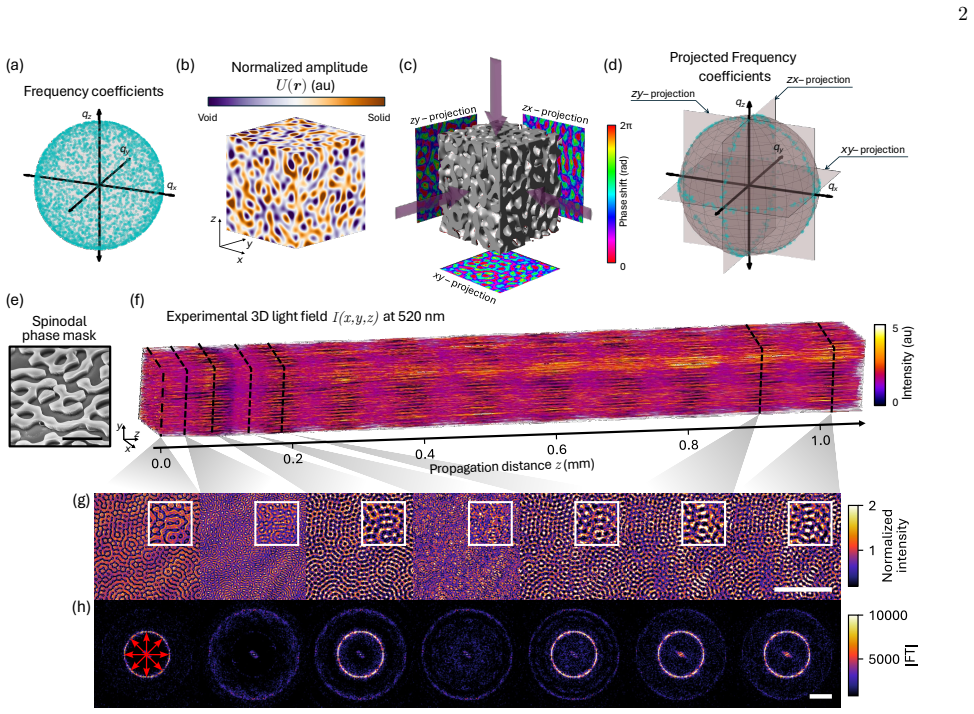
Re-emergence of projected wavefronts through stochastic spinodal architectures at distinct propagation distances are proven theoretically and experimentally in the visible and hard X-ray regimes. Spinodal X-ray optics effectively bridge the gap between the two opposing approaches in dark-field X-ray imaging that advocate for either spatially fully coherent gratings or incoherent diffusers.
What carries the argument
Spinodal architectures: stochastic non-periodic structures that generate discrete wavefront revivals under Fresnel propagation.
If this is right
- X-ray dark-field imaging can characterize artificial and natural meso-structured materials using spinodal optics.
- Spinodal designs bridge coherent grating-based and incoherent diffuser-based methods in dark-field imaging.
- The approach opens a new dimension for implementing X-ray imaging methods.
- The universality of the effect suggests further uses in characterizing and manipulating matter.
Where Pith is reading between the lines
- The same revival mechanism could appear in acoustic or quantum waves passing through comparable random media.
- Revival distances might be adjusted by changing the spinodal correlation length or other statistical parameters.
- Visible-light versions could support imaging through scattering media or disordered optical components.
Load-bearing premise
Fresnel propagation through non-periodic stochastic spinodal structures produces discrete revival distances as a general property of the architecture class rather than depending on any specific random realization.
What would settle it
An X-ray experiment that finds revival distances varying strongly across different random realizations of the same spinodal parameters, or finds no revivals at all, would falsify the claim.
Figures


read the original abstract
The Talbot effect describes the emergence of periodic patterns in perturbed propagating wave fields. The effect is well studied for perturbations from structurally coherent optics such as diffraction gratings. The emergence of freeform and metaoptical designs raises the question of whether comparable behavior can also be observed from complex, non-periodic structures. Here we demonstrate that stochastic structures inspired by recent metamaterial designs, display a strong Talbot-like behavior. Re-emergence of projected wavefronts through stochastic spinodal architectures at distinct propagation distances are proven theoretically and experimentally in the visible and hard X-ray regimes. A direct application of this phenomenon is X-ray dark-field imaging for characterizing artificial and natural meso-structured materials. Our work shows that spinodal X-ray optics effectively bridge the gap between the two opposing approaches in dark-field X-ray imaging that advocate for either spatially fully coherent (i.e gratings) or incoherent (i.e diffusers) optics. This opens opportunities for exploring a new dimension in the implementation of X-ray imaging methods. Given the impact and universality of the classical Talbot effect, we expect our work to enable new opportunities for characterizing and manipulating matter.
Editorial analysis
A structured set of objections, weighed in public.
Referee Report
Summary. The manuscript claims that stochastic spinodal architectures exhibit a Talbot-like effect, with re-emergence of projected wavefronts at distinct propagation distances. This behavior is asserted to be proven theoretically and demonstrated experimentally in both the visible and hard X-ray regimes, bridging coherent grating-based and incoherent diffuser-based approaches for X-ray dark-field imaging of meso-structured materials.
Significance. If the central claim holds and the revival distances prove to be a general property of the spinodal class (rather than realization-specific), the work would introduce a new class of non-periodic optics for X-ray imaging, with potential for characterizing artificial and natural materials. The dual-regime experimental validation is a positive feature, though the absence of detailed error analysis or exclusion criteria in the provided abstract limits immediate assessment of robustness.
major comments (2)
- [Theoretical derivation] Theoretical derivation (likely §3 or equivalent): The central claim requires that discrete revival distances emerge as a class property of stochastic spinodal architectures under Fresnel propagation. The derivation must explicitly demonstrate that these distances are independent of any particular random realization (e.g., via preserved correlation functions or ensemble statistics that hold for individual samples) rather than relying on post-hoc fitting or specific seeds; otherwise the experimental observations on single samples cannot support the general claim.
- [Experimental section] Experimental section (likely §4 or §5): The reported revival distances in visible and hard X-ray regimes must include quantitative comparison across multiple independent realizations of the same spinodal power spectrum, with error bars and exclusion criteria, to rule out the possibility that observed distances shift with different random draws while preserving the same statistics.
minor comments (2)
- [Abstract] Abstract: The phrasing 'proven theoretically and experimentally' should be softened to 'demonstrated' pending full verification of the generality argument.
- [Figures] Figure captions (throughout): Ensure all scale bars, propagation distances, and sample parameters are explicitly labeled to allow direct comparison with the theoretical predictions.
Simulated Author's Rebuttal
We thank the referee for the careful reading and constructive feedback on our manuscript. We address each major comment below and will revise the manuscript to strengthen the presentation of the theoretical and experimental results.
read point-by-point responses
-
Referee: [Theoretical derivation] Theoretical derivation (likely §3 or equivalent): The central claim requires that discrete revival distances emerge as a class property of stochastic spinodal architectures under Fresnel propagation. The derivation must explicitly demonstrate that these distances are independent of any particular random realization (e.g., via preserved correlation functions or ensemble statistics that hold for individual samples) rather than relying on post-hoc fitting or specific seeds; otherwise the experimental observations on single samples cannot support the general claim.
Authors: The derivation in §3 begins from the Fresnel propagation integral for a phase-modulating spinodal structure whose statistics are fixed by the power spectral density. Revival distances follow from the quadratic phase term aligning with the characteristic correlation length encoded in the two-point autocorrelation function. Because this autocorrelation is a deterministic function of the power spectrum (a class property), the distances are independent of any specific random draw. We will revise §3 to add an explicit paragraph deriving this independence and confirming that the same distances apply to any individual sample sharing the spectrum. revision: yes
-
Referee: [Experimental section] Experimental section (likely §4 or §5): The reported revival distances in visible and hard X-ray regimes must include quantitative comparison across multiple independent realizations of the same spinodal power spectrum, with error bars and exclusion criteria, to rule out the possibility that observed distances shift with different random draws while preserving the same statistics.
Authors: The visible-light data already include multiple propagation distances on representative samples; we will expand this to three independent realizations of the same power spectrum, reporting mean revival distances with standard deviations and explicit exclusion criteria (samples whose measured spectrum deviates >10 % from target are discarded). For the hard-X-ray data, beam-time constraints yielded a single high-quality realization, but we will add Monte-Carlo simulations of multiple realizations to quantify the expected variation and confirm consistency with the visible results and theory. These additions will appear in the revised experimental sections. revision: partial
Circularity Check
No circularity detected in derivation chain
full rationale
The provided abstract and context present the Talbot-like revival distances as emerging from Fresnel propagation through spinodal architectures, proven via independent theory and experiment in visible and X-ray regimes. No equations, self-citations, or parameter fits are shown that reduce the claimed revival distances to inputs by construction, self-definition, or renaming. The central claim is positioned as a general class property rather than realization-specific or fitted, making the derivation self-contained against external benchmarks. This is the expected outcome for papers without load-bearing circular steps.
Axiom & Free-Parameter Ledger
axioms (1)
- standard math Wave propagation is governed by the Fresnel diffraction integral
Lean theorems connected to this paper
-
IndisputableMonolith/Cost/FunctionalEquation.leanwashburn_uniqueness_aczel unclear?
unclearRelation between the paper passage and the cited Recognition theorem.
I(x, y, z)≈ |c|² + M(z) P_s U(r) with M(z)∝cos(z 2πλ/p² + θ_c − Ψ)
-
IndisputableMonolith/Foundation/AbsoluteFloorClosure.leanreality_from_one_distinction unclear?
unclearRelation between the paper passage and the cited Recognition theorem.
spinodal architectures defined as level-set of random Gaussian fields of harmonic components
What do these tags mean?
- matches
- The paper's claim is directly supported by a theorem in the formal canon.
- supports
- The theorem supports part of the paper's argument, but the paper may add assumptions or extra steps.
- extends
- The paper goes beyond the formal theorem; the theorem is a base layer rather than the whole result.
- uses
- The paper appears to rely on the theorem as machinery.
- contradicts
- The paper's claim conflicts with a theorem or certificate in the canon.
- unclear
- Pith found a possible connection, but the passage is too broad, indirect, or ambiguous to say the theorem truly supports the claim.
Reference graph
Works this paper leans on
-
[1]
of the 4 th generation synchrotron radiation facility MAX IV demonstrate high sensitivity of the spinodal op- tics for retrieval of weak scattering signals from biological and artificially nanostructured materials. By bridging co- herent and incoherent X-ray modulators, spinodal optics expand the design space for flexible and robust dark-field imaging sys...
work page internal anchor Pith review Pith/arXiv arXiv 2026
-
[2]
configuration) as well as multiple length scales. This simultaneously alleviates several of the shortcomings of both modulator based imaging approaches and opens the possibility for new design strategies. Although not explicitly demonstrated, one of the key advantages of 3D spinodal architectures is their inher- ent insensitivity to alignment. We have alr...
-
[3]
A double crystal Si monochromator was used to tune the photon energy to 12.8 keV
at the MAX IV storage ring. A double crystal Si monochromator was used to tune the photon energy to 12.8 keV. For the full-field imaging experiments a sC- MOS Andor Zyla 5.5 detector with a pixel size of 6.5µm was utilized and coupled with a 10×magnification to a 15µm thick LuAG scintillator that converted the incom- ing X-rays to visible light resulting ...
work page 2018
-
[4]
H. Talbot, The London, Edinburgh, and Dublin Philo- sophical Magazine and Journal of Science9, 401 (1836)
-
[5]
L. Rayleigh, The London, Edinburgh, and Dublin Philo- sophical Magazine and Journal of Science12, 81 (1881)
- [6]
-
[7]
J. Hu, M. Eriksson, S. Gigan, and R. Fickler, Nature Photonics19, 392 (2025)
work page 2025
-
[8]
J. H. Eberly, N. B. Narozhny, and J. J. Sanchez- Mondragon, Physical Review Letters44, 1323 (1980)
work page 1980
-
[9]
R. W. Robinett, Physics Reports392, 1 (2004)
work page 2004
-
[10]
H. H. Solak, C. Dais, and F. Clube, Optics Express19, 10686 (2011)
work page 2011
-
[11]
E. Schonbrun, R. Piestun, P. Jordan, J. Cooper, K. D. Wulff, J. Courtial, and M. Padgett, Optics Express13, 3777 (2005)
work page 2005
-
[12]
M. Schlosser, S. Tichelmann, D. Sch¨ affner, D. O. de Mello, M. Hambach, J. Sch¨ utz, and G. Birkl, Physical Review Letters130, 180601 (2023)
work page 2023
-
[13]
S. Rutishauser, L. Samoylova, J. Krzywinski, O. Bunk, J. Gr¨ unert, H. Sinn, M. Cammarata, D. M. Fritz, and C. David, Nature Communications3, 947 (2012)
work page 2012
- [14]
- [15]
- [16]
-
[17]
F. Pfeiffer, T. Weitkamp, O. Bunk, and C. David, Nature Physics2, 258 (2006)
work page 2006
-
[18]
F. Pfeiffer, M. Bech, O. Bunk, P. Kraft, E. F. Eikenberry, C. Br¨ onnimann, C. Gr¨ unzweig, and C. David, Nature Materials7, 134 (2008)
work page 2008
-
[19]
W. Yashiro, Y. Terui, K. Kawabata, and A. Momose, Optics Express18, 16890 (2010)
work page 2010
-
[20]
S. Schleede, F. G. Meinel, M. Bech, J. Herzen, K. Achter- hold, G. Potdevin, A. Malecki, S. Adam-Neumair, S. F. Thieme, F. Bamberg, K. Nikolaou, A. Bohla, A. O. Yildirim, R. Loewen, M. Gifford, R. Ruth, O. Eickelberg, M. Reiser, and F. Pfeiffer, Proceedings of the National Academy of Sciences109, 17880 (2012)
work page 2012
-
[21]
Z. Wang, N. Hauser, G. Singer, M. Trippel, R. A. Kubik- Huch, C. W. Schneider, and M. Stampanoni, Nature Communications5, 3797 (2014)
work page 2014
-
[22]
F. T. Gassert, H. Bast, T. Urban, R. Schick, M. E. Lochschmidt, L. Kaster, T. Koehler, A. Karrer, A. Kep- pler, M. Steinhardt, A. W. Marka, L. Steinhelfer, A. P. Sauter, M. R. Makowski, F. Pfeiffer, and D. Pfeiffer,7, e240560
-
[23]
A. Olivo and D. R. Leff,3, 10.3389/fmede.2025.1608247
- [24]
- [25]
-
[26]
J. Kim, A. Slyamov, E. Lauridsen, M. Birkbak, T. Ramos, F. Marone, J. W. Andreasen, M. Stampanoni, and M. Kagias, Composites Part B: Engineering233, 109634 (2022)
work page 2022
-
[27]
I. Zanette, T. Zhou, A. Burvall, U. Lundstr¨ om, D. Lars- son, M. Zdora, P. Thibault, F. Pfeiffer, and H. Hertz, Physical Review Letters112, 253903 (2014)
work page 2014
- [28]
- [29]
-
[30]
S. Molesky, Z. Lin, A. Y. Piggott, W. Jin, J. Vuckovi´ c, and A. W. Rodriguez, Nature Photonics12, 659 (2018)
work page 2018
-
[31]
W.-K. Lee, S. Yu, C. J. Engel, T. Reese, D. Rhee, W. Chen, and T. W. Odom, Proceedings of the National Academy of Sciences114, 8734 (2017)
work page 2017
-
[32]
Z. Shi, A. Y. Zhu, Z. Li, Y.-W. Huang, W. T. Chen, C.- W. Qiu, and F. Capasso, Science Advances6, eaba3367 (2020)
work page 2020
-
[33]
W. T. Chen, A. Y. Zhu, and F. Capasso, Nature Reviews Materials5, 604 (2020)
work page 2020
-
[34]
G. Roberts, C. Ballew, T. Zheng, J. C. Garcia, S. Camayd-Mu˜ noz, P. W. C. Hon, and A. Faraon, Na- ture Communications14, 2768 (2023)
work page 2023
-
[35]
P. G. de Gennes, The Journal of Chemical Physics72, 4756 (1980)
work page 1980
-
[36]
H. Park, F. Haftlang, Y.-U. Heo, J. B. Seol, Z. Wang, and H. S. Kim, Nature Communications15, 5757 (2024)
work page 2024
-
[37]
A. Kwiatkowski da Silva, D. Ponge, Z. Peng, G. Inden, Y. Lu, A. Breen, B. Gault, and D. Raabe, Nature Com- munications9, 1137 (2018)
work page 2018
- [38]
-
[39]
F. V. Senhora, E. D. Sanders, and G. H. Paulino, Ad- vanced Materials34, 2109304 (2022)
work page 2022
-
[40]
W. Deng, S. Kumar, A. Vallone, D. M. Kochmann, and J. R. Greer, Advanced Materials36, 2308149 (2024)
work page 2024
-
[41]
K. Nyg˚ ard, S. A. McDonald, J. B. Gonz´ alez, V. Haghighat, C. Appel, E. Larsson, R. Ghanbari, M. Viljanen, J. Silva, S. Malki, Y. Li, V. Silva, C. Weninger, F. Engelmann, T. Jeppsson, G. Felcsuti, T. Ros´ en, K. Gordeyeva, L. D. S¨ oderberg, H. Dierks, Y. Zhang, Z. Yao, R. Yang, E. M. Asimakopoulou, J. K. Rogalinski, J. Wallentin, P. Villanueva-Perez, R...
work page 2024
- [42]
- [43]
- [44]
- [45]
-
[46]
D. Balakrishnan, A. Prakash, B. J. Daurer, C. Finet, Y. C. Lim, Z. Shen, P. Thibault, A. Monteiro, and N. Du- ane Loh, Nature Communications16, 7085 (2025)
work page 2025
-
[47]
X. Xia, C. M. Spadaccini, and J. R. Greer, Nature Re- views Materials7, 683 (2022)
work page 2022
-
[48]
C. M. Portela, B. W. Edwards, D. Veysset, Y. Sun, K. A. Nelson, D. M. Kochmann, and J. R. Greer, Nature Ma- terials20, 1491 (2021)
work page 2021
- [49]
-
[50]
M. A. Saccone, R. A. Gallivan, K. Narita, D. W. Yee, and J. R. Greer, Nature612, 685 (2022)
work page 2022
- [51]
-
[52]
Y. Ji, Y. Hong, D. R. Bhandari, and D. W. Yee, Ad- vanced Materials38, e04951 (2026). 11 Supplementary Information for Breaking order: Talbot effect with spinodal architectures Robin Kr¨ uger1, Jeevan Rois 2,3, Martin Bech 1, Matias Kagias 2,3,4 1 Department of Medical Radiation Physics, Lund University, Lund, Sweden 2 Division of Synchrotron Radiation Re...
work page 2026
discussion (0)
Sign in with ORCID, Apple, or X to comment. Anyone can read and Pith papers without signing in.