Topological analysis in mathcal{R}(p,q)-anisotropic sector and nuclear space on mathcal{R}(p,q)-quantum deformed algebra
Pith reviewed 2026-06-30 17:19 UTC · model grok-4.3
The pith
A Stirling-type asymptotic for the R(p,q)-deformed Gamma function produces quadratic exponential growth estimates that yield sharp bounds and classical inequality analogues for entire functions in the deformed setting.
A machine-rendered reading of the paper's core claim, the machinery that carries it, and where it could break.
Core claim
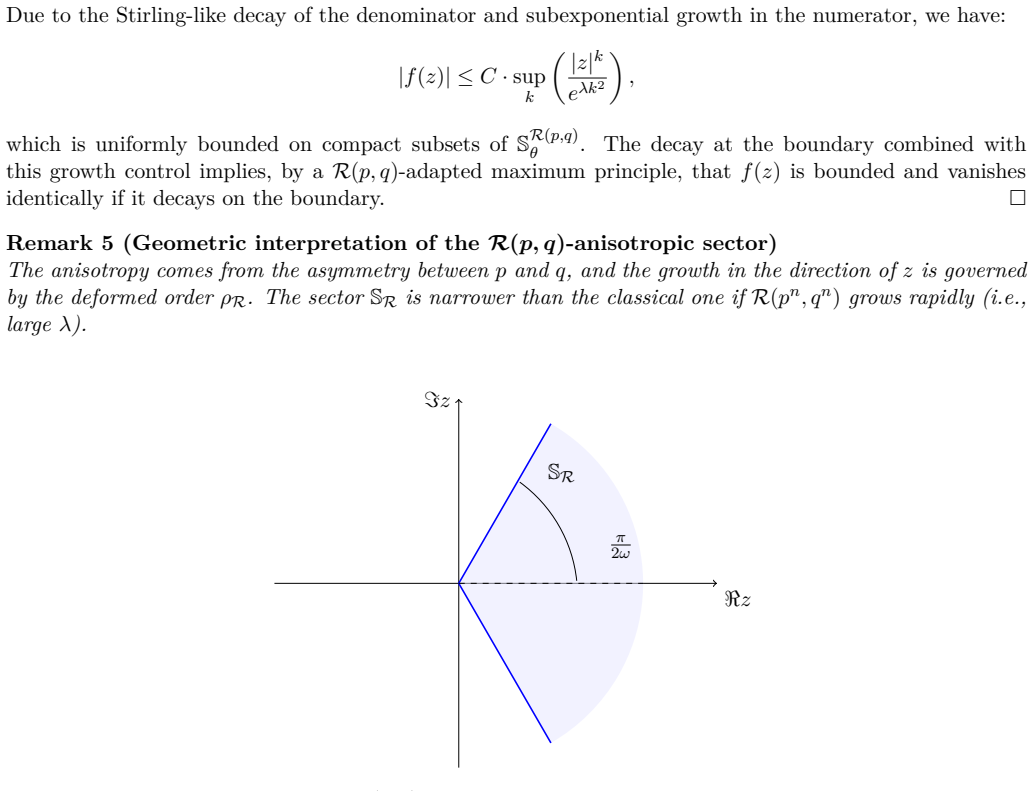
The R(p,q)-deformed Gamma function admits a Stirling-type asymptotic expansion based on the asymptotics R!(p^n, q^n) ∼ exp(λ n²), which induces precise exponential quadratic growth estimates. These in turn yield sharp coefficient bounds and Cauchy-type inequalities for R(p,q)-entire functions, enabling the introduction of R(p,q)-weighted spaces, discs, and anisotropic sectors where analogues of classical complex analysis theorems hold.
What carries the argument
The R(p,q)-deformed Gamma function Γ_{R(p,q)} together with the associated weighted spaces and valuation maps, which translate the deformation geometry into growth controls for holomorphic functions.
Load-bearing premise
The meromorphic kernel must satisfy 0<q<p≤1 with R(1,1)=0 and R(p^n,q^n)>0 so that the deformed Gamma function is well-defined and positive.
What would settle it
Computing the deformed factorial for large n and checking whether its logarithm grows exactly quadratically as predicted, or verifying if a specific entire function violates the induced Cauchy inequality in the sector.
Figures
read the original abstract
The purpose of this article is to develop and analyze $\mathcal{R}(p,q)-$topological analysis of the classical nuclear space within the general framework of $\mathcal{R}(p,q)-$calculus. We begin by introducing the $\mathcal{R}(p,q)-$Gamma functions, establishing their main properties and their connection with the deformed factorials. We develop a rigorous analytic and functional-analytic framework for holomorphic functions governed by a general $\mathcal{R}(p,q)-$deformation, where $\mathcal{R}(u,v)$ is a meromorphic kernel satisfying $0<q<p\leq 1$, $\mathcal{R}(1,1)=0$, and $\mathcal{R}(p^n,q^n)>0$. A Stirling-type asymptotic expansion is established for the $\mathcal{R}(p,q)-$deformed Gamma function $\Gamma_{\mathcal{R}(p,q)}$, yielding precise exponential quadratic growth estimates driven by the asymptotics of the deformed factorial $\mathcal{R}!(p^n,q^n)\sim \exp(\lambda n^2)$. These asymptotics induce sharp coefficient bounds and Cauchy-type inequalities for $\mathcal{R}(p,q)-$entire functions. Based on these estimates, we introduce $\mathcal{R}(p,q)-$weighted Banach and Fr\'echet spaces of holomorphic functions, together with deformation dependent pseudo-norms and valuation maps. Within this setting, we define $\mathcal{R}(p,q)-$discs and anisotropic sectors adapted to the deformation geometry and prove $\mathcal{R}(p,q)-$analogues of the Cauchy-Hadamard theorem, the Borel-Carath\'eodory inequality and Phragm\'en-Lindel\"of type growth principles. These results contribute to the broader program of constructing a consistent functional calculus in $\mathcal{R}(p,q)-$quantum algebras, with potential applications to deformed fractional differential equations, operator theory, spectral problems, and non commutative models arising in mathematical physics.
Editorial analysis
A structured set of objections, weighed in public.
Referee Report
Summary. The paper develops an R(p,q)-deformed calculus framework starting from a meromorphic kernel R(u,v) satisfying 0<q<p≤1, R(1,1)=0 and R(p^n,q^n)>0. It defines an R(p,q)-Gamma function Γ_R(p,q) via the associated deformed factorial, claims a Stirling-type asymptotic expansion for this Gamma function driven by the quadratic-exponential growth R!(p^n,q^n)∼exp(λn²), derives sharp coefficient bounds and Cauchy inequalities for R(p,q)-entire functions, constructs R(p,q)-weighted Banach/Fréchet spaces with deformation-dependent pseudo-norms, introduces R(p,q)-discs and anisotropic sectors, and proves deformed analogues of the Cauchy-Hadamard theorem, Borel-Carathéodory inequality and Phragmén-Lindelöf growth principles.
Significance. If the key asymptotic claim holds under the stated hypotheses, the work supplies a coherent functional-analytic setting for holomorphic functions on R(p,q)-quantum algebras, including growth estimates and sectorial analysis that could support applications to deformed fractional DEs, operator theory and non-commutative models. The explicit construction of weighted spaces and valuation maps from the deformed factorial asymptotics would be a concrete contribution to the program of consistent functional calculus in deformed settings.
major comments (1)
- [the section establishing the Stirling-type asymptotic expansion for Γ_R(p,q) and the asymptotics of R!(p^n,q^n)] The central claim that the deformed factorial satisfies R!(p^n,q^n)∼exp(λn²) (and therefore yields a Stirling-type expansion for Γ_R(p,q)) is asserted for an arbitrary meromorphic kernel obeying only 0<q<p≤1, R(1,1)=0 and R(p^n,q^n)>0. These conditions alone do not force the partial sums of log R(p^k,q^k) to be asymptotically quadratic; generic meromorphic R can produce different growth rates. This gap is load-bearing for the coefficient bounds, Cauchy inequalities, weighted spaces, discs, sectors and all subsequent growth principles.
Simulated Author's Rebuttal
We thank the referee for the thorough review and for pinpointing the foundational gap in the asymptotic justification. We address the concern directly below and will revise the manuscript to incorporate an explicit hypothesis that closes this gap while preserving the overall framework.
read point-by-point responses
-
Referee: [the section establishing the Stirling-type asymptotic expansion for Γ_R(p,q) and the asymptotics of R!(p^n,q^n)] The central claim that the deformed factorial satisfies R!(p^n,q^n)∼exp(λn²) (and therefore yields a Stirling-type expansion for Γ_R(p,q)) is asserted for an arbitrary meromorphic kernel obeying only 0<q<p≤1, R(1,1)=0 and R(p^n,q^n)>0. These conditions alone do not force the partial sums of log R(p^k,q^k) to be asymptotically quadratic; generic meromorphic R can produce different growth rates. This gap is load-bearing for the coefficient bounds, Cauchy inequalities, weighted spaces, discs, sectors and all subsequent growth principles.
Authors: We agree that the referee's observation is correct: the stated conditions on the meromorphic kernel R are insufficient by themselves to guarantee the quadratic growth ∑_{k=1}^n log R(p^k,q^k) ∼ λ n². In the submitted manuscript this asymptotic was introduced to derive the Stirling-type expansion and all downstream results, but without an additional hypothesis the claim does not hold for arbitrary kernels satisfying only the listed properties. In the revised version we will add an explicit standing hypothesis (H): there exists λ>0 such that log R!(p^n,q^n) = ∑_{k=1}^n log R(p^k,q^k) ∼ λ n² as n→∞. Under (H) the Stirling-type expansion for Γ_R(p,q) follows by standard summation arguments, and the coefficient bounds, Cauchy inequalities, weighted spaces, discs, sectors, and growth principles remain valid when conditioned on (H). We will also include concrete examples of kernels (e.g., suitable quadratic-exponential meromorphic functions) that satisfy both the original conditions and (H). This revision makes the logical structure rigorous without changing the paper's scope or conclusions. revision: yes
Circularity Check
No significant circularity; derivations follow from definitions without reduction to inputs by construction
full rationale
The paper defines the R(p,q)-deformed Gamma function and factorials from the meromorphic kernel R(u,v) under the stated conditions (0<q<p≤1, R(1,1)=0, R(p^n,q^n)>0), then claims to establish Stirling-type asymptotics for Γ_R(p,q) driven by R!(p^n,q^n)∼exp(λn²) and derives subsequent bounds, inequalities, and spaces from those estimates. No quoted step shows a prediction equivalent to its inputs by construction, no fitted parameter renamed as prediction, and no load-bearing self-citation chain. The framework adapts standard analytic techniques to the deformation; the central claims are presented as derived rather than tautological. This is the most common honest finding for self-contained papers.
Axiom & Free-Parameter Ledger
free parameters (1)
- p,q
axioms (1)
- domain assumption R(u,v) is meromorphic kernel with R(1,1)=0 and R(p^n,q^n)>0
invented entities (1)
-
R(p,q)-deformed Gamma function
no independent evidence
Reference graph
Works this paper leans on
-
[2]
Jagannathan R and Srinivasa Rao K 2006 Two-parameter quantum algebras, twin-basic numbers, and associated generalized hypergeometric series arXiv:math/0602613
work page internal anchor Pith review Pith/arXiv arXiv 2006
-
[3]
Generalized Fractional Calculus and Applications; Longman—J
Kiryakova, V. Generalized Fractional Calculus and Applications; Longman—J. Wiley, Harlow—New York, Chapman and Hall/CRC: London, UK, 1994
1994
-
[4]
Handbook of Integral Transforms of Higher Transcendental Functions, Theory and Algo- rithmic Tables; Ellis Horwood: Chichester, UK, 1983
Marichev, O.I. Handbook of Integral Transforms of Higher Transcendental Functions, Theory and Algo- rithmic Tables; Ellis Horwood: Chichester, UK, 1983
1983
-
[5]
The H-Functions of One and Two Variables with Applications; South Asian Publs: New Delhi, India, 1982
Srivastava, H.M.; Gupta, K.S.; Goyal, S.P. The H-Functions of One and Two Variables with Applications; South Asian Publs: New Delhi, India, 1982
1982
-
[6]
Special Functions in Queuing Theory and Related Stochastic Pro- cesses; Academic Press: New York, NY, USA, 1982
Srivastava, H.M.; Kashyap, B.R.K. Special Functions in Queuing Theory and Related Stochastic Pro- cesses; Academic Press: New York, NY, USA, 1982
1982
-
[7]
Integrals and Series, Vol
Prudnikov, A.P.; Brychkov, Y.; Marichev, O.I. Integrals and Series, Vol. 3: More Special Functions; Gordon and Breach Sci. Publ.: London, UK, 1992
1992
-
[8]
The Hypergeometric Approach to Integral Transforms and Convolutions; Ser
Yakubovich, S.; Luchko, Y. The Hypergeometric Approach to Integral Transforms and Convolutions; Ser. Mathematics and Its Applications 287; Kluwer Acad. Publ.: Dordrecht, The Netherlands; Boston, MA, USA; London, UK, 1994
1994
-
[9]
Alok Jain, Altaf Ahmad Bhat, Renu Jain and Deepak Kumar Jain,(p,q)−Analogue of Mittag-Leffler Function with(p,q)−Laplace Transform, Anal. Theory Appl., Vol. 38, No. 3 (2022), pp. 351-360, DOI: 10.4208/ata.OA-2018-0014 September 2022
-
[10]
https://doi.org/10.3390/math9010106
Virginia Kiryakova, A Guide to Special Functions in Fractional Calculus, Mathematics 2021, 9, 106. https://doi.org/10.3390/math9010106
-
[11]
Orthogonal Polynomials and Special Functions; SIAM: Philadelphia, PA, USA, 1975
Askey, R. Orthogonal Polynomials and Special Functions; SIAM: Philadelphia, PA, USA, 1975
1975
-
[12]
(Ed.) Higher Transcendental Functions; McGraw Hill: New York, NY, USA, 1953–1955; Vols
Erdélyi, A. (Ed.) Higher Transcendental Functions; McGraw Hill: New York, NY, USA, 1953–1955; Vols. 1, 2, 3
1953
-
[13]
Handbook of Mathematical Functions with Formulas, Graphs, and Math- ematical Tables; National Bureau of Standards, 1964-Dover, 1965
Abramowitz, M.; Stegun, A. Handbook of Mathematical Functions with Formulas, Graphs, and Math- ematical Tables; National Bureau of Standards, 1964-Dover, 1965
1964
-
[14]
Hounkonnou M N and Bukweli Kyemba J D 2010 Generalized(R,p,q)−deformed Heisenberg algebras: coherent states and special functionsJ. Math. Phys.51063518 25
2010
- [15]
-
[16]
MelongFandWulkenhaarRGeneralizedHeisenberg-Virasoroalgebraandmatrixmodelsfromquantum algebra arXiv:1005.4309v1 [math.QA]
work page internal anchor Pith review Pith/arXiv arXiv
-
[17]
Bukweli Kyemba J D and Hounkonnou M N Characterization of(R,p,q)−deformed Rogers-Szegö polynomials: associated quantum algebras, deformed Hermite polynomials and relevant properties arXiv:1204.4705v1 [math-ph] 20 Apr 2012
work page internal anchor Pith review Pith/arXiv arXiv 2012
-
[18]
Hounkonnou M N and Ngompe Nkouankam E B 2007 New(p,q,µ,ν,f)−deformed statesJ. Phys. A: Math. Theor.4012113
2007
-
[19]
Chari V and Pressley A 1994A guide to Quantum groups(Cambridge: Cambridge University Press)
-
[20]
Hounkonnou M. N., Melong F. and Melanija Mitrović.: Generalized Witt, Witt n algebras, Virasoro al- gebrasandKdVequations inducedfromR(p,q)−deformedquantumalgebras, e-printarXiv:2008.04778v1 [math-ph] 8 Aug 2020
-
[21]
N., Melong F
Hounkonnou M. N., Melong F. and Melanija Mitrović.: On a general method of constructing deformed quantum analogs of classical orthogonal polynomials, SUT Journal of mathematics (2020)
2020
-
[22]
Hounkonnou M. N. and Melong F.:R(p,q)−deformed conformal Virasoro algebra,J. Maths. Phys.60, (2019)
2019
- [23]
-
[24]
Bukweli Kyemba and M.N
J.D. Bukweli Kyemba and M.N. Hounkonnou, 2012(q; l,λ)-deformed Heisenberg algebra: coherent states, their statistics and geometry, Afr. Diaspora J. Math, 14 pp 38 -56
2012
-
[25]
Hounkonnou M. N. and Melong F.:R(p,q)−deformed combinatorics: full characterization and illus- tration, arXiv:1906.03059v1 [math.GM](2019)
work page internal anchor Pith review Pith/arXiv arXiv 1906
-
[26]
Hounkonnou M. N. and Kyemba Bukweli J. D.:R(p,q)-calculus: differentiation and integration,SUT. J. Math.Vol49n ◦2, 145-167 (2013)
2013
-
[27]
On the $(p,q)$-Gamma and the $(p,q)$-Beta functions
Sadjang P. N.: On the(p,q)−gamma and the(p,q)−beta functions. arXiv 2015, arXiv:1506.07394
work page internal anchor Pith review Pith/arXiv arXiv 2015
-
[28]
On the fundamental theorem of $(p,q)$-calculus and some $(p,q)$-Taylor formulas
Sadjang P. N.: On the fundamental theorem of(p,q)−calculus and some(p,q)−Taylor formulas. arXiv 2013, arXiv:1309.3934v1
work page internal anchor Pith review Pith/arXiv arXiv 2013
-
[29]
Milovanovic G.V., Gupta V., Malik N.:(p,q)−Beta functions and applications in approximation. Bol. Soc. Mat. Mex. 2016
2016
-
[30]
Some completely monotonic properties for the $(p,q )$-gamma function
V. Krasniqi, F. Merovci.: Some completely monotonic properties for the(p,q)−Gamma function, http://arxiv.org/abs/1407.4231v1, 2014
work page internal anchor Pith review Pith/arXiv arXiv 2014
-
[31]
Kiryakova, V.Generalized Fractional Calculus and Applications, Longman, 1994
1994
-
[32]
and others.Fractional Calculus Operators and Applications to Differential Equations, 1991
Saigo, M. and others.Fractional Calculus Operators and Applications to Differential Equations, 1991
1991
-
[33]
et al.(p,q)-Calculus and Quantum Calculus Extensions, SIGMA, 2023
Chakrabarty, A. et al.(p,q)-Calculus and Quantum Calculus Extensions, SIGMA, 2023
2023
-
[34]
F. H. Jackson,Onq-functions and a certain difference operator, Trans. Roy. Soc. Edinburgh46(1908), 253–281
1908
-
[35]
Gasper and M
G. Gasper and M. Rahman,Basic Hypergeometric Series, Cambridge University Press, Cambridge, 2004. 26
2004
-
[36]
Jagannathan and K
R. Jagannathan and K. Srinivasa Rao,Two-parameter quantum algebras, twin-basic numbers, and associated special functions, Proc. Int. Conf. on Number Theory and Mathematical Physics, 2005
2005
-
[37]
Chakrabarti and R
R. Chakrabarti and R. Jagannathan,A(p,q)-oscillator realization of two-parameter quantum algebras, J. Phys. A24(1991), L711–L718
1991
-
[38]
Burban and A
I. Burban and A. Klimyk,Two-parameter quantum algebras and deformed oscillators, J. Phys. A26 (1993), 4871–4882
1993
-
[39]
M. N. Hounkonnou and J. B. Ngompe,R(p,q)-deformed algebras and special functions, J. Math. Phys. 50(2009), 123502
2009
-
[40]
Exton,q-Hypergeometric Functions and Applications, Ellis Horwood, Chichester, 1983
H. Exton,q-Hypergeometric Functions and Applications, Ellis Horwood, Chichester, 1983
1983
-
[41]
T. H. Koornwinder,q-special functions and quantum groups, Contemp. Math.134(1992), 73–94
1992
-
[42]
V. G. Drinfeld,Quantum groups, Proc. Int. Congr. Math. (Berkeley, 1986), 798–820
1986
-
[43]
Jimbo,Aq-difference analogue ofU(g)and the Yang–Baxter equation, Lett
M. Jimbo,Aq-difference analogue ofU(g)and the Yang–Baxter equation, Lett. Math. Phys.10(1985), 63–69
1985
-
[44]
Herrmann,Fractional Calculus: An Introduction for Physicists, World Scientific, Singapore, 2014
R. Herrmann,Fractional Calculus: An Introduction for Physicists, World Scientific, Singapore, 2014
2014
-
[45]
Podlubny,Fractional Differential Equations, Academic Press, San Diego, 1999
I. Podlubny,Fractional Differential Equations, Academic Press, San Diego, 1999. 27
1999
discussion (0)
Sign in with ORCID, Apple, or X to comment. Anyone can read and Pith papers without signing in.