EMMA: Extracting Multiple physical parameters from Multimodal Data
Pith reviewed 2026-06-30 16:34 UTC · model grok-4.3
The pith
EMMA recovers all identifiable dynamical parameters of a system directly from raw multimodal observations using a unified continuous-time model.
A machine-rendered reading of the paper's core claim, the machinery that carries it, and where it could break.
Core claim
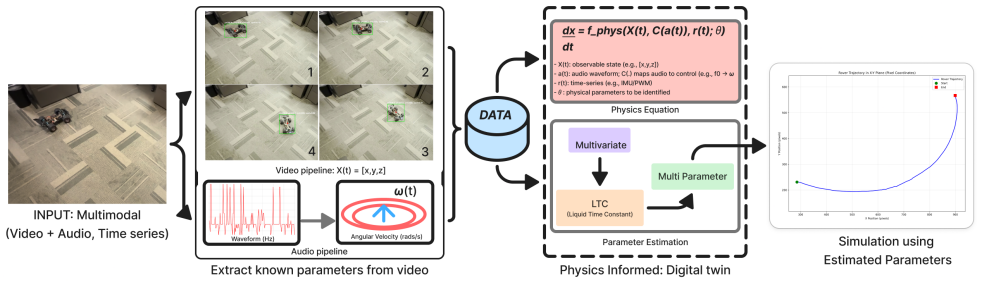
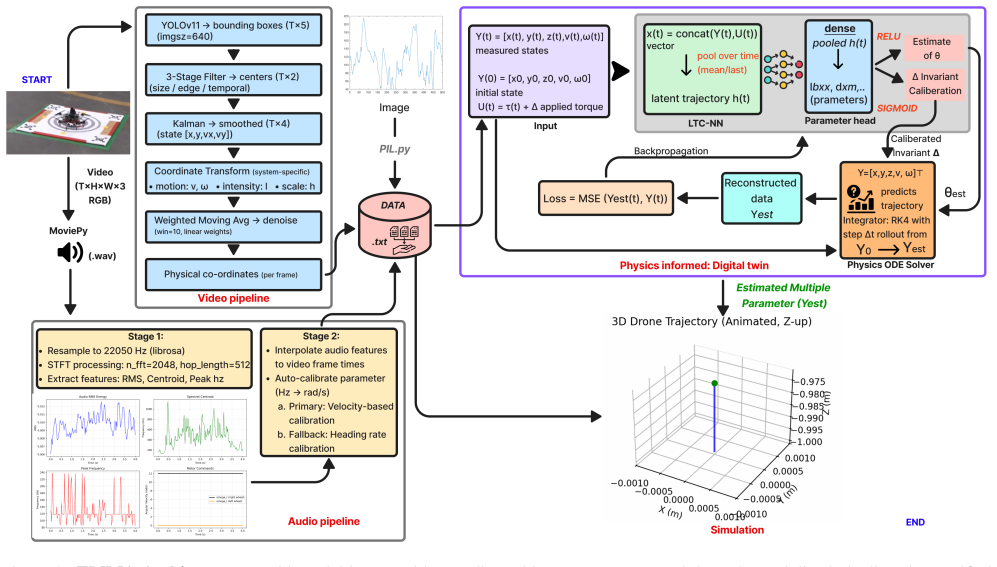
EMMA recovers all identifiable dynamical parameters of a system directly from raw video, audio, and image-based time-series observations by performing joint inference of explicit parameters, implicit dynamical components, and calibration invariants within a unified continuous-time model that combines an LTC network for latent dynamics with a physics-constrained loss enforcing the governing differential equations.
What carries the argument
The Liquid Time-Constant network paired with a physics-constrained loss that aligns multimodal features to known differential equations across video trajectories, acoustic signatures, and chart measurements.
If this is right
- Parameters can be recovered under forced, implicit, and multivariate dynamics without segmentation masks or differentiable rendering.
- The same pipeline works on real rover and quadrotor systems that have hidden actuation inputs.
- Performance exceeds single-modality and equation-discovery baselines on five standard dynamical benchmarks and 75 Delfys videos.
- The framework extends to simulation-chart studies of biological and chaotic systems.
Where Pith is reading between the lines
- If the known-equation requirement can be relaxed, the method could be combined with equation-discovery techniques to handle partially specified systems.
- The multimodal alignment step suggests possible use in domains where only opportunistic recordings exist, such as field biology or infrastructure monitoring.
- Scaling the continuous-time model to higher-dimensional state spaces would require checking whether the LTC component remains stable under increased latent dimensionality.
Load-bearing premise
The governing differential equations of the underlying system are known in advance and can be encoded directly into a differentiable loss that stays consistent across modalities and hidden inputs.
What would settle it
Demonstrating that the recovered parameters deviate significantly from ground-truth values on a new system whose equations are known but whose video and audio contain substantial occlusion and unknown forcing would falsify the central claim.
Figures

read the original abstract
We introduce EMMA, a physics-informed multimodal framework that recovers all identifiable dynamical parameters of a system directly from raw video, audio, and image-based time-series observations. Unlike prior video-only approaches that struggle with occluded states, hidden actuation inputs, or assumptions about known initial conditions and coordinate frames, EMMA performs joint inference of explicit parameters, implicit dynamical components, and calibration invariants within a unified continuous-time model. EMMA leverages a Liquid Time-Constant (LTC) network to learn latent dynamics from heterogeneous modalities while a physics-constrained loss enforces consistency with the governing differential equations. A unified feature pipeline enables consistent alignment across video trajectories, acoustic signatures, and chart-derived measurements, allowing EMMA to estimate parameters under forced, implicit, and multivariate dynamics without requiring segmentation masks, differentiable rendering, or specialized sensors. Across 100+ scenarios including five standard dynamical benchmarks (75 Delfys videos), real-world rover and quadrotor systems with hidden inputs, and simulation-chart case studies spanning biological and chaotic systems, EMMA delivers robust multi-parameter recovery and significantly outperforms existing single-modality and equation-discovery baselines. Our results establish EMMA as a general, scalable solution for physics-consistent model extraction from opportunistic multimodal data. Code and data are available at: https://github.com/ImpactLabASU/EMMA-CVPR2026
Editorial analysis
A structured set of objections, weighed in public.
Referee Report
Summary. The paper introduces EMMA, a physics-informed multimodal framework that recovers all identifiable dynamical parameters of a system directly from raw video, audio, and image-based time-series observations. It uses a Liquid Time-Constant (LTC) network to learn latent dynamics from heterogeneous modalities, a physics-constrained loss to enforce consistency with governing differential equations, and a unified feature pipeline for alignment across modalities. The method performs joint inference of explicit parameters, implicit dynamical components, and calibration invariants in a continuous-time model, handling forced, implicit, and multivariate dynamics without segmentation masks, differentiable rendering, or known initial conditions. Experiments across 100+ scenarios (five standard dynamical benchmarks with 75 Delfys videos, real-world rover/quadrotor with hidden inputs, and simulation-chart studies on biological/chaotic systems) show robust multi-parameter recovery outperforming single-modality and equation-discovery baselines.
Significance. If the central claims hold, the work would be significant for enabling scalable, physics-consistent parameter extraction from opportunistic multimodal data in robotics, system identification, and related fields. Strengths include the unified handling of hidden inputs and multiple modalities, the release of code and data, and the breadth of evaluated scenarios (benchmarks plus real systems).
major comments (2)
- [Method] Method section (around the physics-constrained loss definition): the claim that the loss enforces consistency across modalities and hidden inputs without circularity requires the explicit mathematical form of the loss (e.g., how the LTC latent dynamics are coupled to the known governing ODEs) to be shown; without it the central recovery claim cannot be verified as non-circular.
- [Experiments] Experiments section, Table on benchmark results: the reported outperformance over equation-discovery baselines must include the exact quantitative metrics (e.g., parameter error norms) and ablation on the contribution of each modality; the abstract's summary of 'significantly outperforms' is load-bearing for the general-solution claim but lacks these details.
minor comments (2)
- The abstract states 'Code and data are available at: https://github.com/ImpactLabASU/EMMA-CVPR2026'; confirm the repository contains the exact scripts and datasets used for the 100+ scenarios to support reproducibility.
- [Experiments] Clarify the precise list of the 'five standard dynamical benchmarks' and the 75 Delfys videos in the main text or a table, as this is referenced but not enumerated.
Simulated Author's Rebuttal
We thank the referee for the constructive feedback. We address each major comment below and will revise the manuscript to incorporate the requested clarifications and details.
read point-by-point responses
-
Referee: [Method] Method section (around the physics-constrained loss definition): the claim that the loss enforces consistency across modalities and hidden inputs without circularity requires the explicit mathematical form of the loss (e.g., how the LTC latent dynamics are coupled to the known governing ODEs) to be shown; without it the central recovery claim cannot be verified as non-circular.
Authors: We agree that the explicit mathematical form of the physics-constrained loss is necessary to verify the non-circular coupling. In the revised manuscript, we will expand the method section to include the full loss formulation, explicitly detailing how the LTC latent states are coupled to the known governing ODEs, the enforcement of multimodal consistency, and the handling of hidden inputs. revision: yes
-
Referee: [Experiments] Experiments section, Table on benchmark results: the reported outperformance over equation-discovery baselines must include the exact quantitative metrics (e.g., parameter error norms) and ablation on the contribution of each modality; the abstract's summary of 'significantly outperforms' is load-bearing for the general-solution claim but lacks these details.
Authors: We acknowledge that the current presentation lacks the requested quantitative precision. We will revise the experiments section to report exact parameter error norms in the benchmark table and add a modality ablation study. These additions will directly support the abstract claims with concrete metrics. revision: yes
Circularity Check
No significant circularity detected
full rationale
The abstract and description present EMMA as a standard physics-informed approach that assumes governing differential equations are known a priori and encoded into a differentiable loss to constrain parameter recovery from multimodal data. This matches the stated weakest assumption exactly and does not reduce any claimed prediction or parameter to a fit by construction, self-definition, or self-citation chain. No equations, uniqueness theorems, or ansatzes from prior author work are invoked in a load-bearing way within the provided text. The method is benchmarked against external baselines and datasets, keeping the derivation self-contained against independent verification.
Axiom & Free-Parameter Ledger
axioms (1)
- domain assumption The governing differential equations of the system are known a priori and can be incorporated into a differentiable loss term.
Reference graph
Works this paper leans on
-
[1]
Vid2param: Modeling of dynamics parameters from video
Martin Asenov, Michael Burke, Daniel Angelov, Todor Davchev, Kartic Subr, and Subramanian Ramamoorthy. Vid2param: Modeling of dynamics parameters from video. IEEE Robotics and Automation Letters, 5(2):414–421, 2020
2020
-
[2]
Ayan Banerjee and Sandeep K.S. Gupta. Recovering implicit physics model under real-world constraints. InProceedings of the 27th European Conference on Artificial Intelligence (ECAI), 2024
2024
-
[3]
Ayan Banerjee and Sandeep K.S. Gupta. EMILY: Extracting sparse model from ImpLicit dYnamics. InML-DE Workshop at ECAI, pages 1–11, 2024
2024
-
[4]
Ayan Banerjee, Aranyak Maity, Imane Lamrani, and Sandeep K. S. Gupta. Towards certified safe personaliza- tion in learning-enabled human-in-the-loop human-in-the- plant systems.J. Emerg. Technol. Comput. Syst., 22(1), 2025
2025
-
[5]
Designing digital twins of robots using simscape multibody.Robotics, 13(4): 62, 2024
Giovanni Boschetti and Teresa Sinico. Designing digital twins of robots using simscape multibody.Robotics, 13(4): 62, 2024
2024
-
[6]
The opencv library.Dr
Gary Bradski. The opencv library.Dr. Dobb’s Journal of Software Tools, 2000. OpenCV v4.6 used in this work
2000
-
[7]
Dis- covering governing equations from data by sparse identifi- cation of nonlinear dynamical systems.Proceedings of the National Academy of Sciences, 113(15):3932–3937, 2016
Steven L Brunton, Joshua L Proctor, and J Nathan Kutz. Dis- covering governing equations from data by sparse identifi- cation of nonlinear dynamical systems.Proceedings of the National Academy of Sciences, 113(15):3932–3937, 2016
2016
-
[8]
An approach to improving sound-based vehicle speed estimation.arXiv preprint arXiv:2204.05082, 2022
Nikola Bulatovic and Slobodan Djukanovic. An approach to improving sound-based vehicle speed estimation.arXiv preprint arXiv:2204.05082, 2022
-
[9]
Nikola Bulatovic and Slobodan Djukanovic. Mel- spectrogram features for acoustic vehicle detection and speed estimation.arXiv preprint arXiv:2204.04013, 2022
-
[10]
Learning physics from video: Unsupervised physical parameter estimation for continuous dynamical systems
Alejandro Casta ˜neda Garcia, Jan Warchocki, Jan van Gemert, Daan Brinks, and Nergis T ¨omen. Learning physics from video: Unsupervised physical parameter estimation for continuous dynamical systems. InIEEE/CVF Conference on Computer Vision and Pattern Recognition (CVPR), 2025
2025
-
[11]
Ricky T. Q. Chen, Yulia Rubanova, Jesse Bettencourt, and David Duvenaud. Neural ordinary differential equa- tions. InAdvances in Neural Information Processing Sys- tems (NeurIPS), 2018
2018
-
[12]
Disturbance-observer-based control and related meth- ods—an overview.IEEE Transactions on Industrial Elec- tronics, 63(2):1083–1095, 2016
Wen-Hua Chen, Jun Yang, Lei Guo, and Shihua Li. Disturbance-observer-based control and related meth- ods—an overview.IEEE Transactions on Industrial Elec- tronics, 63(2):1083–1095, 2016
2016
-
[13]
Approximation by superpositions of a sig- moidal function.Mathematics of Control, Signals and Sys- tems, 2(4):303–314, 1989
George Cybenko. Approximation by superpositions of a sig- moidal function.Mathematics of Control, Signals and Sys- tems, 2(4):303–314, 1989
1989
-
[14]
Rizza, and Claudio Co- belli
Claudio Dalla Man, Robert A. Rizza, and Claudio Co- belli. Meal simulation model of the glucose–insulin sys- tem.IEEE Transactions on Biomedical Engineering, 54(10): 1740–1749, 2007
2007
-
[15]
GRU-ODE-Bayes: Continuous modeling of sporadically-observed time series
Edward De Brouwer, Jaak Simm, Adam Arany, and Yves Moreau. GRU-ODE-Bayes: Continuous modeling of sporadically-observed time series. InAdvances in Neural Information Processing Systems (NeurIPS), 2019
2019
-
[16]
de Silva, Kathleen Champion, Markus Quade, Jean-Christophe Loiseau, J
Brian M. de Silva, Kathleen Champion, Markus Quade, Jean-Christophe Loiseau, J. Nathan Kutz, and Steven L. Brunton. Pysindy: A python package for the sparse iden- tification of nonlinear dynamical systems from data.Journal of Open Source Software, 5(49):2104, 2020
2020
-
[17]
Liquid time-constant networks
Ramin Hasani, Mathias Lechner, Alexander Amini, Daniela Rus, and Radu Grosu. Liquid time-constant networks. In Proceedings of the AAAI Conference on Artificial Intelli- gence, pages 7657–7666, 2021
2021
-
[18]
Neural implicit representations for physical param- eter inference from a single video
Florian Hofherr, Lukas Koestler, Florian Bernard, and Daniel Cremers. Neural implicit representations for physical param- eter inference from a single video. InProceedings of the IEEE/CVF Winter Conference on Applications of Computer Vision, pages 2093–2103, 2023
2093
-
[19]
Multilayer feedforward networks are universal approxima- tors.Neural Networks, 2(5):359–366, 1989
Kurt Hornik, Maxwell Stinchcombe, and Halbert White. Multilayer feedforward networks are universal approxima- tors.Neural Networks, 2(5):359–366, 1989
1989
- [20]
-
[21]
Physics-as-inverse-graphics: Unsupervised physical param- eter estimation from video
Miguel Jaques, Michael Burke, and Timothy Hospedales. Physics-as-inverse-graphics: Unsupervised physical param- eter estimation from video. InInternational Conference on Learning Representations, 2020
2020
-
[22]
gradsim: Differentiable simulation for system identification and visuomotor control
Krishna Murthy Jatavallabhula, Miles Macklin, Florian Golemo, Vikram V oleti, Linda Petrini, Martin Weiss, Bre- andan Considine, Jerome Parent-Levesque, Kevin Xie, Kenny Erleben, Liam Paull, Florian Shkurti, Derek Nowrouzezahrai, and Sanja Fidler. gradsim: Differentiable simulation for system identification and visuomotor control. InInternational Conferen...
2021
-
[23]
Yolo11.https : / / github.com/orgs/ultralytics/discussions/ 16603, 2024
Glenn Jocher and Ultralytics. Yolo11.https : / / github.com/orgs/ultralytics/discussions/ 16603, 2024. Ultralytics announcement and docs
2024
-
[24]
Kaptanoglu, Zachary G
Kadierdan Kaheman, Alan A. Kaptanoglu, Zachary G. Nico- laou, Kathleen Champion, Steven L. Brunton, and J. Nathan Kutz. Sindy-pi: A robust algorithm for parallel implicit sparse identification of nonlinear dynamics.Proceedings of the Royal Society A, 476(2242):20200279, 2020
2020
-
[25]
Springer, New York, 2006
Jari Kaipio and Erkki Somersalo.Statistical and Computa- tional Inverse Problems. Springer, New York, 2006
2006
-
[26]
In Proceedings of the IEEE/CVF Conference on Computer Vi- sion and Pattern Recognition (CVPR), pages 3948–3958, 2022
Navami Kairanda, Edith Tretschk, Mohamed Elgharib, Christian Theobalt, and Vladislav Golyanik.ϕ-sft: Shape- from-template with a physics-based deformation model. In Proceedings of the IEEE/CVF Conference on Computer Vi- sion and Pattern Recognition (CVPR), pages 3948–3958, 2022
2022
-
[27]
Nathan Kutz, and Steven L
Eurika Kaiser, J. Nathan Kutz, and Steven L. Brunton. Sparse identification of nonlinear dynamics with control (sindyc).IFAC-PapersOnLine, 51(2):710–715, 2018
2018
-
[28]
Rudolf E. Kalman. A new approach to linear filtering and prediction problems.Journal of Basic Engineering, 82(1): 35–45, 1960
1960
-
[29]
Learning to identify physical parameters from video using differentiable physics
Rama Kandukuri, Jan Achterhold, Michael Moeller, and Joerg Stueckler. Learning to identify physical parameters from video using differentiable physics. InDAGM German Conference on Pattern Recognition, pages 44–57. Springer, 2020
2020
-
[30]
Physical representation learning and parameter identification from video using differentiable physics.International Journal of Computer Vision, 130(1): 3–16, 2022
Rama Krishna Kandukuri, Jan Achterhold, Michael M ¨oller, and J ¨org St ¨uckler. Physical representation learning and parameter identification from video using differentiable physics.International Journal of Computer Vision, 130(1): 3–16, 2022
2022
-
[31]
Nathan Kutz, Steven L
J. Nathan Kutz, Steven L. Brunton, and Joshua L. Proctor. Dynamic Mode Decomposition: Data-Driven Modeling of Complex Systems. SIAM, 2016
2016
-
[32]
Sgdr: Stochastic gradient descent with warm restarts
Ilya Loshchilov and Frank Hutter. Sgdr: Stochastic gradient descent with warm restarts. InInternational Conference on Learning Representations (ICLR), 2017
2017
-
[33]
Decoupled weight de- cay regularization
Ilya Loshchilov and Frank Hutter. Decoupled weight de- cay regularization. InInternational Conference on Learning Representations (ICLR), 2019
2019
-
[34]
Tenenbaum, Wojciech Matusik, and Chuang Gan
Pingchuan Ma, Tao Du, Joshua B. Tenenbaum, Wojciech Matusik, and Chuang Gan. Risp: Rendering-invariant state predictor with differentiable simulation and rendering for cross-domain parameter estimation. InInternational Con- ference on Learning Representations (ICLR), 2022
2022
-
[35]
F. Marin, A. Rohatgi, and S. Charlot. Webplotdigitizer: a polyvalent and free software to extract spectra from old as- tronomical publications. arXiv:1708.02025, 2017
work page internal anchor Pith review Pith/arXiv arXiv 2017
-
[36]
Brian McFee, Colin Raffel, Dawen Liang, Daniel P. W. Ellis, Matt McVicar, Eric Battenberg, and Oriol Nieto. librosa: Audio and music signal analysis in python. InProc. 14th Python in Science Conference, pages 18–25, 2015
2015
-
[37]
Raul Mur-Artal and J. D. Tard ´os. ORB-SLAM2: An open- source SLAM system for monocular, stereo, and RGB-D cameras.IEEE Transactions on Robotics, 33(5):1255–1262, 2017
2017
-
[38]
The Unknown Input Observer and its Advantages with Examples
Sam Nazari. The unknown input observer and its advantages with examples.arXiv preprint arXiv:1504.07300, 2015
work page internal anchor Pith review Pith/arXiv arXiv 2015
-
[39]
Py- torch: An imperative style, high-performance deep learning library
Adam Paszke, Sam Gross, Francisco Massa, Adam Lerer, James Bradbury, Gregory Chanan, Trevor Killeen, Zem- ing Lin, Natalia Gimelshein, Luca Antiga, Alban Desmai- son, Andreas Kopf, Edward Yang, Zachary DeVito, Mar- tin Raison, Alykhan Tejani, Sasank Chilamkurthy, Benoit Steiner, Lu Fang, Junjie Bai, and Soumith Chintala. Py- torch: An imperative style, hi...
2019
-
[40]
Proctor, Steven L
Joshua L. Proctor, Steven L. Brunton, and J. Nathan Kutz. Dynamic mode decomposition with control.SIAM Journal on Applied Dynamical Systems, 15(1):142–161, 2016
2016
-
[41]
Karniadakis
Maziar Raissi, Paris Perdikaris, and George E. Karniadakis. Physics-informed neural networks: A deep learning frame- work for solving forward and inverse problems involving nonlinear partial differential equations.Journal of Computa- tional Physics, 378:686–707, 2019
2019
-
[42]
Peter J. Schmid. Dynamic mode decomposition of numerical and experimental data.Journal of Fluid Mechanics, 656:5– 28, 2010
2010
-
[43]
SIAM, Philadelphia, PA, 2005
Albert Tarantola.Inverse Problem Theory and Methods for Model Parameter Estimation. SIAM, Philadelphia, PA, 2005
2005
-
[44]
Kui Wang, Tao Yu, Zongdian Li, Kei Sakaguchi, Omar Hashash, and Walid Saad. Digital twins for autonomous driving: A comprehensive implementation and demonstra- tion.arXiv preprint arXiv:2401.08653, 2024
-
[45]
Williams, Ioannis G
Matthew O. Williams, Ioannis G. Kevrekidis, and Clarence W. Rowley. A data–driven approximation of the koopman operator: Extended dynamic mode decom- position.Journal of Nonlinear Science, 25(6):1307–1346, 2015
2015
- [46]
-
[47]
Moviepy: Python module for video editing.https://zulko.github.io/moviepy/,
Zulko and contributors. Moviepy: Python module for video editing.https://zulko.github.io/moviepy/,
-
[48]
EMMA: Extracting Multiple physical parameters from Multimodal Data Supplementary Material S1
Version used in this work. EMMA: Extracting Multiple physical parameters from Multimodal Data Supplementary Material S1. Ablation Study This supplement expands on the architecture behind EMMA’s multi-modal, physics-informed estimator by iso- lating the impact of (i) forcing inputs and audio wavelength, (ii) the LTC network vs. alternative sequence models,...
discussion (0)
Sign in with ORCID, Apple, or X to comment. Anyone can read and Pith papers without signing in.