Signature of spin liquid state in a frustrated 3D antiferromagnet
Pith reviewed 2026-06-30 14:59 UTC · model grok-4.3
The pith
ZnCrGaO4 shows no magnetic order or freezing to 125 mK with power-law specific heat indicating algebraic spin correlations.
A machine-rendered reading of the paper's core claim, the machinery that carries it, and where it could break.
Core claim
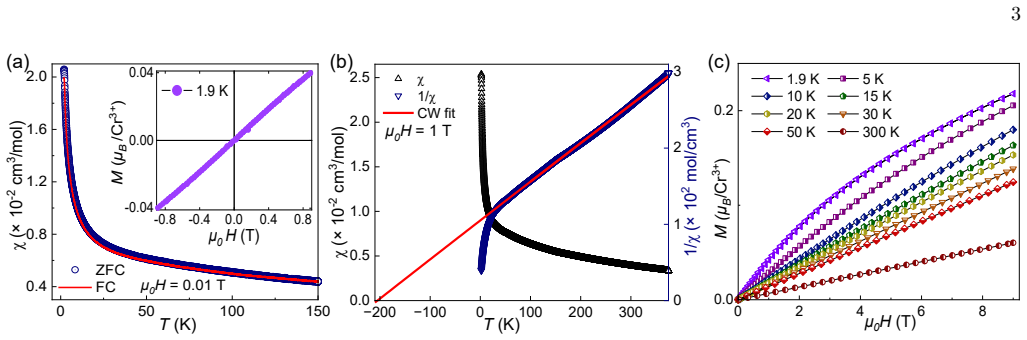
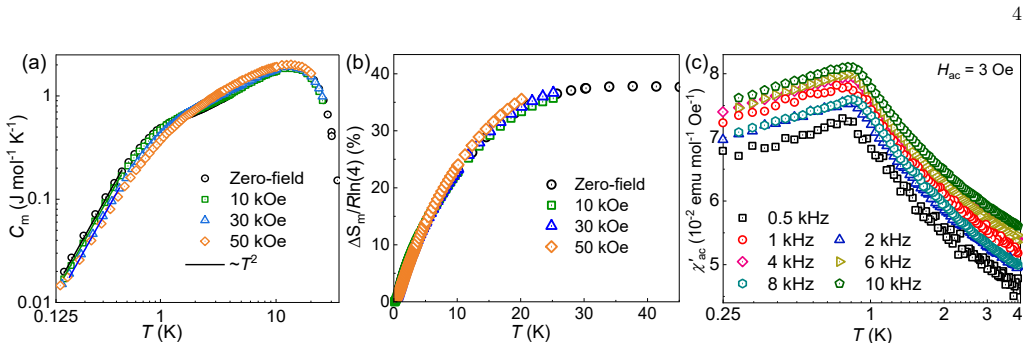
ZnCrGaO4 exhibits dominant antiferromagnetic exchange of order 55 K between Cr3+ moments on a frustrated pyrochlore-like lattice. No long-range magnetic ordering occurs down to 125 mK, and no spin freezing is detected by the lack of zero-field-cooled versus field-cooled bifurcation or frequency dependence in ac susceptibility. Broad maxima in specific heat and susceptibility signal short-range correlations within a dynamic state, while the low-temperature specific heat follows a power law, pointing to algebraic spin correlations and unconventional excitations.
What carries the argument
The pyrochlore lattice of Cr3+ ions subject to unavoidable atomic-site disorder, which preserves macroscopic degeneracy and suppresses conventional order while allowing power-law specific heat.
If this is right
- Strong antiferromagnetic interactions of roughly 55 K fail to produce order or freezing because of geometric frustration on the pyrochlore network.
- Frequency-independent ac susceptibility and lack of ZFC-FC splitting rule out conventional spin-glass freezing.
- Broad maxima in magnetic specific heat and ac susceptibility mark the onset of short-range dynamic correlations.
- Power-law specific heat below 1 K implies unconventional low-energy excitations tied to algebraic spin correlations.
- ZnCrGaO4 is positioned as a platform for studying highly frustrated three-dimensional quantum magnets with S greater than 1/2.
Where Pith is reading between the lines
- Cation disorder introduced by the synthesis route may help stabilize the dynamic state without driving the system into a glass.
- Other mixed-cation pyrochlores could be screened for similar power-law behavior at millikelvin temperatures.
- Inelastic neutron scattering on this compound could test for a continuum of excitations rather than sharp magnon modes.
- The result suggests that spin-liquid candidates need not be restricted to S equals 1/2 or two-dimensional lattices.
Load-bearing premise
The power-law specific heat and absence of ordering or freezing are assumed to arise from algebraic spin correlations of a spin liquid rather than from disorder-induced effects.
What would settle it
Observation of a peak or deviation from power-law behavior in specific heat, or the appearance of long-range order or frequency-dependent susceptibility below 125 mK, would falsify the spin-liquid interpretation.
Figures
read the original abstract
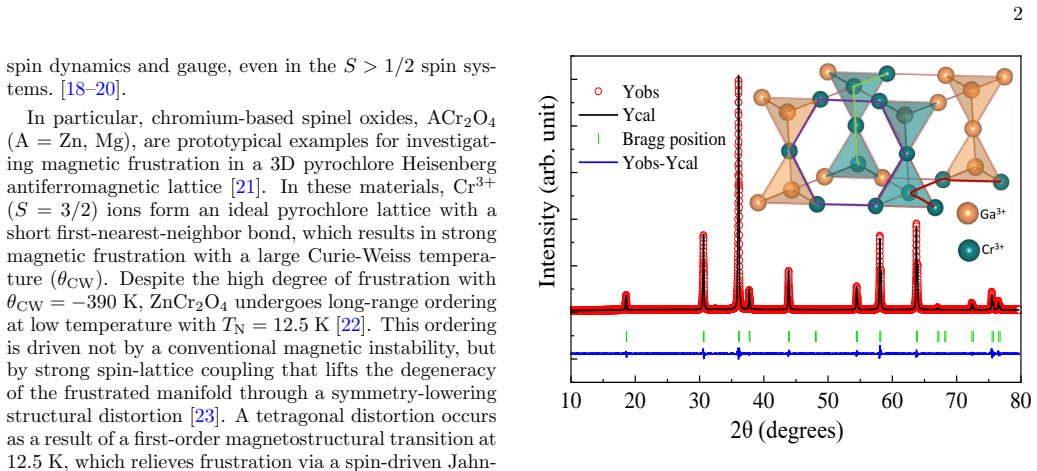
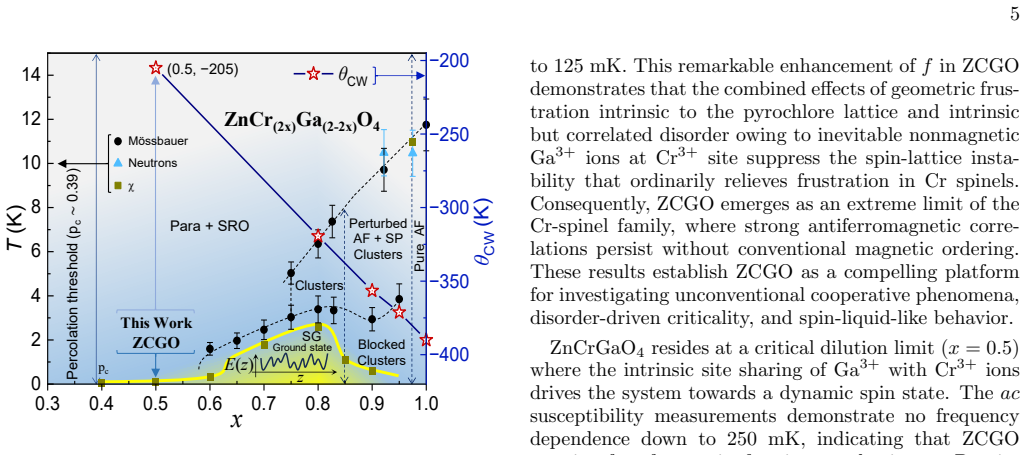
Frustrated pyrochlore lattices in transition-metal oxides provide an ideal platform for realizing exotic quantum states, including spin liquids with unconventional low-energy excitations arising from the macroscopic ground-state degeneracy of corner-sharing tetrahedral networks. Here, we report the synthesis and comprehensive characterization of ZnCrGaO$4$, a frustrated three-dimensional pyrochlore-like magnet in which intrinsic cation ordering gives rise to unavoidable atomic-site disorder. A Curie--Weiss analysis of the high-temperature magnetic susceptibility yields a large negative Curie--Weiss temperature, $\theta{\mathrm{CW}} \approx -205$ K, indicating dominant antiferromagnetic exchange interactions ($J/k_{\mathrm{B}} \sim 55$ K) between Cr$^{3+}$ ($S = 3/2$) moments. Despite the presence of strong antiferromagnetic interactions, no signature of long-range magnetic ordering is observed down to 125 mK, as evidenced by specific-heat and ac-susceptibility measurements. Furthermore, the absence of bifurcation between zero-field-cooled and field-cooled dc magnetic susceptibilities measured at 0.01 T indicates the absence of spin freezing, which is further supported by the frequency-independent ac susceptibility down to 250 mK. The presence of broad maxima in the magnetic specific heat and ac susceptibility at low temperatures suggests the development of short-range spin correlations within a dynamic magnetic state. In addition, the low-temperature specific heat follows a power-law behavior below 1 K, indicating the presence of unconventional low-energy excitations and algebraic spin correlations. These results provide compelling evidence for a dynamic correlated ground state in ZnCrGaO$_4$, establishing it as a promising platform for exploring highly frustrated $S > 1/2$ three-dimensional quantum magnets and potential spin-liquid behavior.
Editorial analysis
A structured set of objections, weighed in public.
Referee Report
Summary. The manuscript reports the synthesis of ZnCrGaO4, a pyrochlore-like antiferromagnet with intrinsic cation disorder, and presents magnetic susceptibility, specific-heat, and ac-susceptibility data showing strong antiferromagnetic interactions (θ_CW ≈ −205 K), no long-range order or spin freezing down to 125 mK, broad maxima at low T, and power-law specific heat below 1 K. These observations are interpreted as evidence for a dynamic correlated ground state with algebraic spin correlations consistent with spin-liquid behavior in a frustrated 3D S = 3/2 system.
Significance. If the spin-liquid interpretation can be substantiated against disorder-based alternatives, the work would be significant because it identifies a new platform for exploring highly frustrated three-dimensional magnets with S > 1/2, a regime where spin liquids remain rare. The synthesis and basic thermodynamic characterization are competently executed and the large frustration parameter is clearly established.
major comments (2)
- [Abstract] Abstract: the central claim that the power-law specific heat and absence of ordering indicate algebraic spin correlations of a spin liquid is presented without any quantitative modeling, fitting, or comparison that would exclude conventional mechanisms (random-bond Heisenberg, random-singlet regime, or Schottky tails from orphan spins) known to arise from the unavoidable cation disorder explicitly noted in the material.
- [Abstract] Abstract: the statement that the low-temperature specific heat “follows a power-law behavior below 1 K” provides neither the numerical value of the exponent, its uncertainty, the fitting range, nor raw data or error bars, rendering the claim impossible to evaluate quantitatively against alternative models.
minor comments (1)
- [Abstract] The formatting of the Curie–Weiss temperature (θ_CW) is inconsistent between the text and the LaTeX rendering in the abstract.
Simulated Author's Rebuttal
We thank the referee for the careful reading of our manuscript and the constructive comments. We address the two major comments on the abstract point by point below, indicating the changes we will implement in the revised version.
read point-by-point responses
-
Referee: [Abstract] Abstract: the central claim that the power-law specific heat and absence of ordering indicate algebraic spin correlations of a spin liquid is presented without any quantitative modeling, fitting, or comparison that would exclude conventional mechanisms (random-bond Heisenberg, random-singlet regime, or Schottky tails from orphan spins) known to arise from the unavoidable cation disorder explicitly noted in the material.
Authors: The abstract is a concise summary; the full manuscript presents the raw data, the large frustration parameter, frequency-independent ac susceptibility, and the temperature range over which the power law is observed. These features are inconsistent with simple Schottky tails (which would saturate) or typical random-singlet behavior (which often shows stronger frequency dependence). We will add a short discussion paragraph comparing the observed power-law regime and lack of freezing to the cited alternative mechanisms, while noting that a full microscopic model lies beyond the present experimental scope. The spin-liquid interpretation is offered as the most consistent reading of the data rather than a rigorously proven exclusion of all alternatives. revision: partial
-
Referee: [Abstract] Abstract: the statement that the low-temperature specific heat “follows a power-law behavior below 1 K” provides neither the numerical value of the exponent, its uncertainty, the fitting range, nor raw data or error bars, rendering the claim impossible to evaluate quantitatively against alternative models.
Authors: We agree that the abstract should be more quantitative. The exponent, its uncertainty, and the fitting range (together with the raw data and error bars) are reported in the main text and figures. We will revise the abstract to include the numerical value of the exponent, its uncertainty, and the fitting range. revision: yes
Circularity Check
No circularity: experimental observations with direct data interpretation
full rationale
This is a purely experimental paper reporting synthesis, magnetic susceptibility, specific-heat, and ac-susceptibility data on ZnCrGaO4. All load-bearing claims rest on measured quantities (Curie-Weiss temperature, absence of ordering or freezing down to 125 mK, power-law C(T) below 1 K, frequency-independent ac susceptibility). No equations, derivations, fitted parameters renamed as predictions, or self-citation chains appear in the text; the spin-liquid interpretation is stated as a reading of the data rather than the output of any self-referential reduction. The paper is therefore self-contained against external benchmarks with score 0.
Axiom & Free-Parameter Ledger
free parameters (1)
- Curie-Weiss temperature
axioms (1)
- standard math Curie-Weiss law applies to extract exchange strength from high-T susceptibility.
Reference graph
Works this paper leans on
-
[1]
P. W. Anderson, Resonating valence bonds: A new kind of insulator?, Materials Research Bulletin8, 153 (1973)
1973
-
[2]
Khatua, B
J. Khatua, B. Sana, A. Zorko, M. Gomilˇ sek, K. Sethu- pathi, M. R. Rao, M. Baenitz, B. Schmidt, and P. Khuntia, Experimental signatures of quantum and topological states in frustrated magnetism, Physics Re- ports1041, 1 (2023)
2023
-
[3]
Broholm, R
C. Broholm, R. J. Cava, S. Kivelson, D. Nocera, M. Nor- man, and T. Senthil, Quantum spin liquids, Science367, eaay0668 (2020)
2020
-
[4]
T. Arh, B. Sana, M. Pregelj, P. Khuntia, Z. Jagliˇ ci´ c, M. Le, P. Biswas, P. Manuel, L. Mangin-Thro, A. Ozarowski,et al., The Ising triangular-lattice antifer- romagnet neodymium heptatantalate as a quantum spin liquid candidate, Nature Materials21, 416 (2022)
2022
-
[5]
Khuntia, Novel magnetism and spin dynamics of strongly correlated electron systems: Microscopic in- sights, Journal of Magnetism and Magnetic Materials 489, 165435 (2019)
P. Khuntia, Novel magnetism and spin dynamics of strongly correlated electron systems: Microscopic in- sights, Journal of Magnetism and Magnetic Materials 489, 165435 (2019)
2019
-
[6]
Khatua, S
J. Khatua, S. Bhattacharya, Q. P. Ding, S. Vrtnik, A. M. Strydom, N. P. Butch, H. Luetkens, E. Kermarrec, M. S. R. Rao, A. Zorko, Y. Furukawa, and P. Khuntia, Spin liquid state in a rare-earth hyperkagome lattice, Phys. Rev. B106, 104404 (2022)
2022
-
[7]
Khatua, S
J. Khatua, S. Bhattacharya, A. M. Strydom, A. Zorko, J. S. Lord, A. Ozarowski, E. Kermarrec, and P. Khuntia, Magnetic properties and spin dynamics in the spin- orbit drivenJ eff = 1 2 triangular lattice antiferromagnet Ba6Yb2Ti4O17, Phys. Rev. B109, 024427 (2024)
2024
-
[8]
Kumar, P
R. Kumar, P. Khuntia, D. Sheptyakov, P. G. Freeman, H. M. Rønnow, B. Koteswararao, M. Baenitz, M. Jeong, and A. V. Mahajan, Sc 2Ga2CuO7: A possible quantum spin liquid near the percolation threshold, Phys. Rev. B 92, 180411(R) (2015)
2015
-
[9]
Khuntia, M
P. Khuntia, M. Vel´ azquez, Q. Barth´ elemy, F. Bert, E. Kermarrec, A. Legros, B. Bernu, L. Messio, A. Zorko, and P. Mendels, Gapless ground state in the archetypal quantum kagome antiferromagnet ZnCu 3(OH)6Cl2, Na- ture Physics16, 469 (2020)
2020
-
[10]
Castelnovo, R
C. Castelnovo, R. Moessner, and S. L. Sondhi, Magnetic monopoles in spin ice, Nature451, 42 (2008)
2008
-
[11]
Khuntia, F
P. Khuntia, F. Bert, P. Mendels, B. Koteswararao, A. V. Mahajan, M. Baenitz, F. C. Chou, C. Baines, A. Amato, and Y. Furukawa, Spin Liquid State in the 3D Frustrated Antiferromagnet PbCuTe2O6: NMR and Muon Spin Re- laxation Studies, Physical Review Letters116, 107203 (2016)
2016
-
[12]
Koteswararao, R
B. Koteswararao, R. Kumar, P. Khuntia, S. Bhowal, S. K. Panda, M. R. Rahman, A. V. Mahajan, I. Dasgupta, M. Baenitz, K. H. Kim, and F. C. Chou, Magnetic prop- erties and heat capacity of the three-dimensional frus- tratedS= 1 2 antiferromagnet PbCuTe2O6, Physical Re- view B90, 035141 (2014)
2014
-
[13]
Chillal, Y
S. Chillal, Y. Iqbal, H. O. Jeschke, J. A. Rodriguez- Rivera, R. Bewley, P. Manuel, D. Khalyavin, P. Steffens, R. Thomale, A. N. Islam,et al., Evidence for a three- dimensional quantum spin liquid in PbCuTe2O6, Nature Communications11, 2348 (2020)
2020
-
[14]
X. Hong, M. Gillig, A. R. N. Hanna, S. Chillal, A. T. M. N. Islam, B. Lake, B. B¨ uchner, and C. Hess, Spinon Heat Transport in the Three-Dimensional Quan- tum Magnet PbCuTe2O6, Phys. Rev. Lett.131, 256701 (2023)
2023
-
[15]
M. Gomilˇ sek, L. Mangin-Thro, T. Arh, S. Petit, B. Gre- nier, V. Simonet, M. Pregelj, A. Zorko, B. Koteswararao, B.-G. Jeon,et al., Quantum spin liquid on a 3d bi- partite lattice of spin trimers stabilized by enhanced effective anisotropy, arXiv preprint arXiv:2605.06752 10.48550/arXiv.2605.06752 (2026)
work page internal anchor Pith review Pith/arXiv arXiv doi:10.48550/arxiv.2605.06752 2026
-
[16]
Tsurkan, H.-A
V. Tsurkan, H.-A. K. Von Nidda, J. Deisenhofer, P. Lunkenheimer, and A. Loidl, On the complexity of spinels: Magnetic, electronic, and polar ground states, Physics Reports926, 1 (2021)
2021
-
[18]
P. W. Anderson, Ordering and Antiferromagnetism in Ferrites, Phys. Rev.102, 1008 (1956)
1956
-
[19]
Canals and C
B. Canals and C. Lacroix, Pyrochlore antiferromagnet: A three-dimensional quantum spin liquid, Physical Review Letters80, 2933 (1998)
1998
-
[20]
Iqbal, T
Y. Iqbal, T. M¨ uller, P. Ghosh, M. J. P. Gingras, H. O. Jeschke, S. Rachel, J. Reuther, and R. Thomale, Quan- tum and classical phases of the pyrochlore heisenberg model with competing interactions, Phys. Rev. X9, 011005 (2019)
2019
-
[21]
J. S. Gardner, M. J. P. Gingras, and J. E. Greedan, Mag- netic pyrochlore oxides, Rev. Mod. Phys.82, 53 (2010)
2010
-
[22]
S.-H. Lee, C. Broholm, T. H. Kim, W. Ratcliff, and S.- W. Cheong, Local Spin Resonance and Spin-Peierls-like Phase Transition in a Geometrically Frustrated Antifer- romagnet, Phys. Rev. Lett.84, 3718 (2000)
2000
-
[23]
Ji, S.-H
S. Ji, S.-H. Lee, C. Broholm, T. Y. Koo, W. Ratcliff, S.- W. Cheong, and P. Zschack, Spin-Lattice Order in Frus- trated ZnCr2O4, Phys. Rev. Lett.103, 037201 (2009)
2009
-
[24]
A. B. Sushkov, O. Tchernyshyov, W. R. II, S. W. Cheong, and H. D. Drew, Probing Spin Correlations with Phonons in the Strongly Frustrated Magnet ZnCr2O4, Phys. Rev. Lett.94, 137202 (2005)
2005
-
[25]
L. D. C. Jaubert, Y. Iqbal, and H. O. Jeschke, Spin- peierls transition in the frustrated spinels ZnCr 2O4 and MgCr2O4, Phys. Rev. Lett.134, 086702 (2025)
2025
-
[26]
Okamoto, G
Y. Okamoto, G. J. Nilsen, J. P. Attfield, and Z. Hiroi, Breathing Pyrochlore Lattice Realized inA-Site Ordered Spinel Oxides LiGaCr 4O8 and LiInCr 4O8, Physical Re- 7 view Letters110, 097203 (2013)
2013
-
[27]
S.-H. Lee, C. Broholm, W. Ratcliff, G. Gasparovic, Q. Huang, T. Kim, and S.-W. Cheong, Emergent excita- tions in a geometrically frustrated magnet, Nature418, 856 (2002)
2002
-
[28]
Tomiyasu, H
K. Tomiyasu, H. Suzuki, M. Toki, S. Itoh, M. Matsuura, N. Aso, and K. Yamada, Molecular Spin Resonance in the Geometrically Frustrated Magnet MgCr2O4 by Inelastic Neutron Scattering, Phys. Rev. Lett.101, 177401 (2008)
2008
-
[29]
Tomiyasu, T
K. Tomiyasu, T. Yokobori, Y. Kousaka, R. I. Bewley, T. Guidi, T. Watanabe, J. Akimitsu, and K. Yamada, Emergence of Highly Degenerate Excited States in the Frustrated Magnet MgCr 2O4, Phys. Rev. Lett.110, 077205 (2013)
2013
-
[30]
Z. He, Y. Gu, H. Wo, Y. Feng, D. Hu, Y. Hao, Y. Gu, H. C. Walker, D. T. Adroja, and J. Zhao, Neutron Scat- tering Studies of the Breathing Pyrochlore Antiferromag- net LiGaCr4O8, Phys. Rev. Lett.127, 147205 (2021)
2021
-
[31]
J. A. Paddison, H. Jacobsen, O. A. Petrenko, M. T. Fern´ andez-D´ ıaz, P. P. Deen, and A. L. Goodwin, Hid- den order in spin-liquid Gd 3Ga5O12, Science350, 179 (2015)
2015
-
[32]
D. A. Keen and A. L. Goodwin, The crystallography of correlated disorder, Nature521, 303 (2015)
2015
-
[33]
Osborn, D
R. Osborn, D. Pelc, M. J. Krogstad, S. Rosenkranz, and M. Greven, Diffuse scattering from correlated electron systems, Science Advances11, eadt7770 (2025)
2025
-
[34]
Plumb, H
K. Plumb, H. J. Changlani, A. Scheie, S. Zhang, J. Krizan, J. Rodriguez-Rivera, Y. Qiu, B. Winn, R. J. Cava, and C. L. Broholm, Continuum of quantum fluctu- ations in a three-dimensionalS= 1 Heisenberg magnet, Nature Physics15, 54 (2019)
2019
-
[35]
Fennell, M
T. Fennell, M. Harris, S. Calder, M. Ruminy, M. Boehm, P. Steffens, M.-H. Lem´ ee-Cailleau, O. Za- harko, A. Cervellino, and S. Bramwell, Multiple Coulomb phase in the fluoride pyrochlore CsNiCrF 6, Nature Physics15, 60 (2019)
2019
-
[36]
Hemmatzade, C
A. Hemmatzade, C. Balz, J. Ollivier, E. Lhotel, N. Colonna, A. d. S. Rufino, G. J. Nilsen, O. S. Fjellv˚ ag, M. Medarde, S. T. Bramwell, M. J. Harris, P. M. Derlet, and T. Fennell, Algebraic Loop Liquid in the Pyrochlore CsNiCrF6, Phys. Rev. Lett.136, 106701 (2026)
2026
-
[37]
See the supplemental material for additional experi- mental details, characterization, extended discusions, and supporting figures,Submitted as a part of this manuscript
-
[38]
Maayouf, H.-G
R. Maayouf, H.-G. Brokmeier, M. Fayek, and S. W¨ ohlert, X-ray and neutron powder diffraction studies of NiFeGaO4 and ZnFeGaO 4, Powder Diffraction8, 132 (1993)
1993
-
[39]
Verger, O
L. Verger, O. Dargaud, G. Rousse, E. Rozs´ alyi, A. Juhin, D. Cabaret, M. Cotte, P. Glatzel, and L. Cormier, Spec- troscopic properties of Cr 3+ in the spinel solid solution ZnAl2−xCrxO4, Physics and Chemistry of Minerals43, 33 (2016)
2016
-
[40]
Takagi and S
H. Takagi and S. Niitaka, Highly Frustrated Magnetism in Spinels, inIntroduction to Frustrated Magnetism: Materials, Experiments, Theory, edited by C. Lacroix, P. Mendels, and F. Mila (Springer Berlin Heidelberg, Berlin, Heidelberg, 2011) pp. 155–175
2011
-
[41]
Ji, S.-H
S. Ji, S.-H. Lee, C. Broholm, T. Y. Koo, W. Ratcliff, S.- W. Cheong, and P. Zschack, Spin-Lattice Order in Frus- trated ZnCr 2O4, Physical Review Letters103, 037201 (2009), publisher: American Physical Society
2009
-
[42]
Kittel and P
C. Kittel and P. McEuen,Introduction to Solid State Physics(Wiley, 2018)
2018
-
[43]
Kittel,Quantum Theory of Solids(Wiley, 1963)
C. Kittel,Quantum Theory of Solids(Wiley, 1963)
1963
-
[44]
Auerbach,Interacting Electrons and Quantum Mag- netism, Graduate Texts in Contemporary Physics (Springer New York, 2012)
A. Auerbach,Interacting Electrons and Quantum Mag- netism, Graduate Texts in Contemporary Physics (Springer New York, 2012)
2012
-
[45]
B. W. Southern and A. P. Young, Spin stiffness in frus- trated antiferromagnets, Phys. Rev. B48, 13170 (1993)
1993
-
[46]
B. W. Southern and A. P. Young, Spin stiffness in frus- trated antiferromagnets, Physical Review B48, 13170 (1993), publisher: American Physical Society
1993
-
[47]
M. F. Sykes and J. W. Essam, Critical percolation prob- abilities by series methods, Phys. Rev.133, A310 (1964)
1964
-
[48]
Keren, Y
A. Keren, Y. J. Uemura, G. Luke, P. Mendels, M. Mekata, and T. Asano, Magnetic dilution in the ge- ometrically frustrated SrCr9pGa12−9pO19 and the role of local dynamics: A muon spin relaxation study, Phys. Rev. Lett.84, 3450 (2000)
2000
-
[49]
Kirkpatrick, Percolation and conduction, Rev
S. Kirkpatrick, Percolation and conduction, Rev. Mod. Phys.45, 574 (1973)
1973
-
[50]
Stauffer and A
D. Stauffer and A. Aharony,Introduction To Percolation Theory: Second Edition, 2nd ed. (Taylor & Francis, Lon- don, 2018)
2018
-
[51]
Bastien, M
G. Bastien, M. Roslova, M. Haghighi, K. Mehlawat, J. Hunger, A. Isaeva, T. Doert, M. Vojta, B. B¨ uchner, and A. Wolter, Spin-glass state and reversed magnetic anisotropy induced by Cr doping in the Kitaev magnet α- RuCl3, Physical Review B99, 214410 (2019)
2019
-
[52]
Lester, S
C. Lester, S. Ramos, R. S. Perry, T. P. Croft, M. Laver, R. I. Bewley, T. Guidi, A. Hiess, A. Wildes, E. M. For- gan, and S. M. Hayden, Magnetic-field-controlled spin fluctuations and quantum criticality in Sr 3Ru2O7, Na- ture Communications12, 5798 (2021)
2021
-
[53]
Khatua, D
J. Khatua, D. Tay, T. Shiroka, M. Pregelj, K. Kargeti, S. K. Panda, G. B. G. Stenning, P. Manuel, M. D. Le, D. T. Adroja, and P. Khuntia, Spin-liquid-like spin dy- namics in the frustrated antiferromagnet tbbo 3, Phys. Rev. B113, 174406 (2026)
2026
-
[54]
Fiorani, S
D. Fiorani, S. Viticoli, J. Dormann, J. Tholence, J. Ham- mann, A. Murani, and J. Soubeyroux, Magnetic phase diagram of ZnCr 2xGa2−2xO4 spinels: an antiferromag- netic frustrated lattice, Journal of Physics C: Solid State Physics16, 3175 (1983)
1983
-
[55]
Saifi, J
A. Saifi, J. L. Dormann, D. Fiorani, P. Renaudin, and J. Jove, A Mossbauer study of the ZnCr 2xGa2−2xO4 spinel system: evidence of a regime of progressive freez- ing of magnetic clusters, Journal of Physics C: Solid State Physics21, 5295 (1988)
1988
-
[56]
S.-H. Lee, W. Ratcliff, Q. Huang, T. H. Kim, and S.-W. Cheong, N´ eel to spin-glass-like phase transition versus dilution in geometrically frustrated ZnCr 2−2xGa2xO4, Phys. Rev. B77, 014405 (2008)
2008
-
[57]
U. Jena, M. Barman, A. Pradhan, and P. Khuntia, Topological spin freezing in frustrated quan- tum materials, arXiv preprint arXiv:2605.06069 10.48550/arXiv.2605.06069 (2026)
work page internal anchor Pith review Pith/arXiv arXiv doi:10.48550/arxiv.2605.06069 2026
-
[58]
U. Jena, S. Kundu, S. Lee, Q. Faure, F. Damay, S. Rols, A. Berlie, S. Petit, K.-Y. Choi, and P. Khuntia, Spin liquid state in the three dimensional pyrochlore-like frus- trated magnet MgCrGaO 4, Phys. Rev. B113, L100404 (2026)
2026
discussion (0)
Sign in with ORCID, Apple, or X to comment. Anyone can read and Pith papers without signing in.