What Medicine Taught Us About Fairness and What It Missed: Lessons from Reconsidering Race-Specific Lung Function Reference Algorithms
Pith reviewed 2026-06-30 14:31 UTC · model grok-4.3
The pith
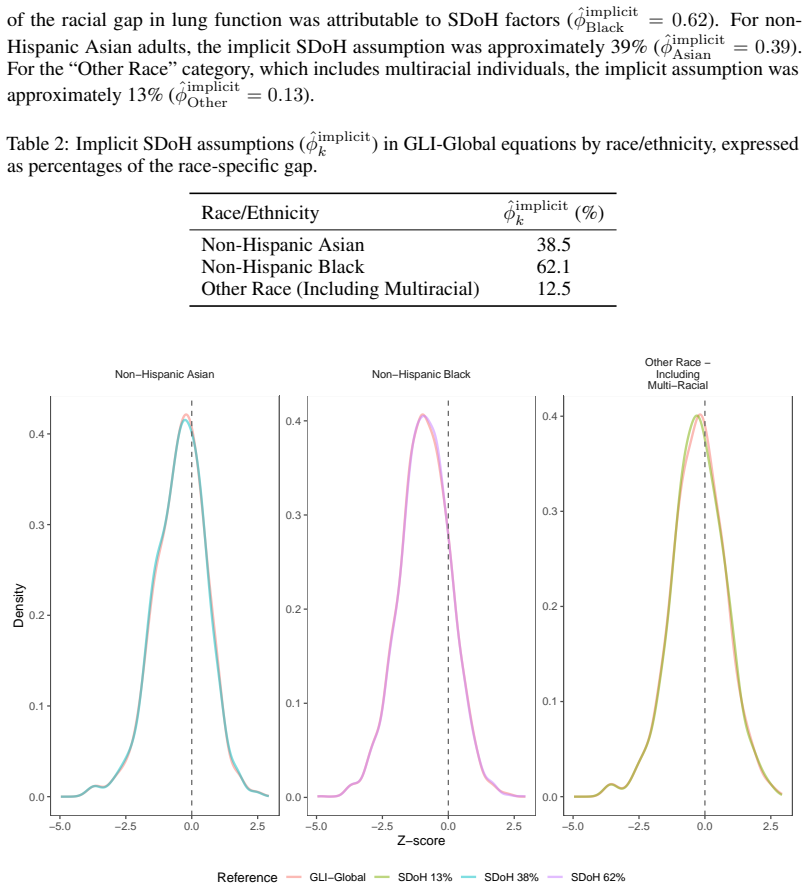
Race-averaged lung equations assume about 62% of Black-White FEV1 gap stems from exposures.
A machine-rendered reading of the paper's core claim, the machinery that carries it, and where it could break.
Core claim
Citation analysis and quantitative evaluation of the GLI-Global equations show that the move away from race-specific references encodes the assumption that approximately 62% of the Black-White gap in FEV1 is exposure-related, that clinical studies had already implemented a sufficiency-like fairness criterion before its formalization elsewhere, and that neglect of the impossibility theorem generated research inefficiencies.
What carries the argument
The GLI-Global race-averaged reference algorithm, whose equation structure and validation studies implicitly decompose racial differences in lung function into exposure-related and non-exposure components.
If this is right
- Deeper engagement between medical guideline developers and fairness researchers would reduce inefficiencies in algorithm validation.
- Clinical studies can operationalize sufficiency criteria in practice even before formal theory exists.
- Public discussion of how reference equations encode assumptions about social determinants can improve transparency in healthcare algorithms.
- Neglect of impossibility results in fairness leads to redundant or conflicting validation efforts in medicine.
Where Pith is reading between the lines
- Other race-adjusted medical reference values may embed similar unstated exposure assumptions that could be quantified the same way.
- Bringing impossibility theorems into clinical research design could shorten the time spent on incompatible fairness targets.
- The approach of decomposing observed group differences into exposure versus other components offers a template for equity audits in additional diagnostic algorithms.
Load-bearing premise
The 62% exposure-related share of the gap and the limited cross-citation between fields can be reliably recovered from citation patterns and the published GLI-Global equations without the raw data or full study protocols.
What would settle it
Re-analysis of the original spirometry datasets used for GLI-Global that produces a markedly different percentage for the exposure-attributable portion of the Black-White FEV1 gap, or a full citation sweep that reveals substantial cross-references between clinical guidelines and fairness literature.
Figures
read the original abstract
Since 2019, medical societies have reconsidered race-specific clinical equations often in parallel to and largely independent from algorithmic fairness research. Focusing on lung function reference algorithms that affect medical care, insurance, and employment for hundreds of millions globally, we analyze the transition from race-specific GLI-2012 to race-averaged GLI-Global through a fairness lens. Drawing on historical context, citation analysis, and quantitative evaluation, we show (i) limited cross-citation between FAccT and clinical guideline revision efforts; (ii) that GLI-Global implicitly encodes assumptions about social determinants of health, behaving as if ~62% of the Black-White gap in FEV1 is exposure-related; and (iii) clinical validation studies operationalized a sufficiency-like fairness criterion long before its formalization in fairness literature, while neglecting foundational results such as the impossibility theorem has led to inefficiencies in clinical research. Overall, our analysis highlights the value of deeper, mutually beneficial engagement between medical and fairness communities and the public to accelerate progress toward equitable healthcare algorithms.
Editorial analysis
A structured set of objections, weighed in public.
Referee Report
Summary. The manuscript analyzes the shift from race-specific GLI-2012 to race-averaged GLI-Global lung function reference equations through an algorithmic fairness lens. It reports (i) limited cross-citation between FAccT and medical guideline efforts, (ii) that GLI-Global implicitly encodes assumptions about social determinants by behaving as if ~62% of the Black-White FEV1 gap is exposure-related, and (iii) that clinical validation studies applied a sufficiency-like fairness criterion before its formalization in the fairness literature, with resulting inefficiencies from neglect of the impossibility theorem.
Significance. If the quantitative interpretation of the GLI-Global equations holds and the citation patterns are robust, the work illustrates concrete benefits of bidirectional engagement between medical algorithm developers and fairness researchers, including earlier incorporation of impossibility results into validation study design.
major comments (2)
- [Abstract; quantitative evaluation section] Abstract and the quantitative evaluation section: the central claim that GLI-Global 'behaves as if ~62% of the Black-White gap in FEV1 is exposure-related' is extracted from the structure of the published race-averaged coefficients. The manuscript must supply the explicit arithmetic steps (e.g., whether the percentage arises from averaging predicted values, z-scores, or regression coefficients) and confirm it is not an arithmetic consequence of the averaging procedure itself; without this, the interpretation that the model encodes assumptions about social determinants of health does not follow and remains load-bearing for claims (ii) and (iii).
- [clinical validation studies discussion] Section discussing clinical validation studies: the assertion that these studies 'operationalized a sufficiency-like fairness criterion long before its formalization' requires concrete mapping from the cited study protocols to the sufficiency definition (e.g., which performance metric was equalized across groups and how counterfactual exposure was handled), together with explicit discussion of how the impossibility theorem would have altered study design.
minor comments (2)
- [citation analysis subsection] The citation-analysis method (search terms, time window, database) is described only at high level; a supplementary table listing the exact query strings and the resulting paper counts would improve reproducibility.
- [quantitative evaluation section] Notation for FEV1 gaps and exposure-related fractions should be introduced with a single equation early in the quantitative section rather than inline in multiple paragraphs.
Simulated Author's Rebuttal
We thank the referee for these constructive comments, which highlight opportunities to improve the transparency of our quantitative claims and the precision of our fairness mappings. We address each major comment below and will revise the manuscript to incorporate the requested clarifications and details.
read point-by-point responses
-
Referee: [Abstract; quantitative evaluation section] Abstract and the quantitative evaluation section: the central claim that GLI-Global 'behaves as if ~62% of the Black-White gap in FEV1 is exposure-related' is extracted from the structure of the published race-averaged coefficients. The manuscript must supply the explicit arithmetic steps (e.g., whether the percentage arises from averaging predicted values, z-scores, or regression coefficients) and confirm it is not an arithmetic consequence of the averaging procedure itself; without this, the interpretation that the model encodes assumptions about social determinants of health does not follow and remains load-bearing for claims (ii) and (iii).
Authors: We will add a dedicated subsection to the quantitative evaluation section that supplies the explicit arithmetic steps. The ~62% figure is obtained by comparing the race-specific coefficients in GLI-2012 against the single set of coefficients in GLI-Global, then solving for the implied fraction of the observed Black-White FEV1 difference that must be attributed to exposure (rather than ancestry) for the averaged equation to be consistent with the data patterns used in its construction. This calculation uses the regression coefficients directly (not merely averaged predicted values or z-scores) and is not an automatic consequence of the averaging procedure; the specific coefficient values chosen in GLI-Global produce this attribution. We will present the full derivation with intermediate equations and numerical checks using the published coefficients to support the interpretation regarding social determinants. revision: yes
-
Referee: [clinical validation studies discussion] Section discussing clinical validation studies: the assertion that these studies 'operationalized a sufficiency-like fairness criterion long before its formalization' requires concrete mapping from the cited study protocols to the sufficiency definition (e.g., which performance metric was equalized across groups and how counterfactual exposure was handled), together with explicit discussion of how the impossibility theorem would have altered study design.
Authors: We will expand the clinical validation studies discussion with a concrete mapping. For each cited study we will specify the performance metric equalized across groups (typically sensitivity or the rate of misclassification for a fixed threshold, aligning with sufficiency via equal positive predictive value or calibration), note that counterfactual exposure was handled implicitly by not adjusting for social or environmental factors, and contrast this directly with the formal sufficiency definition. We will also add an explicit discussion of the impossibility theorem, explaining that awareness of it would have encouraged prioritizing a single primary metric (or using Pareto-optimal trade-offs) rather than attempting to equalize multiple metrics simultaneously, thereby avoiding the documented inefficiencies in study design and sample-size requirements. revision: yes
Circularity Check
No significant circularity; claims rest on external model structure and citation patterns.
full rationale
The paper's central quantitative claim (ii) evaluates the published GLI-Global equations by computing a derived percentage from their race-averaged coefficients; this is presented as an interpretive observation about model behavior rather than a self-derived prediction or fitted parameter renamed as output. No load-bearing step reduces by construction to the paper's own inputs, no self-citation chain justifies a uniqueness result, and no ansatz is smuggled via prior work. The analysis draws on historical context, citation counts, and direct inspection of existing clinical equations, remaining self-contained against external benchmarks.
Axiom & Free-Parameter Ledger
free parameters (1)
- ~62% exposure-related Black-White FEV1 gap
axioms (1)
- domain assumption Limited cross-citation between FAccT and clinical guideline revision efforts can be established via citation analysis
Reference graph
Works this paper leans on
-
[1]
A. Adibi, C. Carlsten, E. P. Brigham, D. D. Sin, P. Loewen, and M. Sadatsafavi. Social Determinants of Health and Racial Disparities in Lung Function: Findings from NHANES 2007-2012.American Journal of Respiratory and Critical Care Medicine, May 2025. ISSN 1535-4970. doi: 10.1164/rccm.202501-0280OC
-
[3]
Adibi, K
A. Adibi, K. X. Le, E. Pierson, J. A. Diao, N. Esfandiari, C. Carlsten, and M. Sadatsafavi. Multinational public opinion on race, ethnicity, and algorithmic reform in medicine.medRxiv,
-
[4]
URL https://www.medrxiv.org/content/ early/2026/05/21/2026.05.15.26352687
doi: 10.64898/2026.05.15.26352687. URL https://www.medrxiv.org/content/ early/2026/05/21/2026.05.15.26352687
-
[5]
J. Adleberg, A. Wardeh, F. X. Doo, B. Marinelli, T. S. Cook, D. S. Mendelson, and A. Kagen. Predicting Patient Demographics From Chest Radiographs With Deep Learning.Journal of the American College of Radiology, 19(10):1151–1161, Oct. 2022. ISSN 1546-1440. doi: 10.1016/j.jacr.2022.06.008. URL https://www.sciencedirect.com/science/article/ pii/S1546144022005440
-
[6]
Angwin, J
J. Angwin, J. Larson, S. Mattu, and L. Kirchner. Machine Bias.ProP- ublica, May 2016. URL https://www.propublica.org/article/ machine-bias-risk-assessments-in-criminal-sentencing
2016
-
[7]
Angwin, J
J. Angwin, J. Larson, S. Mattu, and L. Kirchner. Machine Bias. InEthics of Data and Analytics, pages 254–264. Auerbach Publications, 2022. Num Pages: 11
2022
-
[8]
Barocas, M
S. Barocas, M. Hardt, and A. Narayanan.Fairness and Machine Learning: Limitations and Opportunities. MIT Press, Dec. 2023. ISBN 978-0-262-37652-5. Google-Books-ID: HuGwEAAAQBAJ
2023
-
[9]
A. Baugh, N. R. Bhakta, C. Leduc, Todd, P. G. Woodruff, and N. Thakur. Understanding fire- fighter qualification under race-neutral spirometry & evolving nfpa guidelines.American Journal of Respiratory and Critical Care Medicine, page aamag164, 04 2026. ISSN 1073-449X. doi: 10.1093/ajrccm/aamag164. URLhttps://doi.org/10.1093/ajrccm/aamag164
-
[10]
N. R. Bhakta and J. R. Balmes. A Good Fit versus One Size for All: Alternatives to Race in the Interpretation of Pulmonary Function Tests.American Journal of Respiratory and Critical Care Medicine, 205(6):616–618, Mar. 2022. ISSN 1073-449X. doi: 10.1164/rccm.202201-0076ED. URL https://www.atsjournals.org/doi/10.1164/rccm.202201-0076ED. Publisher: American...
-
[11]
N. R. Bhakta, C. Bime, D. A. Kaminsky, M. C. McCormack, N. Thakur, S. Stanojevic, A. D. Baugh, L. Braun, S. Lovinsky-Desir, R. Adamson, J. Witonsky, R. A. Wise, S. D. Levy, R. Brown, E. Forno, R. T. Cohen, M. Johnson, J. Balmes, Y . Mageto, C. T. Lee, R. Masekela, D. J. Weiner, C. G. Irvin, E. R. Swenson, M. Rosenfeld, R. M. Schwartzstein, A. Agrawal, E. ...
-
[12]
S. N. Bonner, K. Lagisetty, R. M. Reddy, Y . Engeda, J. J. Griggs, and T. S. Valley. Clinical Implications of Removing Race-Corrected Pulmonary Function Tests for African American Patients Requiring Surgery for Lung Cancer.JAMA Surgery, 158(10):1061–1068, Oct. 2023. ISSN 2168-6254. doi: 10.1001/jamasurg.2023.3239. URL https://doi.org/10.1001/ jamasurg.202...
-
[13]
J. Bourbeau, M. Bhutani, P. Hernandez, S. D. Aaron, M.-F. Beauchesne, S. B. Kermelly, A. D’Urzo, A. Lal, F. Maltais, J. D. Marciniuk, S. Mulpuru, E. Penz, D. D. Sin, A. Van Dam, J. Wald, B. L. Walker, and D. D. Marciniuk. 2023 Canadian Thoracic Society Guideline on Pharmacotherapy in Patients with Stable COPD.Canadian Journal of Respiratory, Critical Care...
-
[14]
C. Bowerman, N. R. Bhakta, D. Brazzale, B. R. Cooper, J. Cooper, L. Gochicoa-Rangel, J. Haynes, D. A. Kaminsky, L. T. T. Lan, R. Masekela, M. C. McCormack, I. Steenbruggen, and S. Stanojevic. A Race-neutral Approach to the Interpretation of Lung Function Measurements. American Journal of Respiratory and Critical Care Medicine, 207(6):768–774, Mar. 2023. I...
-
[15]
C. Bowerman, N. R. Bhakta, D. Brazzale, B. G. Cooper, J. Cooper, L. Gochicoa-Rangel, J. Haynes, D. A. Kaminsky, L. T. T. Lan, R. Masekela, M. C. McCormack, I. Steenbruggen, and S. Stanojevic. Reply to: The Race Arithmetic of the Global Lung Function Initiative Global Reference Equations.American Journal of Respiratory and Critical Care Medicine, 209(1):11...
-
[16]
Braun.Breathing Race into the Machine: The Surprising Career of the Spirometer from Plantation to Genetics
L. Braun.Breathing Race into the Machine: The Surprising Career of the Spirometer from Plantation to Genetics. U of Minnesota Press, Feb. 2014. ISBN 978-1-4529-4100-4. Google- Books-ID: My90DwAAQBAJ
2014
-
[17]
L. Braun and R. Grisson. Race, Lung Function, and the Historical Context of Prediction Equations.JAMA Network Open, 6(6):e2316128, June 2023. ISSN 2574-3805. doi: 10. 1001/jamanetworkopen.2023.16128. URL https://doi.org/10.1001/jamanetworkopen. 2023.16128
-
[18]
J. H. Brems, A. Balasubramanian, K. Ferryman, R. Wharton, M. N. Eakin, and M. C. Mc- Cormack. Current practices and preferences regarding race and spirometry interpretation. CHEST Pulmonary, page 100239, 02 2026. doi: 10.1016/j.chpulm.2026.100239. URL http://dx.doi.org/10.1016/j.chpulm.2026.100239
-
[19]
S.-A. M. Burnett-Bowie, N. C. Wright, E. W. Yu, L. Langsetmo, G. M. H. Yearwood, C. J. Crandall, W. D. Leslie, and J. A. Cauley. The American Society for Bone and Mineral Research Task Force on clinical algorithms for fracture risk report.Journal of Bone and Mineral Research, 39(5):517–530, May 2024. ISSN 0884-0431. doi: 10.1093/jbmr/zjae048. URL https://...
-
[20]
P. Burney and R. Hooper. The use of ethnically specific norms for ventilatory function in African-American and white populations.International Journal of Epidemiology, 41(3):782– 790, June 2012. ISSN 0300-5771. doi: 10.1093/ije/dys011. URL https://doi.org/10. 1093/ije/dys011
-
[21]
P. Burney and R. Hooper. Lung function, genetics and ethnicity.European Respiratory Journal, 43(2):340–342, Jan. 2014. ISSN 0903-1936, 1399-3003. doi: 10.1183/09031936.00179313. URL https://publications.ersnet.org/content/erj/43/2/340. Publisher: Euro- pean Respiratory Society Section: Editorials
-
[22]
M. P. Cary, A. Zink, S. Wei, A. Olson, M. Yan, R. Senior, S. Bessias, K. Gadhoumi, G. Jean- Pierre, D. Wang, L. S. Ledbetter, N. J. Economou-Zavlanos, Z. Obermeyer, and M. J. Pencina. Mitigating Racial And Ethnic Bias And Advancing Health Equity In Clinical Algorithms: A Scoping Review.Health Affairs, 42(10):1359–1368, Oct. 2023. ISSN 0278-2715. doi: 10. ...
-
[23]
National Health and Nutrition Examination Survey Examination Protocol 2007-2012
Centers for Disease Control and Prevention (CDC) and National Center for Health Statis- tics (NCHS). National Health and Nutrition Examination Survey Examination Protocol 2007-2012. URL https://wwwn.cdc.gov/nchs/nhanes/continuousnhanes/manuals. aspx?BeginYear=2007
2007
-
[24]
A. Chouldechova. Fair Prediction with Disparate Impact: A Study of Bias in Recidivism Predic- tion Instruments.Big Data, 5(2):153–163, June 2017. ISSN 2167-6461. doi: 10.1089/big.2016
-
[25]
Publisher: Mary Ann Liebert, Inc., publishers
URL https://www.liebertpub.com/doi/10.1089/big.2016.0047. Publisher: Mary Ann Liebert, Inc., publishers
-
[26]
Together to Catalyze Change for Racial Equity in Clini- cal Algorithms, June 2024
Council of Medical Specialty Societies. Together to Catalyze Change for Racial Equity in Clini- cal Algorithms, June 2024. URL https://encodingequity.org/ttcc-key-learnings/
2024
-
[27]
Darwin.The Descent of Man, and Selection in Relation to Sex
C. Darwin.The Descent of Man, and Selection in Relation to Sex. Princeton University Press,
-
[28]
Google-Books-ID: 5sLSLKG5wZ4C
ISBN 978-0-691-02369-4. Google-Books-ID: 5sLSLKG5wZ4C
-
[29]
C. Delgado, M. Baweja, N. R. Burrows, D. C. Crews, N. D. Eneanya, C. A. Gadegbeku, L. A. Inker, M. L. Mendu, W. G. Miller, M. M. Moxey-Mims, G. V . Roberts, W. L. St Peter, C. Warfield, and N. R. Powe. Reassessing the Inclusion of Race in Diagnosing Kidney Diseases: An Interim Report From the NKF-ASN Task Force.American journal of kidney diseases : the of...
-
[30]
Delgado, M
C. Delgado, M. Baweja, D. C. Crews, N. D. Eneanya, C. A. Gadegbeku, L. A. Inker, M. L. Mendu, W. G. Miller, M. M. Moxey-Mims, G. V . Roberts, W. L. S. Peter, C. Warfield, and N. R. Powe. A Unifying Approach for GFR Estimation: Recommendations of the NKF-ASN Task Force on Reassessing the Inclusion of Race in Diagnosing Kidney Disease.American Journal of Ki...
2022
-
[31]
J. A. Diao, Y . He, R. Khazanchi, M. J. Nguemeni Tiako, Witonsky Jonathan I., Pierson Emma, Rajpurkar Pranav, Elhawary Jennifer R., Melas-Kyriazi Luke, Yen Albert, Mar- tin Alicia R., Levy Sean, Patel Chirag J., Farhat Maha, Borrell Luisa N., Cho Michael H., Silverman Edwin K., Burchard Esteban G., and Manrai Arjun K. Implications of Race Adjustment in Lu...
-
[32]
J. A. Diao, R. Movva, L. Cheng, K. Kadoma, A. Shah, N. R. Powe, K. Ferryman, A. K. Manrai, and E. Pierson. Public Opinion on Use of Race in Clinical Algorithms.JAMA Internal Medicine, Dec. 2025. ISSN 2168-6106. doi: 10.1001/jamainternmed.2025.6929. URL https://doi.org/10.1001/jamainternmed.2025.6929
-
[33]
G. Duffy, S. L. Clarke, M. Christensen, B. He, N. Yuan, S. Cheng, and D. Ouyang. Confounders mediate AI prediction of demographics in medical imaging.npj Digital Medicine, 5(1):188, Dec. 2022. ISSN 2398-6352. doi: 10.1038/s41746-022-00720-8. URL https://www.nature. com/articles/s41746-022-00720-8. Publisher: Nature Publishing Group
-
[34]
M. Duong, S. Islam, S. Rangarajan, K. Teo, P. M. O’Byrne, H. J. Schünemann, E. Igumbor, J. Chifamba, L. Liu, W. Li, T. Ismail, K. Shankar, M. Shahid, K. Vijayakumar, R. Yusuf, K. Zatonska, A. Oguz, A. Rosengren, H. Heidari, W. Almahmeed, R. Diaz, G. Oliveira, P. Lopez- Jaramillo, P. Seron, K. Killian, S. Yusuf, and PURE-BREATH Study Investigators. Global ...
-
[35]
M. Ekström and D. Mannino. Race-specific reference values and lung function impairment, breathlessness and prognosis: Analysis of NHANES 2007–2012.Respiratory Research, 23 (1):271, Oct. 2022. ISSN 1465-993X. doi: 10.1186/s12931-022-02194-4. URL https: //doi.org/10.1186/s12931-022-02194-4. 14
-
[36]
A. Elmaleh-Sachs, P. Balte, E. C. Oelsner, N. B. Allen, A. Baugh, A. G. Bertoni, J. L. Hankinson, J. Pankow, W. S. Post, J. E. Schwartz, B. M. Smith, K. Watson, and R. G. Barr. Race/Ethnicity, Spirometry Reference Equations, and Prediction of Incident Clini- cal Events: The Multi-Ethnic Study of Atherosclerosis (MESA) Lung Study.American Journal of Respir...
-
[37]
A. W. Gaffney, D. McCormick, S. Woolhandler, D. C. Christiani, and D. U. Himmelstein. Prog- nostic implications of differences in forced vital capacity in black and white US adults: Findings from NHANES III with long-term mortality follow-up.eClinicalMedicine, 39, Sept. 2021. ISSN 2589-5370. doi: 10.1016/j.eclinm.2021.101073. URL https://www.thelancet.com...
-
[38]
A. J. Ghio, R. O. Crapo, and C. G. Elliott. Reference Equations Used to Predict Pulmonary Function: Survey at Institutions with Respiratory Disease Training Programs in the United States and Canada.CHEST, 97(2):400–403, Feb. 1990. ISSN 0012-3692. doi: 10.1378/chest.97.2.400. URL https://journal.chestnet.org/article/S0012-3692(15)40678-6/abstract. Publishe...
-
[39]
J. W. Gichoya, I. Banerjee, A. R. Bhimireddy, J. L. Burns, L. A. Celi, L.-C. Chen, R. Cor- rea, N. Dullerud, M. Ghassemi, S.-C. Huang, P.-C. Kuo, M. P. Lungren, L. J. Palmer, B. J. Price, S. Purkayastha, A. T. Pyrros, L. Oakden-Rayner, C. Okechukwu, L. Seyyed-Kalantari, H. Trivedi, R. Wang, Z. Zaiman, and H. Zhang. AI recognition of patient race in medica...
-
[40]
Global Strategy for Prevention, di- agnosis and Management of COPD: 2025 report
Global Initiative for Chronic Obstructive Lung Disease. Global Strategy for Prevention, di- agnosis and Management of COPD: 2025 report. Technical report, Global Strategy for the Diagnosis, Management, and Prevention of COPD, 2025. URL https://goldcopd.org/ 2025-gold-report/
2025
-
[41]
B. A. Gould.Investigations in the Military and Anthropological Statistics of American Soldiers. Published for the U. S. Sanitary Commission, by Hurd and Houghton; Riverside Press, New York; Cambridge, 1869. URL https://link.gale.com/apps/doc/U0113046142/MOME? sid=summon&xid=50df57b0&pg=1
-
[42]
J. L. Hankinson, J. R. Odencrantz, and K. B. Fedan. Spirometric Reference Values from a Sample of the General U.S. Population.American Journal of Respiratory and Critical Care Medicine, 159(1):179–187, Jan. 1999. ISSN 1073-449X. doi: 10.1164/ajrccm.159.1.9712108. URLhttps://www.atsjournals.org/doi/10.1164/ajrccm.159.1.9712108
-
[43]
J. Hutchinson. On the capacity of the lungs, and on the respiratory functions, with a view of establishing a precise and easy method of detecting disease by the spirometer.Medico- chirurgical transactions, 29, 1846. ISSN 0959-5287. doi: 10.1177/095952874602900113. URL https://pubmed.ncbi.nlm.nih.gov/20895846/. Publisher: Med Chir Trans
-
[44]
S. Jaime and C. Kern. Ethnic Classifications in Algorithmic Fairness: Concepts, Measures and Implications in Practice. InProceedings of the 2024 ACM Conference on Fairness, Accountabil- ity, and Transparency, FAccT ’24, pages 237–253, New York, NY , USA, June 2024. Association for Computing Machinery. ISBN 979-8-4007-0450-5. doi: 10.1145/3630106.3658902. ...
-
[45]
A. Jain, J. R. Brooks, C. C. Alford, C. S. Chang, N. M. Mueller, C. A. Umscheid, and A. S. Bierman. Awareness of Racial and Ethnic Bias and Potential Solutions to Address Bias With Use of Health Care Algorithms.JAMA Health Forum, 4(6):e231197, June 2023. ISSN 2689-0186. doi: 10.1001/jamahealthforum.2023.1197. URL https://doi.org/10.1001/ jamahealthforum.2...
-
[46]
Jefferson.Notes on the State of Virginia: An Annotated Edition
T. Jefferson.Notes on the State of Virginia: An Annotated Edition. Yale University Press, June 2022. ISBN 978-0-300-26280-3. doi: 10.12987/9780300262803. URL https://www. degruyter.com/document/doi/10.12987/9780300262803/html
-
[47]
D. W. Jones, K. C. Ferdinand, S. J. Taler, H. M. Johnson, D. Shimbo, M. Abdalla, M. M. Altieri, N. Bansal, N. A. Bello, A. P. Bress, J. Carter, J. B. Cohen, K. J. Collins, Y . Commodore-Mensah, L. L. Davis, B. Egan, S. S. Khan, D. M. Lloyd-Jones, B. M. Melnyk, E. A. Mistry, M. O. Ogunniyi, S. L. Schott, S. C. Smith, A. W. Tal- bot, W. V ongpatanasin, K. E...
-
[48]
J. A. Kanis, N. C. Harvey, M. Lorentzon, E. Liu, M. Schini, B. Abrahamsen, J. D. Adachi, M. Alokail, F. Borgstrom, O. Bruyère, J. J. Carey, P. Clark, C. Cooper, E. M. Curtis, E. M. Dennison, M. Díaz-Curiel, H. P. Dimai, D. Grigorie, M. Hiligsmann, P. Khashayar, W. Lems, E. M. Lewiecki, R. S. Lorenc, A. Papaioannou, J.-Y . Reginster, R. Rizzoli, E. Shiroma...
-
[49]
S. S. Khan, J. Coresh, M. J. Pencina, C. E. Ndumele, J. Rangaswami, S. L. Chow, L. P. Palaniappan, L. S. Sperling, S. S. Virani, J. E. Ho, I. J. Neeland, K. R. Tuttle, R. Raj- gopal Singh, M. S. Elkind, D. M. Lloyd-Jones, and on behalf of the American Heart As- sociation. Novel Prediction Equations for Absolute Risk Assessment of Total Cardiovascu- lar Di...
-
[50]
S. S. Khan, K. Matsushita, Y . Sang, S. H. Ballew, M. E. Grams, A. Surapaneni, M. J. Blaha, A. P. Carson, A. R. Chang, E. Ciemins, A. S. Go, O. M. Gutierrez, S.-J. Hwang, S. K. Jassal, C. P. Kovesdy, D. M. Lloyd-Jones, M. G. Shlipak, L. P. Palaniappan, L. Sperling, S. S. Virani, K. Tuttle, I. J. Neeland, S. L. Chow, J. Rangaswami, M. J. Pencina, C. E. Ndu...
-
[51]
Khazanchi and M
R. Khazanchi and M. Morse. NYC Coalition to End Racism in Clinical Algorithms (CERCA) Inaugural Report, Sept. 2022. URLhttps://papers.ssrn.com/abstract=4412122
2022
-
[52]
R. Khazanchi, S. Stanojevic, S. E. Hines, and N. R. Bhakta. Reform and Remedy for Imprecision and Inequity — Ending the Race-Based Evaluation of Occupational Pul- monary Impairment.New England Journal of Medicine, 393(5):508–514, July 2025. ISSN 0028-4793. doi: 10.1056/NEJMms2416661. URL https://www.nejm.org/ doi/full/10.1056/NEJMms2416661. Publisher: Mas...
-
[53]
Inherent Trade-Offs in the Fair Determination of Risk Scores
J. Kleinberg, S. Mullainathan, and M. Raghavan. Inherent Trade-Offs in the Fair Determination of Risk Scores, Nov. 2016. URL http://arxiv.org/abs/1609.05807. arXiv:1609.05807 [cs, stat]
work page internal anchor Pith review Pith/arXiv arXiv 2016
-
[54]
P. Lopez. Grobid.https://github.com/kermitt2/grobid, 2008–2025. 16
2008
-
[55]
T. E. MacGillivray. Impact of Healthcare Algorithms on Racial and Ethnic Disparities in Health and Healthcare, Mar. 2023. URL https://www.sts.org/sites/default/files/ Advocacy/2023-03-08%20AHRQ%20Healthcare%20Algorithms%20Final.pdf
2023
-
[56]
M. C. McCormack, A. Balasubramanian, E. C. Matsui, R. D. Peng, R. A. Wise, and C. A. Keet. Race, Lung Function, and Long-Term Mortality in the National Health and Nutrition Examination Survey III.American Journal of Respiratory and Critical Care Medicine, 205(6): 723–724, Mar. 2022. ISSN 1073-449X. doi: 10.1164/rccm.202104-0822LE. URL https:// www.atsjour...
-
[57]
J. Mickel. Racial/Ethnic Categories in AI and Algorithmic Fairness: Why They Matter and What They Represent. InProceedings of the 2024 ACM Conference on Fairness, Accountability, and Transparency, FAccT ’24, pages 2484–2494, New York, NY , USA, June 2024. Association for Computing Machinery. ISBN 979-8-4007-0450-5. doi: 10.1145/3630106.3659050. URL https:...
-
[58]
National Academies Press, Washington, D.C., 2024
National Academies of Sciences, Engineering, and Medicine.Rethinking Race and Ethnicity in Biomedical Research. National Academies Press, Washington, D.C., 2024. ISBN 978-0-309- 72463-0. doi: 10.17226/27913. URL https://nap.nationalacademies.org/catalog/ 27913. Pages: 27913
-
[59]
N. T. Nkinsi and B. A. Young. How the University of Washington Implemented a Change in eGFR Reporting.Kidney360, 3(3):557–560, Jan. 2022. ISSN 2641-7650. doi: 10.34067/KID. 0006522021. URLhttps://www.ncbi.nlm.nih.gov/pmc/articles/PMC9034824/
-
[60]
Z. Obermeyer, B. Powers, C. V ogeli, and S. Mullainathan. Dissecting racial bias in an algorithm used to manage the health of populations.Science, 366(6464):447–453, Oct. 2019. ISSN 1095-9203. doi: 10.1126/science.aax2342
-
[61]
29 CFR 1910.1043 – Cotton dust., Jan
Occupational Safety and Health Administration and Department of Labor. 29 CFR 1910.1043 – Cotton dust., Jan. 2024. URL https://www.ecfr.gov/current/title-29/part-1910/ section-1910.1043
-
[62]
R. Pellegrino, G. Viegi, V . Brusasco, R. O. Crapo, F. Burgos, R. Casaburi, A. Coates, C. P. M. v. d. Grinten, P. Gustafsson, J. Hankinson, R. Jensen, D. C. Johnson, N. MacIntyre, R. McKay, M. R. Miller, D. Navajas, O. F. Pedersen, and J. Wanger. Interpretative strategies for lung function tests.European Respiratory Journal, 26(5):948–968, Nov. 2005. ISSN...
-
[63]
N. R. Powe. Race, Health Care Algorithms, and Precision Health Equity.Annals of In- ternal Medicine, Mar. 2024. ISSN 0003-4819. doi: 10.7326/M24-0551. URL https: //www.acpjournals.org/doi/full/10.7326/M24-0551. Publisher: American College of Physicians
-
[64]
P. H. Quanjer, S. Stanojevic, T. J. Cole, X. Baur, G. L. Hall, B. H. Culver, P. L. Enright, J. L. Hankinson, M. S. M. Ip, J. Zheng, J. Stocks, and t. E. G. L. F. Initiative. Multi-ethnic reference values for spirometry for the 3–95-yr age range: the global lung function 2012 equations. European Respiratory Journal, 40(6):1324–1343, Dec. 2012. ISSN 0903-19...
-
[65]
P. H. Quanjer, M. Kubota, H. Kobayashi, H. Omori, K. Tatsumi, M. Kanazawa, S. Stanojevic, J. Stocks, and T. J. Cole. Secular Changes in Relative Leg Length Confound Height-Based Spirometric Reference Values.CHEST, 147(3):792–797, Mar. 2015. ISSN 0012-3692. doi: 10. 1378/chest.14-1365. URL https://journal.chestnet.org/article/S0012-3692(15) 39677-X/abstrac...
2015
-
[66]
S. O. Ross, D. Henry-Moss, A. Berkeley, and D. W. McBee. The Regional Coalition to Eliminate Race Based Medicine.Journal of the National Medical Association, 116(4):439, Aug. 2024. ISSN 0027-9684. doi: 10.1016/j.jnma.2024.07.065. URL https://www.sciencedirect. com/science/article/pii/S0027968424001469. 17
-
[67]
C. Rossiter and H. Weill. Ethnic Differences in Lung Function: evidence for proportional differences.International Journal of Epidemiology, 3(1):55–61, Mar. 1974. ISSN 0300-5771. doi: 10.1093/ije/3.1.55. URLhttps://doi.org/10.1093/ije/3.1.55
-
[68]
N. W. Schluger. The Vanishing Rationale for the Race Adjustment in Pulmonary Function Test Interpretation.American Journal of Respiratory and Critical Care Medicine, 205(6):612–614, Mar. 2022. ISSN 1073-449X. doi: 10.1164/rccm.202112-2772ED. URL https://www. atsjournals.org/doi/10.1164/rccm.202112-2772ED. Publisher: American Thoracic Society - AJRCCM
-
[69]
I. M. Schmidt, M. Shohet, M. Serrano, P. Yadati, H. Menn-Josephy, T. Ilori, N. D. Eneanya, E. C. Cleveland Manchanda, and S. S. Waikar. Patients’ Perspectives on Race and the Use of Race- Based Algorithms in Clinical Decision-Making: a Qualitative Study.Journal of General Internal Medicine, 38(9):2045–2051, July 2023. ISSN 1525-1497. doi: 10.1007/s11606-0...
-
[70]
SCImago Journal & Country Rank
SCImago. SCImago Journal & Country Rank. URL https://www.scimagojr.com. Ac- cessed: 2026-01-12
2026
-
[71]
D. M. Shahian, V . Badhwar, S. M. O’Brien, R. H. Habib, J. Han, D. E. McDonald, M. S. Antman, R. S. D. Higgins, O. Preventza, A. L. Estrera, J. H. Calhoon, S. C. Grondin, and D. T. Cooke. Social Risk Factors in Society of Thoracic Surgeons Risk Models. Part 2: Empirical Studies in Cardiac Surgery; Risk Model Recommendations.The Annals of Thoracic Surgery,...
-
[72]
O. Shweish and G. Dronavalli. Indications for lung transplant referral and listing.Journal of Thoracic Disease, 11(Suppl 14):S1708–S1720, Sept. 2019. ISSN 2072-1439. doi: 10.21037/jtd. 2019.05.09
-
[73]
S. M. Siddique, K. Tipton, B. Leas, C. Jepson, J. Aysola, J. B. Cohen, E. Flores, M. O. Harhay, H. Schmidt, G. E. Weissman, J. Fricke, J. R. Treadwell, and N. K. Mull. The Impact of Health Care Algorithms on Racial and Ethnic Disparities.Annals of Internal Medicine, 177(4):484–496, Mar. 2024. ISSN 0003-4819. doi: 10.7326/M23-2960. URL https://www.acpjourn...
-
[74]
S. Stanojevic, D. A. Kaminsky, M. R. Miller, B. Thompson, A. Aliverti, I. Barjaktarevic, B. G. Cooper, B. Culver, E. Derom, G. L. Hall, T. S. Hallstrand, J. D. Leuppi, N. Mac- Intyre, M. McCormack, M. Rosenfeld, and E. R. Swenson. ERS/ATS technical standard on interpretive strategies for routine lung function tests.European Respiratory Journal, 60 (1), Ju...
-
[75]
J. Stephenson. Task Force Advises Excluding Race as Factor in Estimates of Kidney Function. JAMA health forum, 2(10):e213788, Oct. 2021. ISSN 2689-0186. doi: 10.1001/jamahealthforum. 2021.3788. Place: United States
-
[76]
Practice Advisory: Counseling Regarding Approach to Delivery After Cesarean and the Use of a Vaginal Birth After Cesarean Calculator, Dec
the American College of Obstetricians and Gynecologists. Practice Advisory: Counseling Regarding Approach to Delivery After Cesarean and the Use of a Vaginal Birth After Cesarean Calculator, Dec. 2021. URL https://www.acog. org/clinical/clinical-guidance/practice-advisory/articles/2021/12/ counseling-regarding-approach-to-delivery-after-cesarean-and-the-u...
2021
-
[77]
M. C. Townsend and C. T. Cowl. U.S. Occupational Historical Perspective on Race and Lung Function.American Journal of Respiratory and Critical Care Medicine, 206(6):789– 790, Sept. 2022. ISSN 1073-449X. doi: 10.1164/rccm.202203-0565LE. URL https:// www.atsjournals.org/doi/full/10.1164/rccm.202203-0565LE. Publisher: American Thoracic Society - AJRCCM
-
[78]
A guide to calculating the lung allocation score
United Network for Organ Sharing. A guide to calculating the lung allocation score. Technical report, July 2020. URL https://unos.org/wp-content/uploads/unos/ lung-allocation-score.pdf. 18
2020
-
[79]
Visweswaran, E
S. Visweswaran, E. M. Sadhu, M. M. Morris, A. R. Vis, and M. J. Samayamuthu. Online database of clinical algorithms with race and ethnicity.Scientific Reports, 15(1):10913, Mar
-
[80]
doi: 10.1038/s41598-025-94152-5
ISSN 2045-2322. doi: 10.1038/s41598-025-94152-5. URL https://www.nature. com/articles/s41598-025-94152-5. Publisher: Nature Publishing Group
-
[81]
D. A. Vyas, L. G. Eisenstein, and D. S. Jones. Hidden in Plain Sight — Reconsidering the Use of Race Correction in Clinical Algorithms.New England Journal of Medicine, 383 (9):874–882, Aug. 2020. ISSN 0028-4793. doi: 10.1056/NEJMms2004740. URL https: //doi.org/10.1056/NEJMms2004740. Publisher: Massachusetts Medical Society _eprint: https://doi.org/10.1056...
discussion (0)
Sign in with ORCID, Apple, or X to comment. Anyone can read and Pith papers without signing in.