Quantum non-demolition measurements as a practical primitive for fault-tolerant computation against biased noise
Pith reviewed 2026-06-30 15:13 UTC · model grok-4.3
The pith
High-fidelity QND multi-qubit Z measurements can replace bias-preserving CNOT gates for compiling all operations in bias-tailored error correction.
A machine-rendered reading of the paper's core claim, the machinery that carries it, and where it could break.
Core claim
We show that high-fidelity QND multi-qubit Pauli Z measurements provide an equally powerful yet more accessible primitive that can fully replace bias-preserving CNOT gates for all operations required by bias-tailored error correction, including stabilizer measurements for repetition codes, XZZX surface codes, and LDPC codes. We propose concrete physical implementations for solid-state nuclear spins coupled to electron spin ancillas and dissipatively stabilized superconducting cat qubits. Circuit-level simulations show an asymmetric XZZX surface code with weight-four QND Z measurements achieves a phase-flip threshold of ~1.25% and up to 6x qubit overhead reduction at noise bias eta=10^4, whil
What carries the argument
High-fidelity quantum non-demolition multi-qubit Pauli Z measurements, which compile stabilizer measurements and other required operations while preserving phase-flip bias without CNOT gates.
If this is right
- Stabilizer measurements for repetition codes, XZZX surface codes, and LDPC codes can be compiled using only these QND Z measurements.
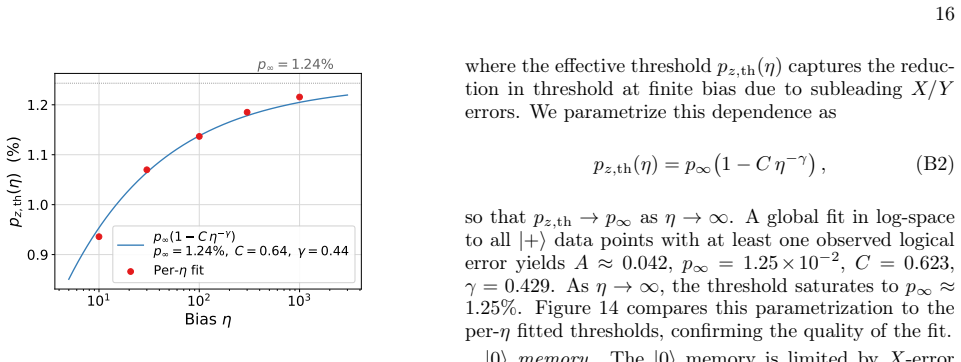
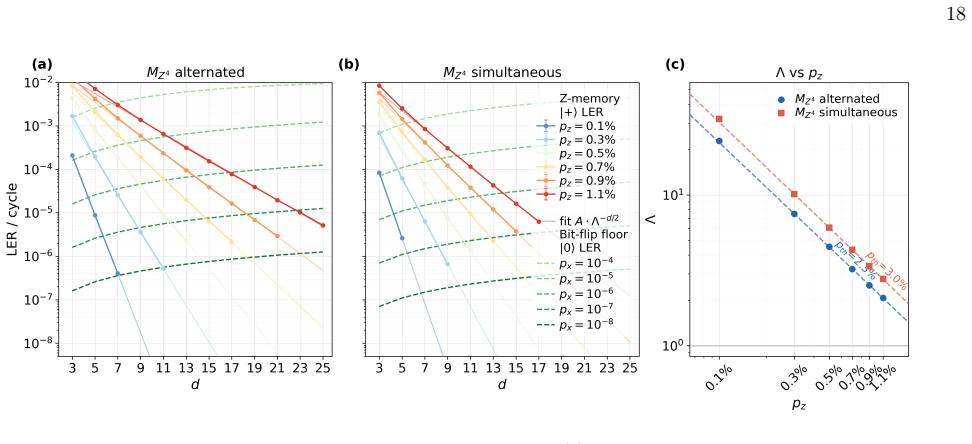
- An asymmetric XZZX surface code with weight-four QND Z measurements achieves a phase-flip threshold of about 1.25%.
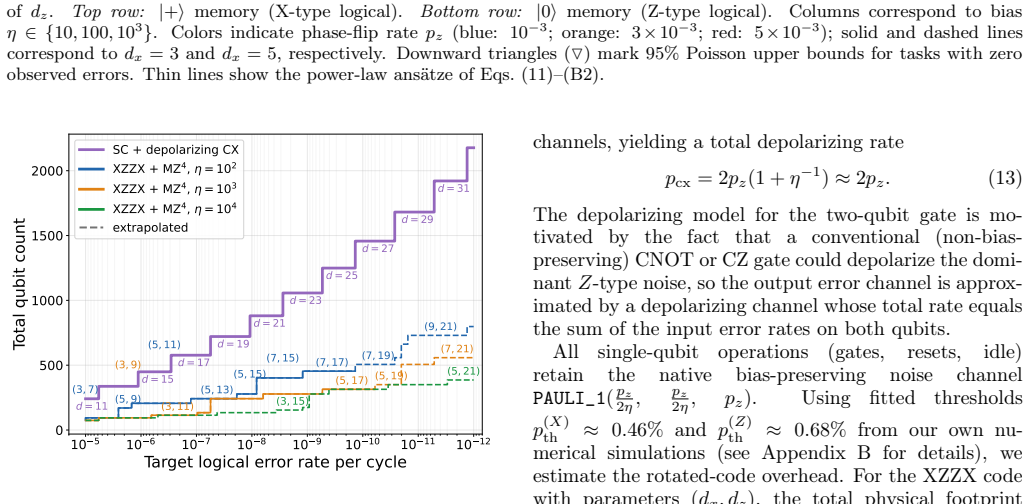
- Qubit overhead can be reduced by up to 6 times compared to bias-unaware surface codes at bias eta=10^4.
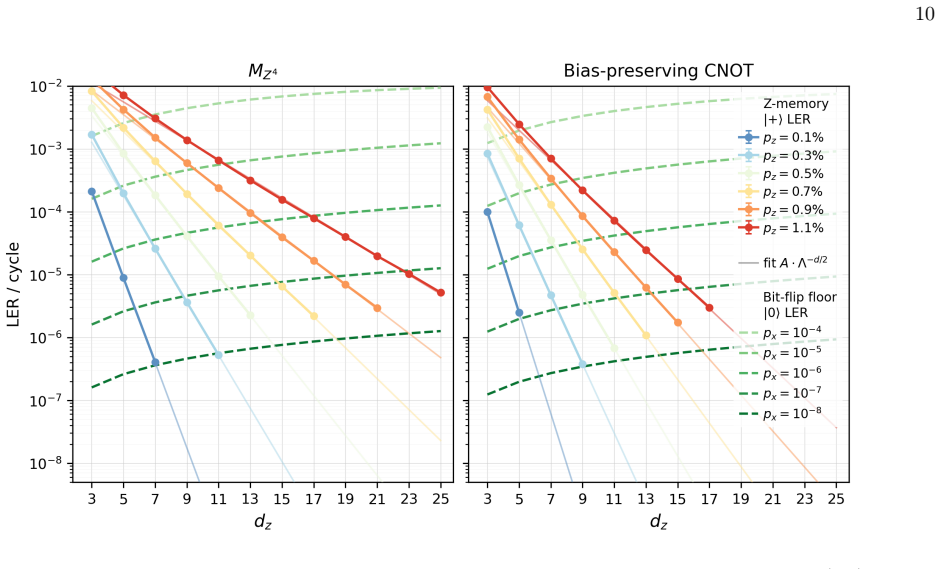
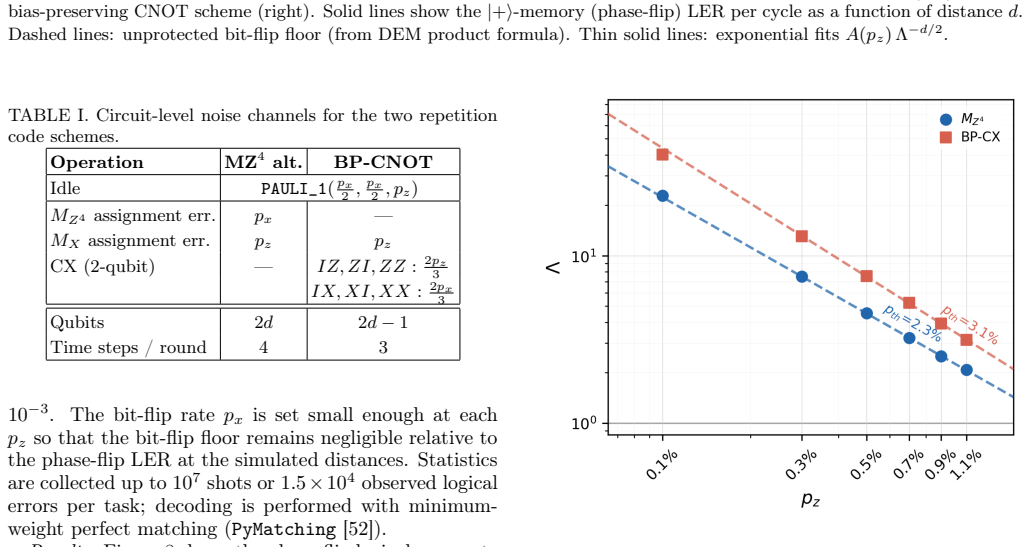
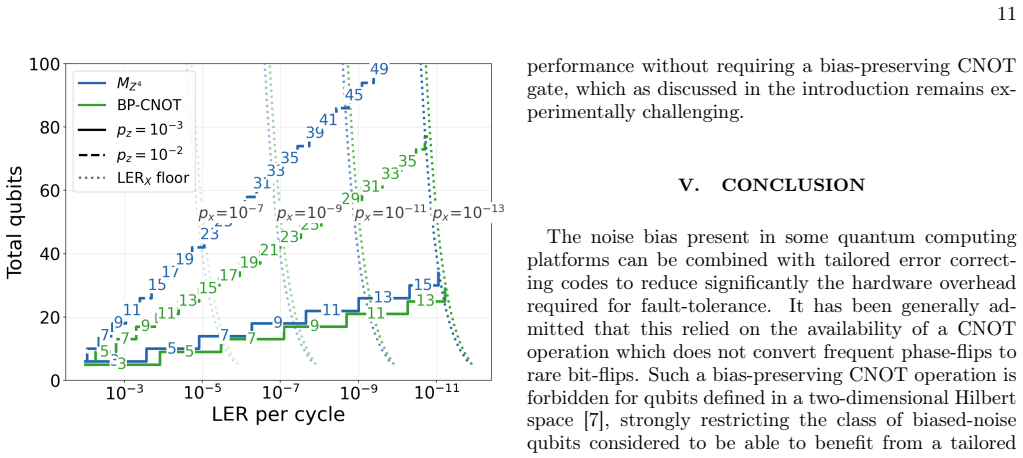
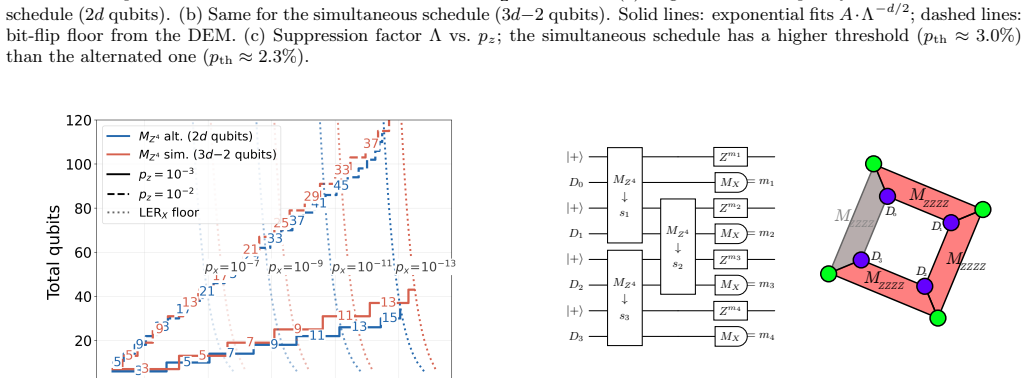
- A repetition code with QND Z measurements reaches a threshold of about 2.3% in the large bias regime.
Where Pith is reading between the lines
- This measurement primitive may open fault tolerance routes in strictly two-dimensional hardware where bias-preserving CNOT gates are impossible.
- Similar QND-based compilation could apply to additional biased-noise codes beyond those explicitly simulated.
- Experimental focus on raising QND Z measurement fidelity would directly test the reported overhead savings.
Load-bearing premise
High-fidelity QND multi-qubit Z measurements can be physically realized in the proposed platforms while preserving the noise bias without introducing dominant new error channels.
What would settle it
An experiment that implements a weight-four QND Z measurement on nuclear spins or cat qubits and measures the resulting bit-flip error rate to check whether it stays low enough for the simulated thresholds to hold.
Figures


read the original abstract
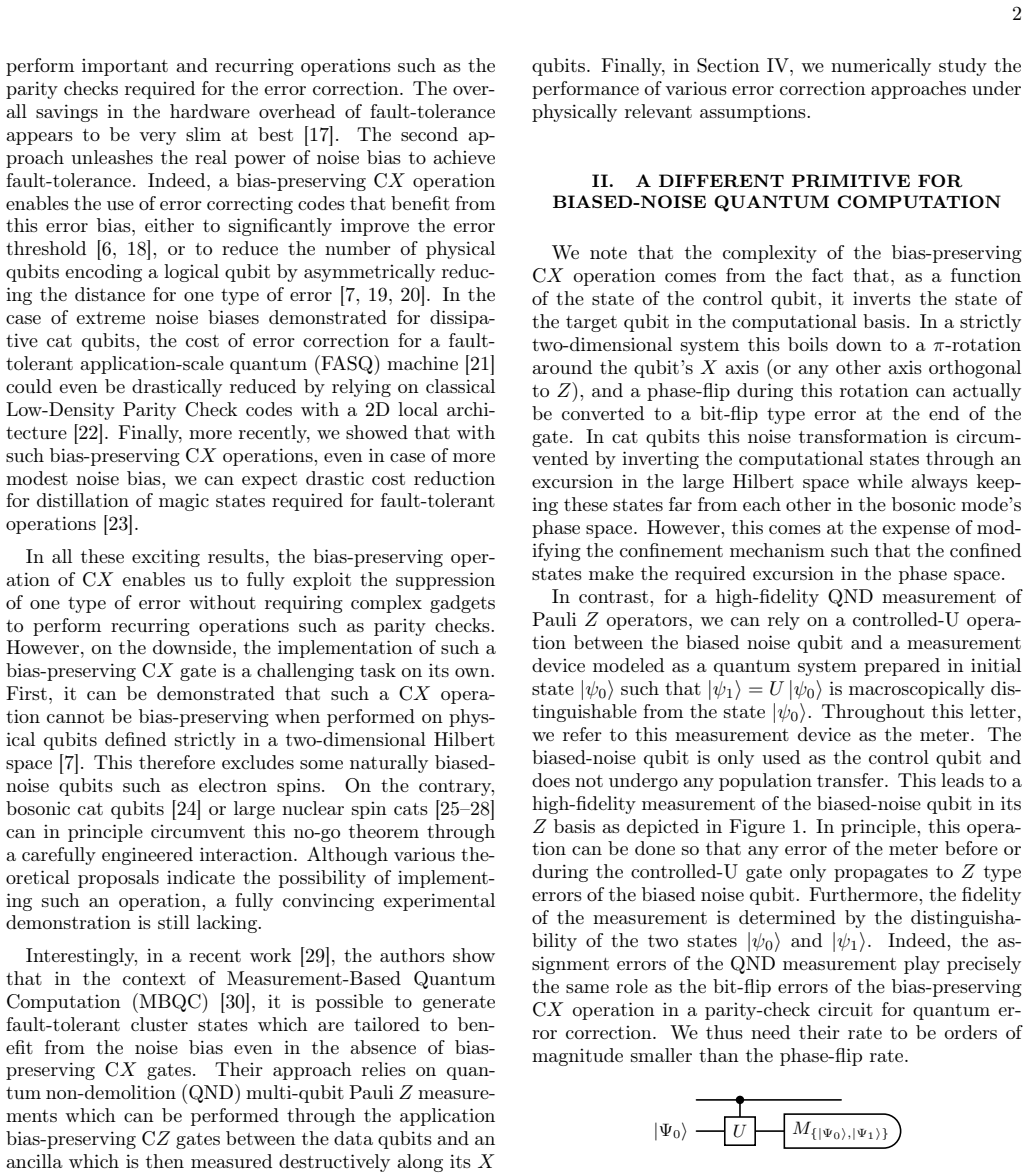
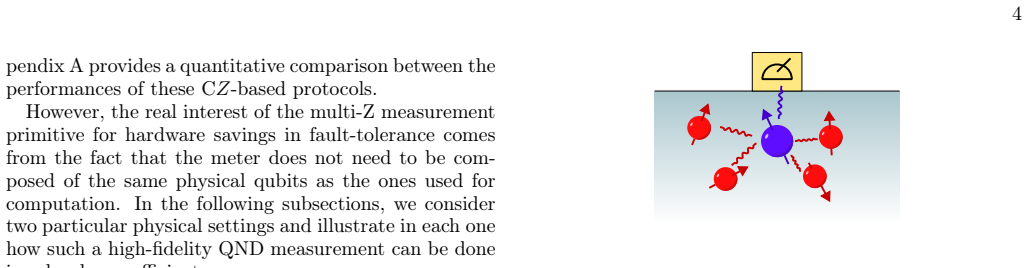
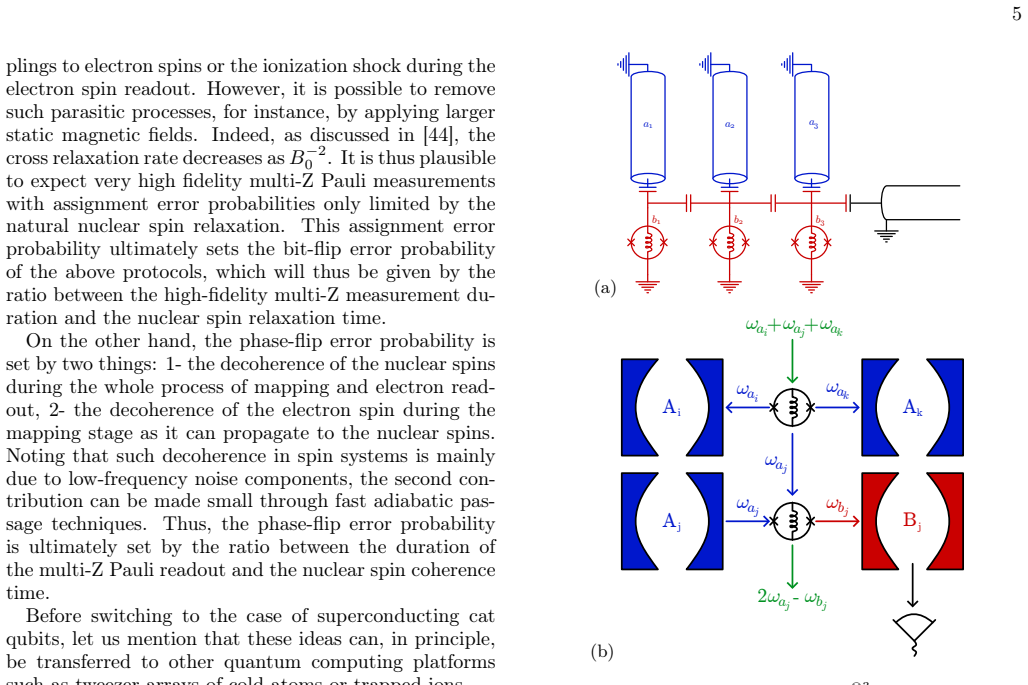
Leveraging noise bias, where phase-flip errors dominate over bit-flips, can drastically reduce the hardware overhead of fault-tolerant quantum computation, but existing approaches require bias-preserving CNOT gates whose implementation remains experimentally challenging and is provably impossible for strictly two-dimensional systems. We show that high-fidelity quantum non-demolition (QND) multi-qubit Pauli $Z$ measurements provide an equally powerful yet more accessible primitive. We demonstrate that such measurements can fully replace bias-preserving CNOT gates for compiling all operations required by bias-tailored error correction, including stabilizer measurements for repetition codes, XZZX surface codes, and LDPC codes. We propose concrete physical implementations of this primitive for two platforms: solid-state nuclear spins coupled to electron spin ancillas, and dissipatively stabilized superconducting cat qubits. Through circuit-level numerical simulations, we show that an asymmetric XZZX surface code implemented with weight-four QND $Z$ measurements achieves a phase-flip threshold of $\sim\!1.25\%$ and provides a qubit overhead reduction of up to $6\times$ compared to a bias-unaware surface code at noise bias $\eta = 10^4$. In the regime of very large bias, a repetition code with QND $Z$ measurements attains a threshold of $\sim\!2.3\%$ and achieves overhead comparable to that of a bias-preserving CNOT scheme, without requiring such a gate. Our results establish QND multi-$Z$ measurements as a practical and hardware-efficient route to fault-tolerant quantum computation for a broad class of biased-noise platforms.
Editorial analysis
A structured set of objections, weighed in public.
Referee Report
Summary. The paper claims that high-fidelity QND multi-qubit Pauli Z measurements can fully replace bias-preserving CNOT gates as a primitive for compiling all operations needed in bias-tailored error correction, including stabilizer extraction for repetition codes, XZZX surface codes, and LDPC codes. It proposes physical realizations in nuclear-spin/electron-ancilla and dissipatively stabilized cat-qubit platforms, and reports circuit-level simulation results of a ~1.25% phase-flip threshold for an asymmetric XZZX code (with up to 6× overhead reduction at η=10^4) and a ~2.3% threshold for a repetition code at very large bias.
Significance. If the explicit constructions and noise-model assumptions hold, the work supplies a concrete, hardware-accessible route to bias-tailored fault tolerance that avoids the experimental difficulty of bias-preserving CNOTs. The reported thresholds and overhead numbers, obtained from circuit-level numerics, would constitute a falsifiable, quantitative advance for the two named physical platforms.
major comments (2)
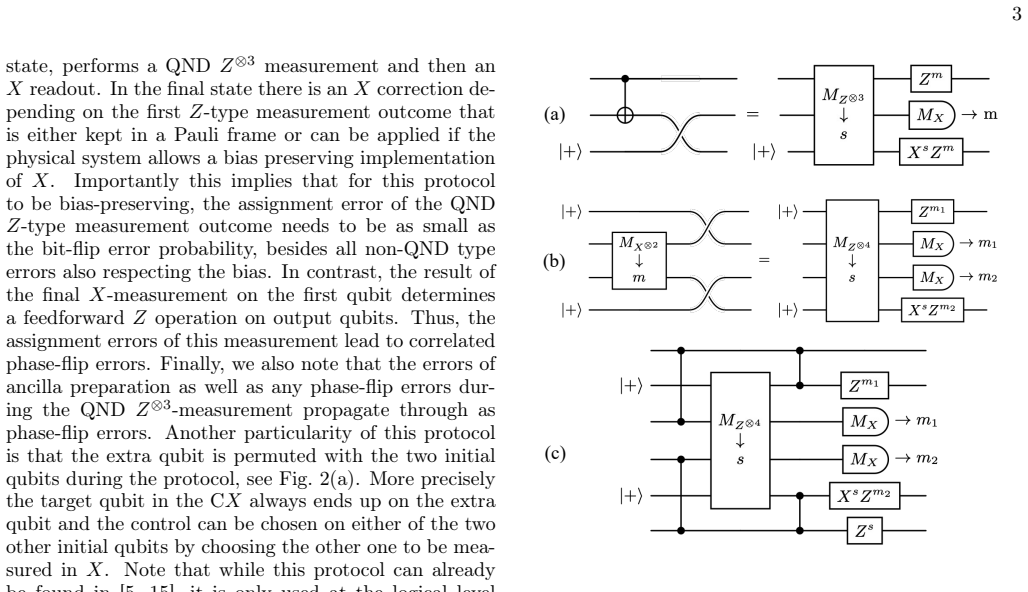
- [§3.3] §3.3 (LDPC stabilizer extraction): the central replacement claim requires that every stabilizer measurement circuit for the LDPC code be compiled using only the QND multi-Z primitive and no auxiliary two-qubit gates whose bias preservation is unproven; if any implicit CNOT or SWAP remains in the construction, the 'fully replace' statement does not follow from the reported thresholds.
- [§5.2] §5.2, noise model: the phase-flip threshold of ~1.25% and the 6× overhead reduction are obtained under an asymmetric noise model whose measurement-error parameters are stated only at the level of the abstract; without the explicit values of the QND readout infidelity and its correlation with the bias parameter η, it is impossible to confirm that the reported numbers remain valid once the physical implementation overhead is included.
minor comments (2)
- The repetition-code threshold is quoted as ~2.3% only for 'very large bias'; the precise bias value at which this threshold is achieved should be stated explicitly so that readers can compare it with the CNOT-based reference.
- Figure captions for the circuit diagrams should include the exact gate list (or a reference to the supplementary material) rather than only the high-level block diagram, to allow direct verification of the QND-only compilation.
Simulated Author's Rebuttal
Thank you for your thorough review and constructive feedback. We address each major comment point-by-point below, with clarifications based on the manuscript content and revisions where appropriate to improve clarity and completeness.
read point-by-point responses
-
Referee: [§3.3] §3.3 (LDPC stabilizer extraction): the central replacement claim requires that every stabilizer measurement circuit for the LDPC code be compiled using only the QND multi-Z primitive and no auxiliary two-qubit gates whose bias preservation is unproven; if any implicit CNOT or SWAP remains in the construction, the 'fully replace' statement does not follow from the reported thresholds.
Authors: In §3.3 we give explicit circuit constructions for LDPC stabilizer extraction that consist solely of QND multi-Z measurements applied to the relevant subsets of data qubits. Because the bias-tailored LDPC codes have exclusively Z-type stabilizers, no auxiliary two-qubit gates (CNOT, SWAP, or otherwise) appear in these circuits; the measurements are performed directly via the QND primitive. We have added a short clarifying paragraph at the end of §3.3 to state this explicitly and to reference the absence of any implicit gates. revision: partial
-
Referee: [§5.2] §5.2, noise model: the phase-flip threshold of ~1.25% and the 6× overhead reduction are obtained under an asymmetric noise model whose measurement-error parameters are stated only at the level of the abstract; without the explicit values of the QND readout infidelity and its correlation with the bias parameter η, it is impossible to confirm that the reported numbers remain valid once the physical implementation overhead is included.
Authors: The simulation parameters, including the QND readout infidelity (fixed at 5×10^{-3} independent of η) and the absence of additional η-dependent correlations beyond the phase-flip bias, are already stated in the main text of §5.2 and in the caption of the relevant figure. To make these values immediately visible without cross-reference, we will insert an explicit table of all noise-model parameters at the beginning of §5.2 in the revised manuscript. revision: yes
Circularity Check
No circularity; results from explicit constructions and simulations
full rationale
The paper's core claims rest on circuit-level numerical simulations yielding thresholds (e.g., ~1.25% for XZZX, ~2.3% for repetition code) and proposed physical implementations for QND Z measurements. No equations reduce by construction to inputs, no fitted parameters are relabeled as predictions, and no load-bearing steps invoke self-citations or uniqueness theorems from prior author work. The replacement of bias-preserving CNOTs is presented as a demonstrated compilation result rather than an assumption, keeping the derivation self-contained.
Axiom & Free-Parameter Ledger
axioms (2)
- domain assumption Standard model of biased Pauli noise in which phase-flip probability greatly exceeds bit-flip probability
- ad hoc to paper High-fidelity implementation of weight-four QND Z measurements is possible in the two named physical platforms without destroying the bias or adding dominant errors
Reference graph
Works this paper leans on
-
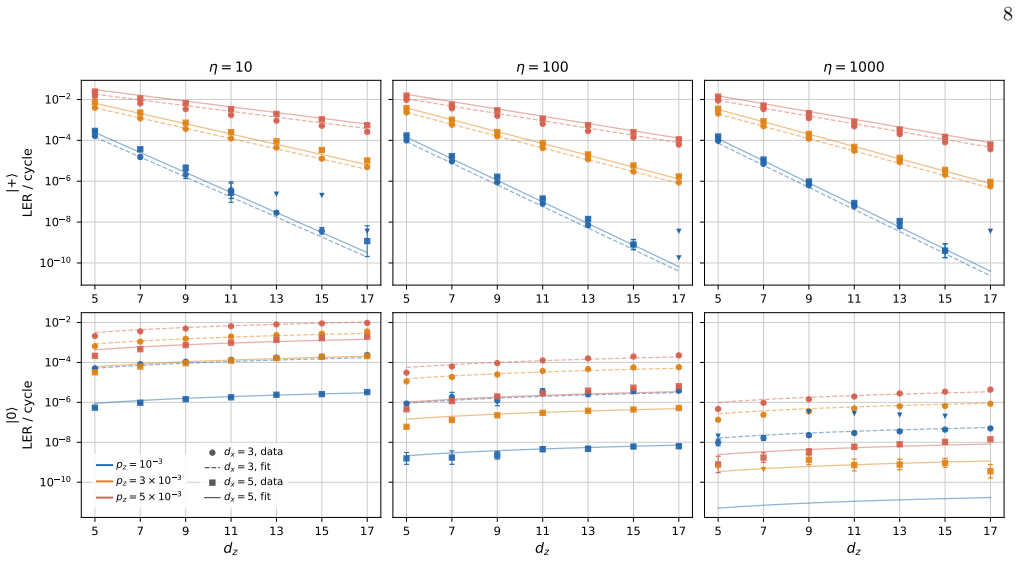
[1]
P. W. Shor, Fault-tolerant quantum computation, inPro- ceedings of the 37th Annual Symposium on Foundations of Computer Science (FOCS)(IEEE Computer Society, Washington, DC, 1996) pp. 56–65
1996
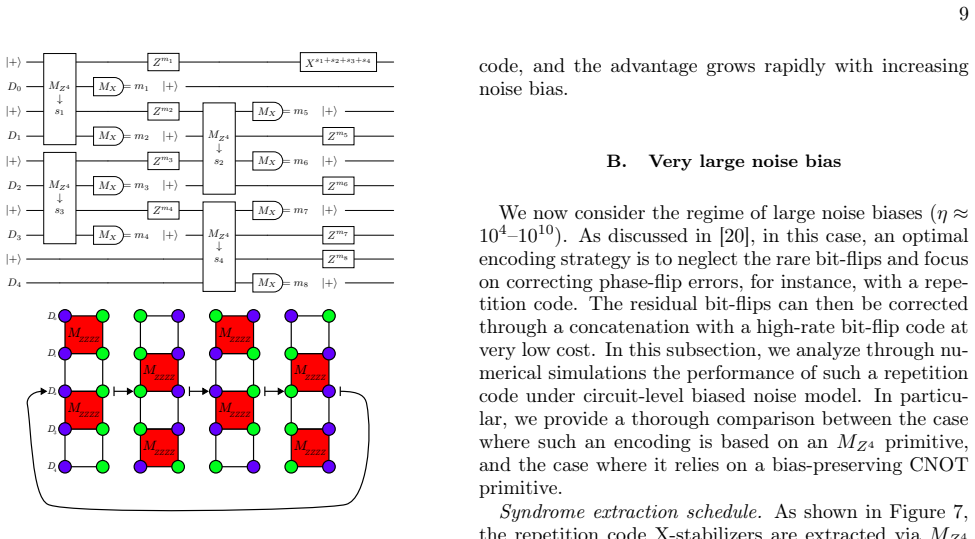
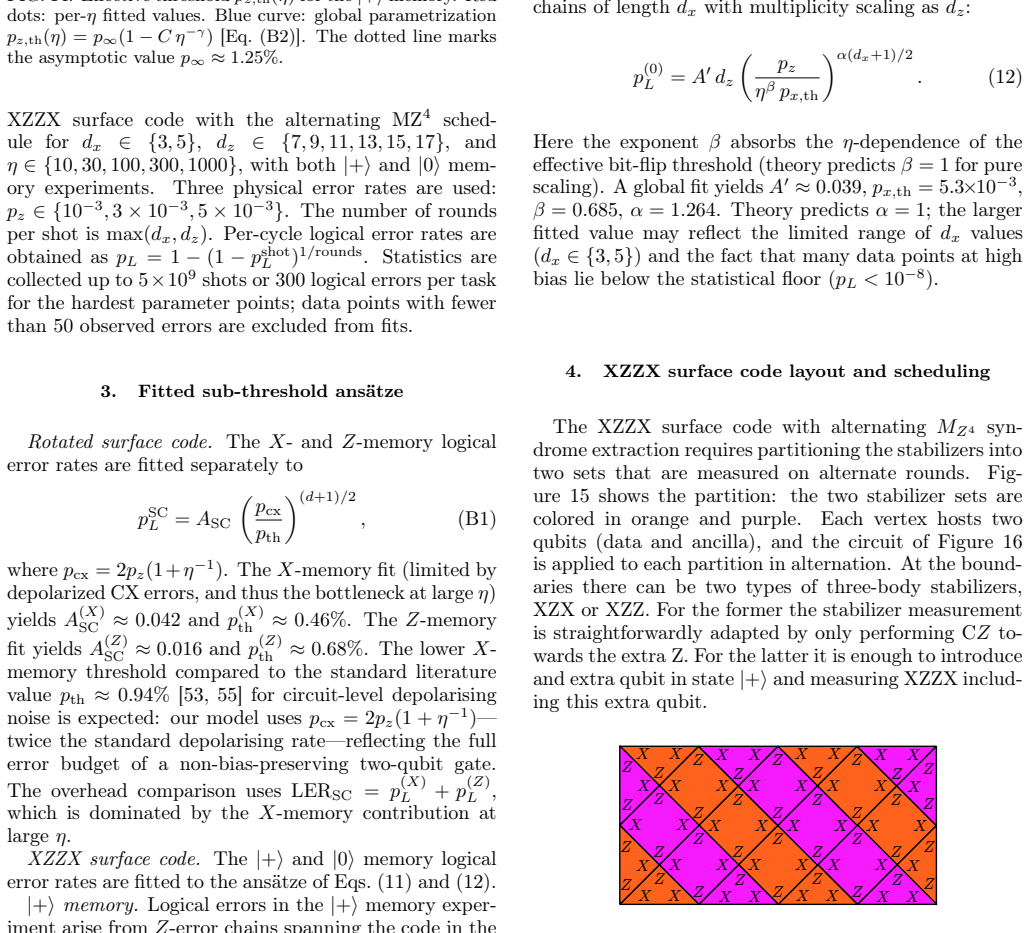
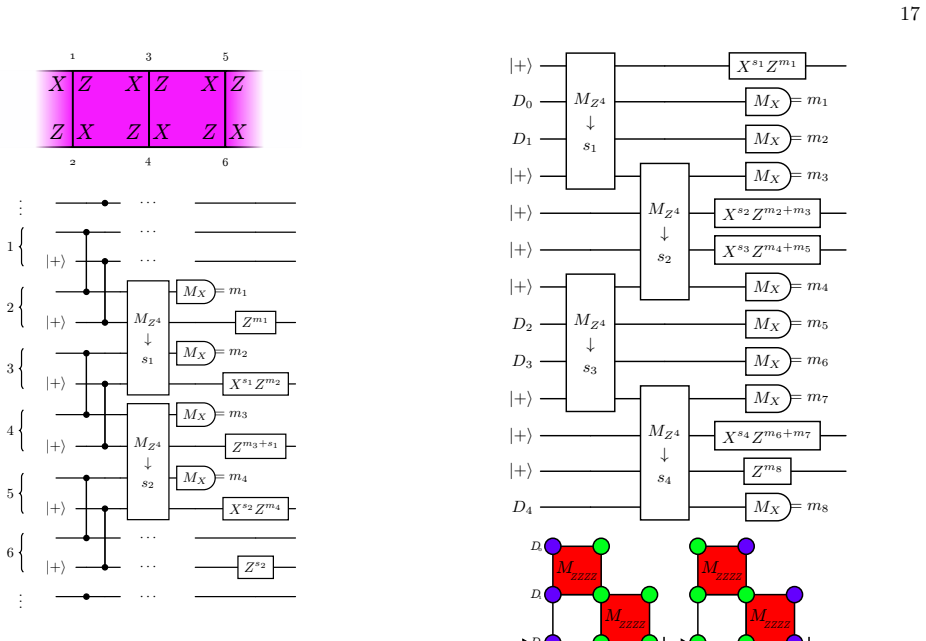
-
[2]
E. T. Campbell, B. M. Terhal, and C. Vuillot, Roads towards fault-tolerant universal quantum computation, Nature549, 172 (2017)
2017
-
[3]
Bluvstein, S
D. Bluvstein, S. J. Evered, A. A. Geim,et al., Logical quantum processor based on reconfigurable atom arrays, Nature626, 58 (2023)
2023
-
[4]
Acharya, L
R. Acharya, L. Aghababaie-Beni, I. Aleiner,et al., Quan- tum error correction below the surface code threshold, Nature638, 920 (2025)
2025
-
[5]
Aliferis and J
P. Aliferis and J. Preskill, Fault-tolerant quantum com- putation against biased noise, Phys. Rev. A78, 052331 (2008)
2008
-
[6]
D. K. Tuckett, S. D. Bartlett, and S. T. Flammia, Ultra- high error threshold for surface codes with biased noise, Phys. Rev. Lett.120, 050505 (2018)
2018
-
[7]
Guillaud and M
J. Guillaud and M. Mirrahimi, Repetition cat qubits for fault-tolerant quantum computation, Phys. Rev. X9, 041053 (2019)
2019
-
[8]
S. Puri, S. Boutin, and A. Blais, Engineering the quan- tum states of light in a kerr-nonlinear resonator by two- photon driving, npj Quantum Information3, 18 (2017)
2017
-
[9]
Grimm, N
A. Grimm, N. E. Frattini, S. Puri, S. Shankar, M. H. Devoret,et al., Stabilization and operation of a kerr-cat qubit, Nature584, 205 (2020)
2020
-
[10]
Mirrahimi, Z
M. Mirrahimi, Z. Leghtas, V. V. Albert, S. Touzard, R. J. Schoelkopf, L. Jiang, and M. H. Devoret, Dynamically protected cat-qubits: a new paradigm for universal quan- tum computation, New Journal of Physics16, 045014 (2014)
2014
-
[11]
Leghtas, S
Z. Leghtas, S. Touzard, I. M. Pop,et al., Confining the state of light to a quantum manifold by engineered two- photon loss, Science347, 853 (2015)
2015
-
[12]
Lescanne, M
R. Lescanne, M. Villiers, T. Peronnin, A. Sarlette, M. Delbecq, B. Huard, T. Kontos, M. Mirrahimi, and Z. Leghtas, Exponential suppression of bit-flips in a qubit encoded in an oscillator, Nature Physics16, 509 (2020)
2020
-
[13]
Réglade, A
U. Réglade, A. Bocquet, R. Gautier, J. Cohen, A. Marquet, E. Albertinale, N. Pankratova, M. Hallén, F. Rautschke, L.-A. Sellem, P. Rouchon, A. Sarlette, M. Mirrahimi, P. Campagne-Ibarcq, R. Lescanne, S. Je- zouin, and Z. Leghtas, Quantum control of a cat qubit with bit-flip times exceeding ten seconds, Nature629, 778 (2024)
2024
-
[14]
Enhancing dissipa- tive cat qubit protection by squeezing
R. Rousseau, D. Ruiz, E. Albertinale, P. d’Avezac, D. Banys, U. Blandin, N. Bourdaud, G. Campanaro, G. Cardoso, N. Cottet, C. Cullip, S. Deléglise, L. De- vanz, A. Devulder, A. Essig, P. Février, A. Gicquel, Élie Gouzien, A. Gras, J. Guillaud, E. Gümüş, M. Hal- lén, A. Jacob, P. Magnard, A. Marquet, S. Miklass, T. Peronnin, S. Polis, F. Rautschke, U. Régl...
-
[15]
Brooks and J
P. Brooks and J. Preskill, Fault-tolerant quantum com- putation with asymmetric bacon-shor codes, Phys. Rev. A87, 032310 (2013)
2013
-
[16]
S. Puri, L. St-Jean, J. A. Gross, A. Grimm, N. E. Frat- tini, P.S.Iyer, A.Krishna, S.Touzard, L.Jiang, A.Blais, S. T. Flammia, and S. M. Girvin, Bias-preserving gates with stabilized cat qubits, Science Advances6, eaay5901 (2020)
2020
-
[17]
D. Ruiz, J. Guillaud, C. Vuillot, and M. Mirrahimi, Faut- tolerant quantum computing with biased-noise qubits (2026), in preparation
2026
-
[18]
J. P. Bonilla Ataides, D. K. Tuckett, S. D. Bartlett, S. T. Flammia, and B. J. Brown, The xzzx surface code, Na- ture communications12, 2172 (2021)
2021
-
[19]
Chamberland, K
C. Chamberland, K. Noh, P. Arrangoiz-Arriola, E. T. Campbell, C. T. Hann, J. Iverson, H. Putterman, T. C. Bohdanowicz, S. T. Flammia, A. Keller, G. Refael, J. Preskill, L. Jiang, A. H. Safavi-Naeini, O. Painter, and F. G. Brandão, Building a fault-tolerant quantum computer using concatenated cat codes, PRX Quantum 3, 010329 (2022)
2022
-
[20]
P. Shanahan and D. Ruiz, Elevator codes: Concatena- tion for resource-efficient quantum memory under biased noise (2026), arXiv:2601.10786 [quant-ph]
-
[21]
J.EisertandJ.Preskill,Mindthegaps: Thefraughtroad to quantum advantage (2025), arXiv:2510.19928 [quant- ph]
work page internal anchor Pith review Pith/arXiv arXiv 2025
-
[22]
D. Ruiz, J. Guillaud, A. Leverrier, M. Mirrahimi, and C. Vuillot, Ldpc-cat codes for low-overhead quantum computing in 2d, Nature Communications16, 1040 (2025)
2025
-
[23]
D. Ruiz, J. Guillaud, C. Vuillot, and M. Mirrahimi, Un- folded distillation: very low-cost magic state preparation for biased-noise qubits, npj Quantum Information12, 53 (2026)
2026
-
[24]
Guillaud, J
J. Guillaud, J. Cohen, and M. Mirrahimi, Quantum com- putation with cat qubits, SciPost Phys. Lect. Notes , 72 (2023)
2023
-
[25]
J. A. Gross, C. Godfrin, A. Blais, and E. Dupont-Ferrier, Hardware-efficient error-correcting codes for large nu- clear spins, Phys. Rev. Appl.22, 014006 (2024)
2024
-
[26]
Omanakuttan, V
S. Omanakuttan, V. Buchemmavari, J. A. Gross, I. H. Deutsch, and M. Marvian, Fault-tolerant quantum com- putation using large spin-cat codes, PRX Quantum5, 020355 (2024)
2024
-
[27]
Kruckenhauser, M
A. Kruckenhauser, M. Yuan, H. Zheng, M. Mamaev, P. Zeng, X. Mao, Q. Xu, T. V. Zache, L. Jiang, R. van Bi- jnen, and P. Zoller, Dark spin-cat states as biased qubits, 13 Phys. Rev. Lett.135, 020601 (2025)
2025
-
[28]
X. Yu, B. Wilhelm, D. Holmes, A. Vaartjes, D. Schwien- bacher, M. Nurizzo, A. Kringhøj, M. R. v. Blankenstein, A. M. Jakob, P. Gupta, F. E. Hudson, K. M. Itoh, R. J. Murray, R. Blume-Kohout, T. D. Ladd, N. Anand, A. S. Dzurak, B. C. Sanders, D. N. Jamieson, and A. Morello, Schrödinger cat states of a nuclear spin qudit in silicon, Nature Physics21, 362 (2025)
2025
-
[29]
Claes, J
J. Claes, J. E. Bourassa, and S. Puri, Tailored cluster states with high threshold under biased noise, npj Quan- tum Information9, 9 (2023)
2023
-
[30]
Raussendorf and H
R. Raussendorf and H. J. Briegel, A one-way quantum computer, Phys. Rev. Lett.86, 5188 (2001)
2001
-
[31]
T. H. Taminiau, J. J. T. Wagenaar, T. van der Sar, F. Jelezko, V. V. Dobrovitski, and R. Hanson, Detection and control of individual nuclear spins using a weakly coupled electron spin, Phys. Rev. Lett.109, 137602 (2012)
2012
-
[32]
Cramer, N
J. Cramer, N. Kalb, M. A. Rol, B. Hensen, M. S. Blok, M. Markham, D. J. Twitchen, R. Hanson, and T. H. Taminiau, Repeated quantum error correction on a con- tinuously encoded qubit by real-time feedback, Nature Communications7, 11526 (2016)
2016
-
[33]
M. H. Abobeih, Y. Wang, J. Randall, S. J. H. Loenen, C. E. Bradley, M. Markham, D. J. Twitchen, B. M. Ter- hal, and T. H. Taminiau, Fault-tolerant operation of a logical qubit in a diamond quantum processor, Nature 606, 884 (2022)
2022
-
[34]
B. E. Kane, A silicon-based nuclear spin quantum com- puter, Nature393, 133 (1998)
1998
-
[35]
J. J. Pla, K. Y. Tan, J. P. Dehollain, W. H. Lim, J. J. L. Morton, F. A. Zwanenburg, D. N. Jamieson, A. S. Dzu- rak, and A. Morello, High-fidelity readout and control of a nuclear spin qubit in silicon, Nature496, 334 (2013)
2013
-
[36]
M. T. Mądzik, S. Asaad, A. Youssry, B. Joecker, K. M. Rudinger, E. Nielsen, K. C. Young, T. J. Proctor, A. D. Baczewski, A. Laucht, V. Schmitt, F. E. Hudson, K. M. Itoh, A. M. Jakob, B. C. Johnson, D. N. Jamieson, A. S. Dzurak, C. Ferrie, R. Blume-Kohout, and A. Morello, Precision tomography of a three-qubit donor quantum processor in silicon, Nature601, ...
2022
-
[37]
O’Sullivan, J
J. O’Sullivan, J. Travesedo, L. Pallegoix, Z. W. Huang, P. Hogan, A. S. May, B. Yavkin, S. Lin, R.-B. Liu, T. Chaneliere, S. Bertaina, P. Goldner, D. Estève, D. Vion, P. Abgrall, P. Bertet, and E. Flurin, Individual solid-state nuclear spin qubits with coherence exceeding seconds, Nature Physics21, 1794 (2025)
2025
-
[38]
Wolfowicz, P.-A
G. Wolfowicz, P.-A. Mortemousque, R. Guichard, S. Sim- mons, M.L.W.Thewalt, K.M.Itoh,andJ.J.L.Morton, 29si nuclear spins as a resource for donor spin qubits in silicon, New Journal of Physics18, 023021 (2016)
2016
-
[39]
Hensen, W
B. Hensen, W. Wei Huang, C.-H. Yang, K. Wai Chan, J. Yoneda, T. Tanttu, F. E. Hudson, A. Laucht, K. M. Itoh, T. D. Ladd, A. Morello, and A. S. Dzurak, A silicon quantum-dot-coupled nuclear spin qubit, Nature Nan- otechnology15, 13 (2020)
2020
-
[40]
Steinacker, G
P. Steinacker, G. Goenka, R. Y. Su, T. Tanttu, W. H. Lim, S. Serrano, T. Botzem, J. D. Cifuentes, S. Q. Lim, J. C. McCallum, B. C. Johnson, F. E. Hudson, K. W. Chan, C. C. Escott, A. Saraiva, C. H. Yang, V. Mourik, A. Morello, A. S. Dzurak, and A. Laucht, Coupling a73ge nuclear spin to an electrostatically defined quantum dot in silicon, Phys. Rev. Lett. (2026)
2026
-
[41]
Jiang, M
L. Jiang, M. V. G. Dutt, E. Togan, L. Childress, P. Cap- pellaro, J. M. Taylor, and M. D. Lukin, Coherence of an optically illuminated single nuclear spin qubit, Phys. Rev. Lett.100, 073001 (2008)
2008
-
[42]
Pfaff, T
W. Pfaff, T. H. Taminiau, L. Robledo, H. Bernien, M. Markham, D. J. Twitchen, and R. Hanson, Demon- stration of entanglement-by-measurement of solid-state qubits, Nature Physics9, 29 (2013)
2013
-
[43]
N. Samkharadze, G. Zheng, N. Kalhor, D. Brousse, A. Sammak, U. C. Mendes, A. Blais, G. Scap- pucci, and L. M. K. Vandersypen, Strong spin- photon coupling in silicon, Science359, 1123 (2018), https://www.science.org/doi/pdf/10.1126/science.aar4054
-
[44]
J. Travesedo, J. O’Sullivan, L. Pallegoix, Z. W. Huang, P. Hogan, P. Goldner, T. Chaneliere, S. Bertaina, D. Estève, P. Abgrall, D. Vion, E. Flurin, and P. Bertet, All-microwave spec- troscopy and polarization of individual nuclear spins in a solid, Science Advances11, eadu0581 (2025), https://www.science.org/doi/pdf/10.1126/sciadv.adu0581
-
[45]
Cortiñas, N
R. Cortiñas, N. Frattini, S. Puri, O. Duke, C. U. Lei, S. Girvin, and M. Devoret, Toward a topological CNOT between two Kerr-cat qubits: part 1/2, inAPS March Meeting Abstracts, APS Meeting Abstracts, Vol. 2021 (2021) p. L33.006
2021
-
[46]
Essig, N
A. Essig, N. Bourdaud, J. Cohen, N. Cottet, L. Devanz, P. Fevrier, A. Gras, J. Guillaud, E. Gümüs, M. Hal- lén, V. Hasanuzzaman Kamrul, S. Jezouin, R. Lescanne, P. Magnard, J. Roul, N. Pankratova, F. Rautschke, T. Peronnin, E. Roverc’h, J. Stevens, S. Polis, J.-L. Ville, P. Wan-Fat, R. Rousseau, Alice, and Bob Team, To- wards a bias-preserving CNOT gate b...
2023
-
[47]
N. E. Frattini, R. G. Cortiñas, J. Venkatraman, X. Xiao, Q. Su, C. U. Lei, B. J. Chapman, V. R. Joshi, S. M. Girvin, R. J. Schoelkopf, S. Puri, and M. H. Devoret, Ob- servation of pairwise level degeneracies and the quantum regime of the arrhenius law in a double-well parametric oscillator, Phys. Rev. X14, 031040 (2024)
2024
-
[48]
B. Qing, A. Hajr, K. Wang, G. Koolstra, L. B. Nguyen, J. Hines, I. Huang, B. Bhandari, L. Chen, Z. Kang, C. Jünger, N. Goss, N. Jain, H. Kim, K.-H. Lee, A. Hashim, N. E. Frattini, Z. Pedramrazi, J. Dressel, A. N. Jordan, D. I. Santiago, and I. Siddiqi, Quantum benchmarking of high-fidelity noise-biased operations on a detuned kerr-cat qubit, Proceedings o...
-
[49]
F. Adinolfi, D. Z. Haxell, A. Bruno, L. Michaud, V. H. Kamrul, P. Pandey, and A. Grimm, Enhancing kerr- cat qubit coherence with controlled dissipation (2025), arXiv:2511.01027 [quant-ph]
-
[50]
Marquet, A
A. Marquet, A. Essig, J. Cohen, N. Cottet, A. Murani, E. Albertinale, S. Dupouy, A. Bienfait, T. Peronnin, S. Jezouin, R. Lescanne, and B. Huard, Autoparamet- ric resonance extending the bit-flip time of a cat qubit up to 0.3 s, Phys. Rev. X14, 021019 (2024)
2024
-
[51]
C.Gidney,Stim: afaststabilizercircuitsimulator,Quan- tum5, 497 (2021)
2021
-
[52]
Higgott and C
O. Higgott and C. Gidney, Pymatching: A python pack- age for decoding quantum codes with minimum-weight perfect matching, Quantum6, 817 (2022)
2022
-
[53]
Dennis, A
E. Dennis, A. Kitaev, A. Landahl, and J. Preskill, Topological quantum memory, Journal of Mathematical Physics43, 4452 (2002). 14
2002
-
[54]
3 events
A finer counting—IZandZZeach at2p z/3per CX gate, giving a marginalZ-rate of4p z/3per layer and neff ≈11/3—predicts≈2.7%and undershoots the nu- merical threshold. The reason is that the correlatedZZ term creates simultaneous ancilla and dataZerrors that produce a characteristic detector pattern (adjacent syn- drome defects at the same time step), which th...
-
[55]
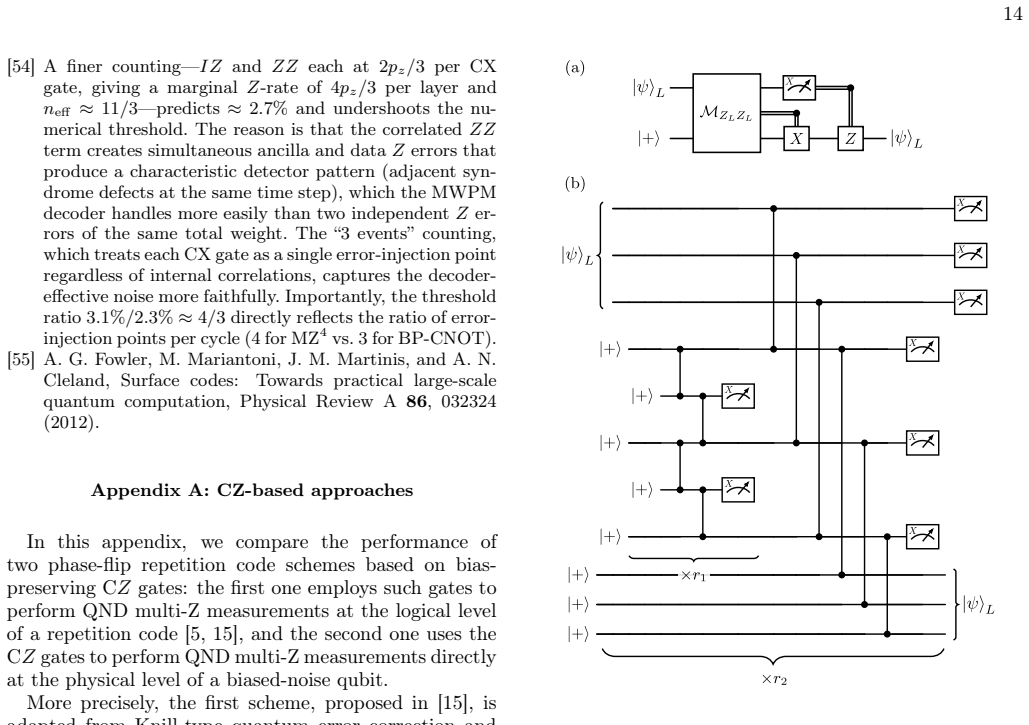
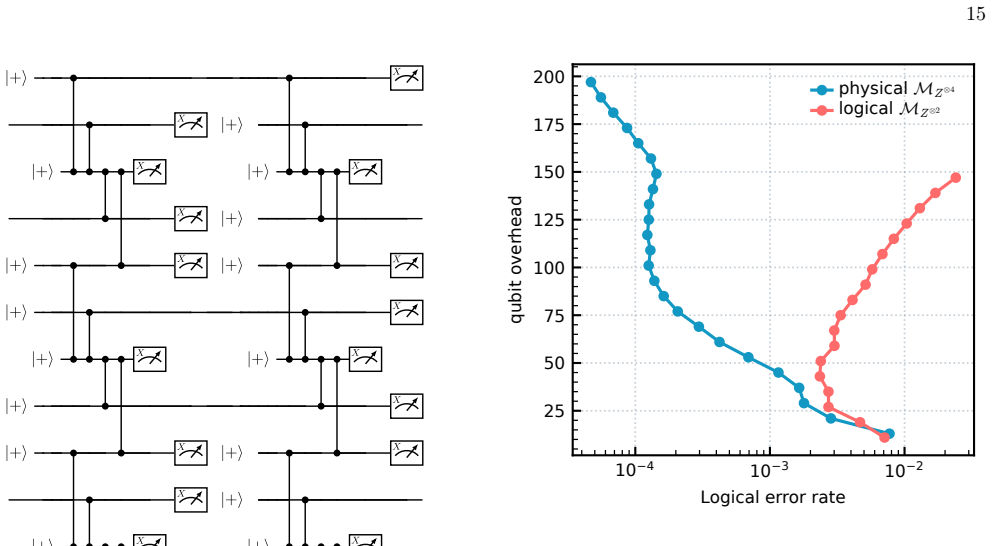
A. G. Fowler, M. Mariantoni, J. M. Martinis, and A. N. Cleland, Surface codes: Towards practical large-scale quantum computation, Physical Review A86, 032324 (2012). Appendix A: CZ-based approaches In this appendix, we compare the performance of two phase-flip repetition code schemes based on bias- preserving CZgates: the first one employs such gates to p...
2012
-
[56]
Both models are parameterised bypz andη; the rotated surface code uses a depolarizing CX with ratepcx = 2pz(1 +η −1)while all single-qubit channels retain the native noise bias
Circuit-level noise models Table II summarises the noise channels applied to each operation in the two simulation setups. Both models are parameterised bypz andη; the rotated surface code uses a depolarizing CX with ratepcx = 2pz(1 +η −1)while all single-qubit channels retain the native noise bias. The rotated surface code noise model uses a de- 10−4 10−3...
-
[57]
The bias is set toη= 10 6 (effectively infinite, so thatp cx ≈2p z) andp z is swept over 14 values from 5×10 −4 to3×10 −2
Simulation parameters Rotated surface code.Wesimulatetherotatedd×dsur- face code (n= 2d 2 −1qubits) ford∈ {3,5,7,9,11,13} androunds =d, with bothZ- andX-memory experi- ments. The bias is set toη= 10 6 (effectively infinite, so thatp cx ≈2p z) andp z is swept over 14 values from 5×10 −4 to3×10 −2. Statistics are collected up to 5×10 6 shots or 500 logical ...
-
[58]
TheX-memory fit (limited by depolarizedCXerrors, andthusthebottleneckatlargeη) yieldsA (X) SC ≈0.042andp (X) th ≈0.46%
Fitted sub-threshold ansätze Rotated surface code.TheX- andZ-memory logical error rates are fitted separately to pSC L =A SC pcx pth (d+1)/2 ,(B1) wherep cx = 2pz(1+η −1). TheX-memory fit (limited by depolarizedCXerrors, andthusthebottleneckatlargeη) yieldsA (X) SC ≈0.042andp (X) th ≈0.46%. TheZ-memory fit yieldsA (Z) SC ≈0.016andp (Z) th ≈0.68%. The lowe...
-
[59]
Fig- ure 15 shows the partition: the two stabilizer sets are colored in orange and purple
XZZX surface code layout and scheduling The XZZX surface code with alternatingM Z4 syn- drome extraction requires partitioning the stabilizers into two sets that are measured on alternate rounds. Fig- ure 15 shows the partition: the two stabilizer sets are colored in orange and purple. Each vertex hosts two qubits (data and ancilla), and the circuit of Fi...
discussion (0)
Sign in with ORCID, Apple, or X to comment. Anyone can read and Pith papers without signing in.