RxGS: Receiver-Generalizable 3D Gaussian Splatting for Radio-Frequency Data Synthesis
Pith reviewed 2026-06-30 13:57 UTC · model grok-4.3
The pith
RxGS uses one shared 3D Gaussian Splatting model to synthesize RF signals for any receiver position in a scene.
A machine-rendered reading of the paper's core claim, the machinery that carries it, and where it could break.
Core claim
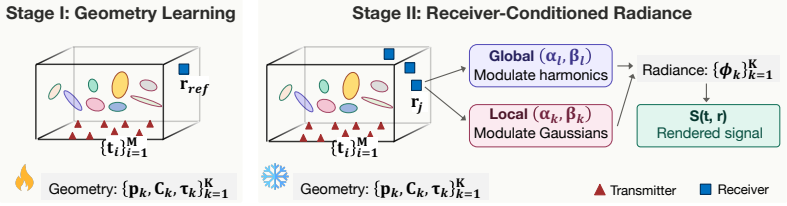
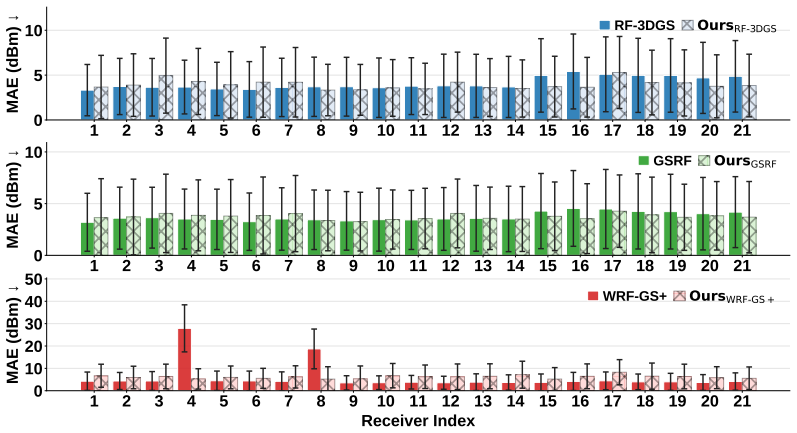
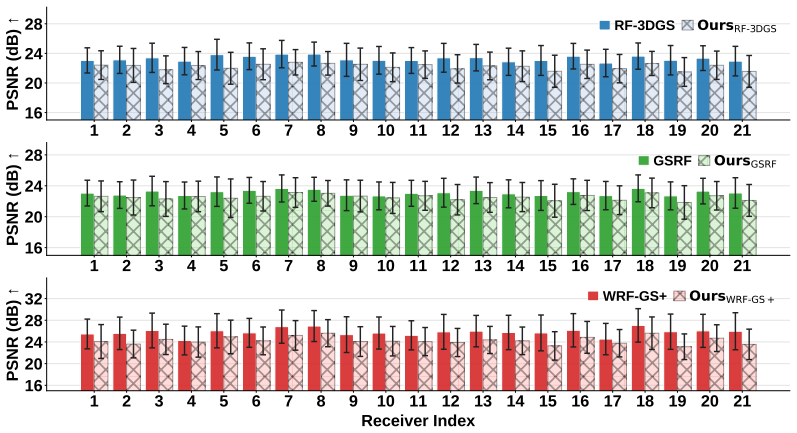
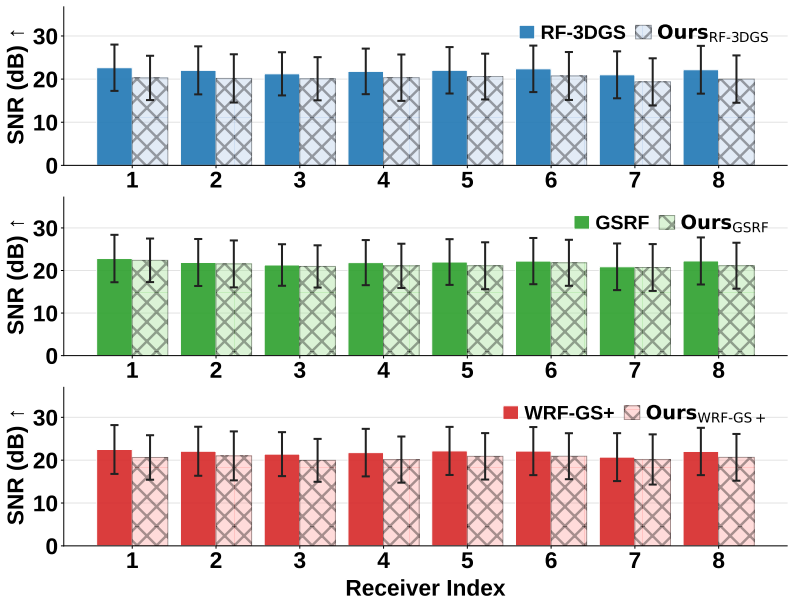
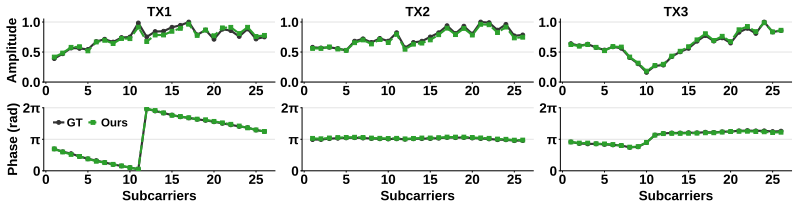
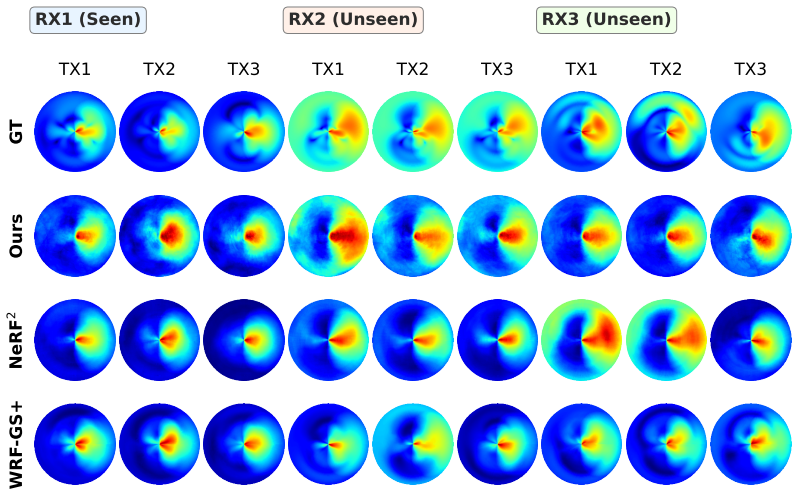
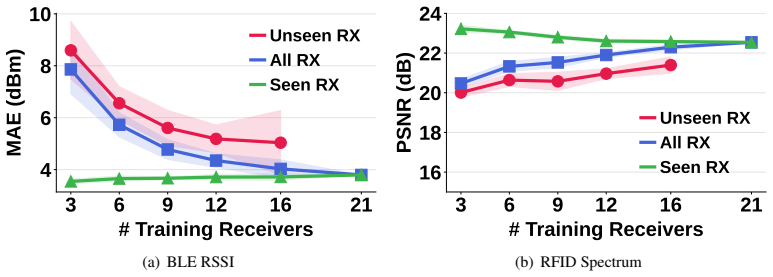
RxGS achieves receiver-generalizable synthesis within a single unified model. A first stage learns shared 3D Gaussian geometry, and a second stage freezes it and learns directional radiance conditioned on receiver position. A global conditioning branch captures shared receiver-dependent effects across the scene, while a local branch models per-scatterer variations from the receiver's geometry and occlusion. A multi-receiver CUDA rasterizer batches rendering across all N receivers. Evaluated across various RF datasets, RxGS matches or improves over per-receiver baselines with a single shared model and generalizes to receivers unseen during training within the scene.
What carries the argument
Two-stage 3D Gaussian Splatting pipeline that first learns receiver-independent scene geometry then freezes those Gaussians to learn receiver-position-conditioned directional radiance via global and local branches.
If this is right
- One model replaces N independent models for N receivers in the same scene.
- Signal prediction works at receiver positions never seen during training.
- Training cost drops by up to 45 times and inference cost by 7.6 times.
- Storage scales with one model instead of scaling linearly with the number of receivers.
- Batch rendering of multiple receivers becomes possible through the multi-receiver CUDA rasterizer.
Where Pith is reading between the lines
- The geometry-versus-radiance split could transfer to acoustic or optical synthesis tasks where listener or viewer position varies but scene structure does not.
- Real-time wireless planning tools might become practical once the reduced per-receiver overhead is combined with existing ray-tracing accelerators.
- Extending the local branch to handle moving scatterers could allow the same model to track changes without full retraining.
Load-bearing premise
Scene geometry stays the same regardless of receiver location while only the directional radiance changes with receiver position.
What would settle it
Train the model on a subset of receivers in a scene and test on a new receiver position; if accuracy falls substantially below that of a model trained specifically for the new receiver, the generalization claim is falsified.
Figures
read the original abstract
Radio-frequency (RF) data synthesis predicts the received signal given transmitter and receiver positions, and is essential for wireless applications. Recent 3D Gaussian Splatting (3DGS)-based methods achieve efficient synthesis at any transmitter but only for a fixed receiver. Therefore, supporting $N$ receivers in one scene requires $N$ independent models and precludes prediction at unseen receivers. We present RxGS, which achieves receiver-generalizable synthesis within a single unified model. Our key insight is that scene geometry is receiver-independent while directional radiance is not: a first stage learns shared 3D Gaussian geometry, and a second stage freezes it and learns directional radiance conditioned on receiver position. A global conditioning branch captures shared receiver-dependent effects across the scene, while a local branch models per-scatterer variations from the receiver's geometry and occlusion. A multi-receiver CUDA rasterizer further batches rendering across all $N$ receivers. Evaluated across various RF datasets, RxGS matches or improves over per-receiver baselines with a single shared model and generalizes to receivers unseen during training within the scene, cutting training cost by up to $45\times$, inference cost by $7.6\times$, and storage by $N\times$.
Editorial analysis
A structured set of objections, weighed in public.
Referee Report
Summary. The paper introduces RxGS, a two-stage 3D Gaussian Splatting approach for RF data synthesis that learns a single shared model for multiple receivers. Stage 1 learns receiver-independent scene geometry via 3D Gaussians; stage 2 freezes those Gaussians and learns receiver-conditioned directional radiance using global and local conditioning branches. A custom multi-receiver CUDA rasterizer supports batched rendering. The central claims are that RxGS matches or exceeds per-receiver baselines, generalizes to unseen receivers within the same scene, and yields up to 45× training, 7.6× inference, and N× storage savings.
Significance. If the empirical claims hold, the work offers a practical route to scalable RF synthesis for multi-receiver and dynamic-receiver wireless applications by exploiting the geometry-radiance separation. The explicit two-stage freezing and the global/local conditioning design are clear engineering contributions that directly address the storage and retraining costs of prior per-receiver 3DGS methods.
minor comments (3)
- [Abstract, §1] Abstract and §1 state performance parity and generalization but supply no quantitative tables, error bars, dataset sizes, or ablation details; the full experimental section should include these to allow verification of the 45×/7.6× claims.
- [Method (rasterizer subsection)] The multi-receiver CUDA rasterizer is described at a high level; pseudocode or a short complexity analysis would clarify how batching across N receivers is implemented without introducing per-receiver overhead.
- [§3.2] Notation for the global and local conditioning branches (e.g., how receiver position is encoded and injected) should be made fully explicit with equations to aid reproducibility.
Simulated Author's Rebuttal
We thank the referee for the positive summary, recognition of the geometry-radiance separation and conditioning design as engineering contributions, and the recommendation of minor revision. No major comments were provided in the report.
Circularity Check
No significant circularity detected
full rationale
The provided abstract and context describe a two-stage modeling approach grounded in an explicit premise (receiver-independent geometry vs. receiver-dependent radiance). This premise directly motivates the freezing step and conditioning branches without any equations, fitted parameters renamed as predictions, or self-citation chains. No load-bearing derivation reduces to its own inputs by construction; the method is a consistent implementation of the stated decomposition. The central claims about generalization and cost savings are empirical outcomes, not tautological re-statements of inputs.
Axiom & Free-Parameter Ledger
axioms (1)
- domain assumption Scene geometry is receiver-independent while directional radiance is receiver-dependent
Reference graph
Works this paper leans on
-
[1]
WiFi Sensing with Channel State Information: A Survey
Yongsen Ma, Gang Zhou, and Shuangquan Wang. WiFi Sensing with Channel State Information: A Survey. ACM Computing Surveys, 52(3):1–36, 2019
2019
-
[2]
WiTAG: Seamless WiFi Backscater Communication
Ali Abedi, Farzan Dehbashi, Mohammad Hossein Mazaheri, Omid Abari, and Tim Brecht. WiTAG: Seamless WiFi Backscater Communication. InACM Special Interest Group on Data Communications (SIG- COMM), 2020
2020
-
[3]
Rappaport.Wireless Communications: Principles and Practice
Theodore S. Rappaport.Wireless Communications: Principles and Practice. Prentice Hall, 2002
2002
-
[4]
Integrated Two-Way Radar Backscatter Communication and Sensing with Low-Power IoT Tags
Ryu Okubo, Luke Jacobs, Jinhua Wang, Steven Bowers, and Elahe Soltanaghai. Integrated Two-Way Radar Backscatter Communication and Sensing with Low-Power IoT Tags. InACM Special Interest Group on Data Communications (SIGCOMM), 2024
2024
-
[5]
NeRF 2: Neural Radio-Frequency Radiance Fields
Xiaopeng Zhao, Zhenlin An, Qingrui Pan, and Lei Yang. NeRF 2: Neural Radio-Frequency Radiance Fields. InACM Annual International Conference on Mobile Computing and Networking (MobiCom), 2023
2023
-
[6]
GeRaF: Neural Geometry Reconstruction from Radio Frequency Signals
Jiachen Lu, Hailan Shanbhag, and Haitham Al Hassanieh. GeRaF: Neural Geometry Reconstruction from Radio Frequency Signals. InConference on Neural Information Processing Systems (NeurIPS), 2025
2025
-
[7]
Can NeRFs See without Cameras?arXiv preprint arXiv:2505.22441, 2025
Chaitanya Amballa, Sattwik Basu, Yu-Lin Wei, Zhijian Yang, Mehmet Ergezer, and Romit Roy Choudhury. Can NeRFs See without Cameras?arXiv preprint arXiv:2505.22441, 2025
-
[8]
Diffusion Model-based RSSI Fingerprint Generation for Indoor Localization in Dynamic Environments
Liuyi Yang, Patrick Finnerty, and Chikara Ohta. Diffusion Model-based RSSI Fingerprint Generation for Indoor Localization in Dynamic Environments. InIEEE Wireless and Optical Communications Conference (WOCC), pages 402–407, 2025
2025
-
[9]
FLog: Automated modeling of link quality for LoRa networks in orchards.ACM Transactions on Sensor Networks, 21(2):1–28, 2025
Kang Yang, Yuning Chen, and Wan Du. FLog: Automated modeling of link quality for LoRa networks in orchards.ACM Transactions on Sensor Networks, 21(2):1–28, 2025
2025
-
[10]
Link Quality Modeling for LoRa Networks in Orchards
Kang Yang, Yuning Chen, Tingruixiang Su, and Wan Du. Link Quality Modeling for LoRa Networks in Orchards. InACM/IEEE International Conference on Information Processing in Sensor Networks (IPSN), 2023
2023
-
[11]
OrchLoc: In-Orchard Localization via a Single LoRa Gateway and Generative Diffusion Model-Based Fingerprinting
Kang Yang, Yuning Chen, and Wan Du. OrchLoc: In-Orchard Localization via a Single LoRa Gateway and Generative Diffusion Model-Based Fingerprinting. InACM International Conference on Mobile Systems, Applications, and Services (MobiSys), 2024
2024
-
[12]
Generative Diffusion Model-Assisted Efficient Fingerprinting for In-Orchard Localization.IEEE Transactions on Mobile Computing, 24(12):12833–12851, 2025
Kang Yang, Yuning Chen, and Wan Du. Generative Diffusion Model-Assisted Efficient Fingerprinting for In-Orchard Localization.IEEE Transactions on Mobile Computing, 24(12):12833–12851, 2025
2025
-
[13]
Site Survey and Radio Frequency Planning for the Deployment of Next Generation WLAN
Pushpendu Kar and Bhasker Dappuri. Site Survey and Radio Frequency Planning for the Deployment of Next Generation WLAN. InTopical Conference on Wireless Sensors and Sensor Networks (WiSNet), 2018
2018
-
[14]
Understand Site Survey Guidelines for WLAN Deployment
Cisco. Understand Site Survey Guidelines for WLAN Deployment. https://www. cisco.com/c/en/us/support/docs/wireless/5500-series-wireless-controllers/ 116057-site-survey-guidelines-wlan-00.html, 2023. [Online]
2023
-
[15]
MRI: Model-Based Radio Interpolation for Indoor War-Walking.IEEE Transactions on Mobile Computing, 14(6):1231–1244, 2014
Hyojeong Shin, Yohan Chon, Yungeun Kim, and Hojung Cha. MRI: Model-Based Radio Interpolation for Indoor War-Walking.IEEE Transactions on Mobile Computing, 14(6):1231–1244, 2014
2014
-
[16]
Aranda, José A
Felipe Parralejo, Fernando J. Aranda, José A. Paredes, Fernando J. Álvarez, and Jorge Morera. Comparative Study of Different BLE Fingerprint Reconstruction Techniques. InInternational Conference on Indoor Positioning and Indoor Navigation (IPIN), 2021. 10
2021
-
[17]
Ray Tracing for Radio Propagation Modeling: Principles and Applications.IEEE Access, 3:1089–1100, 2015
Zhengqing Yun and Magdy F Iskander. Ray Tracing for Radio Propagation Modeling: Principles and Applications.IEEE Access, 3:1089–1100, 2015
2015
-
[18]
Opal: An Open Source Ray-Tracing Propagation Simulator for Electromagnetic Characterization.Plos One, 16(11):e0260060, 2021
Esteban Egea-Lopez, Jose Maria Molina-Garcia-Pardo, Martine Lienard, and Pierre Degauque. Opal: An Open Source Ray-Tracing Propagation Simulator for Electromagnetic Characterization.Plos One, 16(11):e0260060, 2021
2021
-
[19]
Indoor MIMO-OFDM Communication Link Using Ray Tracing
MATLAB. Indoor MIMO-OFDM Communication Link Using Ray Tracing. https://www.mathworks. com/help/comm/ug/indoor-mimo-ofdm-communication-link-using-ray-tracing.html ,
-
[20]
Rad-NeRF: Ray-Decoupled Training of Neural Radiance Field.Conference on Neural Information Processing Systems (NeurIPS), 37:113742–113771, 2024
Lidong Guo, Xuefei Ning, Yonggan Fu, Tianchen Zhao, Zhuoliang Kang, Jincheng Yu, Yingyan Celine Lin, and Yu Wang. Rad-NeRF: Ray-Decoupled Training of Neural Radiance Field.Conference on Neural Information Processing Systems (NeurIPS), 37:113742–113771, 2024
2024
-
[21]
RF-3DGS: Wireless Channel Modeling with Radio Radiance Field and 3D Gaussian Splatting.IEEE Journal on Selected Areas in Communications, 2024
Lihao Zhang, Haijian Sun, Samuel Berweger, Camillo Gentile, and Rose Qingyang Hu. RF-3DGS: Wireless Channel Modeling with Radio Radiance Field and 3D Gaussian Splatting.IEEE Journal on Selected Areas in Communications, 2024
2024
-
[22]
WRF-GS+: Wireless Radiation Field Reconstruction with 3D Gaussian Splatting.IEEE Transactions on Wireless Communications, 2025
Chaozheng Wen, Jingwen Tong, Yingdong Hu, Zehong Lin, and Jun Zhang. WRF-GS+: Wireless Radiation Field Reconstruction with 3D Gaussian Splatting.IEEE Transactions on Wireless Communications, 2025
2025
-
[23]
Kang Yang, Gaofeng Dong, Sijie Ji, Wan Du, and Mani Srivastava. GSRF: Complex-Valued 3D Gaussian Splatting for Efficient Radio-Frequency Data Synthesis.arXiv preprint arXiv:2502.01826, 2025
-
[24]
NeWRF: A Deep Learn- ing Framework for Wireless Radiation Field Reconstruction and Channel Prediction
Haofan Lu, Christopher Vattheuer, Baharan Mirzasoleiman, and Omid Abari. NeWRF: A Deep Learn- ing Framework for Wireless Radiation Field Reconstruction and Channel Prediction. InInternational Conference on Machine Learning (ICML), 2024
2024
-
[25]
3D Gaussian Splatting for Real-Time Radiance Field Rendering
Bernhard Kerbl, Georgios Kopanas, Thomas Leimkühler, and George Drettakis. 3D Gaussian Splatting for Real-Time Radiance Field Rendering. InACM International Conference on Computer Graphics and Interactive Techniques (SIGGRAPH), 2023
2023
-
[26]
Mip-Splatting: Alias-Free 3D Gaussian Splatting
Zehao Yu, Anpei Chen, Binbin Huang, Torsten Sattler, and Andreas Geiger. Mip-Splatting: Alias-Free 3D Gaussian Splatting. InIEEE/CVF Conference on Computer Vision and Pattern Recognition (CVPR), 2024
2024
-
[27]
A Survey on 3D Gaussian Splatting
Guikun Chen and Wenguan Wang. A Survey on 3D Gaussian Splatting.arXiv preprint arXiv:2401.03890, 2024
work page internal anchor Pith review Pith/arXiv arXiv 2024
-
[28]
Massive MIMO Systems for 5G and beyond Networks—overview, Recent Trends, Challenges, and Future Research Direction.Sensors, 20(10):2753, 2020
Robin Chataut and Robert Akl. Massive MIMO Systems for 5G and beyond Networks—overview, Recent Trends, Challenges, and Future Research Direction.Sensors, 20(10):2753, 2020
2020
-
[29]
Cell-Free Massive Multiple-Input Multiple-Output Challenges and Opportunities: A Survey.ICT Express, 10(1):194–212, 2024
Mahnoor Ajmal, Ayesha Siddiqa, Bomi Jeong, Junho Seo, and Dongkyun Kim. Cell-Free Massive Multiple-Input Multiple-Output Challenges and Opportunities: A Survey.ICT Express, 10(1):194–212, 2024
2024
-
[30]
Spherical Harmonics.Computer Graphics and Multimedia Group, 18, 2005
V olker Schönefeld. Spherical Harmonics.Computer Graphics and Multimedia Group, 18, 2005
2005
-
[31]
Spherical Wave Expansion with Arbitrary Origin for Near-Field Antenna Measurements.IEEE Transactions on Antennas and Propagation, 65(8):4385–4388, 2017
Rasmus Cornelius and Dirk Heberling. Spherical Wave Expansion with Arbitrary Origin for Near-Field Antenna Measurements.IEEE Transactions on Antennas and Propagation, 65(8):4385–4388, 2017
2017
-
[32]
Generalizable Radio-Frequency Radiance Fields for Spatial Spectrum Synthesis
Kang Yang, Yuning Chen, and Wan Du. Generalizable Radio-Frequency Radiance Fields for Spatial Spectrum Synthesis.arXiv preprint arXiv:2502.05708, 2025
work page internal anchor Pith review Pith/arXiv arXiv 2025
-
[33]
NeRF-APT: A New NeRF Framework for Wireless Channel Prediction
Jingzhou Shen, Tianya Zhao, Yanzhao Wu, and Xuyu Wang. NeRF-APT: A New NeRF Framework for Wireless Channel Prediction. InIEEE Conference on Computer Communications Workshops (INFOCOM WKSHPS), 2025
2025
-
[34]
V oxelRF: V oxelized Radiance Field for Fast Wireless Channel Modeling.IEEE Communications Letters, 30:617–621, 2025
Zihang Zeng, Shu Sun, Meixia Tao, Yin Xu, and Xianghao Yu. V oxelRF: V oxelized Radiance Field for Fast Wireless Channel Modeling.IEEE Communications Letters, 30:617–621, 2025
2025
-
[35]
NeRF: Representing Scenes as Neural Radiance Fields for View Synthesis.Communications of the ACM, 65(1):99–106, 2021
Ben Mildenhall, Pratul P Srinivasan, Matthew Tancik, Jonathan T Barron, Ravi Ramamoorthi, and Ren Ng. NeRF: Representing Scenes as Neural Radiance Fields for View Synthesis.Communications of the ACM, 65(1):99–106, 2021
2021
-
[36]
MVS- NeRF: Fast Generalizable Radiance Field Reconstruction from Multi-View Stereo
Anpei Chen, Zexiang Xu, Fuqiang Zhao, Xiaoshuai Zhang, Fanbo Xiang, Jingyi Yu, and Hao Su. MVS- NeRF: Fast Generalizable Radiance Field Reconstruction from Multi-View Stereo. InIEEE/CVF Interna- tional Conference on Computer Vision (ICCV), 2021. 11
2021
-
[37]
Deformable 2D Gaussian Splatting for Efficient Wireless Radiance Field Rendering.IEEE Transactions on Visualization and Computer Graphics, pages 1–17, 2026
Mufan Liu, Cixiao Zhang, Qi Yang, Yujie Cao, Yiling Xu, Yin Xu, Shu Sun, Mingzeng Dai, and Yunfeng Guan. Deformable 2D Gaussian Splatting for Efficient Wireless Radiance Field Rendering.IEEE Transactions on Visualization and Computer Graphics, pages 1–17, 2026
2026
-
[38]
Scalable 3D Gaussian Splatting-Based RF Signal Spatial Propagation Modeling
Kang Yang, Wan Du, and Mani Srivastava. Scalable 3D Gaussian Splatting-Based RF Signal Spatial Propagation Modeling. InACM Conference on Embedded Networked Sensor Systems (SenSys), 2025
2025
-
[39]
NeRD: Neural Reflectance Decomposition from Image Collections
Mark Boss, Raphael Braun, Varun Jampani, Jonathan T Barron, Ce Liu, and Hendrik Lensch. NeRD: Neural Reflectance Decomposition from Image Collections. InIEEE/CVF International Conference on Computer Vision (ICCV), 2021
2021
-
[40]
NeRFactor: Neural Factorization of Shape and Reflectance under an Unknown Illumination.ACM Transactions on Graphics, 40(6):1–18, 2021
Xiuming Zhang, Pratul P Srinivasan, Boyang Deng, Paul Debevec, William T Freeman, and Jonathan T Barron. NeRFactor: Neural Factorization of Shape and Reflectance under an Unknown Illumination.ACM Transactions on Graphics, 40(6):1–18, 2021
2021
-
[41]
Relightable 3D Gaussians: Realistic Point Cloud Relighting with Brdf Decomposition and Ray Tracing
Jian Gao, Chun Gu, Youtian Lin, Zhihao Li, Hao Zhu, Xun Cao, Li Zhang, and Yao Yao. Relightable 3D Gaussians: Realistic Point Cloud Relighting with Brdf Decomposition and Ray Tracing. InEuropean Conference on Computer Vision (ECCV), 2024
2024
-
[42]
GS-IR: 3D Gaussian Splatting for Inverse Rendering
Zhihao Liang, Qi Zhang, Ying Feng, Ying Shan, and Kui Jia. GS-IR: 3D Gaussian Splatting for Inverse Rendering. InIEEE/CVF Conference on Computer Vision and Pattern Recognition (CVPR), 2024
2024
-
[43]
Relightable Gaussian Codec Avatars
Shunsuke Saito, Gabriel Schwartz, Tomas Simon, Junxuan Li, and Giljoo Nam. Relightable Gaussian Codec Avatars. InIEEE/CVF Conference on Computer Vision and Pattern Recognition (CVPR), 2024
2024
-
[44]
Sionna: An open-source library for next-generation physical layer research,
Jakob Hoydis, Sebastian Cammerer, Fayçal Ait Aoudia, Avinash Vem, Nikolaus Binder, Guillermo Marcus, and Alexander Keller. Sionna: An Open-Source Library for Next-Generation Physical Layer Research. arXiv preprint arXiv:2203.11854, 2022
-
[45]
Sionna RT: Differentiable Ray Tracing for Radio Propagation Modeling
Jakob Hoydis, Fayçal Aït Aoudia, Sebastian Cammerer, Merlin Nimier-David, Nikolaus Binder, Guillermo Marcus, and Alexander Keller. Sionna RT: Differentiable Ray Tracing for Radio Propagation Modeling. In IEEE Globecom Workshops (GC Wkshps), 2023
2023
-
[46]
Ultra Dense Indoor MaMIMO CSI Dataset
Sibren De Bast and Sofie Pollin. Ultra Dense Indoor MaMIMO CSI Dataset. https://dx.doi.org/10. 21227/nr6k-8r78, 2025. [Online]
2025
-
[47]
Image Quality Metrics: PSNR Vs
A Hore and D Ziou. Image Quality Metrics: PSNR Vs. SSIM. International Conference on Pattern Recognition. InInternational Conference on Pattern Recognition (ICPR), 2010
2010
-
[48]
Understanding Real Many-Antenna MU- MIMO Channels
Clayton Shepard, Jian Ding, Ryan E Guerra, and Lin Zhong. Understanding Real Many-Antenna MU- MIMO Channels. InAsilomar Conference on Signals, Systems and Computers (ACSCC), 2016. Appendix Contents A Proof of Geometry-Radiance Decomposition 14 B Proof of Last-Segment Factorization 16 C Proofs of Corollaries 1–3 17 C.1 Proof of Corollary 1 . . . . . . . . ...
2016
-
[49]
The geometric attributes{p k,C k, τk}are receiver-independent. 14
-
[50]
The radiance ϕk =ϕ k ˆdk,r is receiver-dependent, with receiver-gradient given by Equation(27)under the per-scatterer identification
-
[51]
we were unable to find the license for the dataset we used
Under the per-scatterer identification, the radiance is the only term in Equation(21) that carries receiver-dependence; all remaining factors are receiver-independent. Proof. Step 1 (Per-scatterer decomposition).Each propagation path terminates at the receiver, with its final segment originating from a scatterer sl,Pl for Pl ≥1 , or directly from t for th...
2040
-
[52]
Guidelines: • The answer [N/A] means that the paper does not involve crowdsourcing nor research with human subjects
Institutional review board (IRB) approvals or equivalent for research with human subjects Question: Does the paper describe potential risks incurred by study participants, whether such risks were disclosed to the subjects, and whether Institutional Review Board (IRB) approvals (or an equivalent approval/review based on the requirements of your country or ...
discussion (0)
Sign in with ORCID, Apple, or X to comment. Anyone can read and Pith papers without signing in.