Systematic comparison of approximations and functionals in first-principle calculations of aluminum-based III-V ferroelectric nitrides
Pith reviewed 2026-06-30 13:46 UTC · model grok-4.3
The pith
SQS combined with SCAN gives the most consistent predictions for ferroelectric phase stability in AlScN and AlBN alloys.
A machine-rendered reading of the paper's core claim, the machinery that carries it, and where it could break.
Core claim
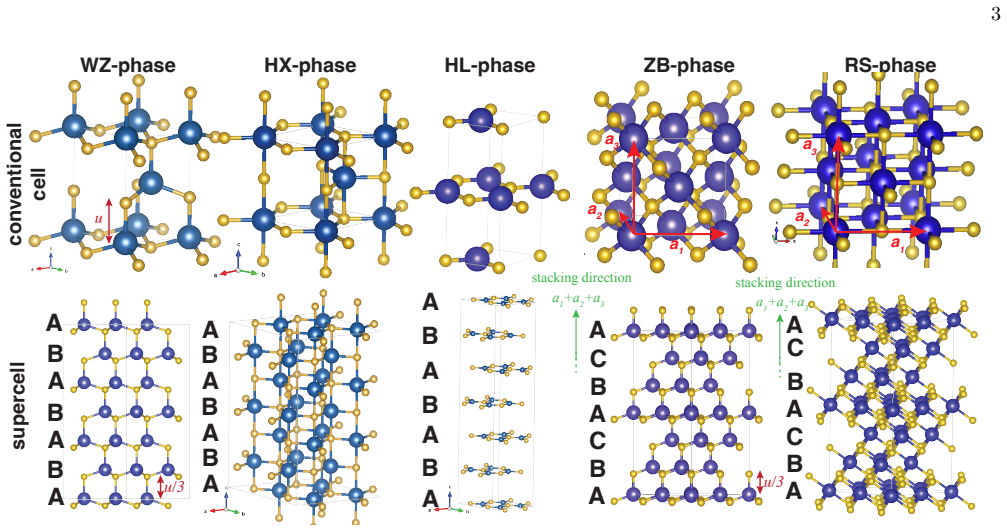
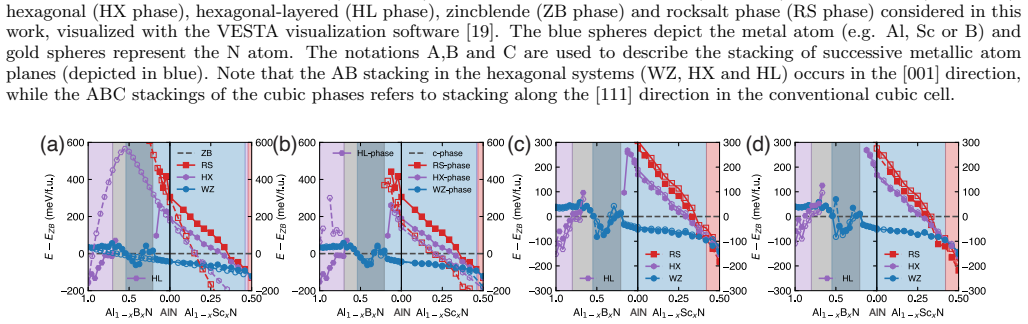
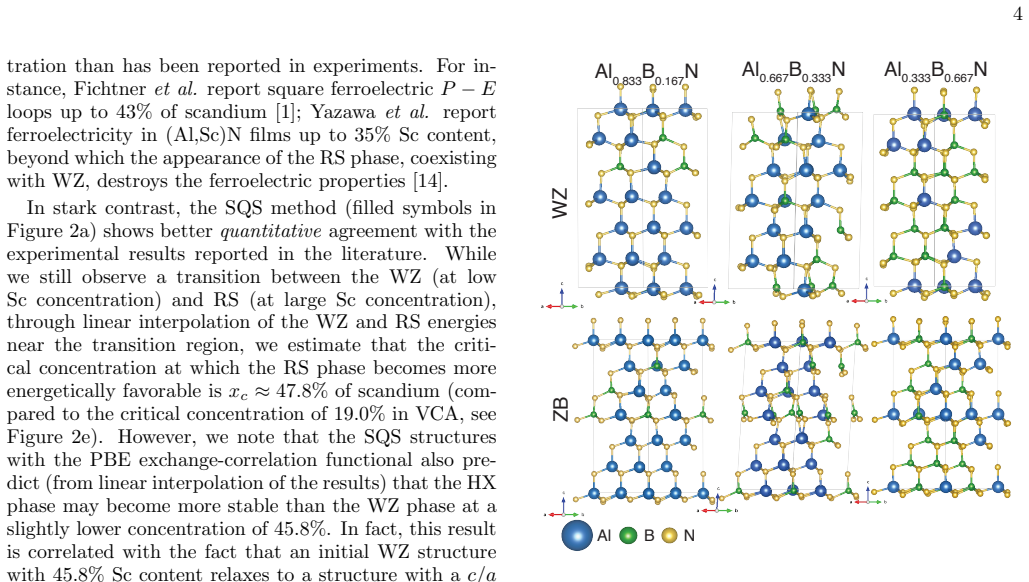
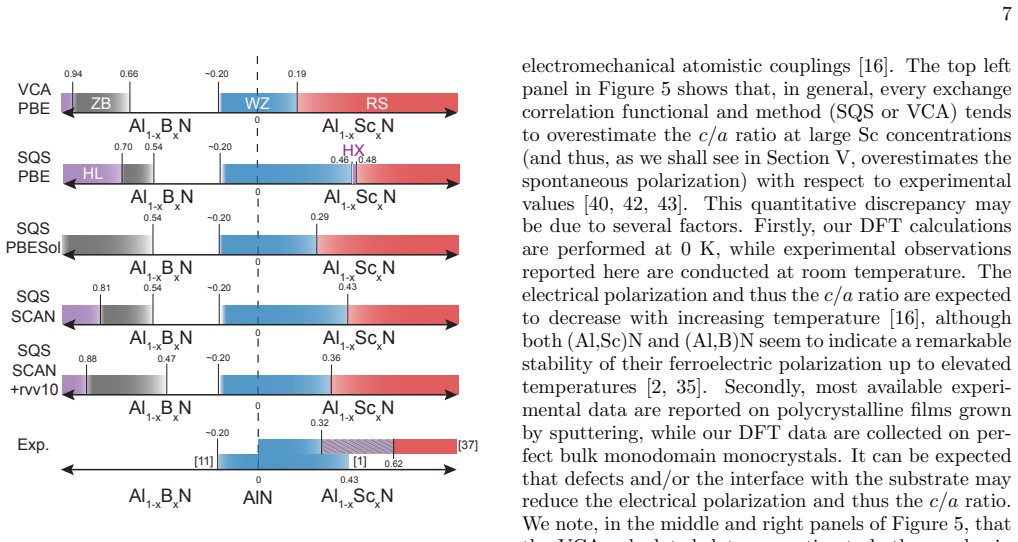
Within a single 48-atom supercell framework the authors find that VCA or SQS PBESol strongly underestimates the stability domain of the ferroelectric wurtzite phase in Al1-xScxN relative to SQS PBE or SQS SCAN. They identify the five-fold coordinated hexagonal phase previously predicted by Farrer and Bellaiche as a low-energy metastable state lying between four-fold wurtzite and six-fold rocksalt near the transition composition. Al1-xBxN instead shows rapid wurtzite destabilization accompanied by bond breaking that distorts the structure, raises polarization, and eventually favors zincblende or three-fold hexagonal layer phases. The analysis concludes that both local chemical disorder and th
What carries the argument
48-atom special quasirandom structures (SQS) that model random alloy disorder together with direct comparison of PBE, PBESol, and SCAN exchange-correlation functionals to compute relative phase energies.
If this is right
- VCA or PBESol results may incorrectly narrow the usable composition range for ferroelectric AlScN devices.
- The five-fold hexagonal phase can act as an intermediate during composition-driven transitions in AlScN.
- AlBN alloys lose the wurtzite ferroelectric phase at lower alloying levels than AlScN, with additional distorted and zincblende phases appearing.
- Accurate modeling of these nitrides requires explicit treatment of local disorder beyond mean-field approximations.
Where Pith is reading between the lines
- Device modeling that relies on PBESol phase diagrams may underestimate the range of compositions where polarization switching remains possible.
- The identified metastable phase suggests that kinetic pathways during growth could trap material in non-wurtzite structures even inside the nominal stability window.
- Extending the same SQS-plus-SCAN protocol to other III-V nitride alloys could reveal similar functional sensitivities.
- Comparison of computed polarization and band gaps against measured values on well-characterized samples would test whether the SCAN preference carries over to functional properties beyond phase stability.
Load-bearing premise
A 48-atom supercell with the chosen disorder models and functionals is large enough to give reliable relative energies and phase boundaries near the transition compositions.
What would settle it
Direct experimental determination of the scandium or boron fraction at which the wurtzite phase loses stability in Al1-xScxN or Al1-xBxN thin films, compared against the composition windows obtained from each method.
Figures
read the original abstract
We revisit first-principles predictions of structural, ferroelectric, and electronic properties in aluminum-based III-V nitride alloys, focusing on Al1-xScxN and Al1-xBxN. Using density functional theory within a unified 48-atom supercell framework, we systematically assess the role of chemical disorder and exchange-correlation approximations by comparing the virtual crystal approximation (VCA) and special quasirandom structures (SQS), as well as PBE, PBESol, SCAN, and SCAN+rVV10 functionals. We demonstrate that, even amongst the similar PBE and PBESol functionals, big quantitative and qualitative differences emerge. In particular, the VCA or SQS PBESol (a popular functional) strongly underestimate the stability domain of the ferroelectric wurtzite phase in Al1-xScxN compared to SQS PBE or SQS SCAN. We demonstrate that the 5-fold coordinated hexagonal phase predicted in 2002 by Farrer and Bellaiche [Phys. Rev. B 66, 201203] is a low-energy metastable state between the four-fold coordinated ferroelectric wurtzite phase and the six-fold coordinated rocksalt phase near the transition point upon increasing the Sc content. In contrast, Al1-xBxN shows a much faster destabilization of the wurtzite ferroelectric phase, with bond breaking which strongly distorts the wurtzite structure (with enhanced polarization) and eventually favor a zincblende phase and a threefold coordinated hexagonal layer phase. Our analysis highlights the critical importance of both local disorder and exchange-correlation treatment in predicting the functional properties of III-V nitride ferroelectrics. Overall, SQS combined with SCAN provides the most consistent theoretical framework for understanding and optimizing emerging nitride-based ferroelectric materials.
Editorial analysis
A structured set of objections, weighed in public.
Referee Report
Summary. The manuscript presents a systematic first-principles DFT comparison of VCA versus SQS disorder models and PBE/PBESol/SCAN/SCAN+rVV10 functionals for Al1-xScxN and Al1-xBxN alloys within a unified 48-atom supercell framework. It claims that SQS+SCAN yields the most consistent results, that VCA or SQS PBESol strongly underestimates the ferroelectric wurtzite stability domain relative to SQS PBE or SQS SCAN, that a 5-fold coordinated hexagonal phase is a low-energy metastable state near the wurtzite-rocksalt transition in AlScN, and that AlBN exhibits faster wurtzite destabilization toward zincblende and layered phases.
Significance. If the central comparisons hold, the work highlights the strong sensitivity of predicted phase boundaries and metastable states in nitride ferroelectrics to both chemical-disorder modeling and exchange-correlation choice, offering practical guidance for material optimization. The explicit identification of the 5-fold hexagonal metastable state and the side-by-side functional benchmarking constitute concrete additions to the literature.
major comments (1)
- [Abstract (unified 48-atom supercell framework) and associated methods/results sections] The quantitative claims on wurtzite stability domains (PBESol underestimation) and the location of the 5-fold hexagonal metastable state rest entirely on relative energies computed in 48-atom SQS supercells. No finite-size scaling, comparison to 96- or 192-atom cells, or explicit tests of periodic-image strain and local-relaxation constraints near the transition compositions are reported; this directly affects the load-bearing assertion that the observed functional differences are intrinsic rather than cell-size artifacts.
minor comments (2)
- The abstract states that 'big quantitative and qualitative differences emerge' between PBE and PBESol but does not preview the magnitude of the energy differences or cite the specific tables/figures that quantify them.
- Details on SQS generation procedure, k-point meshes, plane-wave cutoffs, and force/pressure convergence criteria are referenced only generically; these should be stated explicitly to allow reproduction.
Simulated Author's Rebuttal
We thank the referee for their careful reading of the manuscript and for highlighting the importance of finite-size effects in supercell calculations. We respond to the major comment below.
read point-by-point responses
-
Referee: [Abstract (unified 48-atom supercell framework) and associated methods/results sections] The quantitative claims on wurtzite stability domains (PBESol underestimation) and the location of the 5-fold hexagonal metastable state rest entirely on relative energies computed in 48-atom SQS supercells. No finite-size scaling, comparison to 96- or 192-atom cells, or explicit tests of periodic-image strain and local-relaxation constraints near the transition compositions are reported; this directly affects the load-bearing assertion that the observed functional differences are intrinsic rather than cell-size artifacts.
Authors: We acknowledge that all reported energies and phase stabilities derive from 48-atom SQS supercells and that no explicit finite-size scaling or direct comparisons to 96- or 192-atom cells are presented. The 48-atom size was adopted to maintain a single, computationally tractable framework that permits side-by-side evaluation of VCA versus SQS and of four different functionals across the full composition range. Prior literature on AlScN alloys has routinely employed comparable supercell sizes for SQS disorder modeling, and the functional-dependent trends we observe (most notably the systematic PBESol underestimation of the wurtzite domain relative to PBE and SCAN) are large, monotonic, and consistent with established functional biases in related nitride systems. Nevertheless, the absence of explicit convergence tests with respect to cell size leaves open the possibility that some quantitative details near the transition compositions could be influenced by periodic-image interactions. In the revised manuscript we will add a dedicated paragraph in the Methods and Discussion sections that (i) justifies the 48-atom choice on the basis of literature precedent and computational cost, (ii) cites existing benchmarks on cell-size convergence for similar Al-based nitrides, and (iii) notes the expected direction of any residual finite-size error. revision: partial
Circularity Check
No circularity; results derive from independent DFT energy computations
full rationale
The paper's claims rest on direct DFT total-energy comparisons across VCA/SQS disorder models and PBE/PBESol/SCAN functionals inside fixed 48-atom supercells. No parameters are fitted to the target stability domains or phase boundaries and then re-used as 'predictions'; the 5-fold hexagonal phase is recomputed rather than assumed from the 2002 Bellaiche citation; and no equation reduces to another by definition or self-citation chain. The central ranking of SQS+SCAN therefore follows from the computed numbers themselves, not from any input that already encodes the conclusion.
Axiom & Free-Parameter Ledger
axioms (2)
- domain assumption Density functional theory with the listed functionals accurately ranks the relative energies of wurtzite, rocksalt, and intermediate phases in these alloys.
- domain assumption The 48-atom supercell is large enough to represent both VCA and SQS disorder without finite-size artifacts affecting phase boundaries.
Reference graph
Works this paper leans on
-
[1]
Quite surprisingly, it can be observed that PBESol and PBE give very differ- ent quantitative results in (Al,Sc)N
PBE versus PBESol In Figure 2(b), we depict the energy of the relevant phases in (Al,Sc)N (right panel) and (Al,B)N (left panel) calculated with the PBESol (open symbols) and PBE (plain symbols) exchange correlation. Quite surprisingly, it can be observed that PBESol and PBE give very differ- ent quantitative results in (Al,Sc)N. Specifically, the RS phas...
-
[2]
The latter was deemed al- most as precise as the B1-WC hybrid functional over a wide range of ferroelectric materials, primarily oxides (e.g
PBE versus SCAN Let us now investigate how the semi-local GGA PBE exchange-correlation functional compares with the metaGGA SCAN functional. The latter was deemed al- most as precise as the B1-WC hybrid functional over a wide range of ferroelectric materials, primarily oxides (e.g. BaTiO 3, BiFeO3) and molecular ferroelectrics (e.g. KH2PO4, PhMDA) [18]. Z...
-
[3]
Although we do not expect to play a major role in (Al,Sc)N, the existence of the hexagonal layered phase in BN indicates that these effects may be significant in (Al,B)N
Effect of Van der Waals interactions Finally, we look at the role of potential van der Waals interactions in (Al,Sc)N and (Al,B)N. Although we do not expect to play a major role in (Al,Sc)N, the existence of the hexagonal layered phase in BN indicates that these effects may be significant in (Al,B)N. Here, van der Waals interactions are explored by combin...
-
[4]
[1], indicate that the ferroelectric WZ phase has been ob- served up to 43% scandium content in (Al,Sc)N films
Summary Early experimental reports, by Fichtner et al. [1], indicate that the ferroelectric WZ phase has been ob- served up to 43% scandium content in (Al,Sc)N films. As a result, it may indicate that the SCAN exchange- correlation functional applied on Special Quasirandom Structures may be more appropriate to model the fer- roelectric properties of (Al,S...
-
[5]
Pure AlN.Focusing on the ferroelectric WZ phase, Figure 5 shows its lattice constants along with thec/aratio in (Al,Sc)N and (Al,B)N
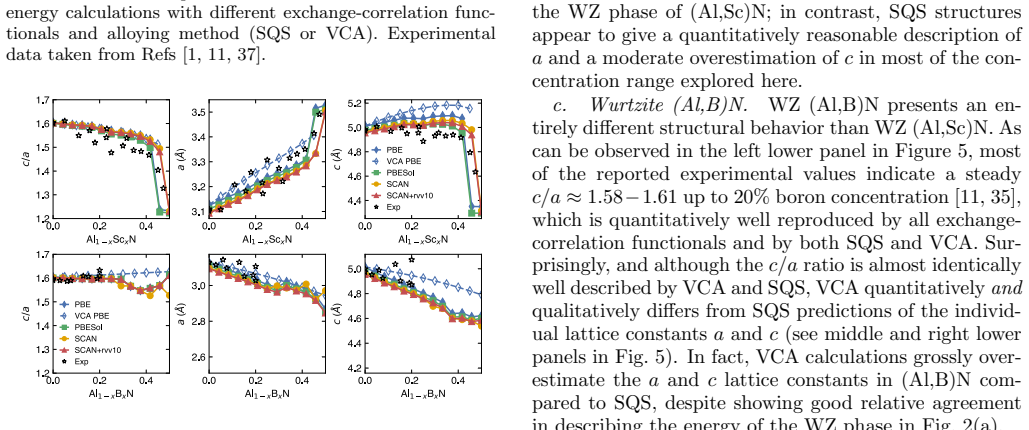
Ferroelectric wurtzite phase and exchange-correlation functionals a. Pure AlN.Focusing on the ferroelectric WZ phase, Figure 5 shows its lattice constants along with thec/aratio in (Al,Sc)N and (Al,B)N. As expected, the WZ phase of AlN shows ac/ain the range of 1.600 - 1.603 depending on the chosen exchange-correlation functional, which agrees almost perf...
2019
-
[6]
As we intend to compare the WZ, RS, HX, HL and ZB phases on an equal footing, we report the lattice constantaandcof the equivalent WZ unit cell
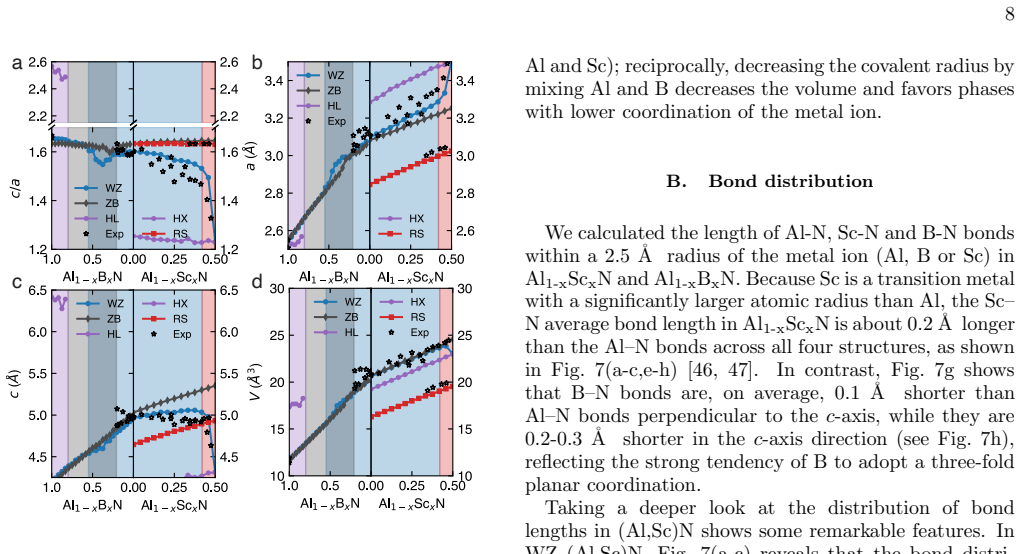
Comparison with other phases. As we intend to compare the WZ, RS, HX, HL and ZB phases on an equal footing, we report the lattice constantaandcof the equivalent WZ unit cell. This 8 a c b d FIG. 6. (a)c/aratio, (b)aand (c)clattice constants, and (d) volume per formula unit in (Al,B)N (left panels) and (Al,Sc)N (right panel). Values are reported for the SC...
-
[7]
Fichtner, N
S. Fichtner, N. Wolff, F. Lofink, L. Kienle, and B. Wag- ner, Alscn: A iii-v semiconductor based ferroelectric, Journal of Applied Physics125, 114103 (2019)
2019
-
[8]
M. R. Islam, N. Wolff, M. Yassine, G. Sch¨ onweger, B. Christian, H. Kohlstedt, O. Ambacher, F. Lofink, L. Kienle, and S. Fichtner, On the exceptional tempera- ture stability of ferroelectric al1-xscxn thin films, Applied Physics Letters118, 232905 (2021)
2021
-
[9]
K.-H. Kim, Z. Han, Y. Zhang, P. Musavigharavi, J. Zheng, D. K. Pradhan, E. A. Stach, R. H. Ols- son, and D. Jariwala, Multistate, ultrathin, back-end-of- line-compatible alscn ferroelectric diodes, ACS Nano18, 15925 (2024)
2024
-
[10]
Z. Hu, H. Cho, R. K. Rai, K. Bao, Y. Zhang, Z. Qu, Y. He, Y. Ji, C. Leblanc, K.-H. Kim, Z. Han, Z. Qiu, X. Du, E. A. Stach, R. Olsson, and D. Jariwala, Demon- stration of highly scaled alscn ferroelectric diode memory with a storage density of>100 mbit/mm 2, Nano Letters 25, 13748 (2025)
2025
-
[11]
G. Yang, H. Wang, S. Mu, H. Xie, T. Wang, C. He, M. Shen, M. Liu, C. G. V. de Walle, and H. X. Tang, Unveiling the pockels coefficient of ferroelectric nitride scaln, Nature Communications15, 9538 (2024)
2024
-
[12]
H. Wang, S. Mu, and C. G. V. de Walle, Towards higher 15 electro-optic response in alscn, Applied Physics Letters 126, 041901 (2025)
2025
-
[13]
D. Wang, S. Yang, J. Liu, D. Wang, and Z. Mi, Perspec- tives on nitride ferroelectric semiconductors: Challenges and opportunities, Applied Physics Letters124, 150501 (2024)
2024
-
[14]
Farrer and L
N. Farrer and L. Bellaiche, Properties of hexagonal scn versus wurtzite gan and inn, Physical Review B66, 201203 (2002)
2002
-
[15]
Limpijumnong and W
S. Limpijumnong and W. R. L. Lambrecht, Theoretical study of the relative stability of wurtzite and rocksalt phases in mgo and gan, Physical Review B63, 104103 (2001)
2001
-
[16]
N. A. Pike, R. Pachter, W. J. Kennedy, and N. Glavin, Understanding the structure and polarization in ferro- electric alscn, scgan, and alscgan from first principles calculations, Physical Review B112, 085204 (2025)
2025
-
[17]
Calderon, J
S. Calderon, J. Hayden, M. Delower, J. P. Maria, and E. C. Dickey, Effect of boron concentration on local struc- ture and spontaneous polarization in albn thin films, APL Materials12, 021105 (2024)
2024
-
[18]
J. P. Perdew, A. Ruzsinszky, G. I. Csonka, O. A. Vydrov, G. E. Scuseria, L. A. Constantin, X. Zhou, and K. Burke, Restoring the density-gradient expansion for exchange in solids and surfaces, Physical Review Letters100, 136406 (2008)
2008
-
[19]
J. P. Perdew, K. Burke, and M. Ernzerhof, Generalized gradient approximation made simple, Physical Review Letters77, 3865 (1996)
1996
-
[20]
Yazawa, J
K. Yazawa, J. S. Mangum, P. Gorai, G. L. Brennecka, and A. Zakutayev, Local chemical origin of ferroelectric behavior in wurtzite nitrides, Journal of Materials Chem- istry C10, 17557 (2022)
2022
-
[21]
Calderon, J
S. Calderon, J. Hayden, S. M. Baksa, W. Tzou, S. Trolier- McKinstry, I. Dabo, J.-P. Maria, and E. C. Dickey, Atomic-scale polarization switching in wurtzite ferro- electrics, Science380, 1034 (2023)
2023
-
[22]
P. Chen, D. Wang, A. M. Tejerina, K. Yazawa, A. Zaku- tayev, C. Paillard, and L. Bellaiche, Towards a deeper fundamental understanding of (al,sc)n ferroelectric ni- trides, Physical Review Materials9, 124418 (2025)
2025
-
[23]
Arras, C
R. Arras, C. Paillard, and L. Bellaiche, Magnetoelectric properties at the co/aln(0001) interface, Physical Review Materials10, 014411 (2026)
2026
-
[24]
Zhang, J
Y. Zhang, J. Sun, J. P. Perdew, and X. Wu, Comparative first-principles studies of prototypical ferroelectric mate- rials by lda, gga, and scan meta-gga, Physical Review B 96, 035143 (2017)
2017
-
[25]
Momma and F
K. Momma and F. Izumi, Vesta : a three-dimensional vi- sualization system for electronic and structural analysis, Journal of Applied Crystallography41, 653 (2008)
2008
-
[26]
Kresse and J
G. Kresse and J. Hafner, Ab initio molecular-dynamics simulation of the liquid-metal–amorphous-semiconductor transition in germanium, Physical Review B49, 14251 (1994)
1994
-
[27]
Kresse and J
G. Kresse and J. Furthm¨ uller, Efficiency of ab-initio total energy calculations for metals and semiconductors using a plane-wave basis set, Computational Materials Science 6, 15 (1996)
1996
-
[28]
P. E. Bl¨ ochl, Projector augmented-wave method, Physi- cal Review B50, 17953 (1994)
1994
-
[29]
Kresse and D
G. Kresse and D. Joubert, From ultrasoft pseudopoten- tials to the projector augmented-wave method, Physical Review B59, 1758 (1999)
1999
-
[30]
J. P. Perdew, K. Burke, and M. Ernzerhof, Generalized gradient approximation made simple, Physical Review Letters78, 1396 (1997)
1997
-
[31]
J. Sun, A. Ruzsinszky, and J. P. Perdew, Strongly con- strained and appropriately normed semilocal density functional, Physical Review Letters115, 036402 (2015)
2015
-
[32]
Sabatini, T
R. Sabatini, T. Gorni, and S. de Gironcoli, Nonlocal van der waals density functional made simple and efficient, Physical Review B87, 041108 (2013)
2013
-
[33]
Peng, Z.-H
H. Peng, Z.-H. Yang, J. P. Perdew, and J. Sun, Versa- tile van der waals density functional based on a meta- generalized gradient approximation, Physical Review X 6, 041005 (2016)
2016
-
[34]
Zunger, S
A. Zunger, S. H. Wei, L. G. Ferreira, and J. E. Bernard, Special quasirandom structures, Physical Review Letters 65, 353 (1990)
1990
-
[35]
van de Walle, P
A. van de Walle, P. Tiwary, M. de Jong, D. Olmsted, M. Asta, A. Dick, D. Shin, Y. Wang, L.-Q. Chen, and Z.- K. Liu, Efficient stochastic generation of special quasir- andom structures, Calphad42, 13 (2013)
2013
-
[36]
Ghosez, D
P. Ghosez, D. Dequesnes, X. Gonze, and K. Rabe, First- principles study of lattice instabilities in ba xsr1-xtio3, in AIP Conference Proceedings, Vol. 535 (AIP, 2000) pp. 102–110
2000
-
[37]
Bellaiche and D
L. Bellaiche and D. Vanderbilt, Virtual crystal approxi- mation revisited: Application to dielectric and piezoelec- tric properties of perovskites, Physical Review B61, 7877 (2000)
2000
-
[38]
R. S. Pease, Crystal structure of boron nitride, Nature 165, 722 (1950)
1950
-
[39]
F. R. Corrigan and F. P. Bundy, Direct transitions among the allotropic forms of boron nitride at high pressures and temperatures, The Journal of Chemical Physics63, 3812 (1975)
1975
-
[40]
Cazorla and T
C. Cazorla and T. Gould, Polymorphism of bulk boron nitride, Science Advances5, eaau5832 (2019)
2019
-
[41]
Hayden, M
J. Hayden, M. D. Hossain, Y. Xiong, K. Ferri, W. Zhu, M. V. Imperatore, N. Giebink, S. Trolier-Mckinstry, I. Dabo, and J. P. Maria, Ferroelectricity in boron- substituted aluminum nitride thin films, Physical Review Materials5, 044412 (2021)
2021
-
[42]
A. Paul, J. Sun, J. P. Perdew, and U. V. Waghmare, Accuracy of first-principles interatomic interactions and predictions of ferroelectric phase transitions in perovskite oxides: Energy functional and effective hamiltonian, Physical Review B95, 054111 (2017)
2017
-
[43]
K. R. Talley, S. L. Millican, J. Mangum, S. Siol, C. B. Musgrave, B. Gorman, A. M. Holder, A. Zakutayev, and G. L. Brennecka, Implications of heterostructural alloy- ing for enhanced piezoelectric performance of (al,sc)n, Physical Review Materials2, 063802 (2018)
2018
-
[44]
S. Liu, O. Cohen, O. Neufeld, and P. Chen, Laser-driven structural transformation from a bulk crystal to a layered material, Physical Review Letters136, 086902 (2026)
2026
-
[45]
V. L. Solozhenko, V. Z. Turkevich, and W. B. Holzapfel, Refined phase diagram of boron nitride, The Journal of Physical Chemistry B103, 2903 (1999)
1999
-
[46]
Satoh, K
S. Satoh, K. Ohtaka, T. Shimatsu, and S. Tanaka, Crystal structure deformation and phase transition of alscn thin films in whole sc concentration range, Journal of Applied Physics132, 025103 (2022)
2022
-
[47]
Schulz and K
H. Schulz and K. Thiemann, Crystal structure refine- ment of aln and gan, Solid State Communications23, 815 (1977). 16
1977
-
[48]
Akiyama, T
M. Akiyama, T. Kamohara, K. Kano, A. Teshigahara, Y. Takeuchi, and N. Kawahara, Enhancement of piezo- electric response in scandium aluminum nitride alloy thin films prepared by dual reactive cosputtering, Advanced Materials21, 593 (2009)
2009
-
[49]
G. A. Alvarez, J. Casamento, L. van Deurzen, M. I. Khan, K. Khan, E. Jeong, E. Ahmadi, H. G. Xing, D. Jena, and Z. Tian, Thermal conductivity enhancement of aluminum scandium nitride grown by molecular beam epitaxy, Materials Research Letters11, 1048 (2023)
2023
-
[50]
Cordero, V
B. Cordero, V. G´ omez, A. E. Platero-Prats, M. Rev´ es, J. Echeverr´ ıa, E. Cremades, F. Barrag´ an, and S. Al- varez, Covalent radii revisited, Dalton Transactions , 2832 (2008)
2008
-
[51]
Yoshiasa, Y
A. Yoshiasa, Y. Murai, O. Ohtaka, and T. Katsura, De- tailed structures of hexagonal diamond (lonsdaleite) and wurtzite-type bn, Japanese Journal of Applied Physics 42, 1694 (2003)
2003
-
[52]
Zhang and et al., New-generation ferroelectric alscn materials, Nano-Micro Letters16, 227 (2024)
Y. Zhang and et al., New-generation ferroelectric alscn materials, Nano-Micro Letters16, 227 (2024)
2024
-
[53]
Bhattarai and et al., Effect of sc spatial distribution on the electronic and ferroelectric properties of alscn, Mate- rials Horizons11, 5402 (2024)
B. Bhattarai and et al., Effect of sc spatial distribution on the electronic and ferroelectric properties of alscn, Mate- rials Horizons11, 5402 (2024)
2024
-
[54]
Resta, Theory of the electric polarization in crystals, Ferroelectrics136, 51 (1992)
R. Resta, Theory of the electric polarization in crystals, Ferroelectrics136, 51 (1992)
1992
-
[55]
Vanderbilt and R
D. Vanderbilt and R. D. King-Smith, Electric polariza- tion as a bulk quantity and its relation to surface charge, Physical Review B48, 4442 (1993)
1993
-
[56]
Resta, Macroscopic polarization in crystalline di- electrics: the geometric phase approach, Reviews of Mod- ern Physics66, 899 (1994)
R. Resta, Macroscopic polarization in crystalline di- electrics: the geometric phase approach, Reviews of Mod- ern Physics66, 899 (1994)
1994
-
[57]
C. E. Dreyer, A. Janotti, C. G. V. de Walle, and D. Van- derbilt, Correct implementation of polarization constants in wurtzite materials and impact on iii-nitrides, Physical Review X6, 021038 (2016)
2016
-
[58]
Messi, J
F. Messi, J. Patidar, N. Rodkey, C. W. Dr¨ ayer, M. Trassin, and S. Siol, Ferroelectric alscn thin films with enhanced polarization and low leakage enabled by high- power impulse magnetron sputtering, APL Materials13, 051123 (2025)
2025
-
[59]
Drury, K
D. Drury, K. Yazawa, A. Zakutayev, B. Hanrahan, and G. Brennecka, High-temperature ferroelectric behavior of al0.7sc0.3n, Micromachines13, 887 (2022)
2022
-
[60]
Yasuoka, T
S. Yasuoka, T. Shimizu, A. Tateyama, M. Uehara, H. Ya- mada, M. Akiyama, Y. Hiranaga, Y. Cho, and H. Fu- nakubo, Effects of deposition conditions on the ferroelec- tric properties of (al 1-xscx)n thin films, Journal of Ap- plied Physics128, 114103 (2020)
2020
-
[61]
S. Song, D. K. Pradhan, Z. Hu, Y. Zhang, R. N. Keneipp, M. A. Susner, P. Bhattacharya, M. Drndi´ c, R. H. Olsson, and D. Jariwala, Observation of giant remnant polariza- tion in ultrathin alscn at cryogenic temperatures, ArXiv (2025)
2025
-
[62]
Jiang, C
Z. Jiang, C. Paillard, D. Vanderbilt, H. Xiang, and L. Bellaiche, Designing multifunctionality via assem- bling dissimilar materials: Epitaxial aln/scn superlat- tices, Physical Review Letters123, 096801 (2019)
2019
-
[63]
C.-W. Lee, R. W. Smaha, G. L. Brennecka, N. M. Haegel, P. Gorai, and K. Yazawa, From prediction to experimen- tal realization of ferroelectric wurtzite al 1-xgdxn alloys, APL Materials13, 10.1063/5.0251168 (2025)
-
[64]
Savant, V
C. Savant, V. Gund, K. Nomoto, T. Maeda, S. Jadhav, J. Lee, M. Ramesh, E. Kim, T.-S. Nguyen, Y.-H. Chen, J. Casamento, F. Rana, A. Lal, H. G. Xing, and D. Jena, Ferroelectric albn films by molecular beam epitaxy, Ap- plied Physics Letters125, 072902 (2024)
2024
-
[65]
W. Zhu, F. He, J. Hayden, Z. Fan, J. I. Yang, J. Maria, and S. Trolier-McKinstry, Wake-up in al 1-xbxn ferro- electric films, Advanced Electronic Materials8, 2100931 (2022)
2022
-
[66]
Mourad and G
D. Mourad and G. Czycholl, Theory of band gap bowing of disordered substitutional ii–vi and iii–v semiconductor alloys, The European Physical Journal B85, 153 (2012)
2012
-
[67]
A. Roy, K. Sieradzki, J. M. Rondinelli, and I. D. Mc- Cue, Effect of chemical short-range order and percolation on passivation in binary alloys, Physical Review B110, 085420 (2024)
2024
-
[68]
See Supplemental Material atURL_will_be_inserted_ by_publisherfor additional data on the electronic bandgap of (Al,Sc)N and (Al,B)N, bowing parameters in the wurtzite and zincblende phases of (Al,B)N
discussion (0)
Sign in with ORCID, Apple, or X to comment. Anyone can read and Pith papers without signing in.