Evolving Robustness--Exploration Trade-off in Online Reinforcement Learning via Quantile Bayesian Risk MDPs
Pith reviewed 2026-06-30 15:07 UTC · model grok-4.3
The pith
Quantile levels in Bayesian risk MDPs can be scheduled adaptively to trade early robustness for later exploration while achieving sublinear Bayesian regret.
A machine-rendered reading of the paper's core claim, the machinery that carries it, and where it could break.
Core claim
The central claim is that quantile BR-MDPs, controlled by an adaptive quantile schedule, achieve sublinear Bayesian regret bounds with respect to both the true optimal value and the optimal BR-MDP robust value. The schedule works because upper- and lower-tail quantiles induce optimism or pessimism toward epistemic uncertainty, with the magnitude of this effect decreasing as data accumulate.
What carries the argument
The quantile Bayesian risk-aware Markov decision process (BR-MDP), in which the quantile level determines how posterior uncertainty enters the Bellman backup.
If this is right
- The adaptive quantile schedule places more weight on robustness early when uncertainty is high and shifts toward exploration of less-visited pairs later.
- Sublinear regret is guaranteed simultaneously to the true-environment optimum and to the robust optimum defined by the BR-MDP.
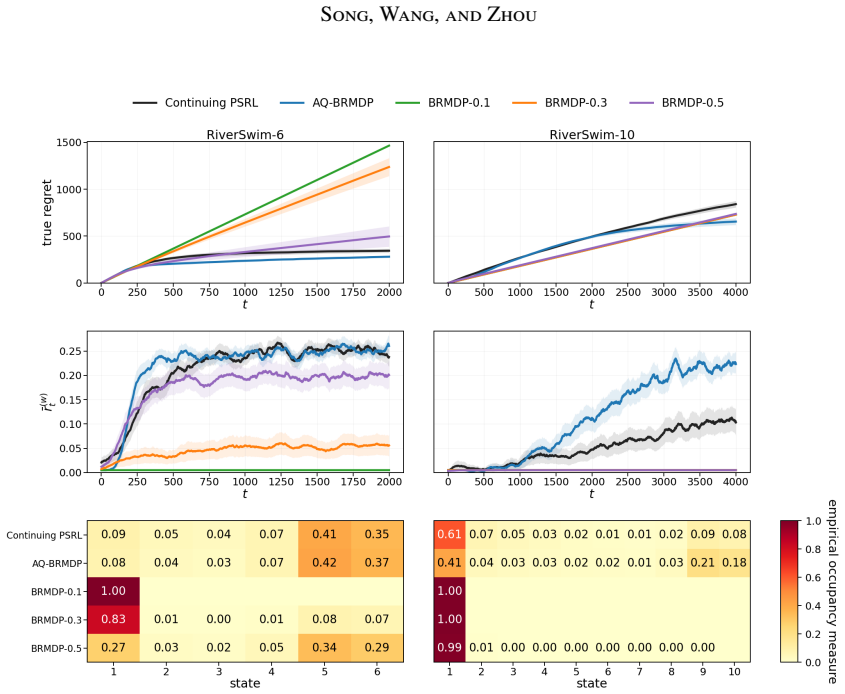
- The method performs well in both exploration-demanding and exploration-costly environments according to the reported experiments.
- The characterization via asymptotic normality directly justifies decreasing the influence of uncertainty as data grow.
Where Pith is reading between the lines
- Similar adaptive schedules could be derived for other risk measures that admit an asymptotic normality characterization.
- The approach may reduce unsafe early behavior in physical systems where early mistakes are costly.
- The regret bounds suggest that the same framework could be applied to risk-sensitive variants of other online decision problems.
Load-bearing premise
The asymptotic normality result for the difference between the quantile BR-MDP value and the true-environment value holds and implies that the magnitude of optimism or pessimism decreases with data accumulation.
What would settle it
A simulation or experiment in which the Bayesian regret grows faster than sublinear or in which the optimism or pessimism induced by tail quantiles fails to diminish as the number of samples increases.
Figures

read the original abstract
In online reinforcement learning, data scarcity creates epistemic uncertainty that makes robustness important early in learning, whereas sufficient exploration is needed to learn the true-environment optimal policy. We study this time-varying robustness--exploration trade-off through a quantile Bayesian risk-aware Markov decision process (BR-MDP), in which the quantile level controls how posterior uncertainty enters the Bellman backup. We characterize this control through an asymptotic normality result for the difference between the quantile BR-MDP value and the value in the true environment. The result implies that upper/lower-tail quantiles induce optimism/pessimism towards epistemic uncertainty, and the magnitude of the optimism/pessimism decreases as data accumulate. Building on this characterization, we propose an online Bayesian risk-aware algorithm with an adaptive quantile schedule that emphasizes robustness early and gradually encourages exploration of less-visited state--action pairs. We establish sublinear Bayesian regret bounds with respect to both the true optimal value and the optimal BR-MDP robust value. Numerical experiments demonstrate strong performance in both exploration-demanding and exploration-costly environments.
Editorial analysis
A structured set of objections, weighed in public.
Referee Report
Summary. The manuscript proposes a quantile Bayesian risk-aware MDP (BR-MDP) framework for online RL in which the quantile level governs how posterior epistemic uncertainty enters the Bellman backup. An asymptotic normality result is derived for the difference between the quantile BR-MDP value and the true-environment value; this is used to motivate an adaptive quantile schedule that begins robust (extreme quantiles) and gradually shifts toward exploration (quantiles near 0.5) as visitation counts increase. An online algorithm implementing this schedule is analyzed, yielding sublinear Bayesian regret bounds simultaneously with respect to the true optimal value and the optimal BR-MDP robust value. Experiments illustrate performance in exploration-demanding and exploration-costly settings.
Significance. If the central derivations hold, the work supplies a principled, time-varying mechanism for balancing robustness against epistemic uncertainty with the need for exploration, together with dual regret guarantees. The explicit link between quantile choice and optimism/pessimism decay, if rigorously justified, would be a useful addition to risk-aware RL.
major comments (1)
- [asymptotic normality result and its use in the adaptive schedule and regret analysis] The asymptotic normality result is stated for a fixed quantile level. The algorithm and regret analysis instead employ a time-varying adaptive schedule q_t that depends on the empirical visitation measure. The centering and scaling arguments that produce the normal limit do not automatically extend to this data-dependent, changing quantile; consequently the claimed rate at which optimism/pessimism vanishes (and therefore the validity of the subsequent Bayesian regret bounds) is not guaranteed. This issue is load-bearing for the central claims.
minor comments (2)
- Clarify the precise definition of the BR-MDP value function and how the quantile is inserted into the Bellman operator (e.g., which equation).
- The experimental section would benefit from explicit reporting of environment details, number of runs, and statistical significance of the reported performance differences.
Simulated Author's Rebuttal
We thank the referee for their careful reading and constructive feedback. We address the major comment below.
read point-by-point responses
-
Referee: [asymptotic normality result and its use in the adaptive schedule and regret analysis] The asymptotic normality result is stated for a fixed quantile level. The algorithm and regret analysis instead employ a time-varying adaptive schedule q_t that depends on the empirical visitation measure. The centering and scaling arguments that produce the normal limit do not automatically extend to this data-dependent, changing quantile; consequently the claimed rate at which optimism/pessimism vanishes (and therefore the validity of the subsequent Bayesian regret bounds) is not guaranteed. This issue is load-bearing for the central claims.
Authors: We agree that the stated asymptotic normality holds for fixed quantiles and that the adaptive schedule q_t is data-dependent. The fixed-quantile result is used primarily to motivate the form of the schedule (extreme quantiles early, approaching 0.5 later). To close the gap for the regret bounds, we will revise the analysis to handle the time-varying case by showing that q_t varies sufficiently slowly (only at visitation increments) for the centering and scaling to carry through with an additional o(1) perturbation term that does not affect the sublinear regret rates. The revised proof will appear in an updated appendix. revision: yes
Circularity Check
No circularity: asymptotic normality result presented as independent characterization; adaptive schedule and regret bounds do not reduce to inputs by construction
full rationale
The paper derives an asymptotic normality result for the difference between quantile BR-MDP value and true-environment value, then uses it to motivate an adaptive quantile schedule and establish regret bounds w.r.t. both true optimal and BR-MDP optimal values. No equations or text in the abstract or description show the normality result being obtained by fitting parameters to the target quantities, self-definition of BR-MDP in terms of the schedule, or load-bearing self-citations. The derivation chain remains self-contained against external benchmarks, with the normality serving as a first-principles characterization rather than a renamed or fitted input.
Axiom & Free-Parameter Ledger
Reference graph
Works this paper leans on
-
[1]
Proceedings of the Thirty-First Conference on Uncertainty in Artificial Intelligence, 1--11
Abbasi-Yadkori Y, Szepesv \'a ri C (2015) Bayesian optimal control of smoothly parameterized systems. Proceedings of the Thirty-First Conference on Uncertainty in Artificial Intelligence, 1--11
2015
-
[2]
Mathematics of Operations Research 48(1):363--392
Agrawal S, Jia R (2023) Optimistic posterior sampling for reinforcement learning: Worst-case regret bounds. Mathematics of Operations Research 48(1):363--392
2023
-
[3]
Proceedings of the 34th International Conference on Machine Learning, volume 70 of Proceedings of Machine Learning Research, 263--272
Azar MG, Osband I, Munos R (2017) Minimax regret bounds for reinforcement learning. Proceedings of the 34th International Conference on Machine Learning, volume 70 of Proceedings of Machine Learning Research, 263--272
2017
-
[4]
Proceedings of the 38th International Conference on Machine Learning, volume 139 of Proceedings of Machine Learning Research, 511--520
Badrinath KP, Kalathil D (2021) Robust reinforcement learning using least squares policy iteration with provable performance guarantees. Proceedings of the 38th International Conference on Machine Learning, volume 139 of Proceedings of Machine Learning Research, 511--520
2021
-
[5]
Proceedings of the Twenty-Fifth Conference on Uncertainty in Artificial Intelligence, 35--42 (AUAI Press)
Bartlett PL, Tewari A (2009) REGAL : A regularization based algorithm for reinforcement learning in weakly communicating MDP s. Proceedings of the Twenty-Fifth Conference on Uncertainty in Artificial Intelligence, 35--42 (AUAI Press)
2009
-
[6]
Advances in Neural Information Processing Systems, volume 36
Blanchet J, Lu M, Zhang T, Zhong H (2023) Double pessimism is provably efficient for distributionally robust offline reinforcement learning: Generic algorithm and robust partial coverage. Advances in Neural Information Processing Systems, volume 36
2023
-
[7]
Electronic Journal of Statistics 3:114--148
Boucheron S, Gassiat E (2009) A Bernstein--von Mises theorem for discrete probability distributions. Electronic Journal of Statistics 3:114--148
2009
-
[8]
Journal of Machine Learning Research 3:213--231
Brafman RI, Tennenholtz M (2002) R-MAX : A general polynomial time algorithm for near-optimal reinforcement learning. Journal of Machine Learning Research 3:213--231
2002
-
[9]
Operations Research 58(1):203--213, ://dx.doi.org/10.1287/opre.1080.0685
Delage E, Mannor S (2010) Percentile optimization for Markov decision processes with parameter uncertainty. Operations Research 58(1):203--213, ://dx.doi.org/10.1287/opre.1080.0685
-
[10]
Der Kiureghian A, Ditlevsen O (2009) Aleatory or epistemic? Does it matter? Structural Safety 31(2):105--112
2009
-
[11]
Dong J, Li J, Wang B, Zhang J (2022) Online policy optimization for robust MDP . ArXiv:2209.13841
-
[12]
International Conference on Learning Representations
Dong K, Wang Y, Chen X, Wang L (2020) Q -learning with UCB exploration is sample efficient for infinite-horizon MDP . International Conference on Learning Representations
2020
-
[13]
Duff MO (2002) Optimal Learning: Computational Procedures for Bayes -adaptive Markov Decision Processes . Ph.D. thesis, University of Massachusetts Amherst
2002
-
[14]
Machine Learning 110(9):2419--2468
Dulac-Arnold G, Levine N, Mankowitz DJ, Li J, Paduraru C, Gowal S, Hester T (2021) Challenges of real-world reinforcement learning: Definitions, benchmarks and analysis. Machine Learning 110(9):2419--2468
2021
-
[15]
Proceedings of the Twenty Third International Conference on Artificial Intelligence and Statistics, volume 108 of Proceedings of Machine Learning Research, 1431--1441
Garcelon E, Ghavamzadeh M, Lazaric A, Pirotta M (2020) Conservative exploration in reinforcement learning. Proceedings of the Twenty Third International Conference on Artificial Intelligence and Statistics, volume 108 of Proceedings of Machine Learning Research, 1431--1441
2020
-
[16]
Foundations and Trends in Machine Learning 8(5--6):359--483
Ghavamzadeh M, Mannor S, Pineau J, Tamar A (2015) Bayesian reinforcement learning: A survey. Foundations and Trends in Machine Learning 8(5--6):359--483
2015
-
[17]
Proceedings of the AAAI Conference on Artificial Intelligence 40(25):21278--21286
Ghosh D, Atia GK, Wang Y (2026) ORVIT : Near-optimal online distributionally robust reinforcement learning. Proceedings of the AAAI Conference on Artificial Intelligence 40(25):21278--21286
2026
-
[18]
Advances in Neural Information Processing Systems, volume 34, 22288--22300
He J, Zhou D, Gu Q (2021) Nearly minimax optimal reinforcement learning for discounted MDP s. Advances in Neural Information Processing Systems, volume 34, 22288--22300
2021
-
[19]
Mathematics of Operations Research 30(2):257--280
Iyengar GN (2005) Robust dynamic programming. Mathematics of Operations Research 30(2):257--280
2005
-
[20]
Journal of Machine Learning Research 11(51):1563--1600
Jaksch T, Ortner R, Auer P (2010) Near-optimal regret bounds for reinforcement learning. Journal of Machine Learning Research 11(51):1563--1600
2010
-
[21]
Jin C, Allen-Zhu Z, Bubeck S, Jordan MI (2018) Is Q -learning provably efficient? Advances in Neural Information Processing Systems, volume 31
2018
-
[22]
Machine Learning 49(2--3):209--232
Kearns M, Singh S (2002) Near-optimal reinforcement learning in polynomial time. Machine Learning 49(2--3):209--232
2002
-
[23]
Proceedings of the AAAI Conference on Artificial Intelligence 39(27):28195--28203
Liang B, Xu L, Taneja A, Tambe M, Janson L (2025) Context in public health for underserved communities: A Bayesian approach to online restless bandits. Proceedings of the AAAI Conference on Artificial Intelligence 39(27):28195--28203
2025
-
[24]
Advances in Neural Information Processing Systems, volume 35, 17430--17442
Lin Y, Ren Y, Zhou E (2022) Bayesian risk Markov decision processes. Advances in Neural Information Processing Systems, volume 35, 17430--17442
2022
-
[25]
Proceedings of the AAAI Conference on Artificial Intelligence 39(25):26605--26613
Lin Y, Zhou E (2025) Approximate bilevel difference convex programming for Bayesian risk Markov decision processes. Proceedings of the AAAI Conference on Artificial Intelligence 39(25):26605--26613
2025
-
[26]
Advances in Neural Information Processing Systems, volume 37
Lu M, Zhong H, Zhang T, Blanchet J (2024) Distributionally robust reinforcement learning with interactive data collection: Fundamental hardness and near-optimal algorithms. Advances in Neural Information Processing Systems, volume 37
2024
-
[27]
International Conference on Learning Representations
Ma J, Lee WS (2026) EUBRL : Epistemic uncertainty directed Bayesian reinforcement learning. International Conference on Learning Representations
2026
-
[28]
Operations Research 53(5):780--798
Nilim A, El Ghaoui L (2005) Robust control of Markov decision processes with uncertain transition matrices. Operations Research 53(5):780--798
2005
-
[29]
Advances in Neural Information Processing Systems, volume 26
Osband I, Russo D, Van Roy B (2013) (More) efficient reinforcement learning via posterior sampling. Advances in Neural Information Processing Systems, volume 26
2013
-
[30]
Posterior Sampling for Reinforcement Learning Without Episodes
Osband I, Van Roy B (2016) Posterior sampling for reinforcement learning without episodes. arXiv preprint arXiv:1608.02731
work page internal anchor Pith review Pith/arXiv arXiv 2016
-
[31]
Osband I, Van Roy B (2017) Why is posterior sampling better than optimism for reinforcement learning? Proceedings of the 34th International Conference on Machine Learning, volume 70 of Proceedings of Machine Learning Research, 2701--2710 (PMLR)
2017
-
[32]
Proceedings of The 25th International Conference on Artificial Intelligence and Statistics, volume 151 of Proceedings of Machine Learning Research, 9582--9602
Panaganti K, Kalathil D (2022) Sample complexity of robust reinforcement learning with a generative model. Proceedings of The 25th International Conference on Artificial Intelligence and Statistics, volume 151 of Proceedings of Machine Learning Research, 9582--9602
2022
-
[33]
Advances in Neural Information Processing Systems, volume 35, 32211--32224
Panaganti K, Xu Z, Kalathil D, Ghavamzadeh M (2022) Robust reinforcement learning using offline data. Advances in Neural Information Processing Systems, volume 35, 32211--32224
2022
-
[34]
Proceedings of the 23rd International Conference on Machine Learning, 697--704
Poupart P, Vlassis N, Hoey J, Regan K (2006) An analytic solution to discrete Bayesian reinforcement learning. Proceedings of the 23rd International Conference on Machine Learning, 697--704
2006
-
[35]
Puterman ML (1994) Markov Decision Processes: Discrete Stochastic Dynamic Programming (New York: John Wiley & Sons)
1994
-
[36]
Advances in Neural Information Processing Systems, volume 20, 1225--1232
Ross S, Chaib-draa B, Pineau J (2007) Bayes -adaptive POMDP s. Advances in Neural Information Processing Systems, volume 20, 1225--1232
2007
-
[37]
Foundations and Trends in Machine Learning 11(1):1--96
Russo DJ, Van Roy B, Kazerouni A, Osband I, Wen Z (2018) A tutorial on Thompson sampling. Foundations and Trends in Machine Learning 11(1):1--96
2018
-
[38]
Proceedings of the 23rd International Conference on Machine Learning, 881--888 (ACM)
Strehl AL, Li L, Wiewiora E, Langford J, Littman ML (2006) PAC model-free reinforcement learning. Proceedings of the 23rd International Conference on Machine Learning, 881--888 (ACM)
2006
-
[39]
Journal of Computer and System Sciences 74(8):1309--1331
Strehl AL, Littman ML (2008) An analysis of model-based interval estimation for Markov decision processes. Journal of Computer and System Sciences 74(8):1309--1331
2008
-
[40]
Tarbouriech J, Lattimore T, O'Donoghue B (2023) Probabilistic inference in reinforcement learning done right. ArXiv:2311.13294
-
[41]
Proceedings of the 39th International Conference on Machine Learning, volume 162 of Proceedings of Machine Learning Research, 21380--21431
Tiapkin D, Belomestny D, Moulines E, Naumov A, Samsonov S, Tang Y, Valko M, Menard P (2022) From Dirichlet to Rubin : Optimistic exploration in RL without bonuses. Proceedings of the 39th International Conference on Machine Learning, volume 162 of Proceedings of Machine Learning Research, 21380--21431
2022
-
[42]
Advances in Neural Information Processing Systems, volume 36
Wang Y, Zhou E (2023) Bayesian risk-averse Q -learning with streaming observations. Advances in Neural Information Processing Systems, volume 36
2023
-
[43]
arXiv preprint arXiv:2509.14077
Wang Y, Zhou E (2025) Online Bayesian risk-averse reinforcement learning. arXiv preprint arXiv:2509.14077
-
[44]
Advances in Neural Information Processing Systems, volume 34, 7193--7206
Wang Y, Zou S (2021) Online robust reinforcement learning with model uncertainty. Advances in Neural Information Processing Systems, volume 34, 7193--7206
2021
-
[45]
Mathematics of Operations Research 38(1):153--183
Wiesemann W, Kuhn D, Rustem B (2013) Robust Markov decision processes. Mathematics of Operations Research 38(1):153--183
2013
-
[46]
SIAM Journal on Optimization 28(2):1588--1612
Wu D, Zhu H, Zhou E (2018) A Bayesian risk approach to data-driven stochastic optimization: Formulations and asymptotics. SIAM Journal on Optimization 28(2):1588--1612
2018
-
[47]
Advances in Neural Information Processing Systems, volume 23
Xu H, Mannor S (2010) Distributionally robust Markov decision processes. Advances in Neural Information Processing Systems, volume 23
2010
-
[48]
Reinforcement Learning Conference (RLC)
Xu W, Dong S, Van Roy B (2024) Posterior sampling for continuing environments. Reinforcement Learning Conference (RLC)
2024
-
[49]
Yamagata T, Santos-Rodr \' guez R (2024) Safe and robust reinforcement learning: Principles and practice. ArXiv:2403.18539
-
[50]
Proceedings of the 2015 Winter Simulation Conference, 3714--3724
Zhou E, Xie W (2015) Simulation optimization when facing input uncertainty. Proceedings of the 2015 Winter Simulation Conference, 3714--3724
2015
-
[51]
Proceedings of The 24th International Conference on Artificial Intelligence and Statistics, volume 130 of Proceedings of Machine Learning Research, 3331--3339
Zhou Z, Zhou Z, Bai Q, Qiu L, Blanchet J, Glynn P (2021) Finite-sample regret bound for distributionally robust offline tabular reinforcement learning. Proceedings of The 24th International Conference on Artificial Intelligence and Statistics, volume 130 of Proceedings of Machine Learning Research, 3331--3339
2021
-
[52]
, " * write output.state after.block = add.period write newline
ENTRY address author booktitle chapter doi edition editor eid howpublished institution isbn issn journal key month note number organization pages publisher school series title type url volume year label extra.label sort.label short.list INTEGERS output.state before.all mid.sentence after.sentence after.block FUNCTION init.state.consts #0 'before.all := #1...
-
[53]
write newline
" write newline "" before.all 'output.state := FUNCTION n.dashify 't := "" t empty not t #1 #1 substring "-" = t #1 #2 substring "--" = not "--" * t #2 global.max substring 't := t #1 #1 substring "-" = "-" * t #2 global.max substring 't := while if t #1 #1 substring * t #2 global.max substring 't := if while FUNCTION word.in "" FUNCTION format.date year ...
discussion (0)
Sign in with ORCID, Apple, or X to comment. Anyone can read and Pith papers without signing in.