REVIEW 1 major objections 2 minor 1 cited by
Evolution of a long-period Cataclysmic Variable from the viewpoint of the donor star: the case of SDSS J085210.48+783246.6
T0 review · 1 major / 2 minor · reviewed 2026-06-30 · grok-4.3
Pith's one-line read A cataclysmic variable with a 17-hour period has a donor star that evolved and lost part of its envelope before mass transfer started.
desk verdict This paper supplies parameters for one new 17-hour CV and ties it to evolved-donor evolution, but the spectral case for nuclear evolution plus stripping looks thin without model grids. read the letter →
The pith
A machine-rendered reading of the paper's core claim, the machinery that carries it, and where it could break.
The reading
What carries the argument
The donor star's prior nuclear evolution combined with partial envelope stripping, which permits Roche-lobe overflow at orbital periods far longer than those reachable by unevolved secondaries.
What would settle it
High-resolution spectroscopy that shows the secondary is a normal zero-age main-sequence star with no signs of prior core evolution or envelope loss would contradict the claimed evolutionary path.
Extended reading notes
Core claim
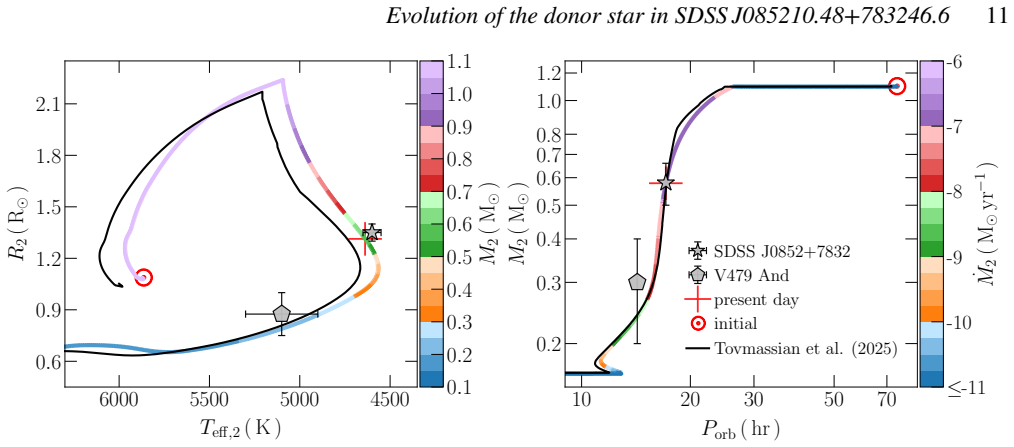
The central claim is that SDSS J085210.48+783246.6 is a long-period CV whose secondary has experienced nuclear evolution and envelope stripping, placing it on an evolutionary track distinct from standard CVs that begin with near-ZAMS donors; the observed spectral features and period are direct consequences of this history and point to future evolution into a double white-dwarf pair.
Load-bearing premise
The spectral lines and other observed properties are produced by a secondary that has already undergone nuclear evolution and partial stripping rather than by some other stellar configuration.
Editorial extensions
If this is right
- Long-period CVs with evolved donors form through channels that begin mass transfer after the secondary has left the main sequence.
- These systems can reach periods exceeding the canonical 2-3 hour gap and the usual upper limit near 10 hours.
- Continued evolution of such objects can produce double-degenerate binaries.
- Population synthesis must include this channel to match the growing number of long-period CVs found in surveys.
Reading between the lines
- If the evolved-donor channel is common, the total number of CVs that will become detectable gravitational-wave sources may be higher than models based only on unevolved secondaries predict.
- Similar systems could be identified by searching for CVs whose secondaries show abundance anomalies or inflated radii at long periods.
- The same stripping mechanism might operate in other close binaries, altering their final fates beyond the CV stage.
Signed reviews
Editorial analysis
A structured set of objections, weighed in public.
Referee Report
Summary. The manuscript presents a detailed study of the cataclysmic variable SDSS J085210.48+783246.6, reporting an orbital period of 17.109 h and deriving basic stellar parameters from spectral characteristics. It argues that the donor has undergone nuclear evolution and partial envelope stripping, enabling periods far beyond standard CV limits, and explores evolutionary paths to such systems and their potential evolution into double-degenerate binaries.
Significance. If the donor characterization holds, the work would contribute to understanding the formation of long-period CVs outside the standard evolutionary channel and their role as progenitors for double degenerates. The paper highlights an emerging population from surveys, but the significance is limited by reliance on qualitative spectral interpretation without demonstrated uniqueness against alternative explanations such as metallicity or contamination effects.
major comments (1)
- [spectral analysis / donor characterization section] The load-bearing assumption that spectral characteristics securely indicate nuclear evolution plus partial envelope stripping (allowing the 17.109 h period) is not supported by quantitative comparison to grids of stripped-star models predicting specific abundances and gravities. The analysis appears to rest on line ratios and T_eff estimates, which could be consistent with an unevolved or mildly evolved donor via other effects; this undermines the evolutionary discussion and double-degenerate implications.
minor comments (2)
- [observations] Clarify the exact method used to measure the orbital period and any error bars or aliases considered.
- [spectral fitting] Add explicit discussion of possible disk contamination or activity effects on the secondary's spectrum.
Simulated Author's Rebuttal
We thank the referee for their careful review and constructive feedback on our manuscript. The major comment concerns the robustness of the donor characterization from spectral data, which we address point-by-point below. We are happy to revise the manuscript accordingly.
read point-by-point responses
-
Referee: [spectral analysis / donor characterization section] The load-bearing assumption that spectral characteristics securely indicate nuclear evolution plus partial envelope stripping (allowing the 17.109 h period) is not supported by quantitative comparison to grids of stripped-star models predicting specific abundances and gravities. The analysis appears to rest on line ratios and T_eff estimates, which could be consistent with an unevolved or mildly evolved donor via other effects; this undermines the evolutionary discussion and double-degenerate implications.
Authors: We agree that a direct quantitative comparison to grids of stripped-star models would strengthen the analysis. Our interpretation rests on the combination of the 17.109 h orbital period (which exceeds the Roche-lobe radius possible for an unevolved ZAMS donor at any plausible mass) together with the observed T_eff and line ratios. These features are difficult to reconcile with an unevolved donor even allowing for metallicity or contamination effects. Nevertheless, we acknowledge the referee's point that explicit model-grid comparisons would better demonstrate uniqueness. In the revised manuscript we will add such a comparison, testing the observed parameters against available grids of evolved, stripped donors for consistency in gravity, abundances, and radius, thereby reinforcing the evolutionary discussion and double-degenerate implications. revision: yes
Circularity Check
No circularity; derivation chain is self-contained
full rationale
The provided abstract and description contain no equations, fitted parameters, or derivations that reduce a claimed prediction or result to its own inputs by construction. The paper reports an observed 17.109 h period, basic stellar parameters from spectra, and a discussion of evolutionary paths; these steps rely on external observational data and standard CV theory rather than self-definitional loops, fitted-input predictions, or load-bearing self-citations. No uniqueness theorem, ansatz smuggling, or renaming of known results is exhibited. The central evolutionary hypothesis is framed as interpretive discussion, not a mathematical output forced by the paper's own prior content.
Assumptions & free parameters
Cite this review
Pith. "Pith review of Evolution of a long-period Cataclysmic Variable from the viewpoint of the donor star: the case of SDSS J085210.48+783246.6." pith.science (2026). https://pith.science/paper/D6GHG3UV
@misc{pith2026260524347,
  author       = {Pith},
  title        = {Pith review of: Evolution of a long-period Cataclysmic Variable from the viewpoint of the donor star: the case of SDSS J085210.48+783246.6},
  year         = {2026},
  howpublished = {\url{https://pith.science/paper/D6GHG3UV}},
  note         = {Machine review of arXiv:2605.24347}
}
read the original abstract
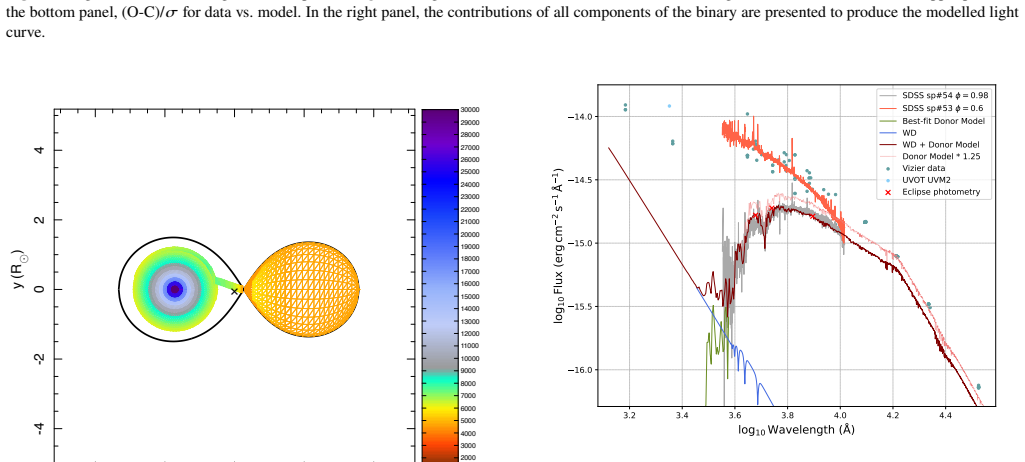
Cataclysmic variables were long considered to be close binaries consisting of a white dwarf and a Roche-lobe-filling, near-zero-age main-sequence (ZAMS) red or brown dwarf. Recent massive surveys have uncovered an increasing number of binaries with similar spectral characteristics but harboring secondary stars that have undergone nuclear evolution and partial envelope stripping, many with orbital periods far exceeding the normal upper limits for ordinary CVs. We present a detailed study of a newly discovered CV with a 17.109 h period and determine its basic stellar parameters. We also discuss the evolutionary paths leading to the formation of these extremely long-period cataclysmic variables. We consider the implications of the new evolutionary hypothesis on their further evolution into double-degenerate binaries.
Figures


Figures from the paper (9 more)




Forward citations
Cited by 1 Pith paper
-
SRG/eROSITA X-ray selected cataclysmic variable candidates observed in SDSS-V DR20
eROSITA-selected SDSS-V DR20 spectroscopy yields 587 cataclysmic variables (274 known), including new nearby systems, AM CVns, and a low-accretion-rate polar.
Reference graph
Works this paper leans on
-
[1]
Exploring the Formation and Evolution of Planetary Systems , year = 2014, editor =
Allard F., 2014, in Booth M., Matthews B. C., Graham J. R., eds, IAU Sym- posium Vol. 299, Exploring the Formation and Evolution of Planetary Systems. pp 271–272, doi:10.1017/S1743921313008545 Álvarez-Hernández A., et al., 2021, MNRAS, 507, 5805 Angulo C., et al., 1999, Nuclear Physics A, 656, 3 Aros-Bunster C., et al., 2025, A&A, 693, L11 Astropy Collabo...
Reviewed June 30, 2026 · model on record in the stance chip above.
Discussion (0). Continue with ORCID to comment.