REVIEW 3 major objections 7 minor 121 references
eROSITA X-ray selection plus SDSS-V spectra yield 587 cataclysmic variables, including many previously uncatalogued systems.
Reviewed by Pith at T0; open to challenge. T0 means a machine referee read the full paper against a public rubric. the ladder, T0–T4 →
T0 review · grok-4.5
2026-07-31 22:09 UTC pith:E5IXL4JN
load-bearing objection Solid eROSITA+SDSS-V CV inventory (587 systems) with honest carton stats and useful nearby finds; single-epoch/low-state limits are already flagged by the authors and do not sink the count. the 3 major comments →
SRG/eROSITA X-ray selected cataclysmic variable candidates observed in SDSS-V DR20
The pith
A machine-rendered reading of the paper's core claim, the machinery that carries it, and where it could break.
Core claim
From eROSITA-selected candidates observed in SDSS-V DR20 the authors identify 587 systems as cataclysmic variables with high certainty: 542 accreting compact binaries from their three Milky Way Mapper cartons (after removing four known low-mass X-ray binaries) plus 49 additional CVs found in BHM SPIDERS cartons that were not in their original selection. Of these, 274 were already known in the literature; the remainder are newly reported or only sparsely catalogued.
What carries the argument
Three complementary optical-counterpart cartons (nearest-neighbour positional match, optically most-variable neighbour, and a Bayesian machine-learning cross-match that uses X-ray/optical colours and proper motions) that feed SDSS-V multi-object spectroscopy; final CV membership rests on visual inspection of Balmer/He emission lines together with eROSITA hardness ratios and public light curves.
Load-bearing premise
A single-epoch or few-epoch optical spectrum showing Balmer or helium emission, aided by X-ray hardness and light curves, is enough to call a source a cataclysmic variable and often to assign its subclass, even though low-state magnetic systems can look like ordinary M stars and low-mass X-ray binaries are spectroscopically almost identical to CVs.
What would settle it
Higher-cadence spectroscopy or photometry of the newly claimed systems (especially the 199 without prior literature entries and the objects still listed as M-star or white-dwarf contaminants) that either reveals no accretion signatures, recovers orbital periods inconsistent with CVs, or reclassifies a substantial fraction as non-CVs or known X-ray binaries.
If this is right
- A 500 pc volume-limited CV sample can be assembled with far better number statistics than earlier 150 pc or 300 pc compilations.
- The observed magnetic-to-non-magnetic ratio (~20 % inside 500 pc) can be compared directly with evolutionary models of white-dwarf field generation.
- Newly found AM CVn and early-type-donor systems enlarge the samples that calibrate gravitational-wave foreground predictions for LISA.
- X-ray luminosity functions of the classified IPs can be used to reassess their contribution to the Galactic Ridge X-ray Emission.
- Continued SDSS-V observations of the remaining high-Pcv candidates are predicted to yield roughly 900 CVs by survey end.
Where Pith is reading between the lines
- Because the western Galactic hemisphere alone already yields hundreds of new systems, an eventual full-sky eROSITA-plus-spectroscopy census should roughly double the known Galactic CV population once the eastern half is released.
- The seven eRASS1-only detections that dropped below the eRASS:3 threshold illustrate that transient high/low states systematically bias single-epoch X-ray selections; stacking strategies or multi-epoch X-ray light curves will be required for completeness.
- The handful of isolated white dwarfs and active M stars with log LX > 31 that remain among the contaminants are natural targets for deeper spectroscopy aimed at recovering quiescent or extremely low-accretion CVs.
Editorial analysis
A structured set of objections, weighed in public.
Referee Report
Summary. The paper presents an inventory of cataclysmic variables (CVs) selected as eROSITA X-ray sources and spectroscopically confirmed in SDSS-V DR20. Three MWM cartons (positional match, optical variability, and RF+NWAY machine-learning counterpart selection on eRASS1/eRASS:3 + Gaia) yielded 89,337 unique candidates, of which 4,946 were observed; 542 were classified as accreting compact binaries. After removing four known LMXBs and adding 49 CVs found only in BHM SPIDERS cartons, the authors report 587 CVs (274 previously known in the literature). They provide carton success rates (5.8–31.5%), attempt DN/NL/mCV/AM CVn subclassifications using spectra, hardness ratios, and public light curves, release an accompanying catalogue, and highlight two new systems within 150 pc (a LARP and a period-bouncer candidate).
Significance. This is a substantial observational catalogue paper that substantially enlarges the set of X-ray-selected, spectroscopically confirmed CVs in the western Galactic hemisphere. The honest reporting of carton success rates, the comparison of selection methods (ML+eRASS:3 clearly outperforming simple positional/variability cuts), the explicit discussion of low-state polars and LMXB contaminants, and the public catalogue with Gaia, eROSITA, and classification columns are genuine strengths. The work is a necessary step toward future 500 pc volume-limited demographics and GRXE constraints, even though those demographic products are not claimed here. Two new d<150 pc systems are a concrete addition to the Pala et al. (2020) volume sample.
major comments (3)
- [§4.3, §5, Abstract] §4.3 and Abstract: the headline count is stated as 587 CVs 'with a high degree of certainty,' yet §4.7–4.8 and §5 document that single-epoch spectra can miss low-state polars (explicit IGR J14536−5522 / Fig. C.2 example), that LMXBs are nearly spectroscopically identical, and that quiescent CVs may hide among M-star/WD contaminants. The paper should quantify (or at least bound) residual contamination and incompleteness for the 587 figure—e.g., a purity estimate from multi-epoch subsets, a clear statement that subclass labels for the ~199 systems without literature entries are tentative, and a recommended use policy for the catalogue (inventory vs. demographic sample).
- [§2.4, §5, Table 3] §2.4 and §5 / Table 3: the BP−RP<2 hard cut on the boss carton is acknowledged in retrospect as having excluded low-accreting systems (including the new LARP at BP−RP=2.59). Because the primary aim is a 'complete inventory' of eROSITA CVs, the paper should either (i) estimate how many known CVs/eRASS sources were lost to this cut and to the log(FX/Fopt)>-2.7 and distance cuts, or (ii) clearly reframe the claim as an inventory of the submitted cartons rather than of all eRASS1/eRASS:3 CVs. Table 3’s extrapolation to ~900 end-of-survey CVs also needs the observation-fraction assumption (~30.6%) and Pcv-bin success rates stated with uncertainties.
- [§4.9, Table B.2] §4.9 Catalogue / CV_TYPE and CV_SUBTYPE: mCV_cand and several DN/NL/PB labels rest on He II λ4686 strength, HRs, and light curves without a documented, reproducible decision tree or quantitative thresholds (e.g., He II/Hβ ratio cuts, HR_P12/HR_P23 boundaries). For a catalogue intended for community use, the classification criteria applied in the visual inspection should be tabulated or flowcharted so that the 17 mCV candidates and the DN/NL assignments are reproducible and their purity can be assessed.
minor comments (7)
- [Abstract, Table 1] Abstract vs. §4/Table 1: Abstract says '538 likely CVs' from submitted candidates; body has 542 ACBs then 538 CVs after removing 4 LMXBs. Align the wording so the 538/542/587 arithmetic is unambiguous in the abstract.
- [§2.2] §2.2: the Galactic proper-motion/parallax cut is written as a long nested expression that is hard to parse; a short plain-language summary or a small schematic would help reproducibility.
- [§4.9, Appendix B] §4.9 and Appendix B: Bailer-Jones distances are cited as 2021 in the main text analysis but the appendix text sometimes says Bailer-Jones et al. (2018); unify the reference and state which release (rgeo geometric) is used in the catalogue columns.
- [Fig. 3] Figure 1 and Figure 3 captions both say 'In all three we identify…' in Fig. 3’s caption though only one panel is shown; clean up caption copy-paste.
- [passim] Typos/wording: 'algortihms' (abstract methods), 'contaminents', 'stragety', 'enivitably', 'cutoffdate', 'V olume', 'Da˘g'; check English and special characters throughout.
- [Table 2] Table 2 success accounting: unique contaminant totals are useful; a single summary row of 'unclassified/noisy/sky' fractions per carton would complete the observed-target budget relative to Table 1.
- [Data availability, Appendix B] Data availability: CDS link is a placeholder (vol/page). Ensure the final catalogue column dictionary matches Table B.1 and that DETUID c020 vs c030 handling is documented for users.
Circularity Check
No significant circularity: observational catalogue built from independent spectroscopic labels, not a self-predicting derivation.
full rationale
This is an observational discovery and catalogue paper. The central claim—identification of 587 CVs from eROSITA-selected SDSS-V DR20 spectra (542 ACBs from three MWM cartons after removing 4 known LMXBs, plus 49 from BHM SPIDERS)—rests on visual inspection of optical spectra for Balmer/He emission lines, aided by X-ray hardness ratios, Gaia distances/colours, and public light curves. Candidate selection (positional matching, variability cuts, and a Random Forest trained on known CVs to rank Gaia counterparts) is ordinary supervised target selection; the spectroscopic confirmations are independent labels, not quantities forced by the training fit. Literature cross-matches establish the known-vs-new split and do not redefine the spectral classifications. No equation, uniqueness theorem, or fitted population model is used to “predict” the inventory. Residual incompleteness (low-state polars, LMXB similarity) is a purity/completeness issue already flagged by the authors, not circularity. Score 0; steps empty.
Axiom & Free-Parameter Ledger
free parameters (7)
- log(FX/Fopt) > -2.7 stellar-coronal cut =
-2.7
- angdist/radec_err < 2.1 match cut =
2.1
- rest < 3000 pc distance cut (DR2 cartons) =
3000 pc
- variability cut var > nonvar × 3σ_var =
3σ above nonvar locus
- RF P_cv ≥ 0.5 and NWAY P_any ≥ 0.2 =
P_cv≥0.5, P_any≥0.2
- BP−RP < 2 color hard cut (boss carton) =
BP-RP < 2
- DET_LIKE band thresholds ≥ 8 =
≥8 in at least one band
axioms (5)
- domain assumption All CVs produce X-rays near the white-dwarf accretion region at levels often reachable by eROSITA within ~500 pc (mCVs to larger distances).
- domain assumption Optical spectra showing Balmer and often He I/II emission (disk/stream) identify accreting compact binaries, with CVs separable from the few known LMXBs via catalogue cross-match.
- domain assumption Bailer-Jones r_geo distances are adequate for luminosity and volume statements used in the paper.
- domain assumption Soft X-ray hardness (HR_P12, HR_P23) plus He II λ4686 / cyclotron features are informative for magnetic subclass assignment.
- ad hoc to paper Random Forest trained on 624 known CVs vs ~90k non-CVs generalizes as a useful counterpart prior inside NWAY.
read the original abstract
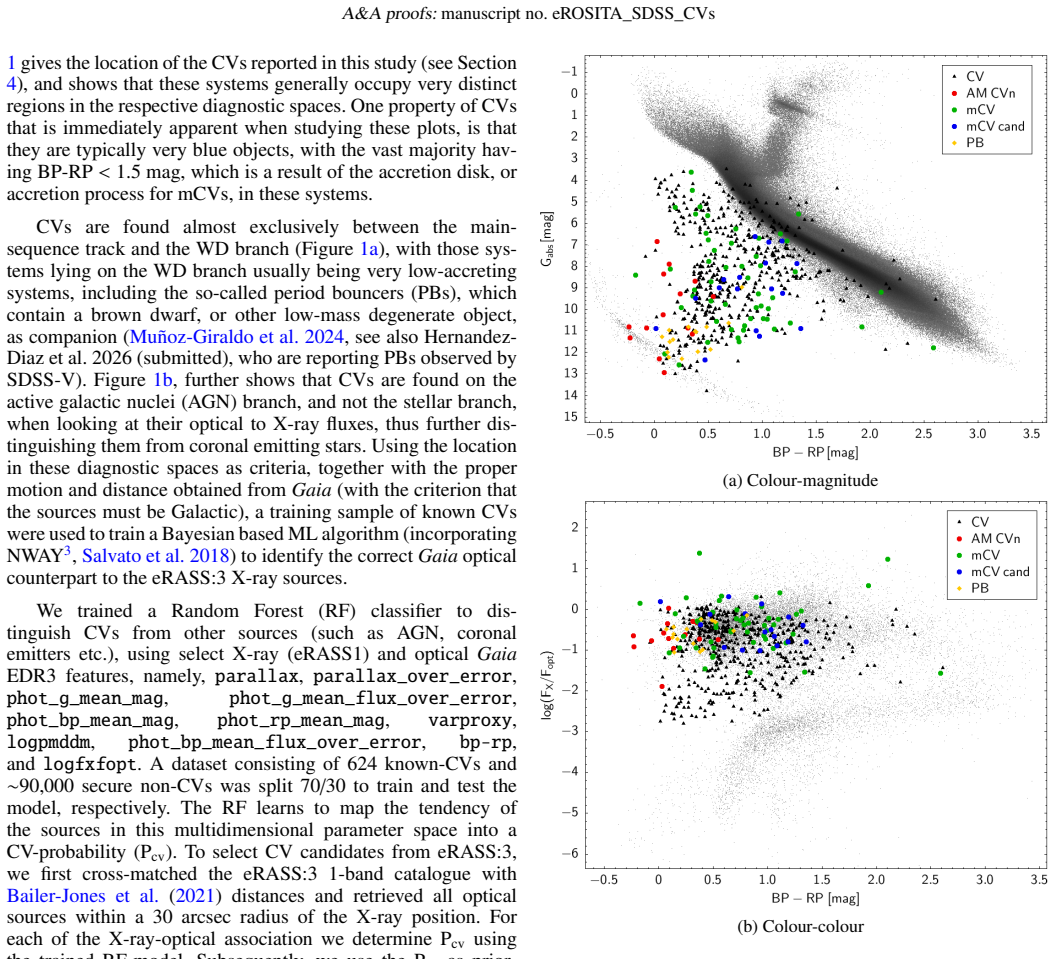
We report on the spectroscopic observations obtained during SDSS-V DR20 of accreting compact binaries (ACB), specifically the cataclysmic variables (CVs), that were identified as likely compact binary candidates from the SRG (Spectrum Roentgen Gamma) eROSITA eRASS1 and eRASS:3 observations. Our primary aim is to obtain a complete inventory of all CVs that were detected in eRASS1 and eRASS:3, with the goal to help better understand close-binary evolution, the population density, and demographics of these systems in the Galaxy. Previous population studies had their respective limitations, with volume-limited samples suffering from low-number statistics, while magnitude-limited observations were biased to only the brighter systems. All CVs are X-ray emitters, eROSITA, therefore, presents a unique opportunity to identify CVs based on their X-ray emission. Given eROSITA's sensitivity, we expect to find most X-ray active CVs within 500 pc, and magnetic CVs to several kpc. Using X-ray data from the eROSITA together with optical data from Gaia, three different approaches were explored to identify the Gaia optical counterpart to the eROSITA X-ray source of the likely ACB. From this, unique candidates were identified and were submitted in three different cartons to SDSS-V for optical spectroscopic observations as part of the Milky Way Mapper survey. From our submitted candidates, we found 538 likely CVs. We also identified CVs that were observed in other eROSITA based cartons, in which we identified an additional 49 systems that are likely CVs and which were not in our selection. We therefore identified 587 systems as CVs from the eROSITA based SDSS-V observations. We also attempted to sub classify the CVs as dwarf-novae, novalikes, or magnetic systems based on the eROSITA X-ray data, the emission line properties in the optical SDSS-V spectra, and other data in the public domain, if available.
Figures


Reference graph
Works this paper leans on
-
[1]
Formation and Evolution of Accreting Compact Objects
Belloni, Diogo and Schreiber, Matthias R. Formation and Evolution of Accreting Compact Objects. Handbook of X-ray and Gamma-ray Astrophysics. 2022. doi:10.1007/978-981-16-4544-0_98-1
-
[2]
Reversing the verdict: Cataclysmic variables could be the dominant progenitors of AM CVn binaries after all. , keywords =. doi:10.1051/0004-6361/202347047 , archivePrefix =. 2305.19312 , primaryClass =
-
[3]
Birth of the ELMs: a ZTF survey for evolved cataclysmic variables turning into extremely low-mass white dwarfs. , keywords =. doi:10.1093/mnras/stab2583 , archivePrefix =. 2108.04255 , primaryClass =
-
[4]
A catalogue of ultracompact mass-transferring white dwarf binaries. , keywords =. doi:10.1051/0004-6361/202554925 , archivePrefix =. 2505.10535 , primaryClass =
-
[5]
A dense 0.1-solar-mass star in a 51-minute-orbital-period eclipsing binary. , keywords =. doi:10.1038/s41586-022-05195-x , archivePrefix =. 2210.01809 , primaryClass =
-
[6]
1995 , publisher=
Warner, Brian , title=. 1995 , publisher=
1995
-
[7]
X-Ray Emissions from Accreting White Dwarfs: A Review. , keywords =. doi:10.1088/1538-3873/aa6736 , archivePrefix =. 1703.06171 , primaryClass =
-
[8]
Science , year = 1966, month = nov, volume =
Ancient Oriental Records of Novae and Supernovae. Science , year = 1966, month = nov, volume =. doi:10.1126/science.154.3749.597 , adsurl =
-
[9]
Hamacher, Duane W. , doi =. Observations of red-giant variable stars by Aboriginal Australians , url =. https://onlinelibrary.wiley.com/doi/pdf/10.1111/taja.12257 , journal =
-
[10]
Novalike cataclysmic variables are significant radio emitters. , keywords =. doi:10.1093/mnras/stv1225 , archivePrefix =. 1506.00003 , primaryClass =
-
[11]
A first systematic characterization of cataclysmic variables in SRG/eROSITA surveys. , keywords =. doi:10.1051/0004-6361/202450537 , archivePrefix =. 2407.20903 , primaryClass =
-
[12]
, keywords =
Ultraviolet observations of cataclysmic variables : the IUE archive. , keywords =
-
[13]
Infrared Properties of Cataclysmic Variables in the 2 Micron All-Sky Survey Second Incremental Data Release. , keywords =. doi:10.1086/324499 , archivePrefix =. astro-ph/0109393 , primaryClass =
-
[14]
Advances in Space Research , keywords =
The ROSAT view of the cataclysmic variable sky. Advances in Space Research , keywords =. doi:10.1016/0273-1177(93)90103-I , adsurl =
-
[15]
Advances in Space Research , keywords =
The ROSAT mission. Advances in Space Research , keywords =. doi:10.1016/0273-1177(82)90070-9 , adsurl =
-
[16]
Soft X-ray emission from dwarf novae. , keywords =. doi:10.1093/mnras/178.2.195 , adsurl =
-
[17]
Extremely high circular polarization of AN Ursae Majoris. , keywords =. doi:10.1086/182506 , adsurl =
- [18]
-
[19]
PolarCat: Catalog of polars, low-accretion rate polars, and candidate objects. , keywords =. doi:10.1051/0004-6361/202554519 , archivePrefix =. 2505.10337 , primaryClass =
-
[20]
High Energy Density Physics , year = 2013, month = mar, volume =
POLAR project: Numerical modeling of the accretion column. High Energy Density Physics , year = 2013, month = mar, volume =. doi:10.1016/j.hedp.2012.10.002 , adsurl =
-
[21]
EXOSAT X-ray observations of the eclipsing magnetic cataclysmic variable EX Hya. , keywords =. doi:10.1093/mnras/231.3.549 , adsurl =
-
[22]
Lamb, D. Q. and Melia, F. Evolution of magnetic cataclysmic binaries. The Physics of Accretion onto Compact Objects. 1986
1986
-
[23]
Why Do Some Intermediate Polars Show Soft X-Ray Emission? A Survey of XMM-Newton Spectra. , keywords =. doi:10.1086/518552 , archivePrefix =. 0704.1388 , primaryClass =
-
[24]
Evidence for Intermediate Polars as the Origin of the Galactic Center Hard X-ray Emission. , keywords =. doi:10.3847/0004-637X/826/2/160 , archivePrefix =. 1605.06066 , primaryClass =
-
[25]
The eROSITA X-ray telescope on SRG. , keywords =. doi:10.1051/0004-6361/202039313 , archivePrefix =. 2010.03477 , primaryClass =
Pith/arXiv arXiv 2010
-
[26]
Its telescopes and first scientific results
SRG X-ray orbital observatory. Its telescopes and first scientific results. , keywords =. doi:10.1051/0004-6361/202141179 , archivePrefix =. 2104.13267 , primaryClass =
-
[27]
The HEAO A-1 X-ray source catalog. , keywords =. doi:10.1086/190992 , adsurl =
-
[28]
Cataclysmic Variable Stars
-
[29]
The fourth Uhuru catalog of X-ray sources. , keywords =. doi:10.1086/190561 , adsurl =
-
[30]
First X-ray catalogues and data release of the western Galactic hemisphere
The SRG/eROSITA all-sky survey. First X-ray catalogues and data release of the western Galactic hemisphere. , keywords =. doi:10.1051/0004-6361/202347165 , archivePrefix =. 2401.17274 , primaryClass =
-
[31]
Sloan Digital Sky Survey. V. Pioneering Panoptic Spectroscopy. , keywords =. doi:10.3847/1538-3881/ae0576 , archivePrefix =. 2507.06989 , primaryClass =
-
[32]
TOPCAT: Desktop Exploration of Tabular Data for Astronomy and Beyond. arXiv e-prints , keywords =. doi:10.48550/arXiv.1707.02160 , archivePrefix =. 1707.02160 , primaryClass =
-
[33]
Photometric content and validation
Gaia Early Data Release 3. Photometric content and validation. , keywords =. doi:10.1051/0004-6361/202039587 , archivePrefix =. 2012.01916 , primaryClass =
Pith/arXiv arXiv 2012
-
[34]
Estimating Distance from Parallaxes. IV. Distances to 1.33 Billion Stars in Gaia Data Release 2. , keywords =. doi:10.3847/1538-3881/aacb21 , archivePrefix =. 1804.10121 , primaryClass =
-
[35]
Stars and their Variability Observed from Space , year = 2020, editor =
Gaia's revolution in stellar variability. Stars and their Variability Observed from Space , year = 2020, editor =. doi:10.48550/arXiv.1912.07659 , archivePrefix =. 1912.07659 , primaryClass =
-
[36]
Cataclysmic variables around the period-bounce: An eROSITA-enhanced multiwavelength catalog. , keywords =. doi:10.1051/0004-6361/202449358 , archivePrefix =. 2401.17298 , primaryClass =
-
[37]
Finding counterparts for all-sky X-ray surveys with NWAY: a Bayesian algorithm for cross-matching multiple catalogues. , keywords =. doi:10.1093/mnras/stx2651 , archivePrefix =. 1705.10711 , primaryClass =
-
[38]
The Baryon Oscillation Spectroscopic Survey of SDSS-III. , keywords =. doi:10.1088/0004-6256/145/1/10 , archivePrefix =. 1208.0022 , primaryClass =
-
[39]
The 2.5 m Telescope of the Sloan Digital Sky Survey. , keywords =. doi:10.1086/500975 , archivePrefix =. astro-ph/0602326 , primaryClass =
-
[40]
I. S. Bowen and A. H. Vaughan , doi =. The Optical Design of the 40-in. Telescope and of the Irenee DuPont Telescope at Las Campanas Observatory, Chile , url =. Appl. Opt. , keywords =
-
[41]
Protostars and Planets VII , year = 2023, editor =
The Origin and Evolution of Multiple Star Systems. Protostars and Planets VII , year = 2023, editor =. doi:10.48550/arXiv.2203.10066 , archivePrefix =. 2203.10066 , primaryClass =
-
[42]
A Volume-limited Sample of Cataclysmic Variables from Gaia DR2: Space Density and Population Properties. , keywords =. doi:10.1093/mnras/staa764 , archivePrefix =. 1907.13152 , primaryClass =
Pith/arXiv arXiv 1907
-
[43]
Exploring the space density of X-ray selected cataclysmic variables. , keywords =. doi:10.1051/0004-6361/201833723 , archivePrefix =. 1808.08144 , primaryClass =
-
[44]
The origin and evolution of magnetic white dwarfs in close binary stars. Nature Astronomy , keywords =. doi:10.1038/s41550-021-01346-8 , archivePrefix =. 2104.14607 , primaryClass =
-
[45]
The cataclysmic variable orbital period gap: More evident than ever. , keywords =. doi:10.1051/0004-6361/202348807 , archivePrefix =. 2402.02076 , primaryClass =
-
[46]
Further evidence of saturated, boosted, and disrupted magnetic braking from evolutionary tracks of cataclysmic variables. , keywords =. doi:10.1051/0004-6361/202553757 , archivePrefix =. 2503.18884 , primaryClass =
-
[47]
HEAO 1 measurements of the galactic ridge. , keywords =. doi:10.1086/159809 , adsurl =
-
[48]
How Dry is the Brown Dwarf Desert? Quantifying the Relative Number of Planets, Brown Dwarfs, and Stellar Companions around Nearby Sun-like Stars. , keywords =. doi:10.1086/500161 , archivePrefix =. astro-ph/0412356 , primaryClass =
-
[49]
Towards a volumetric census of close white dwarf binaries - I. Reference samples. , keywords =. doi:10.1093/mnras/stab753 , archivePrefix =. 2103.06892 , primaryClass =
-
[50]
The expansion of stripped-envelope stars: Consequences for supernovae and gravitational-wave progenitors. , keywords =. doi:10.1051/0004-6361/201937300 , archivePrefix =. 2003.01120 , primaryClass =
Pith/arXiv arXiv 2003
-
[51]
The SDSS-V Local Volume Mapper (LVM): Scientific Motivation and Project Overview. , keywords =. doi:10.3847/1538-3881/ad6de9 , archivePrefix =. 2405.01637 , primaryClass =
-
[52]
The SDSS-V Local Volume Mapper Telescope System. , keywords =. doi:10.3847/1538-3881/ad7948 , adsurl =
-
[53]
The Astronomer's Telegram , keywords =
ePESSTO spectroscopic classification of optical transients. The Astronomer's Telegram , keywords =
-
[54]
The Astronomer's Telegram , keywords =
Discovery of Six ASAS-SN Supernovae. The Astronomer's Telegram , keywords =
-
[55]
Astrophysics and Space Science Library , year = 2022, editor =
Transitional Millisecond Pulsars. Astrophysics and Space Science Library , year = 2022, editor =. doi:10.1007/978-3-030-85198-9_6 , archivePrefix =. 2010.09060 , primaryClass =
Pith/arXiv arXiv 2022
-
[56]
Cataclysmic variables with evolved secondaries and the progenitors of AM CVn stars. , keywords =. doi:10.1046/j.1365-8711.2003.06380.x , adsurl =
arXiv 2003
-
[57]
Optical spectroscopic variability of Herbig Ae/Be stars. , keywords =. doi:10.1051/0004-6361/201015821 , archivePrefix =. 1102.5033 , primaryClass =
-
[58]
An Optical Spectroscopic Study of T Tauri Stars. I. Photospheric Properties. , keywords =. doi:10.1088/0004-637X/786/2/97 , archivePrefix =. 1403.1675 , primaryClass =
-
[59]
DB white dwarfs in the Sloan Digital Sky Survey data release 10 and 12. , keywords =. doi:10.1051/0004-6361/201527169 , archivePrefix =. 1509.08244 , primaryClass =
-
[60]
System parameters of the long-period polar V1309 Ori. , keywords =. doi:10.1051/0004-6361:20010695 , archivePrefix =. astro-ph/0105362 , primaryClass =
-
[61]
Stellar Pulsation: Challenges for Theory and Observation , year = 2009, editor =
Delta Scuti Variables. Stellar Pulsation: Challenges for Theory and Observation , year = 2009, editor =. doi:10.1063/1.3246528 , archivePrefix =. 2110.09806 , primaryClass =
Pith/arXiv arXiv 2009
-
[62]
Two new white dwarfs with variable magnetic Balmer emission lines. , keywords =. doi:10.1093/mnras/stad760 , archivePrefix =. 2302.10207 , primaryClass =
-
[63]
Single magnetic white dwarfs with Balmer emission lines: a small class with consistent physical characteristics as possible signposts for close-in planetary companions. , keywords =. doi:10.1093/mnras/staa2969 , archivePrefix =. 2009.11925 , primaryClass =
Pith/arXiv arXiv 2009
-
[64]
The nebular remnant and quiscent spectrum of nova GK Persei. , keywords =. doi:10.1093/mnras/263.2.335 , adsurl =
-
[65]
Counterpart identification and classification for eRASS1 and characterisation of the active galactic nuclei content. , keywords =. doi:10.1051/0004-6361/202556142 , archivePrefix =. 2509.02842 , primaryClass =
-
[66]
A catalogue of white dwarfs in Gaia EDR3. , keywords =. doi:10.1093/mnras/stab2672 , archivePrefix =. 2106.07669 , primaryClass =
-
[67]
Classification and parameterization of a large Gaia sample of white dwarfs using XP spectra. , keywords =. doi:10.1051/0004-6361/202347694 , archivePrefix =. 2308.05572 , primaryClass =
-
[68]
Physical properties of AM CVn stars: New insights from Gaia DR2. , keywords =. doi:10.1051/0004-6361/201834261 , archivePrefix =. 1810.06548 , primaryClass =
-
[69]
An Empirical Template Library of Stellar Spectra for a Wide Range of Spectral Classes, Luminosity Classes, and Metallicities Using SDSS BOSS Spectra. , keywords =. doi:10.3847/1538-4365/aa656d , archivePrefix =. 1702.06957 , primaryClass =
-
[70]
The NaI D resonance lines in main-sequence late-type stars. , keywords =. doi:10.1111/j.1365-2966.2007.11833.x , archivePrefix =. 0704.0812 , primaryClass =
arXiv 2007
-
[71]
Calcium H&K and sodium D absorption induced by the interstellar and circumgalactic media of the Milky Way. , keywords =. doi:10.1093/mnras/stv1277 , archivePrefix =. 1503.02697 , primaryClass =
-
[72]
Revisiting the extremely long-period cataclysmic variables V479 Andromedae and V1082 Sagittarii. , keywords =. doi:10.1051/0004-6361/202556385 , archivePrefix =. 2508.21358 , primaryClass =
-
[73]
Journal of Astronomical Telescopes, Instruments, and Systems , year = 2015, month = jan, volume =
Transiting Exoplanet Survey Satellite (TESS). Journal of Astronomical Telescopes, Instruments, and Systems , year = 2015, month = jan, volume =. doi:10.1117/1.JATIS.1.1.014003 , adsurl =
-
[74]
A search for the hidden population of AM CVn binaries in the Sloan Digital Sky Survey. , keywords =. doi:10.1093/mnras/sts485 , archivePrefix =. 1211.6439 , primaryClass =
-
[75]
Two decades of optical timing of the shortest-period binary star system HM Cancri. , keywords =. doi:10.1093/mnras/stac3385 , archivePrefix =. 2211.09834 , primaryClass =
-
[76]
Laser Interferometer Space Antenna. arXiv e-prints , keywords =. doi:10.48550/arXiv.1702.00786 , archivePrefix =. 1702.00786 , primaryClass =
-
[77]
Compact white dwarf binaries in the combined SRG/eROSITA/SDSS eFEDS survey. , keywords =. doi:10.1051/0004-6361/202348426 , archivePrefix =. 2401.17304 , primaryClass =
-
[78]
Confirmation of two magnetic cataclysmic variables as polars: 1RXS J174320.1-042953 and YY Sex. , keywords =. doi:10.1093/mnras/stad570 , archivePrefix =. 2302.10002 , primaryClass =
-
[79]
Cataclysmic Variables from the Sloan Digital Sky Survey. VIII. The Final Year (2007-2008). , keywords =. doi:10.1088/0004-6256/142/6/181 , archivePrefix =. 1109.6349 , primaryClass =
Pith/arXiv arXiv 2007
-
[80]
<ASTROBJ>HS 0943+1404</ASTROBJ>, a true intermediate polar. , keywords =. doi:10.1051/0004-6361:20053141 , archivePrefix =. astro-ph/0506055 , primaryClass =
discussion (0)
Sign in with ORCID, Apple, or X to comment. Anyone can read and Pith papers without signing in.