Imprints of Black Hole Shadows and Polarization Patterns of Various Thick Disks: Bumblebee gravity
Pith reviewed 2026-06-30 13:47 UTC · model grok-4.3
The pith
Simulations of Kerr-Sen-like black holes in Bumblebee gravity reveal that central dark regions in the shadow shrink with the Lorentz symmetry breaking parameter while brightness asymmetry increases with the Bumblebee charge.
A machine-rendered reading of the paper's core claim, the machinery that carries it, and where it could break.
Core claim
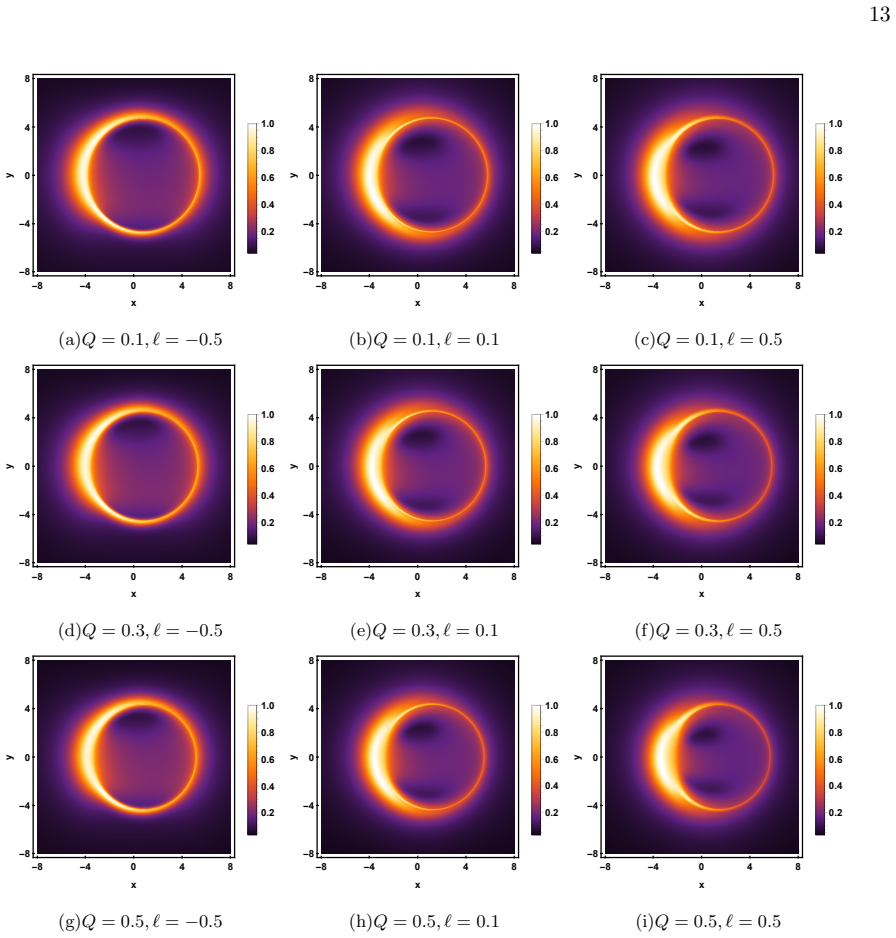
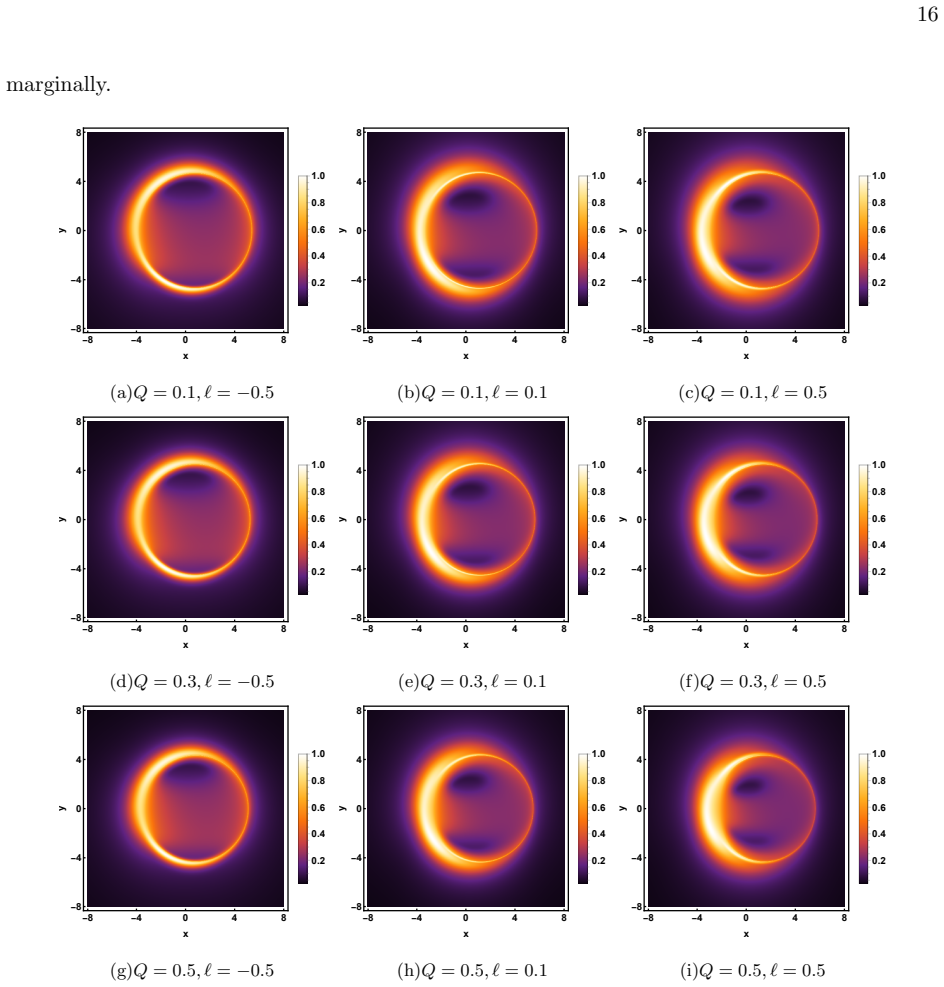
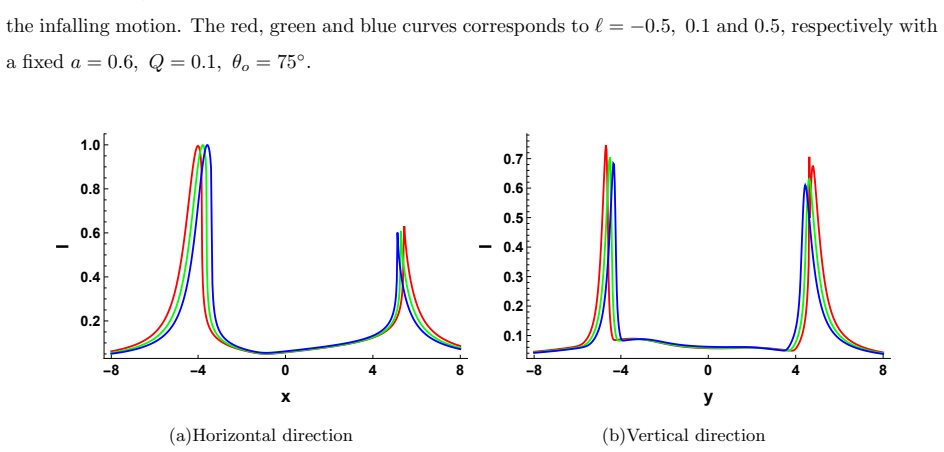
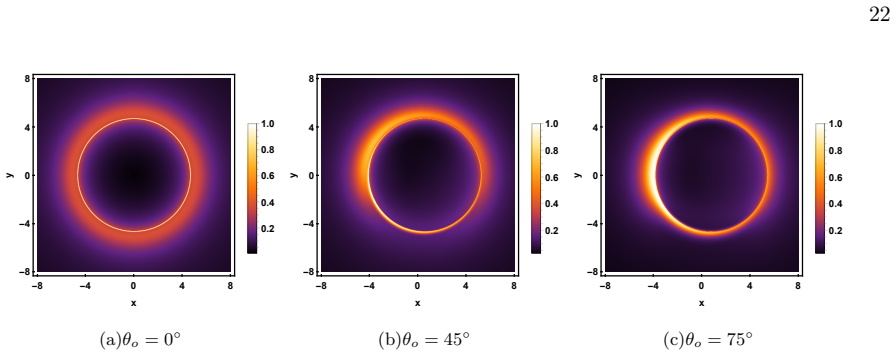
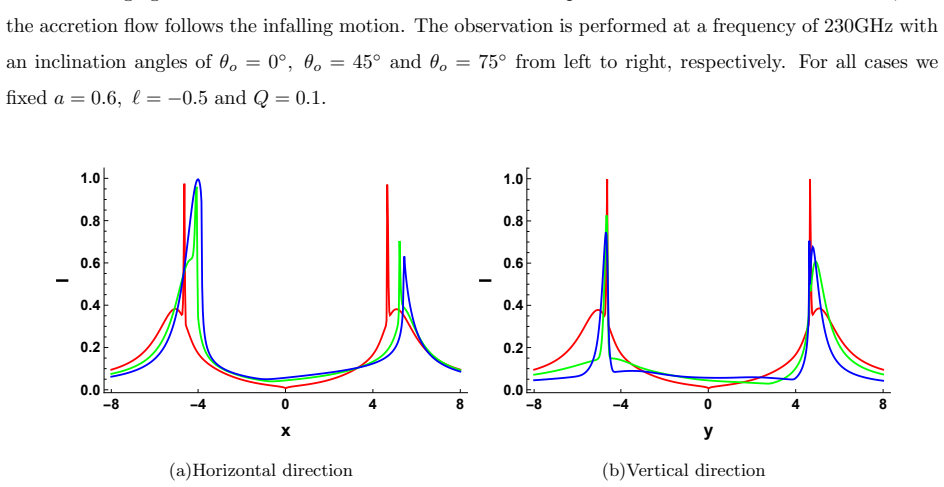
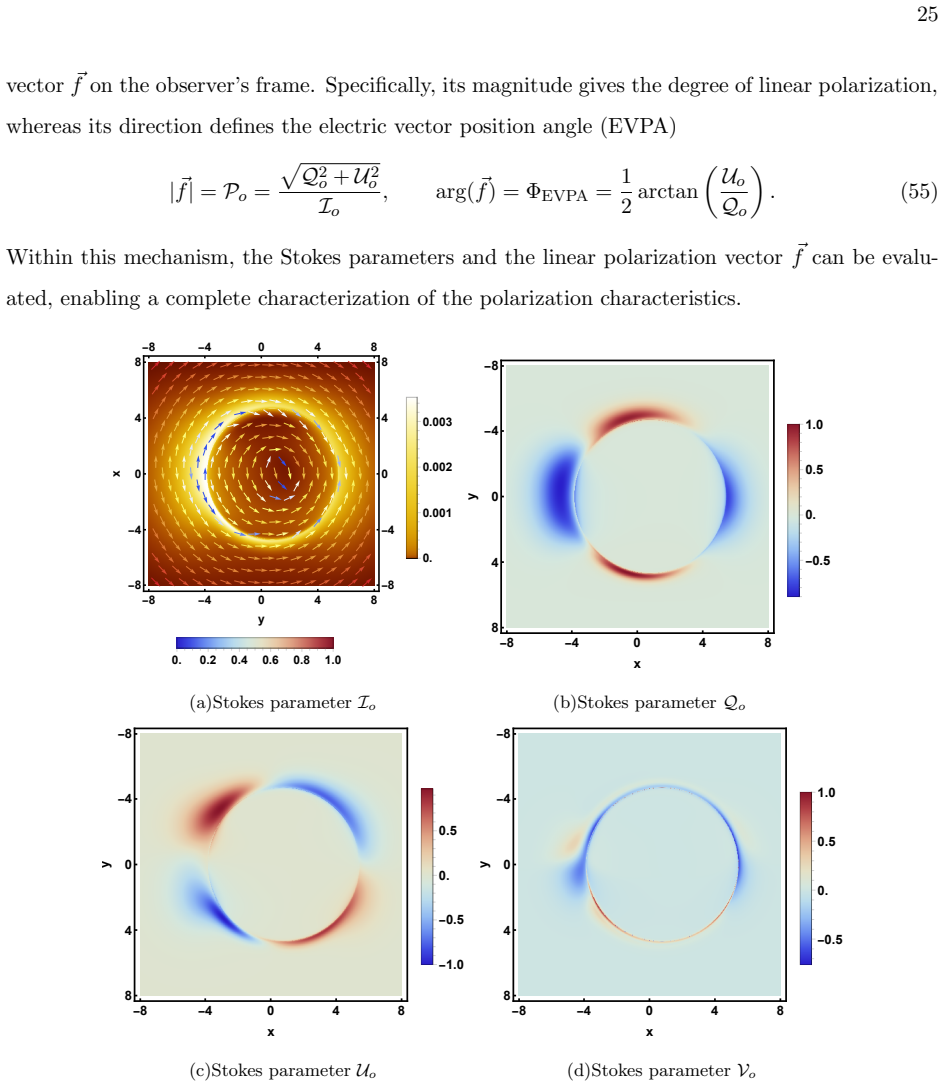
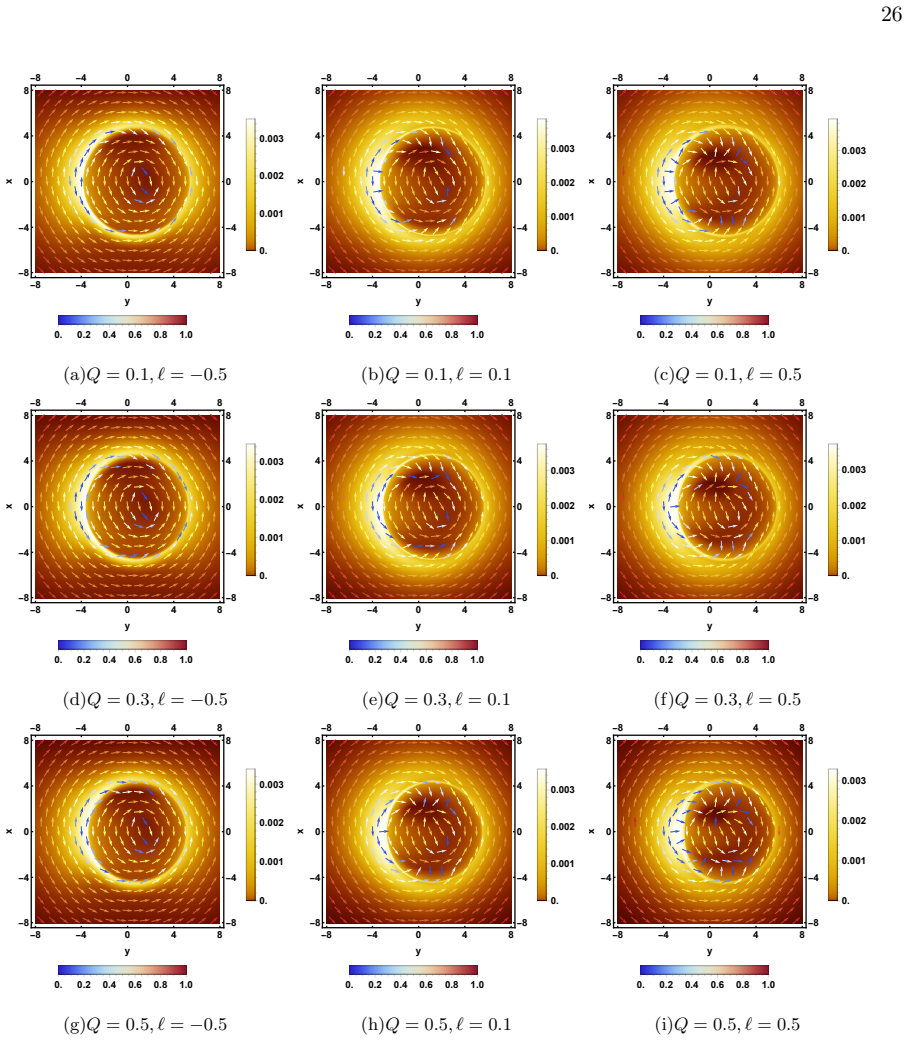
The main discovery is that both models depict the bright ring encircled by two central dark regions, each gradually shrinking with increasing ℓ. Frame-dragging gives rise to pronounced brightness asymmetry enhanced with increasing Q. In anisotropic emission, a vertically stretched elliptical ring structure emerges. The BAAF disk shows a geometrically thinner bright ring with more pronounced separation between primary and higher-order images. Polarization patterns trace the brightness distribution and vary with ℓ and Q, reflecting the spacetime structure.
What carries the argument
Kerr-Sen-like black hole in Bumblebee gravity with LSB parameter ℓ and Bumblebee charge Q, modeled using RIAF-like phenomenological and BAAF analytical thick disk models for emission at 230 GHz.
If this is right
- Both models show two central dark regions encircling the bright ring that shrink with increasing ℓ.
- Frame-dragging produces brightness asymmetry enhanced with increasing Q.
- Anisotropic emission leads to a vertically stretched elliptical ring.
- The BAAF model has a geometrically thinner bright ring and more pronounced image separation than RIAF.
- Polarization patterns trace brightness and vary with ℓ and Q.
Where Pith is reading between the lines
- The described features offer a potential way to test Bumblebee gravity using existing millimeter telescope data.
- Differences between the two disk models imply that accurate accretion modeling is needed to isolate gravity effects.
- Polarization data could help measure the Bumblebee charge independently of the shadow size.
Load-bearing premise
The RIAF-like and BAAF models accurately capture the emission and geometry of accretion flows around the Kerr-Sen-like black hole in Bumblebee gravity.
What would settle it
If high-resolution images at 230 GHz fail to show the predicted shrinkage of central dark regions with ℓ or the enhancement of asymmetry with Q, the claimed imprints would not hold.
Figures
read the original abstract
The main objective of this study is to explore the shadow and polarization patterns of a Kerr-Sen-like BH induced from Bumblebee gravity, which, among other alternative theories of gravity beyond Einstein gravity, stands out as a promising candidate for explaining certain high-energy astrophysical phenomena. Specifically, we would like to probe the influence of the rate of LSB parameter $\ell$ and the Bumblebee charge $Q$ on the resulting image morphology at $230\mathrm{GHz}$. We adopt a phenomenological RIAF-like model and an analytical BAAF disk model. Both models depict that the bright ring is encircled by two central dark regions, each of which gradually shrinks with increasing $\ell$. Consequently, frame-dragging gives rise to a pronounced brightness asymmetry, which is more enhanced with increasing $Q$. A notable feature in the anisotropic emission case is the emergence of a vertically stretched, elliptical ring structure. Compared with the RIAF framework, the bright ring in the BAAF disk images appears geometrically thinner, and the separation between the primary and higher-order images becomes more pronounced. Finally, the polarization patterns trace the brightness distribution and vary with both $\ell$ and $Q$, reflecting the spacetime structure. These results demonstrate that intensity and polarization in thick disk models provide probes of Kerr-Sen-like BHs and near-horizon accretion physics
Editorial analysis
A structured set of objections, weighed in public.
Referee Report
Summary. The paper investigates the shadow and polarization patterns of a Kerr-Sen-like black hole in Bumblebee gravity at 230 GHz. Using a phenomenological RIAF-like model and an analytical BAAF disk model, it reports that the bright ring is surrounded by two central dark regions that shrink with increasing LSB parameter ℓ, that frame-dragging produces brightness asymmetry enhanced by the Bumblebee charge Q, that the BAAF model yields a geometrically thinner ring with more pronounced image separation, and that polarization patterns trace the brightness distribution while varying with both ℓ and Q.
Significance. If the disk models remain valid in the modified spacetime, the work would indicate that intensity and polarization maps from thick accretion flows can serve as probes of the Bumblebee parameters ℓ and Q, offering potential observational tests of this alternative gravity theory near black-hole horizons.
major comments (2)
- [Model sections / abstract] The RIAF-like and BAAF models are imported and applied directly to the Bumblebee-modified Kerr-Sen-like metric without any derivation or consistency check that the underlying density, velocity, and emissivity profiles remain appropriate once the modified field equations and parameters ℓ, Q are introduced (abstract and model-adoption paragraphs). Because every reported morphological feature (shrinking dark regions, Q-enhanced asymmetry, thinner BAAF ring, polarization tracing) rests on these profiles, the absence of such validation is load-bearing for the central claims.
- [Results and abstract] No quantitative metrics, error bars, convergence tests with respect to grid resolution or ray-tracing parameters, or explicit comparisons to the ℓ = 0, Q = 0 limit (recovering the Kerr-Sen or Kerr case) are supplied; the results are stated only as qualitative trends. This omission prevents assessment of the magnitude and robustness of the reported effects on image morphology and polarization.
minor comments (1)
- Clarify the precise definitions and ranges of the free parameters ℓ and Q, and state whether any additional assumptions (e.g., on the magnetic field or plasma beta) are inherited unchanged from the original RIAF/BAAF constructions.
Simulated Author's Rebuttal
We thank the referee for the constructive comments, which help clarify the scope and presentation of our work. We address each major point below and will revise the manuscript accordingly.
read point-by-point responses
-
Referee: [Model sections / abstract] The RIAF-like and BAAF models are imported and applied directly to the Bumblebee-modified Kerr-Sen-like metric without any derivation or consistency check that the underlying density, velocity, and emissivity profiles remain appropriate once the modified field equations and parameters ℓ, Q are introduced (abstract and model-adoption paragraphs). Because every reported morphological feature (shrinking dark regions, Q-enhanced asymmetry, thinner BAAF ring, polarization tracing) rests on these profiles, the absence of such validation is load-bearing for the central claims.
Authors: We acknowledge that the RIAF-like and BAAF models are adopted phenomenologically from the literature without re-derivation from the Bumblebee field equations. This is standard practice for exploratory studies of image morphology in modified gravity, where the focus is on the impact of the modified spacetime geometry on ray-tracing rather than a self-consistent fluid solution. To address the concern, we will add a new paragraph in the model section explicitly stating the assumptions, noting that the density/velocity profiles are taken as given (as in prior works on Kerr-Sen and other alternatives), and discussing potential limitations. This will not change the reported trends but will better frame their applicability. revision: yes
-
Referee: [Results and abstract] No quantitative metrics, error bars, convergence tests with respect to grid resolution or ray-tracing parameters, or explicit comparisons to the ℓ = 0, Q = 0 limit (recovering the Kerr-Sen or Kerr case) are supplied; the results are stated only as qualitative trends. This omission prevents assessment of the magnitude and robustness of the reported effects on image morphology and polarization.
Authors: We agree that the current presentation is limited to qualitative trends. In the revised version we will add direct side-by-side comparisons with the ℓ=0, Q=0 (Kerr-Sen) case, including quantitative measures such as the fractional change in central dark-region area and the degree of brightness asymmetry as functions of ℓ and Q. Basic ray-tracing resolution checks will also be reported. Full error bars and exhaustive convergence studies lie beyond the scope of the present exploratory work but can be noted as future extensions. revision: partial
Circularity Check
No circularity; disk models applied to modified metric without self-referential reduction
full rationale
The paper adopts a phenomenological RIAF-like model and an analytical BAAF disk model, then computes shadow and polarization images for the Bumblebee-modified Kerr-Sen-like metric. The abstract states that both models show bright rings encircled by shrinking dark regions with increasing ℓ, with Q-enhanced asymmetry, but these are outputs of applying the chosen models to the new spacetime parameters rather than quantities defined in terms of themselves or fitted inputs renamed as predictions. No load-bearing self-citations, uniqueness theorems, or ansatzes smuggled via prior work are evident in the provided text that would make the central claims equivalent to the inputs by construction. The derivation remains self-contained for the purpose of this analysis.
Axiom & Free-Parameter Ledger
free parameters (2)
- ℓ
- Q
axioms (1)
- domain assumption The Kerr-Sen-like solution is a valid vacuum solution of Bumblebee gravity
Reference graph
Works this paper leans on
-
[1]
inner shadow
dark matter spike [41] and the process of accretion disk [42] etc. The BH shadow is a dark region formed by the deflection of light in the strong gravitational field of a BH. Its morphology and radius are primarily evaluated by the underlying space-time geometry, allowing one to infer the significant properties of BHs with the analysis of shadow dynamics ...
2021
-
[2]
Additionally, due to the frame-dragging effect induced by LSB parameterℓ, the intensity on the left side of the image becomes significantly enhanced with increasingℓ
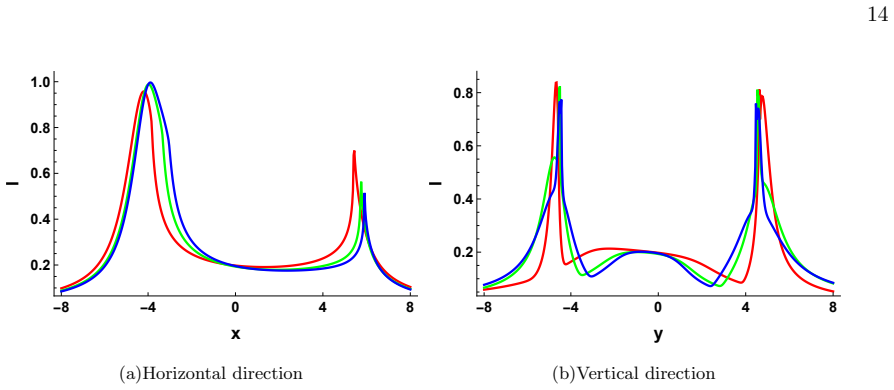
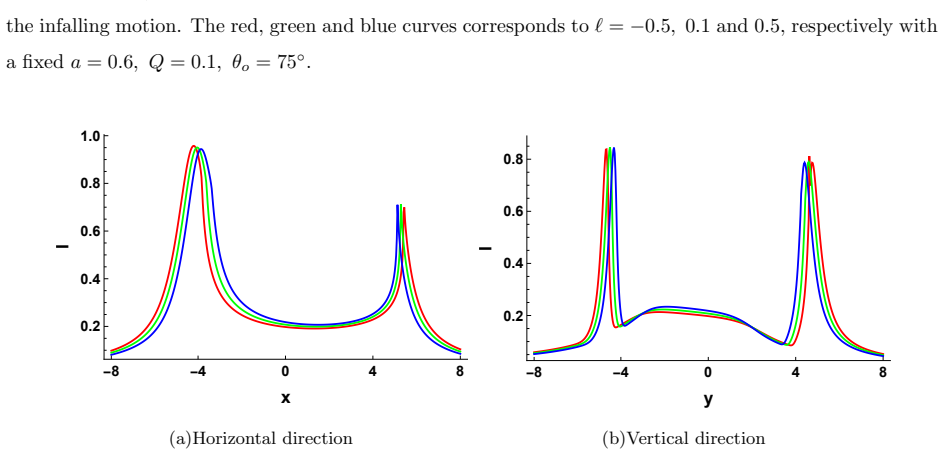
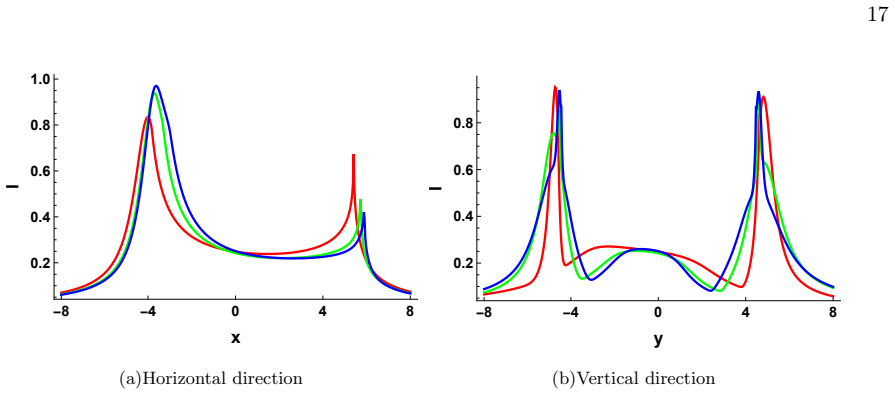
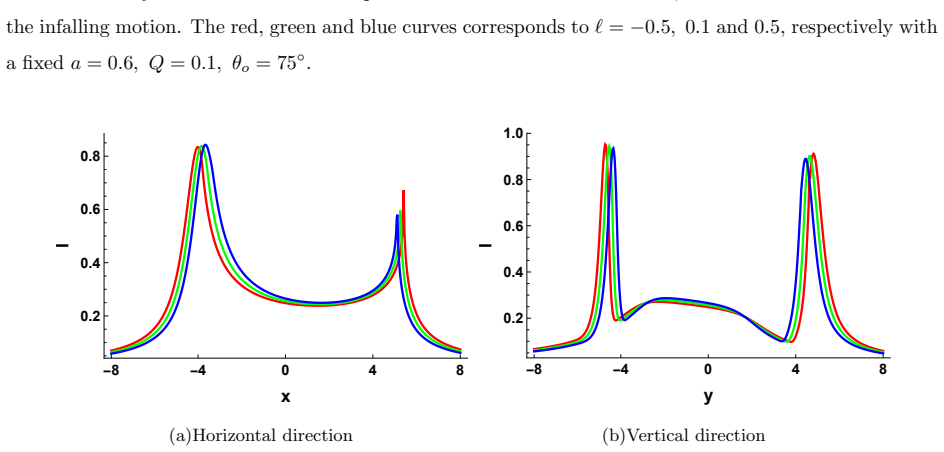
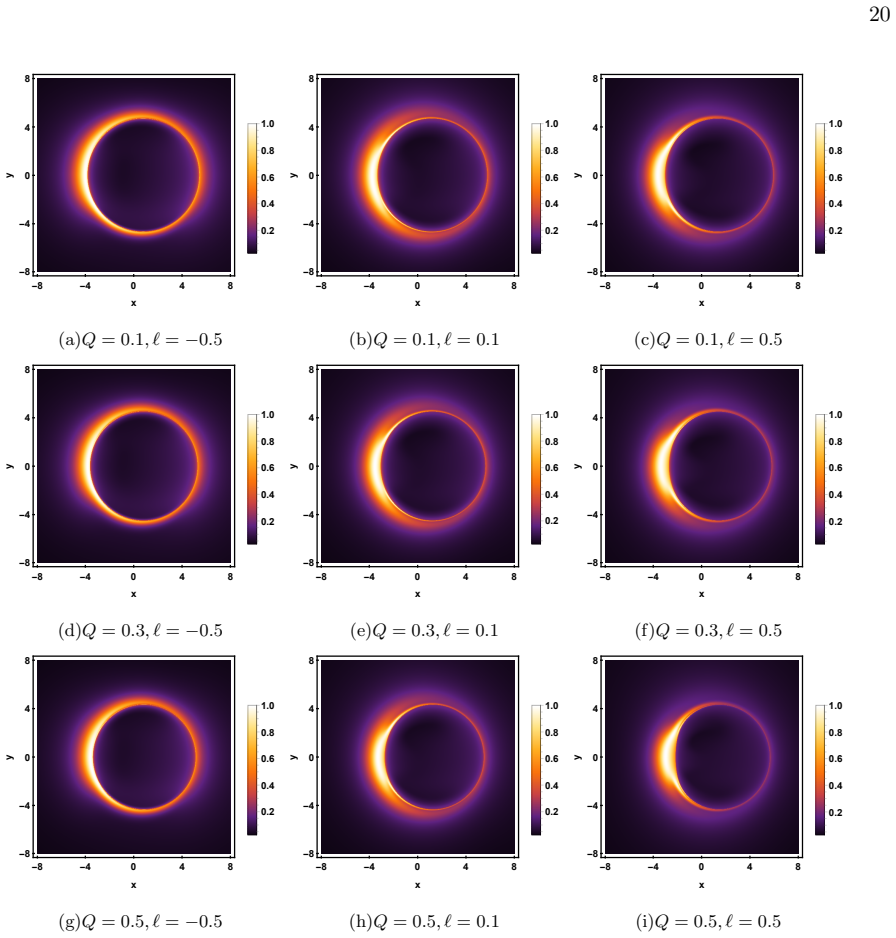
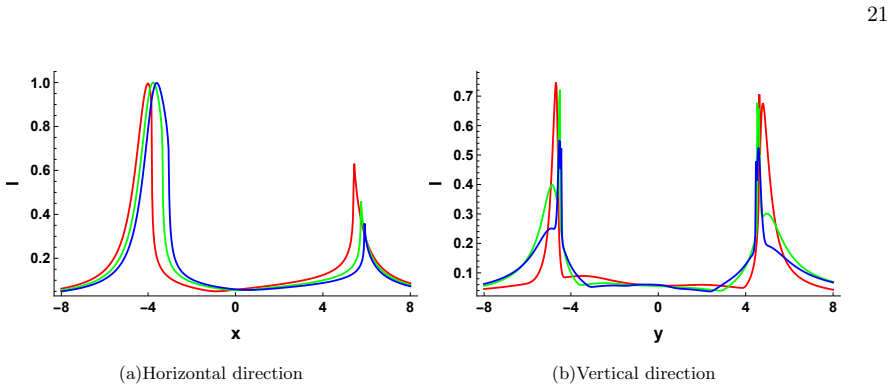
Comparing the rows of Fig.1with Fig.2, we observe that for a fixed value ofQ, both the bright ring and central region are slightly reduces with the augmentation ofℓ. Additionally, due to the frame-dragging effect induced by LSB parameterℓ, the intensity on the left side of the image becomes significantly enhanced with increasingℓ. On the contrary, by comp...
-
[3]
0.5 1.0 (b)Stokes parameterQ o -8 -4 0 4 8 -8 -4 0 4 8 x y -1.0 -0.5 0
0.2 0.4 0.6 0.8 1.0 (a)Stokes parameterI o -8 -4 0 4 8 -8 -4 0 4 8 x y -0.5 0. 0.5 1.0 (b)Stokes parameterQ o -8 -4 0 4 8 -8 -4 0 4 8 x y -1.0 -0.5 0. 0.5 (c)Stokes parameterU o -8 -4 0 4 8 -8 -4 0 4 8 x y -0.5 0. 0.5 1.0 (d)Stokes parameterV o FIG. 12: The resulting Stokes parametersI o,Q o,U o, andV o under the BAAF disk model with an infalling motion. ...
-
[4]
0.001 0.002 0.003
0.2 0.4 0.6 0.8 1.0 (a)Q= 0.1, ℓ=−0.5 -8 -4 0 4 8 -8 -4 0 4 8 -8 -4 0 4 8 -8 -4 0 4 8 y x 0. 0.001 0.002 0.003
-
[5]
0.001 0.002 0.003
0.2 0.4 0.6 0.8 1.0 (b)Q= 0.1, ℓ= 0.1 -8 -4 0 4 8 -8 -4 0 4 8 -8 -4 0 4 8 -8 -4 0 4 8 y x 0. 0.001 0.002 0.003
-
[6]
0.001 0.002 0.003
0.2 0.4 0.6 0.8 1.0 (c)Q= 0.1, ℓ= 0.5 -8 -4 0 4 8 -8 -4 0 4 8 -8 -4 0 4 8 -8 -4 0 4 8 y x 0. 0.001 0.002 0.003
-
[7]
0.001 0.002 0.003
0.2 0.4 0.6 0.8 1.0 (d)Q= 0.3, ℓ=−0.5 -8 -4 0 4 8 -8 -4 0 4 8 -8 -4 0 4 8 -8 -4 0 4 8 y x 0. 0.001 0.002 0.003
-
[8]
0.001 0.002 0.003
0.2 0.4 0.6 0.8 1.0 (e)Q= 0.3, ℓ= 0.1 -8 -4 0 4 8 -8 -4 0 4 8 -8 -4 0 4 8 -8 -4 0 4 8 y x 0. 0.001 0.002 0.003
-
[9]
0.001 0.002 0.003
0.2 0.4 0.6 0.8 1.0 (f)Q= 0.3, ℓ= 0.5 -8 -4 0 4 8 -8 -4 0 4 8 -8 -4 0 4 8 -8 -4 0 4 8 y x 0. 0.001 0.002 0.003
-
[10]
0.001 0.002 0.003
0.2 0.4 0.6 0.8 1.0 (g)Q= 0.5, ℓ=−0.5 -8 -4 0 4 8 -8 -4 0 4 8 -8 -4 0 4 8 -8 -4 0 4 8 y x 0. 0.001 0.002 0.003
-
[11]
0.001 0.002 0.003
0.2 0.4 0.6 0.8 1.0 (h)Q= 0.5, ℓ= 0.1 -8 -4 0 4 8 -8 -4 0 4 8 -8 -4 0 4 8 -8 -4 0 4 8 y x 0. 0.001 0.002 0.003
-
[12]
13: Polarized images of the Kerr-Sen-like BH in the BAAF model with anisotropic emission
0.2 0.4 0.6 0.8 1.0 (i)Q= 0.5, ℓ= 0.5 FIG. 13: Polarized images of the Kerr-Sen-like BH in the BAAF model with anisotropic emission. The accretion flow follows the infalling motion, and the observation is performed at a frequency of 230GHz with an inclination angle ofθ o = 75◦, and a spin parametera= 0.6. In Fig.12, we presents a representative example of...
-
[13]
Akiyama et al., Astrophys
K. Akiyama et al., Astrophys. J. Lett.875, L1 (2019)
2019
-
[14]
Akiyama et al., Astrophys
K. Akiyama et al., Astrophys. J. Lett.910, L12 (2021)
2021
-
[15]
Akiyama et al., Astrophys
K. Akiyama et al., Astrophys. J. Lett.930, L12 (2022)
2022
-
[16]
Akiyama et al., Astrophys
K. Akiyama et al., Astrophys. J. Lett.964, L25 (2024)
2024
-
[17]
Baub¨ ock et al., Astron
M. Baub¨ ock et al., Astron. Astrophys.635, (2020) A143
2020
-
[18]
Abuter et al., Astron
R. Abuter et al., Astron. Astrophys.677, (2023) L10
2023
-
[19]
M. D. Johnson et al., Sci. Adv.6(2020) eaaz1310
2020
-
[20]
Gold et al., Astrophys
R. Gold et al., Astrophys. J.897(2020) 148
2020
-
[21]
P.O. Mazur,Black hole uniqueness theorems, hep-th/0101012
work page internal anchor Pith review Pith/arXiv arXiv
-
[22]
C. M. Will, Living Rev. Rel.17(2014) 4
2014
-
[23]
Yagi and L.C
K. Yagi and L.C. Stein, Class. Quant. Grav.33(2016) 054001
2016
-
[24]
Kerr, Phys
R.P. Kerr, Phys. Rev. Lett.11(1963) 237
1963
-
[25]
Penrose, Phys
R. Penrose, Phys. Rev. Lett.14(1965) 57
1965
-
[26]
Bambi, Mod
C. Bambi, Mod. Phys. Lett. A26(2011) 2453
2011
-
[27]
Cardoso and P
V. Cardoso and P. Pani, Living Rev. Rel.22(2019) 4
2019
-
[28]
V. A. Kostelecky, Phys. Rev. D69(2004) 105009
2004
-
[29]
C. Ding, X. Chen and X. Fu, Nucl. Phys. B975(2022) 115688
2022
-
[30]
V. A. Kostelecky and S. Samuel, Phys. Rev. D39(1989) 683
1989
-
[31]
Jacobson, S
T. Jacobson, S. Liberati and D. Mattingly, Annals Phys.321(2006) 150
2006
-
[32]
V. A. Kosteleck´ y and M. Mewes, Phys. Lett. B757(2016) 510
2016
-
[33]
Colladay and V
D. Colladay and V. A. Kosteleck´ y, Phys. Rev. D58(1998) 116002
1998
-
[34]
V. A. Kosteleck´ y and S. Samuel, Phys. Rev. Lett.63(1989) 224
1989
-
[35]
A. V. Kosteleck´ y and J. D. Tasson, Phys. Rev. D83(2011) 016013
2011
-
[36]
Casana, et al., Phys
R. Casana, et al., Phys. Rev. D97(2018) 104001
2018
-
[37]
G¨ ull¨ u and A.¨Ovg¨ un, Annals Phys.436(2022) 168721
I. G¨ ull¨ u and A.¨Ovg¨ un, Annals Phys.436(2022) 168721
2022
-
[38]
Q. G. Bailey, et al., Phys. Rev. D112(2025) 024069
2025
-
[39]
C. Ding, C. Liu, R. Casana and A. Cavalcante, Eur. Phys. J. C80(2020) 178. 30
2020
-
[40]
Ding and X
C. Ding and X. Chen, Chin. Phys. C45(2021) 025106
2021
-
[41]
Sen, Phys
A. Sen, Phys. Rev. Lett.69(1992) 1006
1992
-
[42]
S. K. Jha and A. Rahaman, Eur. Phys. J. C81(2021) 345
2021
-
[43]
R. Xu, D. Liang, and L. Shao, Phys. Rev. D107(2023) 024011
2023
- [44]
-
[45]
S. K. Jha, S. Aziz, and A. Rahaman, Eur. Phys. J. C82(2022) 106
2022
-
[46]
Z. Wang, S. Chen, and J. Jing, Eur. Phys. J. C82(2022) 528
2022
-
[47]
S. U. Islam, S. G. Ghosh, and S. D. Maharaj, JCAP12(2024) 047
2024
-
[48]
J. Gu. et al., Eur. Phys. J. C82(2022) 708
2022
-
[49]
H. Y. YuChih, and Y. Shen, Phys. Rev. D112(2025) 104016
2025
-
[50]
J. P. Zhang, Y. Zhang, and L. Han, arXiv:2604.23721
work page internal anchor Pith review Pith/arXiv arXiv
-
[51]
New Exact Vacuum Solutions in Extended Bumblebee Gravity
J. Zhu and H. Li, arXiv:2604.09464
work page internal anchor Pith review Pith/arXiv arXiv
- [52]
-
[53]
Capozziello, et al., JCAP2023(2023) 027
S. Capozziello, et al., JCAP2023(2023) 027
2023
-
[54]
Lambiase, et al., JCAP2023(2023) 026
G. Lambiase, et al., JCAP2023(2023) 026
2023
-
[55]
R. D. Blandford and R. L. Znajek, Mon. Not. Roy. Astron. Soc.179(1977) 433
1977
-
[56]
Narayan, M
R. Narayan, M. D. Johnson, and C. F. Gammie, Astrophys. J. Lett.885(2019) L33
2019
-
[57]
X. X. Zeng, H. Q. Zhang and H. Zhang, Eur. Phys. J. C80(2020) 872
2020
-
[58]
X. X. Zeng, M. I. Aslam, R. Saleem, Eur. Phys. J. C83(2023) 129
2023
-
[59]
Saleem and M
R. Saleem and M. I. Aslam, Eur. Phys. J. C83(2023) 257
2023
-
[60]
M. I. Aslam and R. Saleem, Eur. Phys. J. C84(2024) 37
2024
-
[61]
Guo et al., Astrophys
S. Guo et al., Astrophys. J.975(2024) 237
2024
-
[62]
C. Y. Yang, M. I. Aslam and X. X. Zeng, et al., J. High Energy Astrophys.46(2025) 100345
2025
-
[63]
X. X. Zeng, C. Y. Yang and M. I. Aslam, et al., J. Cosmol. Astropart. Phys.2025(2025) 066
2025
-
[64]
Li and K.-J
G.-P. Li and K.-J. He, JCAP06(2021) 037
2021
-
[65]
X. X. Zeng et al., J. High Energy Astrophys.51(2026) 100540
2026
-
[66]
M. I. Aslam et al., arXiv:2604.18628
work page internal anchor Pith review Pith/arXiv arXiv
-
[67]
Hashimoto, S
K. Hashimoto, S. Kinoshita and K. Murata, Phys. Rev. D101, 066018 (2020)
2020
-
[68]
X. Y. Hu, M. I. Aslam and R. Saleem et al., J. Cosmol. Astropart. Phys.2023(2023) 013
2023
-
[69]
M. I. Aslam, X. X. Zeng and R. Saleem et al., Chin. Phys. C48(2024) 115101
2024
-
[70]
X. X. Zeng, M. I. Aslam and R. Saleem et al., Eur. Phys. J. C85(2025) 663
2025
-
[71]
Narayan and I.-s
R. Narayan and I.-s. Yi, Astrophys. J. Lett.428(1994) L13
1994
-
[72]
Yuan and R
F. Yuan and R. Narayan, Ann. Rev. Astron. Astrophys.52(2014) 529
2014
-
[73]
Narayan, I
R. Narayan, I. Yi, and R. Mahadevan, Nature374(1995) 623
1995
-
[74]
Porth et al., Astrophys
O. Porth et al., Astrophys. J. Suppl.243(2019) 26
2019
-
[75]
Jiang et al., JCAP01(2024) 059
H.-X. Jiang et al., JCAP01(2024) 059
2024
-
[76]
Uniyal et al., Astrophys
A. Uniyal et al., Astrophys. J.993(2025) 97. 31
2025
-
[77]
F. Yuan, E. Quataert and R. Narayan, Astrophys. J.598, 301 (2003)
2003
-
[78]
Broderick and A
A. Broderick and A. Loeb, Astrophys. J.697, 1164 (2009)
2009
-
[79]
H. Y. Pu and A. E. Broderick, Astrophys. J.863, 148 (2018)
2018
-
[80]
H. X. Jiang et al., JCAP01, 059 (2024)
2024
discussion (0)
Sign in with ORCID, Apple, or X to comment. Anyone can read and Pith papers without signing in.