Light-Driven Ferroic Switching Enables Reversible Control of Hydrogen Adsorption Thermodynamics
Pith reviewed 2026-06-30 13:38 UTC · model grok-4.3
The pith
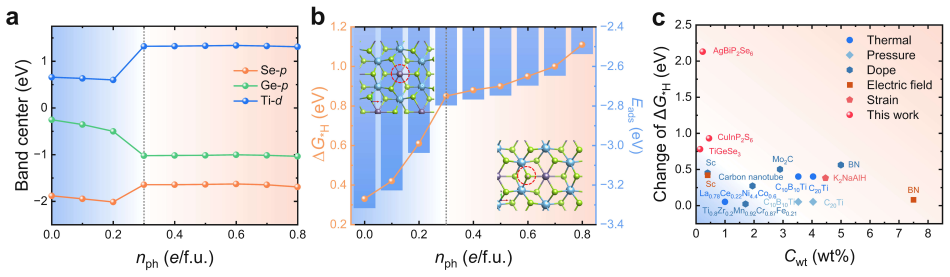
Photoinduced ferroic switching in TiGeSe3 tunes hydrogen adsorption free energy from 0.33 to 1.11 eV
A machine-rendered reading of the paper's core claim, the machinery that carries it, and where it could break.
Core claim
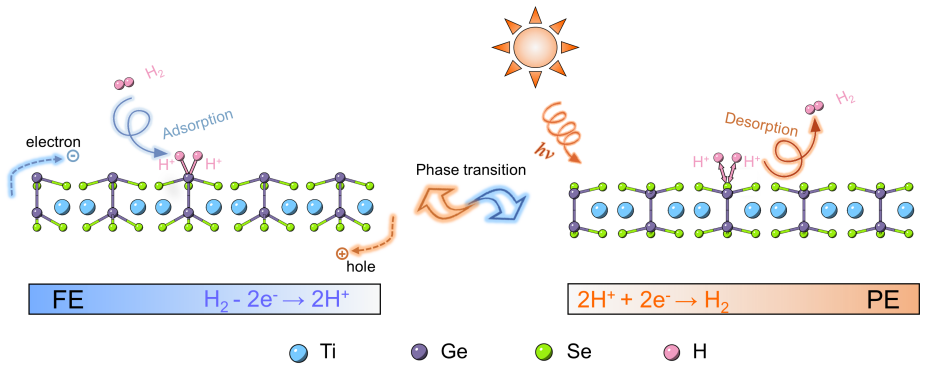
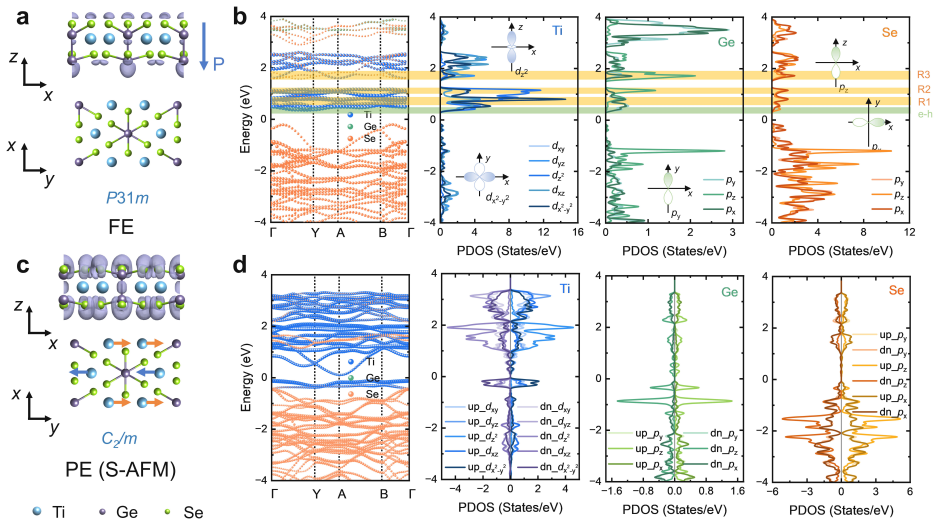
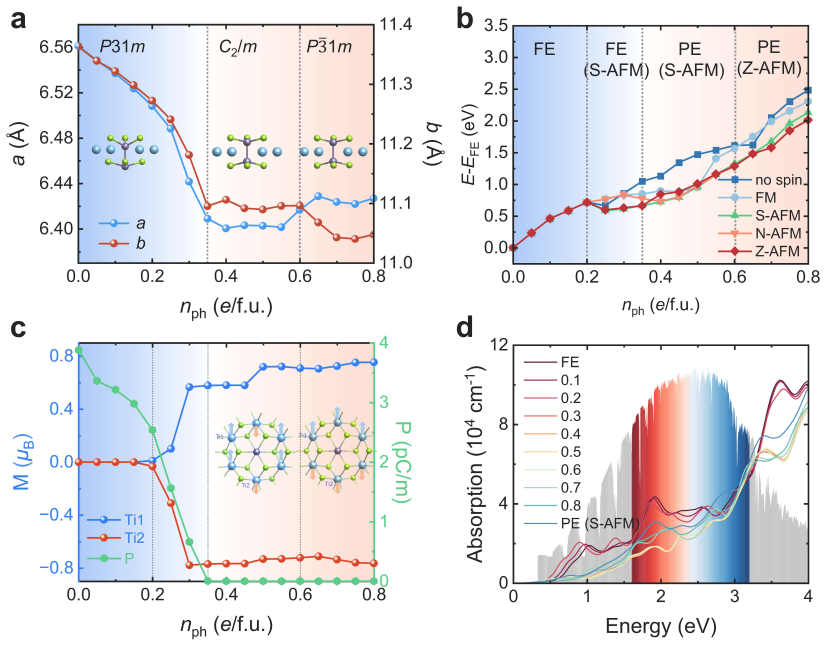
In TiGeSe3, carrier-density-driven redistribution of transition-metal 3d orbital occupations triggers a sequential evolution from the ferroelectric ground state to paraelectric phases with staggered or Zig-Zag antiferromagnetic order. This switch continuously tunes the hydrogen adsorption free energy from 0.33 to 1.11 eV, shifting the interface from near-thermoneutrality to spontaneous desorption. Nonadiabatic dynamics indicate that electron-phonon coupling promotes nonthermal H release, while picosecond carrier recombination rapidly restores the initial ferroic order, closing an ultrafast reversible cycle.
What carries the argument
carrier-density-driven redistribution of transition-metal 3d orbital occupations that drives the material through ferroelectric-to-paraelectric transitions with changing antiferromagnetic order
If this is right
- Hydrogen adsorption free energy can be tuned continuously over a 0.78 eV range by light-induced carrier changes.
- The surface moves from near-thermoneutral binding to spontaneous desorption conditions.
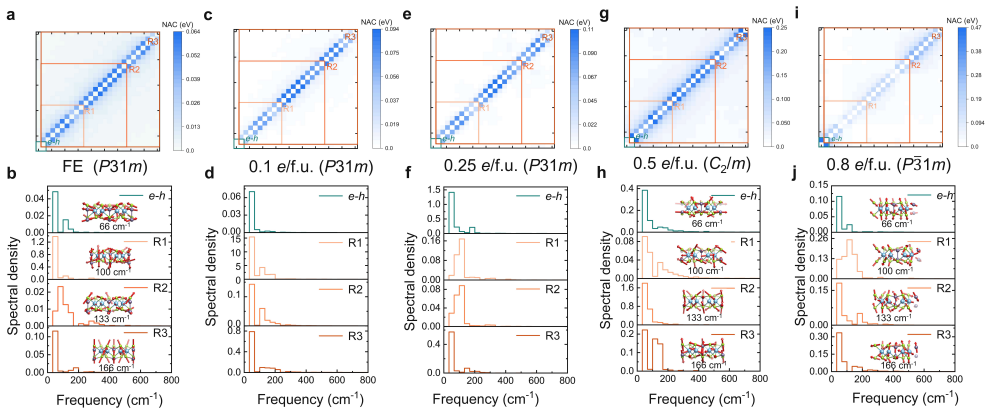
- Electron-phonon coupling enables nonthermal hydrogen release on ultrafast timescales.
- Picosecond carrier recombination restores the starting ferroic order and closes the reversible cycle.
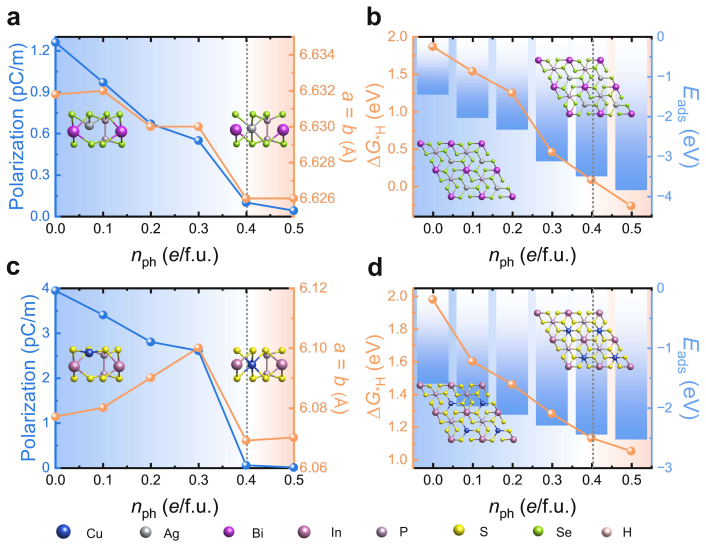
- The carrier-driven mechanism also appears in AgBiP2Se6 and CuInP2S6.
Where Pith is reading between the lines
- Light could serve as an external knob to trigger hydrogen release in storage devices without changing temperature or pressure.
- The same orbital-redistribution route may allow optical switching of catalytic activity for other small molecules.
- Materials with accessible ferroic phases could be screened for similar light-tunable surface thermodynamics.
Load-bearing premise
Nonadiabatic dynamics calculations correctly capture that electron-phonon coupling drives nonthermal hydrogen release and that picosecond carrier recombination restores the original ferroic order to close the cycle.
What would settle it
Direct measurement showing that the hydrogen adsorption free energy on illuminated TiGeSe3 changes continuously from 0.33 eV to 1.11 eV as carrier density is varied, accompanied by the predicted sequence of magnetic and structural phases.
Figures
read the original abstract
Reversible ultrafast switching of surface thermodynamics is highly desirable for hydrogen storage and catalysis yet remains elusive at the nanoscale. Here we demonstrate that photoinduced ferroic-order switching in two-dimensional ionic ferroelectric monolayers enables rapid, reversible control of hydrogen binding. In TiGeSe$_3$, carrier-density-driven redistribution of transition-metal 3\textit{d} orbital occupations triggers a sequential evolution from the ferroelectric ground state to paraelectric phases with staggered or Zig-Zag antiferromagnetic order. This switch continuously tunes the hydrogen adsorption free energy from 0.33 to 1.11 eV, shifting the interface from near-thermoneutrality to spontaneous desorption. Nonadiabatic dynamics indicate that electron-phonon coupling promotes nonthermal H release, while picosecond carrier recombination rapidly restores the initial ferroic order, closing an ultrafast reversible cycle. Generality is further validated in AgBiP$_2$Se$_6$ and CuInP$_2$S$_6$, establishing ferroic order as an optically addressable knob for dynamic thermodynamic reconfiguration beyond static design.
Editorial analysis
A structured set of objections, weighed in public.
Referee Report
Summary. The manuscript claims that photoinduced carrier-density-driven ferroic switching in 2D monolayers such as TiGeSe3 (and analogs AgBiP2Se6, CuInP2S6) enables reversible tuning of hydrogen adsorption free energy from 0.33 to 1.11 eV via sequential transitions from ferroelectric to paraelectric antiferromagnetic phases. Nonadiabatic dynamics are reported to show electron-phonon coupling driving nonthermal H desorption on ultrafast timescales, with picosecond carrier recombination restoring the initial ferroic order to close a reversible cycle.
Significance. If the reported continuous thermodynamic tuning and closed reversible cycle hold under scrutiny, the work would establish ferroic order as an optically addressable control knob for dynamic surface thermodynamics, with potential implications for hydrogen storage and catalysis beyond static descriptor-based design. The multi-material validation adds to the generality assessment.
major comments (2)
- [Abstract / Dynamics section] The nonadiabatic dynamics results (abstract and implied computational sections) provide no specification of the method (surface-hopping, Ehrenfest, or TDDFT), exchange-correlation functional, k-point sampling, or supercell size. These parameters directly affect electron-phonon matrix elements and reported picosecond timescales; without them the nonthermal desorption and order-restoration claims cannot be evaluated for sensitivity to common approximations.
- [Abstract / Results on adsorption energies] The continuous tuning of H adsorption free energy from 0.33 to 1.11 eV is presented as a central result, yet no details are given on how the free energies were computed (e.g., zero-point corrections, entropy contributions, or coverage dependence) or on error bars from the underlying DFT calculations.
minor comments (2)
- [Abstract] Notation for the antiferromagnetic orders (staggered vs. Zig-Zag) should be defined with reference to a figure or table showing the spin configurations.
- [Abstract] The abstract states 'generality is further validated' in two additional compounds; a brief statement of the corresponding adsorption-energy ranges or phase sequences would strengthen the claim.
Simulated Author's Rebuttal
We thank the referee for the constructive comments, which have improved the clarity of our work. We address each major point below and have revised the manuscript accordingly.
read point-by-point responses
-
Referee: [Abstract / Dynamics section] The nonadiabatic dynamics results (abstract and implied computational sections) provide no specification of the method (surface-hopping, Ehrenfest, or TDDFT), exchange-correlation functional, k-point sampling, or supercell size. These parameters directly affect electron-phonon matrix elements and reported picosecond timescales; without them the nonthermal desorption and order-restoration claims cannot be evaluated for sensitivity to common approximations.
Authors: We agree that these computational details are required for proper evaluation. The revised manuscript expands the Methods section to fully specify the nonadiabatic dynamics approach, functional, k-point sampling, and supercell size employed, together with a short assessment of sensitivity of the picosecond timescales to these choices. revision: yes
-
Referee: [Abstract / Results on adsorption energies] The continuous tuning of H adsorption free energy from 0.33 to 1.11 eV is presented as a central result, yet no details are given on how the free energies were computed (e.g., zero-point corrections, entropy contributions, or coverage dependence) or on error bars from the underlying DFT calculations.
Authors: We agree that these computational details should have been provided. The revised manuscript now includes explicit information on zero-point corrections, entropy contributions, coverage dependence, and estimated DFT error bars in both the Results and Methods sections. revision: yes
Circularity Check
No circularity detected
full rationale
The provided abstract and context describe computational results on carrier-density-driven ferroic switching in TiGeSe3 (and analogs) that tunes H adsorption free energy and nonadiabatic dynamics for reversible cycling. No equations, parameter fits, self-citations, or derivation steps are quoted that reduce any claimed prediction or result to its own inputs by construction. The central claims are presented as outputs of simulations rather than self-definitional or fitted-input renamings, satisfying the criteria for a self-contained derivation with no load-bearing circular steps.
Axiom & Free-Parameter Ledger
Reference graph
Works this paper leans on
-
[1]
X. Xu, Y . Dong, Q. Hu, N. Si, and C. Zhang, Energy & Fuels 38, 7579 (2024) . 11
2024
-
[2]
Hassan, S
A. Hassan, S. Z. Ilyas, A. Jalil, and Z. Ullah, Environ. Sci. Pollut. Res. 28, 21204 (2021)
2021
-
[3]
C. R. K. J and M. A. Majid, Energy Sustain Soc 10, 1 (2020)
2020
-
[4]
Y adav, A
S. Y adav, A. S. Oberoi, and M. K. Mittal, Int. J. Energy Res. 46, 16316 (2022)
2022
-
[5]
Eftekhari and B
A. Eftekhari and B. Fang, Int. J. Hydrogen Energy 42, 25143 (2017)
2017
-
[6]
J. Zhou, Q. Wang, Q. Sun, P . Jena, and X. Chen, Proc. Natl. Acad. Sci. 107, 2801 (2010)
2010
-
[7]
W. Liu, Y . Zhao, J. Nguyen, Y . Li, Q. Jiang, and E. Lavernia, Carbon 47, 3452 (2009)
2009
-
[8]
Y . Han, Y . Ni, X. Guo, and T. Jiao, Fuel 357, 129655 (2024)
2024
-
[9]
Zhang, H
F. Zhang, H. Zhang, S. Krylyuk, C. A. Milligan, Y . Zhu, D. Y . Zemlyanov, L. A. Bendersky, B. P . Burton, A. V . Davydov, and J. Appenzeller, Nat. Mater. 18, 55 (2019)
2019
-
[10]
M. Y . Zhang, Z. X. Wang, Y . N. Li, L. Y . Shi, D. Wu, T. Lin, S. J. Zhang, Y . Q. Liu, Q. M. Liu, J. Wang, T. Dong, and N. L. Wang, Phys. Rev. X 9, 021036 (2019)
2019
-
[11]
Z. Wang, X. Li, G. Zhang, Y . Luo, and J. Jiang, ACS Appl. Mater. Interfaces 9, 23309 (2017)
2017
-
[12]
J. Ma, R. Y ang, and H. Chen, Nat. Commun. 12, 2314 (2021)
2021
-
[13]
X. Lin, G. Bridoux, A. Gourgout, G. Seyfarth, S. Krämer, M. Nardone, B. Fauqué, and K. Behnia, Phys. Rev. Lett. 112, 207002 (2014)
2014
-
[14]
B. Peng, G. F. Lange, D. Bennett, K. Wang, R. J. Slager, and B. Monserrat, Phys. Rev. Lett. 132, 116601 (2024)
2024
-
[15]
Cazorla, S
C. Cazorla, S. Bichelmaier, C. Escorihuela Sayalero, J. Íñiguez, J. Carrete, and R. Rurali, Nanoscale 16, 8335 (2024)
2024
-
[16]
A. J. Sternbach, F. L. Ruta, Y . Shi, T. Slusar, J. Schalch, G. Duan, A. S. McLeod, X. Zhang, M. Liu, A. J. Millis, H.-T. Kim, L.-Q. Chen, R. D. Averitt, and D. N. Basov, Nano Lett. 21, 9052 (2021)
2021
-
[17]
A. S. Johnson, D. P . Salinas, K. M. Siddiqui, S. Kim, S. Choi, K. Volckaert, P . E. Majchrzak, S. Ulstrup, N. Agarwal, K. Hallman, R. F. H. Jr, C. M. Günther, B. Pfau, S. Eisebitt, D. Backes, F. Maccherozzi, A. Fitzpatrick, S. S. Dhesi, P . Gargiani, M. Valvidares, N. Artrith, F. de Groot, H. Choi, D. Jang, A. Katoch, S. Kwon, S. H. Park, H. Kim, and S. ...
2023
-
[18]
Lüchtefeld, H
J. Lüchtefeld, H. Hemmelmann, S. Wachs, C. Behling, K. J. Mayrhofer, M. T. Elm, and B. B. Berkes, J. Phys. Chem. C 127, 21211 (2023)
2023
-
[19]
L. Xue, Q. Zhang, X. Zhu, L. Gu, J. Yue, Q. Xia, T. Xing, T. Chen, Y . Y ao, and H. Xia, Nano Energy 56, 463 (2019)
2019
-
[20]
M. L. Brongersma, N. J. Halas, and P . Nordlander, Nat. Nanotechnol. 10, 25 (2015)
2015
-
[21]
Sándor, B
P . Sándor, B. Lovász, J. Budai, Z. Pápa, and P . Dombi, Nano Lett. 24, 8024 (2024). 12
2024
-
[22]
Avdizhiyan, W
A. Avdizhiyan, W. Janus, M. Szpytma, T. Slezak, M. Przybylski, M. Chrobak, V . Roddatis, A. Stu- pakiewicz, and I. Razdolski, Nano Lett. 24, 466 (2023)
2023
-
[23]
Bakalis, S
J. Bakalis, S. Chernov, Z. Li, A. Kunin, Z. H. Withers, S. Cheng, A. Adler, P . Zhao, C. Corder, M. G. White, G. Schönhense, X. DuRol, K. Kawakami, and T. K. Allison, Nano Lett. 24, 9353 (2024)
2024
-
[24]
S. Shen, H. Lu, S. Gumber, O. V . Prezhdo, and R. Long, Nano Lett. 25, 7517 (2025)
2025
-
[25]
Wang and S
Z. Wang and S. Dong, Proc. Natl. Acad. Sci. 120, e2305197120 (2023)
2023
-
[26]
Zhang, B
J.-J. Zhang, B. I. Y akobson, and S. Dong, Phys. Rev. Lett. 134, 216801 (2025)
2025
-
[27]
Paillard, E
C. Paillard, E. Torun, L. Wirtz, J. Íñiguez, and L. Bellaiche, Phys. Rev. Lett. 123, 087601 (2019)
2019
-
[28]
Paillard and L
C. Paillard and L. Bellaiche, Phys. Rev. B 107, 054107 (2023)
2023
-
[29]
Zheng, W
Q. Zheng, W. A. Saidi, Y . Xie, Z. Lan, O. V . Prezhdo, H. Petek, and J. Zhao, Nano. lett. 17, 6435 (2017)
2017
-
[30]
Zheng, W
Q. Zheng, W. Chu, C. Zhao, L. Zhang, H. Guo, Y . Wang, X. Jiang, and J. Zhao, Wiley Interdiscip. Rev.:Comput. Mol. Sci. 9, e1411 (2019)
2019
-
[31]
W. Chu, Q. Zheng, O. V . Prezhdo, J. Zhao, and W. A. Saidi, Sci. Adv. 6, eaaw7453 (2020)
2020
-
[32]
Y ang, X
Z. Y ang, X. Wang, Y . Chen, Z. Zheng, Z. Chen, W. Xu, W. Liu, Y . Y ang, J. Zhao, T. Chen, and H. Zhu, Nat. Commun. 10, 4540 (2019)
2019
-
[33]
R. D. King-Smith and D. Vanderbilt, Phys. Rev. B 47, 1651 (1993)
1993
-
[34]
W. Y ao, D. Li, S. Wei, X. Liu, X. Liu, and W. Wang, ACS omega 7, 36479 (2022)
2022
-
[35]
R. Sun, C. L. Y ang, M. S. Wang, and X. G. Ma, J. Power Sources 547, 232008 (2022)
2022
-
[36]
M. Ge, C. L. Y ang, M. S. Wang, and X. G. Ma, Colloids Surf., A 666, 131286 (2023)
2023
-
[37]
C. A. Gueymard, D. Myers, and K. Emery, Solar energy 73, 443 (2002)
2002
-
[38]
C. F. Fu, J. Sun, Q. Luo, X. Li, W. Hu, and J. Y ang, Nano Lett. 18, 6312 (2018)
2018
-
[39]
Wan, C.-L
X.-Q. Wan, C.-L. Y ang, M.-S. Wang, and X.-G. Ma, Appl. Surf. Sci. 614, 156254 (2023)
2023
-
[40]
X. Zhu, X. Tan, K. H. Wu, S. C. Haw, C. W. Pao, B. J. Su, J. Jiang, S. C. Smith, J. M. Chen, R. Amal, and X. Lu, Angew. Chem., Int. Ed. 60, 21911 (2021)
2021
-
[41]
S. Jiao, X. Fu, and H. Huang, Adv. Funct. Mater. 32, 2107651 (2022)
2022
-
[42]
J. K. Nørskov, F. Abild-Pedersen, F. Studt, and T. Bligaard, Proc. Natl. Acad. Sci. 108, 937 (2011)
2011
-
[43]
Zhang, W
J. Zhang, W. Li, J. Wang, X. Pu, G. Zhang, S. Wang, N. Wang, and X. Li, Angew. Chem. 135, e202215654 (2023)
2023
-
[44]
Zhang, K
W. Zhang, K. Li, B. Wang, Y . Sun, J. Zhou, and Z. Sun, J. Phys. Chem. Lett. 16, 4698 (2025)
2025
-
[45]
H. Yu, H. Irie, and K. Hashimoto, J. Am. Chem. Soc. 132, 6898 (2010). 13
2010
-
[46]
H. Irie, Y . Maruyama, and K. Hashimoto, J. Phys. Chem. C 111, 1847 (2007)
2007
-
[47]
Sabatier,La catalyse en chimie organique , Encyclopédie de Science Chimique Appliquée aux Arts Industriels (C
P . Sabatier,La catalyse en chimie organique , Encyclopédie de Science Chimique Appliquée aux Arts Industriels (C. Béranger, Paris, 1920)
1920
-
[48]
Z. W. Chen, J. Li, P . Ou, J. E. Huang, Z. Wen, L. Chen, X. Y ao, G. Cai, C. C. Y ang, C. V . Singh, and Q. Jiang, Nat. Commun. 15, 359 (2024)
2024
-
[49]
M. G. Kim, S. Kang, B. C. Wood, and E. S. Cho, J. Mater. Chem. A 12, 27212 (2024)
2024
-
[50]
S. Liu, Y . Zhang, F. Zhu, J. Liu, X. Wan, R. Liu, X. Liu, J. Shang, R. Yu, Q. Feng, W. Zili, and S. Jianglan, Adv. Sci. 11, 2401868 (2024)
2024
-
[51]
Z.-Z. Sun, W. Xun, L. Jiang, J.-L. Zhong, and Y .-Z. Wu, J. Phys. D:Appl. Phys. 52, 465302 (2019)
2019
-
[52]
J. Qi, H. Wang, X. Chen, and X. Qian, Appl. Phys. Lett. 113, 043102 (2018)
2018
-
[53]
H. Liu, S. Yu, Y . Wang, B. Huang, Y . Dai, and W. Wei, J. Phys. Chem. Lett. 13, 1972 (2022)
1972
-
[54]
Y . Fan, X. Song, H. Ai, W. Li, and M. Zhao, ACS Appl. Mater. Interfaces 13, 34486 (2021)
2021
-
[55]
L. Ju, J. Shang, X. Tang, and L. Kou, J. Am. Chem. Soc. 142, 1492 (2019)
2019
-
[56]
B. Xu, H. Xiang, Y . Xia, K. Jiang, X. Wan, J. He, J. Yin, and Z. Liu, Nanoscale 9, 8427 (2017)
2017
-
[57]
B. Lin, A. Chaturvedi, J. Di, L. Y ou, C. Lai, R. Duan, J. Zhou, B. Xu, Z. Chen, P . Song, J. Peng, B. Ma, H. Liu, P . Meng, G. Y ang, H. Zhang, Z. Liu, and F. Liu, Nano Energy 76, 104972 (2020)
2020
-
[58]
P . Yu, F. Wang, J. Meng, T. A. Shifa, M. G. Sendeku, J. Fang, S. Li, Z. Cheng, X. Lou, and J. He, CrystEngComm 23, 591 (2021)
2021
-
[59]
Chiang, C.-C
C.-H. Chiang, C.-C. Lin, Y .-C. Lin, C.- Y . Huang, C.-H. Lin, Y .-J. Chen, T.-R. Ko, H.-L. Wu, W.- Y . Tzeng, S.-Z. Ho, Y .-C. Chen, C.-H. Ho, C.-J. Y ang, Z.-W . Cyue, C.-L. Dong, C.-W . Luo, C.-C. Chen, and C.-W . Chen,J. Am. Chem. Soc. 146, 23278 (2024)
2024
-
[60]
D. N. Denzler, C. Frischkorn, C. Hess, M. Wolf, and G. Ertl, Phys. Rev. Lett. 91, 226102 (2003)
2003
-
[61]
Füchsel, J
G. Füchsel, J. C. Tremblay, T. Klamroth, P . Saalfrank, and C. Frischkorn,Phys. Rev. Lett.109, 098303 (2012)
2012
-
[62]
Long and O
R. Long and O. V . Prezhdo, Nano Lett. 16, 1996 (2016)
1996
-
[63]
H. M. Jaeger, S. Fischer, and O. V . Prezhdo, J. Chem. Phys. 137, 22A545 (2012)
2012
-
[64]
Wan, C.-L
X.-Q. Wan, C.-L. Y ang, X.-H. Li, Y .-L. Liu, and W.-K. Zhao, J. Mater. Chem. A 12, 16559 (2024)
2024
-
[65]
Wan, C.-L
X.-Q. Wan, C.-L. Y ang, W.-J. Shi, X. Li, Y . Liu, W. Zhao, and F. Gao, Small 22, 2504146 (2025)
2025
-
[66]
Parkar and A
P . Parkar and A. Chaudhari, Mater. Chem. Phys. 319, 129340 (2024)
2024
-
[67]
Verma and N
R. Verma and N. Jaggi, Diamond Relat. Mater. 148, 111470 (2024). 14
2024
-
[68]
W. Qiao, D. Yin, S. Zhao, N. Ding, L. Liang, C. Wang, L. Wang, M. He, and Y . Cheng, Chem. Eng. J. 465, 142837 (2023)
2023
-
[69]
Y . Gao, P . Gao, C. Li, Q. Yue, Q. Liang, S. Qiao, W. Zhang, W. Zheng, L. Zhang, Z. Li, W.-G. Cui, X. Wang, Y . Wan, M. Zhang, X. Wang, Y . Liu, F. Qi, C. Li, J. Miao, J. Zhang, X. Han, P . Wang, C. Guo, Q. Chen, Z. Xu, M. Gao, W. Sun, Y . Y ang, J. Chen, Z. Xia, and H. Pan,Adv. Funct. Mater.35, e05188 (2025)
2025
-
[70]
Seif and K
A. Seif and K. Azizi, RSC Adv. 6, 58458 (2016)
2016
-
[71]
Z. Shi, K. Nie, Z. J. Shao, B. Gao, H. Lin, H. Zhang, B. Liu, Y . Wang, Y . Zhang, X. Sun, P . Cao, Xiaoming Hu, Q. Gao, and Y . Tang, Energy Environ. Sci. 10, 1262 (2017)
2017
-
[72]
X. Xia, G. Zhao, Q. Y an, B. Wang, Q. Wang, and H. Xie,ACS Sustainable Chem. Eng. 10, 182 (2021)
2021
-
[73]
Baaddi, R
M. Baaddi, R. Chami, O. Baalla, S. E. Quaoubi, A. Saadi, L. E. H. Omari, and M. Chafi, Environ. Sci. Pollut. Res. 31, 62056 (2024)
2024
-
[74]
B. Li, Y . Wu, N. Li, X. Chen, X. Zeng, Arramel, X. Zhao, and J. Jiang, ACS Appl. Mater. Interfaces 12, 9261 (2020)
2020
-
[75]
up” and “dn
W. Zhou, D. Zhu, Z. Tang, C. Wu, L. Huang, Z. Ma, and Y . Chen, J. Power Sources 343, 11 (2017) . 15 FIG. 1. Illustration of the underlying mechanism for photo-controlled hydrogen storage in the ionic ferro- electric of TiGeSe 3 monolayer. The left panel illustrates carrier separation driven by the intrinsic electric field in the FE phase without light. I...
2017
discussion (0)
Sign in with ORCID, Apple, or X to comment. Anyone can read and Pith papers without signing in.