ConceptM³oE: Concept-Guided Multimodal Mixture of Experts for Interpretable Computational Pathology
Pith reviewed 2026-06-30 13:54 UTC · model grok-4.3
The pith
ConceptM³oE embeds concept bottlenecks into multimodal mixture-of-experts to deliver competitive pathology diagnosis performance alongside verifiable clinical reasoning traces.
A machine-rendered reading of the paper's core claim, the machinery that carries it, and where it could break.
Core claim
ConceptM³oE decomposes multimodal evidence into modality-specific, redundant, and synergistic experts that project into structured concept bottlenecks, with residual pathways preserving task-relevant signals to maintain high performance alongside interpretable concept-based explanations.
What carries the argument
Concept Multimodal Mixture of Experts architecture that decomposes inputs into modality-specific, redundant, and synergistic experts, projects latent features through concept bottlenecks, and uses residual pathways for direct task prediction.
If this is right
- The model produces reasoning traces that align with independent neuropathologist validation on pediatric brain tumor and glioma cohorts.
- Limited-data regimes see macro-F1 rise from 56.41 percent to 66.70 percent relative to non-concept-informed baselines.
- Training converges faster, consistent with a regularizing effect from explicit concept learning.
- The architecture supports diagnosis of complex tumor subtypes where single-modality morphology is insufficient.
Where Pith is reading between the lines
- The expert decomposition and concept hierarchy could transfer to other multimodal clinical tasks that combine imaging with tabular or text data.
- Concept bottlenecks might be tuned to alternative clinical taxonomies beyond the morphology-biomarker hierarchy used here.
- Validated reasoning traces could support human-in-the-loop review workflows in settings where black-box outputs are currently rejected.
Load-bearing premise
Residual pathways within each expert preserve task-relevant signals that would otherwise be lost when routing through the concept bottlenecks.
What would settle it
An ablation removing the residual pathways while keeping the concept bottlenecks, then measuring whether performance drops below non-concept baselines on the same cohorts, would test whether the residuals are required for the claimed performance-interpretability balance.
Figures




read the original abstract
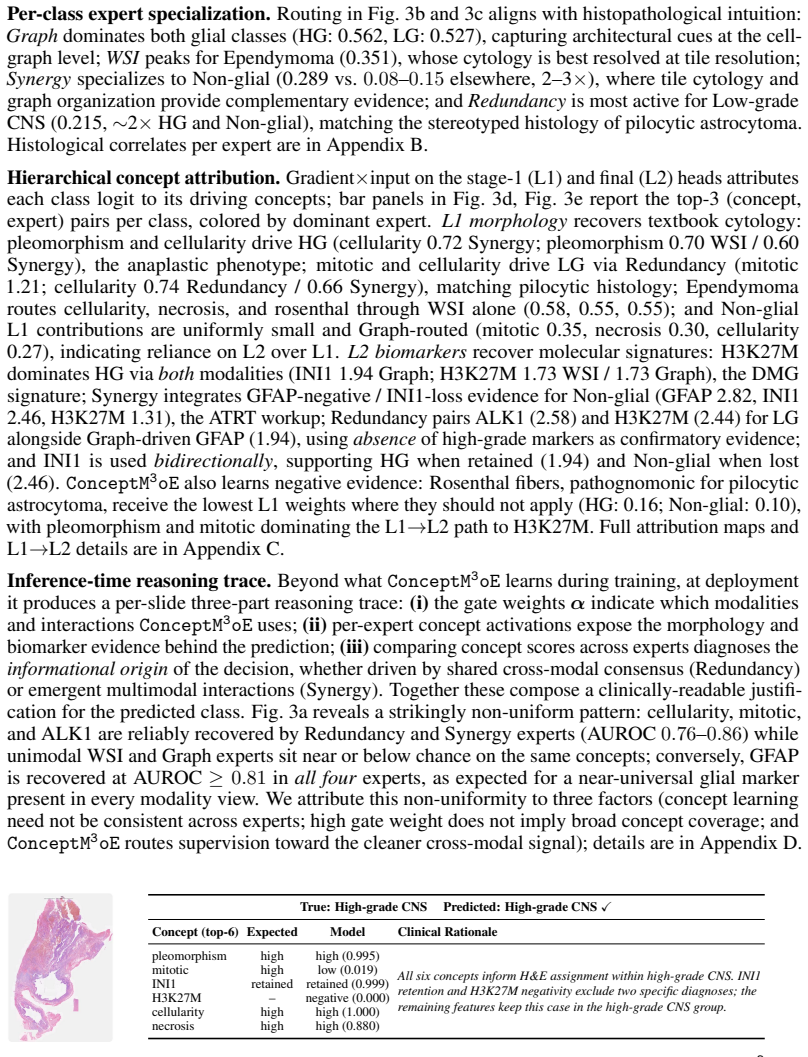
Healthcare models are transitioning from unimodal prediction toward multimodal reasoning over heterogeneous diagnostic inputs. In computational pathology, for complex tumor subtypes where morphology alone can be challenging to distinguish, pathology reports and molecular measurements may provide additional diagnostic evidence alongside whole-slide images, yet existing models often fail to clarify how diverse signals assemble into recognizable diagnostic concepts. We propose ConceptM$^3$oE (Concept Multimodal MoE), which embeds concept formation directly within interaction-aware mixture-of-experts (MoE) pathways. The architecture decomposes evidence into modality-specific, redundant, and synergistic experts, which are then projected into structured concept bottlenecks mapping latent features to a hierarchy of morphology and biomarker concepts. To prevent the information loss typical of interpretable bottlenecks, we utilize residual pathways within each expert to allow task-relevant signals to flow both through the concepts and directly to the final task prediction, so that high performance is maintained alongside interpretability. Across an institutional pediatric brain tumor cohort and a public glioma cohort, the framework delivers competitive performance to unconstrained models while producing reasoning traces validated by an independent neuropathologist. In data-limited regimes, ConceptM$^3$oE improves limited-data performance, increasing macro-F1 from 56.41% to 66.70% at small training sizes compared to non-concept-informed baselines, while also showing faster training convergence consistent with the regularizing effect of concept learning. This work offers a scalable path toward high-performance medical AI that is inherently verifiable and better aligned with the complex decision-making of clinical practice.
Editorial analysis
A structured set of objections, weighed in public.
Referee Report
Summary. The paper proposes ConceptM³oE, a multimodal mixture-of-experts architecture for computational pathology that decomposes inputs (WSIs, reports, molecular data) into modality-specific, redundant, and synergistic experts, projects them into a hierarchy of morphology and biomarker concept bottlenecks, and employs residual pathways within experts to route task-relevant signals directly to the prediction head. It reports competitive performance versus unconstrained baselines on an institutional pediatric brain-tumor cohort and a public glioma cohort, neuropathologist-validated reasoning traces, and improved macro-F1 (56.41% → 66.70%) in limited-data regimes, attributing gains to the concept-regularized MoE with residuals.
Significance. If the empirical claims hold, the work supplies a concrete mechanism for embedding verifiable concept bottlenecks inside high-capacity multimodal models without the usual accuracy penalty, supported by external expert validation and limited-data gains. This directly addresses a core tension in medical AI between interpretability and performance and could influence design of future pathology systems that must produce auditable reasoning traces.
major comments (2)
- [§3.3] §3.3 (Residual pathways): The central claim that residual connections inside each expert 'prevent the information loss typical of interpretable bottlenecks' and thereby enable both competitive accuracy and faithful concept traces is load-bearing for the 'competitive to unconstrained models' and 'improved limited-data' results, yet no ablation that removes only the residual pathways (while holding concept projection, MoE routing, and expert decomposition fixed) is reported in §4 or the supplementary tables; without this isolation the performance attribution remains untested.
- [§4.2] §4.2 and Table 2: The limited-data experiment reports macro-F1 improvement from 56.41% to 66.70% at small training sizes, but the non-concept-informed baselines are not defined with respect to the same expert decomposition or routing mechanism; it is therefore unclear whether the gain is attributable to the concept bottleneck plus residuals or to other architectural differences.
minor comments (2)
- [Abstract] The abstract states 'faster training convergence consistent with the regularizing effect of concept learning' but supplies no learning-curve figure or epoch-to-convergence statistics; a supplementary plot would strengthen this secondary claim.
- [§3] Notation for the three expert types (modality-specific, redundant, synergistic) is introduced without an explicit equation or diagram reference in the methods; adding a compact notation table would improve readability.
Simulated Author's Rebuttal
We thank the referee for their constructive comments on our manuscript. We address each major comment below and commit to revisions that will strengthen the empirical support for our claims.
read point-by-point responses
-
Referee: [§3.3] §3.3 (Residual pathways): The central claim that residual connections inside each expert 'prevent the information loss typical of interpretable bottlenecks' and thereby enable both competitive accuracy and faithful concept traces is load-bearing for the 'competitive to unconstrained models' and 'improved limited-data' results, yet no ablation that removes only the residual pathways (while holding concept projection, MoE routing, and expert decomposition fixed) is reported in §4 or the supplementary tables; without this isolation the performance attribution remains untested.
Authors: We acknowledge that an isolated ablation of the residual pathways would provide clearer attribution for their role in preserving performance. The manuscript currently demonstrates competitive performance of the full model against unconstrained baselines and improved limited-data results, but does not report the requested ablation holding all other components fixed. We will add this ablation experiment to the revised manuscript and supplementary material. revision: yes
-
Referee: [§4.2] §4.2 and Table 2: The limited-data experiment reports macro-F1 improvement from 56.41% to 66.70% at small training sizes, but the non-concept-informed baselines are not defined with respect to the same expert decomposition or routing mechanism; it is therefore unclear whether the gain is attributable to the concept bottleneck plus residuals or to other architectural differences.
Authors: The non-concept-informed baselines are indeed standard multimodal models without the proposed expert decomposition or routing. We agree this makes attribution to the concept bottleneck and residuals less direct. In the revision, we will clarify the baseline definitions in §4.2 and Table 2, and include an additional control using the MoE structure without concept bottlenecks to better isolate the contribution. revision: yes
Circularity Check
No circularity; architecture and results are empirically grounded
full rationale
The paper proposes ConceptM³oE as an architectural design choice (modality-specific experts, concept bottlenecks, residual pathways) whose performance claims rest on direct empirical comparisons to baselines on two cohorts, including macro-F1 gains in limited-data regimes. No equations, fitted parameters, or self-citations are presented that reduce any reported result to a definition or input by construction. The residual pathway mechanism is stated as a design assumption to avoid bottleneck loss, but its justification is empirical rather than derived from prior self-citations or uniqueness theorems. The derivation chain is self-contained and externally falsifiable via the reported cohort experiments.
Axiom & Free-Parameter Ledger
Reference graph
Works this paper leans on
-
[1]
Josh Achiam, Steven Adler, Sandhini Agarwal, Lama Ahmad, Ilge Akkaya, Florencia Leoni Aleman, Diogo Almeida, Janko Altenschmidt, Sam Altman, Shyamal Anadkat, et al. Gpt-4 technical report.arXiv preprint arXiv:2303.08774, 2023
work page internal anchor Pith review Pith/arXiv arXiv 2023
-
[2]
Acosta, Guido J
Julián N. Acosta, Guido J. Falcone, Pranav Rajpurkar, and Eric J. Topol. Multimodal biomedical ai.Nature Medicine, 28:1773–1784, 2022
2022
-
[3]
Multimodal machine learn- ing: A survey and taxonomy.IEEE Transactions on Pattern Analysis and Machine Intelligence, 41(2):423–443, 2019
Tadas Baltrušaitis, Chaitanya Ahuja, and Louis-Philippe Morency. Multimodal machine learn- ing: A survey and taxonomy.IEEE Transactions on Pattern Analysis and Machine Intelligence, 41(2):423–443, 2019
2019
-
[4]
Boehm, Pegah Khosravi, Rami Vanguri, Jianjiong Gao, and Sohrab P
Kevin M. Boehm, Pegah Khosravi, Rami Vanguri, Jianjiong Gao, and Sohrab P. Shah. Har- nessing multimodal data integration to advance precision oncology.Nature Reviews Cancer, 22:114–126, 2022
2022
-
[5]
arXiv preprint arXiv:2407.06204 , year=
Tianle Cai, Yuhang Li, Zhen Geng, Zihan Wang, Hong Peng, Dongsheng Lee, Tianlong Chen, and Ming Liu. A survey on mixture of experts.arXiv preprint arXiv:2407.06204, 2024
-
[6]
Interactive concept bottleneck models
Kushal Chauhan, Rishabh Tiwari, Jan Freyberg, Pradeep Shenoy, and Krishnamurthy Dvijotham. Interactive concept bottleneck models. InAAAI Conference on Artificial Intelligence, 2023
2023
-
[7]
Chen, Tong Ding, Ming Y
Richard J. Chen, Tong Ding, Ming Y . Lu, Drew F. K. Williamson, Guillaume Jaume, Andrew H. Song, Bowen Chen, Andrew Zhang, Daniel Shao, Muhammad Shaban, et al. Towards a general-purpose foundation model for computational pathology.Nature Medicine, 30:850–862, 2024. 10
2024
-
[8]
Chen, Ming Y
Richard J. Chen, Ming Y . Lu, Jingwen Wang, Drew F. K. Williamson, Scott J. Rodig, Neal I. Lindeman, and Faisal Mahmood. Pathomic fusion: An integrated framework for fusing histopathology and genomic features for cancer diagnosis and prognosis.IEEE Transactions on Medical Imaging, 41(4):757–770, 2022
2022
-
[9]
Chen, Ming Y
Richard J. Chen, Ming Y . Lu, Wei-Hung Weng, Tiffany Y . Chen, Drew F. K. Williamson, Trevor Manz, Maha Shady, and Faisal Mahmood. Multimodal co-attention transformer for survival prediction in gigapixel whole slide images. InIEEE/CVF International Conference on Computer Vision, 2021
2021
-
[10]
Mixture of Concept Bottleneck Experts
Francesco De Santis, Gabriele Ciravegna, Giovanni De Felice, Arianna Casanova, Francesco Gi- annini, Michelangelo Diligenti, Mateo Espinosa Zarlenga, Pietro Barbiero, Johannes Schneider, and Danilo Giordano. Mixture of concept bottleneck experts.arXiv preprint arXiv:2602.02886, 2026
work page internal anchor Pith review Pith/arXiv arXiv 2026
-
[11]
Tong Ding, Sophia J. Wagner, Andrew H. Song, Richard J. Chen, Ming Y . Lu, Andrew Zhang, Anurag J. Vaidya, Guillaume Jaume, Muhammad Shaban, Ahrong Kim, et al. Multimodal whole slide foundation model for pathology.arXiv preprint arXiv:2411.19666, 2024
-
[12]
Concept embedding models: Beyond the accuracy- explainability trade-off
Mateo Espinosa Zarlenga, Pietro Barbiero, Gabriele Ciravegna, Giuseppe Marra, Francesco Giannini, Michelangelo Diligenti, Zohreh Shams, Frederic Precioso, Stefano Melacci, Adrian Weller, Pietro Liò, and Mateja Jamnik. Concept embedding models: Beyond the accuracy- explainability trade-off. InAdvances in Neural Information Processing Systems, 2022
2022
-
[13]
Hamilton, Rex Ying, and Jure Leskovec
William L. Hamilton, Rex Ying, and Jure Leskovec. Inductive representation learning on large graphs. InAdvances in Neural Information Processing Systems, volume 30, 2017
2017
-
[14]
The nci genomic data commons.Nature genetics, 53(3):257–262, 2021
Allison P Heath, Vincent Ferretti, Stuti Agrawal, Maksim An, James C Angelakos, Renuka Arya, Rosita Bajari, Bilal Baqar, Justin HB Barnowski, Jeffrey Burt, et al. The nci genomic data commons.Nature genetics, 53(3):257–262, 2021
2021
-
[15]
Hierarchical concept-based inter- pretable models
Oscar Hill, Mateo Espinosa Zarlenga, and Mateja Jamnik. Hierarchical concept-based inter- pretable models. InInternational Conference on Learning Representations, 2026
2026
-
[16]
Shih-Cheng Huang, Anuj Pareek, Saeed Seyyedi, Imon Banerjee, and Matthew P. Lungren. Fusion of medical imaging and electronic health records using deep learning: A systematic review and implementation guidelines.npj Digital Medicine, 3:136, 2020
2020
-
[17]
Montine, and James Zou
Zhi Huang, Federico Bianchi, Mert Yuksekgonul, Thomas J. Montine, and James Zou. A visual- language foundation model for computational pathology.Nature Medicine, 30:1156–1167, 2024
2024
-
[18]
Jacobs, Michael I
Robert A. Jacobs, Michael I. Jordan, Steven J. Nowlan, and Geoffrey E. Hinton. Adaptive mixtures of local experts.Neural Computation, 3(1):79–87, 1991
1991
-
[19]
Jordan and Robert A
Michael I. Jordan and Robert A. Jacobs. Hierarchical mixtures of experts and the em algorithm. Neural Computation, 6(2):181–214, 1994
1994
-
[20]
Probabilistic concept bottleneck models
Eunji Kim, Dahuin Jung, Sangha Park, Siwon Kim, and Sungroh Yoon. Probabilistic concept bottleneck models. InInternational Conference on Machine Learning, 2023
2023
-
[21]
Concept bottleneck models
Pang Wei Koh, Thao Nguyen, Yew Siang Tang, Stephen Mussmann, Emma Pierson, Been Kim, and Percy Liang. Concept bottleneck models. InInternational Conference on Machine Learning, 2020
2020
-
[22]
Multimodal data fusion: An overview of methods, challenges, and prospects.Proceedings of the IEEE, 103(9):1449–1477, 2015
Dana Lahat, Tülay Adali, and Christian Jutten. Multimodal data fusion: An overview of methods, challenges, and prospects.Proceedings of the IEEE, 103(9):1449–1477, 2015
2015
-
[23]
A survey of multimodal learning: Methods, applications, and future directions.Foundations and Trends in Multimedia Information Retrieval, 2024
Paul Pu Liang, Amir Zadeh, and Louis-Philippe Morency. A survey of multimodal learning: Methods, applications, and future directions.Foundations and Trends in Multimedia Information Retrieval, 2024. 11
2024
-
[24]
Chen, Bowen Chen, Ming Y
Jana Lipkova, Richard J. Chen, Bowen Chen, Ming Y . Lu, Matteo Barbieri, Daniel Shao, Anurag J. Vaidya, Chengkuan Chen, Luoting Zhuang, Drew F. K. Williamson, Muhammad Shaban, Tiffany Y . Chen, and Faisal Mahmood. Artificial intelligence in multimodal data integration for oncology.Cancer Cell, 40(10):1095–1110, 2022
2022
-
[25]
Efficient low-rank multimodal fusion with modality-specific factors
Zhun Liu, Ying Shen, Varun Bharadhwaj Lakshminarasimhan, Paul Pu Liang, Amir Zadeh, and Louis-Philippe Morency. Efficient low-rank multimodal fusion with modality-specific factors. InProceedings of the 56th Annual Meeting of the Association for Computational Linguistics, pages 2247–2256, 2018
2018
-
[26]
Lu, Bowen Chen, Drew F
Ming Y . Lu, Bowen Chen, Drew F. K. Williamson, Richard J. Chen, Ivy Liang, Tong Ding, Guillaume Jaume, Igor Odintsov, Long Phi Le, Georg Gerber, et al. A visual-language founda- tion model for pathology image analysis using medical twitter.Nature Medicine, 30:2302–2311, 2024
2024
-
[27]
Lu, Drew F
Ming Y . Lu, Drew F. K. Williamson, Tiffany Y . Chen, Richard J. Chen, Matteo Barbieri, and Faisal Mahmood. Data-efficient and weakly supervised computational pathology on whole-slide images.Nature Biomedical Engineering, 5:555–570, 2021
2021
-
[28]
Taylor, Lynn Bjerke, Matthew Clarke, Mara Vinci, Meera Nandhabalan, et al
Alan Mackay, Anna Burford, Diana Carvalho, Elisa Izquierdo, Janat Fazal-Salom, Kathryn R. Taylor, Lynn Bjerke, Matthew Clarke, Mara Vinci, Meera Nandhabalan, et al. Integrated molecular meta-analysis of 1,000 pediatric high-grade and diffuse intrinsic pontine glioma. Cancer Cell, 32(4):520–537.e5, 2017
2017
-
[29]
Krumholz, Jure Leskovec, Eric J
Michael Moor, Oishi Banerjee, Zahra Shakeri Hossein Abad, Harlan M. Krumholz, Jure Leskovec, Eric J. Topol, and Pranav Rajpurkar. Foundation models for generalist medical artificial intelligence.Nature, 616:259–265, 2023
2023
-
[30]
Multi- modal contrastive learning with LIMoE: The language-image mixture of experts
Basil Mustafa, Carlos Riquelme, Joan Puigcerver, Rodolphe Jenatton, and Neil Houlsby. Multi- modal contrastive learning with LIMoE: The language-image mixture of experts. InAdvances in Neural Information Processing Systems, volume 35, pages 9564–9576, 2022
2022
-
[31]
Attention bottlenecks for multimodal fusion
Arsha Nagrani, Shan Yang, Anurag Arnab, Aren Jansen, Cordelia Schmid, and Chen Sun. Attention bottlenecks for multimodal fusion. InAdvances in Neural Information Processing Systems, volume 34, pages 14200–14213, 2021
2021
-
[32]
Comprehensive, integrative genomic analysis of diffuse lower-grade gliomas.New England Journal of Medicine, 372(26):2481–2498, 2015
Cancer Genome Atlas Research Network. Comprehensive, integrative genomic analysis of diffuse lower-grade gliomas.New England Journal of Medicine, 372(26):2481–2498, 2015
2015
-
[33]
Jiquan Ngiam, Aditya Khosla, Mingyu Kim, Juhan Nam, Honglak Lee, and Andrew Y . Ng. Multimodal deep learning. InInternational Conference on Machine Learning, 2011
2011
-
[34]
Joakim Nguyen, Jian Yu, Jinrui Fang, Nicholas Konz, Tianlong Chen, Sanjay Krishnan, Chandra Krishnan, Ying Ding, Hairong Wang, and Ankita Shukla. Clinically-informed modeling for pediatric brain tumor classification from whole-slide histopathology images.arXiv preprint arXiv:2604.21060, 2026. Accepted at the IEEE International Conference on Healthcare Inf...
work page internal anchor Pith review Pith/arXiv arXiv 2026
-
[35]
Nguyen, and Tsui-Wei Weng
Tuomas Oikarinen, Subhro Das, Lam M. Nguyen, and Tsui-Wei Weng. Label-free concept bottleneck models. InInternational Conference on Learning Representations, 2023
2023
-
[36]
arXiv preprint arXiv:2310.02116 , year=
Konstantinos P. Panousis, Dino Ienco, and Diego Marcos. Coarse-to-fine concept bottleneck models.arXiv preprint arXiv:2310.02116, 2023
-
[37]
Integrated proteogenomic characterization across major histological types of pediatric brain cancer.Cell, 183(7):1962– 1985.e31, 2020
Francesca Petralia, Nicole Tignor, Boris Reva, Mateusz Koptyra, Shrabanti Chowdhury, Dmitry Rykunov, Azra Krek, Weiping Ma, Yuankun Zhu, Jiayi Ji, et al. Integrated proteogenomic characterization across major histological types of pediatric brain cancer.Cell, 183(7):1962– 1985.e31, 2020
1962
-
[38]
Pfister, Miguel Reyes-Múgica, Jennifer A
Stefan M. Pfister, Miguel Reyes-Múgica, Jennifer A. Chan, Henrik Hasle, Alexander J. Lazar, Ingo Müller, Megan Munsie, Barbara Rivera, Dirk Schadendorf, Jack F. Shern, et al. Molecular classification of pediatric brain tumors.Nature Reviews Clinical Oncology, 19:531–547, 2022. 12
2022
-
[39]
Outrageously large neural networks: The sparsely-gated mixture-of-experts layer
Noam Shazeer, Azalia Mirhoseini, Krzysztof Maziarz, Andy Davis, Quoc Le, Geoffrey Hinton, and Jeff Dean. Outrageously large neural networks: The sparsely-gated mixture-of-experts layer. InInternational Conference on Learning Representations, 2017
2017
-
[40]
3 4 5 Brat Daniel J
Cancer Genome Atlas Research Network Tissue source sites: Duke University Medical School McLendon Roger 1 Friedman Allan 2 Bigner Darrell 1, Emory University Van Meir Erwin G. 3 4 5 Brat Daniel J. 5 6 M. Mastrogianakis Gena 3 Olson Jeffrey J. 3 4 5, Henry Ford Hospital Mikkelsen Tom 7 Lehman Norman 8, MD Anderson Cancer Center Aldape Ken 9 Alfred Yung WK ...
2008
-
[41]
VLG-CBM: Training concept bottleneck models with vision-language guidance
Divyansh Srivastava, Ge Yan, and Tsui-Wei Weng. VLG-CBM: Training concept bottleneck models with vision-language guidance. InAdvances in Neural Information Processing Systems, 2024
2024
-
[42]
Multimodal deep learning for biomedical data fusion: A review.Briefings in Bioinformatics, 23(2):bbab569, 2022
Sören Richard Stahlschmidt, Benjamin Ulfenborg, and Jane Synnergren. Multimodal deep learning for biomedical data fusion: A review.Briefings in Bioinformatics, 23(2):bbab569, 2022
2022
-
[43]
Multimodal data fusion for cancer biomarker discovery with deep learning.Nature Machine Intelligence, 6:287–298, 2024
Ario Steva, Amirali Ahmadi, and Jakob Nikolas Kather. Multimodal data fusion for cancer biomarker discovery with deep learning.Nature Machine Intelligence, 6:287–298, 2024
2024
-
[44]
Orr, Umut H
Dominik Sturm, Brent A. Orr, Umut H. Toprak, V olker Hovestadt, David T. W. Jones, David Capper, Martin Sill, Ivo Buchhalter, Paul A. Northcott, Irina Leischner, et al. New brain tumor entities emerge from molecular classification of CNS tumors.Cell, 164(5):1060–1072, 2016
2016
-
[45]
The information bottleneck method
Naftali Tishby, Fernando C Pereira, and William Bialek. The information bottleneck method. arXiv preprint physics/0004057, 2000
work page internal anchor Pith review Pith/arXiv arXiv 2000
-
[46]
Towards generalist biomedical ai.NEJM AI, 1(3), 2024
Tao Tu, Shekoofeh Azizi, Danny Driess, Mike Schaekermann, Mohamed Amin, Pi-Chuan Chang, Andrew Carroll, Chuck Lau, Ryutaro Tanno, Ira Ktena, et al. Towards generalist biomedical ai.NEJM AI, 1(3), 2024
2024
-
[47]
Vanguri, Jia Luo, Andrew T
Rami S. Vanguri, Jia Luo, Andrew T. Aukerman, Jacklynn V . Egger, Christopher J. Fong, Natally Horvat, Andrew Pagano, Jose D. Araujo-Filho, Luke Geneslaw, Hira Rizvi, et al. Multimodal integration of radiology, pathology, and genomics for prediction of response to immunotherapy in non-small cell lung cancer.Nature Cancer, 3:1151–1164, 2022
2022
-
[48]
Virchow: A Million-Slide Digital Pathology Foundation Model
Eugene V orontsov, Alican Bozkurt, Adam Casson, George Shaikovski, Michal Zelechowski, Kristen Severson, Eric Zimmermann, James Hall, Neil Tenenholtz, Nicolo Fusi, et al. Virchow: A million-slide digital pathology foundation model.arXiv preprint arXiv:2309.07778, 2024
work page internal anchor Pith review Pith/arXiv arXiv 2024
-
[49]
Concept flow models: Anchoring concept-based reasoning with hierarchical bottlenecks.Transactions on Machine Learning Research, 2026
Ya Wang and Adrian Paschke. Concept flow models: Anchoring concept-based reasoning with hierarchical bottlenecks.Transactions on Machine Learning Research, 2026
2026
-
[50]
Hierarchical, Interpretable, Label-Free Concept Bottleneck Model
Haodong Xie, Yujun Cai, Rahul Singh Maharjan, Yiwei Wang, Federico Tavella, and Angelo Cangelosi. Hierarchical, interpretable, label-free concept bottleneck model.arXiv preprint arXiv:2604.02468, 2026
work page internal anchor Pith review Pith/arXiv arXiv 2026
-
[51]
Ballard, Tianlong Chen, and Qi Long
Jiayi Xin, Sukwon Yun, Jie Peng, Inyoung Choi, Jenna L. Ballard, Tianlong Chen, and Qi Long. I2MoE: Interpretable multimodal interaction-aware mixture-of-experts. InInternational Con- ference on Machine Learning, 2025. Poster
2025
-
[52]
Peng Xu, Xiatian Zhu, and David A. Clifton. Multimodal learning with transformers: A survey. IEEE Transactions on Pattern Analysis and Machine Intelligence, 2023
2023
-
[53]
Language in a bottle: Language model guided concept bottlenecks for interpretable image classification
Yue Yang, Artemis Panagopoulou, Shenghao Zhou, Daniel Jin, Chris Callison-Burch, and Mark Yatskar. Language in a bottle: Language model guided concept bottlenecks for interpretable image classification. InIEEE/CVF Conference on Computer Vision and Pattern Recognition, 2023. 13
2023
-
[54]
Jian Yu, Joakim Nguyen, Jinrui Fang, Awais Naeem, Zeyuan Cao, Sanjay Krishnan, Nicholas Konz, Tianlong Chen, Chandra Krishnan, Hairong Wang, Edward Castillo, Ying Ding, and Ankita Shukla. PathMoE: Interpretable multimodal interaction experts for pediatric brain tumor classification.arXiv preprint arXiv:2603.01547, 2026
-
[55]
Post-hoc concept bottleneck models
Mert Yuksekgonul, Maggie Wang, and James Zou. Post-hoc concept bottleneck models. In International Conference on Learning Representations, 2023. Spotlight, notable top 25%
2023
-
[56]
more cells, abnormally shaped
Amir Zadeh, Minghai Chen, Soujanya Poria, Erik Cambria, and Louis-Philippe Morency. Tensor fusion network for multimodal sentiment analysis. InProceedings of the 2017 Conference on Empirical Methods in Natural Language Processing, pages 1103–1114, 2017. 14 A Extended Experimental Setup and Implementation Details A.1 Dataset Details and Preprocessing PBT D...
2017
-
[57]
This confirms that the concept embedding layer, with residual pathways, does not act as a lossy bottleneck
CEM embeddings preserve task information comparable to raw latents.The converged I(ˆc;Y) of ConceptM3oE L1 and L2 (12.3–14.2 nats) is comparable to or slightly exceeds that of PathMoE’s raw expert latents (11.6 nats). This confirms that the concept embedding layer, with residual pathways, does not act as a lossy bottleneck
-
[58]
This quantifies the cost of forcing the classifier to rely solely on scalar concept probabilities
Scalar bottlenecks lose substantial information.The CBM variant achieves at most 3.3 nats (L1) and 0.7 nats (L2) of label-relevant information, a 70–95% reduction relative to ConceptM3oE. This quantifies the cost of forcing the classifier to rely solely on scalar concept probabilities. 22
-
[59]
Scalar bottlenecks learn class-relevant concepts slowly.CBM I(p 1;Y) remains at zero for the first 64 epochs, indicating that the scalar concept predictor learns to produce confident concept predictions long before those predictions become class-discriminative. This slow emergence of task-relevant concept structure is invisible to standard validation metr...
discussion (0)
Sign in with ORCID, Apple, or X to comment. Anyone can read and Pith papers without signing in.