Phonetic Modeling of Dialectal Variation in Vietnamese Speech
Pith reviewed 2026-06-30 13:27 UTC · model grok-4.3
The pith
A phonetic decomposition framework models Vietnamese dialectal variation in speech recognition by breaking syllables into components and mapping them to region-specific IPA representations.
A machine-rendered reading of the paper's core claim, the machinery that carries it, and where it could break.
Core claim
The authors claim that explicitly modeling Vietnamese phonological structure at the vocabulary and decoding levels through a phonetic vocabulary of decomposed syllable components and dialect-specific IPA mappings, together with a phonetic-structure decoder that jointly predicts the components, produces ASR performance that matches the strongest pretrained wav2vec2-base-vi-250h baseline across all three major dialects on the UIT-ViMD dataset while requiring substantially fewer parameters and no external pretraining.
What carries the argument
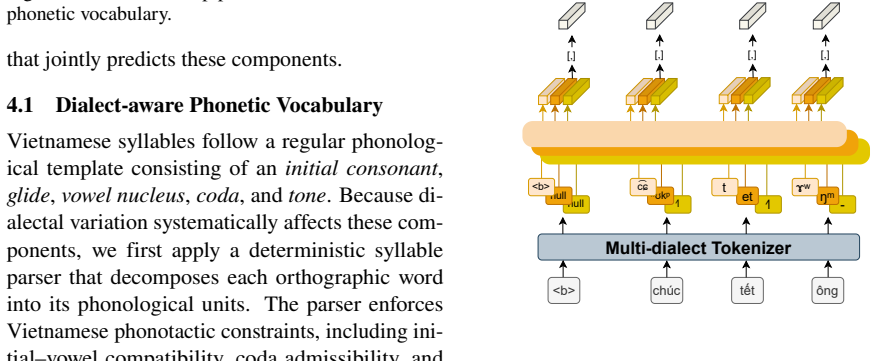
The dialect-aware phonetic framework, which decomposes each syllable into structured phonetic components, maps them to dialect-specific IPA representations in a phonetic vocabulary, and uses a phonetic-structure decoder to jointly predict those components.
If this is right
- The proposed method outperforms various pre-trained baselines on the UIT-ViMD dataset.
- It matches the performance of wav2vec2-base-vi-250h across Northern, Central, and Southern dialects.
- It achieves the result using substantially fewer parameters than the pretrained model.
- It requires no external pretraining data.
Where Pith is reading between the lines
- The same decomposition strategy could be tested on other tonal languages that show regional pronunciation shifts to see whether phonetic modeling reduces the need for large pretraining corpora.
- Deploying the lighter model on mobile or low-resource devices might improve real-time dialect-aware transcription where full pretrained models are impractical.
- The explicit IPA mappings may make it easier to audit or correct recognition errors that arise from specific regional sound changes.
Load-bearing premise
The UIT-ViMD dataset is representative of systematic dialectal phonetic differences and the decomposition plus dialect-specific IPA mappings capture the variation without external pretraining.
What would settle it
A controlled test in which the model is evaluated on new phonetic variants or dialect samples deliberately constructed to fall outside the patterns present in UIT-ViMD and performance falls well below the pretrained baseline would falsify the central claim.
Figures




read the original abstract
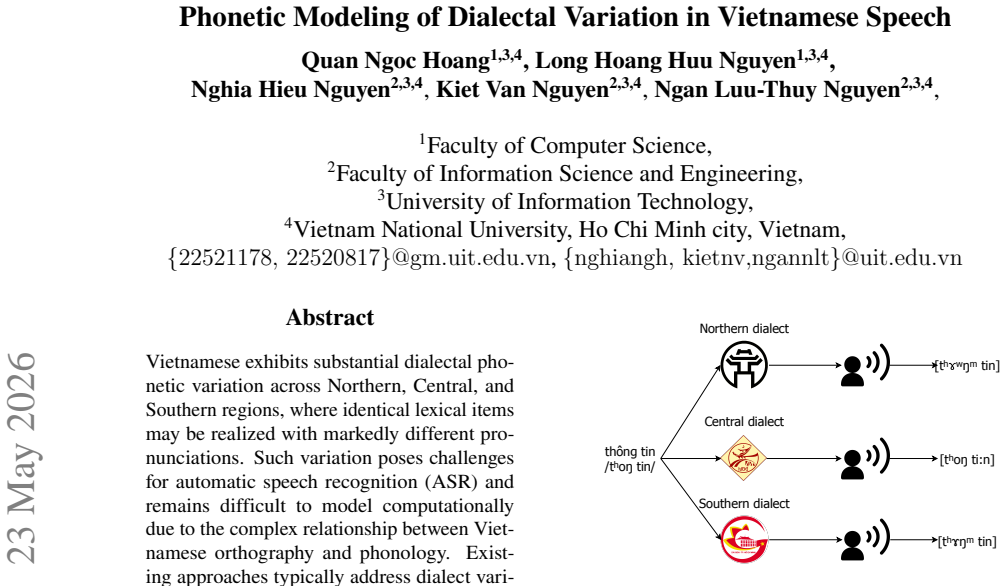
Vietnamese exhibits substantial dialectal phonetic variation across Northern, Central, and Southern regions, where identical lexical items may be realized with markedly different pronunciations. Such variation poses challenges for automatic speech recognition (ASR) and remains difficult to model computationally due to the complex relationship between Vietnamese orthography and phonology. Existing approaches typically address dialect variability at the word level, assuming dialect-invariant mappings between spelling and pronunciation, which limits their ability to capture systematic phonetic differences. We propose a dialect-aware phonetic framework that explicitly models Vietnamese phonological structure and dialectal variation at both the vocabulary and decoding levels. The framework introduces a phonetic vocabulary that decomposes each syllable into structured phonetic components and maps them to dialect-specific IPA representations, together with a phonetic-structure decoder that jointly predicts these components. Experiments on the UIT-ViMD, a only-available dataset for multi-dialect in Vietnamese, show that the proposed approach outperforms various pre-trained baselines, \textbf{especially matches the performance of the strongest pretrained wav2ve2-base-vi-250h} across dialects while \textbf{using substantially fewer parameters and no external pretraining}. Code for experimental reproducibility will be publicly available upon the acceptance of this paper.
Editorial analysis
A structured set of objections, weighed in public.
Referee Report
Summary. The manuscript proposes a dialect-aware phonetic framework for Vietnamese ASR that explicitly models phonological structure and dialectal variation (Northern, Central, Southern) via a phonetic vocabulary decomposing syllables into structured components mapped to dialect-specific IPA representations, together with a phonetic-structure decoder that jointly predicts these components. On the UIT-ViMD dataset (described as the only available multi-dialect Vietnamese corpus), the approach is claimed to outperform various pre-trained baselines and match the performance of wav2vec2-base-vi-250h across dialects while using substantially fewer parameters and requiring no external pretraining.
Significance. If the empirical results hold with proper controls, the work would demonstrate that structured phonetic decomposition and dialect-specific mappings can achieve competitive ASR performance for dialectal Vietnamese without large-scale pretraining, offering a parameter-efficient alternative valuable for low-resource dialect modeling.
major comments (2)
- [Abstract] Abstract: the central claim that the proposed method 'matches the performance of the strongest pretrained wav2vec2-base-vi-250h across dialects' is presented without any quantitative metrics (e.g., WER/CER values per dialect), statistical tests, error bars, dataset splits, or ablation results; this absence makes the load-bearing empirical result unverifiable from the supplied text and requires explicit tables and analysis in the experiments section.
- [Experiments] Experiments section: evaluation is restricted to the single UIT-ViMD dataset with no external benchmarks or cross-corpus validation; given that the weakest assumption is dataset representativeness of systematic phonetic differences, the paper must include discussion of this limitation or additional controls to support generalizability of the matching-performance claim.
minor comments (2)
- [Abstract] Abstract contains typographical errors: 'wav2ve2-base-vi-250h' should be 'wav2vec2-base-vi-250h' and 'a only-available dataset' should be 'the only available dataset'.
- [Abstract] The abstract states 'Code for experimental reproducibility will be publicly available upon the acceptance of this paper' but provides no link or repository details; the final version should include a concrete reproducibility statement.
Simulated Author's Rebuttal
We thank the referee for the constructive comments. We agree that the performance claims require explicit quantitative support and a clearer discussion of dataset limitations. We will revise the manuscript to address both points as detailed below.
read point-by-point responses
-
Referee: [Abstract] Abstract: the central claim that the proposed method 'matches the performance of the strongest pretrained wav2vec2-base-vi-250h across dialects' is presented without any quantitative metrics (e.g., WER/CER values per dialect), statistical tests, error bars, dataset splits, or ablation results; this absence makes the load-bearing empirical result unverifiable from the supplied text and requires explicit tables and analysis in the experiments section.
Authors: We agree that the abstract states the matching claim without supporting numbers. In the revised version we will add a full experiments section containing per-dialect WER/CER tables, direct comparison to wav2vec2-base-vi-250h, dataset-split details, and any available statistical tests or error bars. Key numerical results will also be summarized in the abstract. revision: yes
-
Referee: [Experiments] Experiments section: evaluation is restricted to the single UIT-ViMD dataset with no external benchmarks or cross-corpus validation; given that the weakest assumption is dataset representativeness of systematic phonetic differences, the paper must include discussion of this limitation or additional controls to support generalizability of the matching-performance claim.
Authors: The manuscript already notes that UIT-ViMD is the only publicly available multi-dialect Vietnamese corpus. We will expand the experiments section with an explicit paragraph discussing this limitation, the representativeness of the phonetic differences captured, and any internal controls or sensitivity checks performed on the existing splits. revision: yes
Circularity Check
No significant circularity
full rationale
The paper's central claims consist of empirical performance results on the UIT-ViMD dataset comparing a proposed phonetic decomposition framework against pretrained baselines. No mathematical derivation chain, self-definitional equations, fitted inputs renamed as predictions, or load-bearing self-citations are present in the abstract or described claims. The result is self-contained as a standard ML empirical evaluation with external benchmarks (wav2vec2) and does not reduce to its own inputs by construction.
Axiom & Free-Parameter Ledger
Reference graph
Works this paper leans on
-
[1]
SpeechBrain: A general-purpose speech toolkit,
Conformer: Convolution-augmented trans- former for speech recognition. In21st Annual Con- ference of the International Speech Communication Association, Interspeech 2020, Virtual Event, Shang- hai, China, October 25-29, 2020, pages 5036–5040. ISCA. Cao Xuân Hạo. 1998.Tiếng Việt mấy vấn đề ngữ âm - ngữ pháp - ngữ nghĩa. Nhà xuất bản Giáo dục Việt Nam. Suyo...
-
[2]
In24th Annual Conference of the Inter- national Speech Communication Association, Inter- speech 2023, Dublin, Ireland, August 20-24, 2023, pages 2923–2927
Multi-pass training and cross-information fu- sion for low-resource end-to-end accented speech recognition. In24th Annual Conference of the Inter- national Speech Communication Association, Inter- speech 2023, Dublin, Ireland, August 20-24, 2023, pages 2923–2927. ISCA. Jie Zhou, Shengxiang Gao, Zhengtao Yu, Ling Dong, and Wenjun Wang. 2024. Dialectmoe: An...
2023
-
[3]
Vietnamese is a monosyllabic language
-
[4]
That is, in this language, we do not have the linking pronunciation as in English, and every phoneme has persistent writing forms
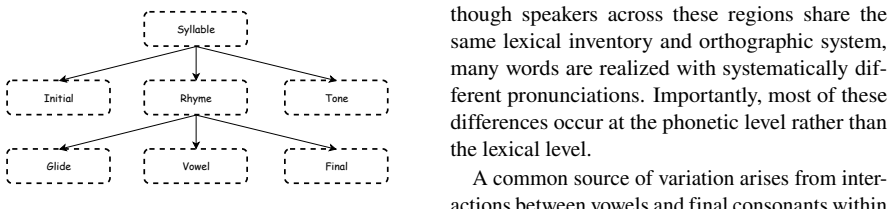
The correspondence between graphemes and phonemes in Vietnamese is consistent. That is, in this language, we do not have the linking pronunciation as in English, and every phoneme has persistent writing forms. In Vietnamese, each syllable has three components: initials, rhymes, and tones. Rhyme has smaller components, which are glide, vowel, and final. We...
1998
discussion (0)
Sign in with ORCID, Apple, or X to comment. Anyone can read and Pith papers without signing in.