Quantum Dynamics of Interacting dissipative oscillators: A novel scheme
Pith reviewed 2026-06-30 13:26 UTC · model grok-4.3
The pith
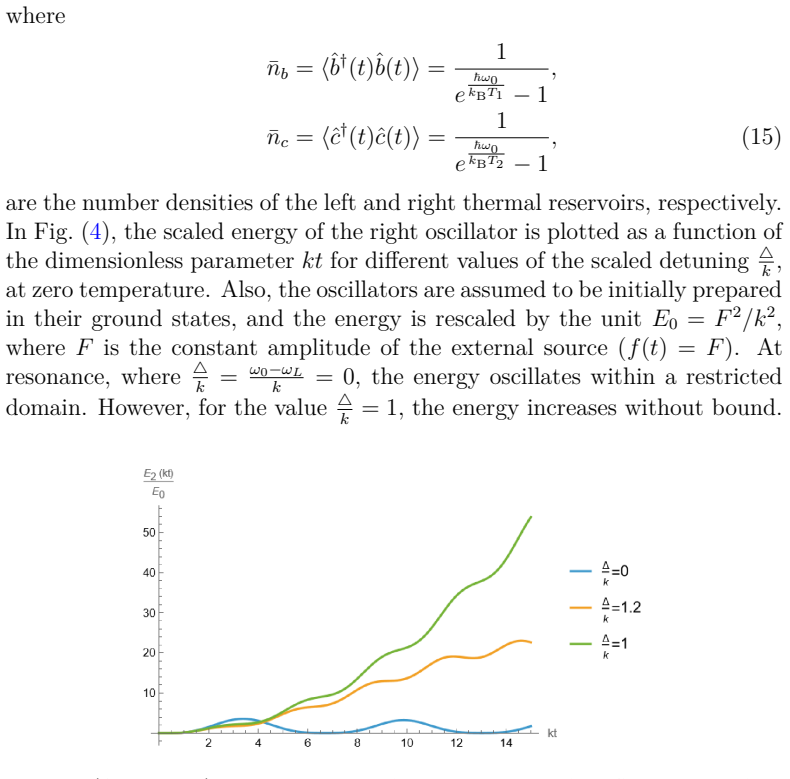
Off resonance the second oscillator's energy grows unbounded while on resonance it stays bounded and periodic.
A machine-rendered reading of the paper's core claim, the machinery that carries it, and where it could break.
Core claim
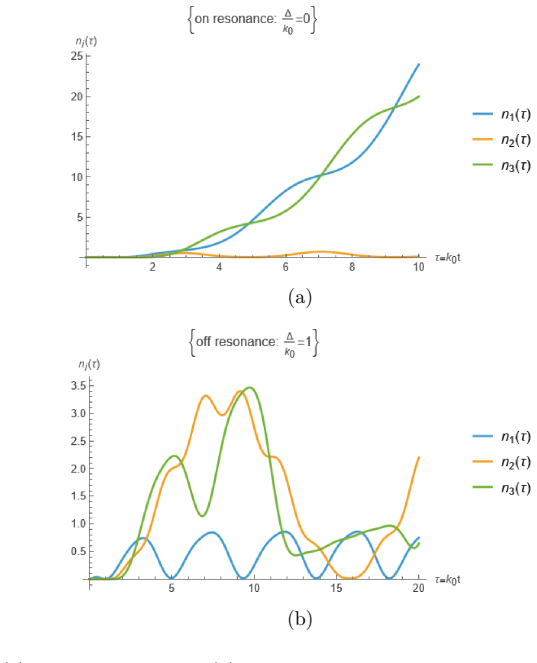
By applying successive Bogoliubov transformations to diagonalize the total Hamiltonian of the driven dissipative system exactly, the energies are obtained explicitly: off resonance the energy of the second oscillator grows unboundedly, whereas on resonance it remains bounded and periodic. For three oscillators the same resonance condition makes the energies of the first and third grow while the second stays periodically bounded.
What carries the argument
Successive Bogoliubov transformations that exactly diagonalize the driven dissipative Hamiltonian.
If this is right
- Explicit time-dependent energy expressions follow directly for each oscillator.
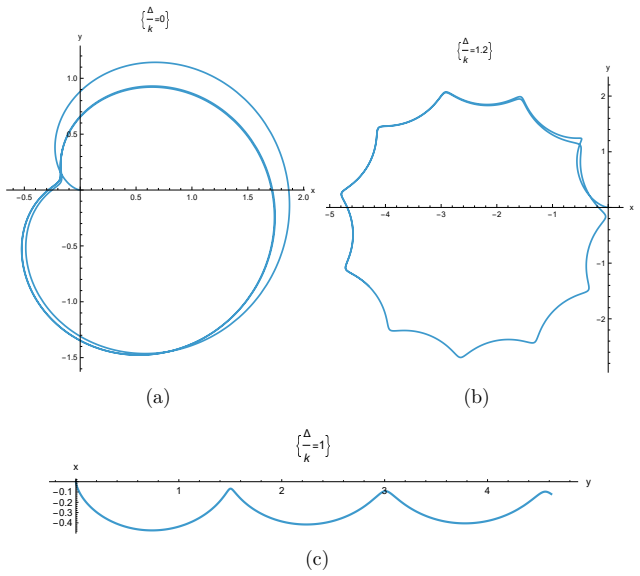
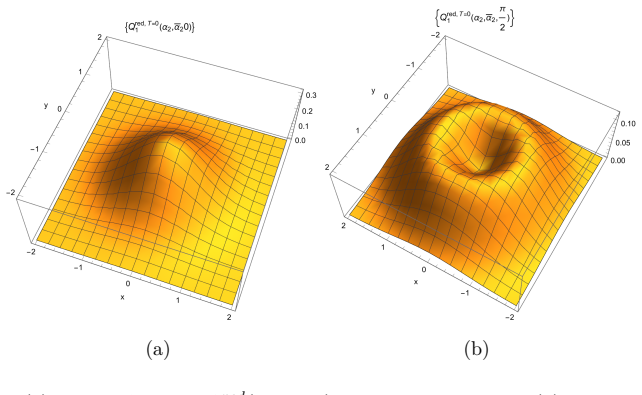
- The Husimi function maximum shifts away from the origin at zero temperature, confirming continuous energy gain.
- An explicit formula is obtained for the reduced density matrix elements in the number-state basis.
- In the three-oscillator generalization the outer oscillators gain energy on resonance while the middle remains periodically bounded.
Where Pith is reading between the lines
- The resonance-bounded behavior may allow selective protection of modes in larger dissipative networks.
- The exact diagonalization could be used to compute other observables such as entanglement or heat currents in similar systems.
- The pattern observed in the three-oscillator case suggests possible alternating growth and boundedness in longer chains.
Load-bearing premise
The total Hamiltonian of the driven dissipative system can be exactly diagonalized by successive Bogoliubov transformations without approximations or restrictions on couplings or drive strength.
What would settle it
Measure the time-dependent energy of the second oscillator: it should grow without bound when the driving frequency is detuned and remain periodic and bounded when the driving frequency matches the resonance condition.
Figures
read the original abstract
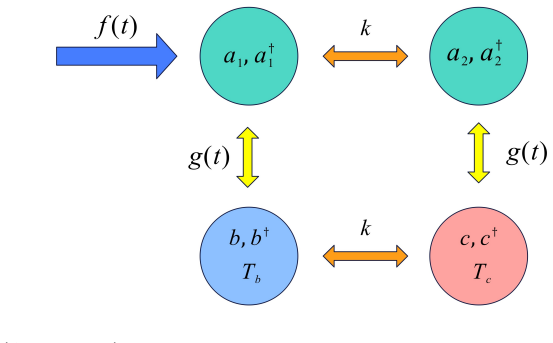
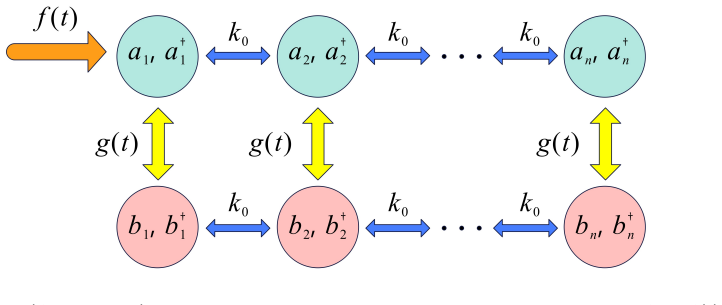
We investigate the dynamics of interacting quantum harmonic oscillators coupled to thermal reservoirs under the influence of an external driving field. In a novel theoretical scheme, we first analyze the case of two interacting oscillators, each coupled to its own thermal reservoir, with an external source applied to the first oscillator. By diagonalizing the total Hamiltonian through successive Bogoliubov transformations, we obtain explicit expressions for the oscillator energies. A key finding is that off resonance, the energy of the second oscillator grows unboundedly, whereas on resonance, it remains bounded and periodic. We then derive the Husimi functions for both oscillators and the reduced Husimi functions for initially separable coherent and number states. The shift of the Husimi function's maximum away from the origin at zero temperature confirms continuous energy gain under specific parameter conditions. An explicit formula for the reduced density matrix components in the number state basis is also provided. Finally, we generalize the model to $n$ interacting oscillators in a thermal medium driven by a classical field. For the three-oscillator case, we show that on resonance, the energies of the first and third oscillators grow, while the energy of the second oscillator remains periodically bounded. These results offer insights into energy transfer and localization in coupled oscillator systems in thermal environments.
Editorial analysis
A structured set of objections, weighed in public.
Referee Report
Summary. The manuscript investigates the quantum dynamics of interacting driven dissipative harmonic oscillators using a scheme based on successive Bogoliubov transformations to diagonalize the total Hamiltonian (system plus baths plus bilinear couplings). For two oscillators with driving on the first, it claims explicit energy expressions showing unbounded growth of the second oscillator's energy off resonance and bounded periodic evolution on resonance. Husimi functions and reduced density matrices are derived for coherent and number states. The model is generalized to n oscillators, with the three-oscillator case showing growth in the first and third oscillators but bounded periodic behavior in the second on resonance.
Significance. If the reported resonance-dependent energy growth and localization results hold after correction, the work could provide insights into energy transfer mechanisms in coupled dissipative quantum systems. The explicit diagonalization approach and derivation of Husimi functions would be technically useful if the underlying dynamics are correctly captured.
major comments (2)
- [Abstract] Abstract (two-oscillator case): The central claim that 'off resonance, the energy of the second oscillator grows unboundedly, whereas on resonance, it remains bounded and periodic' is the reverse of the behavior expected from the described method. After Bogoliubov diagonalization of the quadratic Hamiltonian, the driven equations for the normal modes yield a particular solution with linear-in-t growth (hence unbounded energy) precisely when the drive frequency matches a normal-mode frequency, and bounded oscillations when detuned. Thermal baths add damping but do not invert this resonance condition. This reversal cannot follow from the diagonalized dynamics and indicates an algebraic or interpretive error after the transformation.
- [Abstract] Abstract (three-oscillator generalization): The reported pattern (growth in first and third oscillators, bounded behavior in the second, all on resonance) is likewise inconsistent with the expected resonance condition in the driven normal-mode equations obtained from successive Bogoliubov transformations. This undermines the claim of a general scheme for n oscillators.
minor comments (1)
- [Abstract] Abstract: The statement that the total Hamiltonian 'can be exactly diagonalized by successive Bogoliubov transformations' without approximations requires explicit verification in the text, including the regime of validity for the bath couplings and driving amplitude.
Simulated Author's Rebuttal
We thank the referee for their thorough review and for identifying an apparent reversal in the resonance conditions described in the abstract. Upon re-examination of the derivations following the successive Bogoliubov transformations, we agree that the reported energy-growth behavior is inconsistent with the expected dynamics of the driven normal modes. We will revise the manuscript to correct these claims.
read point-by-point responses
-
Referee: [Abstract] Abstract (two-oscillator case): The central claim that 'off resonance, the energy of the second oscillator grows unboundedly, whereas on resonance, it remains bounded and periodic' is the reverse of the behavior expected from the described method. After Bogoliubov diagonalization of the quadratic Hamiltonian, the driven equations for the normal modes yield a particular solution with linear-in-t growth (hence unbounded energy) precisely when the drive frequency matches a normal-mode frequency, and bounded oscillations when detuned. Thermal baths add damping but do not invert this resonance condition. This reversal cannot follow from the diagonalized dynamics and indicates an algebraic or interpretive error after the transformation.
Authors: We agree with the referee that the standard analysis of driven normal modes after diagonalization predicts linear-in-time growth (unbounded energy) on resonance and bounded behavior off resonance. Our abstract claim inverts this condition, which indicates an error in the post-transformation identification of resonance. We will revise the abstract and the two-oscillator energy expressions to state the correct behavior and will verify the algebraic steps to ensure consistency with the diagonalized Hamiltonian. revision: yes
-
Referee: [Abstract] Abstract (three-oscillator generalization): The reported pattern (growth in first and third oscillators, bounded behavior in the second, all on resonance) is likewise inconsistent with the expected resonance condition in the driven normal-mode equations obtained from successive Bogoliubov transformations. This undermines the claim of a general scheme for n oscillators.
Authors: We likewise acknowledge that the reported resonance pattern for the three-oscillator case does not align with the expected normal-mode resonance conditions. We will revise the generalization section, including the three-oscillator energy expressions, to correct the resonance dependence and will check the n-oscillator scheme for consistency. revision: yes
Circularity Check
No circularity; energies derived from explicit diagonalization of time-dependent quadratic Hamiltonian.
full rationale
The paper states that energies follow from successive Bogoliubov transformations applied to the total Hamiltonian (system + baths + drive). No fitted parameters are renamed as predictions, no self-citation chain justifies the central resonance claim, and the reported bounded/unbounded behavior is presented as an output of the transformed equations rather than an input assumption. The derivation chain is therefore self-contained against the stated Hamiltonian; any algebraic error in the resonance condition would be a correctness issue, not a circularity reduction.
Axiom & Free-Parameter Ledger
axioms (1)
- domain assumption The driven interacting oscillator Hamiltonian can be diagonalized exactly by successive Bogoliubov transformations
Reference graph
Works this paper leans on
-
[1]
M. I. Zimmerman, M. G. Littman, M. M. Kash, and D. Kleppner, Stark structure of the Rydberg states of alkali-metal atoms, Phys. Rev. A 20, 2251 (1979)
1979
-
[2]
Bayer, P
M. Bayer, P. Hawrylak, K. Hinzer, S. Fafard, M. Korkusinski, Z. R. Wasilewski, O. Stern, and A. Forchel, Coupling and entangling of quan- tum dot states in quantum dot molecules, Science 291, 451 (2001)
2001
-
[3]
T. J. Kippenberg and K. J. Vahala, Cavity optomechanics: Back-action at the mesoscale, Science 321, 1172 (2008)
2008
-
[4]
Zhao and G.H
Y. Zhao and G.H. Chen, Two oscillators in a dissipative bath, Physica A: Statistical Mechanics and its Applications, V. 317, 13 (2003)
2003
-
[5]
A. M. Zagoskin, Quantum Engineering: Theory and Design of Quan- tum Coherent Structures, 2nd ed., (Cambridge Univ. Press, Cambridge 2026)
2026
-
[6]
D. F. Walls and G. J. Milburn, Quantum Optics, 3rd ed., (Berlin, Ger- many: Springer, 2025)
2025
-
[7]
B. M. Garraway, Quantum Optics and Quantum Information, (Wein- heim, Germany: Wiley-VCH, 2025)
2025
-
[8]
Bowen, Gerard J
ByWarwick P. Bowen, Gerard J. Milburn, Quantum Optomechanics, (CRC Press, 2015)
2015
-
[9]
Castelletto and M
S. Castelletto and M. Agio, Eds., Nanophotonics with Diamond and Sili- con Carbide for Quantum Technologies, (Amsterdam, The Netherlands: Elsevier 2025)
2025
-
[10]
M. Kang, Y. Zhang, K. R. Brown, and T. Barthel, Non-Gaussian phase transition and cascade of instabilities in the dissipative quantum Rabi model, arXiv:2507.07092v2
work page internal anchor Pith review Pith/arXiv arXiv
-
[11]
X. Li, Y. Li, Y. Yan, et al., Signatures of Environment-Induced Quan- tum Synchronization Transitions via Two-body Dissipator Engineering, Chin. Phys. Lett. 43, 020302 (2026). 29
2026
- [12]
-
[13]
Mivehvar, Driven-Dissipative Landau Polaritons: Two Highly Nonlin- early Coupled Quantum Harmonic Oscillators, Phys
F. Mivehvar, Driven-Dissipative Landau Polaritons: Two Highly Nonlin- early Coupled Quantum Harmonic Oscillators, Phys. Rev. Lett. 136(9), 093602 (2026)
2026
-
[14]
D. W. Luo, E. Yu, and T. Yu, Optimal Transfer of Entanglement in Oscillator Chains in Non-Markovian Open Systems, Entropy 27(12), 1239 (2025)
2025
-
[15]
Abu-Nada and L.-Ao Wu, Dynamics and control of two coupled quan- tum oscillators: An analytical approach, Phys
A. Abu-Nada and L.-Ao Wu, Dynamics and control of two coupled quan- tum oscillators: An analytical approach, Phys. Rev. A 113, 012205 (2026)
2026
-
[16]
Babakan, F
M. Babakan, F. Benatti and L. Memarzadeh, Open harmonic chain: Exact versus global and local reduced dynamics, Phys. Rev. A 113, 012219 (2026)
2026
-
[17]
Bhattacharjee, K
S. Bhattacharjee, K. Mandal, and S. Sinha, Decoherence of a dissipa- tive Brownian charged magneto-anharmonic oscillator: an information theoretic approach, J. Phys. A: Math. Theor. 58, 505301 (2025)
2025
-
[18]
Kheirandish, E
F. Kheirandish, E. Bolandhemmat, N. Cheraghpour, R. Moradi, and S. Ahmadian, A novel scheme for modelling dissipation (gain) and ther- malization in open quantum systems, Phys. Scr. 100 015110 (2025)
2025
-
[19]
Cheraghpour and F
N. Cheraghpour and F. Kheirandish, Quantum dynamics of a bosonic mode and a two-level system interacting with several reservoirs, Laser Phys. 35 055204 (2025)
2025
-
[20]
C. C. Gerry and P. L. Knight, Introductory quantum optics, (Cambridge University Press, 2005)
2005
-
[21]
S. Noschese, L. Pasquini and L. Reichel, Tridiagonal Toeplitz matrices: properties and novel applications, Numer. Linear Algebra Appl. 20, 302 (2013). DOI: 10.1002/nla.1811 30
discussion (0)
Sign in with ORCID, Apple, or X to comment. Anyone can read and Pith papers without signing in.