Quantum Otto machine with q-deformed P\"oschl-Teller oscillator
Pith reviewed 2026-06-30 13:23 UTC · model grok-4.3
The pith
q-deformation of the modified Pöschl-Teller potential partitions the Otto cycle into separate regions of optimal heat-engine and refrigerator performance.
A machine-rendered reading of the paper's core claim, the machinery that carries it, and where it could break.
Core claim
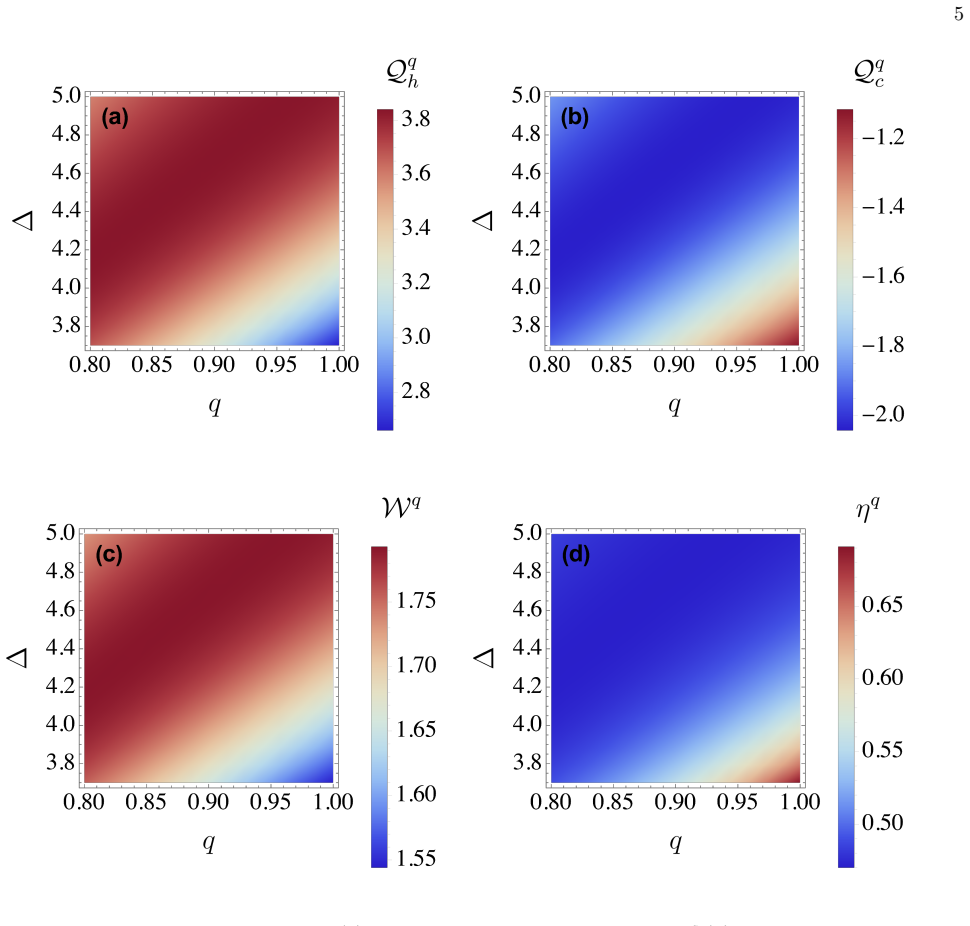
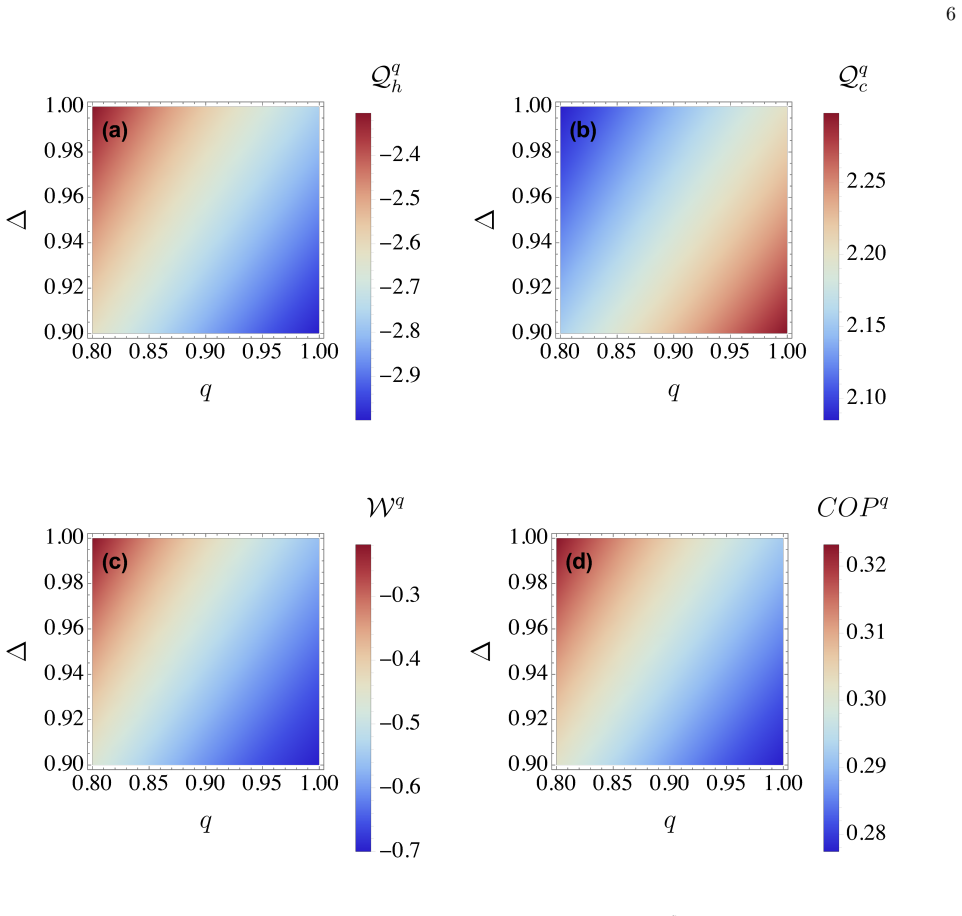
The q-deformed modified Pöschl-Teller potential modifies the energy spectrum of the working substance, which in turn produces separate performance domains in the (q, Δ) parameter space. Low values of Δ combined with high values of q yield the highest heat-engine efficiencies, while high Δ and low q improve the coefficient of performance when the cycle operates as a refrigerator. The efficiency reaches its maximum in the low-Δ, high-q corner of the space.
What carries the argument
The q-deformed modified Pöschl-Teller potential, whose energy eigenvalues depend explicitly on both the deformation parameter q and the potential strength parameter Δ; these eigenvalues enter the heat and work calculations for the Otto cycle and thereby control the thermodynamic figures of merit.
If this is right
- Heat engine efficiency is maximized when Δ is small and q is large.
- Refrigerator coefficient of performance improves when Δ is large and q is small.
- The working substance can be switched between engine and refrigerator regimes by tuning q and Δ alone.
- Distinct performance regions appear in the two-dimensional parameter plane.
Where Pith is reading between the lines
- If the same deformation can be realized in other potentials, similar tunable regions may appear in other quantum thermal machines.
- Experimental implementation would require a physical system whose spectrum matches the q-deformed Pöschl-Teller form over a controllable range of q and Δ.
- The separation of regimes suggests that parameter tuning could replace cycle redesign in some quantum heat devices.
Load-bearing premise
The derived analytical energy spectrum and wave functions of the q-deformed potential can be substituted directly into the thermodynamic formulas for the Otto cycle without additional quantum or validity corrections.
What would settle it
A numerical diagonalization of the q-deformed Hamiltonian that produces energy levels differing from the reported analytic spectrum would falsify the performance maps.
Figures
read the original abstract
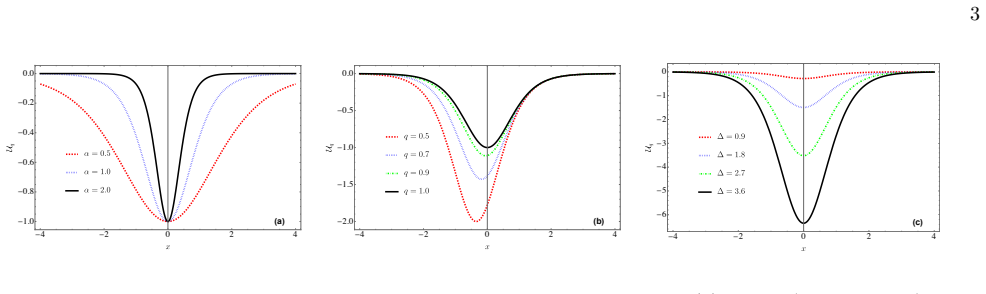
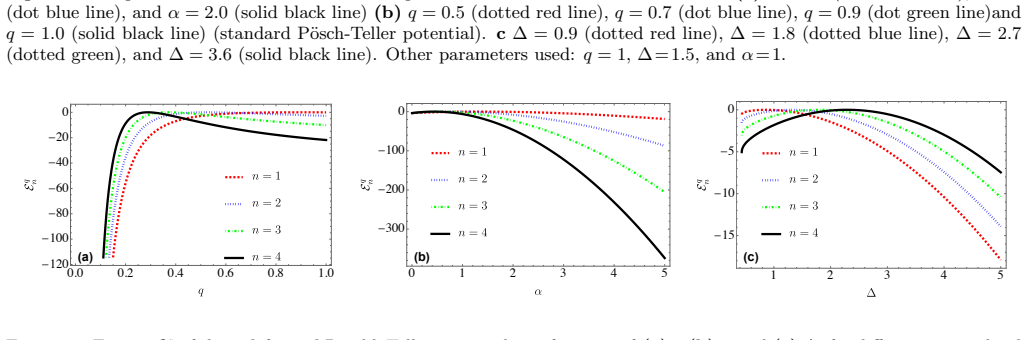
We study the impact of the potential parameters of the q-deformed modified P\"oschl-Teller potential on the thermodynamic performance of a quantum Otto cycle, where the $q$-deformed modified P\"oschl-Teller potential serves as the working substance. Analytical expressions for the energy spectrum and wave functions are derived, enabling a systematic investigation of heat exchange, work output, efficiency, and coefficient of performance. We show that $q$-deformation modifies the energy spectrum and creates distinct performance regions in the ($q$, $\Delta$) parameter space. Low ($\Delta$) and high ($q$) favour optimal heat engine efficiency, whereas high ($\Delta$) and low ($q$) improve refrigerator performance. The heat engine efficiency peaks in the low-($\Delta$), high-($q$) regime. These results highlight the q-deformed modified P\"oschl-Teller potential as a versatile and tunable platform for exploring potential parameter-driven effects in quantum thermal machines.
Editorial analysis
A structured set of objections, weighed in public.
Referee Report
Summary. The manuscript examines a quantum Otto cycle with the q-deformed modified Pöschl-Teller oscillator as the working substance. It claims to derive analytical expressions for the energy spectrum and wave functions of the deformed potential, then inserts these into the thermodynamic expressions for heat, work, efficiency, and COP to map performance across the (q, Δ) parameter space, reporting that low Δ with high q optimizes heat-engine efficiency while high Δ with low q optimizes refrigerator performance, with efficiency peaking in the low-Δ high-q regime.
Significance. If the spectrum derivation holds and the direct insertion into the Otto-cycle formulas is valid, the work supplies an explicit, tunable example of how a deformation parameter can create distinct performance regimes in a quantum thermal machine, offering a concrete platform for exploring parameter-driven optimization in quantum thermodynamics.
major comments (2)
- [Energy spectrum section] § on energy spectrum derivation (the section presenting the analytical E_n(q, Δ) and wave functions): the manuscript states the final expressions but supplies no intermediate derivation steps from the q-deformed Schrödinger equation, no reduction check to the q=1 Pöschl-Teller case, and no domain restrictions on q; because every subsequent heat, work, and efficiency formula is obtained by direct substitution of these E_n, the absence of verification makes the reported (q, Δ) performance regions unverifiable.
- [Performance analysis section] § on Otto-cycle performance (the section mapping efficiency and COP in (q, Δ) space): the claimed optimal regions and efficiency peak are presented without error propagation from the spectrum, without numerical cross-checks against exact diagonalization for sample (q, Δ) values, and without discussion of adiabaticity assumptions; this directly affects the load-bearing claim that low-Δ high-q is optimal for the engine.
minor comments (2)
- Notation for the q-numbers appearing in the spectrum formula should be defined explicitly (standard [n]_q or a custom replacement) to avoid ambiguity when readers attempt to reproduce the expressions.
- Figure captions for the performance-region plots should state the fixed values of temperature ratio, cycle times, and any other parameters held constant while varying q and Δ.
Simulated Author's Rebuttal
We thank the referee for the careful reading and constructive comments on our manuscript. The points raised identify areas where additional detail will improve clarity and verifiability. We address each major comment below and will incorporate the suggested revisions.
read point-by-point responses
-
Referee: [Energy spectrum section] § on energy spectrum derivation (the section presenting the analytical E_n(q, Δ) and wave functions): the manuscript states the final expressions but supplies no intermediate derivation steps from the q-deformed Schrödinger equation, no reduction check to the q=1 Pöschl-Teller case, and no domain restrictions on q; because every subsequent heat, work, and efficiency formula is obtained by direct substitution of these E_n, the absence of verification makes the reported (q, Δ) performance regions unverifiable.
Authors: We agree that the intermediate steps were omitted. The energy spectrum was obtained by solving the q-deformed Schrödinger equation via a change of variables and series solution, but these steps were not shown. In the revised manuscript we will insert the full derivation, explicitly recover the standard Pöschl-Teller spectrum at q=1, and state the domain q>0, Δ>0 required for normalizability. This will allow direct verification of all subsequent thermodynamic expressions. revision: yes
-
Referee: [Performance analysis section] § on Otto-cycle performance (the section mapping efficiency and COP in (q, Δ) space): the claimed optimal regions and efficiency peak are presented without error propagation from the spectrum, without numerical cross-checks against exact diagonalization for sample (q, Δ) values, and without discussion of adiabaticity assumptions; this directly affects the load-bearing claim that low-Δ high-q is optimal for the engine.
Authors: We acknowledge the value of explicit verification. We will add (i) a comparison of the analytical E_n(q,Δ) against numerical diagonalization for several representative (q,Δ) pairs, (ii) a brief discussion of the adiabaticity condition underlying the Otto cycle, and (iii) propagation of the spectrum uncertainty into the efficiency and COP expressions. These additions will substantiate the reported optimal regimes without altering the analytical conclusions. revision: yes
Circularity Check
No circularity; derivation inserts independently derived spectrum into cycle formulas
full rationale
The paper states it derives analytical expressions for the q-deformed energy spectrum and wave functions, then substitutes those expressions into the standard Otto-cycle thermodynamic quantities. No equation is defined in terms of its own output, no fitted parameter is relabeled as a prediction, and no load-bearing premise rests on a self-citation chain. The reported (q, Δ) performance regions are direct consequences of the spectrum formulas rather than a renaming or self-referential construction. The derivation chain is therefore self-contained against external benchmarks.
Axiom & Free-Parameter Ledger
free parameters (2)
- q
- Δ
axioms (1)
- domain assumption The q-deformed modified Pöschl-Teller potential admits an analytically solvable energy spectrum that can be used directly in thermodynamic cycle calculations.
Reference graph
Works this paper leans on
-
[1]
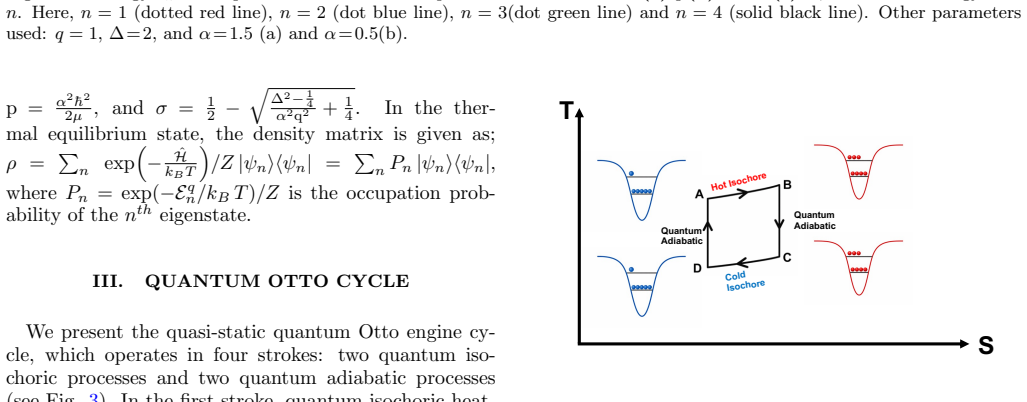
In the ther- mal equilibrium state, the density matrix is given as; ρ= P n exp − ˆH kB T /Z|ψ n⟩⟨ψn|= P n Pn |ψn⟩⟨ψn|, whereP n = exp(−E q n/kB T)/Zis the occupation prob- ability of then th eigenstate. III. QUANTUM OTTO CYCLE We present the quasi-static quantum Otto engine cy- cle, which operates in four strokes: two quantum iso- choric processes and two...
-
[2]
Kondepudi and I
D. Kondepudi and I. Prigogine,Modern thermodynamics: from heat engines to dissipative structures(John wiley & sons, 2014)
2014
-
[3]
H. E. Scovil and E. O. Schulz-DuBois, Three-level masers as heat engines, Physical Review Letters2, 262 (1959)
1959
-
[4]
J. E. Geusic, E. O. Schulz-DuBios, and H. E. D. Scovil, Quantum equivalent of the carnot cycle, Phys. Rev.156, 343 (1967)
1967
-
[5]
Vinjanampathy and J
S. Vinjanampathy and J. Anders, Quantum thermody- namics, Contemporary Physics57, 545 (2016)
2016
-
[6]
Goold, M
J. Goold, M. Huber, A. Riera, L. Del Rio, and P. Skrzypczyk, The role of quantum information in ther- modynamics—a topical review, Journal of Physics A: Mathematical and Theoretical49, 143001 (2016)
2016
-
[7]
Binder, L
F. Binder, L. A. Correa, C. Gogolin, J. Anders, and G. Adesso, Thermodynamics in the quantum regime, Fundamental Theories of Physics195(2018)
2018
-
[8]
Deffner and S
S. Deffner and S. Campbell,Quantum Thermodynamics: An introduction to the thermodynamics of quantum in- formation(Morgan & Claypool Publishers, 2019)
2019
-
[9]
Bhattacharjee and A
S. Bhattacharjee and A. Dutta, Quantum thermal ma- chines and batteries, The European Physical Journal B 94, 239 (2021)
2021
-
[10]
N. M. Myers, O. Abah, and S. Deffner, Quantum ther- modynamic devices: From theoretical proposals to ex- perimental reality, AVS Quantum Science4(2022)
2022
-
[11]
P. P. Potts, Quantum thermodynamics, arXiv preprint arXiv:2406.19206 (2024)
work page internal anchor Pith review Pith/arXiv arXiv 2024
-
[12]
G. A. Barrios, F. Albarr´ an-Arriagada, F. C´ ardenas- L´ opez, G. Romero, and J. Retamal, Role of quantum correlations in light-matter quantum heat engines, Phys- ical Review A96, 052119 (2017)
2017
-
[13]
Mukherjee and U
V. Mukherjee and U. Divakaran, Many-body quantum thermal machines, Journal of Physics: Condensed Matter 33, 454001 (2021)
2021
-
[14]
A. Rolandi, P. Abiuso, and M. Perarnau-Llobet, Col- lective advantages in finite-time thermodynamics, arXiv preprint arXiv:2306.16534 (2023)
-
[15]
A. A. S. Kalaee, A. Wacker, and P. P. Potts, Violating the thermodynamic uncertainty relation in the three-level maser, Physical Review E104, L012103 (2021)
2021
-
[16]
F. J. Pe˜ na, A. Gonz´ alez, A. S. Nunez, P. A. Orellana, R. G. Rojas, and P. Vargas, Magnetic engine for the single-particle landau problem, Entropy19, 639 (2017)
2017
-
[17]
Alvarado Barrios, F
G. Alvarado Barrios, F. J. Pe˜ na, F. Albarr´ an-Arriagada, P. Vargas, and J. C. Retamal, Quantum mechanical en- gine for the quantum rabi model, Entropy20, 767 (2018)
2018
-
[18]
Smith, P
Z. Smith, P. S. Pal, and S. Deffner, Endoreversible otto engines at maximal power, Journal of Non-Equilibrium Thermodynamics45, 305 (2020)
2020
-
[19]
N. M. Myers and S. Deffner, Thermodynamics of statis- tical anyons, PRX Quantum2, 040312 (2021)
2021
-
[20]
Feldmann and R
T. Feldmann and R. Kosloff, Short time cycles of purely quantum refrigerators, Physical Review E—Statistical, Nonlinear, and Soft Matter Physics85, 051114 (2012)
2012
-
[21]
Zheng, P
Y. Zheng, P. H¨ anggi, and D. Poletti, Occurrence of dis- continuities in the performance of finite-time quantum otto cycles, Phys. Rev. E94, 012137 (2016)
2016
-
[22]
Cavina, A
V. Cavina, A. Mari, and V. Giovannetti, Slow dynamics and thermodynamics of open quantum systems, Phys. Rev. Lett.119, 050601 (2017)
2017
-
[23]
S. H. Raja, S. Maniscalco, G.-S. Paraoanu, J. P. Pekola, and N. L. Gullo, Finite-time quantum stirling heat en- gine, New Journal of Physics23, 033034 (2021)
2021
-
[24]
Singh, S
V. Singh, S. Singh, O. Abah, and O. E. M¨ ustecaplıo˘ glu, Unified trade-off optimization of quantum harmonic otto engine and refrigerator, Phys. Rev. E106, 024137 (2022)
2022
-
[25]
del Campo, Shortcuts to adiabaticity by counterdia- batic driving, Physical review letters111, 100502 (2013)
A. del Campo, Shortcuts to adiabaticity by counterdia- batic driving, Physical review letters111, 100502 (2013)
2013
-
[26]
Campbell and S
S. Campbell and S. Deffner, Trade-Off Between Speed and Cost in Shortcuts to Adiabaticity, Physical Review Letters118, 100601 (2017)
2017
-
[27]
Abah and E
O. Abah and E. Lutz, Performance of shortcut-to- adiabaticity quantum engines, Physical Review E98, 032121 (2018)
2018
-
[28]
Denzler and E
T. Denzler and E. Lutz, Efficiency large deviation func- tion of quantum heat engines, New Journal of Physics 23, 075003 (2021)
2021
-
[29]
Denzler and E
T. Denzler and E. Lutz, Power fluctuations in a finite- time quantum carnot engine, Physical Review Research 3, L032041 (2021)
2021
-
[30]
Denzler, J
T. Denzler, J. F. Santos, E. Lutz, and R. M. Serra, Nonequilibrium fluctuations of a quantum heat engine, Quantum Science and Technology9, 045017 (2024)
2024
-
[31]
M. O. Scully, M. S. Zubairy, G. S. Agarwal, and H. Walther, Extracting work from a single heat bath via vanishing quantum coherence, Science299, 862 (2003)
2003
-
[32]
K. E. Dorfman, D. V. Voronine, S. Mukamel, and M. O. Scully, Photosynthetic reaction center as a quantum heat engine, Proceedings of the National Academy of Sciences 110, 2746 (2013)
2013
-
[33]
A. ¨U. Hardal and ¨O. E. M¨ ustecaplıo˘ glu, Superradiant quantum heat engine, Scientific reports5, 12953 (2015)
2015
-
[34]
Uzdin, Coherence-induced reversibility and collective operation of quantum heat machines via coherence recy- cling, Physical Review Applied6, 024004 (2016)
R. Uzdin, Coherence-induced reversibility and collective operation of quantum heat machines via coherence recy- cling, Physical Review Applied6, 024004 (2016)
2016
-
[35]
Watanabe, B
G. Watanabe, B. P. Venkatesh, P. Talkner, and A. Del Campo, Quantum performance of thermal ma- 9 chines over many cycles, Physical review letters118, 050601 (2017)
2017
-
[36]
Dann and R
R. Dann and R. Kosloff, Quantum signatures in the quan- tum carnot cycle, New Journal of Physics22, 013055 (2020)
2020
-
[37]
Hammam, Y
K. Hammam, Y. Hassouni, R. Fazio, and G. Manzano, Optimizing autonomous thermal machines powered by energetic coherence, New Journal of Physics23, 043024 (2021)
2021
-
[38]
Quan, Y.-x
H.-T. Quan, Y.-x. Liu, C.-P. Sun, and F. Nori, Quan- tum thermodynamic cycles and quantum heat engines, Physical Review E76, 031105 (2007)
2007
-
[39]
O. Abah, J. Rossnagel, G. Jacob, S. Deffner, F. Schmidt- Kaler, K. Singer, and E. Lutz, Single-ion heat engine at maximum power, Physical review letters109, 203006 (2012)
2012
-
[40]
Gardas and S
B. Gardas and S. Deffner, Thermodynamic universality of quantum carnot engines, Physical Review E92, 042126 (2015)
2015
-
[41]
Friedenberger and E
A. Friedenberger and E. Lutz, When is a quantum heat engine quantum?, Europhysics Letters120, 10002 (2017)
2017
-
[42]
Roßnagel, S
J. Roßnagel, S. T. Dawkins, K. N. Tolazzi, O. Abah, E. Lutz, F. Schmidt-Kaler, and K. Singer, A single-atom heat engine, Science352, 325 (2016)
2016
-
[43]
Gelbwaser-Klimovsky, A
D. Gelbwaser-Klimovsky, A. Bylinskii, D. Gangloff, R. Is- lam, A. Aspuru-Guzik, and V. Vuletic, Single-atom heat machines enabled by energy quantization, Physical re- view letters120, 170601 (2018)
2018
-
[44]
F. J. Pena and E. Munoz, Magnetostrain-driven quantum engine on a graphene flake, Physical Review E91, 052152 (2015)
2015
-
[45]
Niedenzu, I
W. Niedenzu, I. Mazets, G. Kurizki, and F. Jendrzejew- ski, Quantized refrigerator for an atomic cloud, Quantum 3, 155 (2019)
2019
-
[46]
Cherubim, F
C. Cherubim, F. Brito, and S. Deffner, Non-thermal quantum engine in transmon qubits, Entropy21, 545 (2019)
2019
-
[47]
Zhang, F
K. Zhang, F. Bariani, and P. Meystre, Quantum optome- chanical heat engine, Physical review letters112, 150602 (2014)
2014
-
[48]
Dechant, N
A. Dechant, N. Kiesel, and E. Lutz, All-optical nanome- chanical heat engine, Physical review letters114, 183602 (2015)
2015
-
[49]
F. J. Pe˜ na, O. Negrete, G. Alvarado Barrios, D. Zam- brano, A. Gonz´ alez, A. S. Nunez, P. A. Orellana, and P. Vargas, Magnetic otto engine for an electron in a quan- tum dot: Classical and quantum approach, Entropy21, 512 (2019)
2019
-
[50]
F. J. Pe˜ na, D. Zambrano, O. Negrete, G. De Chiara, P. Orellana, and P. Vargas, Quasistatic and quantum- adiabatic otto engine for a two-dimensional material: The case of a graphene quantum dot, Physical Review E101, 012116 (2020)
2020
-
[51]
Bouton, J
Q. Bouton, J. Nettersheim, S. Burgardt, D. Adam, E. Lutz, and A. Widera, A quantum heat engine driven by atomic collisions, Nature Communications12, 2063 (2021)
2063
-
[52]
Van Horne, D
N. Van Horne, D. Yum, T. Dutta, P. H¨ anggi, J. Gong, D. Poletti, and M. Mukherjee, Single-atom energy- conversion device with a quantum load, npj Quantum Information6, 37 (2020)
2020
-
[53]
J. P. Peterson, T. B. Batalh˜ ao, M. Herrera, A. M. Souza, R. S. Sarthour, I. S. Oliveira, and R. M. Serra, Experi- mental characterization of a spin quantum heat engine, Physical review letters123, 240601 (2019)
2019
-
[54]
Klatzow, J
J. Klatzow, J. N. Becker, P. M. Ledingham, C. Weinzetl, K. T. Kaczmarek, D. J. Saunders, J. Nunn, I. A. Walms- ley, R. Uzdin, and E. Poem, Experimental demonstration of quantum effects in the operation of microscopic heat engines, Physical Review Letters122, 110601 (2019)
2019
-
[55]
C. Edet, U. Okorie, G. Osobonye, A. Ikot, G. Rampho, and R. Sever, Thermal properties of deng–fan–eckart po- tential model using poisson summation approach, Jour- nal of Mathematical Chemistry58, 989 (2020)
2020
-
[56]
Yıldır ım and M
H. Yıldır ım and M. Tomak, Nonlinear optical properties of a p¨ oschl-teller quantum well, Phys. Rev. B72, 115340 (2005)
2005
-
[57]
Oladimeji, The efficiency of quantum engines us- ing the p¨ oschl – teller like oscillator model, Physica E: Low-dimensional Systems and Nanostructures111, 113 (2019)
E. Oladimeji, The efficiency of quantum engines us- ing the p¨ oschl – teller like oscillator model, Physica E: Low-dimensional Systems and Nanostructures111, 113 (2019)
2019
-
[58]
S. H. Abasabadi, S. Y. Mirafzali, and H. R. Baghshahi, Quantum otto heat engine with p¨ oschl–teller potential in contact with coherent thermal bath, Sci. Rep.13, 10522 (2023)
2023
-
[59]
Ozaydin, O
F. Ozaydin, O. E. M¨ ustecaplıo˘ glu, and T. b. u. Hakio˘ glu, Powering quantum otto engines only withq-deformation of the working substance, Phys. Rev. E108, 054103 (2023)
2023
-
[60]
Bayındır, A
C. Bayındır, A. A. Altintas, and F. Ozaydin, Self- localized solitons of a q-deformed quantum system, Com- munications in Nonlinear Science and Numerical Simula- tion92, 105474 (2021)
2021
-
[61]
Chung and A
W. Chung and A. Algin, q-deformed quantum mechanics related to the tamm-dancoff oscillator algebra and some physical applications, Physica Scripta99, 055229 (2024)
2024
-
[62]
S. E. Mousavigharalari, A. A. Altintas, and F. Ozaydin, q-deformed post-selected weak measurement, The Euro- pean Physical Journal Plus140, 494 (2025)
2025
-
[63]
Demirbilek, Analytical study on the generalized q- deformed sinh–gordon (eleuch) equation, Computational Mathematics and Mathematical Physics65, 825 (2025)
U. Demirbilek, Analytical study on the generalized q- deformed sinh–gordon (eleuch) equation, Computational Mathematics and Mathematical Physics65, 825 (2025)
2025
-
[64]
A. A. Altintas, F. Ozaydin, and C. Bayındır, q-deformed three-level quantum logic: A. altintas et al., Quantum Information Processing19, 247 (2020)
2020
-
[65]
M. Arik, D. D. Coon, and Y.-m. Lam, Operator algebra of dual resonance models, Journal of Mathematical Physics 16, 1776 (1975)
1975
-
[66]
Arik and D
M. Arik and D. D. Coon, Hilbert spaces of analytic func- tions and generalized coherent states, Journal of Mathe- matical Physics17, 524 (1976)
1976
-
[67]
Bonatsos and C
D. Bonatsos and C. Daskaloyannis, Generalized deformed oscillators for vibrational spectra of diatomic molecules, Physical Review A46, 75 (1992)
1992
-
[68]
Naseri-Karimvand, B
H. Naseri-Karimvand, B. Lari, and H. Hassanabadi, Non- markovianity and efficiency of a q-deformed quantum heat engine, Physica A: Statistical Mechanics and its Ap- plications598, 127408 (2022)
2022
-
[69]
A. A. Altintas, F. Ozaydin, C. Yesilyurt, S. Bugu, and M. Arik, Constructing quantum logic gates using q- deformed harmonic oscillator algebras, Quantum infor- mation processing13, 1035 (2014)
2014
-
[70]
Kundu and J
A. Kundu and J. A. Miszczak, Transparency and en- hancement in fast and slow light in q-deformed op- tomechanical system, Annalen der Physik534, 2200026 (2022). 10
2022
-
[71]
Sviratcheva, C
K. Sviratcheva, C. Bahri, A. Georgieva, and J. Draayer, Physical significance of q deformation and many-body interactions in nuclei, Physical review letters93, 152501 (2004)
2004
-
[72]
Ma,Yang-Baxter equation and quantum enveloping al- gebras, Vol
Z. Ma,Yang-Baxter equation and quantum enveloping al- gebras, Vol. 1 (World Scientific, 1993)
1993
-
[73]
Chaichian, D
M. Chaichian, D. Ellinas, and P. Kulish, Quantum algebra as the dynamical symmetry of the deformed jaynes-cummings model, Physical Review Letters65, 980 (1990)
1990
-
[74]
Ellinas, Quantum phase and a q-deformed quantum oscillator, Physical Review A45, 3358 (1992)
D. Ellinas, Quantum phase and a q-deformed quantum oscillator, Physical Review A45, 3358 (1992)
1992
-
[75]
Hakioglu, Admissible cyclic representations and an algebraic approach to quantum phase, Journal of Physics A: Mathematical and General31, 707 (1998)
T. Hakioglu, Admissible cyclic representations and an algebraic approach to quantum phase, Journal of Physics A: Mathematical and General31, 707 (1998)
1998
-
[76]
T. Hakioglu, Finite-dimensional schwinger basis, de- formed symmetries, wigner function, and an algebraic approach to quantum phase, Journal of Physics A: Math- ematical and General31, 6975 (1998)
1998
-
[77]
Mir-Kasimov, Suq (1, 1) and the relativistic oscilla- tor, Journal of Physics A: Mathematical and General24, 4283 (1991)
R. Mir-Kasimov, Suq (1, 1) and the relativistic oscilla- tor, Journal of Physics A: Mathematical and General24, 4283 (1991)
1991
-
[78]
Arik and M
M. Arik and M. Mungan, q-oscillators and relativistic position operators, Physics Letters B282, 101 (1992)
1992
-
[79]
I. L. Cooper and R. K. Gupta, q-deformed morse oscilla- tor, Physical Review A52, 941 (1995)
1995
-
[80]
Dayi and I
O. Dayi and I. Duru, slq (2) realizations for kepler and os- cillator potentials and q-canonical transformations, Jour- nal of Physics A: Mathematical and General28, 2395 (1995)
1995
discussion (0)
Sign in with ORCID, Apple, or X to comment. Anyone can read and Pith papers without signing in.