REVIEW 2 major objections 168 references
Cloud Computing Review: A Decade of Research
T0 review · 2 major / 0 minor · reviewed 2026-06-30 · grok-4.3
Pith's one-line read A scientometric analysis of cloud computing publications from 2014 to 2023 maps collaboration patterns and research clusters.
desk verdict Standard CiteSpace mapping of cloud computing papers from 2014-2023 with no new methods or validation details. read the letter →
The pith
A machine-rendered reading of the paper's core claim, the machinery that carries it, and where it could break.
The reading
What carries the argument
CiteSpace visual analysis applied to Web of Science data to generate collaboration networks and document co-citation networks with clustering.
What would settle it
A check that finds many high-impact cloud computing papers or major subfields missing from the Web of Science results, or that the generated topic clusters do not match independent expert assessments of the field's main areas.
Extended reading notes
Core claim
The central claim is that constructing collaboration networks among authors, institutions, and countries, along with journal and document co-citation networks, reveals the underlying research topics and knowledge structure of cloud computing, thereby enhancing understanding of patterns, trends, and critical factors in the field.
Load-bearing premise
Papers retrieved via the chosen query from the Web of Science database and processed through CiteSpace represent the overall structure of cloud computing research without major selection bias or coverage gaps.
Editorial extensions
If this is right
- The analysis identifies the most prolific authors, institutions, and countries contributing to cloud computing research.
- Journal co-citation analysis shows the distribution of core journals in the field.
- Document co-citation networks and clustering uncover the main research topics and knowledge structure.
- The resulting overview supplies a basis for directing research activities and fostering collaborations.
Reading between the lines
- The identified clusters could help researchers locate active sub-areas or gaps within cloud computing.
- Collaboration network data might highlight potential cross-institutional or international partnerships not yet fully realized.
- Repeating the analysis with data from additional databases could test whether the observed patterns persist.
Editorial analysis
A structured set of objections, weighed in public.
Referee Report
Summary. The paper performs a scientometric mapping of cloud computing research published 2014–2023, retrieving records from the Web of Science Core Collection and applying the CiteSpace tool to generate author, institution, and country collaboration networks, journal co-citation distributions, document co-citation networks, and topic clusters. The central claim is that these visualizations reveal prolific contributors, underlying research topics, and the knowledge structure of the field, thereby providing a foundation for guiding future research and collaboration.
Significance. A transparent and reproducible scientometric overview of this scale could usefully synthesize a decade of interdisciplinary cloud-computing literature and highlight collaboration patterns. The work employs standard, off-the-shelf tools on a well-known database, but the absence of methodological specifics prevents assessment of whether the reported networks and clusters are robust or merely artifacts of unstated parameter choices and database coverage.
major comments (2)
- [Methods] Methods (or equivalent section describing data retrieval): the search string, Boolean operators, and exact query submitted to Web of Science are never stated, so it is impossible to determine the scope of the corpus or to replicate the selection step that underpins every subsequent network and cluster.
- [Methods] Methods (CiteSpace analysis): no values are supplied for time slicing, node-type thresholds, link-strength cut-offs, or clustering parameters (e.g., silhouette score, modularity), rendering the reported collaboration networks and co-citation clusters non-reproducible and preventing evaluation of sensitivity to these choices.
Simulated Author's Rebuttal
We thank the referee for the detailed review and for emphasizing the importance of methodological transparency and reproducibility in our scientometric analysis of cloud computing research. We agree that the current manuscript lacks sufficient detail on data retrieval and CiteSpace parameters, and we will revise accordingly to address these points.
read point-by-point responses
-
Referee: [Methods] Methods (or equivalent section describing data retrieval): the search string, Boolean operators, and exact query submitted to Web of Science are never stated, so it is impossible to determine the scope of the corpus or to replicate the selection step that underpins every subsequent network and cluster.
Authors: We acknowledge the omission. The revised manuscript will include the complete search string, Boolean operators, and the exact query submitted to the Web of Science Core Collection, enabling full replication of the corpus selection. revision: yes
-
Referee: [Methods] Methods (CiteSpace analysis): no values are supplied for time slicing, node-type thresholds, link-strength cut-offs, or clustering parameters (e.g., silhouette score, modularity), rendering the reported collaboration networks and co-citation clusters non-reproducible and preventing evaluation of sensitivity to these choices.
Authors: We agree that these parameters must be specified. The revision will report the time slicing (yearly intervals 2014–2023), node-type thresholds, link-strength cut-offs, and clustering parameters including modularity and silhouette scores used to generate the networks and clusters. revision: yes
Circularity Check
No significant circularity
full rationale
This is a descriptive scientometric mapping paper that retrieves papers from the external Web of Science Core database (2014-2023) and applies the off-the-shelf CiteSpace tool to generate collaboration networks, co-citation networks, and clusters. No equations, fitted parameters, predictions, or derivations appear; the reported outputs are direct products of the chosen external data source and standard software. No self-citations are load-bearing, no ansatzes are smuggled, and no results reduce by construction to author-defined quantities. The central claim is a modest descriptive statement about patterns within the sampled corpus.
Assumptions & free parameters
assumptions (1)
- domain assumption Scientometric techniques applied to Web of Science records can empirically examine the evolution and current state of cloud computing research from a macroscopic perspective.
Cite this review
Pith. "Pith review of Cloud Computing Review: A Decade of Research." pith.science (2026). https://pith.science/paper/AO4WVF42
@misc{pith2026260524499,
  author       = {Pith},
  title        = {Pith review of: Cloud Computing Review: A Decade of Research},
  year         = {2026},
  howpublished = {\url{https://pith.science/paper/AO4WVF42}},
  note         = {Machine review of arXiv:2605.24499}
}
read the original abstract
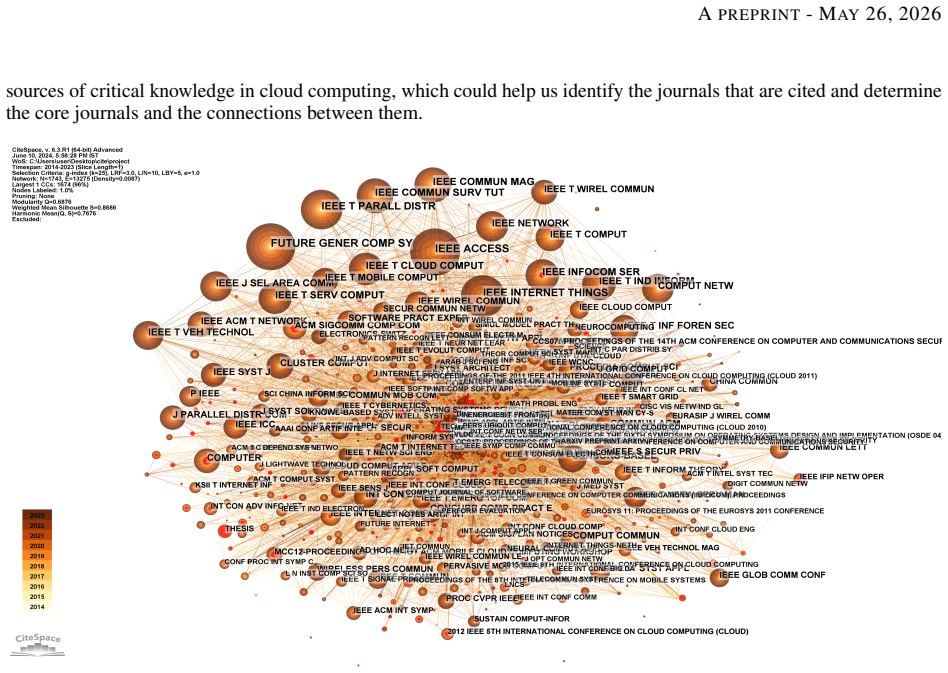
The popularity and rapid development of Cloud Computing in recent years has led to a vast number of publications capturing the accumulated knowledge in this field. Due to the interdisciplinary nature and significant relevance of cloud computing research, it has become increasingly challenging to comprehend the overall structure and progress of this field without employing analytical methods. While the evaluation of scientific research has a long tradition in many fields, we have identified a lack of comprehensive scientometric studies specifically focused on cloud computing. This study applies scientometric techniques to empirically examine cloud computing research evolution and current state from a macroscopic perspective. We employed the CiteSpace tool for visual analysis, exploring topics related to cloud computing by retrieving papers published between 2014 and 2023 from the Web of Science Core database. Our approach involved constructing collaboration networks among authors, institutions, and countries to pinpoint the most prolific contributors in each category. Through the analysis of core journal distributions via journal co-citations, document co-citation networks, and clustering analysis, we uncovered the underlying research topics and knowledge structure. The results of this study enhance our understanding of patterns, trends, and other critical factors, offering a foundation for guiding research activities, sharing knowledge, and fostering collaboration in the field of cloud computing research.
Figures


Figures from the paper (8 more)




Reference graph
Works this paper leans on
-
[1]
D. Saxena and A. K. Singh, “Concepts, taxonomic review, and emerging trends in computational intelligence for green cloud systems,”Computer Science Review, vol. 60, p. 100894, 2026
work page 2026
-
[2]
Quantum-based multifaceted cybersecurity model for smart grid data communications,
P. Rani, A. K. Singh, A. Parashar, and D. Saxena, “Quantum-based multifaceted cybersecurity model for smart grid data communications,”IEEE Transactions on Automation Science and Engineering, vol. 23, pp. 7778–7793, 2026
work page 2026
-
[3]
Multifactor trust-driven secure communication model for cloud-based digital twins,
D. Saxena and A. K. Singh, “Multifactor trust-driven secure communication model for cloud-based digital twins,” IEEE Transactions on Industrial Informatics, pp. 1–10, 2026
work page 2026
-
[4]
Neighbor-embedded graph neural network-based crowd delivery traffic management in smart city,
K. Gupta, D. Saxena, A. K. Singh, and C.-N. Lee, “Neighbor-embedded graph neural network-based crowd delivery traffic management in smart city,”IEEE Transactions on Emerging Topics in Computational Intelligence, pp. 1–13, 2026
work page 2026
-
[5]
D. Saxena, A. Rajput, and A. Kumar Singh, “Unleashing the power of artificial intelligence for exploring unrevealed and unexplored natural resources,”IT Professional, vol. 28, no. 1, pp. 35–43, 2026
work page 2026
-
[6]
R. N. Wedamuni Arachchige, D. Saxena, and A. K. Singh, “An adaptive cyber threat intelligence model to counter evolving security attacks in industrial communication networks,”Neural Computing and Applications, vol. 38, no. 2, p. 15, 2026. 15 APREPRINT- MAY26, 2026
work page 2026
-
[7]
Digital health challenges and opportunities for health-care it profession- als,
V . Mishra, D. Saxena, and A. K. Singh, “Digital health challenges and opportunities for health-care it profession- als,”IT Professional, vol. 27, no. 6, pp. 65–70, 2025
work page 2025
-
[8]
P. Rani, A. K. Singh, A. Parashar, and D. Saxena, “Quantum fourier transformation and clifford gate-driven secure communication model for smart grid environments,”IEEE Transactions on Dependable and Secure Computing, vol. 23, no. 2, pp. 3681–3695, 2026
work page 2026
Show all 168 references
-
[9]
A meta-unified global cyber threat intelligence model for industrial cross-cloud networks,
D. Saxena and A. K. Singh, “A meta-unified global cyber threat intelligence model for industrial cross-cloud networks,”IEEE Transactions on Information Forensics and Security, vol. 20, pp. 12 317–12 327, 2025
2025
-
[10]
Quantum blackhole learning-optimized hadamard neural network model for dynamic resource reservation in industry clouds,
D. Saxena, H. M. Gaur, A. K. Singh, and A. Mohan, “Quantum blackhole learning-optimized hadamard neural network model for dynamic resource reservation in industry clouds,”IEEE Transactions on Systems, Man, and Cybernetics: Systems, vol. 56, no. 1, pp. 134–147, 2026
2026
-
[11]
Syntax element encryption for h.265/hevc using chaotic map-based coefficient scrambling scheme,
L.-W. Li, C.-N. Lee, K. Gupta, H.-F. Yang, and A. Kumar Singh, “Syntax element encryption for h.265/hevc using chaotic map-based coefficient scrambling scheme,”IEEE Transactions on Circuits and Systems for Video Technology, vol. 36, no. 4, pp. 5655–5670, 2026
2026
-
[12]
Reinforcement learning based multi- agent system for smart microgrid,
N. Singh, K. Gupta, A. K. Singh, P. Nallagownden, and I. Elamvazuthi, “Reinforcement learning based multi- agent system for smart microgrid,”Journal of Network and Computer Applications, p. 104339, 2025
2025
-
[13]
Sustainability in large language model supply chains-insights and recommendations using analysis of utility for affecting factors,
V . Mishra, D. Saxena, K. Gupta, S. Patni, and A. K. Singh, “Sustainability in large language model supply chains-insights and recommendations using analysis of utility for affecting factors,”Scientific Reports, vol. 15, no. 1, p. 33524, 2025
2025
-
[14]
Quad-caching management model for heterogeneous data lake environments,
D. Saxena, A. K. Singh, and V . Lindenstruth, “Quad-caching management model for heterogeneous data lake environments,”Expert Systems with Applications, p. 129133, 2025
2025
-
[15]
An intelligent secure and reliable cloud services management model with toffoli gate-embedded quantum adam neural network,
D. Saxena and A. K. Singh, “An intelligent secure and reliable cloud services management model with toffoli gate-embedded quantum adam neural network,”IEEE Transactions on Dependable and Secure Computing, vol. 22, no. 6, pp. 6554–6565, 2025
2025
-
[16]
Ree-tm: Reliable and energy-efficient traffic management model for diverse cloud workloads,
A. K. Singh, D. Saxena, and V . Lindenstruth, “Ree-tm: Reliable and energy-efficient traffic management model for diverse cloud workloads,”IEEE Transactions on Cloud Computing, vol. 13, no. 3, pp. 953–968, 2025
2025
-
[17]
A comprehensively adaptive architectural optimization-ingrained quantum neural network model for cloud workloads prediction,
J. Kumar, D. Saxena, K. Gupta, S. Kumar, and A. K. Singh, “A comprehensively adaptive architectural optimization-ingrained quantum neural network model for cloud workloads prediction,”IEEE Transactions on Neural Networks and Learning Systems, vol. 36, no. 10, pp. 19 039–19 053, 2025
2025
-
[18]
Evolutionary learning driven load forecasting and demand response management model for smart grid,
J. Kumar, P. Rani, D. Saxena, A. K. Singh, and A. Makkar, “Evolutionary learning driven load forecasting and demand response management model for smart grid,”Applied Soft Computing, vol. 177, p. 113169, 2025
2025
-
[19]
An intelligent multi-depot vehicle routing and management model for smart cities,
D. Saxena, N. Singh, K. Gupta, A. Verma, V . Mishra, J. Kumar, I. Gupta, S. Patni, R. Gupta, J. Kumar, and A. K. Singh, “An intelligent multi-depot vehicle routing and management model for smart cities,”IEEE Transactions on Intelligent Transportation Systems, vol. 26, no. 6, p...
2025
-
[20]
A multi-agent deep reinforcement learning approach for optimal resource management in serverless computing,
A. K. Singh, S. Kumar, and S. Jain, “A multi-agent deep reinforcement learning approach for optimal resource management in serverless computing,”Cluster Computing, vol. 28, no. 2, p. 102, 2025
2025
-
[21]
A secure and multiobjective virtual machine placement framework for cloud data center,
D. Saxena, I. Gupta, J. Kumar, A. K. Singh, and X. Wen, “A secure and multiobjective virtual machine placement framework for cloud data center,”IEEE Systems Journal, 2021
2021
-
[23]
Reducing security risks of clouds through virtual machine placement,
J. Han, W. Zang, S. Chen, and M. Yu, “Reducing security risks of clouds through virtual machine placement,” in IFIP Annual Conference on Data and Applications Security and Privacy. Springer, 2017, pp. 275–292
2017
-
[24]
Secure and energy aware load balancing framework for cloud data centre networks,
A. K. Singh and J. Kumar, “Secure and energy aware load balancing framework for cloud data centre networks,” Electronics Letters, vol. 55, no. 9, pp. 540–541, 2019
2019
-
[25]
A proactive autoscaling and energy-efficient vm allocation framework using online multi-resource neural network for cloud data center,
D. Saxena and A. K. Singh, “A proactive autoscaling and energy-efficient vm allocation framework using online multi-resource neural network for cloud data center,”Neurocomputing, vol. 426, pp. 248–264, 2021
2021
-
[26]
Energy aware resource efficient-(eare) server consolidation framework for cloud datacenter,
——, “Energy aware resource efficient-(eare) server consolidation framework for cloud datacenter,” inAdvances in communication and computational technology. Springer, 2021, pp. 1455–1464
2021
-
[27]
Communication cost aware resource efficient load balancing (carelb) framework for cloud datacenter,
——, “Communication cost aware resource efficient load balancing (carelb) framework for cloud datacenter,” Recent Advances in Computer Science and Communications (Formerly: Recent Patents on Computer Science), vol. 14, no. 9, pp. 2920–2933, 2021
2021
-
[28]
Workload prediction in cloud using artificial neural network and adaptive differential evolution,
J. Kumar and A. K. Singh, “Workload prediction in cloud using artificial neural network and adaptive differential evolution,”Future Generation Computer Systems, vol. 81, pp. 41–52, 2018. 16 APREPRINT- MAY26, 2026
2018
-
[29]
Long short term memory recurrent neural network (lstm-rnn) based workload forecasting model for cloud datacenters,
J. Kumar, R. Goomer, and A. K. Singh, “Long short term memory recurrent neural network (lstm-rnn) based workload forecasting model for cloud datacenters,”Procedia Computer Science, vol. 125, pp. 676–682, 2018
2018
-
[30]
A fault tolerant elastic resource management framework towards high availability of cloud services,
D. Saxena, I. Gupta, A. K. Singh, and C.-N. Lee, “A fault tolerant elastic resource management framework towards high availability of cloud services,”IEEE Transactions on Network and Service Management, 2022
2022
-
[31]
A hybrid neural network and cooperative pso model for dynamic cloud workloads prediction,
J. Kumar, D. Saxena, J. Kumar, A. Bhadoria, A. Anjali, and A. K. Singh, “A hybrid neural network and cooperative pso model for dynamic cloud workloads prediction,”Computing, vol. 107, no. 3, p. 72, 2025
2025
-
[32]
A self-healing and fault-tolerant cloud-based digital twin processing management model,
D. Saxena and A. K. Singh, “A self-healing and fault-tolerant cloud-based digital twin processing management model,”IEEE Transactions on Industrial Informatics, vol. 21, no. 5, pp. 4233–4242, 2025
2025
-
[33]
Classified dynamic hierarchical load balancer for cloud data centers,
S. Patni, J. Kumar, D. Saxena, and A. Kumar Singh, “Classified dynamic hierarchical load balancer for cloud data centers,”SN Computer Science, vol. 6, no. 3, p. 218, 2025
2025
-
[34]
Data security and leakage detection models,
S. Patni, D. Saxena, and A. K. Singh, “Data security and leakage detection models,” inResource Management in Cloud Computing: Concepts and Implementation. Springer, 2025, pp. 159–189
2025
-
[35]
Secure and energy-efficient cloud traffic management schemes,
——, “Secure and energy-efficient cloud traffic management schemes,” inResource Management in Cloud Computing: Concepts and Implementation. Springer, 2025, pp. 135–157
2025
-
[36]
Exploring the shift from 3-d printing to 4-d printing: A review,
S. K. Sood, Y . S. Lamba, and A. K. Singh, “Exploring the shift from 3-d printing to 4-d printing: A review,” IEEE Sensors Journal, vol. 25, no. 6, pp. 9224–9232, 2025
2025
-
[37]
Multi-vm-workloads learning-based forecasting model for resilient server manage- ment in industry clouds,
D. Saxena and A. K. Singh, “Multi-vm-workloads learning-based forecasting model for resilient server manage- ment in industry clouds,”Procedia Computer Science, vol. 260, pp. 923–929, 2025
2025
-
[38]
An intelligent virtual machine allocation optimization model for energy-efficient and reliable cloud environment: Sr swain et al
S. R. Swain, A. Parashar, A. K. Singh, and C. N. Lee, “An intelligent virtual machine allocation optimization model for energy-efficient and reliable cloud environment: Sr swain et al.”The Journal of Supercomputing, vol. 81, no. 1, p. 237, 2025
2025
-
[39]
A bio-inspired virtual machine placement toward sustainable cloud resource management,
A. K. Singh, S. R. Swain, D. Saxena, and C.-N. Lee, “A bio-inspired virtual machine placement toward sustainable cloud resource management,”IEEE Systems Journal, 2023
2023
-
[40]
Op-mlb: an online vm prediction-based multi-objective load balancing framework for resource management at cloud data center,
D. Saxena, A. K. Singh, and R. Buyya, “Op-mlb: an online vm prediction-based multi-objective load balancing framework for resource management at cloud data center,”IEEE Transactions on Cloud Computing, vol. 10, no. 4, pp. 2804–2816, 2021
2021
-
[41]
Growth and development of publication on cloud computing: A scientometric study,
K. Sivakumaren, S. Swaminathan, and G. Karthikeyan, “Growth and development of publication on cloud computing: A scientometric study,”International Journal of Information Library and Society, vol. 1, no. 1, p. 37, 2012
2012
-
[42]
Scientometric analysis on the papers of cloud computing,
Q. Bai and W.-h. Dong, “Scientometric analysis on the papers of cloud computing,”Sci-Tech Inform. Develop. Econ., vol. 5, no. 1, pp. 6–8, 2011
2011
-
[43]
A multiple controlled toffoli driven adaptive quantum neural network model for dynamic workload prediction in cloud environments,
I. Gupta, D. Saxena, A. K. Singh, and C.-N. Lee, “A multiple controlled toffoli driven adaptive quantum neural network model for dynamic workload prediction in cloud environments,”IEEE Transactions on Pattern Analysis and Machine Intelligence, pp. 1–16, 2024
2024
-
[44]
An intelligent straggler traffic management framework for sustainable cloud environments,
S. R. Swain, D. Saxena, J. Kumar, A. K. Singh, and C.-N. Lee, “An intelligent straggler traffic management framework for sustainable cloud environments,”IEEE Transactions on Sustainable Computing, pp. 1–13, 2024
2024
-
[45]
A high up-time and security centered resource provisioning model towards sustainable cloud service management,
D. Saxena and A. K. Singh, “A high up-time and security centered resource provisioning model towards sustainable cloud service management,”IEEE Transactions on Green Communications and Networking, pp. 1–1, 2024
2024
-
[46]
Performance analysis of machine learning centered workload prediction models for cloud,
D. Saxena, J. Kumar, A. K. Singh, and S. Schmid, “Performance analysis of machine learning centered workload prediction models for cloud,”IEEE Transactions on Parallel and Distributed Systems, vol. 34, no. 4, pp. 1313–1330, 2023
2023
-
[47]
A bio-inspired virtual machine placement toward sustainable cloud resource management,
A. K. Singh, S. R. Swain, D. Saxena, and C.-N. Lee, “A bio-inspired virtual machine placement toward sustainable cloud resource management,”IEEE Systems Journal, vol. 17, no. 3, pp. 3894–3905, 2023
2023
-
[48]
A quantum controlled-not neural network-based load forecast and management model for smart grid,
J. Kumar, D. Saxena, A. K. Singh, and A. V . Vasilakos, “A quantum controlled-not neural network-based load forecast and management model for smart grid,”IEEE Systems Journal, vol. 17, no. 4, pp. 5714–5725, 2023
2023
-
[49]
A comprehensive survey on sustainable resource management in cloud computing environments,
D. Saxena and A. K. Singh, “A comprehensive survey on sustainable resource management in cloud computing environments,”Authorea Preprints, 2024
2024
-
[50]
Secure and energy efficient dynamic hierarchical load balancing framework for cloud data centers,
S. Chhabra and A. K. Singh, “Secure and energy efficient dynamic hierarchical load balancing framework for cloud data centers,”Multimedia Tools and Applications, vol. 82, no. 19, pp. 29 843–29 856, 2023. 17 APREPRINT- MAY26, 2026
2023
-
[51]
Efficient straggler task management in cloud environment using stochastic gradient descent with momentum learning-driven neural networks,
S. R. Swain, A. Parashar, A. K. Singh, and C. N. Lee, “Efficient straggler task management in cloud environment using stochastic gradient descent with momentum learning-driven neural networks,”Cluster Computing, pp. 1–13, 2023
2023
-
[52]
A quantum approach towards the adaptive prediction of cloud workloads,
A. K. Singh, D. Saxena, J. Kumar, and V . Gupta, “A quantum approach towards the adaptive prediction of cloud workloads,”IEEE Transactions on Parallel and Distributed Systems, vol. 32, no. 12, pp. 2893–2905, 2021
2021
-
[53]
Research progress of cloud security from 2008 to 2011 in china,
T. Wang and G.-b. Huang, “Research progress of cloud security from 2008 to 2011 in china,”Inform. Sci., 2013
2008
-
[54]
A scientometric analysis of cloud computing literature,
L. Heilig and S. V oß, “A scientometric analysis of cloud computing literature,”IEEE Transactions on Cloud Computing, vol. 2, no. 3, pp. 266–278, 2014
2014
-
[55]
Dynamic resource scaling in cloud using neural network and black hole algorithm,
J. Kumar and A. K. Singh, “Dynamic resource scaling in cloud using neural network and black hole algorithm,” in2016 Fifth International Conference on Eco-friendly Computing and Communication Systems (ICECCS). IEEE, 2016, pp. 63–67
2016
-
[56]
Cloud datacenter workload estimation using error preventive time series forecasting models,
——, “Cloud datacenter workload estimation using error preventive time series forecasting models,”Cluster Computing, vol. 23, no. 2, pp. 1363–1379, 2020
2020
-
[57]
Mlpam: A machine learning and probabilistic analysis based model for preserving security and privacy in cloud environment,
I. Gupta, R. Gupta, A. K. Singh, and R. Buyya, “Mlpam: A machine learning and probabilistic analysis based model for preserving security and privacy in cloud environment,”IEEE Systems Journal, vol. 15, no. 3, pp. 4248–4259, 2020
2020
-
[58]
Differential and access policy based privacy-preserving model in cloud environment,
R. Gupta and A. K. Singh, “Differential and access policy based privacy-preserving model in cloud environment,” Journal of Web Engineering, vol. 21, no. 3, pp. 609–632, 2022
2022
-
[59]
Privacy-preserving cloud data model based on differential approach,
——, “Privacy-preserving cloud data model based on differential approach,” in2022 Second International Conference on Power, Control and Computing Technologies (ICPC2T). IEEE, 2022, pp. 1–6
2022
-
[60]
Dynamic resource allocation method for load balance scheduling over cloud data center networks,
S. Chhabra and A. K. Singh, “Dynamic resource allocation method for load balance scheduling over cloud data center networks,”Journal of Web Engineering, vol. 20, no. 8, pp. 2269–2284, 2021
2021
-
[61]
A secure vm allocation scheme to preserve against co-resident threat,
——, “A secure vm allocation scheme to preserve against co-resident threat,”International Journal of Web Engineering and Technology, vol. 15, no. 1, pp. 96–115, 2020
2020
-
[62]
Resource-efficient load-balancing framework for cloud data center networks,
J. Kumar, A. K. Singh, and A. Mohan, “Resource-efficient load-balancing framework for cloud data center networks,”ETRI Journal, vol. 43, no. 1, pp. 53–63, 2021
2021
-
[63]
Data security and privacy in cloud computing: concepts and emerging trends,
R. Gupta, D. Saxena, and A. K. Singh, “Data security and privacy in cloud computing: concepts and emerging trends,”arXiv preprint arXiv:2108.09508, 2021
2021
-
[64]
Dynamic hierarchical load balancing model for cloud data centre networks,
S. Chhabra and A. Singh, “Dynamic hierarchical load balancing model for cloud data centre networks,”Electron- ics Letters, vol. 55, no. 2, pp. 94–96, 2019
2019
-
[65]
A privacy-preserving model based on differential approach for sensitive data in cloud environment,
A. K. Singh and R. Gupta, “A privacy-preserving model based on differential approach for sensitive data in cloud environment,”Multimedia Tools and Applications, vol. 81, no. 23, pp. 33 127–33 150, 2022
2022
-
[66]
Optimal vm placement model for load balancing in cloud data centers,
S. Chhabra and A. K. Singh, “Optimal vm placement model for load balancing in cloud data centers,” in2019 7th International Conference on Smart Computing & Communications (ICSCC). IEEE, 2019, pp. 1–5
2019
-
[67]
Cloud resource demand prediction using differential evolution based learning,
J. Kumar and A. K. Singh, “Cloud resource demand prediction using differential evolution based learning,” in 2019 7th International Conference on Smart Computing & Communications (ICSCC). IEEE, 2019, pp. 1–5
2019
-
[68]
Performance assessment of time series forecasting models for cloud datacenter networks’ workload prediction,
——, “Performance assessment of time series forecasting models for cloud datacenter networks’ workload prediction,”Wireless Personal Communications, vol. 116, no. 3, pp. 1949–1969, 2021
1949
-
[69]
Vm failure prediction based intelligent resource management model for cloud environments,
D. Saxena and A. K. Singh, “Vm failure prediction based intelligent resource management model for cloud environments,” in2022 Second International Conference on Power, Control and Computing Technologies (ICPC2T). IEEE, 2022, pp. 1–6
2022
-
[70]
Adaptive learning based prediction framework for cloud datacenter networks’ workload anticipation
J. Kumar and A. K. Singh, “Adaptive learning based prediction framework for cloud datacenter networks’ workload anticipation.”Journal of Information Science & Engineering, vol. 36, no. 5, 2020
2020
-
[71]
Security embedded dynamic resource allocation model for cloud data centre,
D. Saxena and A. Singh, “Security embedded dynamic resource allocation model for cloud data centre,”Elec- tronics Letters, vol. 56, no. 20, pp. 1062–1065, 2020
2020
-
[72]
Auto-adaptive learning-based workload forecasting in dynamic cloud environment,
D. Saxena and A. K. Singh, “Auto-adaptive learning-based workload forecasting in dynamic cloud environment,” International Journal of Computers and Applications, vol. 44, no. 6, pp. 541–551, 2022
2022
-
[73]
Osc-mc: Online secure communication model for cloud environment,
——, “Osc-mc: Online secure communication model for cloud environment,”IEEE Communications Letters, vol. 25, no. 9, pp. 2844–2848, 2021
2021
-
[74]
Biphase adaptive learning-based neural network model for cloud datacenter workload forecasting,
J. Kumar, D. Saxena, A. K. Singh, and A. Mohan, “Biphase adaptive learning-based neural network model for cloud datacenter workload forecasting,”Soft Computing, vol. 24, no. 19, pp. 14 593–14 610, 2020. 18 APREPRINT- MAY26, 2026
2020
-
[75]
Google scholar, scopus and the web of science: a longitudinal and cross- disciplinary comparison,
A.-W. Harzing and S. Alakangas, “Google scholar, scopus and the web of science: a longitudinal and cross- disciplinary comparison,”Scientometrics, vol. 106, pp. 787–804, 2016
2016
-
[76]
A secure and multiobjective virtual machine placement framework for cloud data center,
D. Saxena, I. Gupta, J. Kumar, A. K. Singh, and X. Wen, “A secure and multiobjective virtual machine placement framework for cloud data center,”IEEE Systems Journal, vol. 16, no. 2, pp. 3163–3174, 2021
2021
-
[78]
Multi-objective energy efficient virtual machines allocation at the cloud data center,
N. K. Sharma and G. R. M. Reddy, “Multi-objective energy efficient virtual machines allocation at the cloud data center,”IEEE Transactions on Services Computing, vol. 12, no. 1, pp. 158–171, 2016
2016
-
[79]
Ofp-tm: an online vm failure prediction and tolerance model towards high availability of cloud computing environments,
D. Saxena and A. K. Singh, “Ofp-tm: an online vm failure prediction and tolerance model towards high availability of cloud computing environments,”The Journal of Supercomputing, vol. 78, no. 6, pp. 8003–8024, 2022
2022
-
[80]
Cloud-hpa: hierarchical privacy perseverance anatomy for data storage in cloud environment,
A. K. Singh, N. Singh, and I. Gupta, “Cloud-hpa: hierarchical privacy perseverance anatomy for data storage in cloud environment,”Multimedia Tools and Applications, vol. 83, no. 13, pp. 37 431–37 451, 2024
2024
-
[81]
Privacy-preserving multi-keyword hybrid search over encrypted data in cloud,
N. Singh, J. Kumar, A. K. Singh, and A. Mohan, “Privacy-preserving multi-keyword hybrid search over encrypted data in cloud,”Journal of Ambient Intelligence and Humanized Computing, vol. 15, no. 1, pp. 261–274, 2024
2024
-
[82]
An energy efficient virtual machine placement scheme for intelligent resource management at cloud data center,
S. R. Swain, A. Parashar, A. K. Singh, and C. N. Lee, “An energy efficient virtual machine placement scheme for intelligent resource management at cloud data center,” in2023 OITS International Conference on Information Technology (OCIT). IEEE, 2023, pp. 65–70
2023
-
[83]
An optimal host allocation and load distribution framework using maximum likelihood in cloud environment,
S. Patni and A. K. Singh, “An optimal host allocation and load distribution framework using maximum likelihood in cloud environment,”SN Computer Science, vol. 4, no. 5, p. 572, 2023
2023
-
[84]
An efficient and privacy-preserving data aggregation scheme for smart grids in cloud environment,
P. Rani and A. K. Singh, “An efficient and privacy-preserving data aggregation scheme for smart grids in cloud environment,”SN Computer Science, vol. 4, no. 5, p. 540, 2023
2023
-
[85]
A data privacy-preserving model driven on differential approach in cloud environment,
R. Gupta, D. Saxena, and A. K. Singh, “A data privacy-preserving model driven on differential approach in cloud environment,” inInternational Conference on Green Energy, Computing and Intelligent Technology (GEn-CITy 2023), vol. 2023. IET, 2023, pp. 109–116
2023
-
[86]
A comparison between two main academic literature collections: Web of science and scopus databases,
A. A. Chadegani, H. Salehi, M. M. Yunus, H. Farhadi, M. Fooladi, M. Farhadi, and N. A. Ebrahim, “A comparison between two main academic literature collections: Web of science and scopus databases,”arXiv preprint arXiv:1305.0377, 2013
2013 arXiv
-
[87]
An ai-driven vm threat prediction model for multi-risks analysis-based cloud cybersecurity,
D. Saxena, I. Gupta, R. Gupta, A. K. Singh, and X. Wen, “An ai-driven vm threat prediction model for multi-risks analysis-based cloud cybersecurity,”IEEE Transactions on Systems, Man, and Cybernetics: Systems, 2023
2023
-
[88]
Cryptography approach for secure outsourced data storage in cloud environment,
R. Gupta, D. Saxena, and A. K. Singh, “Cryptography approach for secure outsourced data storage in cloud environment,”arXiv preprint arXiv:2306.08322, 2023
2023
-
[89]
Secom: An outsourced cloud-based secure communication model for advanced privacy preserving data computing and protection,
I. Gupta, D. Saxena, A. K. Singh, and C.-N. Lee, “Secom: An outsourced cloud-based secure communication model for advanced privacy preserving data computing and protection,”IEEE Systems Journal, vol. 17, no. 4, pp. 5130–5141, 2023
2023
-
[90]
A differential approach and deep neural network based data privacy-preserving model in cloud environment,
R. Gupta, I. Gupta, D. Saxena, and A. K. Singh, “A differential approach and deep neural network based data privacy-preserving model in cloud environment,”Journal of Ambient Intelligence and Humanized Computing, vol. 14, no. 5, pp. 4659–4674, 2023
2023
-
[91]
A sustainable and secure load management model for green cloud data centres,
D. Saxena, A. K. Singh, C.-N. Lee, and R. Buyya, “A sustainable and secure load management model for green cloud data centres,”Scientific Reports, vol. 13, no. 1, p. 491, 2023
2023
-
[92]
A differential privacy-based secure data sharing model in cloud environment,
R. Gupta and A. K. Singh, “A differential privacy-based secure data sharing model in cloud environment,” in 2022 IEEE 6th Conference on Information and Communication Technology (CICT). IEEE, 2022, pp. 1–6
2022
-
[93]
A survey of the workload forecasting methods in cloud computing,
A. Yadav, S. Kushwaha, J. Gupta, D. Saxena, and A. K. Singh, “A survey of the workload forecasting methods in cloud computing,” inProceedings of 3rd International Conference on Machine Learning, Advances in Computing, Renewable Energy and Communication: MARC 2021. Springer, 20...
2021
-
[94]
A high availability management model based on vm significance ranking and resource estimation for cloud applications,
D. Saxena and A. K. Singh, “A high availability management model based on vm significance ranking and resource estimation for cloud applications,”IEEE Transactions on Services Computing, vol. 16, no. 3, pp. 1604–1615, 2022
2022
-
[95]
A comprehensive vision on cloud computing environment: Emerging challenges and future research directions,
S. Chhabra and A. K. Singh, “A comprehensive vision on cloud computing environment: Emerging challenges and future research directions,”arXiv preprint arXiv:2207.07955, 2022. 19 APREPRINT- MAY26, 2026
2022
-
[96]
Emerging vm threat prediction and dynamic workload estimation for secure resource management in industrial clouds,
D. Saxena, R. Gupta, A. K. Singh, and A. Vasilakos, “Emerging vm threat prediction and dynamic workload estimation for secure resource management in industrial clouds,”IEEE Transactions on Automation Science and Engineering, 2023
2023
-
[97]
Visualizing a field of research: A methodology of systematic scientometric reviews,
C. Chen and M. Song, “Visualizing a field of research: A methodology of systematic scientometric reviews,” PloS one, vol. 14, no. 10, p. e0223994, 2019
2019
-
[98]
Emerging trends in regenerative medicine: a scientometric analysis in citespace,
C. Chen, Z. Hu, S. Liu, and H. Tseng, “Emerging trends in regenerative medicine: a scientometric analysis in citespace,”Expert opinion on biological therapy, vol. 12, no. 5, pp. 593–608, 2012
2012
-
[99]
Forceatlas2, a continuous graph layout algorithm for handy network visualization designed for the gephi software,
M. Jacomy, T. Venturini, S. Heymann, and M. Bastian, “Forceatlas2, a continuous graph layout algorithm for handy network visualization designed for the gephi software,”PloS one, vol. 9, no. 6, p. e98679, 2014
2014
-
[100]
Software survey: V osviewer, a computer program for bibliometric mapping,
N. Van Eck and L. Waltman, “Software survey: V osviewer, a computer program for bibliometric mapping,” scientometrics, vol. 84, no. 2, pp. 523–538, 2010
2010
-
[101]
Scimat: A new science mapping analysis software tool,
M. J. Cobo, A. G. López-Herrera, E. Herrera-Viedma, and F. Herrera, “Scimat: A new science mapping analysis software tool,”Journal of the American Society for information Science and Technology, vol. 63, no. 8, pp. 1609–1630, 2012
2012
-
[102]
Ucinet: a software tool for network analysis,
J. D. Johnson, “Ucinet: a software tool for network analysis,” 1987
1987
-
[103]
Citespace ii: Detecting and visualizing emerging trends and transient patterns in scientific literature,
C. Chen, “Citespace ii: Detecting and visualizing emerging trends and transient patterns in scientific literature,” Journal of the American Society for information Science and Technology, vol. 57, no. 3, pp. 359–377, 2006
2006
-
[104]
A review on sustainable resource management in cloud environment,
J. Kumar, D. Saxena, and S. Rekha, “A review on sustainable resource management in cloud environment,” 2023
2023
-
[105]
Defensive countermeasures towards addressing cloud security attacks,
D. Saxena and S. Rekha, “Defensive countermeasures towards addressing cloud security attacks,” 2023
2023
-
[106]
A review on secure cloud resource management,
S. Chhabra, D. Saxena, and S. Rekha, “A review on secure cloud resource management,” 2023
2023
-
[107]
An ai-driven intelligent traffic management model for 6g cloud radio access networks,
S. R. Swain, D. Saxena, J. Kumar, A. K. Singh, and C.-N. Lee, “An ai-driven intelligent traffic management model for 6g cloud radio access networks,”IEEE Wireless Communications Letters, 2023
2023
-
[108]
Power consumption forecast model using ensemble learning for smart grid,
J. Kumar, R. Gupta, D. Saxena, and A. K. Singh, “Power consumption forecast model using ensemble learning for smart grid,”The Journal of Supercomputing, pp. 1–22, 2023
2023
-
[109]
A discussion and comparative study on security and privacy of smart meter data,
J. Kumar and A. K. Singh, “A discussion and comparative study on security and privacy of smart meter data,” arXiv preprint arXiv:2111.09227, 2021
2021
-
[110]
Security and privacy-preservation of iot data in cloud-fog computing environment,
——, “Security and privacy-preservation of iot data in cloud-fog computing environment,”arXiv preprint arXiv:2212.00321, 2022
2022
-
[111]
A demand and response management model using load forecasting technique for smart grid,
——, “A demand and response management model using load forecasting technique for smart grid,” in2023 5th International Conference on Energy, Power and Environment: Towards Flexible Green Energy Technologies (ICEPE). IEEE, 2023, pp. 1–6
2023
-
[112]
Fedmup: Federated learning driven malicious user prediction model for secure data distribution in cloud environments
D. Saxena, K. Gupta, R. Gupta, J. Kumar, and A. K. Singh, “Fedmup: Federated learning driven malicious user prediction model for secure data distribution in cloud environments.”
-
[113]
A differential approach for data and classification service-based privacy-preserving machine learning model in cloud environment,
R. Gupta and A. K. Singh, “A differential approach for data and classification service-based privacy-preserving machine learning model in cloud environment,”New Generation Computing, vol. 40, no. 3, pp. 737–764, 2022
2022
-
[114]
Climate change and tourism: A scientometric analysis using citespace,
Y . Fang, J. Yin, and B. Wu, “Climate change and tourism: A scientometric analysis using citespace,”Journal of Sustainable Tourism, vol. 26, no. 1, pp. 108–126, 2018
2018
-
[115]
The prisma statement for reporting systematic reviews and meta-analyses of studies that evaluate health care interventions: explanation and elaboration,
A. Liberati, D. G. Altman, J. Tetzlaff, C. Mulrow, P. C. Gøtzsche, J. P. Ioannidis, M. Clarke, P. J. Devereaux, J. Kleijnen, and D. Moher, “The prisma statement for reporting systematic reviews and meta-analyses of studies that evaluate health care interventions: explanation a...
2009
-
[116]
Visualization analysis of organizational resilience research based on citespace from 1990–2022,
T. Ma, Y . Liu, and M. Han, “Visualization analysis of organizational resilience research based on citespace from 1990–2022,”IEEE Access, vol. 10, pp. 65 854–65 872, 2022
1990
-
[117]
A privacy-preserving model for cloud data storage through fog computing,
R. Gupta and A. K. Singh, “A privacy-preserving model for cloud data storage through fog computing,”Interna- tional Journal of Computer Aided Engineering and Technology, vol. 17, no. 3, pp. 348–359, 2022
2022
-
[118]
Hedcm: Human emotions detection and classification model from speech using cnn,
A. Tripathi, U. Singh, G. Bansal, R. Gupta, and A. K. Singh, “Hedcm: Human emotions detection and classification model from speech using cnn,” inWorkshop on Advances in Computational Intelligence at ISIC, 2021
2021
-
[119]
A reliable client detection system during load balancing for multi-tenant cloud environment,
A. K. Singh, S. Chhabra, R. Gupta, and D. Saxena, “A reliable client detection system during load balancing for multi-tenant cloud environment,”SN Computer Science, vol. 4, no. 1, p. 86, 2022. 20 APREPRINT- MAY26, 2026
2022
-
[120]
Emotional information-based hybrid recommen- dation system,
M. Sharma, R. Mittal, A. Bharati, D. Saxena, and A. K. Singh, “Emotional information-based hybrid recommen- dation system,” inSoft Computing for Problem Solving: Proceedings of the SocProS 2022. Springer, 2023, pp. 249–267
2022
-
[121]
Efficient resource management in cloud environment,
S. R. Swain, A. K. Singh, and C. N. Lee, “Efficient resource management in cloud environment,”arXiv preprint arXiv:2207.12085, 2022
2022
-
[122]
Auxiliary informatics system: an advancement towards a smart home environment,
I. Gupta, P. K. Yadav, S. Pareek, S. Shakeel, and A. K. Singh, “Auxiliary informatics system: an advancement towards a smart home environment,” 2022
2022
-
[123]
Pca-rf: An efficient parkinson’s disease prediction model based on random forest classification,
I. Gupta, V . Sharma, S. Kaur, and A. K. Singh, “Pca-rf: An efficient parkinson’s disease prediction model based on random forest classification,”arXiv preprint arXiv:2203.11287, 2022
2022
-
[124]
An efficient design of scalable reversible multiplier with testability,
H. M. Gaur, A. K. Singh, and U. Ghanekar, “An efficient design of scalable reversible multiplier with testability,” Journal of Circuits, Systems and Computers, p. 2250179, 2022
2022
-
[125]
Mlrm: A multiple linear regression based model for average temperature prediction of a day,
I. Gupta, H. Mittal, D. Rikhari, and A. K. Singh, “Mlrm: A multiple linear regression based model for average temperature prediction of a day,”arXiv preprint arXiv:2203.05835, 2022
2022
-
[126]
Hisa-smfm: Historical and sentiment analysis based stock market forecasting model,
I. Gupta, T. K. Madan, S. Singh, and A. K. Singh, “Hisa-smfm: Historical and sentiment analysis based stock market forecasting model,”arXiv preprint arXiv:2203.08143, 2022
2022
-
[127]
Tidf-dlpm: Term and inverse document frequency based data leakage prevention model,
I. Gupta, S. Mittal, A. Tiwari, P. Agarwal, and A. K. Singh, “Tidf-dlpm: Term and inverse document frequency based data leakage prevention model,”arXiv preprint arXiv:2203.05367, 2022
2022
-
[128]
An intelligent traffic entropy learning-based load management model for cloud networks,
D. Saxena and A. K. Singh, “An intelligent traffic entropy learning-based load management model for cloud networks,”IEEE Networking Letters, vol. 4, no. 2, pp. 59–63, 2022
2022
-
[129]
A holistic view on data protection for sharing, communicating, and computing environments: Taxonomy and future directions,
I. Gupta and A. K. Singh, “A holistic view on data protection for sharing, communicating, and computing environments: Taxonomy and future directions,”arXiv preprint arXiv:2202.11965, 2022
2022
-
[130]
Secureiiot environment: Federated learning empowered approach for securing iiot from data breach,
A. Makkar, T. W. Kim, A. K. Singh, J. Kang, and J. H. Park, “Secureiiot environment: Federated learning empowered approach for securing iiot from data breach,”IEEE Transactions on Industrial Informatics, 2022
2022
-
[131]
Maci: Malicious api call identifier model to secure the host platform,
A. Acharya, H. Prasad, V . Kumar, I. Gupta, and A. K. Singh, “Maci: Malicious api call identifier model to secure the host platform,” inProceedings of the Seventh International Conference on Mathematics and Computing. Springer, 2022, pp. 309–320
2022
-
[132]
Lstm and nlp based forecasting model for stock market analysis,
R. Patel, V . Choudhary, D. Saxena, and A. K. Singh, “Lstm and nlp based forecasting model for stock market analysis,” in2021 First International Conference on Advances in Computing and Future Communication Technologies (ICACFCT). IEEE, 2021, pp. 52–57
2021
-
[133]
Communication cost aware resource efficient load balancing (care-lb) framework for cloud datacenter,
D. Saxena and A. K. Singh, “Communication cost aware resource efficient load balancing (care-lb) framework for cloud datacenter,”Recent Advances in Computer Science and Communications, vol. 12, pp. 1–00, 2020
2020
-
[134]
Performance evaluation of metaheuristics algorithms for workload prediction in cloud environment,
J. Kumar and A. K. Singh, “Performance evaluation of metaheuristics algorithms for workload prediction in cloud environment,”Applied Soft Computing, vol. 113, p. 107895, 2021
2021
-
[135]
A survey and comparative study on multi-cloud architectures: emerging issues and challenges for cloud federation,
D. Saxena, R. Gupta, and A. K. Singh, “A survey and comparative study on multi-cloud architectures: emerging issues and challenges for cloud federation,”arXiv preprint arXiv:2108.12831, 2021
2021
-
[136]
A study on machine learning approaches for player performance and match results prediction,
H. Mittal, D. Rikhari, J. Kumar, and A. K. Singh, “A study on machine learning approaches for player performance and match results prediction,”arXiv preprint arXiv:2108.10125, 2021
2021
-
[137]
Credit card fraud detection using machine learning: A study,
P. Tiwari, S. Mehta, N. Sakhuja, J. Kumar, and A. K. Singh, “Credit card fraud detection using machine learning: A study,”arXiv preprint arXiv:2108.10005, 2021
2021
-
[138]
Testable designs of toffoli fredkin reversible circuits,
H. M. Gaur, A. K. Singh, and U. Ghanekar, “Testable designs of toffoli fredkin reversible circuits,”arXiv preprint arXiv:2108.07448, 2021
2021
-
[139]
Workload forecasting and resource management models based on machine learning for cloud computing environments,
D. Saxena and A. K. Singh, “Workload forecasting and resource management models based on machine learning for cloud computing environments,”arXiv preprint arXiv:2106.15112, 2021
2021
-
[140]
A comparative study on cipher text policy attribute based encryption schemes,
B. Pradhan, B. Singh, A. Bhoria, and A. K. Singh, “A comparative study on cipher text policy attribute based encryption schemes,” 2021
2021
-
[141]
Machine learning techniques for plant disease detection,
D. Varshney, B. Babukhanwala, J. Khan, D. Saxena, and A. kumar Singh, “Machine learning techniques for plant disease detection,” in2021 5th International Conference on Trends in Electronics and Informatics (ICOEI). IEEE, 2021, pp. 1574–1581
2021
-
[142]
Review of stock prediction using machine learning techniques,
R. Patel, V . Choudhary, D. Saxena, and A. K. Singh, “Review of stock prediction using machine learning techniques,” in2021 5th International Conference on Trends in Electronics and Informatics (ICOEI). IEEE, 2021, pp. 840–846. 21 APREPRINT- MAY26, 2026
2021
-
[143]
A review of fake news detection methods using machine learning,
M. Choudhary, S. Jha, D. Saxena, A. K. Singhet al., “A review of fake news detection methods using machine learning,” in2021 2nd International Conference for Emerging Technology (INCET). IEEE, 2021, pp. 1–5
2021
-
[144]
Self directed learning based workload forecasting model for cloud resource management,
J. Kumar, A. K. Singh, and R. Buyya, “Self directed learning based workload forecasting model for cloud resource management,”Information Sciences, vol. 543, pp. 345–366, 2021
2021
-
[145]
Host platform security and mobile agent classification: A systematic study,
A. Acharya, H. Prasad, V . Kumar, I. Gupta, and A. K. Singh, “Host platform security and mobile agent classification: A systematic study,” inComputer Networks and Inventive Communication Technologies. Springer, 2021, pp. 1001–1010
2021
-
[146]
Real-time human locator and advance home security appliances,
A. Kesharwani, A. Nag, A. Tiwari, I. Gupta, B. Sharma, and A. K. Singh, “Real-time human locator and advance home security appliances,” inEvolutionary Computing and Mobile Sustainable Networks. Springer, 2021, pp. 37–49
2021
-
[147]
A lightweight effective randomized caesar cipher algorithm for security of data,
V . Sharma, S. Jalwa, A. R. Siddiqi, I. Gupta, and A. K. Singh, “A lightweight effective randomized caesar cipher algorithm for security of data,” inEvolutionary Computing and Mobile Sustainable Networks. Springer, 2021, pp. 411–419
2021
-
[148]
Hybrid method in identifying the fraud detection in the credit card,
P. Tiwari, S. Mehta, N. Sakhuja, I. Gupta, and A. K. Singh, “Hybrid method in identifying the fraud detection in the credit card,” inEvolutionary Computing and Mobile Sustainable Networks. Springer, 2021, pp. 27–35
2021
-
[149]
Comprehensive and comparative analysis of different files using cp-abe,
S. Jalwa, V . Sharma, A. R. Siddiqi, I. Gupta, and A. K. Singh, “Comprehensive and comparative analysis of different files using cp-abe,” inAdvances in Communication and Computational Technology. Springer, 2021, pp. 189–198
2021
-
[150]
Online information leaker identification scheme for secure data sharing,
A. K. Singh and I. Gupta, “Online information leaker identification scheme for secure data sharing,”Multimedia Tools and Applications, vol. 79, no. 41, pp. 31 165–31 182, 2020
2020
-
[151]
Decomposition based cloud resource demand prediction using extreme learning machines,
J. Kumar and A. K. Singh, “Decomposition based cloud resource demand prediction using extreme learning machines,”Journal of Network and Systems Management, vol. 28, no. 4, pp. 1775–1793, 2020
2020
-
[152]
Seli: statistical evaluation based leaker identification stochastic scheme for secure data sharing,
I. Gupta and A. K. Singh, “Seli: statistical evaluation based leaker identification stochastic scheme for secure data sharing,”IET Communications, vol. 14, no. 20, pp. 3607–3618, 2020
2020
-
[153]
An integrated approach for data leaker detection in cloud environment
——, “An integrated approach for data leaker detection in cloud environment.”Journal of Information Science & Engineering, vol. 36, no. 5, 2020
2020
-
[154]
Guim-smd: guilty user identification model using summation matrix-based distribution,
——, “Guim-smd: guilty user identification model using summation matrix-based distribution,”IET Information Security, vol. 14, no. 6, pp. 773–782, 2020
2020
-
[155]
G. S. Hura, A. K. Singh, and L. S. Hoe,Advances in Communication and Computational Technology: Select Proceedings of ICACCT 2019. Springer, 2020
2019
-
[156]
A review on data privacy using attribute-based encryption,
D. Deepika, R. Malik, S. Kumar, R. Gupta, and A. K. Singh, “A review on data privacy using attribute-based encryption,” inProceedings of the International Conference on Innovative Computing & Communications (ICICC), 2020
2020
-
[157]
A review on emotion detection and classification using speech,
A. Tripathi, U. Singh, G. Bansal, R. Gupta, and A. K. Singh, “A review on emotion detection and classification using speech,” inProceedings of the International Conference on Innovative Computing & Communications (ICICC), 2020
2020
-
[158]
A survey on privacy-preserving outsourced data on cloud with multiple data providers,
A. S. Chauhan, D. Rani, A. Kumar, R. Gupta, and A. K. Singh, “A survey on privacy-preserving outsourced data on cloud with multiple data providers,” inProceedings of the International Conference on Innovative Computing & Communications (ICICC), 2020
2020
-
[159]
A framework for malicious agent detection in cloud computing environment,
I. Gupta and A. Singh, “A framework for malicious agent detection in cloud computing environment,”Int J Adv Sci Technol (IJAST), vol. 135, pp. 49–62, 2020
2020
-
[160]
Layer-based privacy and security architecture for cloud data sharing,
I. Gupta, N. Singh, and A. K. Singh, “Layer-based privacy and security architecture for cloud data sharing,” Journal of Communications Software and Systems, vol. 15, no. 2, pp. 173–185, 2019
2019
-
[161]
Authenticating cryptography over network in data,
P. Agarwal, S. Mittal, A. Tiwari, I. Gupta, A. K. Singh, and B. Sharma, “Authenticating cryptography over network in data,” in2019 International Conference on Intelligent Computing and Control Systems (ICCS). IEEE, 2019, pp. 632–636
2019
-
[162]
Advancements and security issues of iot & cyber physical systems,
P. K. Yadav, S. Pareek, S. Shakeel, J. Kumar, and A. K. Singh, “Advancements and security issues of iot & cyber physical systems,” in2019 International Conference on Intelligent Computing and Control Systems (ICCS). IEEE, 2019, pp. 940–945
2019
-
[163]
A confidentiality preserving data leaker detection model for secure sharing of cloud data using integrated techniques,
I. Gupta and A. K. Singh, “A confidentiality preserving data leaker detection model for secure sharing of cloud data using integrated techniques,” in2019 7th International Conference on Smart Computing & Communications (ICSCC). IEEE, 2019, pp. 1–5. 22 APREPRINT- MAY26, 2026
2019
-
[164]
Sql-injection vulnerabilities resolving using valid security tool in cloud
N. Singh and A. K. Singh, “Sql-injection vulnerabilities resolving using valid security tool in cloud.”Pertanika Journal of Science & Technology, vol. 27, no. 1, 2019
2019
-
[165]
A probabilistic model for finding an optimal host framework and load distribution in cloud environment,
S. Chhabra and A. K. Singh, “A probabilistic model for finding an optimal host framework and load distribution in cloud environment,”Procedia Computer Science, vol. 125, pp. 683–690, 2018
2018
-
[166]
A probabilistic approach for guilty agent detection using bigraph after distribution of sample data,
I. Gupta and A. K. Singh, “A probabilistic approach for guilty agent detection using bigraph after distribution of sample data,”Procedia Computer Science, vol. 125, pp. 662–668, 2018
2018
-
[167]
Oph-lb: Optimal physical host for load balancing in cloud environment
S. Chhabra and A. K. Singh, “Oph-lb: Optimal physical host for load balancing in cloud environment.”Pertanika Journal of Science & Technology, vol. 26, no. 3, 2018
2018
-
[168]
Compendium of data security in cloud storage by applying hybridization of encryption algorithm,
I. Gupta, D. Gurnani, N. Gupta, C. Singla, P. Thakral, and A. K. Singh, “Compendium of data security in cloud storage by applying hybridization of encryption algorithm,” 2022
2022
-
[169]
Data privacy protection mechanisms in cloud,
N. Singh and A. K. Singh, “Data privacy protection mechanisms in cloud,”Data Science and Engineering, vol. 3, no. 1, pp. 24–39, 2018
2018
-
[170]
Data leakage prevention: e-mail protection via gateway,
K. Kaur, I. Gupta, and A. K. Singh, “Data leakage prevention: e-mail protection via gateway,” inJournal of Physics: Conference Series, vol. 933. IOP Publishing, 2017, p. 012013. 23
2017
Reviewed June 30, 2026 · model on record in the stance chip above.
Discussion (0). Sign in to comment.