Code-agnostic bosonic noise suppression with hybrid rotations
Pith reviewed 2026-06-30 13:09 UTC · model grok-4.3
The pith
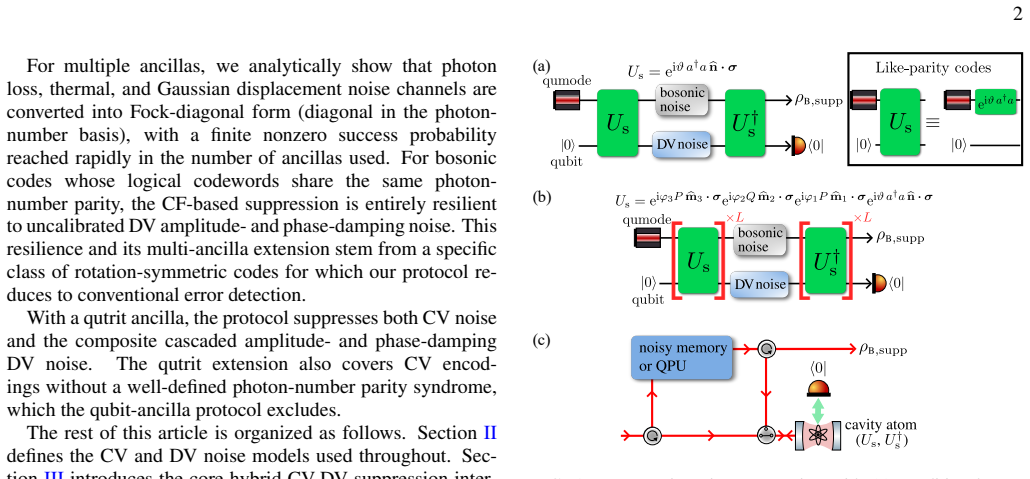
A hybrid CV-DV interferometer with one qubit ancilla suppresses thermal and Gaussian displacement noise on any bosonic code from linear to quadratic scaling.
A machine-rendered reading of the paper's core claim, the machinery that carries it, and where it could break.
Core claim
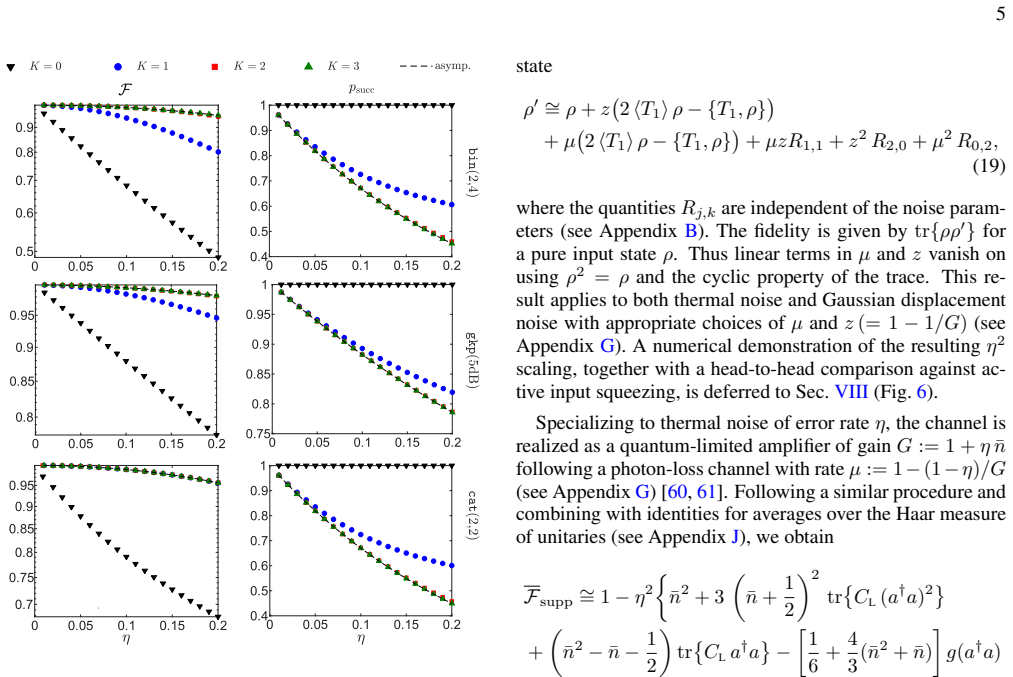
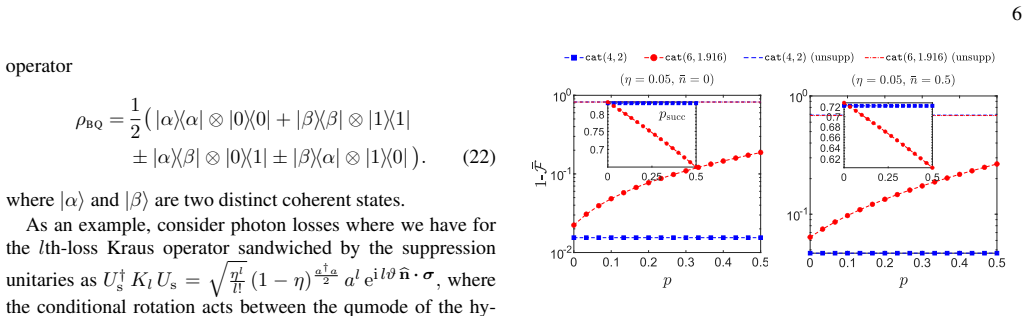
For any single-mode bosonic code corrupted by thermal or Gaussian displacement noise at loss rate μ and amplification G, a hybrid continuous-discrete-variable interferometer using a single qubit ancilla and two controlled-Fourier gates sandwiching the noise channel suppresses its effects from linear to quadratic scaling without active error correction or destructive measurements of the encoded state, maintaining high success probabilities ≥0.5 when μG ≤0.5.
What carries the argument
The hybrid CV-DV interferometer formed by a qubit ancilla and two controlled-Fourier gates placed on either side of the noise channel.
If this is right
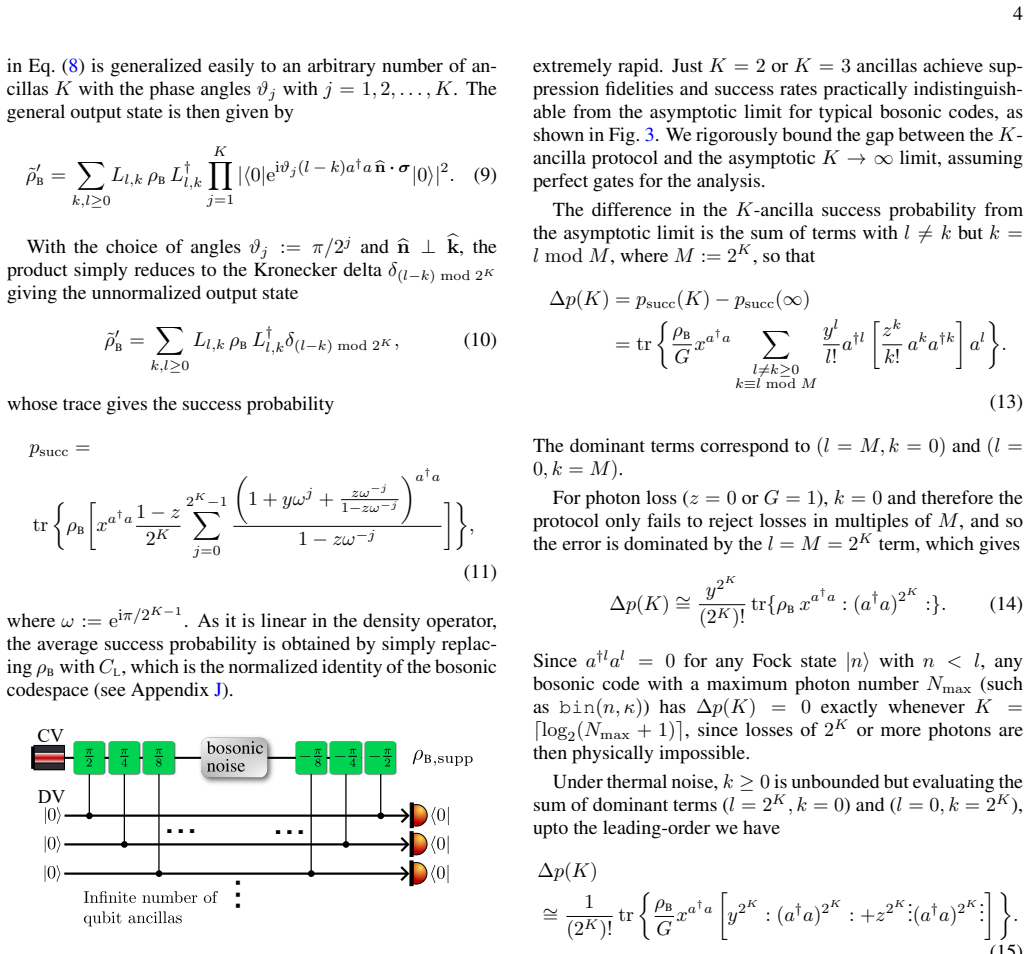
- With multiple ancillas the protocol converts photon loss into coherent Fock-damping and thermal or displacement noise into a mixture of Fock-diagonal noise.
- For 2^K-fold rotation-symmetric bosonic codes the protocol reduces to conventional error detection and projection using K ancillas.
- Extending the ancilla to a qutrit yields resilience against both CV noise and composite DV damping noise even on encodings without a well-defined photon-number parity syndrome.
- The scheme uses only simple gates and few ancillas, avoiding the ancilla-noise vulnerability of bypass schemes that transfer quantum information to DV registers.
Where Pith is reading between the lines
- The same sandwich structure may be testable on existing continuous-variable hardware by calibrating the controlled-Fourier operation on a single bosonic mode plus qubit.
- If the gates remain high-fidelity, the quadratic suppression could be stacked with existing bosonic error-correction layers to reduce the overhead of the latter.
- The conversion of loss into Fock damping suggests a route to deterministic preparation of approximate code states by post-selecting on the ancilla.
- Generalization to multi-mode channels would require commuting controlled-Fourier operations across modes but could protect distributed bosonic encodings.
Load-bearing premise
The controlled-Fourier gates can be applied perfectly without introducing extra noise on the ancilla or the bosonic mode, and the input noise consists only of the stated thermal or Gaussian displacement models at the given rates.
What would settle it
Apply the two controlled-Fourier gates with the ancilla to a known bosonic code state, let thermal or displacement noise act in the middle, then measure the output noise variance or logical error rate as a function of μG; quadratic rather than linear growth confirms the claim.
Figures

read the original abstract
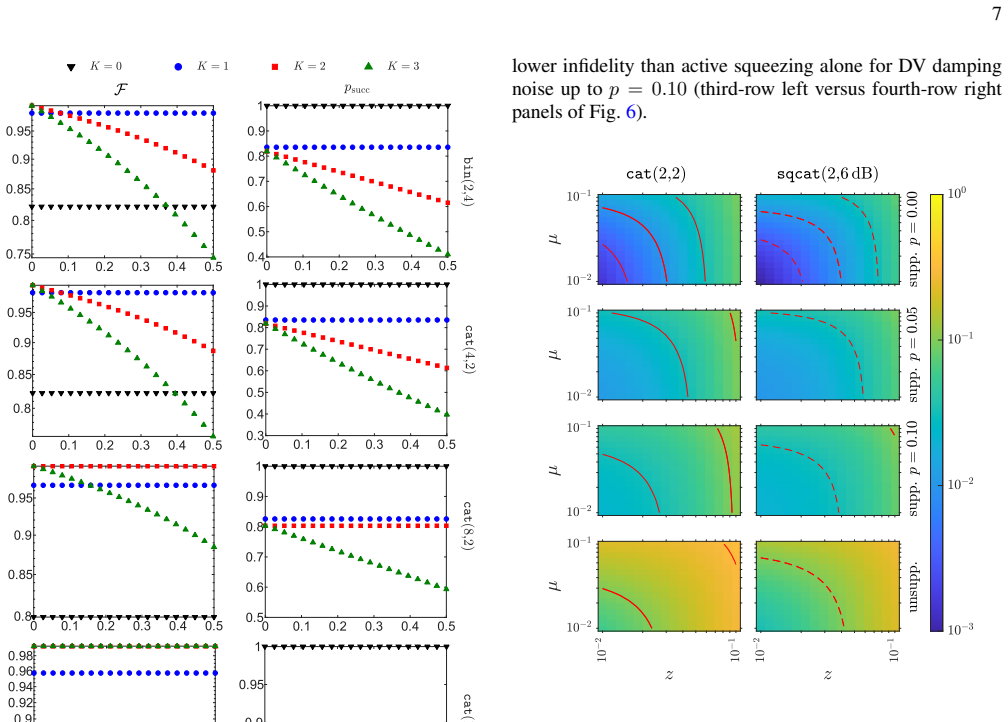
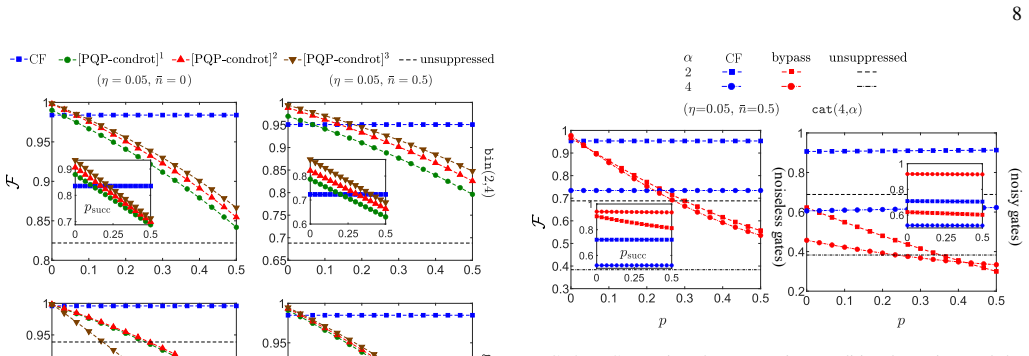
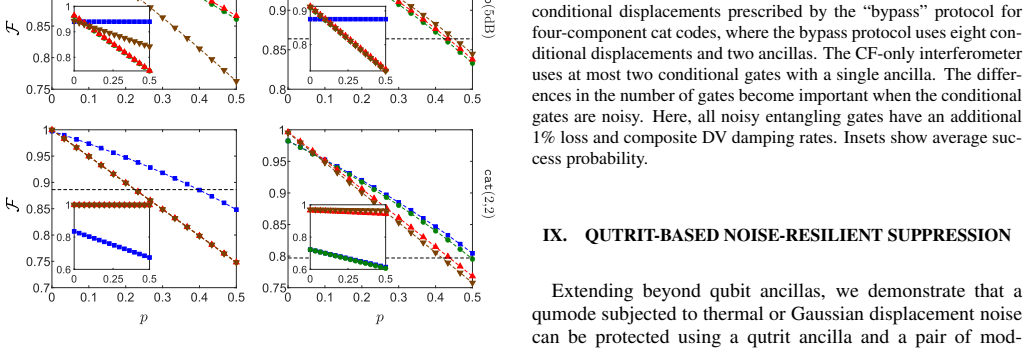
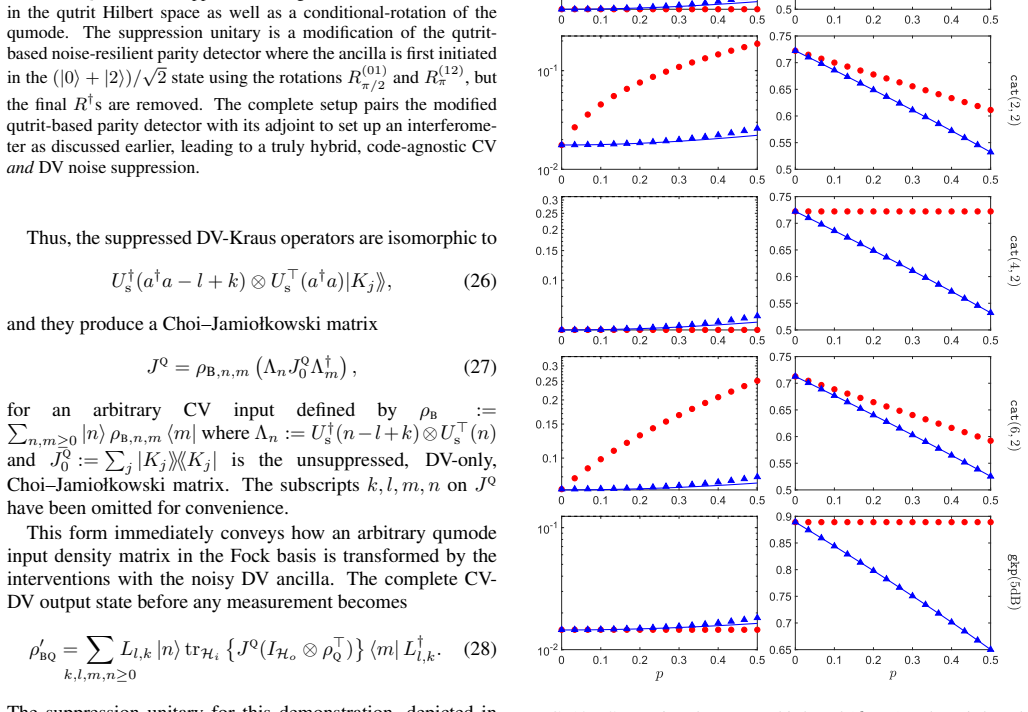
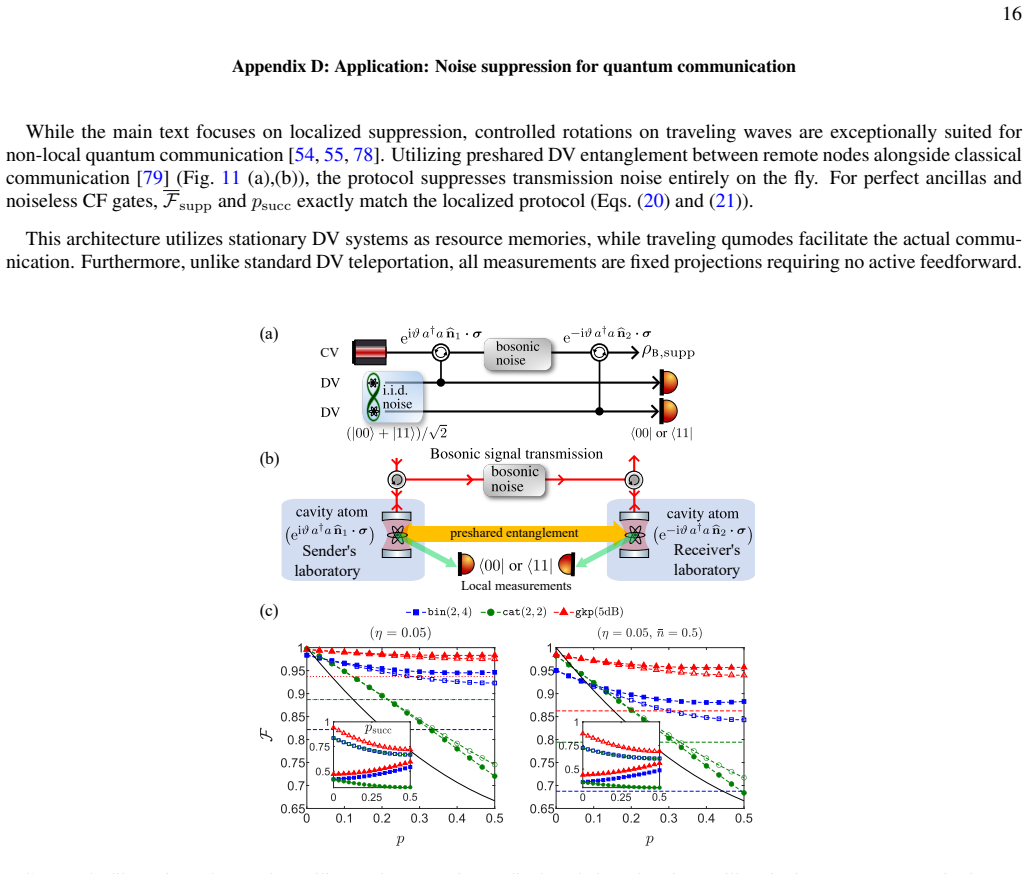
Physical-level noise on traveling bosonic modes remains a critical bottleneck for scalable quantum information processing. We show that for any single-mode bosonic code (qumode) corrupted by thermal or Gaussian displacement noise at loss rate $\mu$ and amplification $G$, a hybrid continuous-discrete-variable (CV-DV) interferometer using a single qubit ancilla and two controlled-Fourier (CF) gates sandwiching the noise channel suppresses its effects from linear to quadratic scaling. This is achieved without active error correction or destructive measurements of the encoded state, maintaining high success probabilities $\geq 0.5$ when $\mu G \leq 0.5$. When supplemented with multiple ancillas, the protocol converts photon loss into coherent Fock-damping, and thermal or displacement noise into a mixture of Fock-diagonal noise. The protocol is entirely code-agnostic. For the special case of $2^K$-fold rotation-symmetric bosonic codes, it simplifies to conventional error detection and projection with $K$ ancillas. Suppression with simple gates and few ancillas demonstrates a clear hardware-efficient advantage over previously proposed ``bypass'' schemes, where quantum information transferred to the DV ancillas is readily corrupted by ancilla noise. Finally, we extend the protocol to a qutrit DV ancilla. This demonstrates resilience to both CV noise and composite DV damping noise, achieving a truly hybrid noise suppression scheme that operates effectively even on CV encodings lacking a well-defined photon-number parity syndrome.
Editorial analysis
A structured set of objections, weighed in public.
Referee Report
Summary. The manuscript claims that for any single-mode bosonic code subject to thermal or Gaussian displacement noise (loss rate μ, amplification G), a hybrid CV-DV interferometer with one qubit ancilla and two controlled-Fourier gates placed around the noise channel suppresses the noise effects from linear to quadratic scaling in μG. The protocol requires no active error correction or destructive measurements of the encoded state, achieves success probabilities ≥0.5 when μG≤0.5, is entirely code-agnostic, converts loss into Fock-damping with multiple ancillas, and extends to a qutrit ancilla for resilience against composite DV damping noise. For 2^K-fold rotation-symmetric codes it reduces to conventional error detection.
Significance. If the central derivation holds, the result is significant for hardware-efficient bosonic noise suppression. It provides a clear advantage over bypass schemes by retaining information in the CV mode and using only simple gates with few ancillas. The code-agnostic construction, the explicit conversion of noise types, and the qutrit extension are notable strengths that broaden applicability without requiring code-specific syndromes.
major comments (2)
- [Protocol derivation] The derivation of linear-term cancellation (main text, protocol section following the definition of the hybrid interferometer) assumes ideal controlled-Fourier gates that introduce zero additional noise on the ancilla or bosonic mode. No quantitative robustness analysis is provided for finite gate fidelity or ancilla decoherence during gate application; this assumption is load-bearing for the claimed quadratic scaling.
- [Success probability analysis] The success-probability bound ≥0.5 for μG≤0.5 is asserted without an explicit expression or plot showing the probability as a function of μ and G (or a table of numerical values); verification of this bound is needed to support the practical-utility claim.
minor comments (2)
- The title refers to 'hybrid rotations' while the text consistently uses 'controlled-Fourier gates'; a brief clarification of the relationship would improve consistency.
- [Qutrit extension] In the qutrit-ancilla extension, the definition of the qutrit basis states and the composite noise model could be stated more explicitly to aid readability.
Simulated Author's Rebuttal
We thank the referee for their careful reading, positive assessment of the work's significance, and constructive major comments. We address each point below and will revise the manuscript accordingly.
read point-by-point responses
-
Referee: [Protocol derivation] The derivation of linear-term cancellation (main text, protocol section following the definition of the hybrid interferometer) assumes ideal controlled-Fourier gates that introduce zero additional noise on the ancilla or bosonic mode. No quantitative robustness analysis is provided for finite gate fidelity or ancilla decoherence during gate application; this assumption is load-bearing for the claimed quadratic scaling.
Authors: We agree that the derivation assumes ideal controlled-Fourier gates, which is a standard idealization in theoretical analyses of noise-suppression protocols to isolate the effect of the hybrid interferometer. The quadratic scaling follows directly from this assumption. In revision we will explicitly flag the ideal-gate assumption in the protocol section and add a concise discussion noting that small gate errors introduce higher-order perturbations but do not restore the leading linear term for sufficiently high fidelity. A full quantitative numerical study of ancilla decoherence during gate execution lies outside the present scope. revision: partial
-
Referee: [Success probability analysis] The success-probability bound ≥0.5 for μG≤0.5 is asserted without an explicit expression or plot showing the probability as a function of μ and G (or a table of numerical values); verification of this bound is needed to support the practical-utility claim.
Authors: We acknowledge the omission. The success probability is the probability that the ancilla qubit is measured in the |+⟩ state after the second controlled-Fourier gate and admits an analytic expression in terms of the thermal/displacement noise parameters μ and G. In the revised manuscript we will supply this explicit formula together with a plot (or table) confirming that the probability remains ≥0.5 for all μG≤0.5, thereby substantiating the practical-utility statement. revision: yes
Circularity Check
No circularity: derivation is an independent gate-based construction
full rationale
The paper constructs a hybrid CV-DV protocol that places two controlled-Fourier gates around a thermal or Gaussian displacement noise channel acting on an arbitrary single-mode bosonic code. The claimed linear-to-quadratic suppression follows from the explicit unitary action of those ideal gates on the joint system; the abstract and description contain no fitted parameters that are later renamed as predictions, no self-citation load-bearing uniqueness theorems, and no ansatz smuggled from prior work. The result is therefore self-contained against external benchmarks and does not reduce to its inputs by construction.
Axiom & Free-Parameter Ledger
axioms (1)
- domain assumption Controlled-Fourier gates can be realized ideally without extra noise.
Reference graph
Works this paper leans on
-
[1]
Haroche and D
S. Haroche and D. Kleppner, Cavity quantum electrodynamics, Physics Today42, 24 (1989)
1989
-
[2]
J. M. Raimond, M. Brune, and S. Haroche, Manipulating quan- tum entanglement with atoms and photons in a cavity, Rev. Mod. Phys.73, 565 (2001)
2001
-
[3]
Wallraff, D
A. Wallraff, D. I. Schuster, A. Blais, L. Frunzio, R.-S. Huang, J. Majer, S. Kumar, S. M. Girvin, and R. J. Schoelkopf, Strong coupling of a single photon to a superconducting qubit using circuit quantum electrodynamics, Nature431, 162 (2004)
2004
-
[4]
Blais, R.-S
A. Blais, R.-S. Huang, A. Wallraff, S. M. Girvin, and R. J. Schoelkopf, Cavity quantum electrodynamics for supercon- ducting electrical circuits: An architecture for quantum com- putation, Phys. Rev. A69, 062320 (2004)
2004
-
[5]
R. W. Heeres, B. Vlastakis, E. Holland, S. Krastanov, V . V . Al- bert, L. Frunzio, L. Jiang, and R. J. Schoelkopf, Cavity state manipulation using photon-number selective phase gates, Phys. Rev. Lett.115, 137002 (2015)
2015
-
[6]
Krastanov, V
S. Krastanov, V . V . Albert, C. Shen, C.-L. Zou, R. W. Heeres, B. Vlastakis, R. J. Schoelkopf, and L. Jiang, Universal control of an oscillator with dispersive coupling to a qubit, Phys. Rev. A92, 040303 (2015)
2015
-
[7]
Blais, A
A. Blais, A. L. Grimsmo, S. M. Girvin, and A. Wallraff, Circuit quantum electrodynamics, Rev. Mod. Phys.93, 025005 (2021)
2021
-
[8]
Leibfried, R
D. Leibfried, R. Blatt, C. Monroe, and D. Wineland, Quan- tum dynamics of single trapped ions, Rev. Mod. Phys.75, 281 (2003)
2003
-
[9]
D. Lv, S. An, Z. Liu, J.-N. Zhang, J. S. Pedernales, L. Lamata, E. Solano, and K. Kim, Quantum simulation of the quantum rabi model in a trapped ion, Phys. Rev. X8, 021027 (2018)
2018
-
[10]
Xiang, S
Z.-L. Xiang, S. Ashhab, J. Q. You, and F. Nori, Hybrid quantum circuits: Superconducting circuits interacting with other quan- tum systems, Rev. Mod. Phys.85, 623 (2013)
2013
-
[11]
U. L. Andersen, J. S. Neergaard-Nielsen, P. Van Loock, and A. Furusawa, Hybrid discrete-and continuous-variable quantum information, Nature Physics11, 713 (2015)
2015
-
[12]
V . V . Albert, K. Noh, K. Duivenvoorden, D. J. Young, R. T. Brierley, P. Reinhold, C. Vuillot, L. Li, C. Shen, S. M. Girvin, B. M. Terhal, and L. Jiang, Performance and structure of single- mode bosonic codes, Phys. Rev. A97, 032346 (2018)
2018
-
[13]
Joshi, K
A. Joshi, K. Noh, and Y . Y . Gao, Quantum information process- ing with bosonic qubits in circuit QED, Quantum Science and Technology6, 033001 (2021)
2021
-
[14]
Leghtas, G
Z. Leghtas, G. Kirchmair, B. Vlastakis, R. J. Schoelkopf, M. H. Devoret, and M. Mirrahimi, Hardware-efficient autonomous quantum memory protection, Phys. Rev. Lett.111, 120501 (2013)
2013
-
[15]
Leghtas, G
Z. Leghtas, G. Kirchmair, B. Vlastakis, M. H. Devoret, R. J. Schoelkopf, and M. Mirrahimi, Deterministic protocol for map- ping a qubit to coherent state superpositions in a cavity, Phys. Rev. A87, 042315 (2013)
2013
-
[16]
N. Ofek, A. Petrenko, R. Heeres, P. Reinhold, Z. Leghtas, B. Vlastakis, Y . Liu, L. Frunzio, S. M. Girvin, L. Jiang,et al., Extending the lifetime of a quantum bit with error correction in superconducting circuits, Nature536, 441 (2016)
2016
-
[17]
V . V . Sivak, A. Eickbusch, B. Royer, S. Singh, I. Tsioutsios, S. Ganjam, A. Miano, B. Brock, A. Ding, L. Frunzio,et al., Real-time quantum error correction beyond break-even, Nature 616, 50 (2023)
2023
-
[18]
Z. Ni, S. Li, X. Deng, Y . Cai, L. Zhang, W. Wang, Z.-B. Yang, H. Yu, F. Yan, S. Liu,et al., Beating the break-even point with a discrete-variable-encoded logical qubit, Nature616, 56 (2023)
2023
-
[19]
Campagne-Ibarcq, A
P. Campagne-Ibarcq, A. Eickbusch, S. Touzard, E. Zalys- Geller, N. E. Frattini, V . V . Sivak, P. Reinhold, S. Puri, S. Shankar, R. J. Schoelkopf,et al., Quantum error correction of a qubit encoded in grid states of an oscillator, Nature584, 368 (2020)
2020
-
[20]
Eickbusch, V
A. Eickbusch, V . Sivak, A. Z. Ding, S. S. Elder, S. R. Jha, J. Venkatraman, B. Royer, S. M. Girvin, R. J. Schoelkopf, and M. H. Devoret, Fast universal control of an oscillator with weak dispersive coupling to a qubit, Nature Physics18, 1464 (2022)
2022
-
[21]
Y . Y . Gao, M. A. Rol, S. Touzard, and C. Wang, Practical guide for building superconducting quantum devices, PRX quantum 2, 040202 (2021)
2021
-
[22]
H. J. Kimble, The quantum internet, Nature453, 1023 (2008)
2008
-
[23]
Reiserer,A Controlled Phase Gate Between a Single Atom and an Optical Photon(Springer, 2015)
A. Reiserer,A Controlled Phase Gate Between a Single Atom and an Optical Photon(Springer, 2015)
2015
-
[24]
Hacker, S
B. Hacker, S. Welte, S. Daiss, A. Shaukat, S. Ritter, L. Li, and G. Rempe, Deterministic creation of entangled atom–light Schr¨odinger-cat states, Nature Photonics13, 110 (2019)
2019
-
[25]
Omkar, Y
S. Omkar, Y . S. Teo, S.-W. Lee, and H. Jeong, Highly photon- loss-tolerant quantum computing using hybrid qubits, Phys. Rev. A103, 032602 (2021)
2021
-
[26]
Q. Xu, P. Zeng, D. Xu, and L. Jiang, Fault-tolerant operation of bosonic qubits with discrete-variable ancillae, Phys. Rev. X14, 031016 (2024)
2024
-
[27]
Y . Liu, S. Singh, K. C. Smith, E. Crane, J. M. Martyn, A. Eick- busch, A. Schuckert, R. D. Li, J. Sinanan-Singh, M. B. Soley, T. Tsunoda, I. L. Chuang, N. Wiebe, and S. M. Girvin, Hybrid oscillator-qubit quantum processors: Instruction set architec- tures, abstract machine models, and applications, PRX Quan- tum7, 010201 (2026)
2026
-
[28]
J. Lee, S. Omkar, Y . S. Teo, S.-H. Lee, H. Kwon, M. Kim, and H. Jeong, Photonic hybrid quantum computing, Newton (2025)
2025
-
[29]
M. Kang, W. Chen, H. Kwon, K. Kim, and J. Huh, Doubling qubits in a trapped-ion system via vibrational dual-rail encoding, arXiv preprint arXiv:2505.12937 10.48550/arXiv.2505.12937 (2025). 12
-
[30]
Omkar, Y
S. Omkar, Y . S. Teo, and H. Jeong, Resource-efficient topolog- ical fault-tolerant quantum computation with hybrid entangle- ment of light, Phys. Rev. Lett.125, 060501 (2020)
2020
-
[31]
J. Lee, N. Kang, S.-H. Lee, H. Jeong, L. Jiang, and S.-W. Lee, Fault-tolerant quantum computation by hybrid qubits with bosonic cat code and single photons, PRX Quantum5, 030322 (2024)
2024
-
[32]
Kurpiers, P
P. Kurpiers, P. Magnard, T. Walter, B. Royer, M. Pechal, J. Heinsoo, Y . Salath´e, A. Akin, S. Storz, J.-C. Besse,et al., Deterministic quantum state transfer and remote entanglement using microwave photons, Nature558, 264 (2018)
2018
-
[33]
C. J. Axline, L. D. Burkhart, W. Pfaff, M. Zhang, K. Chou, P. Campagne-Ibarcq, P. Reinhold, L. Frunzio, S. Girvin, L. Jiang,et al., On-demand quantum state transfer and entan- glement between remote microwave cavity memories, Nature Physics14, 705 (2018)
2018
-
[34]
Xiang, M
Z.-L. Xiang, M. Zhang, L. Jiang, and P. Rabl, Intracity quantum communication via thermal microwave networks, Phys. Rev. X 7, 011035 (2017)
2017
-
[35]
Vermersch, P.-O
B. Vermersch, P.-O. Guimond, H. Pichler, and P. Zoller, Quan- tum state transfer via noisy photonic and phononic waveguides, Phys. Rev. Lett.118, 133601 (2017)
2017
-
[36]
J. Qiu, Z. Zhang, Z. Wang, L. Zhang, Y . Zhou, X. Sun, J. Zhang, X. Linpeng, S. Liu, J. Niu,et al., A thermal-noise-resilient mi- crowave quantum network up to 4 K, Nature Electronics , 1 (2026)
2026
-
[37]
K. Park, J. Hastrup, J. S. Neergaard-Nielsen, J. B. Brask, R. Filip, and U. L. Andersen, Slowing quantum decoherence of oscillators by hybrid processing, npj Quantum Information 8, 67 (2022)
2022
-
[38]
Taylor, G
A. Taylor, G. Bressanini, H. Kwon, and M. S. Kim, Quantum error cancellation in photonic systems: Undoing photon losses, Phys. Rev. A110, 022622 (2024)
2024
-
[39]
Y . S. Teo, S. U. Shringarpure, S. Cho, and H. Jeong, Linear- optical protocols for mitigating and suppressing noise in bosonic systems, Quantum Science and Technology10, 035003 (2025)
2025
-
[40]
Takagi, S
R. Takagi, S. Endo, S. Minagawa, and M. Gu, Fundamental limits of quantum error mitigation, npj Quantum Information8, 114 (2022)
2022
-
[41]
Z. Cai, R. Babbush, S. C. Benjamin, S. Endo, W. J. Huggins, Y . Li, J. R. McClean, and T. E. O’Brien, Quantum error mitiga- tion, Rev. Mod. Phys.95, 045005 (2023)
2023
-
[42]
Y . Quek, D. Stilck Franc ¸a, S. Khatri, J. J. Meyer, and J. Eisert, Exponentially tighter bounds on limitations of quantum error mitigation, Nature Physics20, 1648 (2024)
2024
-
[43]
Le Jeannic, A
H. Le Jeannic, A. Cavaill `es, K. Huang, R. Filip, and J. Lau- rat, Slowing quantum decoherence by squeezing in phase space, Phys. Rev. Lett.120, 073603 (2018)
2018
-
[44]
R. A. Brewster, T. B. Pittman, and J. D. Franson, Reduced de- coherence using squeezing, amplification, and antisqueezing, Phys. Rev. A98, 033818 (2018)
2018
-
[45]
D. S. Schlegel, F. Minganti, and V . Savona, Quantum error cor- rection using squeezed Schr ¨odinger cat states, Phys. Rev. A 106, 022431 (2022)
2022
-
[46]
X. Pan, J. Schwinger, N.-N. Huang, P. Song, W. Chua, F. Hana- mura, A. Joshi, F. Valadares, R. Filip, and Y . Y . Gao, Protecting the quantum interference of cat states by phase-space compres- sion, Phys. Rev. X13, 021004 (2023)
2023
-
[47]
Enhancing dissipa- tive cat qubit protection by squeezing
R. Rousseau, D. Ruiz, E. Albertinale, P. d’Avezac, D. Banys, U. Blandin, N. Bourdaud, G. Campanaro, G. Cardoso, N. Cottet,et al., Enhancing dissipative cat qubit pro- tection by squeezing, arXiv preprint arXiv:2502.07892 10.48550/arXiv.2502.07892 (2025)
-
[48]
Srikanth and S
R. Srikanth and S. Banerjee, Squeezed generalized amplitude damping channel, Physical Review A—Atomic, Molecular, and Optical Physics77, 012318 (2008)
2008
-
[49]
Omkar, R
S. Omkar, R. Srikanth, and S. Banerjee, Dissipative and non- dissipative single-qubit channels: dynamics and geometry, Quantum information processing12, 3725 (2013)
2013
-
[50]
Provazn ´ık, P
J. Provazn ´ık, P. Marek, J. Laurat, and R. Filip, Adapting coherent-state superpositions in noisy channels, Optics Express 33, 16520 (2025)
2025
-
[51]
T. C. Ralph, Quantum error correction of continuous-variable states against Gaussian noise, Phys. Rev. A84, 022339 (2011)
2011
-
[52]
Mi ˇcuda, I
M. Mi ˇcuda, I. Straka, M. Mikov ´a, M. Du ˇsek, N. J. Cerf, J. Fiur´aˇsek, and M. Je ˇzek, Noiseless loss suppression in quan- tum optical communication, Phys. Rev. Lett.109, 180503 (2012)
2012
-
[53]
Reiserer, N
A. Reiserer, N. Kalb, G. Rempe, and S. Ritter, A quantum gate between a flying optical photon and a single trapped atom, Na- ture508, 237 (2014)
2014
-
[54]
Li and P
P.-Z. Li and P. van Loock, Memoryless quantum repeaters based on cavity-QED and coherent states, Advanced Quantum Tech- nologies6, 2200151 (2023)
2023
-
[55]
P.-Z. Li, J. Dias, W. J. Munro, P. van Loock, K. Nemoto, and N. Lo Piparo, Performance of rotation-symmetric bosonic codes in a quantum repeater network, Advanced Quantum Technologies7, 2300252 (2024)
2024
-
[56]
I. C. Nodurft, R. A. Brewster, T. B. Pittman, and J. D. Fran- son, Optical attenuation without absorption, Phys. Rev. A100, 013850 (2019)
2019
-
[57]
L. Sun, A. Petrenko, Z. Leghtas, B. Vlastakis, G. Kirchmair, K. Sliwa, A. Narla, M. Hatridge, S. Shankar, J. Blumoff,et al., Tracking photon jumps with repeated quantum non-demolition parity measurements, Nature511, 444 (2014)
2014
-
[58]
Rosenblum, P
S. Rosenblum, P. Reinhold, M. Mirrahimi, L. Jiang, L. Frun- zio, and R. J. Schoelkopf, Fault-tolerant detection of a quantum error, Science361, 266 (2018)
2018
-
[59]
Gisin, N
N. Gisin, N. Linden, S. Massar, and S. Popescu, Error filtra- tion and entanglement purification for quantum communica- tion, Phys. Rev. A72, 012338 (2005)
2005
-
[60]
J. S. Ivan, K. K. Sabapathy, and R. Simon, Operator-sum rep- resentation for bosonic Gaussian channels, Phys. Rev. A84, 042311 (2011)
2011
-
[61]
C. N. Gagatsos, B. A. Bash, S. Guha, and A. Datta, Bounding the quantum limits of precision for phase estimation with loss and thermal noise, Phys. Rev. A96, 062306 (2017)
2017
-
[62]
K. Noh, V . V . Albert, and L. Jiang, Quantum capacity bounds of Gaussian thermal loss channels and achievable rates with Gottesman-Kitaev-Preskill codes, IEEE Transactions on Infor- mation Theory65, 2563 (2019)
2019
-
[63]
M. A. Nielsen and I. L. Chuang,Quantum Computation and Quantum Information: 10th Anniversary Edition(Cambridge University Press, 2010)
2010
-
[64]
Gonzales, D
A. Gonzales, D. Dilley, B. Li, L. Jiang, and Z. H. Saleem, De- tecting errors in a quantum network with pauli checks, Phys. Rev. A111, 052629 (2025)
2025
-
[65]
A. W. Harrow, The church of the symmetric subspace, arXiv preprint arXiv:1308.6595 10.48550/arXiv.1308.6595 (2013)
work page internal anchor Pith review Pith/arXiv arXiv doi:10.48550/arxiv.1308.6595 2013
-
[66]
A. A. Mele, Introduction to Haar measure tools in quantum in- formation: A beginner’s tutorial, Quantum8, 1340 (2024)
2024
-
[67]
A. L. Grimsmo, J. Combes, and B. Q. Baragiola, Quantum com- puting with rotation-symmetric bosonic codes, Phys. Rev. X10, 011058 (2020)
2020
-
[68]
P. T. Cochrane, G. J. Milburn, and W. J. Munro, Macroscop- ically distinct quantum-superposition states as a bosonic code for amplitude damping, Phys. Rev. A59, 2631 (1999). 13
1999
-
[69]
Jeong and M
H. Jeong and M. S. Kim, Efficient quantum computation using coherent states, Phys. Rev. A65, 042305 (2002)
2002
-
[70]
T. C. Ralph, A. Gilchrist, G. J. Milburn, W. J. Munro, and S. Glancy, Quantum computation with optical coherent states, Phys. Rev. A68, 042319 (2003)
2003
-
[71]
S. U. Shringarpure, Y . S. Teo, and H. Jeong, Error suppres- sion in multicomponent cat codes with photon subtraction and teleamplification, Optics Express32, 20719 (2024)
2024
-
[72]
M. H. Michael, M. Silveri, R. T. Brierley, V . V . Albert, J. Salmilehto, L. Jiang, and S. M. Girvin, New class of quan- tum error-correcting codes for a bosonic mode, Phys. Rev. X6, 031006 (2016)
2016
-
[73]
Gottesman, A
D. Gottesman, A. Kitaev, and J. Preskill, Encoding a qubit in an oscillator, Phys. Rev. A64, 012310 (2001)
2001
-
[74]
S. Bose, J. Singh, A. Cabello, and H. Jeong, Long-distance en- tanglement sharing using hybrid states of discrete and continu- ous variables, Phys. Rev. Appl.21, 064013 (2024)
2024
-
[75]
Z.-J. Chen, W. Cai, L.-X. Xie, Q.-X. Jie, X.-B. Zou, G.-C. Guo, L. Sun, and C.-L. Zou, Fault-tolerant preparation of arbitrary logical states in the cat code, arXiv preprint arXiv:2602.17438 10.48550/arXiv.2602.17438 (2026)
-
[76]
S. Endo, Y . Suzuki, K. Tsubouchi, R. Asaoka, K. Yamamoto, Y . Matsuzaki, and Y . Tokunaga, Quantum error mitigation for rotation-symmetric bosonic codes with symmetry expansion, Phys. Rev. A111, 062402 (2025)
2025
-
[77]
Hastrup, K
J. Hastrup, K. Park, J. B. Brask, R. Filip, and U. L. Ander- sen, Universal unitary transfer of continuous-variable quantum states into a few qubits, Phys. Rev. Lett.128, 110503 (2022)
2022
-
[78]
W. J. Munro, A. M. Stephens, S. J. Devitt, K. A. Harrison, and K. Nemoto, Quantum communication without the necessity of quantum memories, Nature Photonics6, 777 (2012)
2012
-
[79]
Ritter, C
S. Ritter, C. N ¨olleke, C. Hahn, A. Reiserer, A. Neuzner, M. Up- hoff, M. M¨ucke, E. Figueroa, J. Bochmann, and G. Rempe, An elementary quantum network of single atoms in optical cavities, Nature484, 195 (2012)
2012
-
[80]
Horodecki, M
R. Horodecki, M. Horodecki, and P. Horodecki, Teleportation, bell’s inequalities and inseparability, Phys. Lett. A222, 21 (1996). Appendix A: Success probability Here we analyze the success probability of single mode thermal or Gaussian random displacement noise suppression using multiple ancilla from the main text, given as psucc = tr ρB G xa†a X l,k≥0 y...
1996
discussion (0)
Sign in with ORCID, Apple, or X to comment. Anyone can read and Pith papers without signing in.