Application and Performance Assessment of Annealing Methods for Electrostatic-Energy-Based Configuration Search in Mixed Crystals
Pith reviewed 2026-06-30 13:06 UTC · model grok-4.3
The pith
Simulated annealing using Ewald electrostatic energy locates lowest-energy mixed-crystal configurations 200-300 times faster than exhaustive search.
A machine-rendered reading of the paper's core claim, the machinery that carries it, and where it could break.
Core claim
Mapping the Ewald electrostatic energy of substitutional configurations in mixed crystals to an Ising-type Hamiltonian allows simulated annealing to identify the lowest-energy structures with speed-ups of roughly 30 times in small systems and 200-300 times in medium and large systems, while quantum annealing works well only at small scale before chain-break limitations appear.
What carries the argument
The mapping of Ewald electrostatic energy onto an Ising Hamiltonian so that annealing methods can perform combinatorial optimization over binary occupation variables.
If this is right
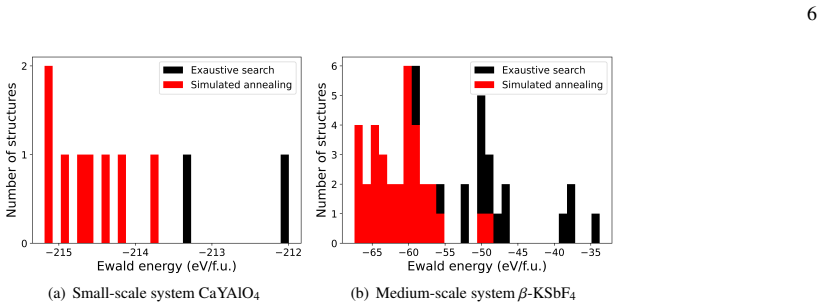
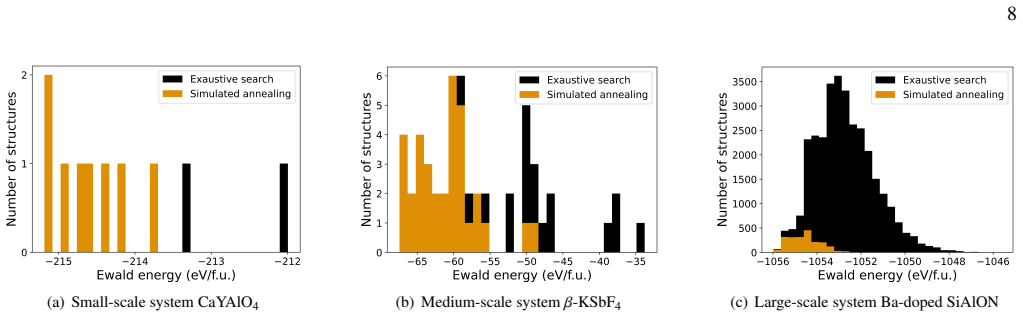
- For medium-scale systems such as β-KSbF4, simulated annealing recovers all lowest-energy structures at 200-300 times the speed of exhaustive enumeration.
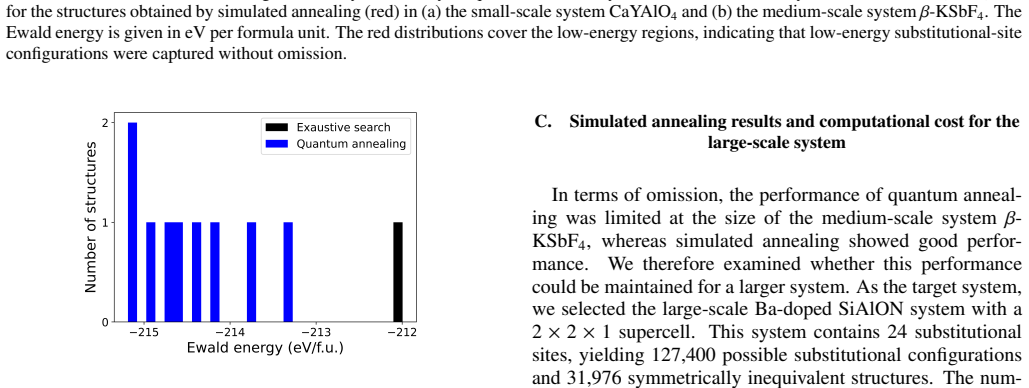
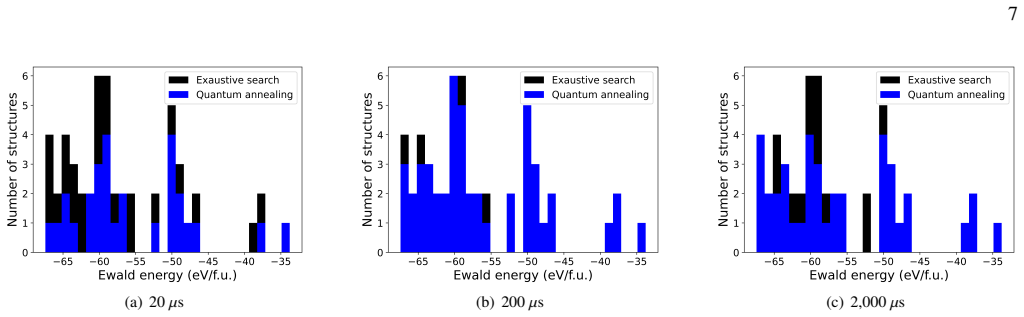
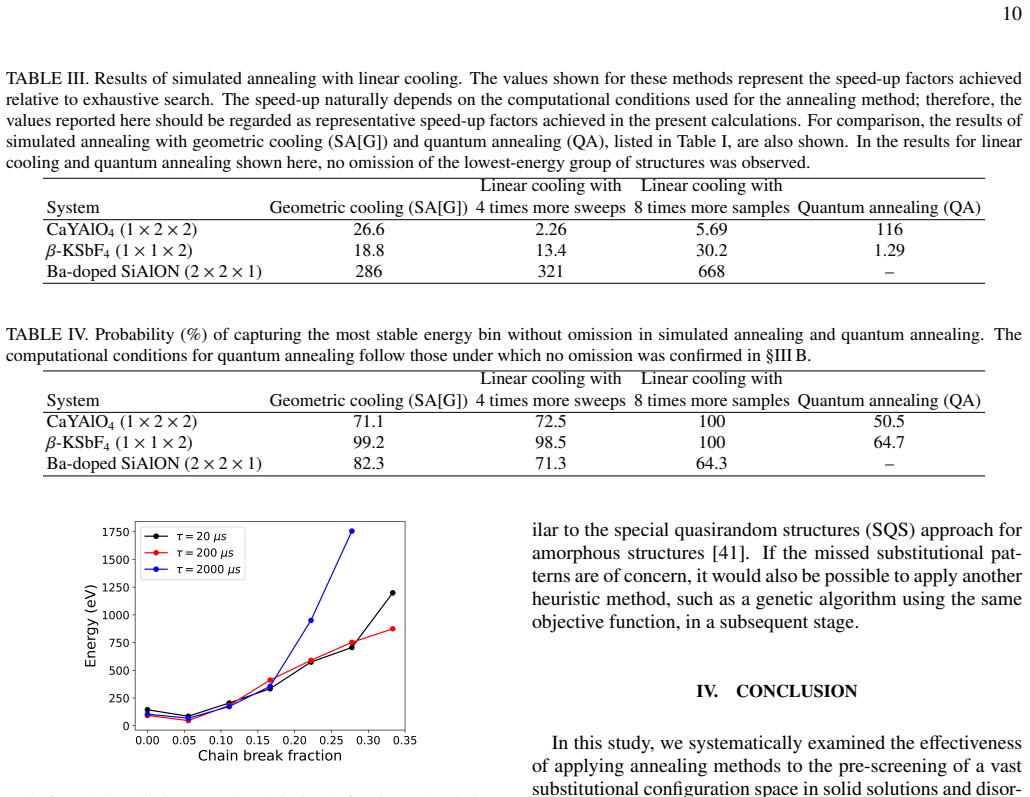
- Quantum annealing exceeds 100-fold speed-up only on the smallest test case (CaYAlO4) and begins to miss low-energy configurations at medium scale due to chain breaks.
- The formulation can be implemented automatically with publicly available libraries without manual reformulation for each new crystal system.
- The method supplies a practical filter that reduces the number of candidates passed to subsequent first-principles calculations.
Where Pith is reading between the lines
- Because the electrostatic pre-screening is cheap, it could be run on larger supercells than are feasible for full DFT relaxation, widening the configuration space that is examined.
- If the electrostatic ranking correlates with total-energy ranking across a wider range of chemistries, the same annealing pipeline could be reused as an initial step in high-throughput screening of solid solutions.
- The observed difference in robustness between simulated and quantum annealing suggests that hybrid classical-quantum workflows may be needed once quantum hardware scales to medium-sized Ising problems.
Load-bearing premise
Structures with the lowest Ewald electrostatic energy will also be lowest in total energy once kinetic, exchange-correlation, and other contributions are included.
What would settle it
A direct comparison in which a configuration with higher Ewald energy is found to have lower total DFT energy than the electrostatic minimum for the same composition and cell size.
Figures
read the original abstract
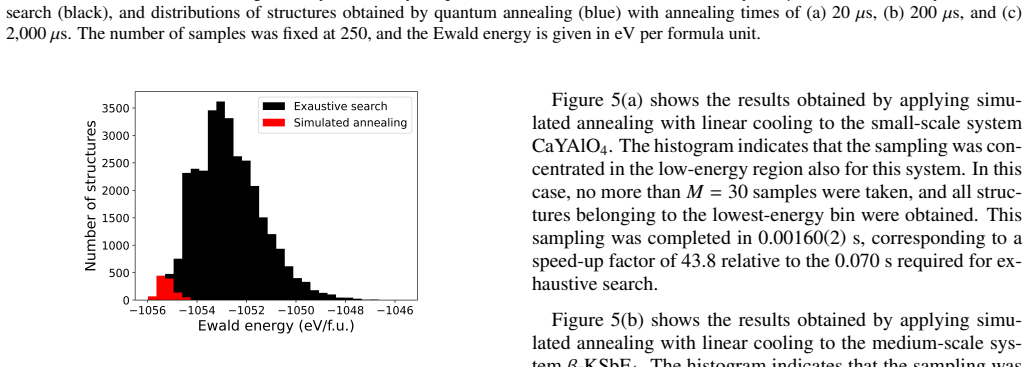
In first-principles design of solid solutions and disordered materials, exhaustive evaluation of all possible substitutional configurations is often impractical because the number of site occupations increases exponentially. Here, we develop a framework for pre-screening mixed-crystal configurations using annealing methods, where the Ewald electrostatic energy is used as the objective function. Substitutional occupations are represented by binary variables, allowing the Ewald energy to be mapped onto an Ising-type Hamiltonian and the search for low-energy configurations to be formulated as a combinatorial optimization problem. We implement this formulation using simulated annealing (SA) and quantum annealing (QA), and benchmark their performance against exhaustive search. For the small-scale system CaYAlO$_4$, SA achieved a speed-up of about 30 times, while QA achieved a speed-up of more than 100 times; both methods identified all lowest-energy configurations. For the medium-scale system $\beta$-KSbF$_4$ and the large-scale Ba-doped SiAlON system, SA achieved speed-ups of about 200-300 times while robustly identifying the lowest-energy structures. In contrast, QA was effective for the small-scale case but showed limited speed-up for medium-scale problems and missed some low-energy configurations due to chain breaks. These results indicate that SA is currently the most robust and general-purpose approach for rapid pre-screening of mixed-crystal configurations based on electrostatic energy. The proposed formulation can be implemented automatically using publicly available libraries and provides a practical route for accelerating candidate-structure generation before first-principles calculations.
Editorial analysis
A structured set of objections, weighed in public.
Referee Report
Summary. The manuscript develops a framework to pre-screen substitutional configurations in mixed crystals by minimizing the Ewald electrostatic energy using simulated annealing (SA) and quantum annealing (QA) after mapping the problem to an Ising Hamiltonian. It benchmarks both methods against exhaustive enumeration on the small CaYAlO4 system, reporting speed-ups of 30x for SA and >100x for QA while recovering all lowest-energy configurations. For the medium-scale β-KSbF4 and large-scale Ba-doped SiAlON systems, it claims SA achieves 200-300x speed-ups while robustly identifying the lowest-energy structures, whereas QA shows limitations.
Significance. If the SA method can be shown to reliably locate the global Ewald minima on larger systems, the work would provide a practical, automatable tool for accelerating candidate generation prior to DFT calculations in materials design. The direct wall-clock comparison to exhaustive search on the small system and the use of public libraries are strengths. However, the lack of verification for optimality on larger systems limits the strength of the performance claims.
major comments (2)
- [Abstract] Abstract: The statement that SA 'robustly identified the lowest-energy structures' for β-KSbF4 and Ba-doped SiAlON lacks supporting evidence such as exhaustive search (infeasible) or cross-validation with an independent global optimizer; it appears to rest on consistency of multiple SA runs, which does not establish global optimality and thus undermines the reported speed-up for locating the actual minima.
- [Results] Results (medium/large systems): Unlike the CaYAlO4 case where exhaustive search confirms recovery of all minima, no verification method or error statistics are provided for the larger systems; the performance numbers therefore cannot be interpreted as speed-ups to the true global Ewald minima.
minor comments (2)
- Clarify the precise criterion used to declare that a configuration is the 'lowest-energy structure' when exhaustive enumeration is impossible.
- The paper correctly limits its scope to Ewald pre-screening; the implicit assumption that lowest-Ewald configurations will also be lowest in total energy is presented as a practical heuristic rather than a claim requiring proof.
Simulated Author's Rebuttal
We thank the referee for the careful and constructive review. We agree that the language in the abstract and results sections regarding identification of lowest-energy structures for the larger systems overstates what the data can support, and we will revise the manuscript to qualify these claims appropriately while preserving the core contribution on the SA framework.
read point-by-point responses
-
Referee: [Abstract] Abstract: The statement that SA 'robustly identified the lowest-energy structures' for β-KSbF4 and Ba-doped SiAlON lacks supporting evidence such as exhaustive search (infeasible) or cross-validation with an independent global optimizer; it appears to rest on consistency of multiple SA runs, which does not establish global optimality and thus undermines the reported speed-up for locating the actual minima.
Authors: We agree that repeated SA runs with different random seeds, while showing consistent convergence to the same energies, do not rigorously establish global optimality. The original phrasing was based on this observed consistency for the medium- and large-scale cases. We will revise the abstract to state that SA achieves 200-300x speed-ups while consistently locating low-energy configurations (with the small-system exhaustive verification serving as the benchmark for recovery of true minima), and we will add an explicit note on the heuristic character of the method for systems where exhaustive search is impossible. revision: yes
-
Referee: [Results] Results (medium/large systems): Unlike the CaYAlO4 case where exhaustive search confirms recovery of all minima, no verification method or error statistics are provided for the larger systems; the performance numbers therefore cannot be interpreted as speed-ups to the true global Ewald minima.
Authors: We accept the point. The reported speed-ups for β-KSbF4 and Ba-doped SiAlON are computed relative to the (infeasible) exhaustive-search wall-clock time versus the time for SA to reach the lowest energies observed across our runs. We will expand the results section to report the number of independent SA runs, the observed energy variance, and a clear statement that the figures represent efficiency in locating low-energy configurations rather than proven global minima. This will align the interpretation with the available evidence. revision: yes
Circularity Check
No significant circularity detected
full rationale
The paper maps Ewald energy to an Ising Hamiltonian via standard binary substitution variables, then applies off-the-shelf SA and QA solvers; speed-ups are obtained by direct wall-clock comparison to exhaustive enumeration on the identical objective function for the small CaYAlO4 case, with larger-system timings reported without fitted parameters, self-referential predictions, or load-bearing self-citations. No step reduces by construction to its own inputs.
Axiom & Free-Parameter Ledger
axioms (1)
- domain assumption Ewald electrostatic energy alone ranks substitutional configurations in the same order as the full total energy for the purpose of pre-screening.
Reference graph
Works this paper leans on
-
[1]
Kageyama, K
H. Kageyama, K. Hayashi, K. Maeda, J. P. Attfield, Z. Hiroi, J. M. Rondinelli, and K. R. Poeppelmeier, Expanding frontiers in materials chemistry and physics with multiple anions, Nature Communications9, 772 (2018)
2018
-
[2]
Okhotnikov, T
K. Okhotnikov, T. Charpentier, and S. Cadars, Supercell pro- gram: a combinatorial structure-generation approach for the local-level modeling of atomic substitutions and partial occu- pancies in crystals, Journal of Cheminformatics8, 17 (2016)
2016
-
[3]
G. I. Prayogo, A. Tirelli, K. Utimula, K. Hongo, R. Maezono, and K. Nakano, Shry: Application of canonical augmentation to the atomic substitution problem, Journal of Chemical In- formation and Modeling62, 2909 (2022), pMID: 35678099, https://doi.org/10.1021/acs.jcim.2c00389
-
[4]
Gra ˇzulis, D
S. Gra ˇzulis, D. Chateigner, R. T. Downs, A. F. T. Yokochi, M. Quir´os, L. Lutterotti, E. Manakova, J. Butkus, P. Moeck, and A. Le Bail, Crystallography Open Database – an open-access collection of crystal structures, Journal of Applied Crystallog- raphy42, 726 (2009)
2009
-
[5]
K. Utimula, G. I. Prayogo, K. Nakano, K. Hongo, and R. Mae- zono, Stochastic estimations of the total number of classes for a clustering having extremely large samples to be included in the clustering engine, Advanced Theory and Simulations 4, 2000301 (2021),https://advanced.onlinelibrary. wiley.com/doi/pdf/10.1002/adts.202000301
-
[6]
X. Jin, S. Chen, and T. Li, Coexistence of two types of short- range order in Si–Ge–Sn medium-entropy alloys, Communica- tions Materials3, 66 (2022)
2022
-
[7]
Ichikawa, S
K. Ichikawa, S. Ohuchi, K. Ueno, and T. Yokoyama, Accel- erating optimal elemental configuration search in crystal using ising machine, Phys. Rev. Res.6, 033321 (2024)
2024
-
[8]
S.-H. Jang, R. Jalem, and Y . Tateyama, Ewaldsolidsolu- tion: A high-throughput application to quickly sample sta- ble site arrangements for ionic solid solutions, The Journal of Physical Chemistry A127, 5734 (2023), pMID: 37381735, https://doi.org/10.1021/acs.jpca.3c00076
-
[9]
C. J. Pickard, Real-space pairwise electrostatic summation in a uniform neutralizing background, Phys. Rev. Mater.2, 013806 (2018)
2018
-
[10]
M. J. Rutter, Pseudopotential contributions to the quadrupole moment in charged periodic systems, Phys. Rev. B107, 075133 (2023)
2023
-
[11]
M. G. Trefry, E. N. Maslen, and M. A. Spackman, Electrostatic, madelung and cohesive energies for solids, Journal of Physics C: Solid State Physics20, 19 (1987)
1987
-
[12]
S. P. Ong, W. D. Richards, A. Jain, G. Hautier, M. Kocher, S. Cholia, D. Gunter, V . L. Chevrier, K. A. Persson, and G. Ceder, Python materials genomics (pymatgen): A robust, open-source python library for materials analysis, Computa- tional Materials Science68, 314 (2013)
2013
-
[13]
J. D. Gale and A. L. Rohl, The general utility lat- tice program (gulp), Molecular Simulation29, 291 (2003), https://doi.org/10.1080/0892702031000104887
-
[14]
Binninger, Y .-Y
T. Binninger, Y .-Y . Ting, P. M. Kowalski, and M. H. Eiker- ling, Optimization of ionic configurations in battery materials by quantum annealing, Phys. Rev. B110, L180202 (2024). 12
2024
-
[15]
Optimization by Simulated Annealing
S. Kirkpatrick, C. D. Gelatt, and M. P. Vecchi, Opti- mization by Simulated Annealing, Science220, 671 (1983), https://www.science.org/doi/pdf/10.1126/science.220.4598.671
-
[16]
P. Song, Z. Hou, P. B. de Castro, K. Nakano, K. Hongo, Y . Takano, and R. Maezono, High-Tc Superconducting Hy- drides Formed by LaH 24 and YH 24 Cage Structures as Basic Blocks, Chemistry of Materials33, 9501 (2021)
2021
-
[17]
T. Alam, S. Qamar, A. Dixit, and M. Benaida, Genetic algo- rithm: Reviews, implementations, and applications, Interna- tional Journal of Engineering Pedagogy (iJEP)10, pp. 57–77 (2020)
2020
-
[18]
Ichibha, Y
T. Ichibha, Y . Zhang, K. Hongo, R. Maezono, and F. A. Re- boredo, Candidate structure for the H 2-PRE phase of solid hy- drogen, Phys. Rev. B104, 214111 (2021)
2021
-
[19]
Eberhart and J
R. Eberhart and J. Kennedy, A new optimizer using particle swarm theory (1995) pp. 39–43, mHS’95. Proceedings of the Sixth International Symposium on Micro Machine and Human Science
1995
-
[20]
Yoshida, R
T. Yoshida, R. Maezono, and K. Hongo, Synergy of Binary Substitutions for Improving the Cycle Performance in LiNiO 2 Revealed by Ab Initio Materials Informatics, ACS Omega5, 13403 (2020)
2020
-
[21]
Shahriari, K
B. Shahriari, K. Swersky, Z. Wang, R. P. Adams, and N. de Fre- itas, Taking the human out of the loop: A review of bayesian optimization, Proceedings of the IEEE104, 148 (2016)
2016
-
[22]
Kadowaki and H
T. Kadowaki and H. Nishimori, Quantum annealing in the trans- verse Ising model, Phys. Rev. E58, 5355 (1998)
1998
-
[23]
Shannon, R
R. Shannon, R. Oswald, J. Parise, B. Chai, P. Byszewski, A. Pa- jaczkowska, and R. Sobolewski, Dielectric constants and crys- tal structures of CaY AlO4, CaNdAlO4, and SrLaAlO4, and de- viations from the oxide additivity rule, Journal of Solid State Chemistry98, 90 (1992)
1992
-
[24]
Yamada, Y
K. Yamada, Y . Ohnuki, H. Ohki, and T. Okuda, New an- ionic conductor KSbF 4 with fluorite structure, Chemistry Let- ters28, 627 (2003), https://academic.oup.com/chemlett/article- pdf/28/7/627/56076277/cl.1999.627.pdf
2003
-
[25]
Esmaeilzadeh, J
S. Esmaeilzadeh, J. Grins, Z. Shen, M. Ed ´en, and M. Thiaux, Study of Sialon S-phases M 2AlxSi12−xN16−xO2+x, M=Ba and Ba0.9Eu0.1, by X-ray Single Crystal Diffraction, X-ray Pow- der Diffraction, and Solid-State Nuclear Magnetic Resonance, Chemistry of Materials16, 2113 (2004)
2004
-
[26]
M. Xia, Y . Zhang, M. Li, Y . Zhong, S. Gu, N. Zhou, and Z. Zhou, High thermal stability and blue-violet emitting phos- phor CaY AlO4:Ti4+ with enhanced emission by Ca2+ vacancies, Journal of Rare Earths38, 227 (2020)
2020
-
[27]
Y . Liu, Y . Wang, M. Wang, H. Shen, C. Huang, X. Wang, J. Gao, and C. Tu, Structure and spectral properties of Dy 3+ doped CaY AlO4 single crystal, Scientific Reports13, 6066 (2023)
2023
-
[28]
Hisasue, T
R. Hisasue, T. Saquai, T. Ichibha, Y . Fujii, A. Yamashita, K. Hongo, R. Maezono, K. Tadanaga, and A. Miura, Kinetic effects of ball-milling precursors on the synthesis pathway of KSbF4, Ceramics International51, 33653 (2025)
2025
-
[29]
C. Duan, W. Otten, A. Delsing, and H. Hintzen, Pho- toluminescence properties of Eu 2+-activated sialon S-phase BaAlSi5O2N7, Journal of Alloys and Compounds461, 454 (2008)
2008
-
[30]
C. C. McGeoch and P. Farr´e, The d-wave advantage system: An overview technical report (2020)
2020
-
[31]
D-Wave Systems, D-Wave Ocean SDK (2024)
2024
-
[32]
Vinci, T
W. Vinci, T. Albash, G. Paz-Silva, I. Hen, and D. A. Lidar, Quantum annealing correction with minor embedding, Phys. Rev. A92, 042310 (2015)
2015
-
[33]
Grant and T
E. Grant and T. S. Humble, Benchmarking embedded chain breaking in quantum annealing*, Quantum Science and Tech- nology7, 025029 (2022)
2022
-
[34]
C. Roch, D. Ratke, J. N ¨ußlein, T. Gabor, and S. Feld, The effect of penalty factors of constrained hamiltonians on the eigenspec- trum in quantum annealing, ACM Transactions on Quantum Computing4, 10.1145/3577202 (2023)
-
[35]
Willsch, M
D. Willsch, M. Willsch, C. D. Gonzalez Calaza, F. Jin, H. De Raedt, M. Svensson, and K. Michielsen, Benchmark- ing advantage and d-wave 2000q quantum annealers with ex- act cover problems, Quantum Information Processing21, 141 (2022)
2022
-
[36]
C. S. Pedamallu and L. Ozdamar, Investigating a hybrid simu- lated annealing and local search algorithm for constrained opti- mization, European Journal of Operational Research185, 1230 (2008)
2008
-
[37]
F. A. Quinton, P. A. S. Myhr, M. Barani, P. Crespo del Granado, and H. Zhang, Quantum annealing applications, challenges and limitations for optimisation problems compared to classical solvers, Scientific Reports15, 12733 (2025)
2025
-
[38]
Zaman, K
M. Zaman, K. Tanahashi, and S. Tanaka, Pyqubo: Python li- brary for mapping combinatorial optimization problems to qubo form, IEEE Transactions on Computers71, 838 (2022)
2022
-
[39]
K. Hukushima and K. Nemoto, Exchange monte carlo method and application to spin glass simulations, Jour- nal of the Physical Society of Japan65, 1604 (1996), https://doi.org/10.1143/JPSJ.65.1604
-
[40]
Carugno, M
C. Carugno, M. Ferrari Dacrema, and P. Cremonesi, Evaluating the job shop scheduling problem on a d-wave quantum annealer, Scientific Reports12, 6539 (2022)
2022
-
[41]
Zunger, S.-H
A. Zunger, S.-H. Wei, L. G. Ferreira, and J. E. Bernard, Special quasirandom structures, Phys. Rev. Lett.65, 353 (1990)
1990
discussion (0)
Sign in with ORCID, Apple, or X to comment. Anyone can read and Pith papers without signing in.