Geometric phases of reduced states in the transverse-field Ising chain
Pith reviewed 2026-06-30 12:56 UTC · model grok-4.3
The pith
The interferometric geometric phase from two-site reduced states of the transverse-field Ising chain marks the quantum phase transition more reliably than the Uhlmann phase.
A machine-rendered reading of the paper's core claim, the machinery that carries it, and where it could break.
Core claim
In the transverse-field Ising model, after coordinated local unitary rotations are applied to two-site reduced density matrices, the interferometric geometric phase reliably indicates the quantum phase transition across the critical point, whereas the Uhlmann phase does not.
What carries the argument
two-site reduced density matrices of the Ising chain, subjected to coordinated local unitary rotations, from which the interferometric geometric phase and Uhlmann phase are extracted
Load-bearing premise
That geometric phases computed from locally rotated two-site reduced states faithfully reflect the global quantum phase transition of the full chain.
What would settle it
A calculation on larger finite chains in which the interferometric phase fails to show any distinguishing feature exactly at the known critical field value.
Figures
read the original abstract
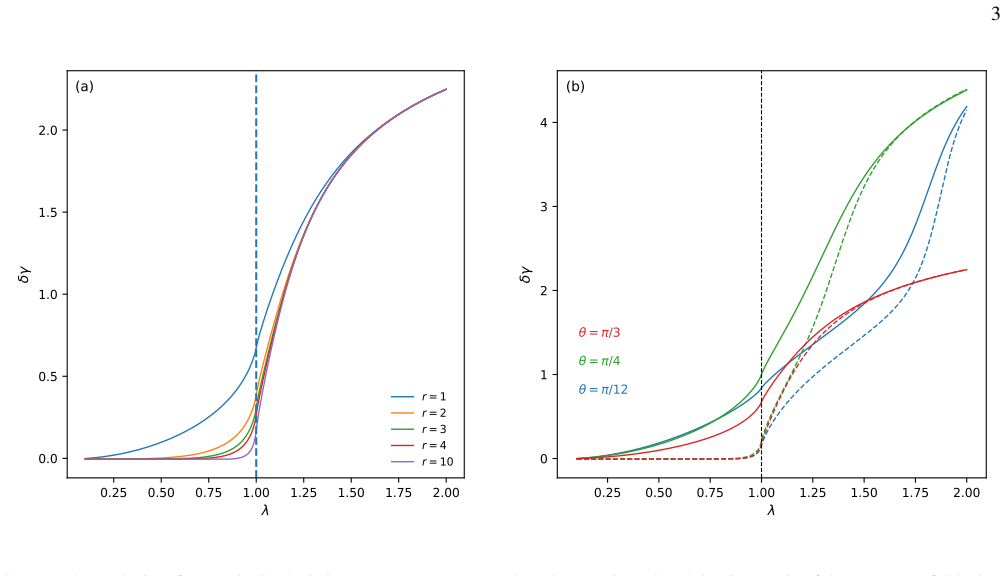
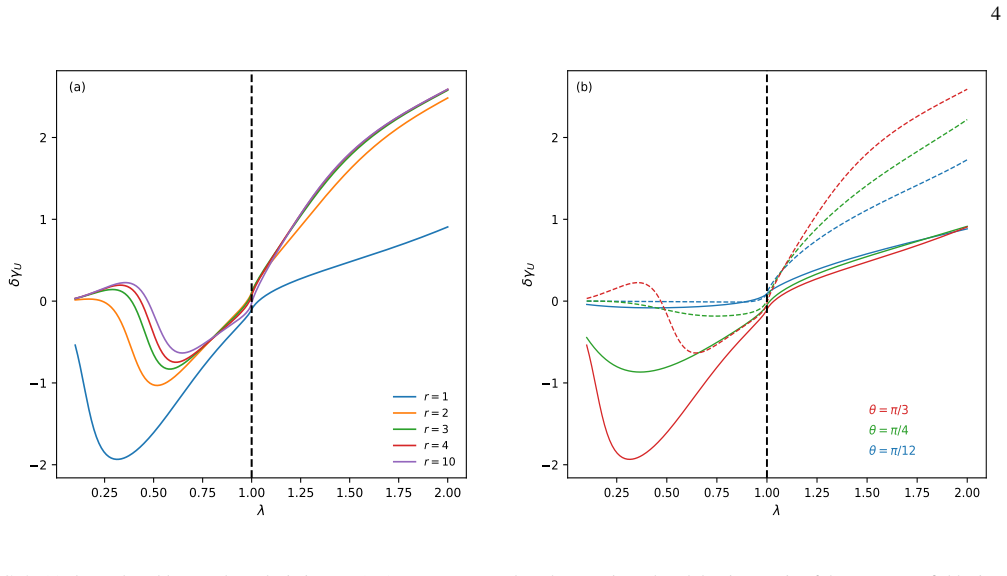
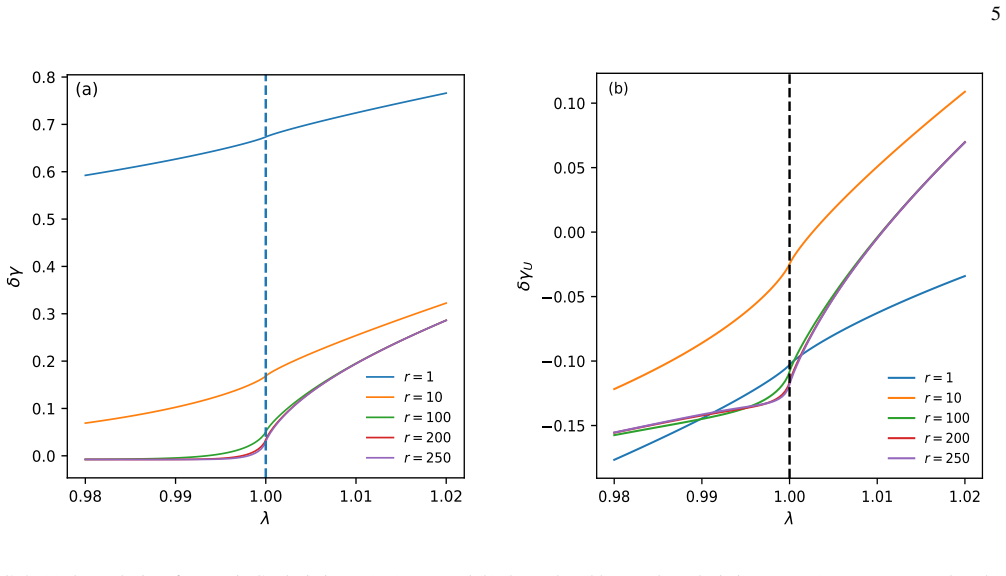
Geometric phases have been extensively investigated in a wide range of quantum systems, often revealing deep connections to the underlying topology of many-body states. In this work, we examine two geometric phases defined for mixed quantum states$-$the interferometric geometric phase and the Uhlmann phase$-$extracted from two-site reduced density matrices of the transverse-field Ising model with nearest-neighbor interacting spins. By applying coordinated local unitary rotations to the spins, we compute the geometric phases associated with the two-site states across the critical point. We find that the interferometric phase is a more reliable indicator of the quantum phase transition in this model than the Uhlmann phase.
Editorial analysis
A structured set of objections, weighed in public.
Referee Report
Summary. The manuscript computes the interferometric geometric phase and the Uhlmann phase from two-site reduced density matrices of the transverse-field Ising chain after coordinated local unitary rotations on the spins. It reports that the interferometric phase exhibits clearer signatures of the quantum phase transition at the critical point than the Uhlmann phase.
Significance. If the local phases after the chosen rotations are shown to faithfully track global observables, the result would provide a concrete example of how geometric phases of reduced states can serve as local diagnostics for quantum phase transitions in integrable spin chains, extending prior work on geometric phases in many-body systems.
major comments (2)
- [abstract, §3] The central claim that the interferometric phase is 'a more reliable indicator' of the QPT rests on the unverified assumption that coordinated local unitaries applied to two-site RDMs preserve the non-analyticities associated with the global ground-state transition (abstract and §3). No derivation or numerical test is provided showing that these phases reproduce the known divergence in the second derivative of the ground-state energy or the order-parameter jump at λ=1.
- [§4] At criticality the TFIM has power-law correlations; the manuscript does not demonstrate that the chosen local rotations commute with the global ℤ₂ symmetry or that the resulting two-site phases remain sensitive to the long-range entanglement structure rather than being artifacts of the marginalization (no section derives the fidelity between the local phase signatures and full-chain observables such as the magnetization or correlation length).
minor comments (2)
- [§2] Notation for the interferometric phase (e.g., definition of the parallel transport condition) should be stated explicitly with reference to the original literature rather than assumed.
- [Fig. 2] Figure captions should include the precise value of the transverse field at which each curve is evaluated and the system size used for the RDM extraction.
Simulated Author's Rebuttal
We thank the referee for the careful reading of our manuscript and the constructive comments. We address the two major comments point by point below, indicating where revisions will be made to strengthen the presentation.
read point-by-point responses
-
Referee: [abstract, §3] The central claim that the interferometric phase is 'a more reliable indicator' of the QPT rests on the unverified assumption that coordinated local unitaries applied to two-site RDMs preserve the non-analyticities associated with the global ground-state transition (abstract and §3). No derivation or numerical test is provided showing that these phases reproduce the known divergence in the second derivative of the ground-state energy or the order-parameter jump at λ=1.
Authors: We agree that the manuscript would benefit from an explicit link between the local geometric phases and the known non-analyticities of the global ground state. Our numerical results already indicate a sharper signature of the transition in the interferometric phase, but we did not provide a direct comparison to the second derivative of the ground-state energy or the magnetization jump. In the revised manuscript we will add a short derivation justifying why the chosen coordinated rotations preserve the critical non-analyticities together with numerical plots overlaying the phase derivatives against the energy second derivative and order parameter across λ=1. revision: yes
-
Referee: [§4] At criticality the TFIM has power-law correlations; the manuscript does not demonstrate that the chosen local rotations commute with the global ℤ₂ symmetry or that the resulting two-site phases remain sensitive to the long-range entanglement structure rather than being artifacts of the marginalization (no section derives the fidelity between the local phase signatures and full-chain observables such as the magnetization or correlation length).
Authors: The rotations are constructed to be invariant under the global ℤ₂ symmetry of the TFIM, but the manuscript indeed lacks an explicit verification of this property and of the fidelity with global observables. We will add a brief symmetry analysis of the rotations and a quantitative comparison of the interferometric-phase signatures with the magnetization and correlation length in the revised version to confirm that the local phases capture the essential critical behavior rather than marginalization artifacts. revision: yes
Circularity Check
No circularity: computations are direct and self-contained.
full rationale
The paper extracts interferometric and Uhlmann phases from two-site reduced density matrices of the transverse-field Ising chain after applying coordinated local unitaries, then compares their behavior across the critical point. No equations or claims reduce a derived quantity to a fitted parameter by construction, no self-citations are invoked as load-bearing uniqueness theorems, and the reported finding that one phase is a more reliable indicator rests on explicit numerical evaluation rather than definitional equivalence or imported ansatze. The derivation chain is therefore independent of its inputs.
Axiom & Free-Parameter Ledger
Reference graph
Works this paper leans on
-
[1]
quantum holonomy
A. Uhlmann, Parallel transport and “quantum holonomy” along density operators, Rep. Math. Phys.24, 229 (1986)
1986
-
[2]
Sj ¨oqvist, A
E. Sj ¨oqvist, A. K. Pati, A. Ekert, J. S. Anandan, M. Ericsson, D. K. L. Oi, and V . Vedral, Geometric phases for mixed states in interferometry, Phys. Rev. Lett.85, 2845 (2000)
2000
-
[3]
Bhandari, Singularities of the mixed state phase, Phys
R. Bhandari, Singularities of the mixed state phase, Phys. Rev. Lett.89, 268901 (2002)
2002
-
[4]
J. S. Anandan, E. Sj ¨oqvist, A. K. Pati, A. Ekert, M. Ericsson, D. K. L. Oi, and V . Vedral, Reply to ‘Singularities of the mixed state phase’, Phys. Rev. Lett.89, 268902 (2002)
2002
-
[5]
Filipp and E
S. Filipp and E. Sj ¨oqvist, Off-Diagonal geometric phase for mixed states, Phys. Rev. Lett.90, 050403 (2003)
2003
-
[6]
J. Du, P. Zou, M. Shi, L. C. Kwek, J.-W. Pan, C. H. Oh, A. Ekert, D. K. L. Oi, and M. Ericsson, Observation of geometric phases for mixed states using NMR interferometry, Phys. Rev. Lett.91, 100403 (2003)
2003
-
[7]
L´evay, Thomas rotation and the mixed state geometric phase, J
P. L´evay, Thomas rotation and the mixed state geometric phase, J. Phys. A: Math. Gen.37, 4593 (2004)
2004
-
[8]
Sj ¨oqvist, Quantal interferometry with dissipative internal motion, Phys
E. Sj ¨oqvist, Quantal interferometry with dissipative internal motion, Phys. Rev. A70, 052109 (2004)
2004
-
[9]
Filipp and E
S. Filipp and E. Sj ¨oqvist, Off-diagonal quantum holonomy along density operators, Phys. Lett. A342, 205 (2005)
2005
-
[10]
Ericsson, D
M. Ericsson, D. Achilles, J. T. Barreiro, D. Branning, N. A. Peters, and P. G. Kwiat, Measurement of geometric phase for mixed states using single photon interferometry, Phys. Rev. Lett.94, 050401 (2005)
2005
-
[11]
M. S. Sarandy and D. A. Lidar, Abelian and non-Abelian geo- metric phases in adiabatic open quantum systems, Phys. Rev. A 73, 062101 (2006)
2006
-
[12]
Milman, Phase dynamics of entangled qubits, Phys
P. Milman, Phase dynamics of entangled qubits, Phys. Rev. A 73, 062118 (2006)
2006
-
[13]
Klepp, S
J. Klepp, S. Sponar, S. Filipp, Matthias Lettner, G. Badurek, and Y . Hasegawa, Observation of nonadditive mixed-state phases with polarized neutrons, Phys. Rev. Lett.101, 150404 (2008)
2008
-
[14]
Mart ´ın-Mart´ınez, A
E. Mart ´ın-Mart´ınez, A. Dragan, R. B. Mann, and I. Fuentes, Berry phase quantum thermometer, New J. Phys.15, 053036 (2013)
2013
-
[15]
Viyuela, A
O. Viyuela, A. Rivas, S. Gasparinetti, A. Wallraff, S. Filipp, and M. A. Martin-Delgado, Observation of topological Uhlmann phases with superconducting qubits, npj Quantum Inf.4, 10 (2018)
2018
-
[16]
He and C.-C
Y . He and C.-C. Chien, Uhlmann holonomy against Lindblad dynamics of topological systems at finite temperatures, Phys. Rev. B106, 024310 (2022)
2022
-
[17]
F. C. Lombardo and P. I. Villar, Ergotropy from geometric phases in a dephasing qubit, Quantum Rep.8, 13 (2026). 6
2026
-
[18]
Mixed-State Topology in Non-Hermitian Systems
S.-B. Yang, P.-R. Han, W. Ning, F. Wu, Z.-B. Yang, and S.- B. Zheng, Mixed-State topology in non-Hermitian systems, arXiv:2602.10831
work page internal anchor Pith review Pith/arXiv arXiv
-
[19]
M. V . Berry, Quantal phase factors accompanying adiabatic changes, Proc. R. Soc. London, Ser. A392, 45 (1984)
1984
-
[20]
P. B. Slater, Mixed state holonomies, Lett. Math. Phys.60, 123 (2002)
2002
-
[21]
Ericsson, A
M. Ericsson, A. K. Pati, E. Sj ¨oqvist, J. Br¨annlund, and D. K. L. Oi, Mixed state geometric phases, entangled systems, and local unitary transformations, Phys. Rev. Lett.91, 090405 (2003)
2003
-
[22]
A. T. Rezakhani and P. Zanardi, General setting for a geometric phase of mixed states under an arbitrary nonunitary evolution, Phys. Rev. A73, 012107 (2006)
2006
-
[23]
J. Zhu, M. Shi, V . Vedral, X. Peng, D. Suter, and J. Du, Exper- imental demonstration of a unified framework for mixed-state geometric phases, Europhys. Lett.94, 20007 (2011)
2011
-
[24]
Andersson and H
O. Andersson and H. Heydari, A symmetry approach to geo- metric phase for quantum ensembles, J. Phys. A: Math. Theor. 48, 485302 (2015)
2015
-
[25]
A. D. Kiselev and V . V . Kesaev, Interferometric and Uhlmann phases of mixed polarization states, Phys. Rev. A98, 033816 (2018)
2018
-
[26]
A. C. M. Carollo and J. K. Pachos, Geometric phases and criticality in spin-chain systems, Phys. Rev. Lett.95, 157203 (2005)
2005
-
[27]
Zhu, Scaling of geometric phases close to the quantum phase transition in the XY spin chain, Phys
S.-L. Zhu, Scaling of geometric phases close to the quantum phase transition in the XY spin chain, Phys. Rev. Lett.96, 077206 (2006)
2006
-
[28]
Plastina, G
F. Plastina, G. Liberti, and A. Carollo, Scaling of Berry’s phase close to the Dicke quantum phase transition, Europhys. Lett. 76, 182 (2006)
2006
-
[29]
Azimi Mousolou, C
V . Azimi Mousolou, C. M. Canali, and E. Sj ¨oqvist, Unify- ing geometric entanglement and geometric phase in a quantum phase transition, Phys. Rev. A88, 012310 (2013)
2013
-
[30]
Carollo, D
A. Carollo, D. Valenti, and B. Spagnolo, Geometry of quantum phase transitions, Phys. Rep.838, 1 (2020)
2020
-
[31]
Viyuela, A
O. Viyuela, A. Rivas, and M. A. Martin-Delgado, Uhlmann phase as a topological measure for one-dimensional fermion systems, Phys. Rev. Lett.112, 130401 (2014)
2014
-
[32]
Huang and D
Z. Huang and D. P. Arovas, Topological indices for open and thermal systems via Uhlmann’s phase, Phys. Rev. Lett.113, 076407 (2014)
2014
-
[33]
J. C. Budich and S. Diehl, Topology of density matrices, Phys. Rev. B91, 165140 (2015)
2015
-
[34]
Andersson, I
O. Andersson, I. Bengtsson, M. Ericsson, and E. Sj¨oqvist, Geo- metric phases for mixed states of the Kitaev chain, Phil. Trans. R. Soc. A374, 20150231 (2016)
2016
-
[35]
T. J. Osborne and M. A. Nielsen, Entanglement in a simple quantum phase transition, Phys. Rev. A66, 032110 (2002)
2002
-
[36]
Dillenschneider, Quantum discord and quantum phase tran- sition in spin chains, Phys
R. Dillenschneider, Quantum discord and quantum phase tran- sition in spin chains, Phys. Rev. B78, 224413 (2008)
2008
-
[37]
Sult ´an Sj ¨oqvist,Entanglement in the quantum Ising chain, Bachelor thesis, Uppsala University, 2025
O. Sult ´an Sj ¨oqvist,Entanglement in the quantum Ising chain, Bachelor thesis, Uppsala University, 2025
2025
-
[38]
Sachdev,Quantum phase transitions, (Cambridge, Cam- bridge University Press, 1999)
S. Sachdev,Quantum phase transitions, (Cambridge, Cam- bridge University Press, 1999)
1999
-
[39]
M. S. Williamson and V . Vedral, Composite geometric phase for multipartite entangled states, Phys. Rev. A76, 032115 (2007)
2007
-
[40]
Pfeuty, The one-dimensional Ising model with a transverse field, Ann
P. Pfeuty, The one-dimensional Ising model with a transverse field, Ann. Phys. (N.Y .)57, 79 (1970)
1970
-
[41]
H ¨ubner, Computation of Uhlmann’s parallel transport for density matrices and the Bures metric on three-dimensional Hilbert space, Phys
M. H ¨ubner, Computation of Uhlmann’s parallel transport for density matrices and the Bures metric on three-dimensional Hilbert space, Phys. Lett. A179, 226 (1993)
1993
discussion (0)
Sign in with ORCID, Apple, or X to comment. Anyone can read and Pith papers without signing in.