Influence of quantum decoherence on the survival of quantumness in neutrino oscillations
Pith reviewed 2026-06-30 12:53 UTC · model grok-4.3
The pith
Quantum correlation measures in two-flavor neutrino oscillations respond directly to off-diagonal coherence loss under dephasing.
A machine-rendered reading of the paper's core claim, the machinery that carries it, and where it could break.
Core claim
Within the effective two-qubit description, a dephasing channel suppresses off-diagonal coherence and thereby reduces entanglement of formation, quantum discord, and local quantum uncertainty; quantum discord remains a broader witness that survives where entanglement is already weak, while for pure states local quantum uncertainty equals the square of concurrence and therefore tracks entanglement monotonically.
What carries the argument
Effective two-qubit mapping of neutrino flavor states together with the dephasing channel that damps off-diagonal coherence terms while leaving diagonal populations unchanged.
If this is right
- In the unitary regime all three measures oscillate with amplitudes controlled by the mixing angle, largest for MINOS parameters.
- Under dephasing the quantifiers decrease monotonically with increasing decoherence strength.
- Quantum discord remains positive in parameter regions where entanglement of formation has dropped to zero.
- Local quantum uncertainty equals concurrence squared for pure states and therefore follows entanglement exactly.
- The measures exhibit quantifiable sensitivity to both oscillation parameters and the decoherence rate.
Where Pith is reading between the lines
- The same observables could be extracted from long-baseline or reactor data to place bounds on environmental decoherence strength.
- Extension to the three-flavor case would introduce additional cross terms whose survival under dephasing could distinguish mass-ordering scenarios.
- Comparison with amplitude-damping or depolarizing channels would test whether the observed damping is specifically dephasing-like.
Load-bearing premise
The effective two-qubit mapping together with the chosen dephasing channel accurately captures the dominant decoherence physics of real neutrino propagation without significant contributions from other environmental channels or higher-dimensional effects.
What would settle it
Measurement of neutrino oscillation data in which the extracted quantum discord or entanglement values fail to decrease when the estimated decoherence strength is increased, or fail to follow the predicted dependence on the experimental mixing angles.
Figures
read the original abstract
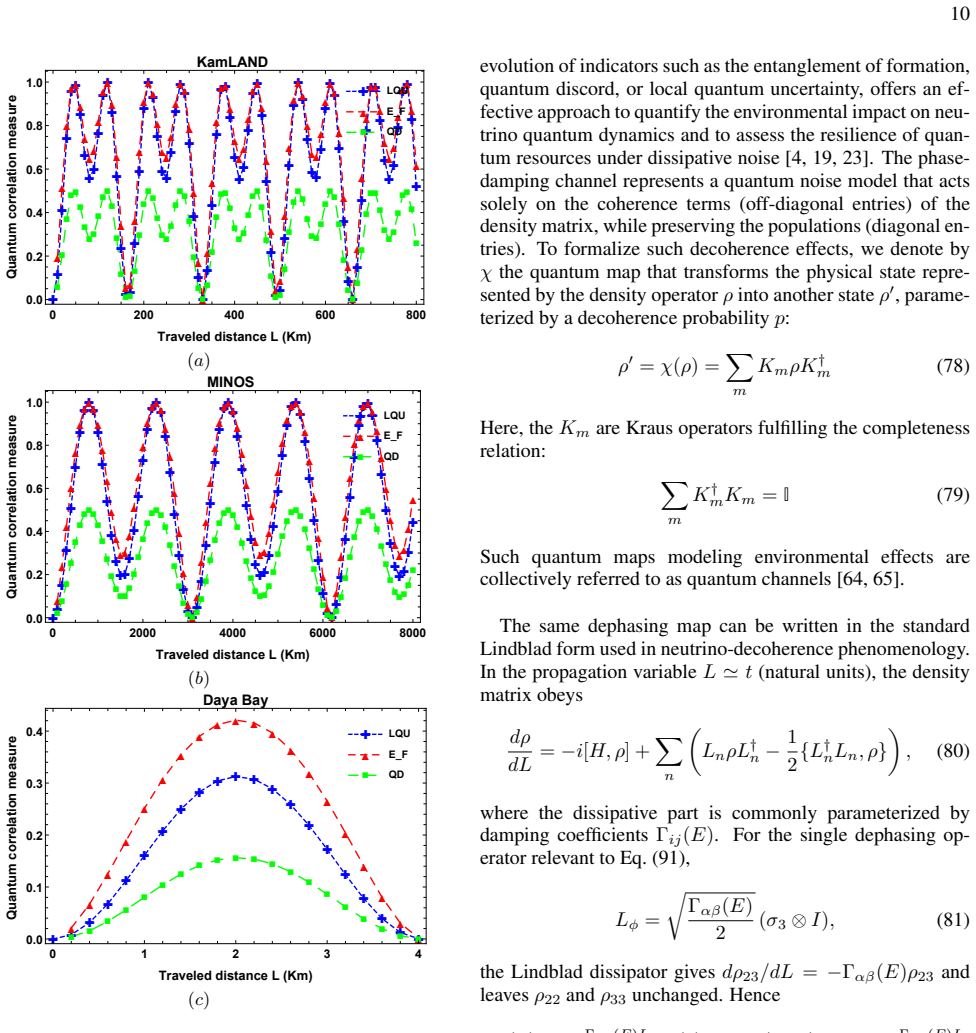
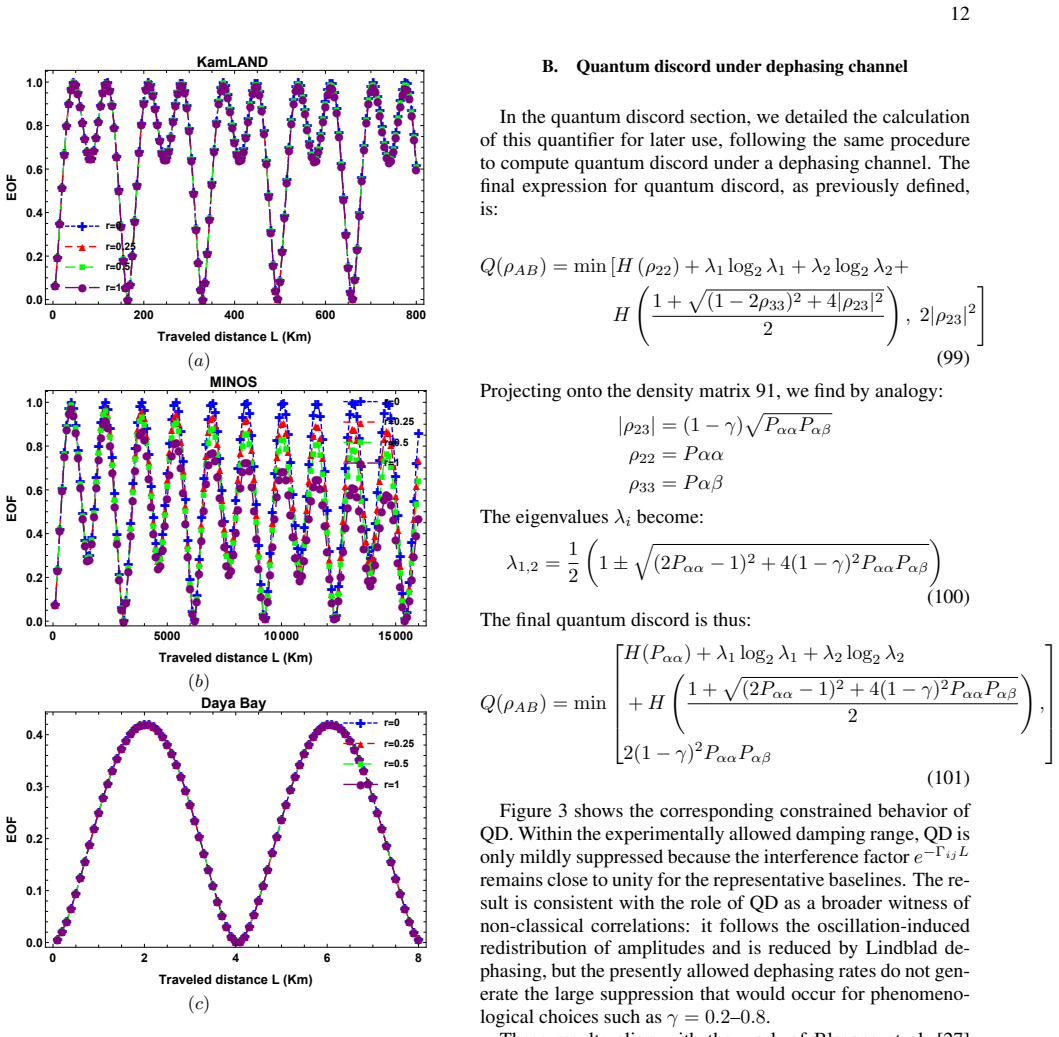
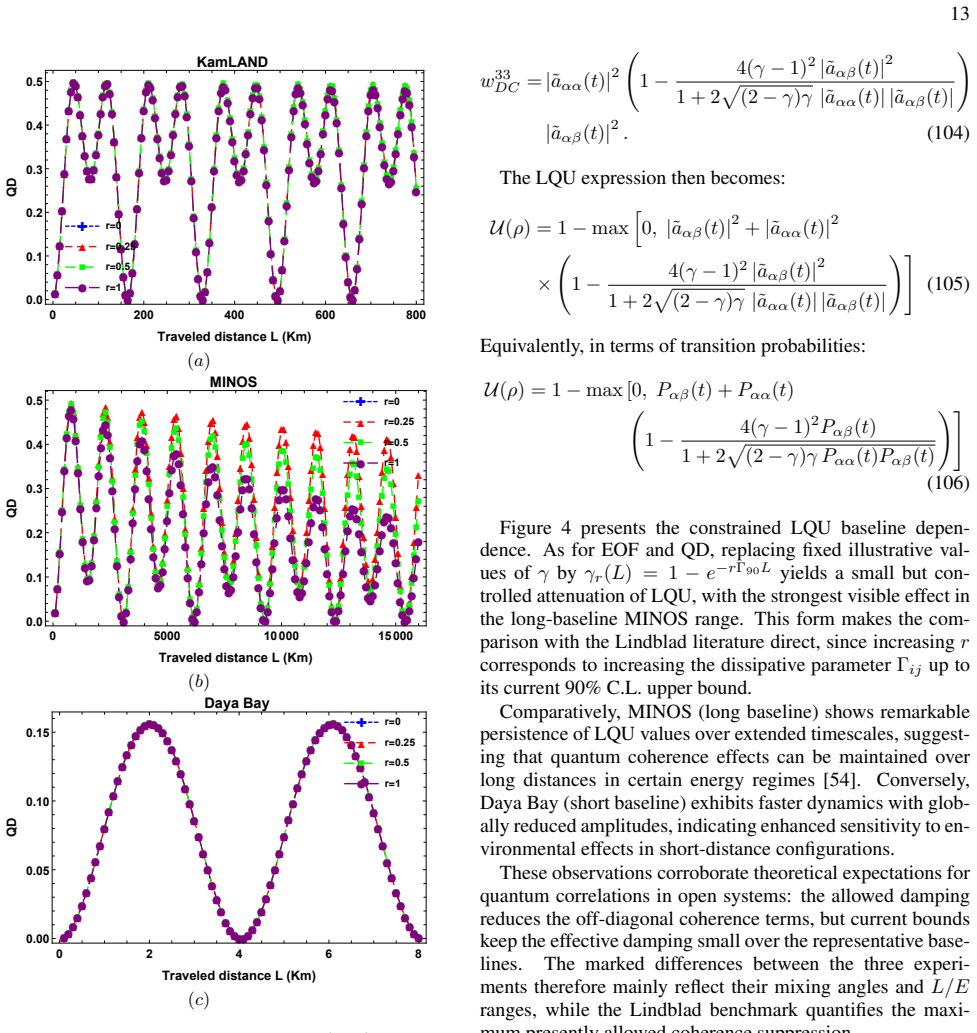
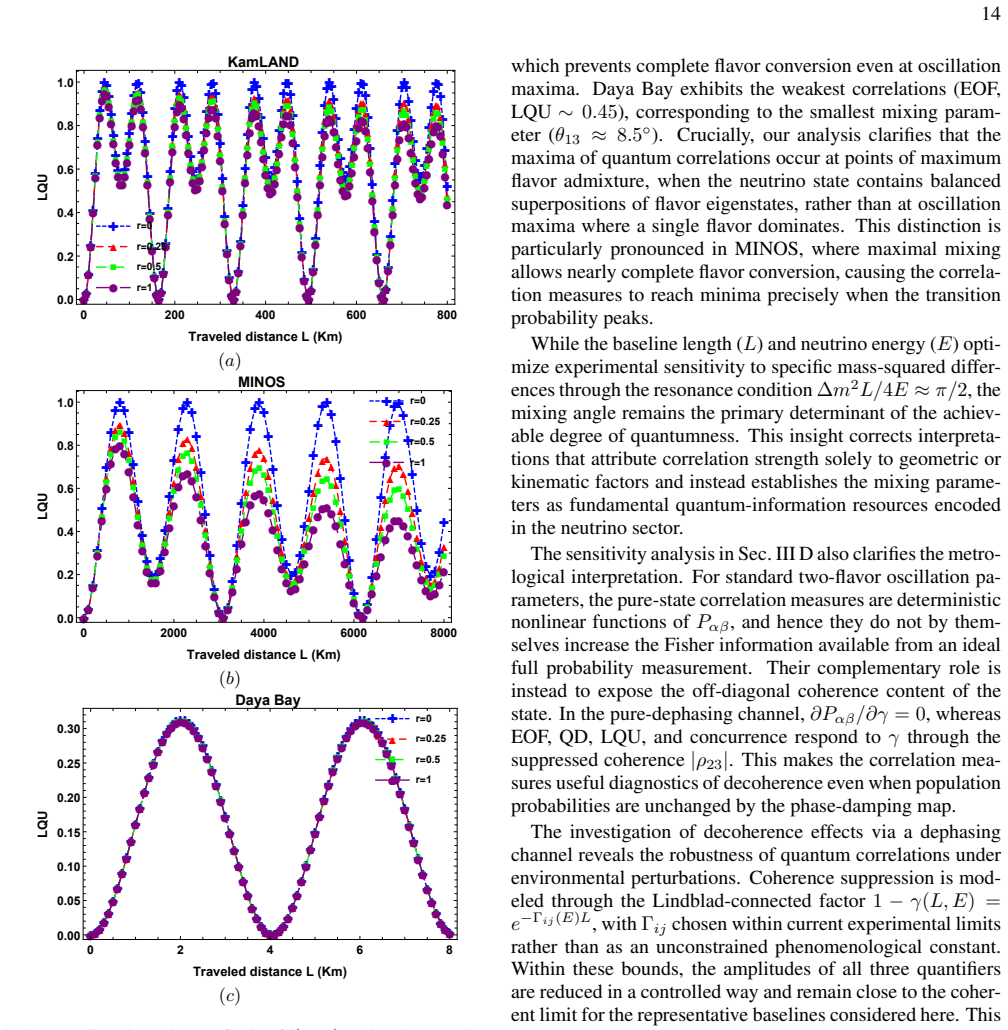
This study examines the dynamics of quantumness in two-flavor neutrino oscillations subjected to a dephasing channel, using representative oscillation parameters associated with the KamLAND, MINOS, and Daya Bay experiments. We analyze three complementary quantum-correlation measures -- entanglement of formation (EOF), quantum discord (QD), and local quantum uncertainty (LQU) -- within an effective two-qubit description. In the unitary case, all three measures display oscillatory behavior controlled by flavor mixing, and their amplitudes are strongly shaped by the relevant mixing angle. MINOS exhibits the largest correlations because $\theta_{23}$ is close to maximal, KamLAND shows intermediate values associated with the solar sector, and Daya Bay yields smaller correlations due to the relatively small value of $\theta_{13}$. Under dephasing, the off-diagonal coherence terms are suppressed and the three quantifiers decrease accordingly, while QD remains non-zero in regimes where entanglement is weak. For pure states, LQU satisfies $\mathcal{U}=\mathcal{C}^2$ and therefore tracks entanglement monotonically, whereas QD provides a broader witness of non-classical correlations. These results provide a compact quantum-information description of two-flavor neutrino oscillations in both coherent and dephased regimes. We also quantify the sensitivity of these observables to oscillation and decoherence parameters, showing that their main added value relative to flavor probabilities is their direct response to off-diagonal coherence loss.
Editorial analysis
A structured set of objections, weighed in public.
Referee Report
Summary. The paper studies the dynamics of quantum correlations in two-flavor neutrino oscillations under a dephasing channel, employing an effective two-qubit mapping and representative parameters from the KamLAND, MINOS, and Daya Bay experiments. It computes entanglement of formation (EOF), quantum discord (QD), and local quantum uncertainty (LQU), reporting oscillatory behavior in the unitary regime (with amplitudes set by the mixing angles) that is suppressed by dephasing while QD remains nonzero in regimes of weak entanglement; the central added value claimed is the direct sensitivity of these measures to off-diagonal coherence loss relative to flavor probabilities.
Significance. If the effective model is accepted on its own terms, the work supplies a compact quantum-information characterization of coherence loss in neutrino oscillations. The ordering of correlation strengths across the three experiments follows directly from the known mixing angles, and the persistence of QD under dephasing is a standard feature of the chosen quantifiers once the density matrix is written in the flavor basis. The study does not claim that dephasing dominates real propagation, limiting its immediate phenomenological reach but preserving internal consistency as a model investigation.
minor comments (3)
- [Abstract] The abstract and introduction refer to 'representative oscillation parameters' for the three experiments but do not list the numerical values of Δm^{2} and heta used in the plots; adding an explicit table or reference to the precise inputs would improve reproducibility.
- [Methods] Section describing the dephasing channel (presumably §3) should state the explicit Kraus operators or Lindblad form employed, together with the range of the single free parameter (dephasing strength) scanned in the figures.
- [Results] The statement that 'LQU satisfies U = C^{2} for pure states' is correct by definition but would benefit from a one-line reminder of the relevant formula (e.g., Eq. (X)) to avoid any ambiguity for readers unfamiliar with the LQU literature.
Simulated Author's Rebuttal
We thank the referee for the positive evaluation of our manuscript and for recommending minor revision. No specific major comments were listed in the report.
Circularity Check
No significant circularity; derivation self-contained
full rationale
The paper constructs an effective two-qubit density matrix from externally tabulated oscillation parameters (KamLAND, MINOS, Daya Bay) and applies standard textbook quantifiers EOF, QD and LQU under a chosen dephasing channel. The claimed sensitivity of these measures to off-diagonal coherence loss follows immediately from their definitions once the flavor-basis matrix is written; no parameter is fitted to the reported results, no uniqueness theorem is invoked via self-citation, and the model study makes no claim that the chosen channel is the dominant physical mechanism. All load-bearing steps remain independent of the paper's own outputs.
Axiom & Free-Parameter Ledger
free parameters (1)
- dephasing strength
axioms (2)
- domain assumption Neutrino flavor oscillations admit an effective two-qubit description
- domain assumption A Markovian dephasing channel adequately represents environmental decoherence for the oscillation lengths considered
Forward citations
Cited by 1 Pith paper
-
Quantum Information as a New Lens for Precision Neutrino Physics
Concurrence minima in neutrino oscillations identify low-entanglement energy regions that, when aligned with NOνA and T2K data, yield tighter joint constraints on sin²θ₂₃, δ_CP, and Δm²₃₁.
Reference graph
Works this paper leans on
-
[1]
for∆m 2 32 andθ 23 constraints via acceleratorν µ dis- appearance. Each experiment probes distinct aspects of the oscillation parameter space, enabling a comprehensive quan- tum information-theoretic analysis across complementary energy and baseline regimes [4, 6]. The KamLAND experiment, an intermediate-distance an- tineutrino disappearance study, analyz...
2000
-
[2]
Pontecorvo,Mesonium and anti-mesonium, Sov
B. Pontecorvo,Mesonium and anti-mesonium, Sov. Phys. JETP 6, 429 (1957)
1957
-
[3]
Pontecorvo,Inverse beta processes and nonconservation of lepton charge, Sov
B. Pontecorvo,Inverse beta processes and nonconservation of lepton charge, Sov. Phys. JETP7, 172 (1958)
1958
-
[4]
Z. Maki, M. Nakagawa, S. Sakata,Remarks on the unified model of elementary particles, Prog. Theor. Phys.28, 870 (1962)
1962
-
[5]
S. M. Bilenky,Introduction to the Physics of Massive and Mixed Neutrinos, Springer (2010)
2010
-
[6]
Tanabashiet al.(Particle Data Group),Review of Particle Physics, Phys
M. Tanabashiet al.(Particle Data Group),Review of Particle Physics, Phys. Rev. D98, 030001 (2018)
2018
-
[7]
Giunti, C
C. Giunti, C. W. Kim,Fundamentals of Neutrino Physics and Astrophysics, Oxford University Press (2007)
2007
-
[8]
Q. R. Ahmadet al.(SNO Collaboration),Direct Evidence for Neutrino Flavor Transformation from Neutral-Current Interac- tions in the Sudbury Neutrino Observatory, Phys. Rev. Lett.89, 011301 (2002)
2002
-
[9]
B. T. Clevelandet al.,Measurement of the Solar Neutrino Flux with the Homestake Chlorine Detector, Astrophys. J.496, 505 (1998)
1998
-
[10]
Fukudaet al.(Super-Kamiokande Collaboration),Evidence for Oscillation of Atmospheric Neutrinos, Phys
Y . Fukudaet al.(Super-Kamiokande Collaboration),Evidence for Oscillation of Atmospheric Neutrinos, Phys. Rev. Lett.81, 1562 (1998)
1998
-
[11]
Eguchiet al.(KamLAND Collaboration),First results from KamLAND: Evidence for reactor anti-neutrino disappearance, Phys
K. Eguchiet al.(KamLAND Collaboration),First results from KamLAND: Evidence for reactor anti-neutrino disappearance, Phys. Rev. Lett.90, 021802 (2003)
2003
-
[12]
Adamsonet al.(MINOS Collaboration),Measurement of Neutrino Oscillations with the MINOS Detectors in the NuMI Beam, Phys
P. Adamsonet al.(MINOS Collaboration),Measurement of Neutrino Oscillations with the MINOS Detectors in the NuMI Beam, Phys. Rev. Lett.101, 131802 (2008)
2008
-
[13]
Abeet al.(T2K Collaboration),Observation of Electron Neutrino Appearance in a Muon Neutrino Beam, Phys
K. Abeet al.(T2K Collaboration),Observation of Electron Neutrino Appearance in a Muon Neutrino Beam, Phys. Rev. Lett.107, 041801 (2011)
2011
-
[14]
Einstein, B
A. Einstein, B. Podolsky, N. Rosen,Can quantum-mechanical description of physical reality be considered complete?, Phys. Rev.47, 777 (1935)
1935
-
[15]
J. S. Bell,On the Einstein-Podolsky-Rosen paradox, Physics1, 195 (1964)
1964
-
[16]
Ollivier, W
H. Ollivier, W. H. Zurek,Quantum discord: A measure of the quantumness of correlations, Phys. Rev. Lett.88, 017901 (2001)
2001
-
[17]
Henderson, V
L. Henderson, V . Vedral,Classical, quantum and total correla- tions, J. Phys. A34, 6899 (2001)
2001
-
[18]
Giorda and M
P. Giorda and M. G. A. Paris,Gaussian quantum discord, Phys. Rev. Lett.105, 020503 (2010)
2010
-
[19]
K. Modi, A. Brodutch, H. Cable, T. Paterek, V . Vedral,The classical-quantum boundary for correlations, Rev. Mod. Phys. 84, 1655 (2012)
2012
-
[20]
Girolami, T
D. Girolami, T. Tufarelli, G. Adesso,Characterizing nonclassi- cal correlations via local quantum uncertainty, Phys. Rev. Lett. 110, 240402 (2013)
2013
-
[21]
C. H. Bennett, D. P. DiVincenzo, J. A. Smolin, and W. K. Woot- ters,Mixed-state entanglement and quantum error correction, Phys. Rev. A54, 3824–3851 (1996)
1996
-
[22]
W. K. Wootters,Entanglement of Formation of an Arbitrary Mixed State of Two Qubits, Phys. Rev. Lett.80, 2245 (1998)
1998
-
[23]
M. B. Plenio and S. Virmani,An introduction to entanglement measures, Quantum Inf. Comput.7, 1–51 (2007)
2007
-
[24]
Blasone, F
M. Blasone, F. Dell’Anno, S. De Siena, F. Illuminati,Entan- glement in neutrino oscillations, EPL85, 50002 (2009)
2009
-
[25]
Banerjee, A
S. Banerjee, A. K. Alok, R. MacKenzie,Quantum correlations in neutrino oscillations in curved spacetime, Eur. Phys. J. Plus 130, 164 (2015)
2015
-
[26]
A. K. Alok, S. Banerjee, and S. Uma Sankar,Quantum correla- tions in terms of neutrino oscillation probabilities, Nucl. Phys. B909, 65–72 (2016)
2016
-
[27]
Dixit, J
K. Dixit, J. Naikoo, S. Banerjee, and A. K. Alok,Quantum correlations and the neutrino mass degeneracy problem, Eur. Phys. J. C78, 914 (2018)
2018
-
[28]
Blasone, A
M. Blasone, A. Capolupo, C.-R. Ji, and G. Vitiello,Neutrino Mixing and Oscillations in Quantum Field Theory, Int. J. Mod. 16 Phys. A23, 4845 (2008)
2008
-
[29]
Blasone, F
M. Blasone, F. Dell’Anno, S. De Siena, F. Illuminati,Multi- partite entangled states in particle mixing, Phys. Rev. D83, 093018 (2011)
2011
-
[30]
Blennow, E
M. Blennow, E. Fern ´andez-Mart´ınez, and J. Men´endez,Entan- glement of neutrino states in quantum field theory, Phys. Rev. D82, 093002 (2010)
2010
-
[31]
Wang,Quantum Discord in Neutrino Oscillations, Phys
X. Wang,Quantum Discord in Neutrino Oscillations, Phys. Rev. D93, 053003 (2016)
2016
-
[32]
Gandoet al.(KamLAND),Reactor On-Off Antineutrino Measurement with KamLAND, Phys
A. Gandoet al.(KamLAND),Reactor On-Off Antineutrino Measurement with KamLAND, Phys. Rev. D88, 033001 (2013)
2013
-
[33]
Estebanet al.,The fate of hints: updated global analysis of three-flavor neutrino oscillations, JHEP09, 178 (2020)
I. Estebanet al.,The fate of hints: updated global analysis of three-flavor neutrino oscillations, JHEP09, 178 (2020)
2020
-
[34]
Abeet al.(KamLAND),Precision measurement of neu- trino oscillation parameters with KamLAND, JHEP2021, 035 (2021)
S. Abeet al.(KamLAND),Precision measurement of neu- trino oscillation parameters with KamLAND, JHEP2021, 035 (2021)
2021
-
[35]
Abeet al.(KamLAND Collaboration),Precision Mea- surement of Neutrino Oscillation Parameters with KamLAND, Phys
S. Abeet al.(KamLAND Collaboration),Precision Mea- surement of Neutrino Oscillation Parameters with KamLAND, Phys. Rev. Lett.100, 221803 (2008)
2008
-
[36]
J. K. de Jonget al.(MINOS Collaboration),Near-to-Final MI- NOS Oscillation Results, Nucl. Phys. B Proc. Suppl.237, 166– 169 (2013)
2013
-
[37]
Adamsonet al.(MINOS),Measurement of Neutrino Oscilla- tions with the MINOS Detectors in the NuMI Beam, Phys
P. Adamsonet al.(MINOS),Measurement of Neutrino Oscilla- tions with the MINOS Detectors in the NuMI Beam, Phys. Rev. D73, 072002 (2006)
2006
-
[38]
Adamsonet al.(MINOS+),Combined Analysis ofν µ Disap- pearance andν µ →ν e Appearance in MINOS Using Acceler- ator and Atmospheric Neutrinos, Phys
P. Adamsonet al.(MINOS+),Combined Analysis ofν µ Disap- pearance andν µ →ν e Appearance in MINOS Using Acceler- ator and Atmospheric Neutrinos, Phys. Rev. Lett.110, 251801 (2013)
2013
-
[39]
Anet al.(Daya Bay),Observation of electron-antineutrino disappearance at Daya Bay, Phys
J. Anet al.(Daya Bay),Observation of electron-antineutrino disappearance at Daya Bay, Phys. Rev. Lett.108, 171803 (2012)
2012
-
[40]
F. P. Anet al.(Daya Bay),Measurement of electron antineu- trino oscillation based on 1230 days of operation at Daya Bay, Phys. Rev. Lett.121, 241805 (2018)
2018
-
[41]
F. P. Anet al.(Daya Bay Collaboration),Improved Measure- ment of the Reactor Antineutrino Flux and Spectrum at Daya Bay, Chin. Phys. C41, 013002 (2017)
2017
-
[42]
D. M. Webberet al.(Daya Bay Collaboration),An improved measurement of electron antineutrino disappearance at Daya Bay, Nucl. Phys. B Proc. Suppl.233, 96–101 (2012)
2012
-
[43]
M. A. Nielsen and I. L. Chuang,Quantum Computation and Quantum Information, Cambridge University Press (2010)
2010
-
[44]
Breuer and F
H.-P. Breuer and F. Petruccione,The Theory of Open Quantum Systems, Oxford University Press (2002)
2002
-
[45]
Naimy, A
A. Naimy, A. Slaoui, A. Ali, H. El Hadfi, R. A. Laamara, and S. Al-Kuwari,Dynamic evolution of quantum Fisher and skew information under decoherence in three-qubit X-states, Phys. Lett. A547, 130536 (2025)
2025
-
[46]
Dakir, A
Y . Dakir, A. Slaoui, A. B. A. Mohamedet al.,Quantum tele- portation and dynamics of quantum coherence and metrologi- cal non-classical correlations for open two-qubit systems, Sci. Rep.13, 20526 (2023)
2023
-
[47]
Giovannetti, S
V . Giovannetti, S. Lloyd, and L. Maccone,Advances in quan- tum metrology, Nature Photonics5, 222–229 (2011)
2011
-
[48]
Pezz `e, A
L. Pezz `e, A. Smerzi, M. K. Oberthaler, R. Schmied, and P. Treutlein,Quantum metrology with nonclassical states of atomic ensembles, Rev. Mod. Phys.90, 035005 (2018)
2018
-
[49]
K. El Bouzaidi, A. Slaoui, L. B. Drissi, E. H. Saidi, and R. A. Laamara,Dynamics of quantum information resources in two- flavor neutrino oscillations, Eur. Phys. J. C85, 1349 (2025), doi:10.1140/epjc/s10052-025-15083-z
-
[50]
Quantum Estimation Theory Limits in Neutrino Oscillation Experiments,
C. Frugiuele, M. G. Genoni, M. Ignoti, and M. G. A. Paris, “Quantum Estimation Theory Limits in Neutrino Oscillation Experiments,” arXiv:2602.16534 [hep-ph] (2026)
-
[51]
El Bakraoui, A
M. El Bakraoui, A. Slaoui, H. El Hadfi, and M. Daoud,En- hancing the estimation precision of an unknown phase shift in multipartite Glauber coherent states via skew information cor- relations and local quantum Fisher information, J. Opt. Soc. Am. B39, 1297–1306 (2022)
2022
-
[52]
Capozziet al.,Status of three-neutrino oscillation parame- ters, Nucl
F. Capozziet al.,Status of three-neutrino oscillation parame- ters, Nucl. Phys. B908, 218–234 (2016)
2016
-
[53]
Guoet al.,Precision Measurement of Reactor Antineutrino Oscillation at Kilometer-Scale Baselines, Phys
X. Guoet al.,Precision Measurement of Reactor Antineutrino Oscillation at Kilometer-Scale Baselines, Phys. Rev. Lett.125, 111801 (2020)
2020
-
[54]
Ahmedet al.,Experimental Constraints onν e Disappear- ance with Low-Energy Neutrinos, J
S. Ahmedet al.,Experimental Constraints onν e Disappear- ance with Low-Energy Neutrinos, J. High Energy Phys.2015, 030 (2015)
2015
-
[55]
Blasone, F
M. Blasone, F. Dell’Anno, S. De Siena, and F. Illuminati,En- tanglement in Neutrino Oscillations, EPL106, 30002 (2014)
2014
-
[56]
M. Ali, A. R. P. Rau, and G. Alber,Quantum Discord for Two- Qubit X States, Phys. Rev. A81, 042105 (2010)
2010
-
[57]
C. Z. Wang, C. X. Li, L. Y . Nie, and J. F. Li,Classical Correla- tion and Quantum Discord Mediated by Cavity in Two Coupled Qubits, Phys. Rev. A90, 032323 (2014)
2014
-
[58]
Luo,Quantum Discord for Two-Qubit Systems, Phys
S. Luo,Quantum Discord for Two-Qubit Systems, Phys. Rev. A77, 042303 (2008)
2008
-
[59]
Daki ´c, V
B. Daki ´c, V . Vedral, andˇC. Brukner,Necessary and Sufficient Condition for Nonzero Quantum Discord, Nat. Phys.6, 666– 669 (2010)
2010
-
[60]
E. P. Wigner, M. M. Yanase,On the Structure of the Quantum Mechanical Density Matrix, Proc. Natl. Acad. Sci. U.S.A.49, 910 (1963)
1963
-
[61]
W. H. Zurek,Decoherence, einselection, and the quantum ori- gins of the classical, Rev. Mod. Phys.75, 715–775 (2003)
2003
-
[62]
F. M. Paula, I. A. Silva, J. D. Montealegre, T. R. de Oliveira, and M. S. Sarandy,Geometric Local Quantum Uncertainty, Phys. Rev. Lett.111, 250401 (2013)
2013
-
[63]
Alicki and M
R. Alicki and M. Fannes,Quantum Correlations in the Multi- Partite Setting, Quantum Inf. Comput.8, 208–218 (2008)
2008
-
[64]
Adesso, T
G. Adesso, T. R. Bromley, and M. Cianciaruso,Measures and applications of quantum correlations, J. Phys. A: Math. Theor. 49, 473001 (2016)
2016
-
[65]
Lloyd,Measures of the quantumness of correlations, Phys
S. Lloyd,Measures of the quantumness of correlations, Phys. Rev. A55, 1613 (1997)
1997
-
[66]
Devetak and P
I. Devetak and P. W. Shor,Classical and quantum information theoretic measures of correlations, Commun. Math. Phys.256, 287–303 (2005)
2005
-
[67]
Slaoui, B
A. Slaoui, B. Amghar, and R. Ahl Laamara,Interferomet- ric phase estimation and quantum resource dynamics in Bell coherent-state superpositions generated via a unitary beam splitter, J. Opt. Soc. Am. B40, 2013–2027 (2023)
2013
-
[68]
J. P. Paz and W. H. Zurek,Quantum discord and quantum de- coherence, Phys. Rev. Lett.82, 5181 (1999)
1999
-
[69]
Joos and H
E. Joos and H. D. Zeh,The emergence of classical properties from quantum systems, Z. Phys. B59, 223–243 (1985)
1985
-
[70]
Gaidiet al.,Effects of DM and KSEA interactions on entan- glement, Fisher and Wigner–Yanase information correlations of two XYZ-Heisenberg-qubit states under a magnetic field, Phys
S. Gaidiet al.,Effects of DM and KSEA interactions on entan- glement, Fisher and Wigner–Yanase information correlations of two XYZ-Heisenberg-qubit states under a magnetic field, Phys. Scr.99, 115115 (2024)
2024
-
[71]
F. N. Loreti and A. B. Balantekin,Neutrino oscillations in noisy media, Phys. Rev. D50, 4762 (1994)
1994
-
[72]
C. P. Burgess and D. Michaud,Neutrino propagation in a fluc- tuating sun, Annals Phys.256, 1 (1997)
1997
-
[73]
Benatti and R
F. Benatti and R. Floreanini,Dissipative neutrino oscillations in randomly fluctuating matter, Phys. Rev. D71, 013003 (2005)
2005
-
[74]
Lichkunov, K
A. Lichkunov, K. Stankevich, and A. Studenikin,Neutrino 17 quantum decoherence in a fluctuating ALPs field, Phys. Rev. D112, 123007 (2025)
2025
-
[75]
Dvornikov,Interaction of supernova neutrinos with stochas- tic gravitational waves, Phys
M. Dvornikov,Interaction of supernova neutrinos with stochas- tic gravitational waves, Phys. Rev. D104, 043018 (2021)
2021
-
[76]
J. F. Nieves and S. Sahu,Neutrino decoherence in an electron and nucleon background, Phys. Rev. D102, 056007 (2020)
2020
-
[77]
J. F. Nieves and S. Sahu,Neutrino decoherence in a fermion and scalar background, Phys. Rev. D100, 115049 (2019)
2019
-
[78]
Stankevich, A
K. Stankevich, A. Studenikin, and M. Vyalkov,Generalized Lindblad master equation for neutrino evolution, Phys. Rev. D 111, 036014 (2025)
2025
-
[79]
Stankevich and A
K. Stankevich and A. Studenikin,Neutrino quantum decoher- ence engendered by neutrino radiative decay, Phys. Rev. D101, 056004 (2020)
2020
-
[80]
Balieiro Gomes, M
G. Balieiro Gomes, M. M. Guzzo, P. C. de Holanda, and R. L. N. Oliveira,Parameter limits for neutrino oscillation with decoherence in KamLAND, Phys. Rev. D95, 113005 (2017)
2017
discussion (0)
Sign in with ORCID, Apple, or X to comment. Anyone can read and Pith papers without signing in.