A contaminant-concentration-dependent surface tension does not explain the absence of solutal Marangoni flow in evaporating droplets
Pith reviewed 2026-06-30 12:05 UTC · model grok-4.3
The pith
Contaminants cannot explain absent Marangoni flows via a concentration-dependent surface tension in evaporating droplets.
A machine-rendered reading of the paper's core claim, the machinery that carries it, and where it could break.
Core claim
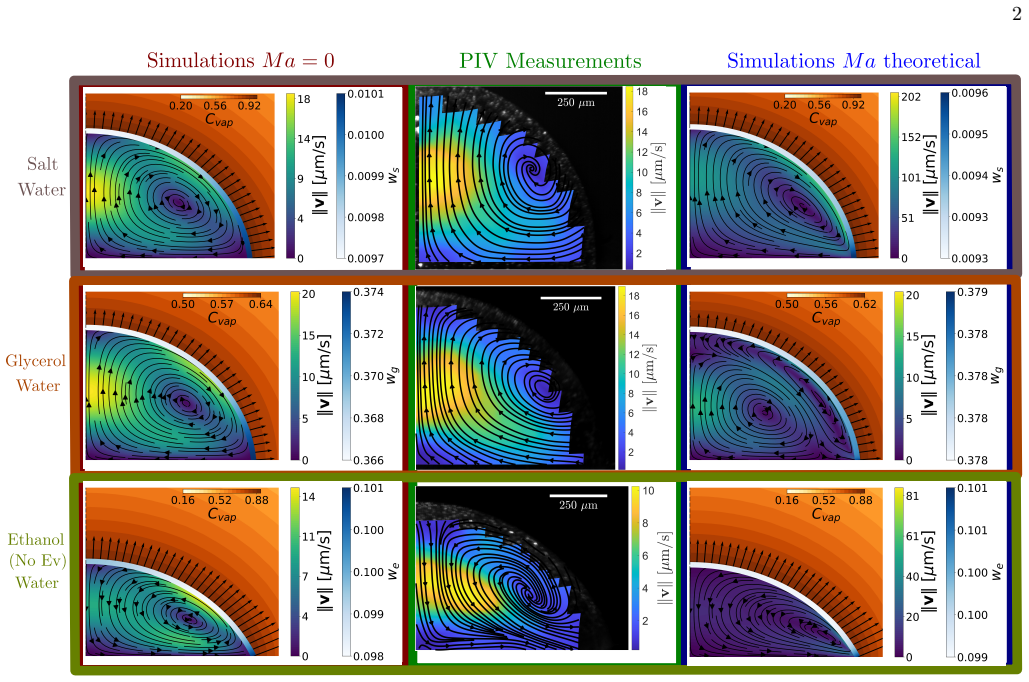
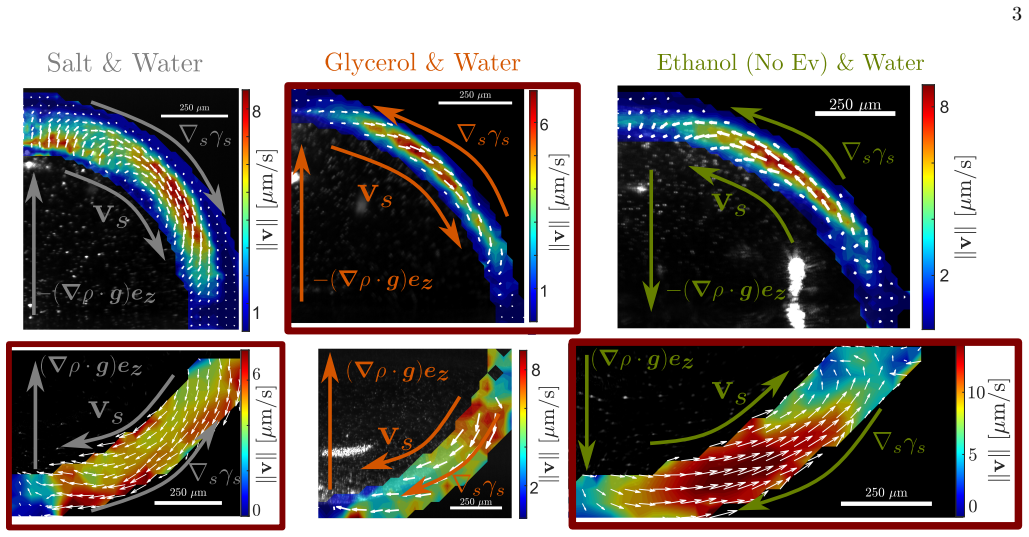
By comparing particle image velocimetry measurements in sessile and pendant droplets containing salt, glycerol or ethanol with predictions from a coupled hydrodynamic and solute transport model, the flow is found to be driven solely by natural convection. The experimental surface velocity is sometimes directed against the surface-tension gradient predicted from the solute concentration field. Standard contamination models based on surfactants or surface rheology cannot account for this reversal, indicating that Marangoni stresses are effectively suppressed altogether.
What carries the argument
The direct comparison of measured surface velocity direction with the surface-tension gradient computed from the solute concentration field alone.
Load-bearing premise
The surface-tension gradient direction and magnitude can be predicted accurately from the solute concentration field alone, independent of contaminant effects.
What would settle it
Measuring surface velocities in an evaporating droplet prepared under rigorously contaminant-free conditions and finding that they match both the speed and direction predicted by the surface-tension gradient model.
Figures
read the original abstract
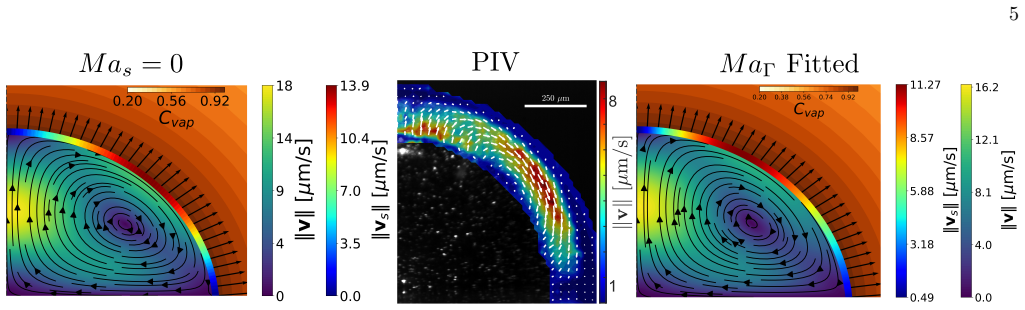
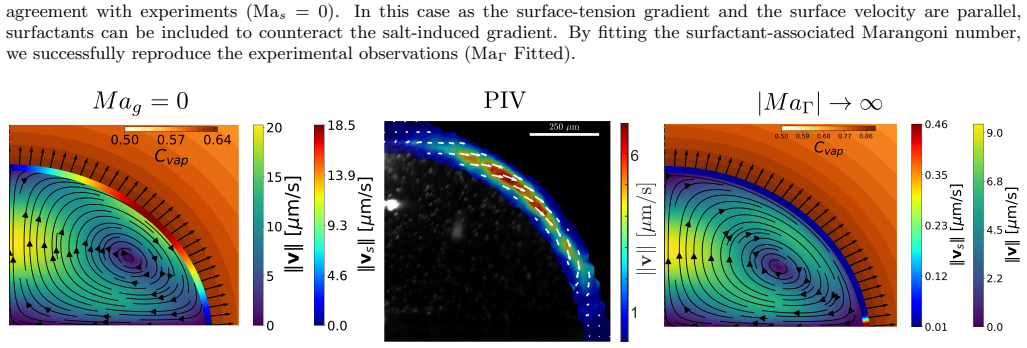
Theoretical models of evaporating droplets predict Marangoni flows orders of magnitude faster than those observed experimentally. While this discrepancy is often attributed to surface contamination, the underlying mechanism by which contaminants weaken Marangoni stresses remains unclear. In this study, we compare particle image velocimetry (PIV) experiments with a coupled hydrodynamic and solute transport model to investigate the internal flow of evaporating aqueous droplets containing salt, glycerol, or ethanol. By analyzing both sessile and pendant droplets, we demonstrate that the flow is driven entirely by natural convection, in contrast to theoretical predictions that use surface-tension gradients. Remarkably, in some cases, the experimental surface velocity is found to be directed against the predicted surface-tension gradient. We further prove that standard contamination models, whether based on surfactants lowering the surface tension or on surface rheology, cannot account for this flow reversal. Our results therefore suggest that Marangoni stresses are not merely reduced by contaminants, but that their macroscopic manifestation is effectively suppressed altogether.
Editorial analysis
A structured set of objections, weighed in public.
Referee Report
Summary. The manuscript compares PIV experiments on evaporating sessile and pendant aqueous droplets containing salt, glycerol, or ethanol against a coupled hydrodynamic-solute transport model. It concludes that observed internal flows match natural convection entirely, with surface velocities in some cases directed opposite the surface-tension gradient predicted from the solute concentration field via the standard σ(c) relation. The authors further claim to prove that conventional surfactant-lowering or surface-rheology contamination models cannot reproduce this reversal, implying that Marangoni stresses are suppressed altogether rather than merely reduced.
Significance. If the flow-reversal observations and the exclusion of standard contamination mechanisms are robust, the result would be significant for droplet-evaporation modeling in fluid dynamics and related applications. It challenges the prevailing attribution of weak Marangoni flows to contamination and suggests a more fundamental suppression, potentially requiring revision of theoretical predictions that assume surface-tension gradients drive flow. The use of multiple solutes and both sessile/pendant geometries provides a useful cross-check.
major comments (2)
- [Model description and flow-reversal analysis] The identification of flow reversal and the subsequent proof that standard models cannot explain it both rest on the assumption that the direction and magnitude of the surface-tension gradient can be computed directly from the solute concentration field using an uncontaminated σ(c) curve. If contaminants alter adsorption kinetics or introduce additional concentration-dependent terms outside the considered surfactant/rheology models, this assumption becomes load-bearing for the central claim. A dedicated validation (e.g., independent surface-tension measurements on the experimental solutions or a sensitivity analysis in the model) is needed to confirm independence.
- [Results and discussion] The abstract states the reversal observation and model-exclusion result but supplies no quantitative velocity magnitudes, error bars, or explicit model equations. The full text must demonstrate that the natural-convection match is within experimental uncertainty and that the contamination-model exclusions are exhaustive rather than illustrative.
minor comments (2)
- [Methods] Clarify the precise functional form of σ(c) adopted for each solute and state whether it is taken from literature or measured in-house.
- [Numerical methods] Add a brief statement on how the hydrodynamic model is initialized and whether any free parameters are tuned to the PIV data.
Simulated Author's Rebuttal
We thank the referee for the constructive comments and the opportunity to clarify aspects of our work. We respond to each major comment below.
read point-by-point responses
-
Referee: [Model description and flow-reversal analysis] The identification of flow reversal and the subsequent proof that standard models cannot explain it both rest on the assumption that the direction and magnitude of the surface-tension gradient can be computed directly from the solute concentration field using an uncontaminated σ(c) curve. If contaminants alter adsorption kinetics or introduce additional concentration-dependent terms outside the considered surfactant/rheology models, this assumption becomes load-bearing for the central claim. A dedicated validation (e.g., independent surface-tension measurements on the experimental solutions or a sensitivity analysis in the model) is needed to confirm independence.
Authors: The σ(c) relations employed are taken from independent literature measurements on bulk solutions of the same solutes (NaCl, glycerol, ethanol) that predate our evaporation experiments and do not rely on the droplet geometry or flow field. The central observation—surface velocity directed opposite the sign of dσ/dc predicted by these relations—is therefore insensitive to moderate uncertainties in magnitude. To address the referee’s concern directly, the revised manuscript will include a sensitivity study in which the slope dσ/dc is varied by ±30 % around the literature values; the flow reversal and the inability of the contamination models to reproduce it persist throughout this range. revision: partial
-
Referee: [Results and discussion] The abstract states the reversal observation and model-exclusion result but supplies no quantitative velocity magnitudes, error bars, or explicit model equations. The full text must demonstrate that the natural-convection match is within experimental uncertainty and that the contamination-model exclusions are exhaustive rather than illustrative.
Authors: Section 2 of the manuscript already presents the complete set of governing equations, boundary conditions, and numerical implementation. Figures 3–6 and the associated text report measured surface velocities together with PIV uncertainty estimates; the natural-convection simulations lie inside these error bars for all three solutes and both geometries. The contamination-model analysis consists of systematic parameter sweeps over surfactant bulk concentration and surface shear viscosity, showing that neither mechanism can produce the observed reversal. We agree that the abstract would be improved by the inclusion of representative velocity magnitudes and will revise it accordingly. revision: yes
Circularity Check
No significant circularity; claims rest on independent experimental-model comparison
full rationale
The paper compares PIV velocity fields directly against predictions from a coupled hydrodynamic and solute-transport model that solves the Navier-Stokes and advection-diffusion equations without reference to the target Marangoni suppression result. Flow reversal is identified by comparing measured surface velocities to the sign of the surface-tension gradient computed from the independently solved concentration field via a literature σ(c) relation; this comparison is falsifiable against the external data and does not reduce to a fitted parameter or self-definition. The subsequent demonstration that standard surfactant or rheology models cannot reproduce the observed reversal likewise proceeds from the same independent transport solution and does not invoke self-citation chains or ansatzes smuggled from prior work by the same authors. The derivation chain is therefore self-contained against external benchmarks.
Axiom & Free-Parameter Ledger
axioms (1)
- domain assumption Standard Navier-Stokes and solute transport equations without Marangoni boundary conditions accurately describe the observed flows when compared to PIV data.
Reference graph
Works this paper leans on
-
[1]
in water–12-propanediol droplets. Notably, none of these studies describe cleaning procedures that deviate substantially from standard laboratory practice, further 6 complicating the picture we have presented throughout this work. We emphasize that the question of how surface- active contaminants might suppress surface-tension gra- dients remains unresolv...
-
[2]
R. D. Deegan, O. Bakajin, T. F. Dupont, G. Huber, S. R. Nagel, and T. A. Witten, Contact line deposits in an evaporating drop, Phys. Rev. E62, 10.1103/Phys- RevE.62.756 (2000)
-
[3]
Hu and R
H. Hu and R. G. Larson, Marangoni effect reverses coffee- ring depositions, The Journal of Physical Chemistry B 110, 7090 (2006)
2006
-
[4]
Xu and J
X. Xu and J. Luo, Marangoni flow in an evaporating water droplet, Applied Physics Letters91, 124102 (2007)
2007
-
[5]
J. R. Trantum, Z. E. Eagleton, C. A. Patil, J. M. Tucker- Schwartz, M. L. Baglia, M. C. Skala, and F. R. Haselton, Cross-sectional tracking of particle motion in evaporating drops: Flow fields and interfacial accumulation, Lang- muir29, 6221 (2013)
2013
-
[6]
A. Marin, S. Karpitschka, D. Noguera-Mar´ ın, M. A. Cabrerizo-V´ ılchez, M. Rossi, C. J. K¨ ahler, and M. A. Rodr´ ıguez Valverde, Solutal marangoni flow as the cause of ring stains from drying salty colloidal drops, Phys. Rev. Fluids4, 10.1103/PhysRevFluids.4.041601 (2019)
-
[7]
J. Mart´ ınez-Puig, C. de la Torre Luque, C. A. Ni- eto, P. Hoekstra, F. Usera, B. M. Jouve, A. de la Encina, T. Bartolom´ e, M. Sanz, F. Almaz´ an, A. O˜ na, A. Marin, and J. Rodr´ ıguez-Rodr´ ıguez, Viral transport in evaporating sessile model respiratory droplets, bioRxiv 10.1101/2025.09.30.679206 (2025)
-
[8]
K. H. Kang, H. C. Lim, H. W. Lee, and S. J. Lee, Evaporation-induced saline rayleigh convection inside a colloidal droplet, Physics of Fluids25, 042001 (2013)
2013
-
[9]
Gelderblom, C
H. Gelderblom, C. Diddens, and A. Marin, Evaporation- driven liquid flow in sessile droplets, Soft Matter18, 8535 (2022)
2022
-
[10]
Rocha, P
D. Rocha, P. L. Lederer, P. J. Dekker, A. Marin, D. Lohse, and C. Diddens, Evaporating sessile droplets: solutal marangoni effects overwhelm thermal marangoni flow, Journal of Fluid Mechanics1013, A39 (2025)
2025
-
[11]
A. M. J. Edwards, P. S. Atkinson, C. S. Cheung, H. Liang, D. J. Fairhurst, and F. F. Ouali, Density-driven flows in evaporating binary liquid droplets, Phys. Rev. Lett.121, 184501 (2018)
2018
-
[12]
Y. Li, C. Diddens, P. Lv, H. Wijshoff, M. Versluis, and D. Lohse, Gravitational effect in evaporating binary mi- crodroplets, Phys. Rev. Lett.122, 114501 (2019)
2019
-
[13]
Efstratiou, J
M. Efstratiou, J. Christy, and K. Sefiane, Crystallization- driven flows within evaporating aqueous saline droplets, Langmuir36, 4995 (2020)
2020
-
[14]
Chowdhury, A
A. Chowdhury, A. Agharkar, S. Majee, S. Basu, D. Chakravortty, R. Pinto, and A. Chattopadhyay, Spa- tiotemporal evaporating droplet dynamics on fomites en- hances long term bacterial pathogenesis, Communica- tions Biology4(2021)
2021
-
[15]
Selva, L
B. Selva, L. Daubersies, and J.-B. Salmon, Solutal con- vection in confined geometries: Enhancement of colloidal transport, Phys. Rev. Lett.108, 198303 (2012)
2012
-
[16]
A. Mizev, M. Denisova, K. Kostarev, R. Birikh, and A. Viviani, Threshold onset of marangoni convection in narrow channels, The European Physical Journal Special Topics192, https://doi.org/10.1140/epjst/e2011-01371- 9 (2011)
-
[17]
Ponce-Torres, E
A. Ponce-Torres, E. J. Vega, and J. M. Montanero, Ef- fects of surface-active impurities on the liquid bridge dy- namics, Experiments in Fluids57, 67 (2016)
2016
-
[18]
Molaei, N
M. Molaei, N. G. Chisholm, J. Deng, J. C. Crocker, and K. J. Stebe, Interfacial flow around brownian colloids, Phys. Rev. Lett.126, 228003 (2021)
2021
-
[19]
Franiatte, P
S. Franiatte, P. Tordjeman, and T. Ondar¸ cuhu, Molecu- lar desorption by a moving contact line, Phys. Rev. Lett. 127, 065501 (2021)
2021
-
[20]
K. H. Kang, S. J. Lee, C. M. Lee, and I. S. Kang, Quanti- tative visualization of flow inside an evaporating droplet using the ray tracing method, Measurement Science and Technology15, 1104 (2004)
2004
-
[21]
Matubayasi, S
N. Matubayasi, S. ichiro Yamaguchi, K. Yamamoto, and H. Matsuo, Thermodynamic quantities of surface forma- tion of aqueous electrolyte solutions: Ii. mixed aqueous solutions of nacl and mgcl2, Journal of Colloid and In- terface Science209, 403 (1999)
1999
-
[22]
Vazquez, E
G. Vazquez, E. Alvarez, and J. M. Navaza, Surface ten- sion of alcohol water + water from 20 to 50 .degree.c, Journal of Chemical & Engineering Data40, 611 (1995)
1995
-
[23]
Takamura, H
K. Takamura, H. Fischer, and N. R. Morrow, Physi- cal properties of aqueous glycerol solutions, Journal of Petroleum Science and Engineering98-99, 50 (2012)
2012
-
[24]
L. E. Scriven, Dynamics of a fluid interface equation of motion for newtonian surface fluids, Chemical Engineer- ing Science12, 98 (1960)
1960
-
[25]
Boussinesq, Speed of the slow, uniform fall of a liquid spherical drop in a viscous fluid of lesser specific weight, Ann
M. Boussinesq, Speed of the slow, uniform fall of a liquid spherical drop in a viscous fluid of lesser specific weight, Ann. Chim. Phys29, 364 (1913). 7
1913
-
[26]
van Gaalen, H
R. van Gaalen, H. Wijshoff, J. Kuerten, and C. Diddens, Competition between thermal and surfactant-induced marangoni flow in evaporating sessile droplets, Journal of Colloid and Interface Science622, 892 (2022)
2022
-
[27]
J. R. Christy, K. Sefiane, and E. Munro, A study of the velocity field during evaporation of sessile water and wa- ter/ethanol drops, Journal of Bionic Engineering7, 321 (2010)
2010
-
[28]
Diddens, H
C. Diddens, H. Tan, P. Lv, M. Versluis, J. G. M. Kuerten, X. Zhang, and D. Lohse, Evaporating pure, bi- nary and ternary droplets: thermal effects and axial sym- metry breaking, Journal of Fluid Mechanics823, 470–497 (2017)
2017
-
[29]
Thayyil Raju, C
L. Thayyil Raju, C. Diddens, Y. Li, A. Marin, M. N. van der Linden, X. Zhang, and D. Lohse, Evaporation of a sessile colloidal water–glycerol droplet: Marangoni ring formation, Langmuir38, 12082 (2022)
2022
-
[30]
Ram´ ırez-Soto and S
O. Ram´ ırez-Soto and S. Karpitschka, Taylor dispersion in thin liquid films of volatile mixtures: A quantitative model for marangoni contraction, Phys. Rev. Fluids7, L022001 (2022)
2022
discussion (0)
Sign in with ORCID, Apple, or X to comment. Anyone can read and Pith papers without signing in.