A unified classification-quantification framework for bubble-like nuclei within the extended quantum molecular dynamics model
Pith reviewed 2026-06-30 12:04 UTC · model grok-4.3
The pith
A BHTU parameter set classifies all known nuclei as droplets, bubbles, or toroidal bubbles from their density profiles.
A machine-rendered reading of the paper's core claim, the machinery that carries it, and where it could break.
Core claim
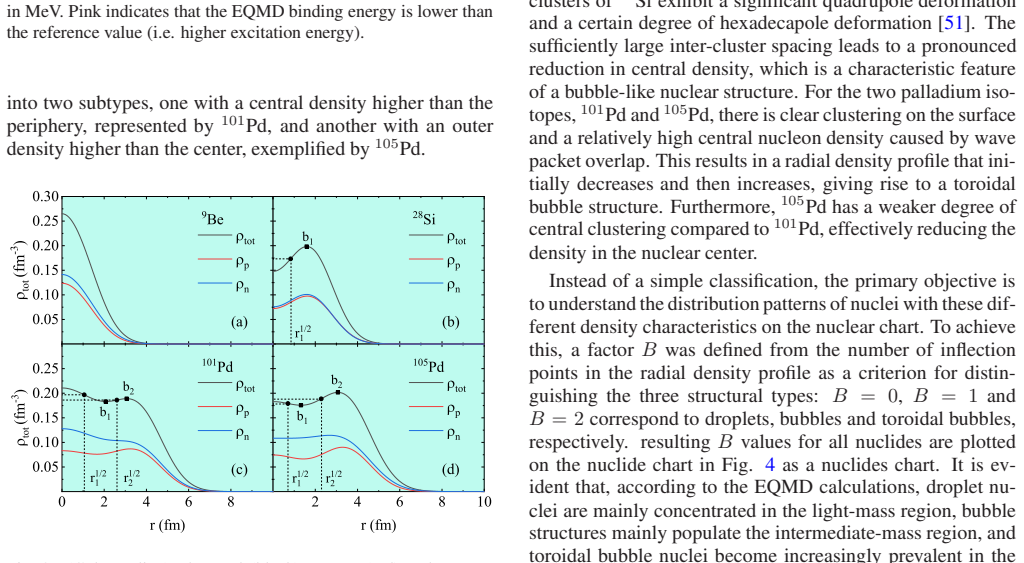
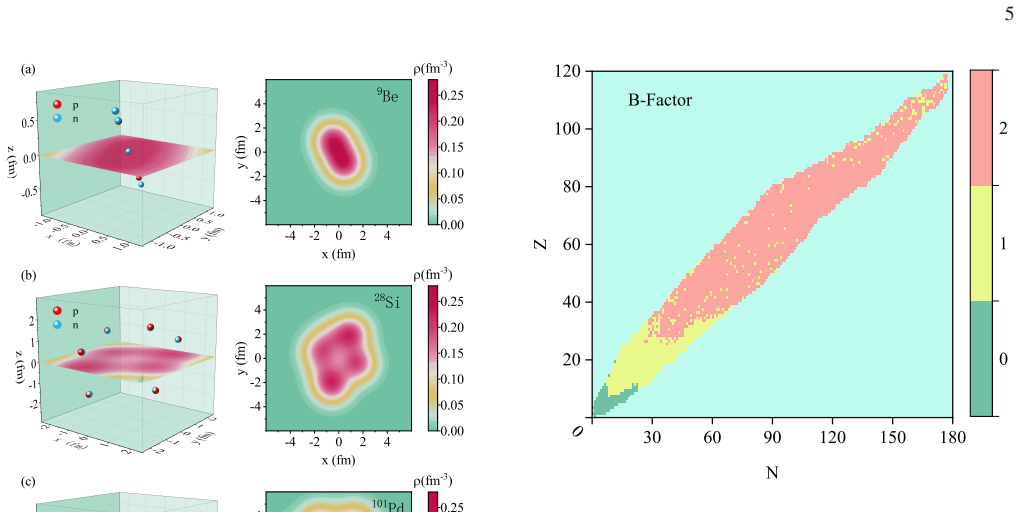
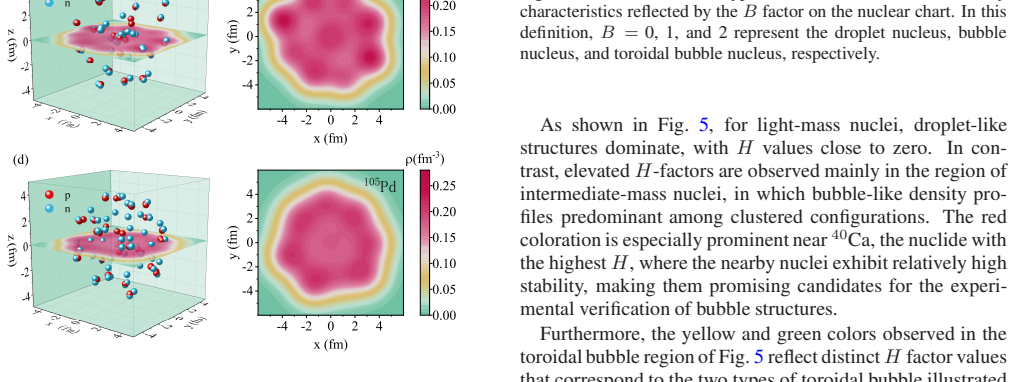
Within the extended quantum molecular dynamics model, a unified framework using the dimensionless parameters BHTU characterizes bubble-like nuclear morphologies. B is determined from the number of inflection points in the radial density profile to categorize nuclei as droplet (B=0), bubble (B=1), or toroidal bubble (B=2). H quantifies central density depletion, T the relative surface thickness, and U the relative size of the internal low-density region. Light nuclei show droplet-like features, medium-mass nuclei often exhibit bubbles especially near calcium-40, and toroidal bubbles appear in heavier systems with bubble structures common in superheavy nuclei.
What carries the argument
The BHTU parameters, with B set by the count of inflection points in the radial density profile from EQMD calculations, and H, T, U measuring depletion, thickness, and hollow size respectively. This machinery assigns morphological labels to nuclei based on their relaxed density distributions.
If this is right
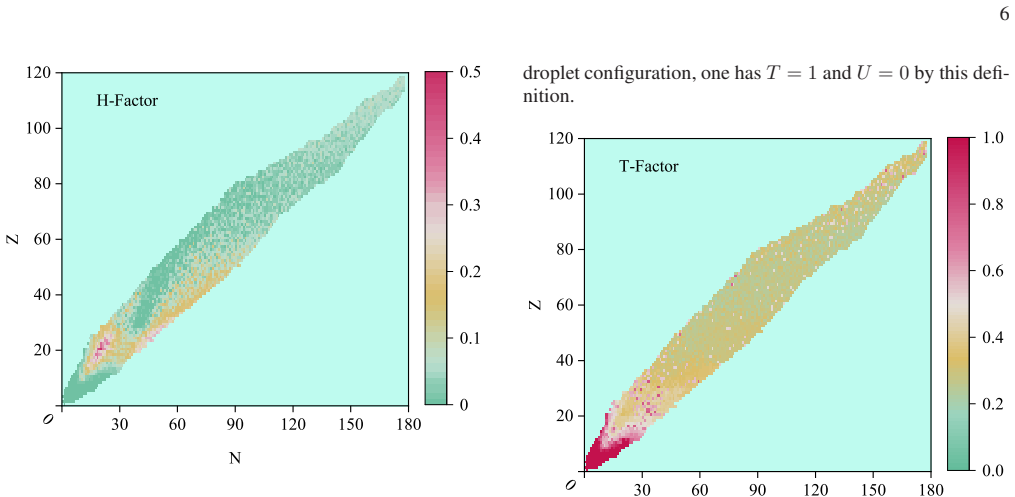
- Light nuclei are classified as droplet-like with B=0, H=0, T=1, U=0.
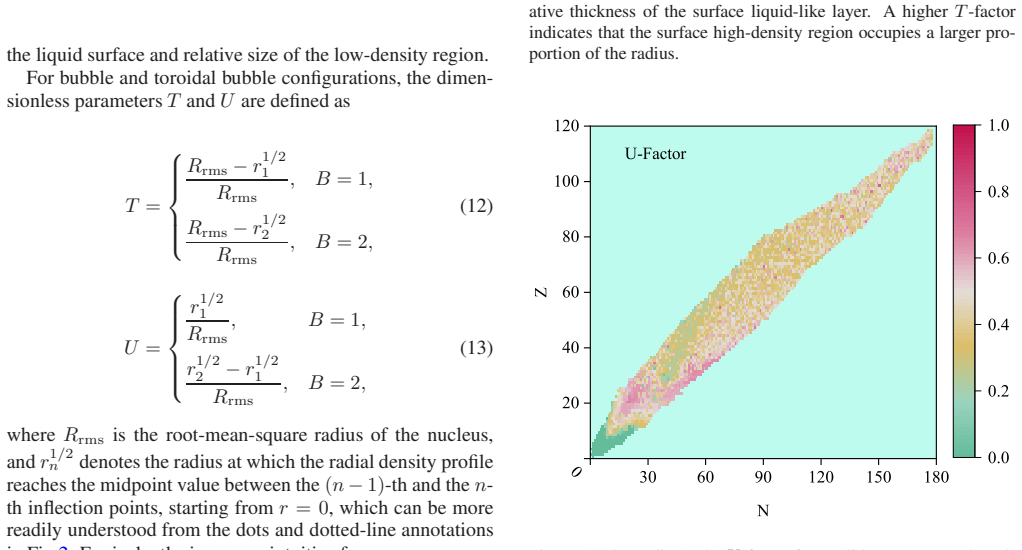
- Most medium-mass nuclei have B=1, with pronounced central hollowing near 40Ca and in neutron-rich regions.
- Toroidal bubble nuclei (B=2) emerge for Z around 25 and are prevalent in heavy systems.
- Bubble structures are widespread in the superheavy region.
- The parameter scheme establishes a predictive framework for exploring exotic nuclear shapes.
Where Pith is reading between the lines
- The classification could be applied to other nuclear models to check consistency across different theoretical approaches.
- Experimental probes like electron scattering on the identified bubble candidates could confirm or refute the predicted central depletions.
- In superheavy elements, the presence of bubble structures might affect calculated binding energies or decay modes.
- This scheme opens the possibility of searching for toroidal shapes in intermediate mass nuclei.
Load-bearing premise
The density profiles generated by the EQMD model with frictional cooling match the actual ground-state densities of nuclei closely enough for inflection points to define real morphological categories.
What would settle it
Measuring the charge density distribution of a medium-mass nucleus predicted to be a bubble (B=1) and finding it lacks a central density minimum would contradict the framework's assignments.
Figures
read the original abstract
A systematic study of relaxed low-energy cluster configurations for all nuclides listed in the AME2020 database is performed within the extended quantum molecular dynamics (EQMD) framework, with frictional cooling enabling stable relaxation. A unified classification-quantification framework based on the dimensionless parameters $BHTU$ is established to characterize bubble-like nuclear morphologies. The factor $B$, determined from the number of inflection points in the radial density profile, categorizes nuclei into droplet ($B=0$), bubble ($B=1$), and toroidal bubble ($B=2$). The parameter $H$ defines the degree of central density depletion, while $T$ and $U$ characterize the relative surface thickness and the relative size of the internal low-density region, respectively. Light nuclei are predominantly droplet-like with $B=0$, $H=0$, $T=1$, $U=0$. Most medium-mass nuclei have $B=1$, consistent with previous studies, especially in the vicinity of $^{40}$Ca and the neutron-rich region, where nuclei show a pronounced central hollowing with large $H$ and $U$ values, identifying them as prime candidates for experimental searches for bubble structures. Toroidal bubble nuclei ($B=2$), emerging for $Z\approx25$ and prevalent in heavy systems, display a local density minimum at intermediate radius together with a shell-like low-density region. Furthermore, bubble structures are found to be widespread in the superheavy region, in agreement with earlier studies. This parameter scheme not only reveals the morphological richness of nuclei but also establishes a predictive framework for exploring exotic nuclear shapes, thereby opening new avenues for future theoretical and experimental investigations.
Editorial analysis
A structured set of objections, weighed in public.
Referee Report
Summary. The manuscript performs a systematic EQMD simulation with frictional cooling to obtain relaxed low-energy configurations for all nuclides in the AME2020 database. It introduces a unified BHTU classification-quantification framework in which B is defined as the number of inflection points in the spherically averaged radial density profile (B=0 droplet, B=1 bubble, B=2 toroidal bubble), H quantifies the degree of central density depletion, T the relative surface thickness, and U the relative size of the internal low-density region. The study reports that light nuclei are predominantly droplet-like (B=0, H=0, T=1, U=0), most medium-mass nuclei exhibit B=1 (especially near 40Ca and in neutron-rich regions with large H and U), toroidal bubbles (B=2) emerge for Z≈25 and become prevalent in heavy systems, and bubble structures are widespread in the superheavy region, consistent with selected prior results.
Significance. If the EQMD radial densities are sufficiently faithful to physical ground-state densities, the BHTU scheme supplies a compact, dimensionless language for classifying and quantifying bubble-like nuclear morphologies over the entire chart of nuclides, with concrete candidate lists for experimental searches. The exhaustive coverage of AME2020 and the introduction of parameters that permit quantitative inter-nucleus comparison constitute clear strengths. The work could usefully guide future model comparisons and experimental proposals on exotic shapes.
major comments (2)
- [Abstract and radial-density analysis] The central claim that B (and downstream H, T, U) furnishes physically meaningful morphological labels rests on the assumption that the number of inflection points in the EQMD radial density profile is a robust indicator. No benchmark of these profiles against ab initio calculations, DFT densities, or experimental charge radii is presented even for a single test case such as 40Ca (abstract and results sections). This validation gap is load-bearing for the interpretation of the entire BHTU framework.
- [Results on medium-mass nuclei] The statement that B=1 classifications are “consistent with previous studies, especially in the vicinity of 40Ca and the neutron-rich region” is made without a quantitative overlap table, confusion matrix, or direct comparison of H/U values to earlier classifications (results section). The absence of such metrics prevents assessment of how much the new scheme reproduces or extends prior work.
minor comments (2)
- [Methods] Explicit functional definitions or equations for H, T, and U (beyond the verbal descriptions in the abstract) should be supplied in the methods section to allow independent reproduction.
- [Density-profile construction] The manuscript should state whether the spherical averaging used to obtain the radial density is applied uniformly or only after confirming near-spherical symmetry; any deformation handling should be clarified.
Simulated Author's Rebuttal
We thank the referee for the constructive feedback on our manuscript. We address the two major comments point by point below, indicating where revisions will be made to improve clarity and support for the BHTU framework.
read point-by-point responses
-
Referee: [Abstract and radial-density analysis] The central claim that B (and downstream H, T, U) furnishes physically meaningful morphological labels rests on the assumption that the number of inflection points in the EQMD radial density profile is a robust indicator. No benchmark of these profiles against ab initio calculations, DFT densities, or experimental charge radii is presented even for a single test case such as 40Ca (abstract and results sections). This validation gap is load-bearing for the interpretation of the entire BHTU framework.
Authors: The BHTU scheme is introduced as an intrinsic classification tool operating on EQMD-generated radial density profiles to enable systematic, dimensionless quantification across the full AME2020 chart. We agree that explicit benchmarks against ab initio or DFT densities for cases such as 40Ca would strengthen claims of broader physical relevance. The manuscript does not contain such direct comparisons. In the revised version we will add a dedicated paragraph in the methods or results section that references existing EQMD validations from the literature for bulk properties and notes the model-specific character of the BHTU labels, while clarifying that the framework's primary value is consistent intra-model comparison rather than direct experimental mapping. revision: partial
-
Referee: [Results on medium-mass nuclei] The statement that B=1 classifications are “consistent with previous studies, especially in the vicinity of 40Ca and the neutron-rich region” is made without a quantitative overlap table, confusion matrix, or direct comparison of H/U values to earlier classifications (results section). The absence of such metrics prevents assessment of how much the new scheme reproduces or extends prior work.
Authors: We accept that the consistency statement would be more robust with quantitative metrics. The original phrasing reflected a qualitative assessment of overlap with known bubble candidates reported in the literature. The revised manuscript will include a new table in the results section that lists representative B=1 nuclei (near 40Ca and selected neutron-rich cases), their computed H and U values, and the corresponding classifications or central-depletion indicators from selected prior studies. This will allow readers to evaluate the degree of reproduction and the quantitative extensions provided by the BHTU parameters. revision: yes
Circularity Check
No significant circularity; classification is direct post-processing of model densities
full rationale
The paper computes radial density profiles via EQMD + frictional cooling, then defines B explicitly as the number of inflection points in that profile and H/T/U as direct functions of the same profile (central depletion, surface thickness, internal low-density size). No equation or step reduces an output quantity to a fitted input or to a prior self-citation; the BHTU scheme is a definitional mapping applied to the simulation results. Consistency statements with earlier studies are not load-bearing for the framework itself. The derivation chain is therefore self-contained against external benchmarks.
Axiom & Free-Parameter Ledger
axioms (2)
- domain assumption The extended quantum molecular dynamics model with frictional cooling yields stable, physically representative radial density profiles for all nuclides in AME2020.
- ad hoc to paper The number of inflection points in a radial density profile is a sufficient and unambiguous indicator of morphological class (droplet, bubble, toroidal bubble).
Reference graph
Works this paper leans on
-
[1]
˙Ri = 0 ˙Pi = 0 ˙λ i = 0 ˙δi = 0 (8) Applying the Wigner transform to Eq
is satisfied. ˙Ri = 0 ˙Pi = 0 ˙λ i = 0 ˙δi = 0 (8) Applying the Wigner transform to Eq. ( 2), the phase space distribution function is obtained as f (r, p) = 1 (2π ℏ)3/ 4 ∫ exp ( ipξ ℏ ) φ i ( r− ) φ ∗ i ( r+) dξ = 1 (π ℏ)3 exp [ − 1 + λ 2 i δ2 i λ i (r − Ri)2 ] × exp [ − λ i ℏ2 (p − Pi)2 ] × exp [ 2λ iδi ℏ (r − Ri) ·(p − Pi) ] , (9) where r± = r ± ξ 2 (ξ ...
-
[2]
Y . Ye, X. Yang, H. Sakurai,et al., Physics of exotic nuclei. Nat. Rev. Phys. 7, 21–37 (2025). doi: 10.1038/s42254-024-00782-5
-
[3]
S.-B. Ma, L.-N. Sheng, X.-H. Zhang, et al ., Opportunities for production and property research of neutron-rich nucle i around N = 126 at HIAF. Nucl. Sci. Tech. 35, 97 (2024). doi: 10.1007/s41365-024-01454-w
-
[4]
Y . Kondo, N. L. Achouri, H. Al Falou, et al ., First observation of 28O. Nature 620, 965 (2023). doi: 10.1038/s41586-023-06352-6
-
[5]
D.-Q. Fang, X.-Z. Cai, H.-W. Wang, et al ., Preface to spe- cial issue: dedicated to Professor Wenqing Shen in honor of his 80th birthday. Nucl. Sci. Tech. 35, 210 (2024). 9 doi: 10.1007/s41365-024-01592-1
-
[6]
J. H. Chen, X. Dong, X. H. He, et al., Properties of the QCD matter: review of selected results from the relativistic he avy ion collider beam energy scan (RHIC BES) program. Nucl. Sci. Tech. 35, 214 (2024). doi: 10.1007/s41365-024-01591-2
-
[7]
J. Pu, K.-J. Sun, C.-W. Ma, et al ., Probing the inter- nal structures of pΩ and ΩΩ with their production at the Large Hadron Collider. Phys. Rev. C 110, 024908 (2024). doi: 10.1103/PhysRevC.110.024908
-
[8]
Z.-L. Liao, X.-G. Cao, Y .-X. Yang, et al ., Design and con- struction of charged-particle telescope array for study of exotic nuclear clustering structure. Nucl. Sci. Tech. 35, 134 (2024). doi: 10.1007/s41365-024-01503-4
-
[9]
D.-W. Si, S. Xiao, Z. Qi, et al ., Extracting Neutron- Neutron Interaction Strength and Spatiotemporal Dynam- ics of Neutron Emission from the Two-Particle Corre- lation Function. Phys. Rev. Lett. 134, 222301 (2025). doi: 10.1103/PhysRevLett.134.222301
-
[10]
P . J. Li, D. Beaumel, J. Lee, et al ., V alidation of the 10Be Ground-State Molecular Structure Using 10Be(p, pα )6He Triple Differential Reaction Cross- Section Measurements. Phys. Rev. Lett. 131, 212501 (2023). doi: 10.1103/PhysRevLett.131.212501
-
[11]
Y .-Y . Cao, D.-Y . Tao, B. Zhou, et al ., Hoyle-analog state in 13N. Phys. Rev. C 112, 034313 (2025). doi: 10.1103/PhysRevC.112.034313
-
[12]
K. H. Li, J. G. Li, N. Michel, et al ., Gamow shell model for dynamic Thomas-Ehrman shift in 16Ne/16C and 18Mg/18C. Phys. Rev. C 111, 014302 (2025). doi: 10.1103/PhysRevC.111.014302
-
[13]
X.-Y . Wu, J.-Z. Cao, K.-N. Zhao, et al., Static or dynamic pear shapes in radioactive nucleus 224Rn? Nucl. Sci. Tech. 35, 202 (2024). doi: 10.1007/s41365-024-01578-z
-
[14]
M. T. Wan, L. Ou, M. Liu, N. Wang, Properties of the drip-l ine nucleus and mass relation of mirror nuclei. Nucl. Sci. Tech. 36, 26 (2025). doi: 10.1007/s41365-024-01633-9
-
[15]
L.-Y . Shen, Q. Y uan, H.-H. Li, et al., Study of shell evolution in neutron-rich boron, carbon, and nitrogen isotopes with i n- medium similarity renormalization group calculations. Nu cl. Sci. Tech. 36, 220 (2025). doi: 10.1007/s41365-025-01796-z
-
[16]
B. Dey, S.-S. Wang, D. Pandit, et al., Exotic nuclear shape due to cluster formation at high angular momentum. Phys. Rev. C 102, 031301 (2020). doi: 10.1103/PhysRevC.102.031301
-
[17]
T. Ichikawa, J. A. Maruhn, N. Itagaki, et al ., Exis- tence of an Exotic Torus Configuration in High-Spin Ex- cited States of 40Ca. Phys. Rev. Lett. 109, 232503 (2012). doi: 10.1103/PhysRevLett.109.232503
-
[18]
I. Tanihata, T. Kobayashi, T. Suzuki, et al ., Determi- nation of the density distribution and the correlation of halo neutrons in 11Li. Phys. Lett. B 287, 307 (1992). doi: 10.1016/0370-2693(92)90988-G
-
[19]
I. Tanihata, H. Savajols, R. Kanungo, Recent experimen tal progress in nuclear halo structure studies. Prog. Part. Nuc l. Phys. 68, 215–313 (2013). doi: 10.1016/j.ppnp.2012.07.001
-
[20]
S. Abrahamyan, Z. Ahmed, H. Albataineh, et al ., Measure- ment of the Neutron Radius of 208Pb through Parity Violation in Electron Scattering. Phys. Rev. Lett. 108, 112502 (2012). doi: 10.1103/PhysRevLett.108.112502
-
[21]
D. Adhikari, H. Albataineh, D. Androic, et al ., Pre- cision Determination of the Neutral Weak Form Fac- tor of 48Ca. Phys. Rev. Lett. 129, 042501 (2022). doi: 10.1103/PhysRevLett.129.042501
-
[22]
C.-W. Ma, Y .-J. Duan, Y .-F. Guo, et al ., A possible probe to neutron-skin thickness by fragment parallel momentum dist ri- bution in projectile fragmentation reactions. Nucl. Sci. T ech. 35, 99 (2024). doi: 10.1007/s41365-024-01455-9
-
[23]
Y . Liu, Y . L. Ye, J. L. Lou, et al., Positive-Parity Linear-Chain Molecular Band in 16C. Phys. Rev. Lett. 124, 192501 (2020). doi: 10.1103/PhysRevLett.124.192501
-
[24]
J. Han, Y . Ye, J. Lou, et al ., Nuclear linear-chain struc- ture arises in carbon-14. Commun. Phys. 6, 220 (2023). doi: 10.1038/s42005-023-01342-6
-
[25]
C. Y . Wong, Toroidal nuclei. Phys. Lett. B 41, 446 (1972). doi: 10.1016/0370-2693(72)90671-5
-
[26]
X. G. Cao, et al ., Examination of evidence for resonances at high excitation energy in the 7α disassembly of 28Si. Phys. Rev. C 99, 014606 (2019). doi: 10.1103/PhysRevC.99.014606
-
[27]
Y . Z. Wang, J. Z. Gu, X. Z. Zhang, J. M. Dong, Tensor effect s on the proton sd states in neutron-rich Ca isotopes and bub- ble structure of exotic nuclei. Phys. Rev. C 84, 044333 (2011). doi: 10.1103/PhysRevC.84.044333
-
[28]
J. J. Li, W. H. Long, J. L. Song, et al ., Pseudospin- orbit splitting and its consequences for the central depres - sion in nuclear density. Phys. Rev. C 93, 054312 (2016). doi: 10.1103/PhysRevC.93.054312
-
[29]
H. A. Wilson, A Spherical Shell Nuclear Model. Phys. Rev . 69, 538 (1946). doi: 10.1103/PhysRev.69.538
-
[30]
M. Grasso, E. Khan, J. Margueron, et al ., Bubbles in exotic nuclei. Int. J. Mod. Phys. E 18, 2009 (2009). doi: 10.1142/S0218301309014184
-
[31]
X. Y . Wu, J. M. Yao, Z. P . Li, et al., Low-energy structure and anti-bubble effect of dynamical correlations in 46Ar. Phys. Rev. C 89, 017304 (2014). doi: 10.1103/PhysRevC.89.017304
-
[32]
V . Choudhary, W. Horiuchi, M. Kimura, R. Chatterjee, Imprint of a nuclear bubble in nucleon-nucleus diffraction. Phys. R ev. C 102, 034619 (2020). doi: 10.1103/PhysRevC.102.034619
-
[33]
M. Bender, K. Rutz, P .-G. Reinhard, et al ., Shell structure of superheavy nuclei in self-consistent mean-field models. Ph ys. Rev. C 60, 034304 (1999). doi: 10.1103/PhysRevC.60.034304
-
[34]
J. Dechargé, J.-F. Berger, M. Girod, K. Dietrich, Bubbl es and semi-bubbles as a new kind of superheavy nuclei. Nucl. Phys. A 716, 55 (2003). doi: 10.1016/S0375-9474(02)01398-2
-
[35]
Mutschler, et al ., A proton density bubble in the dou- bly magic 34Si nucleus
A. Mutschler, et al ., A proton density bubble in the dou- bly magic 34Si nucleus. Nat. Phys. 13, 152–156 (2017). doi: 10.1038/nphys3916
-
[36]
E. Khan, M. Grasso, J. Margueron, et al ., Detecting bub- bles in exotic nuclei. Nucl. Phys. A 800, 37 (2008). doi: 10.1016/j.nuclphysa.2007.11.012
-
[37]
J. M. Yao, H. Mei, Z. P . Li, et al ., Does a proton “bubble” structure exist in the low-lying states of 34Si? Phys. Lett. B 723, 459 (2013). doi: 10.1016/j.physletb.2013.05.049
-
[38]
J. Chen, B. P . Kay, C. R. Hoffman, et al ., Evolution of the nuclear spin-orbit splitting explored via the 32Si(d,p)33Si re- action using SOLARIS. Phys. Lett. B 853, 138678 (2024). doi: 10.1016/j.physletb.2024.138678
-
[39]
G. Saxena, M. Kumawat, M. Kaushik, et al ., Bubble structure in magic nuclei. Phys. Lett. B 788, 1 (2019). doi: 10.1016/j.physletb.2018.08.076
-
[40]
G. Ren, C.-W. Ma, X.-G. Cao, Y .-G. Ma, Bubble 36Ar and Its New Breathing Modes. Phys. Lett. B 857, 138990 (2024). doi: 10.1016/j.physletb.2024.138990
-
[41]
J. B. Natowitz, Extended quantum molecular dynamics mo del predicts new breathing modes in 36Ar bubble nuclei. Nucl. Sci. Tech. 35, 187 (2024). doi: 10.1007/s41365-024-01581-4 10
-
[42]
M. Grasso, L. Gaudefroy, E. Khan, et al ., Nuclear “bub- ble” structure in 34Si. Phys. Rev. C 79, 034318 (2009). doi: 10.1103/PhysRevC.79.034318
-
[43]
X.-H. Fan, G.-C. Y ong, W. Zuo, Probing nuclear bubble config- urations by proton-induced reactions. Phys. Rev. C 99, 041601 (2019). doi: 10.1103/PhysRevC.99.041601
-
[44]
X. Campi, D. W. L. Sprung, Possible bubble nuclei 36Ar and 200Hg. Phys. Lett. B 46, 291–295 (1973). doi: 10.1016/0370-2693(73)90121-4
-
[45]
B. Schuetrumpf, W. Nazarewicz, P .-G. Reinhard, et al., Central depression in nucleonic densities: Trend analysis in the nu clear density functional theory approach. Phys. Rev. C 96, 024306 (2017). doi: 10.1103/PhysRevC.96.024306
-
[46]
J.-P . Ebran, E. Khan, T. Nikši ´c, et al., How atomic nuclei clus- ter. Nature 487, 341–344 (2012). doi: 10.1038/nature11246
-
[47]
B. Zhou, Y . Funaki, H. Horiuchi, et al ., Nonlocal- ized Clustering: A New Concept in Nuclear Cluster Structure Physics. Phys. Rev. Lett. 110, 262501 (2013). doi: 10.1103/PhysRevLett.110.262501
-
[48]
K. Wei, Y .-L. Ye, Z.-H. Yang, Clustering in nuclei: progress and perspectives. Nucl. Sci. Tech. 35, 216 (2024). doi: 10.1007/s41365-024-01588-x
-
[49]
F.-L. Xu, X.-G. Cao, Y .-G. Ma, Two-body cluster entangl ed structure in the H1 ⊗ H 2 Hilbert space. Phys. Rev. C 113, 014313 (2026). doi: 10.1103/wc1r-8l74
-
[50]
W. B. He, Y . G. Ma, X. G. Cao, et al ., Giant dipole resonance as a fingerprint of α clustering configurations in 12C and 16O. Phys. Rev. Lett. 113, 032506 (2014). doi: 10.1103/PhysRevLett.113.032506
-
[51]
T. Maruyama, K. Niita, A. Iwamoto, Extension of quantum molecular dynamics and its application to heavy-ion collis ions. Phys. Rev. C 53, 297 (1996). doi: 10.1103/PhysRevC.53.297
-
[52]
Y . K. Gupta, V . B. Katariya, G. K. Prajapati, et al ., Precise determination of quadrupole and hexadecapole deformation parameters of the sd-shell nucleus, 28Si. Phys. Lett. B 845, 138120 (2023). doi: 10.1016/j.physletb.2023.138120
-
[53]
Y .-G. Ma, Multi-proton emission at the limits of nuclea r stabil- ity: challenges for extreme open quantum systems. Nucl. Sci . Tech. 36, 236 (2025). doi: 10.1007/s41365-025-01831-z
-
[54]
L. Zhou, D.-Q. Fang, S.-M. Wang, et al ., Structure and 2p decay mechanism of 18Mg. Nucl. Sci. Tech. 35, 107 (2024). doi: 10.1007/s41365-024-01479-1
-
[55]
X.-Q. Du, C.-W. Wang, D.-Y . Tao, et al., Dineutron and dipro- ton correlations in the exotic nuclei 6He and 6Be. Nucl. Sci. Tech. 36, 205 (2025). doi: 10.1007/s41365-025-01778-1
-
[56]
D.-Y . Tao, B. Zhou, Y .-G. Ma, 3α correlations of ground and excited 0+ states of 12C within the microscopic cluster model. Phys. Rev. C 112, 044324 (2025). doi: 10.1103/rbgt-tf98
discussion (0)
Sign in with ORCID, Apple, or X to comment. Anyone can read and Pith papers without signing in.